Two Dimensional Image
         Reconstruction Algorithms


-By,
Srihari K. Malagi,
Reg No. 090907471
Roll No. 53
Section A
Dept. of Electronics & Communication
Manipal Institute of Technology.

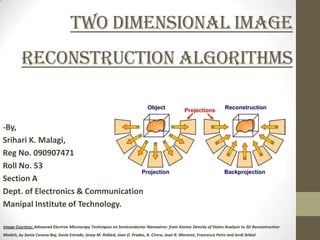
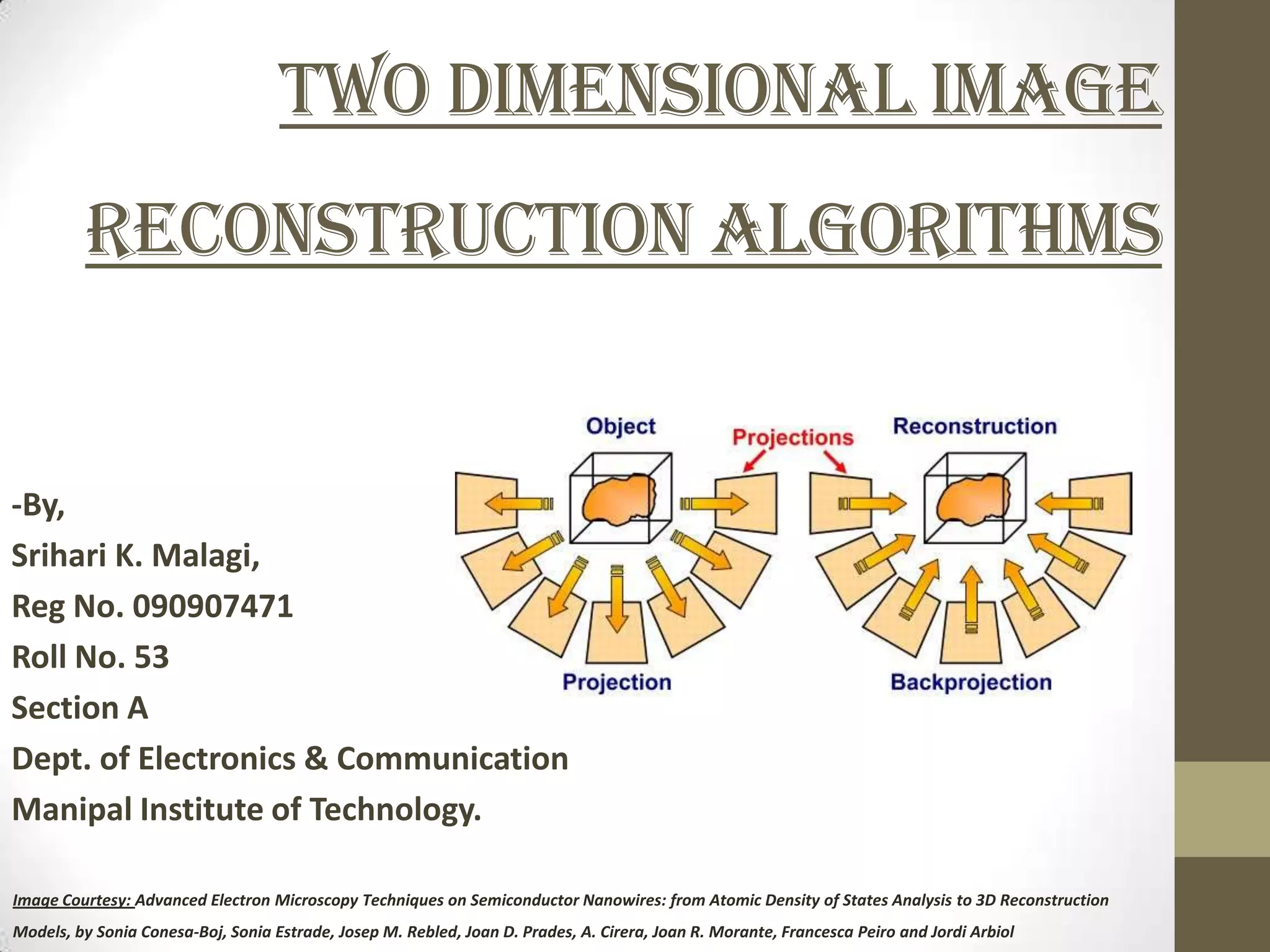
Image Courtesy: Advanced Electron Microscopy Techniques on Semiconductor Nanowires: from Atomic Density of States Analysis to 3D Reconstruction
Models, by Sonia Conesa-Boj, Sonia Estrade, Josep M. Rebled, Joan D. Prades, A. Cirera, Joan R. Morante, Francesca Peiro and Jordi Arbiol
Data Flow
 Introduction
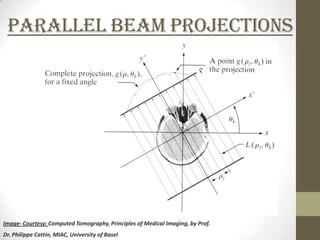
 Parallel Beam Projections
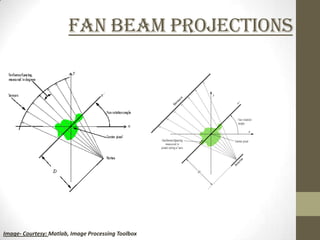
 Fan Beam Projections
 Truncated Projections
 Convolution Back-Projection Algorithm
 Digital Implementation
 Results
 Applications
 Present Research
 Conclusion
 References
Introduction
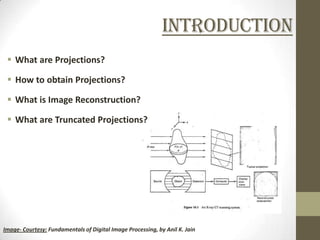
  What are Projections?

  How to obtain Projections?

  What is Image Reconstruction?

  What are Truncated Projections?


Image- Courtesy: Fundamentals of Digital Image Processing, by Anil K. Jain
Parallel Beam Projections


Image- Courtesy: Computed Tomography, Principles of Medical Imaging, by Prof.
Dr. Philippe Cattin, MIAC, University of Basel
Fan Beam Projections


Image- Courtesy: Matlab, Image Processing Toolbox
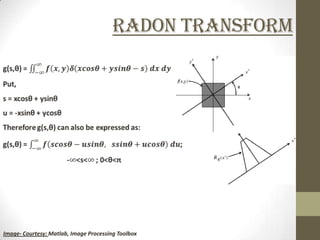
Radon Transform


Image- Courtesy: Matlab, Image Processing Toolbox
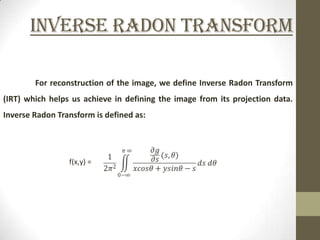
Inverse Radon Transform

        For reconstruction of the image, we define Inverse Radon Transform
(IRT) which helps us achieve in defining the image from its projection data.
Inverse Radon Transform is defined as:


                 f(x,y) =
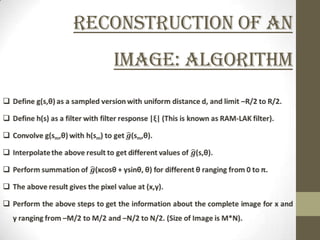
Reconstruction of an
   Image: Algorithm
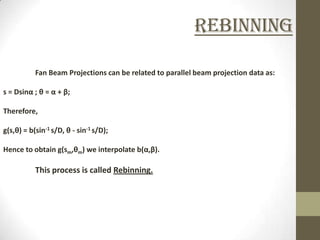
Rebinning

           Fan Beam Projections can be related to parallel beam projection data as:

s = Dsinα ; θ = α + β;

Therefore,

g(s,θ) = b(sin-1 s/D, θ - sin-1 s/D);

Hence to obtain g(sm,θm) we interpolate b(α,β).

           This process is called Rebinning.
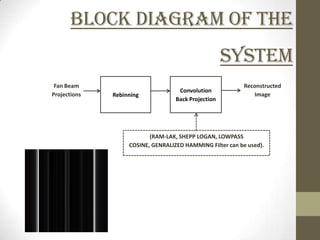
Block Diagram of the
                                                     System
 Fan Beam                                                  Reconstructed
                                    Convolution
Projections   Rebinning                                       Image
                                   Back Projection


                          (RAM-LAK, SHEPP LOGAN, LOWPASS
                   COSINE, GENRALIZED HAMMING Filter can be used).
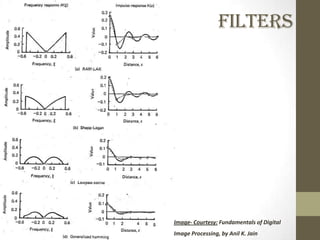
Filters


Image- Courtesy: Fundamentals of Digital
Image Processing, by Anil K. Jain
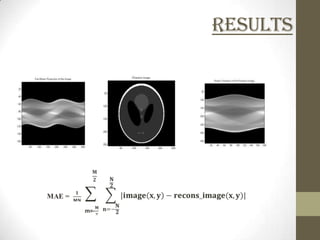
Results
Results
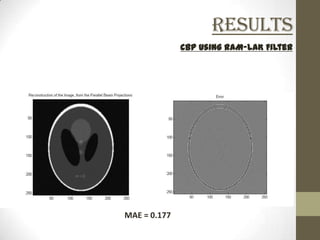
              CBP using RAM-LAK Filter


MAE = 0.177
Results
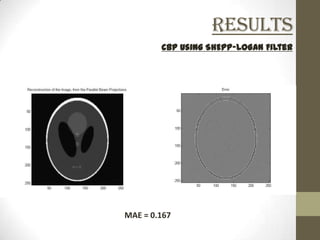
        CBP using SHEPP-LOGAN Filter


MAE = 0.167
Results
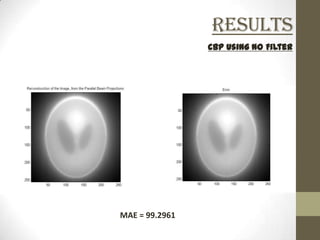
                CBP using No Filter


MAE = 99.2961
Results
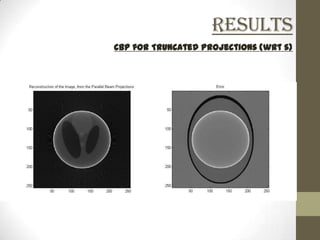
CBP for Truncated Projections (wrt s)
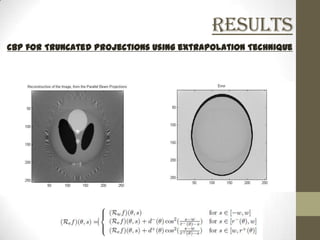
Results
CBP for Truncated Projections using extrapolation Technique
Results
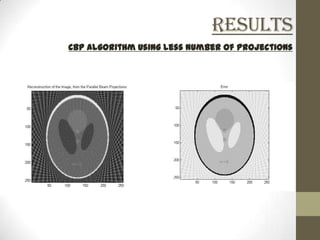
CBP algorithm using less number of projections
Applications
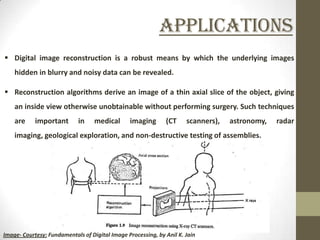
 Digital image reconstruction is a robust means by which the underlying images
    hidden in blurry and noisy data can be revealed.

 Reconstruction algorithms derive an image of a thin axial slice of the object, giving
    an inside view otherwise unobtainable without performing surgery. Such techniques
    are     important       in     medical      imaging       (CT     scanners),   astronomy,   radar
    imaging, geological exploration, and non-destructive testing of assemblies.


Image- Courtesy: Fundamentals of Digital Image Processing, by Anil K. Jain
Present Research
        Presently, the key concern is on Reconstruction of objects using
limited data such as truncated projections, limited projections etc… Filtered
Back-projection (FBP) Algorithms have been implemented since the system is
faster when compared to CBP Algorithm.        Also new techniques such as
Discrete Radon Transform (DRT) Techniques have been implemented to
achieve the goal.

        Also Fan Beam projections are considered for 2D image
reconstructions, since less number of projections will be required when
compared to parallel beam projections. Also from the conventional fixed focal
length Fan-Beam projections, we have observed that the research is moved
onto defining variable focal length Fan-Beam Projections.
Conclusion
         Image reconstruction is unfortunately an ill-posed problem.
Mathematicians consider a problem to be well posed if its solution (a)
exists, (b) is unique, and (c) is continuous under infinitesimal changes of the
input. The problem is ill posed if it violates any of the three conditions.

         In image reconstruction, the main challenge is to prevent
measurement errors in the input data from being amplified to unacceptable
artifacts in the reconstructed image.

         “New techniques are being implemented, and tested to overcome
these problems.”
References
 Soumekh, M., IEEE Transactions on Acoustics, Speech and Signal
   Processing, Image reconstruction techniques in tomographic imaging
   systems, Aug 1986, ISSN : 0096-3518.

 Matej, S., Bajla, I., Alliney, S., IEEE Transactions on Medical Imaging, On
   the possibility of direct Fourier reconstruction from divergent-beam
   projections, Jun 1993, ISSN : 0278-0062.

 You, J., Liang, Z., Zeng, G.L., IEEE Transactions on Medical Imaging, A
   unified reconstruction framework for both parallel-beam and variable
   focal-length fan-beam collimators by a Cormack-type inversion of
   exponential Radon transform, Jan. 1999, ISBN: 0278-0062.
References
   Clackdoyle, R., Noo, F., Junyu Guo., Roberts, J.A., IEEE Transactions on
    Nuclear Science, Quantitative reconstruction from truncated projections in
    classical tomography, Oct. 2004, ISSN : 0018-9499.

   O'Connor, Y.Z., Fessler, J.A., IEEE Transactions on Medical Imaging, Fourier-
    based forward and back-projectors in iterative fan-beam tomographic
    image reconstruction, May 2006, ISSN : 0278-0062.

   Wang, L., IEEE Transactions on Computers, Cross-Section Reconstruction
    with a Fan-Beam Scanning Geometry, March 1977, ISSN : 0018-9340.
References

 Anil K. Jain, Fundamentals of Digital Image Processing, Prentice
  Hall, Englewood Cliffs, NJ 07632, ISBN 0-13-336165-9.

 Avinash C. Kak and Malcolm Slaney, Principles of Computerized
  Tomographic      Imaging,     Society    for   Industrial   and     Applied
  Mathematics, Philadelphia, ISBN 0-89871-494-X.

 G.    Van     Gompel,       Department    of    Physics,    University   of
  Antwerp, Antwerp, Towards accurate image reconstruction from truncated
  X-ray CT projections, Publication Type: Thesis, 2009.
Two Dimensional Image Reconstruction Algorithms

Two Dimensional Image Reconstruction Algorithms

  • 1.
    Two Dimensional Image Reconstruction Algorithms -By, Srihari K. Malagi, Reg No. 090907471 Roll No. 53 Section A Dept. of Electronics & Communication Manipal Institute of Technology. Image Courtesy: Advanced Electron Microscopy Techniques on Semiconductor Nanowires: from Atomic Density of States Analysis to 3D Reconstruction Models, by Sonia Conesa-Boj, Sonia Estrade, Josep M. Rebled, Joan D. Prades, A. Cirera, Joan R. Morante, Francesca Peiro and Jordi Arbiol
  • 2.
    Data Flow  Introduction Parallel Beam Projections  Fan Beam Projections  Truncated Projections  Convolution Back-Projection Algorithm  Digital Implementation  Results  Applications  Present Research  Conclusion  References
  • 3.
    Introduction  Whatare Projections?  How to obtain Projections?  What is Image Reconstruction?  What are Truncated Projections? Image- Courtesy: Fundamentals of Digital Image Processing, by Anil K. Jain
  • 4.
    Parallel Beam Projections Image-Courtesy: Computed Tomography, Principles of Medical Imaging, by Prof. Dr. Philippe Cattin, MIAC, University of Basel
  • 5.
    Fan Beam Projections Image-Courtesy: Matlab, Image Processing Toolbox
  • 6.
    Radon Transform Image- Courtesy:Matlab, Image Processing Toolbox
  • 7.
    Inverse Radon Transform For reconstruction of the image, we define Inverse Radon Transform (IRT) which helps us achieve in defining the image from its projection data. Inverse Radon Transform is defined as: f(x,y) =
  • 8.
    Reconstruction of an Image: Algorithm
  • 9.
    Rebinning Fan Beam Projections can be related to parallel beam projection data as: s = Dsinα ; θ = α + β; Therefore, g(s,θ) = b(sin-1 s/D, θ - sin-1 s/D); Hence to obtain g(sm,θm) we interpolate b(α,β). This process is called Rebinning.
  • 10.
    Block Diagram ofthe System Fan Beam Reconstructed Convolution Projections Rebinning Image Back Projection (RAM-LAK, SHEPP LOGAN, LOWPASS COSINE, GENRALIZED HAMMING Filter can be used).
  • 11.
    Filters Image- Courtesy: Fundamentalsof Digital Image Processing, by Anil K. Jain
  • 12.
  • 13.
    Results CBP using RAM-LAK Filter MAE = 0.177
  • 14.
    Results CBP using SHEPP-LOGAN Filter MAE = 0.167
  • 15.
    Results CBP using No Filter MAE = 99.2961
  • 16.
    Results CBP for TruncatedProjections (wrt s)
  • 17.
    Results CBP for TruncatedProjections using extrapolation Technique
  • 18.
    Results CBP algorithm usingless number of projections
  • 19.
    Applications  Digital imagereconstruction is a robust means by which the underlying images hidden in blurry and noisy data can be revealed.  Reconstruction algorithms derive an image of a thin axial slice of the object, giving an inside view otherwise unobtainable without performing surgery. Such techniques are important in medical imaging (CT scanners), astronomy, radar imaging, geological exploration, and non-destructive testing of assemblies. Image- Courtesy: Fundamentals of Digital Image Processing, by Anil K. Jain
  • 20.
    Present Research Presently, the key concern is on Reconstruction of objects using limited data such as truncated projections, limited projections etc… Filtered Back-projection (FBP) Algorithms have been implemented since the system is faster when compared to CBP Algorithm. Also new techniques such as Discrete Radon Transform (DRT) Techniques have been implemented to achieve the goal. Also Fan Beam projections are considered for 2D image reconstructions, since less number of projections will be required when compared to parallel beam projections. Also from the conventional fixed focal length Fan-Beam projections, we have observed that the research is moved onto defining variable focal length Fan-Beam Projections.
  • 21.
    Conclusion Image reconstruction is unfortunately an ill-posed problem. Mathematicians consider a problem to be well posed if its solution (a) exists, (b) is unique, and (c) is continuous under infinitesimal changes of the input. The problem is ill posed if it violates any of the three conditions. In image reconstruction, the main challenge is to prevent measurement errors in the input data from being amplified to unacceptable artifacts in the reconstructed image. “New techniques are being implemented, and tested to overcome these problems.”
  • 22.
    References  Soumekh, M.,IEEE Transactions on Acoustics, Speech and Signal Processing, Image reconstruction techniques in tomographic imaging systems, Aug 1986, ISSN : 0096-3518.  Matej, S., Bajla, I., Alliney, S., IEEE Transactions on Medical Imaging, On the possibility of direct Fourier reconstruction from divergent-beam projections, Jun 1993, ISSN : 0278-0062.  You, J., Liang, Z., Zeng, G.L., IEEE Transactions on Medical Imaging, A unified reconstruction framework for both parallel-beam and variable focal-length fan-beam collimators by a Cormack-type inversion of exponential Radon transform, Jan. 1999, ISBN: 0278-0062.
  • 23.
    References  Clackdoyle, R., Noo, F., Junyu Guo., Roberts, J.A., IEEE Transactions on Nuclear Science, Quantitative reconstruction from truncated projections in classical tomography, Oct. 2004, ISSN : 0018-9499.  O'Connor, Y.Z., Fessler, J.A., IEEE Transactions on Medical Imaging, Fourier- based forward and back-projectors in iterative fan-beam tomographic image reconstruction, May 2006, ISSN : 0278-0062.  Wang, L., IEEE Transactions on Computers, Cross-Section Reconstruction with a Fan-Beam Scanning Geometry, March 1977, ISSN : 0018-9340.
  • 24.
    References  Anil K.Jain, Fundamentals of Digital Image Processing, Prentice Hall, Englewood Cliffs, NJ 07632, ISBN 0-13-336165-9.  Avinash C. Kak and Malcolm Slaney, Principles of Computerized Tomographic Imaging, Society for Industrial and Applied Mathematics, Philadelphia, ISBN 0-89871-494-X.  G. Van Gompel, Department of Physics, University of Antwerp, Antwerp, Towards accurate image reconstruction from truncated X-ray CT projections, Publication Type: Thesis, 2009.