PRINCIPLES OF IMAGE
RECONSTRUCTION IN CT
PRESENTED BY POONAM RIJAL
Bsc.MIT 2ND Year
Roll no. :- 154
Maharajgunj Medical Campus,IOM
Content
• Introduction
• Basic terminologies
• Simple back projection
• Analytical method
1. Filtered back projection
2. Fourier reconstruction
• Iterative reconstruction
1. Statistical/hybrid iterative reconstruction
2. Model based iterative reconstruction
• Deep learning reconstruction
Introduction
• It is a method of forming the CT image by manipulating the raw data
obtained from the detector.
• Mathematical process to generate image data from different angle
around the patient .
• Algorithm use attenuation data measured by detector &
systematically buildup the image for viewing and interpretation.
• Computer intensive task and most crucial step in CT imaging process.
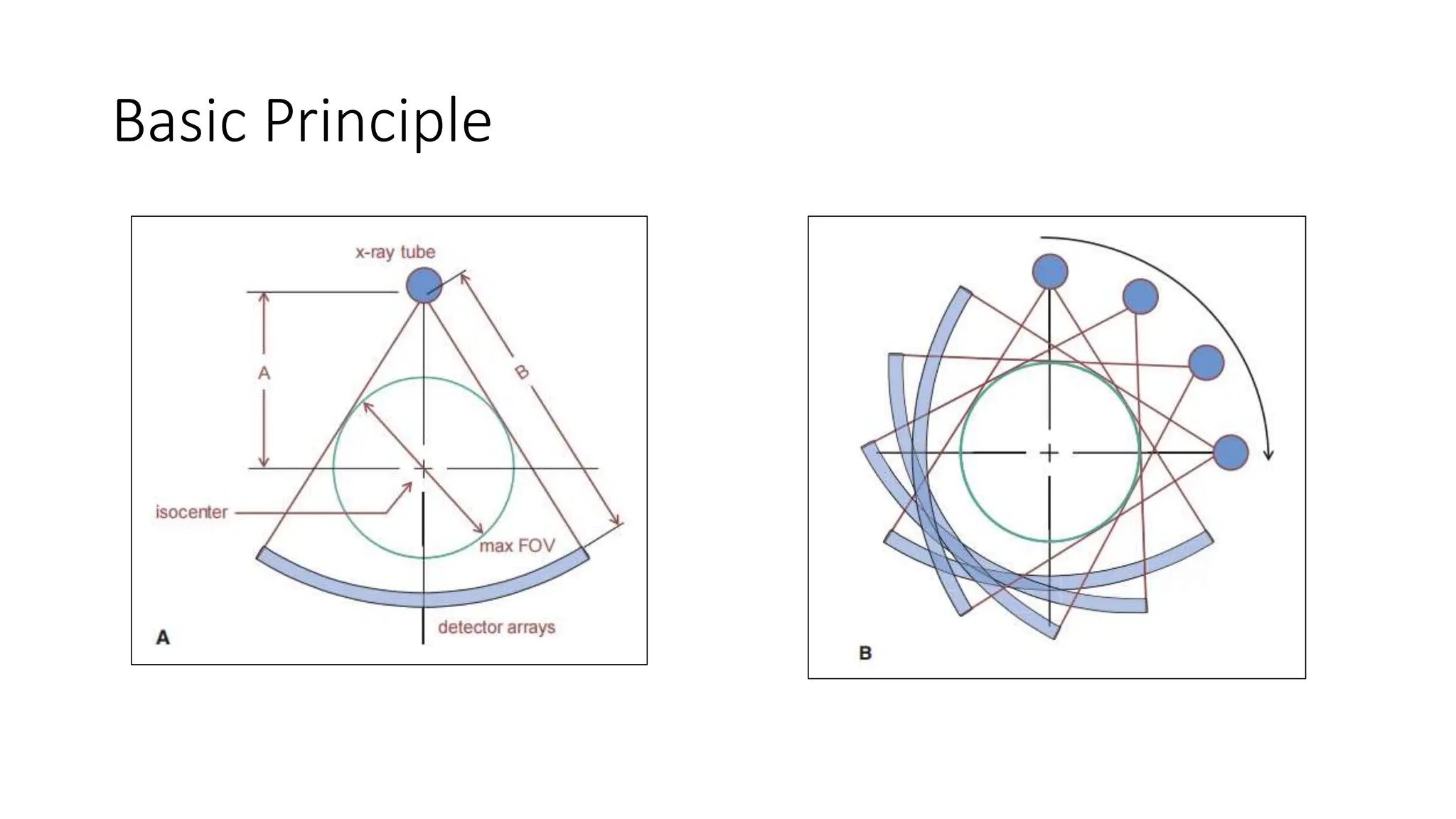
Basic Principle
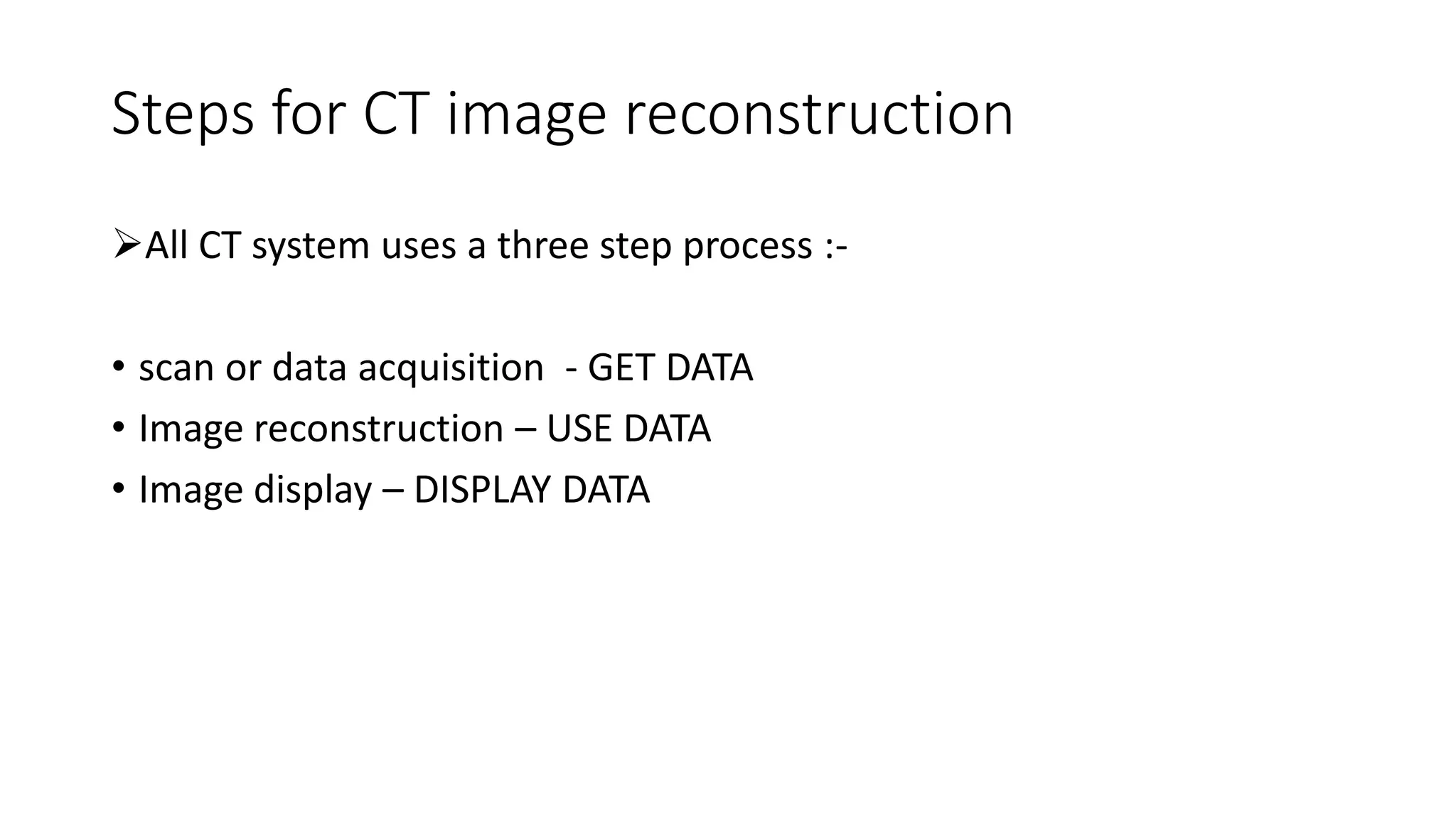
Steps for CT image reconstruction
All CT system uses a three step process :-
• scan or data acquisition - GET DATA
• Image reconstruction – USE DATA
• Image display – DISPLAY DATA
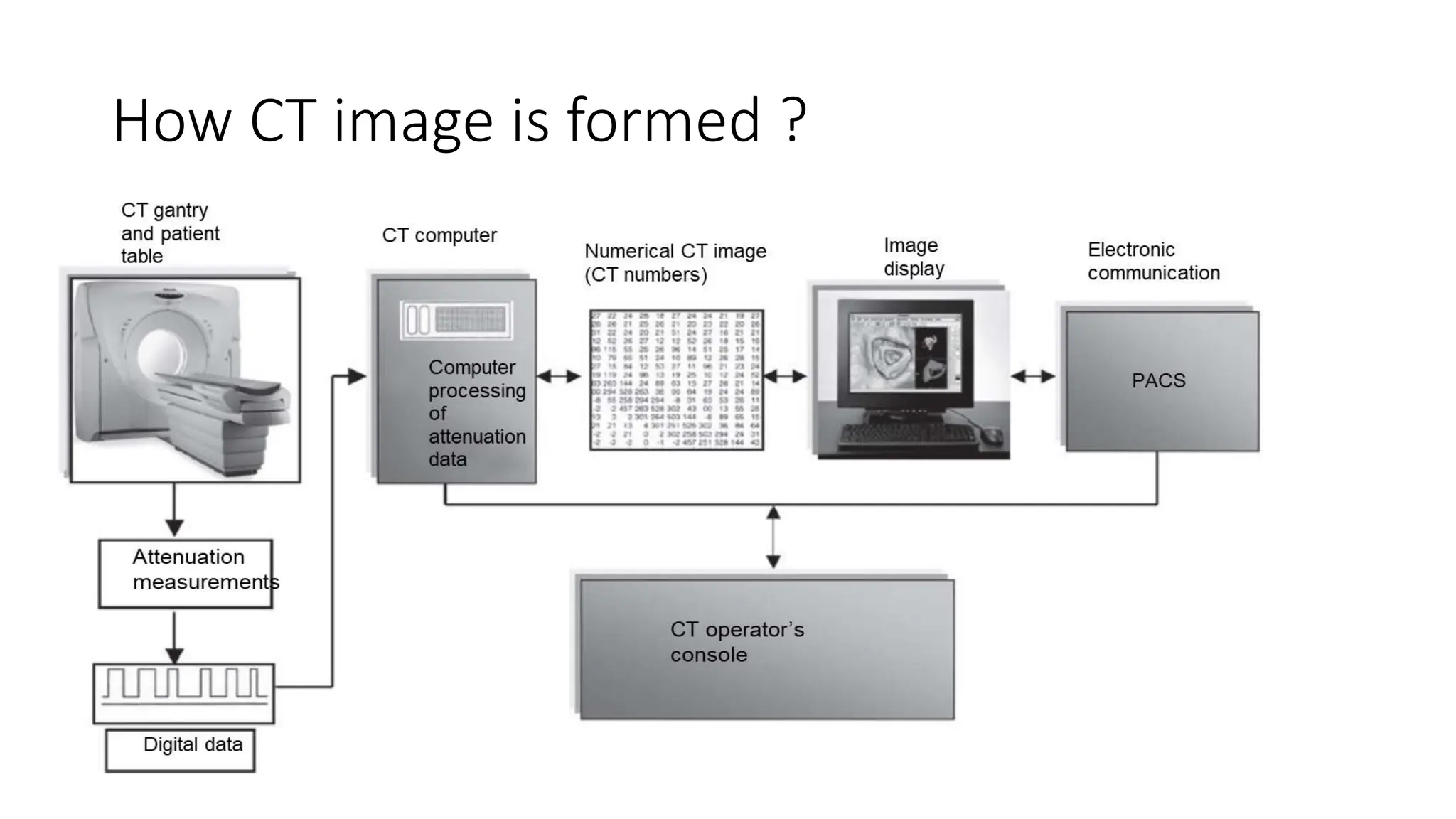
How CT image is formed ?
History
Dates Events
1917 J. Radon (an Austrian mathematician) presented
mathematic solution for reconstruction as radon
transform
1963 William H. Oldendorf developed a direct back projection
method
1967 Bracewell and Riddle first proposed the idea of filter
back projection
1970 Gordon et al. proposed the algebraic reconstruction
technique (ART)
History
Dates Events
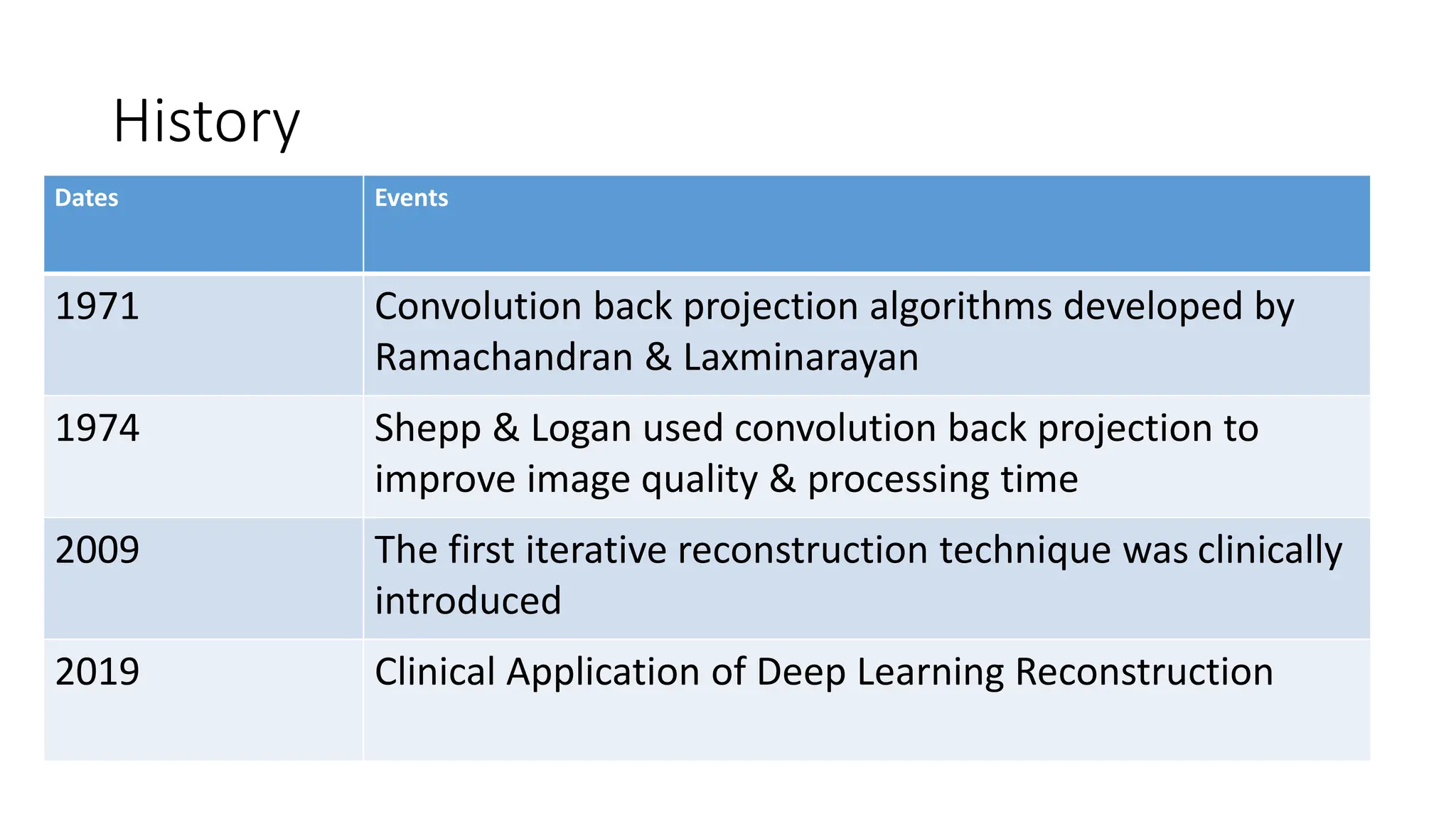
1971 Convolution back projection algorithms developed by
Ramachandran & Laxminarayan
1974 Shepp & Logan used convolution back projection to
improve image quality & processing time
2009 The first iterative reconstruction technique was clinically
introduced
2019 Clinical Application of Deep Learning Reconstruction
Reconstruction Terminologies
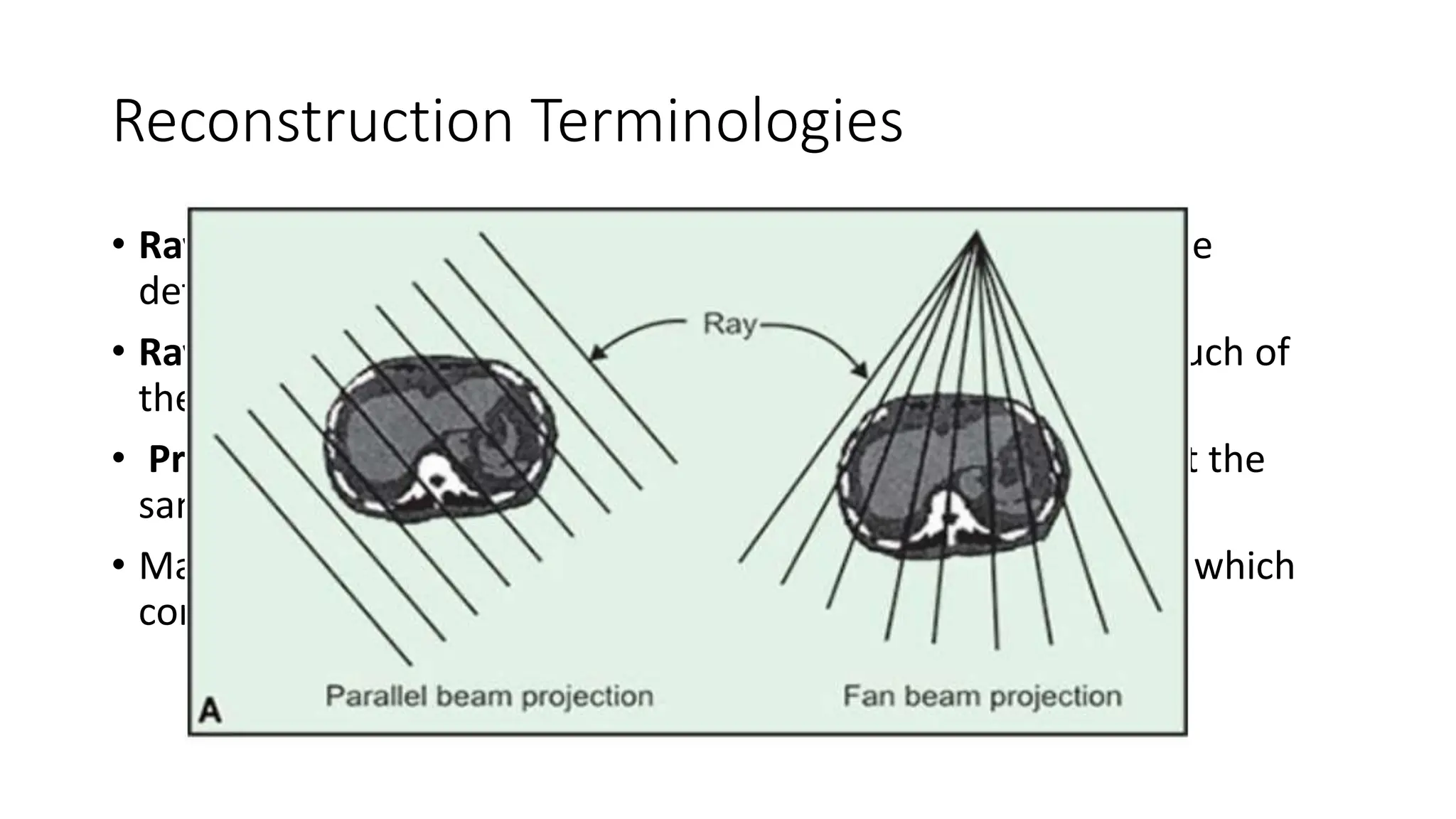
• Ray :- the path that the x-ray beam takes from the tube to the
detector at a given movement in a time is referred to a ray.
• Ray sum :- DAS reads each arriving ray and measured how much of
the beam is attenuated the measurement is call ray sum.
• Projection: a series of rays that passes through the patient at the
same orientation is called projection or a view .
• Many projections or views are required to create a CT image which
consist of many scan lines called rays.
Raw Data
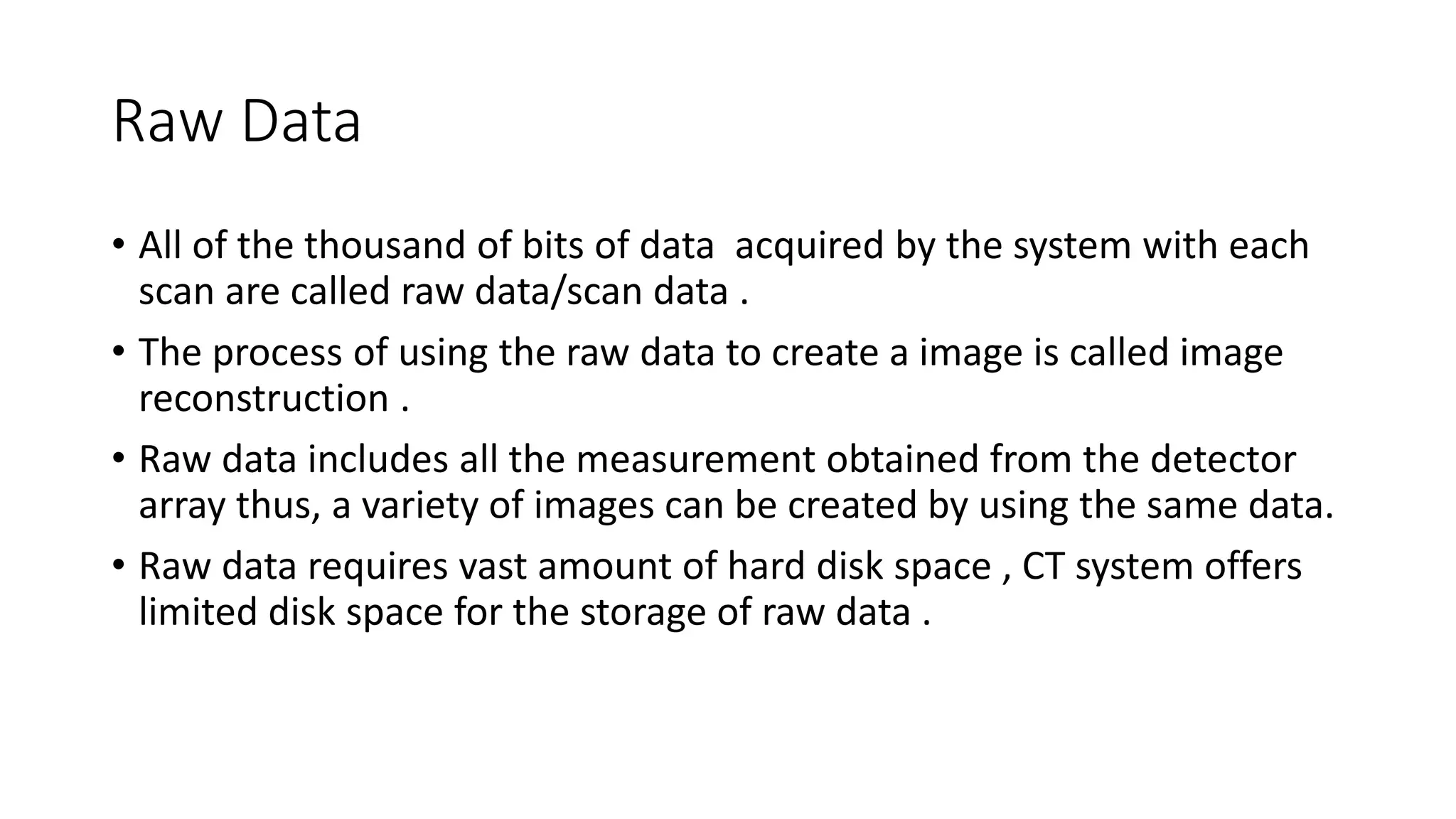
• All of the thousand of bits of data acquired by the system with each
scan are called raw data/scan data .
• The process of using the raw data to create a image is called image
reconstruction .
• Raw data includes all the measurement obtained from the detector
array thus, a variety of images can be created by using the same data.
• Raw data requires vast amount of hard disk space , CT system offers
limited disk space for the storage of raw data .
Image data
• computer assigns one value (Hounsfield unit ) to each pixel to form
an image .
• The value is the average of all the attenuation measurement for that
pixel .
• Once the raw data are averaged so that each pixel has one associated
number image is formed and data obtained from the image is called
image data.
• Image data required approximately one-fifth of the computer space
needed for raw data.
• Data manipulation is limited in presence of only image data
Attenuation
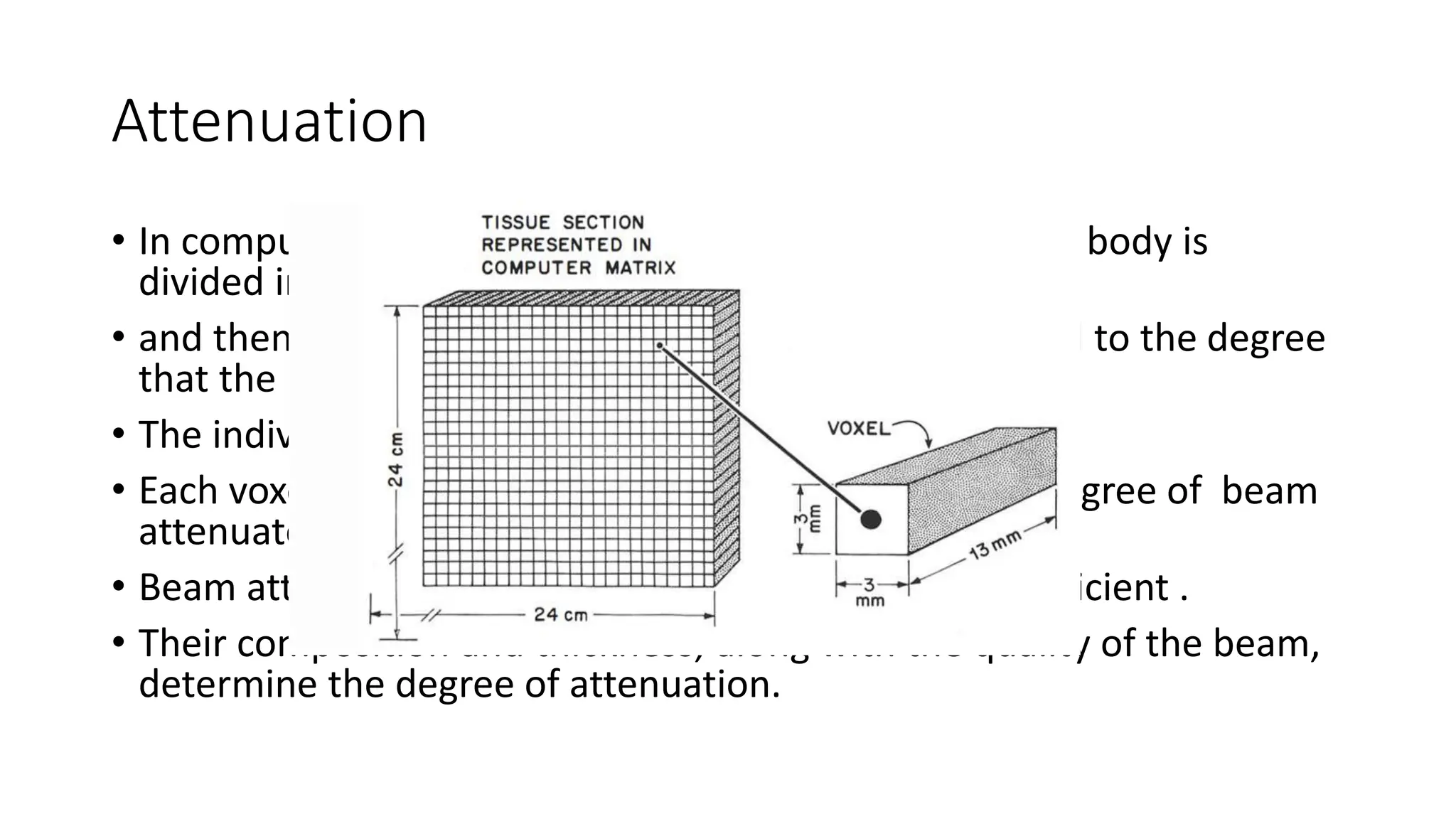
• In computed tomography a cross-sectional layer of the body is
divided into many tiny blocks,
• and then each block is assigned a number proportional to the degree
that the block attenuated the x-ray beam.
• The individual blocks are called "voxels."
• Each voxel is assigned a number proportional to the degree of beam
attenuated .
• Beam attenuation depends on linear attenuation coefficient .
• Their composition and thickness, along with the quality of the beam,
determine the degree of attenuation.
N=NOe-(µ1+µ2+µ3+µ4+………µi)x
(i is determined by matrix size)
CT number
• The relative attenuation coefficient is normally expressed in
“Hounsfield unit “ which are also known as a “CT number”.
• Therefore each tissue element (voxel) is assigned by a “CT number“.
• The relation between linear attenuation coefficient and CT number is
given by :-
• where , k = 1000 is a constant factor which determines the contrast
scale, are linear coefficient of element tissue and water .
Algorithm
• precise set of steps to be followed in specific order .
• Basis of computer programming.
• Thousands of equations must be solved to determine the linear
attenuation coefficients of all the pixels in the image matrix.
• Reconstruction algorithms are used to solve the mathematical equations to
convert information from detector array to image suitable for the display .
• CT reconstruction algorithms are divided into the three types :-
oBack projection
oIterative method
oAnalytical method
Sinogram
• The data acquired for an individual slice can be displayed before
reconstruction . This type of display is called sinogram .
• Thus it is the 2D representation of the data obtained during a scan.
• Provides visual representation of x-ray attenuation values at each point
within the object as the beam passes through it from different angles.
• Intensity measurement are done and then angle of projection (Rays) are
plotted horizontally (x-axis) and views are shown on a vertical axis (y-axis) .
• During the 360 degree CT acquisition of a particular object, the position of
the ray corresponding to that object varies sinusoidally as a function of the
view angle .
AP
Gantry angle
Attenuation
profile
0º 180º
Sinogram
• The sinogram is useful for analyzing the raw projection data ,
flexibility in reconstruction in artifacts detection , inconsistencies and
evaluating the quality of acquired data.
Convolution
• Mathematical filtering process of projected data by the mathematical
filter to reduce blurring effect of projection
• Depending on manufacturer the mathematical filter may be called as
• Algorithm
• Convolution
• Filter
• Kernel
• Filter function applied to raw data
Parallel beam and Fan beam
• Every ray sum in fan beam sinogram has equivalent parallel
beam sinogram
• The diverging ray is interpolated into a parallel ray sinogram
• For fan beam reconstruction, the previous parallel beam
algorithms may be applied after we reformat fan beam
projection into parallel beam projection which is known as
Rebinning
• Reconstruction is performed as if data were collected in
parallel beam geometry
Interpolation
• Mathematical method of estimating the value of a unknown function
using the known value on either side of the function .
• Interpolation is used in CT in the image reconstruction process and
the determination of slices in spiral/ helical CT imaging,
Image Reconstruction in Helical CT
• Reconstruction of Helical CT is same as conventional axial CT with
interpolation
• Data interpolation is performed by a special program called as
interpolation algorithm
• During Helical CT image data are received continuously but when
image is reconstructed the plane of image doesn’t contain enough
data for image reconstruction so, the data needed for image
reconstruction is estimated by a special computation method known
as Interpolation algorithm
Interpolation
• Reconstruct image at z-axis position through interpolation
• There are two types of interpolation algorithm
• 360º linear interpolation algorithm:- Plane of reconstructed image
interpolated form data acquired on a revolution apart , thicker slice
,blurring in reforrmated image ,noise reduction
• 180º Linear interpolation algorithm :- Plane of reconstructed
imageinterpolated form data acquired on a half revolution apart
,thinner slices ,increased noise improved resolution
Projected data from
helical scanning
sinogram
Select interpolation
points
Linear interpolation for
each projection angle
Reconstruction
algorithm
Image data
Cone Beam Algorithm
• The fan beam approximation algorithms are not very
accurate used with the new generation of MSCT
scanners, so other image reconstruction algorithms
are needed. These algorithms are called cone-beam
algorithm.
• ls in case of MDCT where the cone angle is larger
resulting cone beam artifact
• The cone beam algorithm is developed to eliminate
cone beam artifact
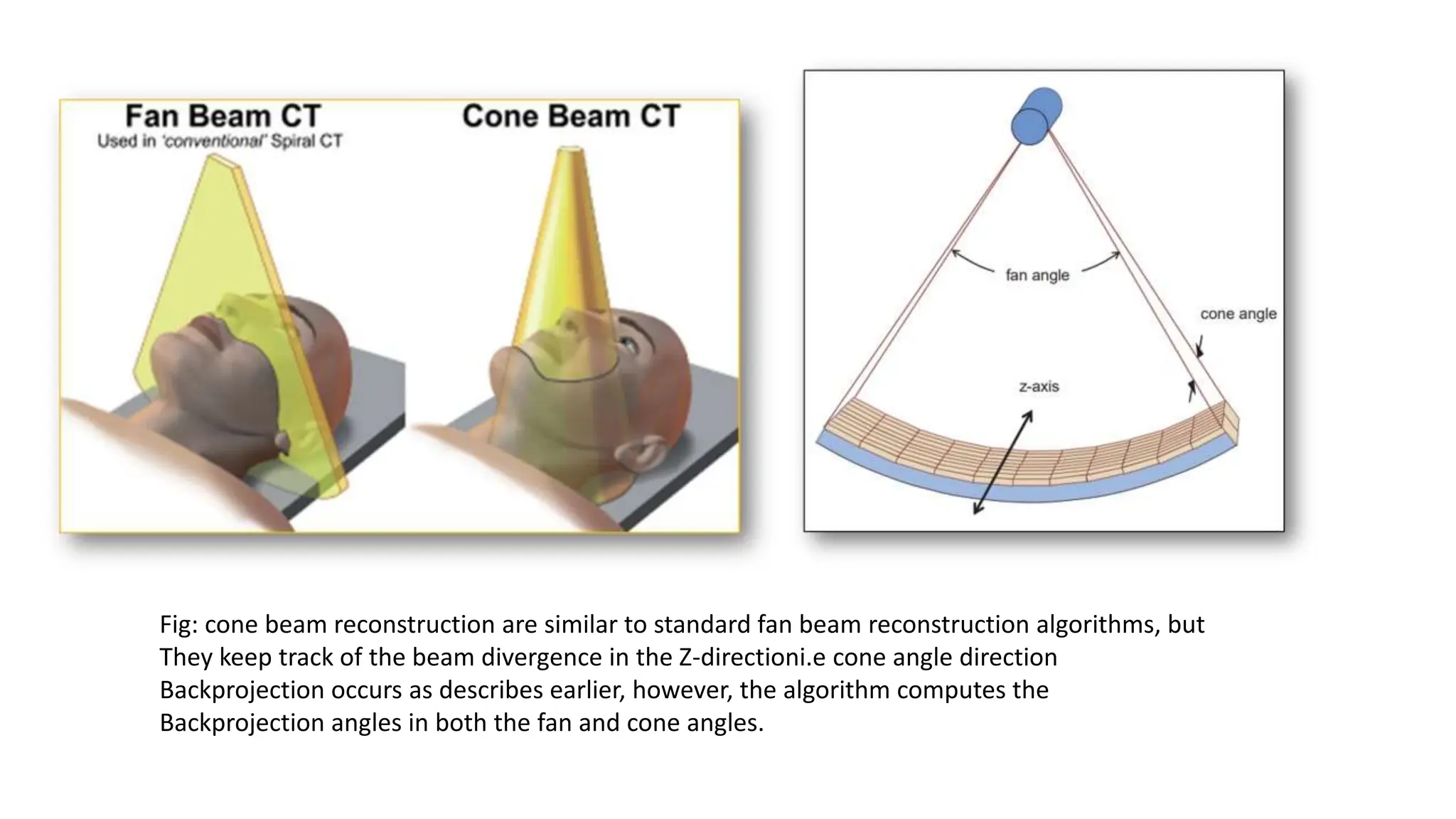
Fig: cone beam reconstruction are similar to standard fan beam reconstruction algorithms, but
They keep track of the beam divergence in the Z-directioni.e cone angle direction
Backprojection occurs as describes earlier, however, the algorithm computes the
Backprojection angles in both the fan and cone angles.
• There are two classes of cone beam algorithm
with new generation of MSCT scanners :-
• Exact cone beam algorithm (computationally
complex & difficult to implement)
• Approximate cone beam algorithm
• 3D Algorithm (Fledkamp-Devis-Kress
Algorithm)
• 2D Algorithm (Advanced Single-slice
Rebinning Algorithm )
Preprocessing : Prior to Image Reconstruction
• Various preprocessing procedures are applied to the actual acquired projection
data prior to CT image reconstruction
• air calibration scans: the influence of bow tie filter is characterized ,
characterize the differences in individual detector response ,corrects
previously identified inhomogeneity's in the field
• A dead pixel correction algorithm: replaces dead pixel data with interpolated
data from surrounding pixels
• Scatter correction algorithms: Adaptive noise filtration methods algorithms;
to reduce the impact of noise
Image display
Image acquisition
Image
reconstruction
Dead pixel correction
algorithm :replace dead
pixels with interpolated
data from surrounding
pixel
Air calibration scan:
characterize difference in
individual detector
reponse
Adaptive noise filtration
algorithm :reduce impact
of noise
Methods of Image Reconstruction
• Simple Back projection
• Analytical methods
1. Filtered Back projection
2.Fourier transformation
• Iterative method
1. Statistical iterative reconstruction/ Hybrid Iterative
Reconstruction(HIR)
2. Model based iterative reconstruction(MBIR)
Simple Back Projection
• Also known as summation method
• It is the oldest reconstruction method.
• The term back projection is used because it reverses the process of
acquiring the projection .
• Here the images are reconstructed if the average attenuated value of
a certain body part are projected back on to the image area thus
from attenuated value to a matrix.
Patient scan
Acquisition of projected
data through multiple
angle
Assign average attenuation
values from each ray sum to
corresponding pixel in image
Pixel value are added up
along the direction of the
projection
Repeated for each gantry
angle
Final back projection is sum
of all back projected
attenuation profiles
Backprojection image from a single projection
Simple Back Projection
Advantages :-
1. Simple to understand
2. Basis for modern image reconstruction technique
Disadvantages :-
1. no sharp images due to blurring effect
2. Prone to artifacts (star type)
3. Poor handling of noisy data
Analytical Method
• Creates high quality images from acquired projection .
• A mathematical technique known as convolution or filtering .
• It employs filter to remove blurring artifact.
• Two types :-
1. Filtered back projection
2. Fourier reconstruction
Filtered Back projection
• It is similar to back projection except that the image is filtered to
counterbalance the effect of star pattern .
• Projection data is applied with mathematical filter before back
projection as a result the blurring faced during simple back projection
is removed .
• The Mathematical filtering step involve convolving the projection
data with a convolution “KERNEL” on a spatial domain .
• Convolution filter refers to a mathematical filtering of the data
designed to change the appearance of the image.
MEASUREMENT
DATA
PREPROCESSING
RAW DATA
CONVOLUTION
FILTERED OR CONVOLUTED
DATA
BACK PROJECTION
IMAGE DATA
Filters
• The primary purpose of the filter is to correct the blurring effect
inherent in the back projection process and to control noise .
• Filter function is applied to the raw data .
• Various filter involves :-
1. Ramp filter : ideal reconstruction filter , sensitive to noise
2. Shepp - Logan filter: Ramp filter X Sinc function
3. Cosine filter: Ramp filter X Cosine function
4. Hamming window filter: Ramp filter X Hamming window
5. Hann window filter: Ramp filter X Han window
Filters
oRamp filter : It amplifies high-frequency components linearly, which
helps in sharpening the image. While it enhances edge definition, it
can also amplify noise significantly
oShepp-Logan Filter: A modification of the Ram-Lak filter that includes
a sinc function to reduce noise with still enhancing edges.
oCosine filter : gradually attenuates higher frequency Provides
smoother images with reduced noise but slightly less sharpness
compared to the Ramp filter
Filters
• Hamming Filter: A filter that smooths the high-frequency
components to reduce noise at the cost of some resolution.
• Hann Filter: Similar to the Hamming filter, it provides a compromise
between resolution and noise reduction
Produces very smooth images with significant noise reduction, but can
lead to loss of fine details
HIGH PASS FILTER
• Keeps edge information intact
• Ramp & Shepp – Logan filter
• Commercially named as Ultrasharp, Sharp, Bone
Gantry angle
Attenuation
profile
0º 180º
LOW PASS FILTER
• Also known as band pass filter
• Smooth the image & reduce noise
• Cosine filter, Hamming filter, Hann filter
• Commercially named as Soft tissue, Standard
Gantry angle
Attenuation
profile
0º 180º
SHARPNESS
SMOOTHNESS
Vendors Specific Filters
SIEMENS RECONSTRUCTION KERNEL
• Siemens kernel have four position : (Kernal type, Resolution, version,
Scan mode)
a) Kernel type: B: Body, C: Child head, H: Head, U: Ultrahigh
resolution, S: Special kernel, T: Topogram
b) Resolution : 1, 2, 3, 4, 5, 6, 7, 8, 9 (Higher number high resolution &
vice versa)
c) Version: 0, 1, 2, 3, 4, 5, 6, 7, 8, 9
d) Scan mode: f: fast, s: standard, h: high resolution, u: ultrahigh
resolution
• GE RECONSTRUCTION KERNEL
• Soft
• Standard
• Detail
• Lung
• Bone plus
• Edge
• SIMENS RECONSTRUCTION KERNEL
• The available kernel are
• B10 – B90 for Body
• H10 – H90 for Head
• U30 – U90 for Ultrahigh resolution
• T20 – T81 for Topogarm
• Lower number smoother
• Middle number standard
• Higher number sharper
Advantages of Filtered Back Projection
• Simple & easy to understand
• Rapid reconstruction & suitable for real time or near real time image
reconstruction
• Require fewer computational resources compared to advanced
iterative reconstruction algorithms
• Improved image quality but lower than that of iterative
reconstruction
• The characteristics of FBP reconstructed image data are user
controlled (specific choice of reconstruction kernel resulting image of
well known noise structure & texture)
Disadvantages of Filtered Back Projection
• FBP can amplify noise, especially in low-dose CT scans. The high-
frequency components enhanced by the filters can also enhance
noise, leading to grainy images..
• Any deviation in the acquisition data can produce dramatic image
artifacts, such as streak or ring artifacts.
• FBP offers negligible dose reduction potential.
Fourier Reconstruction
• A radiograph can be considered an image in the spatial domain;ie
shades of grey represents various parts of the anatomy (e.g..,bone is
white and air is black)in space.
• With FT, this spatial domain image –the radiograph represented by
the function f(x,y) can be transformed into a frequency domain image
represented by the function f(u,v).
Fourier transform
• The Fourier transform is a mathematical operation that transforms a
function of time (or space) into a function of frequency.
• This is particularly useful for analyzing the frequency components of
signals
Steps for Fourier Reconstruction
1. The object to be scanned is represented by the function f(x,y)
2. Projection data are obtained from the object. A projection dataset
for at least a 180 degree rotation is required for adequate
reconstruction.These projections represent a spatial domain image.
3. Each projection is transformed into the frequency domain by the
fourier transform.These image must be converted into a clinically
useful image.
4. Because ct scanners use FFT developed specifically for digital
implementation,the frequency domain image must be placed on a
rectangular grid.
5. Finally,the interpolated image is transformed into a spatial domain
image of the object through an inverse fourier transform operations
Advantages of Fourier reconstruction
• The image in the frequency domain can be manipulated(e.g..,edge
enhancement or smoothing)by changing the amplitude of frequency
components.
• Computer can perform those manipulations (digital image
processing).
• Frequency information can be used to measure image quality through
point spread function, line spread function, and modulation transfer
function
Iterative Reconstruction
• Iterative refers to “repetition”
• It is also called successive approximation method or correction method.
• The Algebraic Reconstruction Technique (ART) was the first iterative
reconstruction technique used for computed tomography by Hounsfield.
• This method starts with the assumption that all points in the matrix along
the ray have the same value.
• This assumption is compared with the measured value and make
correction to bring the two into agreement.
• Iterative reconstruction attempts to find the image that is the “best fit” to
the acquired data.
Iterative Reconstruction
• Generic Steps:
• Assumption : (for example all points in the matrix have same value)
• Comparison: (with the measured values)
• Correction(to bring the two into agreement)
• Repetition(of the process until the assumed and measured values are the
same or within acceptable limit
Image with low exposure
technique
Reduced image noise and
artifact
Preserve image quality
Undergoes
Iterative reconstruction
Low radiation dose to the
patient
Image with higher noise
and artifact
Iterative Reconstruction
• Iterative reconstruction is divided into two types :-
1. Statistical or Hybrid iterative reconstruction :- HIR
2. Model based iterative reconstruction :- MBIR
Statistical/Hybrid Iterative Reconstruction
• used originally by Godfrey Hounsfield, however not commercially
used due to the inherent limitations of microprocessors at that time
• Term system statistics refers to the photon spectrum emitted by the
x-ray tube, the statistical distribution of photons & the noise of
detector electronics
• Characterized by iterative filtration of data separately performed in
projection or image space to reduce noise
• Actual image reconstruction relies on filter back projection so termed
Hybrid iterative reconstruction
• The speed of iterative reconstruction is comparable to FBP
Hybrid Iterative Reconstruction
Image data iteratively
filtered
Iteratively filtered
Reduce noise
Reduce artifacts
Backprojection
Projection data
Advantages of HIR
• Higher image quality compared to FBP particulary in terms of noise
reduction and artifact suppression but less than MBIR.
• Less computational time so quick processing speed.
• Requires less power less energy consumption.
• Uses simpler algorithm making it easy to implement and optimize.
• Lower cost
Disadvantage of HIR
• Moderate noise reduction and image quality as compared to MBIR
but higher than FBP.
• Although less demanding than MBIR, HIR still requires more
computational resources than traditional FBP
VENDOR SPECIFIC STATISTICAL ITERATIVE
RECONSTRUCTION
Hybrid IR Vendor
AIDR 3D Adaptive Iterative Dose Reduction 3D Canon Medical
Systems
ASIR Adaptive Statistical Iterative Reconstruction GE Healthcare
ASIR - V Adaptive statistical iterative reconstruction -
V
GE Healthcare
iDose4 Philips Healthcare
SAFIRE Sinogram- Affirmed Iterative Reconstruction Siemens
Healthineers
Model Based Iterative Reconstruction
• To overcome the limitations of FBP, MBIR was introduced for clinical
use in 2009 .
• MBIR is the most computationally demanding type of IR because it
uses multiple iterations of forward and back projections between the
sinogram domain and image domain to optimize image quality.
• It aims to produce highly accurate and high-quality images by
iteratively refining the image based on comprehensive modeling of
the entire imaging system.
• Models of the acquisition process, noise statistics, and system
geometry reconstruct the projections as accurately as possible..
Model Based Iterative Reconstruction
• The more complete model of MBIR allows for more reduction of
noise and artifacts than FBP does
• However, the high computational requirements and long
reconstruction times of MBIR have limited its widespread clinical
application.
Projection data
Backprojected into image
space
Image space data forward
projected
Artificial projection data
Compared to true
projection data
Update the image with
noise reduction
Model Based Iterative Reconstruction
iteratively refine the image
based on comprehensive
modeling of the entire
imaging system
Advantages of MBIR
• In terms of image quality and noise reduction, MBIR>HIR>FBP
• In terms of reduced patient dose , , MBIR>HIR>FBP
• Higher SNR
• Better artifact suppression high diagnostic accuracy
• uses detailed models of the CT system, including the geometry of the
scanner, the X-ray tube, and detector characteristics, leading to more
accurate image reconstruction.
Disadvantage of MBIR
• MBIR requires extensive computational resources, leading to longer
processing times compared to traditional methods like FBP and HIR.
• Powerful computational hardware requirement increasing cost and
complexity.
VENDOR SPECIFIC MODEL BASED
ITERATIVE RECONSTRUCTION
Model Based IR Vendor
ADMIRE Advanced modeled Iterative
Reconstruction
Siemens
Healthineers
FIRST Forward Projected Model – Based
Iterative Reconstruction Solution
Canon Medical
System
IMR Iterative Model Reconstruction Philips Healthcare
VEO (MBIR) GE Healthcare
SAFIRE
• sinogram affirmed iterative reconstruction
• Introduced in 2010 by Siemens Healthineers
• Utilizes both projection (raw data) & image data
• Reconstruct 20 images/ second
• In comparison to FBP
• Dose: 60% ↓
• Image noise: ≈35%↓
• SNR: ≈50%↑
• five different strength defining parameter of the underlying noise model/
regularization (SAFIRE 1 – 5)
Deep Learning Reconstruction
• It uses AI technology to reconstruct a CT image.
• DLR is the combination of AI & supercomputing (Higher computing
power)
• DLR uses artificial intelligence to reconstruct high-quality images from
lower-dose CT faster than MBIR
• DLR algorithm can be applied in both the raw data domain & image
domain or both
• DLR potentially allows for radiation dose reductions between 30%
and 71% compared with HIR while maintaining diagnostic image
quality due to improved noise reduction.
Deep Learning Reconstruction
• Lower noise (30% - 70% ↓ compared to HIR & 50% ↓ compared to
FBP)
• High SNR
• Increased spatial resolution
• Low radiation dose (30% - 71%↓ compared to HIR)
• Fast reconstruction speed
• Reconstructed image more natural in appearance than MBIR & HIR
(image texture preserved)
• Higher metal artifact reduction
Summary
• Image reconstruction is the mathematical process of displaying CT image
from the raw data obtained from the detector .
• There re generally three methods of image reconstruction :-
• Simple Back projection
• Analytical methods
1. Filtered Back projection
2.Fourier transformation
• Iterative method
1. Hybrid iterative reconstruction
2. Model based iterative reconstruction
References
• Seeram, E. Computed tomography: Physical Principles, Clinical Applications, and Quality
• Bushberg., 2012. Essential Physics of Medical Imaging, The. Lippincott, Williams & Wilkins.
• Stewart C. Bushong-Radiologic Science for Technologists_ Physics, Biology, a
• CT for technologist Williams and wilkins
• Chrinstensen physics of diagnostic radiology
• Deep Learning Image Reconstruction for CT: Technical Principles and Clinical Prospects
• Filtered BackProjection (FBP) Illustrated Guide For Radiologic Technologists • How Radiology
Works
• https://www.dspguide.com/ch25/5.htm
• https://chat.openai.com/
• Previous presentations
Thank you !!

PRINCIPLES OF IMAGE RECONSTRUCTION IN CT - poonam rijal.pptx

  • 1.
    PRINCIPLES OF IMAGE RECONSTRUCTIONIN CT PRESENTED BY POONAM RIJAL Bsc.MIT 2ND Year Roll no. :- 154 Maharajgunj Medical Campus,IOM
  • 2.
    Content • Introduction • Basicterminologies • Simple back projection • Analytical method 1. Filtered back projection 2. Fourier reconstruction • Iterative reconstruction 1. Statistical/hybrid iterative reconstruction 2. Model based iterative reconstruction • Deep learning reconstruction
  • 3.
    Introduction • It isa method of forming the CT image by manipulating the raw data obtained from the detector. • Mathematical process to generate image data from different angle around the patient . • Algorithm use attenuation data measured by detector & systematically buildup the image for viewing and interpretation. • Computer intensive task and most crucial step in CT imaging process.
  • 4.
  • 5.
    Steps for CTimage reconstruction All CT system uses a three step process :- • scan or data acquisition - GET DATA • Image reconstruction – USE DATA • Image display – DISPLAY DATA
  • 6.
    How CT imageis formed ?
  • 7.
    History Dates Events 1917 J.Radon (an Austrian mathematician) presented mathematic solution for reconstruction as radon transform 1963 William H. Oldendorf developed a direct back projection method 1967 Bracewell and Riddle first proposed the idea of filter back projection 1970 Gordon et al. proposed the algebraic reconstruction technique (ART)
  • 8.
    History Dates Events 1971 Convolutionback projection algorithms developed by Ramachandran & Laxminarayan 1974 Shepp & Logan used convolution back projection to improve image quality & processing time 2009 The first iterative reconstruction technique was clinically introduced 2019 Clinical Application of Deep Learning Reconstruction
  • 9.
    Reconstruction Terminologies • Ray:- the path that the x-ray beam takes from the tube to the detector at a given movement in a time is referred to a ray. • Ray sum :- DAS reads each arriving ray and measured how much of the beam is attenuated the measurement is call ray sum. • Projection: a series of rays that passes through the patient at the same orientation is called projection or a view . • Many projections or views are required to create a CT image which consist of many scan lines called rays.
  • 10.
    Raw Data • Allof the thousand of bits of data acquired by the system with each scan are called raw data/scan data . • The process of using the raw data to create a image is called image reconstruction . • Raw data includes all the measurement obtained from the detector array thus, a variety of images can be created by using the same data. • Raw data requires vast amount of hard disk space , CT system offers limited disk space for the storage of raw data .
  • 11.
    Image data • computerassigns one value (Hounsfield unit ) to each pixel to form an image . • The value is the average of all the attenuation measurement for that pixel . • Once the raw data are averaged so that each pixel has one associated number image is formed and data obtained from the image is called image data. • Image data required approximately one-fifth of the computer space needed for raw data. • Data manipulation is limited in presence of only image data
  • 12.
    Attenuation • In computedtomography a cross-sectional layer of the body is divided into many tiny blocks, • and then each block is assigned a number proportional to the degree that the block attenuated the x-ray beam. • The individual blocks are called "voxels." • Each voxel is assigned a number proportional to the degree of beam attenuated . • Beam attenuation depends on linear attenuation coefficient . • Their composition and thickness, along with the quality of the beam, determine the degree of attenuation.
  • 14.
  • 15.
    CT number • Therelative attenuation coefficient is normally expressed in “Hounsfield unit “ which are also known as a “CT number”. • Therefore each tissue element (voxel) is assigned by a “CT number“. • The relation between linear attenuation coefficient and CT number is given by :- • where , k = 1000 is a constant factor which determines the contrast scale, are linear coefficient of element tissue and water .
  • 16.
    Algorithm • precise setof steps to be followed in specific order . • Basis of computer programming. • Thousands of equations must be solved to determine the linear attenuation coefficients of all the pixels in the image matrix. • Reconstruction algorithms are used to solve the mathematical equations to convert information from detector array to image suitable for the display . • CT reconstruction algorithms are divided into the three types :- oBack projection oIterative method oAnalytical method
  • 17.
    Sinogram • The dataacquired for an individual slice can be displayed before reconstruction . This type of display is called sinogram . • Thus it is the 2D representation of the data obtained during a scan. • Provides visual representation of x-ray attenuation values at each point within the object as the beam passes through it from different angles. • Intensity measurement are done and then angle of projection (Rays) are plotted horizontally (x-axis) and views are shown on a vertical axis (y-axis) . • During the 360 degree CT acquisition of a particular object, the position of the ray corresponding to that object varies sinusoidally as a function of the view angle .
  • 18.
  • 19.
  • 21.
    Sinogram • The sinogramis useful for analyzing the raw projection data , flexibility in reconstruction in artifacts detection , inconsistencies and evaluating the quality of acquired data.
  • 22.
    Convolution • Mathematical filteringprocess of projected data by the mathematical filter to reduce blurring effect of projection • Depending on manufacturer the mathematical filter may be called as • Algorithm • Convolution • Filter • Kernel • Filter function applied to raw data
  • 23.
    Parallel beam andFan beam • Every ray sum in fan beam sinogram has equivalent parallel beam sinogram • The diverging ray is interpolated into a parallel ray sinogram • For fan beam reconstruction, the previous parallel beam algorithms may be applied after we reformat fan beam projection into parallel beam projection which is known as Rebinning • Reconstruction is performed as if data were collected in parallel beam geometry
  • 24.
    Interpolation • Mathematical methodof estimating the value of a unknown function using the known value on either side of the function . • Interpolation is used in CT in the image reconstruction process and the determination of slices in spiral/ helical CT imaging,
  • 25.
    Image Reconstruction inHelical CT • Reconstruction of Helical CT is same as conventional axial CT with interpolation • Data interpolation is performed by a special program called as interpolation algorithm • During Helical CT image data are received continuously but when image is reconstructed the plane of image doesn’t contain enough data for image reconstruction so, the data needed for image reconstruction is estimated by a special computation method known as Interpolation algorithm
  • 26.
    Interpolation • Reconstruct imageat z-axis position through interpolation • There are two types of interpolation algorithm • 360º linear interpolation algorithm:- Plane of reconstructed image interpolated form data acquired on a revolution apart , thicker slice ,blurring in reforrmated image ,noise reduction • 180º Linear interpolation algorithm :- Plane of reconstructed imageinterpolated form data acquired on a half revolution apart ,thinner slices ,increased noise improved resolution
  • 28.
    Projected data from helicalscanning sinogram Select interpolation points Linear interpolation for each projection angle Reconstruction algorithm Image data
  • 29.
    Cone Beam Algorithm •The fan beam approximation algorithms are not very accurate used with the new generation of MSCT scanners, so other image reconstruction algorithms are needed. These algorithms are called cone-beam algorithm. • ls in case of MDCT where the cone angle is larger resulting cone beam artifact • The cone beam algorithm is developed to eliminate cone beam artifact
  • 30.
    Fig: cone beamreconstruction are similar to standard fan beam reconstruction algorithms, but They keep track of the beam divergence in the Z-directioni.e cone angle direction Backprojection occurs as describes earlier, however, the algorithm computes the Backprojection angles in both the fan and cone angles.
  • 31.
    • There aretwo classes of cone beam algorithm with new generation of MSCT scanners :- • Exact cone beam algorithm (computationally complex & difficult to implement) • Approximate cone beam algorithm • 3D Algorithm (Fledkamp-Devis-Kress Algorithm) • 2D Algorithm (Advanced Single-slice Rebinning Algorithm )
  • 32.
    Preprocessing : Priorto Image Reconstruction • Various preprocessing procedures are applied to the actual acquired projection data prior to CT image reconstruction • air calibration scans: the influence of bow tie filter is characterized , characterize the differences in individual detector response ,corrects previously identified inhomogeneity's in the field • A dead pixel correction algorithm: replaces dead pixel data with interpolated data from surrounding pixels • Scatter correction algorithms: Adaptive noise filtration methods algorithms; to reduce the impact of noise
  • 33.
    Image display Image acquisition Image reconstruction Deadpixel correction algorithm :replace dead pixels with interpolated data from surrounding pixel Air calibration scan: characterize difference in individual detector reponse Adaptive noise filtration algorithm :reduce impact of noise
  • 34.
    Methods of ImageReconstruction • Simple Back projection • Analytical methods 1. Filtered Back projection 2.Fourier transformation • Iterative method 1. Statistical iterative reconstruction/ Hybrid Iterative Reconstruction(HIR) 2. Model based iterative reconstruction(MBIR)
  • 35.
    Simple Back Projection •Also known as summation method • It is the oldest reconstruction method. • The term back projection is used because it reverses the process of acquiring the projection . • Here the images are reconstructed if the average attenuated value of a certain body part are projected back on to the image area thus from attenuated value to a matrix.
  • 36.
    Patient scan Acquisition ofprojected data through multiple angle Assign average attenuation values from each ray sum to corresponding pixel in image Pixel value are added up along the direction of the projection Repeated for each gantry angle Final back projection is sum of all back projected attenuation profiles
  • 38.
    Backprojection image froma single projection
  • 43.
    Simple Back Projection Advantages:- 1. Simple to understand 2. Basis for modern image reconstruction technique Disadvantages :- 1. no sharp images due to blurring effect 2. Prone to artifacts (star type) 3. Poor handling of noisy data
  • 44.
    Analytical Method • Createshigh quality images from acquired projection . • A mathematical technique known as convolution or filtering . • It employs filter to remove blurring artifact. • Two types :- 1. Filtered back projection 2. Fourier reconstruction
  • 45.
    Filtered Back projection •It is similar to back projection except that the image is filtered to counterbalance the effect of star pattern . • Projection data is applied with mathematical filter before back projection as a result the blurring faced during simple back projection is removed . • The Mathematical filtering step involve convolving the projection data with a convolution “KERNEL” on a spatial domain . • Convolution filter refers to a mathematical filtering of the data designed to change the appearance of the image.
  • 46.
    MEASUREMENT DATA PREPROCESSING RAW DATA CONVOLUTION FILTERED ORCONVOLUTED DATA BACK PROJECTION IMAGE DATA
  • 50.
    Filters • The primarypurpose of the filter is to correct the blurring effect inherent in the back projection process and to control noise . • Filter function is applied to the raw data . • Various filter involves :- 1. Ramp filter : ideal reconstruction filter , sensitive to noise 2. Shepp - Logan filter: Ramp filter X Sinc function 3. Cosine filter: Ramp filter X Cosine function 4. Hamming window filter: Ramp filter X Hamming window 5. Hann window filter: Ramp filter X Han window
  • 51.
    Filters oRamp filter :It amplifies high-frequency components linearly, which helps in sharpening the image. While it enhances edge definition, it can also amplify noise significantly oShepp-Logan Filter: A modification of the Ram-Lak filter that includes a sinc function to reduce noise with still enhancing edges. oCosine filter : gradually attenuates higher frequency Provides smoother images with reduced noise but slightly less sharpness compared to the Ramp filter
  • 52.
    Filters • Hamming Filter:A filter that smooths the high-frequency components to reduce noise at the cost of some resolution. • Hann Filter: Similar to the Hamming filter, it provides a compromise between resolution and noise reduction Produces very smooth images with significant noise reduction, but can lead to loss of fine details
  • 53.
    HIGH PASS FILTER •Keeps edge information intact • Ramp & Shepp – Logan filter • Commercially named as Ultrasharp, Sharp, Bone Gantry angle Attenuation profile 0º 180º
  • 54.
    LOW PASS FILTER •Also known as band pass filter • Smooth the image & reduce noise • Cosine filter, Hamming filter, Hann filter • Commercially named as Soft tissue, Standard Gantry angle Attenuation profile 0º 180º
  • 57.
  • 58.
    Vendors Specific Filters SIEMENSRECONSTRUCTION KERNEL • Siemens kernel have four position : (Kernal type, Resolution, version, Scan mode) a) Kernel type: B: Body, C: Child head, H: Head, U: Ultrahigh resolution, S: Special kernel, T: Topogram b) Resolution : 1, 2, 3, 4, 5, 6, 7, 8, 9 (Higher number high resolution & vice versa) c) Version: 0, 1, 2, 3, 4, 5, 6, 7, 8, 9 d) Scan mode: f: fast, s: standard, h: high resolution, u: ultrahigh resolution
  • 59.
    • GE RECONSTRUCTIONKERNEL • Soft • Standard • Detail • Lung • Bone plus • Edge • SIMENS RECONSTRUCTION KERNEL • The available kernel are • B10 – B90 for Body • H10 – H90 for Head • U30 – U90 for Ultrahigh resolution • T20 – T81 for Topogarm • Lower number smoother • Middle number standard • Higher number sharper
  • 60.
    Advantages of FilteredBack Projection • Simple & easy to understand • Rapid reconstruction & suitable for real time or near real time image reconstruction • Require fewer computational resources compared to advanced iterative reconstruction algorithms • Improved image quality but lower than that of iterative reconstruction • The characteristics of FBP reconstructed image data are user controlled (specific choice of reconstruction kernel resulting image of well known noise structure & texture)
  • 61.
    Disadvantages of FilteredBack Projection • FBP can amplify noise, especially in low-dose CT scans. The high- frequency components enhanced by the filters can also enhance noise, leading to grainy images.. • Any deviation in the acquisition data can produce dramatic image artifacts, such as streak or ring artifacts. • FBP offers negligible dose reduction potential.
  • 62.
    Fourier Reconstruction • Aradiograph can be considered an image in the spatial domain;ie shades of grey represents various parts of the anatomy (e.g..,bone is white and air is black)in space. • With FT, this spatial domain image –the radiograph represented by the function f(x,y) can be transformed into a frequency domain image represented by the function f(u,v).
  • 63.
    Fourier transform • TheFourier transform is a mathematical operation that transforms a function of time (or space) into a function of frequency. • This is particularly useful for analyzing the frequency components of signals
  • 64.
    Steps for FourierReconstruction 1. The object to be scanned is represented by the function f(x,y) 2. Projection data are obtained from the object. A projection dataset for at least a 180 degree rotation is required for adequate reconstruction.These projections represent a spatial domain image. 3. Each projection is transformed into the frequency domain by the fourier transform.These image must be converted into a clinically useful image. 4. Because ct scanners use FFT developed specifically for digital implementation,the frequency domain image must be placed on a rectangular grid. 5. Finally,the interpolated image is transformed into a spatial domain image of the object through an inverse fourier transform operations
  • 65.
    Advantages of Fourierreconstruction • The image in the frequency domain can be manipulated(e.g..,edge enhancement or smoothing)by changing the amplitude of frequency components. • Computer can perform those manipulations (digital image processing). • Frequency information can be used to measure image quality through point spread function, line spread function, and modulation transfer function
  • 66.
    Iterative Reconstruction • Iterativerefers to “repetition” • It is also called successive approximation method or correction method. • The Algebraic Reconstruction Technique (ART) was the first iterative reconstruction technique used for computed tomography by Hounsfield. • This method starts with the assumption that all points in the matrix along the ray have the same value. • This assumption is compared with the measured value and make correction to bring the two into agreement. • Iterative reconstruction attempts to find the image that is the “best fit” to the acquired data.
  • 67.
    Iterative Reconstruction • GenericSteps: • Assumption : (for example all points in the matrix have same value) • Comparison: (with the measured values) • Correction(to bring the two into agreement) • Repetition(of the process until the assumed and measured values are the same or within acceptable limit
  • 68.
    Image with lowexposure technique Reduced image noise and artifact Preserve image quality Undergoes Iterative reconstruction Low radiation dose to the patient Image with higher noise and artifact
  • 69.
    Iterative Reconstruction • Iterativereconstruction is divided into two types :- 1. Statistical or Hybrid iterative reconstruction :- HIR 2. Model based iterative reconstruction :- MBIR
  • 70.
    Statistical/Hybrid Iterative Reconstruction •used originally by Godfrey Hounsfield, however not commercially used due to the inherent limitations of microprocessors at that time • Term system statistics refers to the photon spectrum emitted by the x-ray tube, the statistical distribution of photons & the noise of detector electronics • Characterized by iterative filtration of data separately performed in projection or image space to reduce noise • Actual image reconstruction relies on filter back projection so termed Hybrid iterative reconstruction • The speed of iterative reconstruction is comparable to FBP
  • 71.
    Hybrid Iterative Reconstruction Imagedata iteratively filtered Iteratively filtered Reduce noise Reduce artifacts Backprojection Projection data
  • 72.
    Advantages of HIR •Higher image quality compared to FBP particulary in terms of noise reduction and artifact suppression but less than MBIR. • Less computational time so quick processing speed. • Requires less power less energy consumption. • Uses simpler algorithm making it easy to implement and optimize. • Lower cost
  • 73.
    Disadvantage of HIR •Moderate noise reduction and image quality as compared to MBIR but higher than FBP. • Although less demanding than MBIR, HIR still requires more computational resources than traditional FBP
  • 74.
    VENDOR SPECIFIC STATISTICALITERATIVE RECONSTRUCTION Hybrid IR Vendor AIDR 3D Adaptive Iterative Dose Reduction 3D Canon Medical Systems ASIR Adaptive Statistical Iterative Reconstruction GE Healthcare ASIR - V Adaptive statistical iterative reconstruction - V GE Healthcare iDose4 Philips Healthcare SAFIRE Sinogram- Affirmed Iterative Reconstruction Siemens Healthineers
  • 75.
    Model Based IterativeReconstruction • To overcome the limitations of FBP, MBIR was introduced for clinical use in 2009 . • MBIR is the most computationally demanding type of IR because it uses multiple iterations of forward and back projections between the sinogram domain and image domain to optimize image quality. • It aims to produce highly accurate and high-quality images by iteratively refining the image based on comprehensive modeling of the entire imaging system. • Models of the acquisition process, noise statistics, and system geometry reconstruct the projections as accurately as possible..
  • 76.
    Model Based IterativeReconstruction • The more complete model of MBIR allows for more reduction of noise and artifacts than FBP does • However, the high computational requirements and long reconstruction times of MBIR have limited its widespread clinical application.
  • 77.
    Projection data Backprojected intoimage space Image space data forward projected Artificial projection data Compared to true projection data Update the image with noise reduction Model Based Iterative Reconstruction iteratively refine the image based on comprehensive modeling of the entire imaging system
  • 78.
    Advantages of MBIR •In terms of image quality and noise reduction, MBIR>HIR>FBP • In terms of reduced patient dose , , MBIR>HIR>FBP • Higher SNR • Better artifact suppression high diagnostic accuracy • uses detailed models of the CT system, including the geometry of the scanner, the X-ray tube, and detector characteristics, leading to more accurate image reconstruction.
  • 79.
    Disadvantage of MBIR •MBIR requires extensive computational resources, leading to longer processing times compared to traditional methods like FBP and HIR. • Powerful computational hardware requirement increasing cost and complexity.
  • 80.
    VENDOR SPECIFIC MODELBASED ITERATIVE RECONSTRUCTION Model Based IR Vendor ADMIRE Advanced modeled Iterative Reconstruction Siemens Healthineers FIRST Forward Projected Model – Based Iterative Reconstruction Solution Canon Medical System IMR Iterative Model Reconstruction Philips Healthcare VEO (MBIR) GE Healthcare
  • 82.
    SAFIRE • sinogram affirmediterative reconstruction • Introduced in 2010 by Siemens Healthineers • Utilizes both projection (raw data) & image data • Reconstruct 20 images/ second • In comparison to FBP • Dose: 60% ↓ • Image noise: ≈35%↓ • SNR: ≈50%↑ • five different strength defining parameter of the underlying noise model/ regularization (SAFIRE 1 – 5)
  • 83.
    Deep Learning Reconstruction •It uses AI technology to reconstruct a CT image. • DLR is the combination of AI & supercomputing (Higher computing power) • DLR uses artificial intelligence to reconstruct high-quality images from lower-dose CT faster than MBIR • DLR algorithm can be applied in both the raw data domain & image domain or both • DLR potentially allows for radiation dose reductions between 30% and 71% compared with HIR while maintaining diagnostic image quality due to improved noise reduction.
  • 84.
    Deep Learning Reconstruction •Lower noise (30% - 70% ↓ compared to HIR & 50% ↓ compared to FBP) • High SNR • Increased spatial resolution • Low radiation dose (30% - 71%↓ compared to HIR) • Fast reconstruction speed • Reconstructed image more natural in appearance than MBIR & HIR (image texture preserved) • Higher metal artifact reduction
  • 85.
    Summary • Image reconstructionis the mathematical process of displaying CT image from the raw data obtained from the detector . • There re generally three methods of image reconstruction :- • Simple Back projection • Analytical methods 1. Filtered Back projection 2.Fourier transformation • Iterative method 1. Hybrid iterative reconstruction 2. Model based iterative reconstruction
  • 86.
    References • Seeram, E.Computed tomography: Physical Principles, Clinical Applications, and Quality • Bushberg., 2012. Essential Physics of Medical Imaging, The. Lippincott, Williams & Wilkins. • Stewart C. Bushong-Radiologic Science for Technologists_ Physics, Biology, a • CT for technologist Williams and wilkins • Chrinstensen physics of diagnostic radiology • Deep Learning Image Reconstruction for CT: Technical Principles and Clinical Prospects • Filtered BackProjection (FBP) Illustrated Guide For Radiologic Technologists • How Radiology Works • https://www.dspguide.com/ch25/5.htm • https://chat.openai.com/ • Previous presentations
  • 87.

Editor's Notes

  • #10 .
  • #20 .
  • #29 . For each point in the image, sum the interpolated values from all projection angles. Each pixel value represents the cumulative attenuation of X-rays through the corresponding point in the patient's body.
  • #33 .
  • #42 Image resembles object
  • #52 Ramp filter used when edge clarity and resolution is significant Shepplogan filter makes balance between image sharpness and noise suppression Cosine filter used where a smoother image with less noise is preferred over maximum sharpness
  • #79 Photon starvation and beam hardening and metal artifacts
  • #82 .
  • #83 Safire 1 noiser safire 3 default safire 5 smoother . The strength are not an indication of the number of iterations & will not affect the reconstruction tim
  • #86 iteratively refine the image based on comprehensive modeling of the entire imaging system