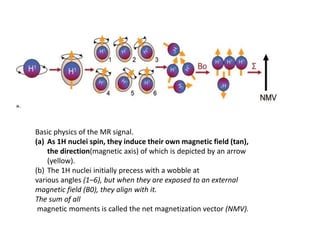
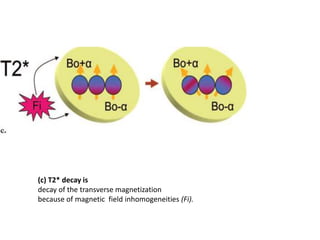
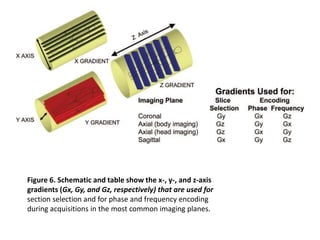
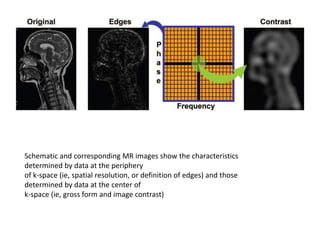
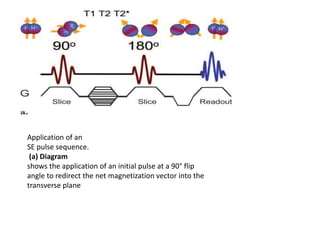
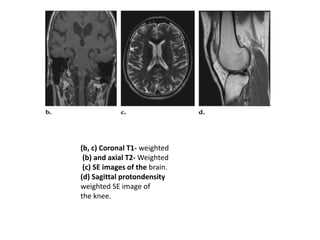
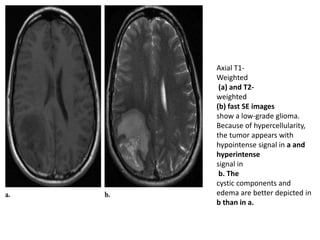
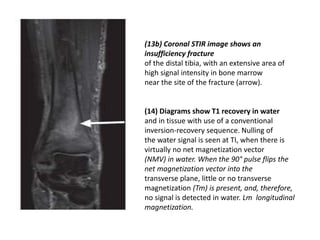
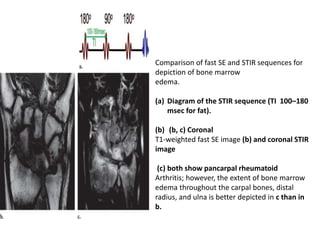
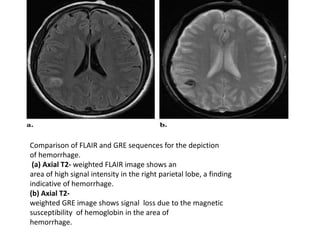
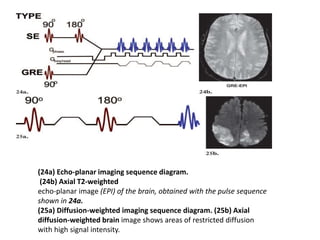
MRI sequences use radiofrequency pulses and magnetic field gradients to manipulate the alignment of hydrogen nuclei in tissues and generate signal used to form images. A fast spin echo sequence reduces scan time by applying multiple 180 degree refocusing pulses after a single 90 degree excitation pulse, generating a train of echoes. This allows acquisition of a T2-weighted image of the brain showing a low-grade glioma in less than a minute, compared to over 7 minutes for a conventional spin echo sequence. Understanding tissue contrast mechanisms and manipulating pulse sequence parameters like repetition time and echo time allows targeting specific types of contrast like T1-weighting to optimize clinical applications of MRI.