MISCARRIAGESMISCARRIAGES
Dr. TARIG MAHMOUDDr. TARIG MAHMOUD
MD SUDANMD SUDAN
HAIL UNIVERSITY KSAHAIL UNIVERSITY KSA
CAUSES OF EARLY BLEEDING INCAUSES OF EARLY BLEEDING IN
PREGNANCYPREGNANCY
MiscarriagesMiscarriages
Ectopic pregnancyEctopic pregnancy
Hydatidiform moleHydatidiform mole
MISCARRIAGE / ABORTION
Definition :
Termination of pregnancy before viability.
OR:
Expulsion of a fetus or an embryo weighing 500 gm or less
Incidence: 15 - 20% of pregnancies total reproductive losses are much
higher if one considers losses that occur prior to clinical recognition.
Classification:
1. spontaneous:
occurs without medical or mechanical means.
2. induced abortion
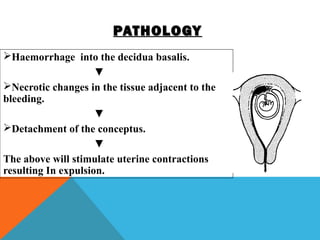
PATHOLOGYPATHOLOGY
Haemorrhage into the decidua basalis.
▼
Necrotic changes in the tissue adjacent to the
bleeding.
▼
Detachment of the conceptus.
▼
The above will stimulate uterine contractions
resulting In expulsion.
RISK FACTORS
 Maternal age - more than 35years.
 Increased gravidity.
 Previous history of miscarriage.
 Multiple pregnancy
CAUSES OF MISCARRIAGE
Fetal causes:
 Abnormal conceptus:
Chromosomal e.g. Trisomy.
Structural e.g. Neural tube defect.
Genetic e.g. X- Linked diseases.
CAUSES OF MISCARRIAGE
Maternal causes:
1. Immunological:
 Alloimmune response: failure of a normal immune response in
the mother to accept the fetus for a duration of a normal
pregnancy.
 Autoimmune disease: antiphospholipid antibodies especially
lupus anticoagulant (LA) and the anticardiolipin antibodies
(ACL)
2. uterine abnormality:
 congenital: septate uterus → recurrent abortion.
 cervical incompetence: - Congenital
- aquired
▼
second trimester abortions.
 - fibroids (submucus): →
• disruption of implantation and development of the fetal blood supply.
• rapid growth and degeneration with release of cytokines.
• occupation of space for the fetus to grow..
3. Endocrine :
-Poorly controlled diabetes (type 1/type 2).
- hypothyroidism and hyperthyroidism.
- Luteal phase Deficiency : Decreased level of progesterone which
secreted by corpus luteum so endometrium is poorly or
improperly hormonally prepared for implantation and is
therefore inhospitable for implantation.
4. Infections (maternal/fetal): as TORCH infections, Ureaplasma
urealyticum, listeria
5. Environmental toxins: alcohol, smoking, drug abuse, ionizing
radiation……
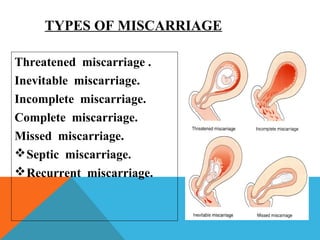
TYPES OF MISCARRIAGE
Threatened miscarriage .
Inevitable miscarriage.
Incomplete miscarriage.
Complete miscarriage.
Missed miscarriage.
Septic miscarriage.
Recurrent miscarriage.
CLINICAL FEATURES/MANAGEMENT
Threatened miscarriage
- Short period of amenorrhea.
- Uterus corresponding to the duration.
- Mild bleeding (spotting).
- Mild pain.
- P.V.: closed cervical os.
- Pregnancy test (hCG): + ve.
- US: viable intra uterine fetus.
Management
-reassurance.
-Rest.
-Repeated U/S
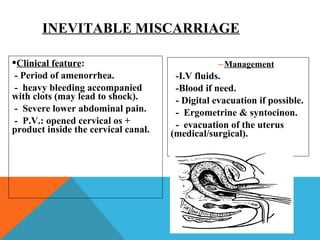
Clinical feature:
- Period of amenorrhea.
- heavy bleeding accompanied
with clots (may lead to shock).
- Severe lower abdominal pain.
- P.V.: opened cervical os +
product inside the cervical canal.
–Management
-I.V fluids.
-Blood if need.
- Digital evacuation if possible.
- Ergometrine & syntocinon.
- evacuation of the uterus
(medical/surgical).
INEVITABLE MISCARRIAGE
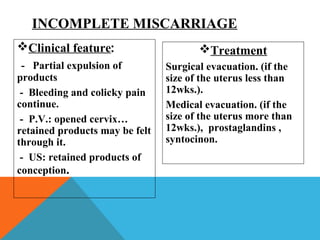
Clinical feature:
- Partial expulsion of
products
- Bleeding and colicky pain
continue.
- P.V.: opened cervix…
retained products may be felt
through it.
- US: retained products of
conception.
Treatment
Surgical evacuation. (if the
size of the uterus less than
12wks.).
Medical evacuation. (if the
size of the uterus more than
12wks.), prostaglandins ,
syntocinon.
INCOMPLETE MISCARRIAGE
COMPLETE MISCARRIAGE
- Expulsion of all products of conception.
- Cessation of bleeding and abdominal pain.
- P.V.: closed cervix.
- US: empty uterus.
Treatment
Antibiotic
Analgesia
Feature:
- gradual disappearance of
pregnancy Symptoms Signs.
- Brownish vaginal
discharge.
- Milk secretion.
- Pregnancy test: negative
but it may be + ve for 3-4
weeks after the death of the
fetus.
- US: absent fetal heart
pulsations.
Complications
- Hypofibrenogenaemia
Treatment
- Wait 4 weeks for spontaneous
expulsion
- evacuate if:
Spontaneous expulsion does
not occur after 4 weeks.
Infection.
DIC.
- Manage according to size of
uterus
- Uterus < 12 weeks :
dilatation and evacuation.
- Uterus > 12 weeks :
try Oxytocin or PGs.
MISSED MISCARRIAGE
RECURRENT MISCARRIAGE
Definition: Three or more consecutive
miscarriage.
Causes:
1)Chromosomal abnormality.
2)Immunological factors- antiphospholipids
antibodies.
3)Cervical incompetence: 2nd
trimester
miscarriage.
a) Congenital.
b)Acquired-(cervical injury, con biopsy).
.
DIGNOSIS OF RECURRENT
MISCARRIAGE
From the history : Painless.
decreased
gestational age
Investigation: Hagar dilator(No.8).
HSG.
During pregnancy: Funnel shape, short cervix
.
Management: Cervical cerclage.
SEPTIC MISCARRIAGE
Following an incomplete miscarriage due to
ascending infection.
Or following criminal abortion.
Clinical picture:Clinical picture:
- Offensive bloody vaginal discharge.
- Increased body temperature.
- Lower abdominal pain (pelvic peritonitis)
generalized peritonitis.
- Increased pulse rate, dehydration, toxicity.
InvestigationInvestigation :High vaginal swab for c/s + CBC.
Treatment:Treatment:
- Antibiotic, iv fluids,blood transfusion.
- Evacuation of retained product.
In all form of miscarriages
general clinical assessment should be
made: vital signs, abdominal
examination, vaginal examination.
All needed investigations + / - u/s
Management should be according to
clinical
Type & gestational age.
COUNSELLING
Patients who have suffered miscarriages
should be offered counseling to ensure
that they understand that most
miscarriages are non recurrent.
They should also be provided with the
necessary psychological support where
necessary.
THANK YOU

Miscarriages

  • 1.
    MISCARRIAGESMISCARRIAGES Dr. TARIG MAHMOUDDr.TARIG MAHMOUD MD SUDANMD SUDAN HAIL UNIVERSITY KSAHAIL UNIVERSITY KSA
  • 2.
    CAUSES OF EARLYBLEEDING INCAUSES OF EARLY BLEEDING IN PREGNANCYPREGNANCY MiscarriagesMiscarriages Ectopic pregnancyEctopic pregnancy Hydatidiform moleHydatidiform mole
  • 3.
    MISCARRIAGE / ABORTION Definition: Termination of pregnancy before viability. OR: Expulsion of a fetus or an embryo weighing 500 gm or less Incidence: 15 - 20% of pregnancies total reproductive losses are much higher if one considers losses that occur prior to clinical recognition. Classification: 1. spontaneous: occurs without medical or mechanical means. 2. induced abortion
  • 4.
    PATHOLOGYPATHOLOGY Haemorrhage into thedecidua basalis. ▼ Necrotic changes in the tissue adjacent to the bleeding. ▼ Detachment of the conceptus. ▼ The above will stimulate uterine contractions resulting In expulsion.
  • 5.
    RISK FACTORS  Maternalage - more than 35years.  Increased gravidity.  Previous history of miscarriage.  Multiple pregnancy
  • 6.
    CAUSES OF MISCARRIAGE Fetalcauses:  Abnormal conceptus: Chromosomal e.g. Trisomy. Structural e.g. Neural tube defect. Genetic e.g. X- Linked diseases.
  • 7.
    CAUSES OF MISCARRIAGE Maternalcauses: 1. Immunological:  Alloimmune response: failure of a normal immune response in the mother to accept the fetus for a duration of a normal pregnancy.  Autoimmune disease: antiphospholipid antibodies especially lupus anticoagulant (LA) and the anticardiolipin antibodies (ACL)
  • 8.
    2. uterine abnormality: congenital: septate uterus → recurrent abortion.  cervical incompetence: - Congenital - aquired ▼ second trimester abortions.  - fibroids (submucus): → • disruption of implantation and development of the fetal blood supply. • rapid growth and degeneration with release of cytokines. • occupation of space for the fetus to grow..
  • 9.
    3. Endocrine : -Poorlycontrolled diabetes (type 1/type 2). - hypothyroidism and hyperthyroidism. - Luteal phase Deficiency : Decreased level of progesterone which secreted by corpus luteum so endometrium is poorly or improperly hormonally prepared for implantation and is therefore inhospitable for implantation. 4. Infections (maternal/fetal): as TORCH infections, Ureaplasma urealyticum, listeria 5. Environmental toxins: alcohol, smoking, drug abuse, ionizing radiation……
  • 10.
    TYPES OF MISCARRIAGE Threatenedmiscarriage . Inevitable miscarriage. Incomplete miscarriage. Complete miscarriage. Missed miscarriage. Septic miscarriage. Recurrent miscarriage.
  • 11.
    CLINICAL FEATURES/MANAGEMENT Threatened miscarriage -Short period of amenorrhea. - Uterus corresponding to the duration. - Mild bleeding (spotting). - Mild pain. - P.V.: closed cervical os. - Pregnancy test (hCG): + ve. - US: viable intra uterine fetus. Management -reassurance. -Rest. -Repeated U/S
  • 12.
    Clinical feature: - Periodof amenorrhea. - heavy bleeding accompanied with clots (may lead to shock). - Severe lower abdominal pain. - P.V.: opened cervical os + product inside the cervical canal. –Management -I.V fluids. -Blood if need. - Digital evacuation if possible. - Ergometrine & syntocinon. - evacuation of the uterus (medical/surgical). INEVITABLE MISCARRIAGE
  • 13.
    Clinical feature: - Partialexpulsion of products - Bleeding and colicky pain continue. - P.V.: opened cervix… retained products may be felt through it. - US: retained products of conception. Treatment Surgical evacuation. (if the size of the uterus less than 12wks.). Medical evacuation. (if the size of the uterus more than 12wks.), prostaglandins , syntocinon. INCOMPLETE MISCARRIAGE
  • 14.
    COMPLETE MISCARRIAGE - Expulsionof all products of conception. - Cessation of bleeding and abdominal pain. - P.V.: closed cervix. - US: empty uterus. Treatment Antibiotic Analgesia
  • 15.
    Feature: - gradual disappearanceof pregnancy Symptoms Signs. - Brownish vaginal discharge. - Milk secretion. - Pregnancy test: negative but it may be + ve for 3-4 weeks after the death of the fetus. - US: absent fetal heart pulsations. Complications - Hypofibrenogenaemia Treatment - Wait 4 weeks for spontaneous expulsion - evacuate if: Spontaneous expulsion does not occur after 4 weeks. Infection. DIC. - Manage according to size of uterus - Uterus < 12 weeks : dilatation and evacuation. - Uterus > 12 weeks : try Oxytocin or PGs. MISSED MISCARRIAGE
  • 16.
    RECURRENT MISCARRIAGE Definition: Threeor more consecutive miscarriage. Causes: 1)Chromosomal abnormality. 2)Immunological factors- antiphospholipids antibodies. 3)Cervical incompetence: 2nd trimester miscarriage. a) Congenital. b)Acquired-(cervical injury, con biopsy). .
  • 17.
    DIGNOSIS OF RECURRENT MISCARRIAGE Fromthe history : Painless. decreased gestational age Investigation: Hagar dilator(No.8). HSG. During pregnancy: Funnel shape, short cervix . Management: Cervical cerclage.
  • 18.
    SEPTIC MISCARRIAGE Following anincomplete miscarriage due to ascending infection. Or following criminal abortion. Clinical picture:Clinical picture: - Offensive bloody vaginal discharge. - Increased body temperature. - Lower abdominal pain (pelvic peritonitis) generalized peritonitis. - Increased pulse rate, dehydration, toxicity. InvestigationInvestigation :High vaginal swab for c/s + CBC. Treatment:Treatment: - Antibiotic, iv fluids,blood transfusion. - Evacuation of retained product.
  • 19.
    In all formof miscarriages general clinical assessment should be made: vital signs, abdominal examination, vaginal examination. All needed investigations + / - u/s Management should be according to clinical Type & gestational age.
  • 20.
    COUNSELLING Patients who havesuffered miscarriages should be offered counseling to ensure that they understand that most miscarriages are non recurrent. They should also be provided with the necessary psychological support where necessary.
  • 21.