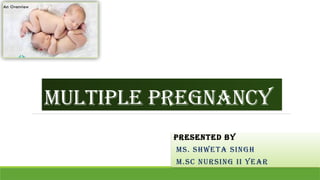
MULTIPLE PREGNANCY
PRESENTED BY
MS. SHWETA SINGH
M.SC NURSING II YEAR
Globally multiple pregnancies pose challenges to the Obstetrician. This is
mainly due to increased maternal and foetal complications both in
developed and developing countries. There has been a widespread increase
in multiple pregnancies in recent years mainly due to late childbearing
age, use of ovulation-inducing drugs and Assisted reproductive
techniques (ART). The worldwide incidence of multiple pregnancies
varies considerably and it is around 2-20 per 1000 births.
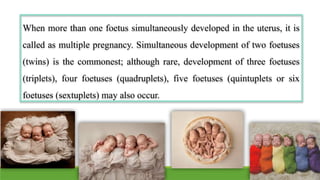
When more than one foetus simultaneously developed in the uterus, it is
called as multiple pregnancy. Simultaneous development of two foetuses
(twins) is the commonest; although rare, development of three foetuses
(triplets), four foetuses (quadruplets), five foetuses (quintuplets or six
foetuses (sextuplets) may also occur.
DEFINITION:
When more than one foetus simultaneously develops in the uterus
then it is called multiple pregnancy. -D.C. Dutta
TWINS PREGNANCY: VARIETIES:
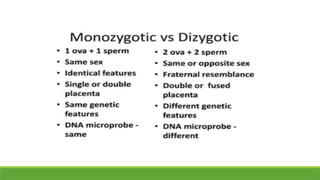
Dizygotic twins: is the commonest results from the fertilization of two ova.
Monozygotic twins: (one-third) results from the fertilization of single ovum.
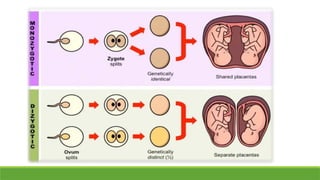
Dizygotic twins 80% (Syn: fraternal, binovular) result from fertilization of two
ova, most likely ruptured from two distinct Graafian follicles usually of the same
or one from each ovary, by two sperms during a single ovarian cycle. Their
subsequent implantation and development differ little from those of a single
fertilized ovum. The babies bear only fraternal resemblance to each other (that of
brothers and sisters from different births) and hence called fraternal twins.
In monozygotic (MZ) twins 20% (Syn: identical, uniovular), the twinning
(cleavage of fertilized ovum) may occur at different periods after fertilization and
this markedly influences the process of implantation and the formation of the fetal
membranes.
In Monozygotic Twin
On rare occasion, the following possibilities may occur:
 If the division takes place within 72 hours after fertilization the resulting embryos will
have two separate placenta, chorions and amnions (D/D)
 If the division takes place between the 4th and 8th day after the formation of inner cell
mass when chorion has already developed diamniotic mono chorionic twins develop
(D/M)- (diamniotic-monochorionic twin or D/M -66%)
 If division occurs after 8th days of fertilisation, when the amniotic cavity has already
developed-(monoamniotic-monochorionic or M/M -3%).
 If division takes place after 2weeks of the development of embryonic disc resulting in the
formation of conjoined twin (<1%) called Siamese twin.
ZYGOSITY
Zygosity refers to the genetic makeup of twin pregnancy.
DETERMINATION OF ZYGOSITY:
With the advent of organ transplantation, the identification of the zygosity of the
multiple foetuses has assumed much importance
♦ Examination of placenta and membranes:
Dizygotic twins:
(i) There are two placentae, either com- pletely separated or more commonly fused at
the mar- gin appearing to be one (9 out of 10). There is no anastomosis between the
two foetal vessels.

(ii) Each foetus is surrounded by a separate amnion and chorion.
(iii) As such, the intervening membranes consist of four layers-amnion, chorion,
chorion and amnion. In fact in early pregnancy the decidua capsularis of each sac
may be identified under the microscope in between the chorionic layers.
Monozygotic twins:
(i) The placenta is single. There is varying degree of free anastomosis between the two
foetal vessels.
(ii) Each foetus is surrounded by a separate amniotic sac with the chorionic layer
common to both in D/M.
(iii) As such the intervening membranes consist of two layers of amnion only.
However, on rare occasions, the uniovular twins may be D/D OR M/M
 Sex: while twins having opposite sex are almost always binovular and twins of the
same sex are not always uniovular but the uniovular twins are always of the same
sex.
 If the foetuses are of the same sex and have the same genetic features (dominant
blood groups), monozygosity is likely.
 A test skin graft: Acceptance of reciprocal skin graft-proof of monozygosity.
 DNA microprobe technique is more definitive.
 Follow-up study between 2-4 years showing almost similar physical and
behavioural features suggestive of monozygosity
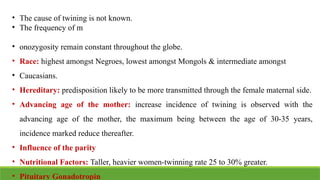
• The cause of twining is not known.
• The frequency of m
• onozygosity remain constant throughout the globe.
• Race: highest amongst Negroes, lowest amongst Mongols & intermediate amongst
• Caucasians.
• Hereditary: predisposition likely to be more transmitted through the female maternal side.
• Advancing age of the mother: increase incidence of twining is observed with the
advancing age of the mother, the maximum being between the age of 30-35 years,
incidence marked reduce thereafter.
• Influence of the parity
• Nutritional Factors: Taller, heavier women-twinning rate 25 to 30% greater.
• Pituitary Gonadotropin
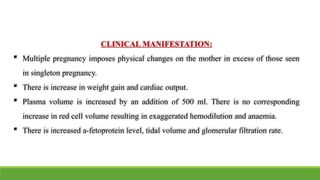
CLINICAL MANIFESTATION:
 Multiple pregnancy imposes physical changes on the mother in excess of those seen
in singleton pregnancy.
 There is increase in weight gain and cardiac output.
 Plasma volume is increased by an addition of 500 ml. There is no corresponding
increase in red cell volume resulting in exaggerated hemodilution and anaemia.
 There is increased a-fetoprotein level, tidal volume and glomerular filtration rate.
LIE AND PRESENTATION:
The most common lie of the foetuses is longitudinal (90%) but malpresentations are quite
common. The combination of presentation of the foetuses are
1. both vertex (50%),
2. first vertex and second breech (30%),
3. first breech and second vertex (10%),
4. both breech (10%),
5. first vertex and second transverse and so on,
but rarest one, being both transverse when the possibility of conjoined twins should be
ruled out.
HISTORY:
‣ H/O ovulation inducing drugs specially gonadotropins, for infertility or use of
ART.
‣ Family history of twining (more present in the maternal side).
SYMPTOM: some of the symptoms are related to undue enlargement of the uterus
‣ Increase nausea & vomiting in early months
‣ Cardiorespiratory embarrassment which is evident in the later months such as
palpitation or shortness of breath
‣ Tendency of swelling of the legs, varicose veins & haemorrhoids is greater
‣ Unusual rate of abdominal enlargement & excessive foetal movements may be
noticed by an experienced porous mother.
GENERAL EXAMINATION:
* Prevalence of anaemia is more
* Unusual weight gain, not preeclampsia or obesity
* Evidence of preeclampsia is common association.
ABDOMINAL EXAMINATION:
Inspection: Barrel shaped and the abdomen is unduly enlarged
Palpation:
* Height of uterus > period of amenorrhoea
* Girth of abdomen> normal average at term (100 cm)
* Foetal bulk disproportionately larger in relation to the size of the
* foetal head.
* Palpation of too many foetal parts
* Finding of two foetal heads or three foetal poles
Auscultation:
Two distinct FHS at separate spots, difference in heart rates is at least 10 beats/minute.
INTERNAL EXAM:
* In some cases, one hand is felt deep o the pelvis, while other hand is located by
abdominal examination.
* On occasions, the clinical methods fail to detect twins prior to the delivery of the baby.
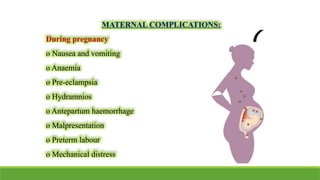
MATERNAL COMPLICATIONS:
During pregnancy
o Nausea and vomiting
o Anaemia
o Pre-eclampsia
o Hydramnios
o Antepartum haemorrhage
o Malpresentation
o Preterm labour
o Mechanical distress
During labour:
o Early rupture of membranes and cord prolapse
o Prolonged labour
o Increased operative interference Bleeding
o Postpartum haemorrhage
o During puerperium:
o Sub involution
o Infection
o Lactation failure
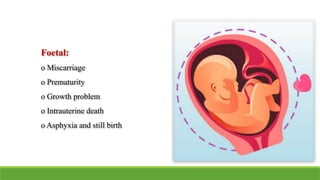
Foetal:
o Miscarriage
o Prematurity
o Growth problem
o Intrauterine death
o Asphyxia and still birth
• Maternal mortality: is increased in twins than in a singleton pregnancy. Death is
mostly due to haemorrhage (before, during & after delivery), preeclampsia &
anaemia. Increased maternal morbidity is due to the prevalence of complications &
increased operative interference.
• Perinatal mortality: is markedly increased mainly due to prematurity. It is 4-5
times higher than in a singleton pregnancy. It is extremely high in monoamniotic
monozygotic twins due to cord entanglement. One third loss is due to stillbirth & two
third due to neonatal death.
COMPLICATIONS OF
MONOCHORIONIC TWINS
 TWIN TWIN TRANSFUSION SYNDROME (TTTS)
 TWIN REVERSED ARTERIAL PERFUSION (TRAP)
 DEAD FETUS SYNDROME
 MONOAMNIOCITY
 CONJOINED TWIN
To reduce perinatal mortality and morbidity rates in pregnancies complicated by
twins, it is imperative that:
 Delivery of markedly preterm neonates be prevented
 Foetal-growth restriction be identified and afflicted foetuses be delivered
before they become moribund
 Foetal trauma during labour and delivery be avoided, and
 Expert neonatal care be available.
* Diet: increased requirement of calories, protein, minerals, vitamins, and essential fatty
acids. Caloric should be increased by another 300 kcal/day. Supplementation with 60 to 100
mg/day of iron and1 mg/day of folic acid.
* Interval of antenatal visit should be frequent to detect earliest, the evidence of its
complication
* Bed Rest:
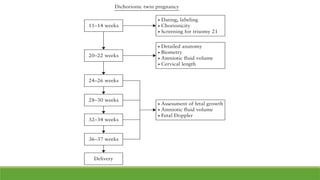
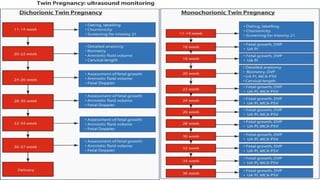
* Antepartum Surveillance: sonographic examinations
* Tests of Foetal Well-Being
* Prevention of Preterm Delivery
* Hospitalization
MANAGEMENT DURING LABOUR
 Place of delivery: in an equipped hospital with neonatal ICU facilities.
 Vaginal delivery is allowed when both twins are or at least the first twin vertex
presentation.
FIRST STAGE:
* A skilled obstetrician, presence of ultrasound machine and experienced anaesthetist
* Bed rest to prevent early rupture of membrane.
* Limit use of analgesic drugs
* Careful monitoring
* Internal examination soon after the rupture of membranes
* An intravenous line with ringer's solution
*Availability of one unit of compatible and cross matched blood
* Neonatologist: Present at the time of delivery.
DELIVERY OF THE FIRST BABY:
Same guideline as normal delivery. Usually the baby is small so not usually pose any
problem.
(i) Libaral episiotomy under L/A.
(ii) Forceps delivery: if needed, should be done preferably under pudendal block
anaesthesia.
(iii) Do not give intravenous ergometrine with delivery of the anterior shoulder of the first
baby (iv Clamp the cord at two places and cut it between.
(v) At least 8-10 cm cord is left behind for any drug administration or blood transfusion, if
required.
(vi)The baby is handed over to the nurse after labelling it as 1st baby or No. 1.
CONDUCTION OF LABOUR
AFTER DELIVERY OF 1ST BABY
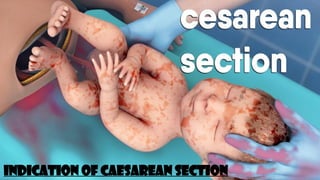
INDICATION OF CAESAREAN SECTION
Divided into two - obstetric cause & for twins
• Obstetric indication
1.Placenta Praevia
2.Severe preeclampsia
3.Previous caesarean section
4.Cord prolapse of 1st baby
5.Abnormal uterine contraction
6.Contracted pelvis.
For twins
1. Both the foetuses or 1st foetus with non-cephalic presentation
2.Twin with complications: IUGR, Conjoint twins,
3.Monoamniotic twins
4.Monochorionic twins with TTS
5.Collision of the heads at brim preventing engagement of either head.
1st baby breech and 2nd baby cephalic there will be locked twin or interlocking.
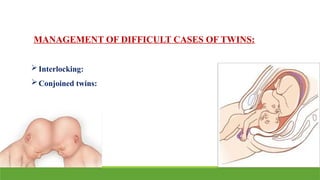
MANAGEMENT OF DIFFICULT CASES OF TWINS:
Interlocking:
Conjoined twins:
STATEMENT: Multiple Pregnancy among Deliveries in a Tertiary Care Center: A
Descriptive Cross-sectional Study
ABSTRACT-
Introduction:
Multiple pregnancy is associated with increased obstetric complications as well as poor
perinatal outcomes in developing countries because of the increased risk to both mother
and baby. So better understanding of the risk factors is required to improve the quality
of perinatal care. The aim of the study was to find out the prevalence of multiple
pregnancies among deliveries in a tertiary care centre
Methods:
A descriptive cross-sectional study was done among total deliveries in the Department of
Obstetrics and Gynaecology of a tertiary care centre from inpatient records starting from 15
August 2020 to 15 February 2021 after obtaining ethical approval from the Institutional
Review Committee (Reference number: 1208202005). Convenience sampling was done.
Point estimate and 95% Confidence Interval were calculated.
Results:
Out of 4400 deliveries, multiple pregnancy was seen in 35 (0.79%) (0.53-1.06, 95%
Confidence Interval).
Author- Bajagain Rupa et al.
Year- 2022
I prepared seminar on Multiple pregnancy. In this topic I discussed about
multiple pregnancy, definition, verities, genesis of twins, zygosity , difference
between monozygotic and dizygotic ,incidence ,etiology ,clinical
manifestations ,diagnosis ,Maternal and foetal complications , prognosis,
complications of monochorionic twins, antepartum management of twin
pregnancy, Indication of caesarean section and management of difficult cases of
twins
It is the presence of more than one foetus in the abdomen of the mother. Twin
pregnancy is the high risk one, maternal and perinatal morbidity and mortality
are significantly high compared to singletone pregnancy. Cerclage for women
with twin pregnancies: a systematic review and meta-analysis.
BOOK REFERENCE
1. Datta D.C. textbook of obstetrics: Multiple pregnancy. 9th
ed. jaypee brother’s medical publishers:2018.
2. Jacob Annamma. Comprehensive Textbook of Midwifery & Gynaecological Nursing.: Multiple
pregnancy. 5th ed. Jaypee Brothers Medical Publishers(P)Ltd, New Delhi India: 2018.
3. Sira Sanju. Midwifery and obstetrics: Multiple pregnancy. 1st
ed. lotus publishers:2020
4. Bhaskar Nima. Midwifery and Obstetrical Nursing: Multiple pregnancy.3rd
ed. Emmess publishers:2019:
5. Corton Marlene at el. Williams Obstetrics: Multiple pregnancy.24th
ed. McGraw Hill Education publishers
2014
6. Sharma. J.B. Textbook of obstetrics: Multiple pregnancy. 3rd
ed. Arya publishing company:2022.
7. Magon shally, sira sanju. Midwifery and obstetrics: 2023 ed. Lotus publishers:2023
8. Pati Suchismita. Midwifery /obstetrics & gynaecological nursing: Multiple pregnancy. Lotus
publishers:2024.
JOURNAL REFERENCE
1. Santana DS, Surita FG, Cecatti JG. Multiple Pregnancy: Epidemiology and Association with Maternal and Perinatal
Morbidity. Rev Bras Ginecol Obstet. 2018 Sep;40(9):554-562. doi: 10.1055/s-0038-1668117. Epub 2018 Sep
19. PMID: 30231294; PMCID: PMC10316907.
2. Bajagain R, Karki C, Mahato S, Saha R, Saha N. Multiple Pregnancy among Deliveries in a Tertiary Care
Center: A Descriptive Cross-sectional Study. JNMA J Nepal Med Assoc. 2022 Nov 2;60(255):927-930. doi:
10.31729/jnma.7897. PMID: 36705171; PMCID: PMC9795090.
NET REFERENCE
3. Zakwan fahad. 2015. Multiple pregnancy: https://www.slideshare.net/fahadzaq1/multiple-pregnancy-48053673
4. Dhakal prativa.2013. Multiple pregnancy: https://www.slideshare.net/Prativas/multiple-pregnancy-29181727
5. Wilson John Walter.2019. https://slideplayer.com/slide/13609525/
MULTIPLE PREGNANCY.pptx Shweta Singh M.Sc Nursing

MULTIPLE PREGNANCY.pptx Shweta Singh M.Sc Nursing

  • 2.
    MULTIPLE PREGNANCY PRESENTED BY MS.SHWETA SINGH M.SC NURSING II YEAR
  • 4.
    Globally multiple pregnanciespose challenges to the Obstetrician. This is mainly due to increased maternal and foetal complications both in developed and developing countries. There has been a widespread increase in multiple pregnancies in recent years mainly due to late childbearing age, use of ovulation-inducing drugs and Assisted reproductive techniques (ART). The worldwide incidence of multiple pregnancies varies considerably and it is around 2-20 per 1000 births.
  • 5.
    When more thanone foetus simultaneously developed in the uterus, it is called as multiple pregnancy. Simultaneous development of two foetuses (twins) is the commonest; although rare, development of three foetuses (triplets), four foetuses (quadruplets), five foetuses (quintuplets or six foetuses (sextuplets) may also occur.
  • 6.
    DEFINITION: When more thanone foetus simultaneously develops in the uterus then it is called multiple pregnancy. -D.C. Dutta
  • 7.
    TWINS PREGNANCY: VARIETIES: Dizygotictwins: is the commonest results from the fertilization of two ova. Monozygotic twins: (one-third) results from the fertilization of single ovum.
  • 8.
    Dizygotic twins 80%(Syn: fraternal, binovular) result from fertilization of two ova, most likely ruptured from two distinct Graafian follicles usually of the same or one from each ovary, by two sperms during a single ovarian cycle. Their subsequent implantation and development differ little from those of a single fertilized ovum. The babies bear only fraternal resemblance to each other (that of brothers and sisters from different births) and hence called fraternal twins.
  • 9.
    In monozygotic (MZ)twins 20% (Syn: identical, uniovular), the twinning (cleavage of fertilized ovum) may occur at different periods after fertilization and this markedly influences the process of implantation and the formation of the fetal membranes.
  • 10.
    In Monozygotic Twin Onrare occasion, the following possibilities may occur:  If the division takes place within 72 hours after fertilization the resulting embryos will have two separate placenta, chorions and amnions (D/D)  If the division takes place between the 4th and 8th day after the formation of inner cell mass when chorion has already developed diamniotic mono chorionic twins develop (D/M)- (diamniotic-monochorionic twin or D/M -66%)  If division occurs after 8th days of fertilisation, when the amniotic cavity has already developed-(monoamniotic-monochorionic or M/M -3%).  If division takes place after 2weeks of the development of embryonic disc resulting in the formation of conjoined twin (<1%) called Siamese twin.
  • 11.
    ZYGOSITY Zygosity refers tothe genetic makeup of twin pregnancy. DETERMINATION OF ZYGOSITY: With the advent of organ transplantation, the identification of the zygosity of the multiple foetuses has assumed much importance ♦ Examination of placenta and membranes:
  • 12.
    Dizygotic twins: (i) Thereare two placentae, either com- pletely separated or more commonly fused at the mar- gin appearing to be one (9 out of 10). There is no anastomosis between the two foetal vessels. (ii) Each foetus is surrounded by a separate amnion and chorion. (iii) As such, the intervening membranes consist of four layers-amnion, chorion, chorion and amnion. In fact in early pregnancy the decidua capsularis of each sac may be identified under the microscope in between the chorionic layers.
  • 13.
    Monozygotic twins: (i) Theplacenta is single. There is varying degree of free anastomosis between the two foetal vessels. (ii) Each foetus is surrounded by a separate amniotic sac with the chorionic layer common to both in D/M. (iii) As such the intervening membranes consist of two layers of amnion only. However, on rare occasions, the uniovular twins may be D/D OR M/M
  • 14.
     Sex: whiletwins having opposite sex are almost always binovular and twins of the same sex are not always uniovular but the uniovular twins are always of the same sex.  If the foetuses are of the same sex and have the same genetic features (dominant blood groups), monozygosity is likely.  A test skin graft: Acceptance of reciprocal skin graft-proof of monozygosity.  DNA microprobe technique is more definitive.  Follow-up study between 2-4 years showing almost similar physical and behavioural features suggestive of monozygosity
  • 18.
    • The causeof twining is not known. • The frequency of m • onozygosity remain constant throughout the globe. • Race: highest amongst Negroes, lowest amongst Mongols & intermediate amongst • Caucasians. • Hereditary: predisposition likely to be more transmitted through the female maternal side. • Advancing age of the mother: increase incidence of twining is observed with the advancing age of the mother, the maximum being between the age of 30-35 years, incidence marked reduce thereafter. • Influence of the parity • Nutritional Factors: Taller, heavier women-twinning rate 25 to 30% greater. • Pituitary Gonadotropin
  • 19.
    CLINICAL MANIFESTATION:  Multiplepregnancy imposes physical changes on the mother in excess of those seen in singleton pregnancy.  There is increase in weight gain and cardiac output.  Plasma volume is increased by an addition of 500 ml. There is no corresponding increase in red cell volume resulting in exaggerated hemodilution and anaemia.  There is increased a-fetoprotein level, tidal volume and glomerular filtration rate.
  • 20.
    LIE AND PRESENTATION: Themost common lie of the foetuses is longitudinal (90%) but malpresentations are quite common. The combination of presentation of the foetuses are 1. both vertex (50%), 2. first vertex and second breech (30%), 3. first breech and second vertex (10%), 4. both breech (10%), 5. first vertex and second transverse and so on, but rarest one, being both transverse when the possibility of conjoined twins should be ruled out.
  • 22.
    HISTORY: ‣ H/O ovulationinducing drugs specially gonadotropins, for infertility or use of ART. ‣ Family history of twining (more present in the maternal side).
  • 23.
    SYMPTOM: some ofthe symptoms are related to undue enlargement of the uterus ‣ Increase nausea & vomiting in early months ‣ Cardiorespiratory embarrassment which is evident in the later months such as palpitation or shortness of breath ‣ Tendency of swelling of the legs, varicose veins & haemorrhoids is greater ‣ Unusual rate of abdominal enlargement & excessive foetal movements may be noticed by an experienced porous mother.
  • 24.
    GENERAL EXAMINATION: * Prevalenceof anaemia is more * Unusual weight gain, not preeclampsia or obesity * Evidence of preeclampsia is common association.
  • 25.
    ABDOMINAL EXAMINATION: Inspection: Barrelshaped and the abdomen is unduly enlarged Palpation: * Height of uterus > period of amenorrhoea * Girth of abdomen> normal average at term (100 cm) * Foetal bulk disproportionately larger in relation to the size of the * foetal head. * Palpation of too many foetal parts * Finding of two foetal heads or three foetal poles
  • 26.
    Auscultation: Two distinct FHSat separate spots, difference in heart rates is at least 10 beats/minute. INTERNAL EXAM: * In some cases, one hand is felt deep o the pelvis, while other hand is located by abdominal examination. * On occasions, the clinical methods fail to detect twins prior to the delivery of the baby.
  • 30.
    MATERNAL COMPLICATIONS: During pregnancy oNausea and vomiting o Anaemia o Pre-eclampsia o Hydramnios o Antepartum haemorrhage o Malpresentation o Preterm labour o Mechanical distress
  • 31.
    During labour: o Earlyrupture of membranes and cord prolapse o Prolonged labour o Increased operative interference Bleeding o Postpartum haemorrhage o During puerperium: o Sub involution o Infection o Lactation failure
  • 32.
    Foetal: o Miscarriage o Prematurity oGrowth problem o Intrauterine death o Asphyxia and still birth
  • 34.
    • Maternal mortality:is increased in twins than in a singleton pregnancy. Death is mostly due to haemorrhage (before, during & after delivery), preeclampsia & anaemia. Increased maternal morbidity is due to the prevalence of complications & increased operative interference. • Perinatal mortality: is markedly increased mainly due to prematurity. It is 4-5 times higher than in a singleton pregnancy. It is extremely high in monoamniotic monozygotic twins due to cord entanglement. One third loss is due to stillbirth & two third due to neonatal death.
  • 35.
  • 36.
     TWIN TWINTRANSFUSION SYNDROME (TTTS)  TWIN REVERSED ARTERIAL PERFUSION (TRAP)  DEAD FETUS SYNDROME  MONOAMNIOCITY  CONJOINED TWIN
  • 38.
    To reduce perinatalmortality and morbidity rates in pregnancies complicated by twins, it is imperative that:  Delivery of markedly preterm neonates be prevented  Foetal-growth restriction be identified and afflicted foetuses be delivered before they become moribund  Foetal trauma during labour and delivery be avoided, and  Expert neonatal care be available.
  • 39.
    * Diet: increasedrequirement of calories, protein, minerals, vitamins, and essential fatty acids. Caloric should be increased by another 300 kcal/day. Supplementation with 60 to 100 mg/day of iron and1 mg/day of folic acid. * Interval of antenatal visit should be frequent to detect earliest, the evidence of its complication * Bed Rest: * Antepartum Surveillance: sonographic examinations * Tests of Foetal Well-Being * Prevention of Preterm Delivery * Hospitalization
  • 40.
    MANAGEMENT DURING LABOUR Place of delivery: in an equipped hospital with neonatal ICU facilities.  Vaginal delivery is allowed when both twins are or at least the first twin vertex presentation.
  • 41.
    FIRST STAGE: * Askilled obstetrician, presence of ultrasound machine and experienced anaesthetist * Bed rest to prevent early rupture of membrane. * Limit use of analgesic drugs * Careful monitoring * Internal examination soon after the rupture of membranes * An intravenous line with ringer's solution *Availability of one unit of compatible and cross matched blood * Neonatologist: Present at the time of delivery.
  • 42.
    DELIVERY OF THEFIRST BABY: Same guideline as normal delivery. Usually the baby is small so not usually pose any problem. (i) Libaral episiotomy under L/A. (ii) Forceps delivery: if needed, should be done preferably under pudendal block anaesthesia. (iii) Do not give intravenous ergometrine with delivery of the anterior shoulder of the first baby (iv Clamp the cord at two places and cut it between. (v) At least 8-10 cm cord is left behind for any drug administration or blood transfusion, if required. (vi)The baby is handed over to the nurse after labelling it as 1st baby or No. 1.
  • 43.
    CONDUCTION OF LABOUR AFTERDELIVERY OF 1ST BABY
  • 44.
  • 45.
    Divided into two- obstetric cause & for twins • Obstetric indication 1.Placenta Praevia 2.Severe preeclampsia 3.Previous caesarean section 4.Cord prolapse of 1st baby 5.Abnormal uterine contraction 6.Contracted pelvis.
  • 46.
    For twins 1. Boththe foetuses or 1st foetus with non-cephalic presentation 2.Twin with complications: IUGR, Conjoint twins, 3.Monoamniotic twins 4.Monochorionic twins with TTS 5.Collision of the heads at brim preventing engagement of either head. 1st baby breech and 2nd baby cephalic there will be locked twin or interlocking.
  • 47.
    MANAGEMENT OF DIFFICULTCASES OF TWINS: Interlocking: Conjoined twins:
  • 49.
    STATEMENT: Multiple Pregnancyamong Deliveries in a Tertiary Care Center: A Descriptive Cross-sectional Study ABSTRACT- Introduction: Multiple pregnancy is associated with increased obstetric complications as well as poor perinatal outcomes in developing countries because of the increased risk to both mother and baby. So better understanding of the risk factors is required to improve the quality of perinatal care. The aim of the study was to find out the prevalence of multiple pregnancies among deliveries in a tertiary care centre
  • 50.
    Methods: A descriptive cross-sectionalstudy was done among total deliveries in the Department of Obstetrics and Gynaecology of a tertiary care centre from inpatient records starting from 15 August 2020 to 15 February 2021 after obtaining ethical approval from the Institutional Review Committee (Reference number: 1208202005). Convenience sampling was done. Point estimate and 95% Confidence Interval were calculated. Results: Out of 4400 deliveries, multiple pregnancy was seen in 35 (0.79%) (0.53-1.06, 95% Confidence Interval). Author- Bajagain Rupa et al. Year- 2022
  • 52.
    I prepared seminaron Multiple pregnancy. In this topic I discussed about multiple pregnancy, definition, verities, genesis of twins, zygosity , difference between monozygotic and dizygotic ,incidence ,etiology ,clinical manifestations ,diagnosis ,Maternal and foetal complications , prognosis, complications of monochorionic twins, antepartum management of twin pregnancy, Indication of caesarean section and management of difficult cases of twins
  • 54.
    It is thepresence of more than one foetus in the abdomen of the mother. Twin pregnancy is the high risk one, maternal and perinatal morbidity and mortality are significantly high compared to singletone pregnancy. Cerclage for women with twin pregnancies: a systematic review and meta-analysis.
  • 56.
    BOOK REFERENCE 1. DattaD.C. textbook of obstetrics: Multiple pregnancy. 9th ed. jaypee brother’s medical publishers:2018. 2. Jacob Annamma. Comprehensive Textbook of Midwifery & Gynaecological Nursing.: Multiple pregnancy. 5th ed. Jaypee Brothers Medical Publishers(P)Ltd, New Delhi India: 2018. 3. Sira Sanju. Midwifery and obstetrics: Multiple pregnancy. 1st ed. lotus publishers:2020 4. Bhaskar Nima. Midwifery and Obstetrical Nursing: Multiple pregnancy.3rd ed. Emmess publishers:2019: 5. Corton Marlene at el. Williams Obstetrics: Multiple pregnancy.24th ed. McGraw Hill Education publishers 2014 6. Sharma. J.B. Textbook of obstetrics: Multiple pregnancy. 3rd ed. Arya publishing company:2022. 7. Magon shally, sira sanju. Midwifery and obstetrics: 2023 ed. Lotus publishers:2023 8. Pati Suchismita. Midwifery /obstetrics & gynaecological nursing: Multiple pregnancy. Lotus publishers:2024.
  • 57.
    JOURNAL REFERENCE 1. SantanaDS, Surita FG, Cecatti JG. Multiple Pregnancy: Epidemiology and Association with Maternal and Perinatal Morbidity. Rev Bras Ginecol Obstet. 2018 Sep;40(9):554-562. doi: 10.1055/s-0038-1668117. Epub 2018 Sep 19. PMID: 30231294; PMCID: PMC10316907. 2. Bajagain R, Karki C, Mahato S, Saha R, Saha N. Multiple Pregnancy among Deliveries in a Tertiary Care Center: A Descriptive Cross-sectional Study. JNMA J Nepal Med Assoc. 2022 Nov 2;60(255):927-930. doi: 10.31729/jnma.7897. PMID: 36705171; PMCID: PMC9795090. NET REFERENCE 3. Zakwan fahad. 2015. Multiple pregnancy: https://www.slideshare.net/fahadzaq1/multiple-pregnancy-48053673 4. Dhakal prativa.2013. Multiple pregnancy: https://www.slideshare.net/Prativas/multiple-pregnancy-29181727 5. Wilson John Walter.2019. https://slideplayer.com/slide/13609525/