MULTIPLE GESTATION
 Peggy Foster, RNC-OB, MSN
 Sandy Warner RNC-OB, MSN
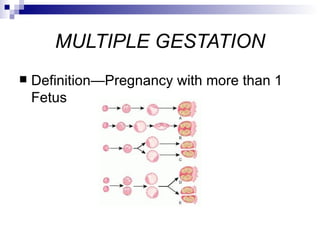
MULTIPLE GESTATION
   Definition—Pregnancy with more than 1
    Fetus
Diagnosis of multiple gestation
 Size greater than dates
 Greatly elevated hCG levels
 Elevated alpha-fetoprotein (MSAFP)
 More than one audible heart beat
 U/S confirmation
 ART
Multiple Gestation
   Twins are most common form of multiples

   Monozygotic twins - 25%
           One sperm and one ova
           “identical”
           Can separate into more than 2 (identical triplets etc)


   Dizygotic twins are majority
        Includes twins and higher order multiples
         “fraternal” or nonidentical

         Two ova and two sperm
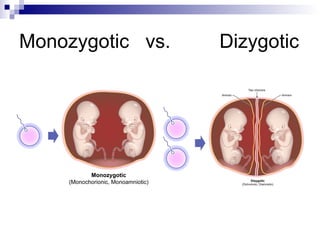
Monozygotic vs.   Dizygotic
Monozygotic vs. Dizygotic
 Amnion layer inside Chorion
 Dizygotic twins always have 2 amnions and 2
  chorions
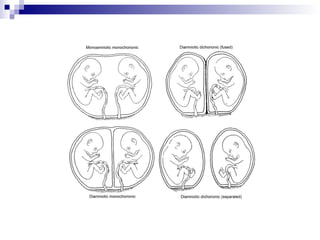
 Monozygotic twins can be

  Mono Chorionic - Mono Amnionic
  Mono Chorionic - Di Amnionic
  OR Di Amnionic - Di Chorionic
Associated factors for dizygotic
             twins
   ART (assisted reproductive technology)
   Age
   Ovarian follicicle stimulation
   Parity > 4
   Race—More common in Blacks—Less common
    in Oriental populations
   Family history
   Coital frequency
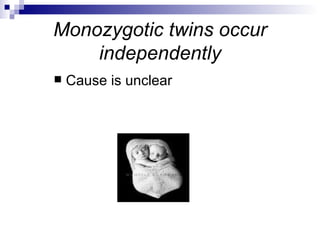
Monozygotic twins occur
    independently
   Cause is unclear
Monozygotic twins can be:
   Diamnionic/dichorionic—Occur<72 hours after
    conception
   Monochorionic/diamnionic (MOST !!)—Occur 3-7
    days after conception
   Conjoined twins >7 days after conception—
    incomplete separation of developing embryonic
    cell masses
   Monochorionic/monoamnionic –RARE !!
What we do know for Sure !!
 Different sex—always dizygous
 Different blood types—always dizygous
 If Monochorionic—always monozygous
Pregnancy Outcomes
 85% of multiple gestation mothers have
  antepartal complications—compared with
  only 32% of singleton pregnancies
 Perinatal morbidity and mortality is TWICE
  that of singleton pregnancies—In these
  women 4% of all maternal deaths are
  related to vascular problems
Antepartum complications with
          multiple gestation
   “Vanishing twins” may occur< 12 weeks
    gestation
   “Fetal Papyraceous” > 12 weeks
   ↑ Spontaneous abortions
   ↑ Nausea and Vomiting
   ↑ Anemia
   ↑ uterine size and ↑ placental hormones—
    explains minor discomforts of pregnancy—both
    chemically and pressure related
Antepartum complications cont.
   ↑ PIH (20% of twin pregnancies)
   ↑ Hydraminous (Polyhydraminous)
   ↑ Blood Volume 500 ml > than singleton
   ↑ Uterine size causes ↑ Vena Cava Syndrome
   ↑ SOB
   ↑ Varicosities, VTEs, PEs
   Cholestasis
Ante & Intrapartum complications
                    cont.
   ↑ Edema
   ↑ Placenta Previa and ↑ Abruption
   ↑ Labor dystocia—secondarily to an over-
    stretched myometrium-- ↑ PP Hemorrhage
   ↑ Preterm labor and deliveries (12 X that of
    Singleton pregnancies)
   ↑ Cesarean rates
   ↑ Emotional adjustments and stress on family
    relationships—both partner and siblings
Intrapartum complications

   Maternal                    Fetal
     Acute fatty liver           Cord accidents
     Difficulty of fetal
                                  Malpresentation
      monitoring
     Cardiac issues              Congenital anomalies


   ENVIRONMENTAL
      Availability of
       necessary equipment
      Availability of
       necessary personnel
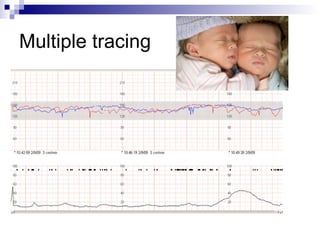
Multiple tracing
Postpartum Complications
   PPH
   Pulmonary edema
   Lack of bonding/breastfeeding
   Feelings of being overwhelmed
   Delayed return to normal activity if long periods
    of bed rest
   Fatigue
   Grief – acknowledging individuality
Risks to fetus (es)
   The 2 major causes of Neonatal M&M are:
    PREMATURITY AND IUGR—50% of twins
    weigh < 2500 gms at birth
   Monozygotic twins have 2-3 X PM&M rates as
    Dizygotic
   ↑ Congenital Anomalies 2-3 X that of Singletons
    and is more common in Monozygous twins
   Preterm Delivery is 5-10 X that of Singletons
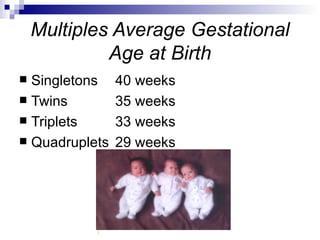
Multiples Average Gestational
             Age at Birth
 Singletons    40 weeks
 Twins         35 weeks
 Triplets      33 weeks
 Quadruplets   29 weeks
                Prevention: Don’t do this 
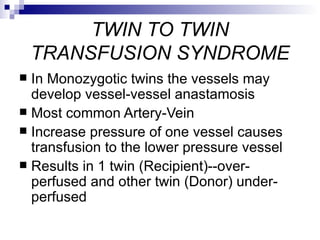
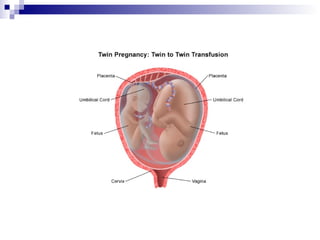
TWIN TO TWIN
    TRANSFUSION SYNDROME
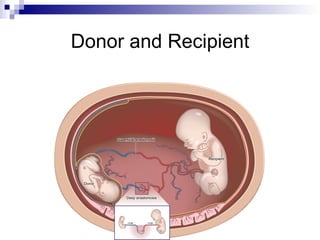
 In Monozygotic twins the vessels may
  develop vessel-vessel anastamosis
 Most common Artery-Vein
 Increase pressure of one vessel causes
  transfusion to the lower pressure vessel
 Results in 1 twin (Recipient)--over-
  perfused and other twin (Donor) under-
  perfused
Twin-Twin Transfusion cont’d
   Recipient develops:
    Polycythemia
    Hypervolemia
    Hypertension
    Enlarged Heart
    Increased Renal perfusion and excessive voiding
    Polyhydraminous
Twin-Twin Transfusion cont’d
   Donor develops:
    Hypovolemia
    Anemia
    Decreased Renal perfusion
    Oligohydramnious
    “Stuck twin”
Donor and Recipient
Common problems with Twins
   If twins share same sac
    (Monoamnion/Monochorion) is ↑ chance
    for Cord Entanglement
     Stillbirthrate ↑ to 50%
      These babies have ↑ developmental issues,
    ↓ IQ levels, and ↓ physical growth
   In all Multiple births there is ↑ Fetal
    distress and ↑ Cesarean deliveries
Goals for Care of Multiples
 Promote Normal Development of all
  fetuses
 Prevent Preterm Birth
 Decrease Fetal Trauma at Birth
 Support Mother’s needs throughout
  Pregnancy
Interventions
 Nutrition: ↑ Calories 300 > Singleton
 ↑ weight gain to 40-60 #
 ↑ Folic acid
 ↑ Iron 60-100 mg/day
 ↑ Protein from 40 to 74 gms/day
Interventions cont.
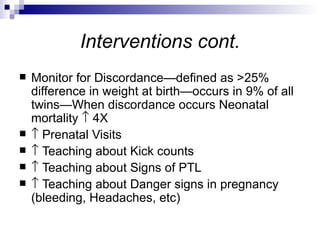
   Monitor for Discordance—defined as >25%
    difference in weight at birth—occurs in 9% of all
    twins—When discordance occurs Neonatal
    mortality ↑ 4X
   ↑ Prenatal Visits
   ↑ Teaching about Kick counts
   ↑ Teaching about Signs of PTL
   ↑ Teaching about Danger signs in pregnancy
    (bleeding, Headaches, etc)
Interventions cont.
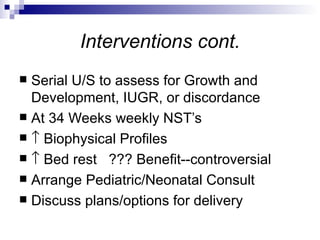
 Serial U/S to assess for Growth and
  Development, IUGR, or discordance
 At 34 Weeks weekly NST’s
 ↑ Biophysical Profiles
 ↑ Bed rest ??? Benefit--controversial
 Arrange Pediatric/Neonatal Consult
 Discuss plans/options for delivery
Interventions cont.
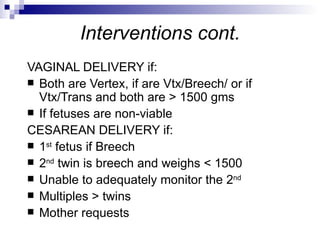
VAGINAL DELIVERY if:
 Both are Vertex, if are Vtx/Breech/ or if
  Vtx/Trans and both are > 1500 gms
 If fetuses are non-viable
CESAREAN DELIVERY if:
 1st fetus if Breech
 2nd twin is breech and weighs < 1500
 Unable to adequately monitor the 2nd
 Multiples > twins
 Mother requests
NURSING IMPLICATIONS
   Antepartum
     Emotional    support of woman and significant
     others

     Teaching


     Monitoring   each fetus
NURSING IMPLICATIONS--IP
   INTRAPARTUM
       IV
       Type and Screen

       Monitoring

       Anesthesia always present and aware

       SCN/NICU/Neonatology aware

       Staffing to accommodate labor/Cesarean and

        Neonatal outcomes
NURSING IMPLICATIONS--PP
Postpartum
Mom prone to PP hemorrhage
Many changes in Body systems back to Non-
 pregnant state
Emotional changes—weary—
 Needs ↑ Sleep
Humans are Monotropic—difficult to bond with 2
 people at same time
Moms focus on concrete factors
NURSING PP cont’d
 May feel overwhelmed
 Feeding and Caring for 2 (+)
 Assistance with Breastfeeding
 Shock/Inadequacy/Guilt/Sadness
NURSING NEONATAL
   ↑ Birth Trauma
   ↑ Hyperbilirubinemia
   ↑ Respiratory problems
   Size Discrepancy
   Rx infections
   Effect of tocolytics given to mother
   ↑ Nutritional needs
   ↑Bonding needs of entire family
   ↑ Risks for Late Preterm infant
References
   AWHONN (2009) POEP

   Gilbert, E. S., (2011) 5th edition Manual of
    High Risk Pregnancy and Delivery.

   Mattson, S. & Smith, J.E., (2011) 4th
    edition Core Curriculum for Maternal-
    Newborn Nursing.

Wiki.multiples for review class 2011

  • 1.
    MULTIPLE GESTATION PeggyFoster, RNC-OB, MSN Sandy Warner RNC-OB, MSN
  • 2.
    MULTIPLE GESTATION  Definition—Pregnancy with more than 1 Fetus
  • 3.
    Diagnosis of multiplegestation  Size greater than dates  Greatly elevated hCG levels  Elevated alpha-fetoprotein (MSAFP)  More than one audible heart beat  U/S confirmation  ART
  • 4.
    Multiple Gestation  Twins are most common form of multiples  Monozygotic twins - 25%  One sperm and one ova  “identical”  Can separate into more than 2 (identical triplets etc)  Dizygotic twins are majority Includes twins and higher order multiples  “fraternal” or nonidentical  Two ova and two sperm
  • 5.
  • 6.
    Monozygotic vs. Dizygotic Amnion layer inside Chorion  Dizygotic twins always have 2 amnions and 2 chorions  Monozygotic twins can be Mono Chorionic - Mono Amnionic Mono Chorionic - Di Amnionic OR Di Amnionic - Di Chorionic
  • 8.
    Associated factors fordizygotic twins  ART (assisted reproductive technology)  Age  Ovarian follicicle stimulation  Parity > 4  Race—More common in Blacks—Less common in Oriental populations  Family history  Coital frequency
  • 9.
    Monozygotic twins occur independently  Cause is unclear
  • 10.
    Monozygotic twins canbe:  Diamnionic/dichorionic—Occur<72 hours after conception  Monochorionic/diamnionic (MOST !!)—Occur 3-7 days after conception  Conjoined twins >7 days after conception— incomplete separation of developing embryonic cell masses  Monochorionic/monoamnionic –RARE !!
  • 11.
    What we doknow for Sure !!  Different sex—always dizygous  Different blood types—always dizygous  If Monochorionic—always monozygous
  • 12.
    Pregnancy Outcomes  85%of multiple gestation mothers have antepartal complications—compared with only 32% of singleton pregnancies  Perinatal morbidity and mortality is TWICE that of singleton pregnancies—In these women 4% of all maternal deaths are related to vascular problems
  • 13.
    Antepartum complications with multiple gestation  “Vanishing twins” may occur< 12 weeks gestation  “Fetal Papyraceous” > 12 weeks  ↑ Spontaneous abortions  ↑ Nausea and Vomiting  ↑ Anemia  ↑ uterine size and ↑ placental hormones— explains minor discomforts of pregnancy—both chemically and pressure related
  • 14.
    Antepartum complications cont.  ↑ PIH (20% of twin pregnancies)  ↑ Hydraminous (Polyhydraminous)  ↑ Blood Volume 500 ml > than singleton  ↑ Uterine size causes ↑ Vena Cava Syndrome  ↑ SOB  ↑ Varicosities, VTEs, PEs  Cholestasis
  • 15.
    Ante & Intrapartumcomplications cont.  ↑ Edema  ↑ Placenta Previa and ↑ Abruption  ↑ Labor dystocia—secondarily to an over- stretched myometrium-- ↑ PP Hemorrhage  ↑ Preterm labor and deliveries (12 X that of Singleton pregnancies)  ↑ Cesarean rates  ↑ Emotional adjustments and stress on family relationships—both partner and siblings
  • 16.
    Intrapartum complications  Maternal  Fetal  Acute fatty liver  Cord accidents  Difficulty of fetal  Malpresentation monitoring  Cardiac issues  Congenital anomalies  ENVIRONMENTAL  Availability of necessary equipment  Availability of necessary personnel
  • 17.
  • 18.
    Postpartum Complications  PPH  Pulmonary edema  Lack of bonding/breastfeeding  Feelings of being overwhelmed  Delayed return to normal activity if long periods of bed rest  Fatigue  Grief – acknowledging individuality
  • 19.
    Risks to fetus(es)  The 2 major causes of Neonatal M&M are: PREMATURITY AND IUGR—50% of twins weigh < 2500 gms at birth  Monozygotic twins have 2-3 X PM&M rates as Dizygotic  ↑ Congenital Anomalies 2-3 X that of Singletons and is more common in Monozygous twins  Preterm Delivery is 5-10 X that of Singletons
  • 20.
    Multiples Average Gestational Age at Birth  Singletons 40 weeks  Twins 35 weeks  Triplets 33 weeks  Quadruplets 29 weeks Prevention: Don’t do this 
  • 21.
    TWIN TO TWIN TRANSFUSION SYNDROME  In Monozygotic twins the vessels may develop vessel-vessel anastamosis  Most common Artery-Vein  Increase pressure of one vessel causes transfusion to the lower pressure vessel  Results in 1 twin (Recipient)--over- perfused and other twin (Donor) under- perfused
  • 23.
    Twin-Twin Transfusion cont’d  Recipient develops: Polycythemia Hypervolemia Hypertension Enlarged Heart Increased Renal perfusion and excessive voiding Polyhydraminous
  • 24.
    Twin-Twin Transfusion cont’d  Donor develops: Hypovolemia Anemia Decreased Renal perfusion Oligohydramnious “Stuck twin”
  • 25.
  • 26.
    Common problems withTwins  If twins share same sac (Monoamnion/Monochorion) is ↑ chance for Cord Entanglement  Stillbirthrate ↑ to 50%  These babies have ↑ developmental issues, ↓ IQ levels, and ↓ physical growth  In all Multiple births there is ↑ Fetal distress and ↑ Cesarean deliveries
  • 27.
    Goals for Careof Multiples  Promote Normal Development of all fetuses  Prevent Preterm Birth  Decrease Fetal Trauma at Birth  Support Mother’s needs throughout Pregnancy
  • 28.
    Interventions  Nutrition: ↑Calories 300 > Singleton  ↑ weight gain to 40-60 #  ↑ Folic acid  ↑ Iron 60-100 mg/day  ↑ Protein from 40 to 74 gms/day
  • 29.
    Interventions cont.  Monitor for Discordance—defined as >25% difference in weight at birth—occurs in 9% of all twins—When discordance occurs Neonatal mortality ↑ 4X  ↑ Prenatal Visits  ↑ Teaching about Kick counts  ↑ Teaching about Signs of PTL  ↑ Teaching about Danger signs in pregnancy (bleeding, Headaches, etc)
  • 30.
    Interventions cont.  SerialU/S to assess for Growth and Development, IUGR, or discordance  At 34 Weeks weekly NST’s  ↑ Biophysical Profiles  ↑ Bed rest ??? Benefit--controversial  Arrange Pediatric/Neonatal Consult  Discuss plans/options for delivery
  • 31.
    Interventions cont. VAGINAL DELIVERYif:  Both are Vertex, if are Vtx/Breech/ or if Vtx/Trans and both are > 1500 gms  If fetuses are non-viable CESAREAN DELIVERY if:  1st fetus if Breech  2nd twin is breech and weighs < 1500  Unable to adequately monitor the 2nd  Multiples > twins  Mother requests
  • 32.
    NURSING IMPLICATIONS  Antepartum  Emotional support of woman and significant others  Teaching  Monitoring each fetus
  • 33.
    NURSING IMPLICATIONS--IP  INTRAPARTUM  IV  Type and Screen  Monitoring  Anesthesia always present and aware  SCN/NICU/Neonatology aware  Staffing to accommodate labor/Cesarean and Neonatal outcomes
  • 34.
    NURSING IMPLICATIONS--PP Postpartum Mom proneto PP hemorrhage Many changes in Body systems back to Non- pregnant state Emotional changes—weary— Needs ↑ Sleep Humans are Monotropic—difficult to bond with 2 people at same time Moms focus on concrete factors
  • 35.
    NURSING PP cont’d May feel overwhelmed  Feeding and Caring for 2 (+)  Assistance with Breastfeeding  Shock/Inadequacy/Guilt/Sadness
  • 36.
    NURSING NEONATAL  ↑ Birth Trauma  ↑ Hyperbilirubinemia  ↑ Respiratory problems  Size Discrepancy  Rx infections  Effect of tocolytics given to mother  ↑ Nutritional needs  ↑Bonding needs of entire family  ↑ Risks for Late Preterm infant
  • 37.
    References  AWHONN (2009) POEP  Gilbert, E. S., (2011) 5th edition Manual of High Risk Pregnancy and Delivery.  Mattson, S. & Smith, J.E., (2011) 4th edition Core Curriculum for Maternal- Newborn Nursing.

Editor's Notes

  • #4 Increased nausea due to hormones
  • #7 Sometimes tell by u/s – often placental pathology
  • #9 Ovarian follicicles stimulated by drugs, not necessarily ART
  • #11 Monoamniotic twins are delivered at 32 wks to prevent cord entanglement
  • #14 Papyraceous – rare condition where one fetus dies, atrophies and mummifies - very unusual
  • #15 Pulmonary edema Gallbladder due to increased progesterone
  • #16 Emotional/social isolation if on hospitalized bed rest, especially during flu season
  • #17 Increased progesterone - cholestasis
  • #18 Synchronous FHR patterns – hard to distinguish b/w fetus –may need to get U/S to distinguish Asychronous patterns – able to tell
  • #22 Threatens fetal life and maternal well being. Almost always in pregnancies with one placenta/2 amniotic sacs. Mortality rates as high as 80-100% if untreated (Cromblehome and Harkness – 05). Numerous theories as to why it occurs, but no definitive answer (renin – angiotension and brain peptides all areas of current study).
  • #25 Stuck when no urine visible in donor twin’s bladder. Amniotic sac appears on U/S to be adhered to fetus, leaving no room for movement. Centers that perform various treatments: amnioreduction – most common; amniotic septosomy (perforation of intertwin membrane so fluid volumes equal); fetal laser coagulation of vascular anastomoses; finally fetoscopic cord coagulation occludes umbilical cord of twin with severe cardiomyopathy who had no chance of survival. Any of these methods can cause fetal death of both.
  • #27 Monoamniotic twins usually hsopitalized and monitored TID. Challenge to monitor. Delivery at 32 wks – ACOG recommendation
  • #28 Emotional/social needs with hospitalization. Importance of support groups. TriState multiple and Mothers of Twins clubs
  • #29 In order to support normal growth of fetus. Supplements. Increased risk of GDM due to multiple placentas secreting HPL and other insulin antagonistic hormones. Small frequent meals.
  • #33 Social needs and networking with other multiple moms Don’t rub abdomen – stimulate ctxs