Protocol for management of
Multiple pregnancy
Aboubakr Elnashar
Benha university Hospital, Egypt
Sources:
SOGC, 2011
NICE, 2012
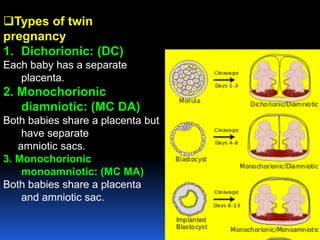
Types of twin
pregnancy
1. Dichorionic: (DC)
Each baby has a separate
placenta.
2. Monochorionic
diamniotic: (MC DA)
Both babies share a placenta but
have separate
amniotic sacs.
3. Monochorionic
monoamniotic: (MC MA)
Both babies share a placenta
and amniotic sac.
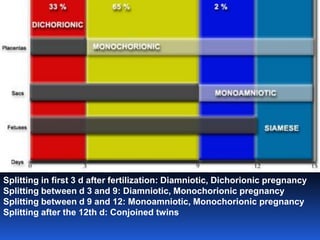
Splitting in first 3 d after fertilization: Diamniotic, Dichorionic pregnancy
Splitting between d 3 and 9: Diamniotic, Monochorionic pregnancy
Splitting between d 9 and 12: Monoamniotic, Monochorionic pregnancy
Splitting after the 12th d: Conjoined twins
Types of triplet pregnancy
1. Trichorionic:
Each baby has a separate placenta and amniotic sac.
2. Dichorionic triamniotic:
One baby has a separate placenta and two of the babies
share a placenta. All three babies have separate amniotic
sacs.
3. Dichorionic diamniotic:
One baby has a separate placenta and amniotic sac and
two of the babies share a placenta and amniotic sac.
4. Monochorionic triamniotic:
All three babies share one placenta but each has its own
amniotic sac.
5. Monochorionic diamniotic:
All three babies share one placenta. One baby has a
separate amniotic sac and two babies share one sac.
6. Monochorionic monoamniotic:
All three babies share a placenta and amniotic sac.
A. Antenatal
I. Determining g age and chorionicity
II. ANC
III.Fetal complications: screening
IV.Maternal complications: screening
V. PTL: prediction and prevention
VI.Indications for referral to fetal medicine
centre
B. Delivery
I. Timing of delivery
II. Mode of delivery
III. Vaginal delivery
IV. CS
I. Determining g age and chorionicity
US:
when CRL: 45 mm to 84 mm (11-14 W)
A. Estimate g age
B. Determine chorionicity
C. Screen for Down's syndrome
 Use the largest baby to estimate g age
{avoid the risk of estimating it from a baby with
early growth pathology}.
When twin pregnancy is the result of IVF,
accurate determination of gestational age should
be made from the date of ET. (II-1A)
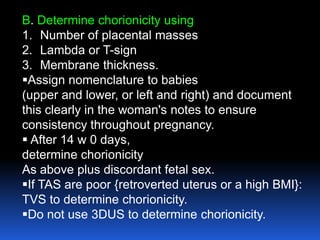
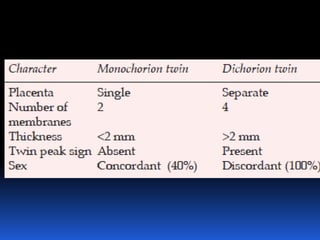
B. Determine chorionicity using
1. Number of placental masses
2. Lambda or T-sign
3. Membrane thickness.
Assign nomenclature to babies
(upper and lower, or left and right) and document
this clearly in the woman's notes to ensure
consistency throughout pregnancy.
 After 14 w 0 days,
determine chorionicity
As above plus discordant fetal sex.
If TAS are poor {retroverted uterus or a high BMI}:
TVS to determine chorionicity.
Do not use 3DUS to determine chorionicity.
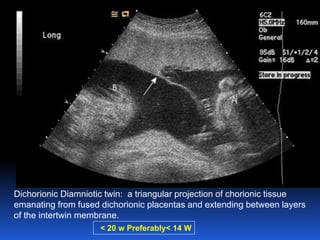
Dichorionic Diamniotic twin: a triangular projection of chorionic tissue
emanating from fused dichorionic placentas and extending between layers
of the intertwin membrane.
< 20 w Preferably< 14 W
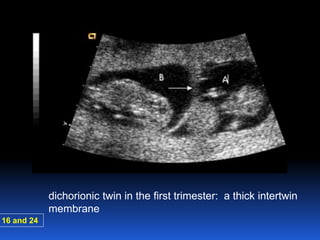
dichorionic twin in the first trimester: a thick intertwin
membrane
16 and 24
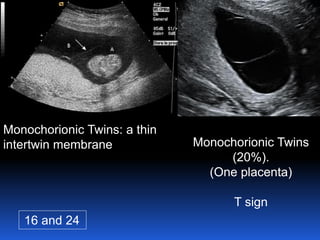
Monochorionic Twins: a thin
intertwin membrane
16 and 24
Monochorionic Twins
(20%).
(One placenta)
T sign
II. ANC
Multidisciplinary team:
1. Specialist obstetricians
2. Ultrasonographers
3. Foetal medicine Referrals center
1. Information and emotional support
Explain aims and possible outcomes of all
(screening and diagnostic) tests {minimise anxiety}.
2. Diet, lifestyle and nutritional supplements
Same as in routine ANC.
Higher incidence of anaemia
CBC
At 20–24 w {identify who need early
supplementation with iron or folic acid
At 28 w: as in routine ANC
3. Frequent AN visits combined with US
First
CRL measures from 45 mm to 84 mm (11- 14 w)
MC: every 2 to 3 w, starting at 16 w
DC: every 3 to 4 w, starting from the anatomy
scan (18 to 22 weeks) (II-1)
III. Fetal complications
Information about screening
Before and after every screening test.
.
1. Screening for Down's syndrome
2. Screening for structural abnormalities
3. Screening for feto-fetal transfusion syndrome
4. Screening for IUGR
1. Screening for Down's syndrome
Why: {greater likelihood of Down's syndrome in
twin and triplet pregnancies}
When
CRL measures from 45 mm to 84 mm (11-14 W)
How:
Map the fetal positions
Use the combined screening test:
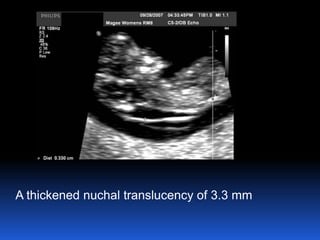
 Nuchal translucency
 ßHCG,
 Pregnancy-associated plasma protein-A
(PAPPA)
calculate the risk of Down's syndrome
A thickened nuchal translucency of 3.3 mm
2. Screening for structural abnormalities
Cardiac abnormalities
between 18 and 22 w (II-2B)
45 minutes for the anomaly scan
3. Monitoring for feto-fetal transfusion
syndrome
Start diagnostic monitoring at 16w.
Repeat monitoring fortnightly until 24 w.
Weekly monitoring if
intertwin membrane infolding or
amniotic fluid discordance
Incidence:
15% of MC
Pathology:
In MC placenta: vascular anastamoses.
Superficial and deep.
1) arterioarterial (AA)
2) arteriovenous (AV), or
3) venovenous (VV).
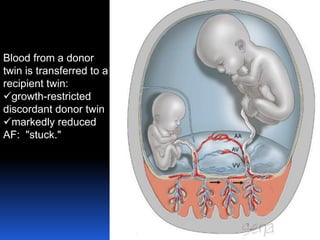
Blood from a donor
twin is transferred to a
recipient twin:
growth-restricted
discordant donor twin
markedly reduced
AF: "stuck."
Diagnosis
Early
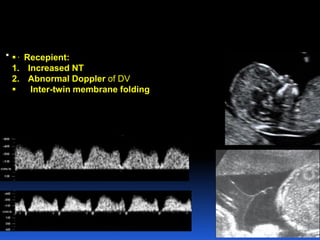
1. Recipient:
Increased nuchal translucency
Abnormal Doppler of DV
2. Folding of intertwin membrane can at 16w.
Late:
1. Recient:
 Polyhydramnios
 An enlarged fetal bladder
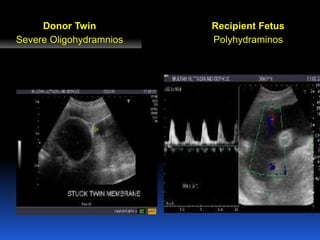
2. Donor:
 oligohydramnios
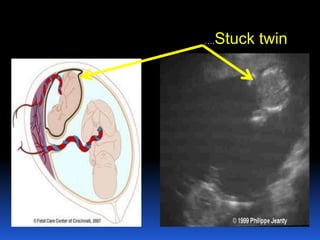
Severe oligohydramnios: amniotic membrane is closely
applied to the fetus, which lies apposed to the uterine wall
(stuck twin).
bladder can be barely visible
 . Recepient:
1. Increased NT
2. Abnormal Doppler of DV
 Inter-twin membrane folding
Donor Twin
Severe Oligohydramnios
Recipient Fetus
Polyhydraminos
….Stuck twin
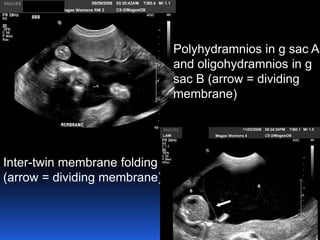
Inter-twin membrane folding
(arrow = dividing membrane)
Polyhydramnios in g sac A
and oligohydramnios in g
sac B (arrow = dividing
membrane)
4. Monitoring for IUGR
Growth curves
As Singleton
30 min for growth scans
Start at 20 w
undertake scans at intervals of less 4w.
Estimate f Wt discordance using two or more
biometric parameters
Growth discordance: either
Difference (20 mm) in AC or
Difference of 20% EFW. (II-2)
Consider a 25% or greater difference in size between twins or triplets
as a clinically important indicator of IUGR
AFV:
deepest vertical pocket
oligohydramnios when < 2 cm
polyhydramnios when > 8 cm. (II-2B)
Umbilical artery Doppler
should not be routinely offered in uncomplicated
twin pregnancies. (I-E)
Do not use umbilical artery Doppler US to monitor for IUGR or birth weight differences in twin or triplet pregnancies.
Umbilical artery Doppler may be useful in the surveillance of twin gestations when there are complications involving
the placental circulation or fetal hemodynamic physiology. (II-2)
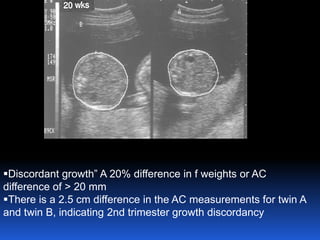
Discordant growth” A 20% difference in f weights or AC
difference of > 20 mm
There is a 2.5 cm difference in the AC measurements for twin A
and twin B, indicating 2nd trimester growth discordancy
IV. Maternal complications
Hypertension
1. Measure BP and test urine for proteinuria
{screen for hypertensive disorders} at each ANV
2. 75 mg of aspirin daily from 12 w until the birth of
the babies if they have one or more of the following
risk factors for hypertension:
first pregnancy
age 40 years or older
pregnancy interval of more than 10 y
BMI of 35 kg/m2 or more at first visit
family history of PET.
V. Preterm birth
1. Prediction
women with twin pregnancies have a higher risk of
PTL if they have had PTL in a previous singleton
pregnancy.
Do not use cervical length (with or without fetal
fibronectin) routinely to predict the risk
2. Prevention
Do not use the following interventions (alone or in
combination) :
bed rest at home or in hospital
IM or vaginal progesterone
cervical cerclage
oral tocolytics.
3. Untargeted corticosteroids
Do not use single or multiple untargeted (routine)
courses of corticosteroids
{no benefit in using untargeted administration of
corticosteroids}.
VI. Indications for referral to a tertiary level fetal
medicine centre
1. MC MA twin pregnancies
2. MC MA triplet pregnancies
3. MC DA triplet pregnancies
4. DC DA triplet pregnancies
5. Pregnancies complicated by any of the
following:
A. discordant fetal growth
B. fetal anomaly
C. discordant fetal death
D. feto-fetal transfusion syndrome.
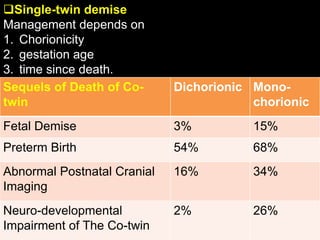
Mono-
chorionic
DichorionicSequels of Death of Co-
twin
15%3%Fetal Demise
68%54%Preterm Birth
34%16%Abnormal Postnatal Cranial
Imaging
26%2%Neuro-developmental
Impairment of The Co-twin
Single-twin demise
Management depends on
1. Chorionicity
2. gestation age
3. time since death.
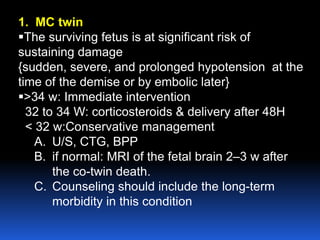
1. MC twin
The surviving fetus is at significant risk of
sustaining damage
{sudden, severe, and prolonged hypotension at the
time of the demise or by embolic later}
>34 w: Immediate intervention
32 to 34 W: corticosteroids & delivery after 48H
< 32 w:Conservative management
A. U/S, CTG, BPP
B. if normal: MRI of the fetal brain 2–3 w after
the co-twin death.
C. Counseling should include the long-term
morbidity in this condition
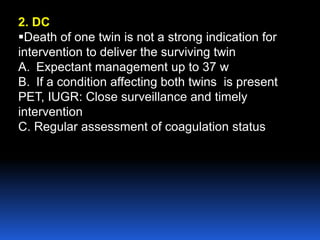
2. DC
Death of one twin is not a strong indication for
intervention to deliver the surviving twin
A. Expectant management up to 37 w
B. If a condition affecting both twins is present
PET, IUGR: Close surveillance and timely
intervention
C. Regular assessment of coagulation status
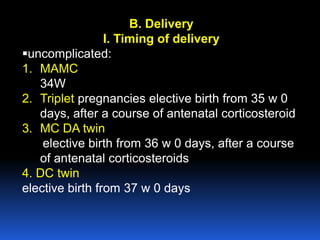
B. Delivery
I. Timing of delivery
uncomplicated:
1. MAMC
34W
2. Triplet pregnancies elective birth from 35 w 0
days, after a course of antenatal corticosteroid
3. MC DA twin
elective birth from 36 w 0 days, after a course
of antenatal corticosteroids
4. DC twin
elective birth from 37 w 0 days
For women who decline elective birth
weekly appointments
US: weekly
FBP
fetal growth scans: fortnightly
II. The mode of delivery
1. Triplet:
CS
2. MCMA twins:
CS
3. DC twins:
Very low birth weight infant (1500 g):
CS
 Prerequisites for vaginal delivery
continuous intrapartum monitoring
appropriate analgesia
an obstetrician experienced in twin delivery
Presentation of the first twin.
A. Vertex-vertex:
Vaginal delivery .
B. 2nd non-vertex:
The optimal mode is unknown with retrospective
reviews providing support for both CS and vaginal
birth
Indications for CS:
1. Non vertex1st twin (23%) {high-risk of cord complication
and thus foetal demise}
2. IUGR in dichorionic twins
3. Twin 2 significantly larger (> 500 gm) than twin 1
4. Antepartum death of 1st twin
5. Placenta praevia
6. Foetal abnormality precluding safe vaginal delivery
7. Chronic TTTS in monochorionic twins
8. Monoamniotic twins
9. Monochorionic twins
Controversial Indications for CS
1. Maternal request
2. Unfavourable cervix at 39 w in nulliparas
3. Death of 2nd twin
4. Non vertex 2nd twin
5. Previous CS.
III. Vaginal delivery
Admission:
Inform obstetric consultant
First stage:
Labour conducted as for a singleton continuous
CTG monitoring in active labour (>4cm).
If there is any doubt about the validity of the
recording or difficulty picking up one of the twins:
US for viability
IVF access
blood sent for CBC/G&SAVE.
The anaesthetic registrar
N.I.C.U. should be aware of the admission.
Second stage:
1. Delivery must be attended by
Obstetric Consultant
Neonatal team
Anaesthetic Registrar
Operating department assistant should also be
immediately available.
2. Both fetal hearts should be electronically
monitored continuously
3. Syntocinon infusion should be made ready for
use after the first twin has delivered, to be used at
the discretion of the consultant
[20 units added to 500ml NS at 30ml/h – i.e.20 milliunits
/min.]
4. Delivery of the second twin
Perform an abdominal palpation and vaginal
examination immediately after delivery of twin one
Confirm fetal presentation by US
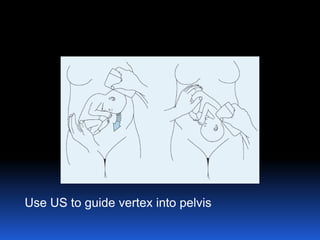
An assistant to compress the uterus in its long
axis between his or her hands, to encourage a
longitudinal lie in the second twin.
Monitor the FHR of twin two continuously
Perform ARM when clinically appropriate
Aim to deliver the second twin within 30 min
Use US to guide vertex into pelvis
THIRD STAGE:
{significant risk of PPH}
syntocinon and methrgin to be given according to
protocol following delivery of the second twin.
A syntocinon infusion of 20 units in 500ml NS
immediately after the birth of the second twin, and
given at a rate of 120ml/h
[i.e.80 milliunits/minute] for 2-3 h.
IV. Cesarean Delivery
1.Position:
Left lateral tilt {deflect uterine wt off the aorta
Hypotension commonly develops in women
carrying twins when they are placed supine}.
2. The uterine incision:
A. large enough to allow atraumatic delivery of
both fetuses.
B. Vertical in the lower uterine segment.
-fetus is transverse with its back down, and the
arms are inadvertently delivered first,
3. If 2nd twin is breech and delivery of the head is
obstructed
Piper forceps can be used just as for a vag delivery
4. CS of 2nd twin
Attempts to deliver 2nd twin vaginally after delivery
of 1st twin are not only unwise but also impossible
1. Second fetus is much larger than the first and is
breech or transverse
2. Cervix promptly contracts and thickens after
delivery of the first twin and does not dilate
subsequently
3. Non-reassuring FHR pattern develops.
Thank you

Multiple pregnancy: Aboubakr Elnashar

  • 1.
    Protocol for managementof Multiple pregnancy Aboubakr Elnashar Benha university Hospital, Egypt
  • 2.
  • 3.
    Types of twin pregnancy 1.Dichorionic: (DC) Each baby has a separate placenta. 2. Monochorionic diamniotic: (MC DA) Both babies share a placenta but have separate amniotic sacs. 3. Monochorionic monoamniotic: (MC MA) Both babies share a placenta and amniotic sac.
  • 4.
    Splitting in first3 d after fertilization: Diamniotic, Dichorionic pregnancy Splitting between d 3 and 9: Diamniotic, Monochorionic pregnancy Splitting between d 9 and 12: Monoamniotic, Monochorionic pregnancy Splitting after the 12th d: Conjoined twins
  • 5.
    Types of tripletpregnancy 1. Trichorionic: Each baby has a separate placenta and amniotic sac. 2. Dichorionic triamniotic: One baby has a separate placenta and two of the babies share a placenta. All three babies have separate amniotic sacs. 3. Dichorionic diamniotic: One baby has a separate placenta and amniotic sac and two of the babies share a placenta and amniotic sac. 4. Monochorionic triamniotic: All three babies share one placenta but each has its own amniotic sac. 5. Monochorionic diamniotic: All three babies share one placenta. One baby has a separate amniotic sac and two babies share one sac. 6. Monochorionic monoamniotic: All three babies share a placenta and amniotic sac.
  • 6.
    A. Antenatal I. Determiningg age and chorionicity II. ANC III.Fetal complications: screening IV.Maternal complications: screening V. PTL: prediction and prevention VI.Indications for referral to fetal medicine centre B. Delivery I. Timing of delivery II. Mode of delivery III. Vaginal delivery IV. CS
  • 7.
    I. Determining gage and chorionicity US: when CRL: 45 mm to 84 mm (11-14 W) A. Estimate g age B. Determine chorionicity C. Screen for Down's syndrome  Use the largest baby to estimate g age {avoid the risk of estimating it from a baby with early growth pathology}. When twin pregnancy is the result of IVF, accurate determination of gestational age should be made from the date of ET. (II-1A)
  • 8.
    B. Determine chorionicityusing 1. Number of placental masses 2. Lambda or T-sign 3. Membrane thickness. Assign nomenclature to babies (upper and lower, or left and right) and document this clearly in the woman's notes to ensure consistency throughout pregnancy.  After 14 w 0 days, determine chorionicity As above plus discordant fetal sex. If TAS are poor {retroverted uterus or a high BMI}: TVS to determine chorionicity. Do not use 3DUS to determine chorionicity.
  • 10.
    Dichorionic Diamniotic twin:a triangular projection of chorionic tissue emanating from fused dichorionic placentas and extending between layers of the intertwin membrane. < 20 w Preferably< 14 W
  • 11.
    dichorionic twin inthe first trimester: a thick intertwin membrane 16 and 24
  • 12.
    Monochorionic Twins: athin intertwin membrane 16 and 24 Monochorionic Twins (20%). (One placenta) T sign
  • 13.
    II. ANC Multidisciplinary team: 1.Specialist obstetricians 2. Ultrasonographers 3. Foetal medicine Referrals center
  • 14.
    1. Information andemotional support Explain aims and possible outcomes of all (screening and diagnostic) tests {minimise anxiety}. 2. Diet, lifestyle and nutritional supplements Same as in routine ANC. Higher incidence of anaemia CBC At 20–24 w {identify who need early supplementation with iron or folic acid At 28 w: as in routine ANC
  • 15.
    3. Frequent ANvisits combined with US First CRL measures from 45 mm to 84 mm (11- 14 w) MC: every 2 to 3 w, starting at 16 w DC: every 3 to 4 w, starting from the anatomy scan (18 to 22 weeks) (II-1)
  • 16.
    III. Fetal complications Informationabout screening Before and after every screening test. . 1. Screening for Down's syndrome 2. Screening for structural abnormalities 3. Screening for feto-fetal transfusion syndrome 4. Screening for IUGR
  • 17.
    1. Screening forDown's syndrome Why: {greater likelihood of Down's syndrome in twin and triplet pregnancies} When CRL measures from 45 mm to 84 mm (11-14 W) How: Map the fetal positions Use the combined screening test:  Nuchal translucency  ßHCG,  Pregnancy-associated plasma protein-A (PAPPA) calculate the risk of Down's syndrome
  • 18.
    A thickened nuchaltranslucency of 3.3 mm
  • 19.
    2. Screening forstructural abnormalities Cardiac abnormalities between 18 and 22 w (II-2B) 45 minutes for the anomaly scan
  • 20.
    3. Monitoring forfeto-fetal transfusion syndrome Start diagnostic monitoring at 16w. Repeat monitoring fortnightly until 24 w. Weekly monitoring if intertwin membrane infolding or amniotic fluid discordance
  • 21.
    Incidence: 15% of MC Pathology: InMC placenta: vascular anastamoses. Superficial and deep. 1) arterioarterial (AA) 2) arteriovenous (AV), or 3) venovenous (VV).
  • 22.
    Blood from adonor twin is transferred to a recipient twin: growth-restricted discordant donor twin markedly reduced AF: "stuck."
  • 23.
    Diagnosis Early 1. Recipient: Increased nuchaltranslucency Abnormal Doppler of DV 2. Folding of intertwin membrane can at 16w. Late: 1. Recient:  Polyhydramnios  An enlarged fetal bladder 2. Donor:  oligohydramnios Severe oligohydramnios: amniotic membrane is closely applied to the fetus, which lies apposed to the uterine wall (stuck twin). bladder can be barely visible
  • 24.
     . Recepient: 1.Increased NT 2. Abnormal Doppler of DV  Inter-twin membrane folding
  • 25.
  • 26.
  • 27.
    Inter-twin membrane folding (arrow= dividing membrane) Polyhydramnios in g sac A and oligohydramnios in g sac B (arrow = dividing membrane)
  • 28.
    4. Monitoring forIUGR Growth curves As Singleton 30 min for growth scans Start at 20 w undertake scans at intervals of less 4w. Estimate f Wt discordance using two or more biometric parameters Growth discordance: either Difference (20 mm) in AC or Difference of 20% EFW. (II-2) Consider a 25% or greater difference in size between twins or triplets as a clinically important indicator of IUGR
  • 29.
    AFV: deepest vertical pocket oligohydramnioswhen < 2 cm polyhydramnios when > 8 cm. (II-2B) Umbilical artery Doppler should not be routinely offered in uncomplicated twin pregnancies. (I-E) Do not use umbilical artery Doppler US to monitor for IUGR or birth weight differences in twin or triplet pregnancies. Umbilical artery Doppler may be useful in the surveillance of twin gestations when there are complications involving the placental circulation or fetal hemodynamic physiology. (II-2)
  • 30.
    Discordant growth” A20% difference in f weights or AC difference of > 20 mm There is a 2.5 cm difference in the AC measurements for twin A and twin B, indicating 2nd trimester growth discordancy
  • 31.
    IV. Maternal complications Hypertension 1.Measure BP and test urine for proteinuria {screen for hypertensive disorders} at each ANV 2. 75 mg of aspirin daily from 12 w until the birth of the babies if they have one or more of the following risk factors for hypertension: first pregnancy age 40 years or older pregnancy interval of more than 10 y BMI of 35 kg/m2 or more at first visit family history of PET.
  • 32.
    V. Preterm birth 1.Prediction women with twin pregnancies have a higher risk of PTL if they have had PTL in a previous singleton pregnancy. Do not use cervical length (with or without fetal fibronectin) routinely to predict the risk
  • 33.
    2. Prevention Do notuse the following interventions (alone or in combination) : bed rest at home or in hospital IM or vaginal progesterone cervical cerclage oral tocolytics.
  • 34.
    3. Untargeted corticosteroids Donot use single or multiple untargeted (routine) courses of corticosteroids {no benefit in using untargeted administration of corticosteroids}.
  • 35.
    VI. Indications forreferral to a tertiary level fetal medicine centre 1. MC MA twin pregnancies 2. MC MA triplet pregnancies 3. MC DA triplet pregnancies 4. DC DA triplet pregnancies 5. Pregnancies complicated by any of the following: A. discordant fetal growth B. fetal anomaly C. discordant fetal death D. feto-fetal transfusion syndrome.
  • 36.
    Mono- chorionic DichorionicSequels of Deathof Co- twin 15%3%Fetal Demise 68%54%Preterm Birth 34%16%Abnormal Postnatal Cranial Imaging 26%2%Neuro-developmental Impairment of The Co-twin Single-twin demise Management depends on 1. Chorionicity 2. gestation age 3. time since death.
  • 37.
    1. MC twin Thesurviving fetus is at significant risk of sustaining damage {sudden, severe, and prolonged hypotension at the time of the demise or by embolic later} >34 w: Immediate intervention 32 to 34 W: corticosteroids & delivery after 48H < 32 w:Conservative management A. U/S, CTG, BPP B. if normal: MRI of the fetal brain 2–3 w after the co-twin death. C. Counseling should include the long-term morbidity in this condition
  • 38.
    2. DC Death ofone twin is not a strong indication for intervention to deliver the surviving twin A. Expectant management up to 37 w B. If a condition affecting both twins is present PET, IUGR: Close surveillance and timely intervention C. Regular assessment of coagulation status
  • 39.
    B. Delivery I. Timingof delivery uncomplicated: 1. MAMC 34W 2. Triplet pregnancies elective birth from 35 w 0 days, after a course of antenatal corticosteroid 3. MC DA twin elective birth from 36 w 0 days, after a course of antenatal corticosteroids 4. DC twin elective birth from 37 w 0 days
  • 40.
    For women whodecline elective birth weekly appointments US: weekly FBP fetal growth scans: fortnightly
  • 41.
    II. The modeof delivery 1. Triplet: CS 2. MCMA twins: CS
  • 42.
    3. DC twins: Verylow birth weight infant (1500 g): CS  Prerequisites for vaginal delivery continuous intrapartum monitoring appropriate analgesia an obstetrician experienced in twin delivery Presentation of the first twin. A. Vertex-vertex: Vaginal delivery . B. 2nd non-vertex: The optimal mode is unknown with retrospective reviews providing support for both CS and vaginal birth
  • 43.
    Indications for CS: 1.Non vertex1st twin (23%) {high-risk of cord complication and thus foetal demise} 2. IUGR in dichorionic twins 3. Twin 2 significantly larger (> 500 gm) than twin 1 4. Antepartum death of 1st twin 5. Placenta praevia 6. Foetal abnormality precluding safe vaginal delivery 7. Chronic TTTS in monochorionic twins 8. Monoamniotic twins 9. Monochorionic twins Controversial Indications for CS 1. Maternal request 2. Unfavourable cervix at 39 w in nulliparas 3. Death of 2nd twin 4. Non vertex 2nd twin 5. Previous CS.
  • 44.
    III. Vaginal delivery Admission: Informobstetric consultant First stage: Labour conducted as for a singleton continuous CTG monitoring in active labour (>4cm). If there is any doubt about the validity of the recording or difficulty picking up one of the twins: US for viability IVF access blood sent for CBC/G&SAVE. The anaesthetic registrar N.I.C.U. should be aware of the admission.
  • 45.
    Second stage: 1. Deliverymust be attended by Obstetric Consultant Neonatal team Anaesthetic Registrar Operating department assistant should also be immediately available. 2. Both fetal hearts should be electronically monitored continuously 3. Syntocinon infusion should be made ready for use after the first twin has delivered, to be used at the discretion of the consultant [20 units added to 500ml NS at 30ml/h – i.e.20 milliunits /min.]
  • 46.
    4. Delivery ofthe second twin Perform an abdominal palpation and vaginal examination immediately after delivery of twin one Confirm fetal presentation by US An assistant to compress the uterus in its long axis between his or her hands, to encourage a longitudinal lie in the second twin. Monitor the FHR of twin two continuously Perform ARM when clinically appropriate Aim to deliver the second twin within 30 min
  • 47.
    Use US toguide vertex into pelvis
  • 48.
    THIRD STAGE: {significant riskof PPH} syntocinon and methrgin to be given according to protocol following delivery of the second twin. A syntocinon infusion of 20 units in 500ml NS immediately after the birth of the second twin, and given at a rate of 120ml/h [i.e.80 milliunits/minute] for 2-3 h.
  • 49.
    IV. Cesarean Delivery 1.Position: Leftlateral tilt {deflect uterine wt off the aorta Hypotension commonly develops in women carrying twins when they are placed supine}. 2. The uterine incision: A. large enough to allow atraumatic delivery of both fetuses. B. Vertical in the lower uterine segment. -fetus is transverse with its back down, and the arms are inadvertently delivered first, 3. If 2nd twin is breech and delivery of the head is obstructed Piper forceps can be used just as for a vag delivery
  • 50.
    4. CS of2nd twin Attempts to deliver 2nd twin vaginally after delivery of 1st twin are not only unwise but also impossible 1. Second fetus is much larger than the first and is breech or transverse 2. Cervix promptly contracts and thickens after delivery of the first twin and does not dilate subsequently 3. Non-reassuring FHR pattern develops.
  • 51.