CO N T RO L L I N G YO U R W R I T I N G W I T H S T Y L E
TWENTY SENTENCE
PATTERNS
PATTERN 1
CO M P O U N D S E N T E N C E W I T H A S E M I CO L O N
( N O CO N J U N C T I O N )
2
DEFINITION OF TERMS
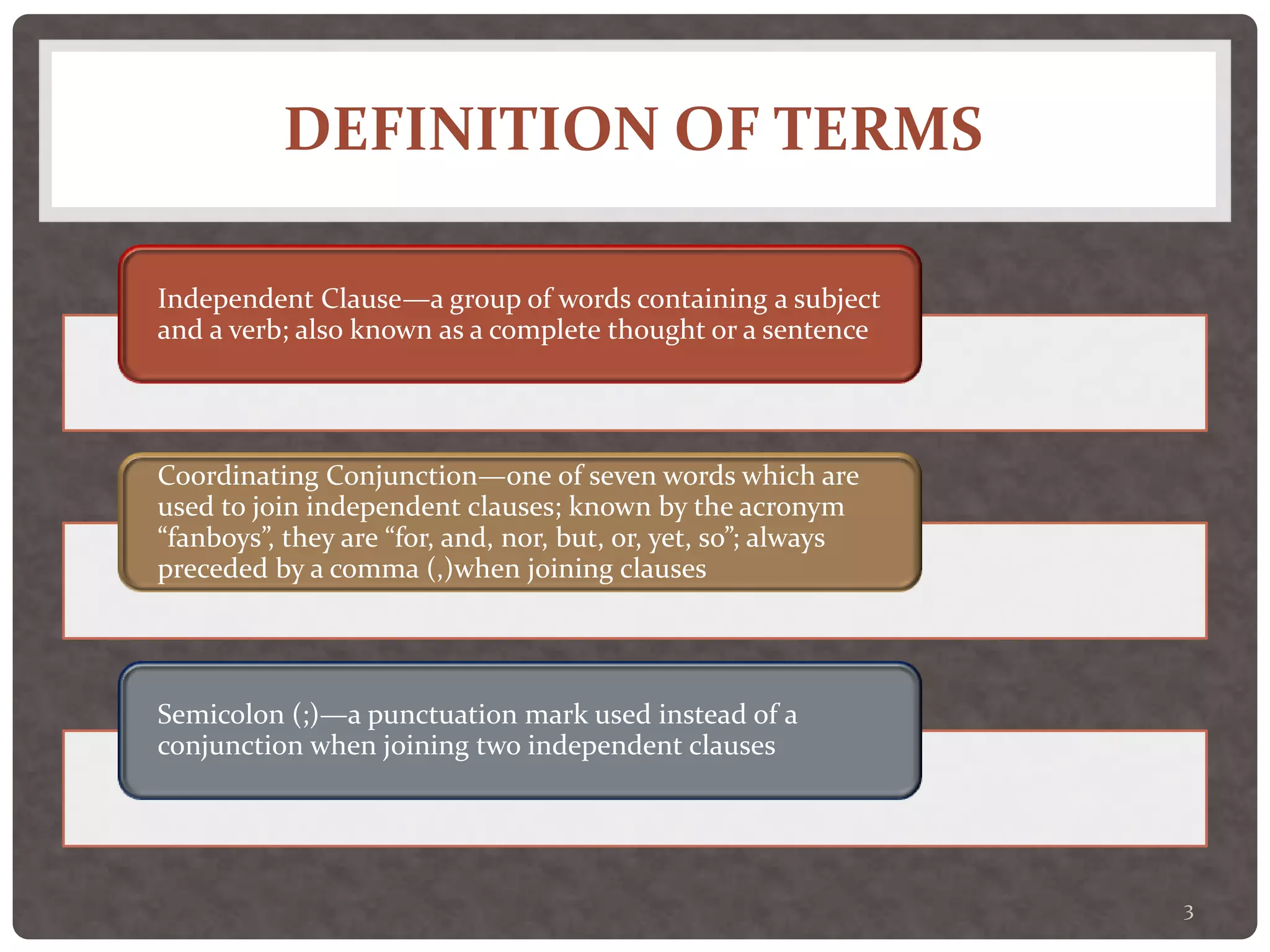
Independent Clause—a group of words containing a subject
and a verb; also known as a complete thought or a sentence
Coordinating Conjunction—one of seven words which are
used to join independent clauses; known by the acronym
“fanboys”, they are “for, and, nor, but, or, yet, so”; always
preceded by a comma (,)when joining clauses
Semicolon (;)—a punctuation mark used instead of a
conjunction when joining two independent clauses
3
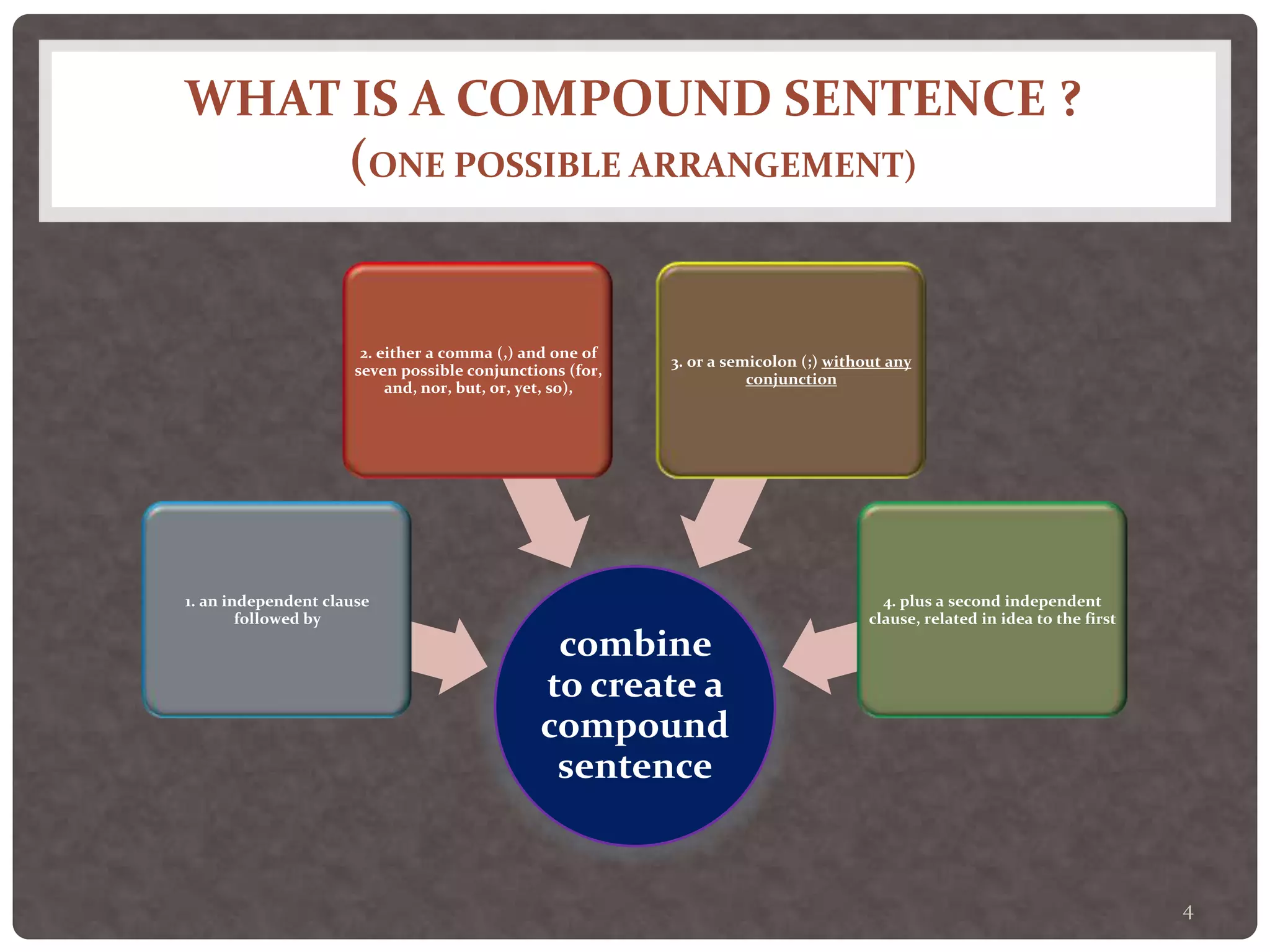
WHAT IS A COMPOUND SENTENCE ?
(ONE POSSIBLE ARRANGEMENT)
combine
to create a
compound
sentence
1. an independent clause
followed by
2. either a comma (,) and one of
seven possible conjunctions (for,
and, nor, but, or, yet, so),
3. or a semicolon (;) without any
conjunction
4. plus a second independent
clause, related in idea to the first
4
EXAMPLES OF COMPOUND SENTENCES
5
“They may take our lives, but they will never take our freedom.”–Mel
Gibson, Braveheart
“The drought had lasted now for ten million years, and the reign of the
terrible lizards had long since ended.” – Arthur C. Clark
“Arguments are to be avoided; they are always vulgar and often
convincing.”– Oscar Wilde
• The compound sentence contains two ideas, each represented by an
independent clause.
• The ideas are balanced and of equal importance.
• The relationship between the two ideas is suggested by the particular
coordinating conjunction used.
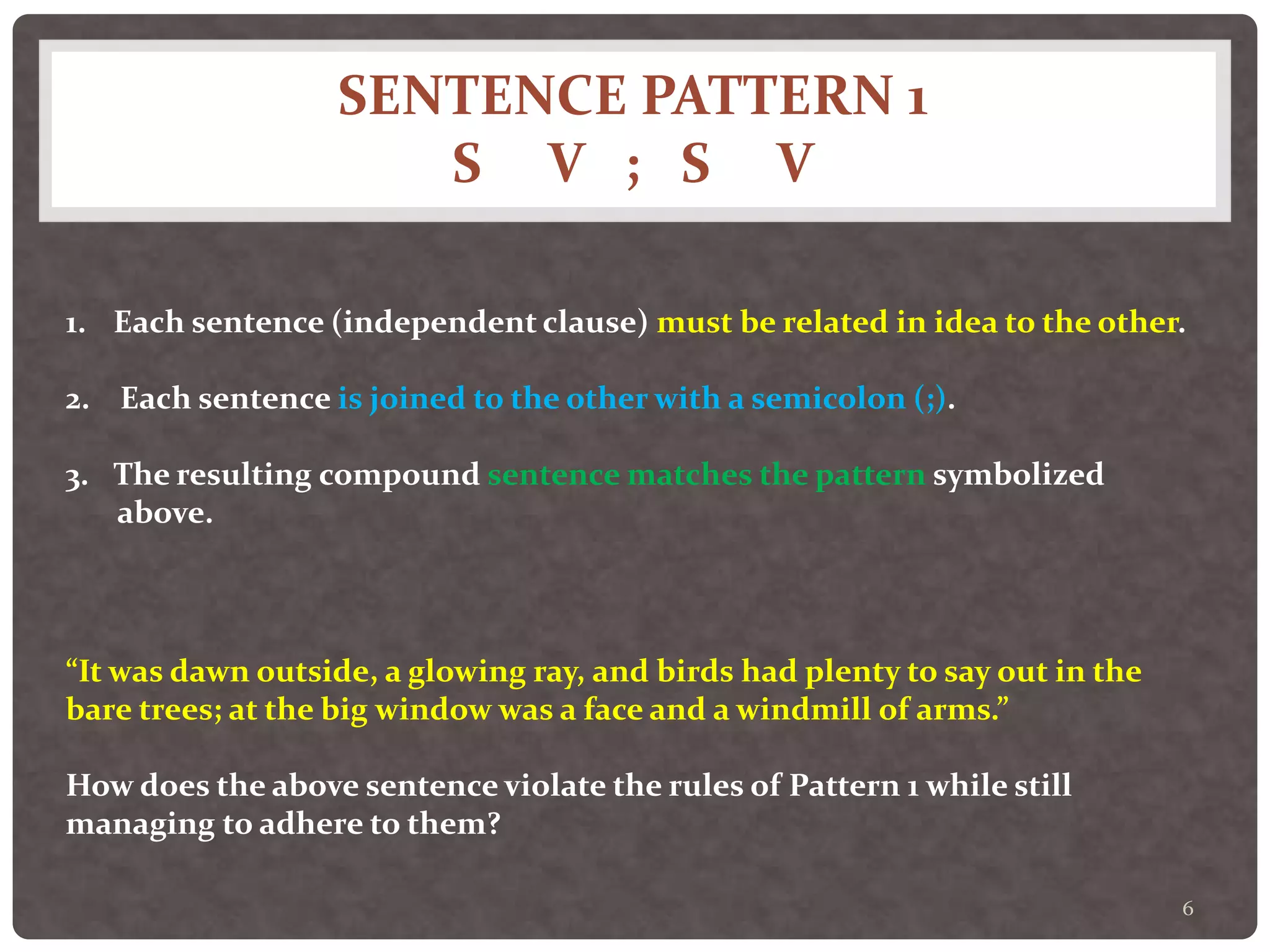
SENTENCE PATTERN 1
S V ; S V
6
1. Each sentence (independent clause) must be related in idea to the other.
2. Each sentence is joined to the other with a semicolon (;).
3. The resulting compound sentence matches the pattern symbolized
above.
“It was dawn outside, a glowing ray, and birds had plenty to say out in the
bare trees; at the big window was a face and a windmill of arms.”
How does the above sentence violate the rules of Pattern 1 while still
managing to adhere to them?
QUESTIONS
7
1. Explain the relationship created between two independent clauses
joined by each of the following coordinating conjunctions:
• and
• but
• or
• a semicolon (;)
2. Explore the functional differences in a sentence between a colon (:) and
a semicolon (;).
• When would a colon be appropriate to join two independent clauses?
• Speculate as to the origin of each mark based on the need to convey
exact information in a sentence.
3. What is a conjunctive adverb? How does it allow for variation
to Pattern 1?
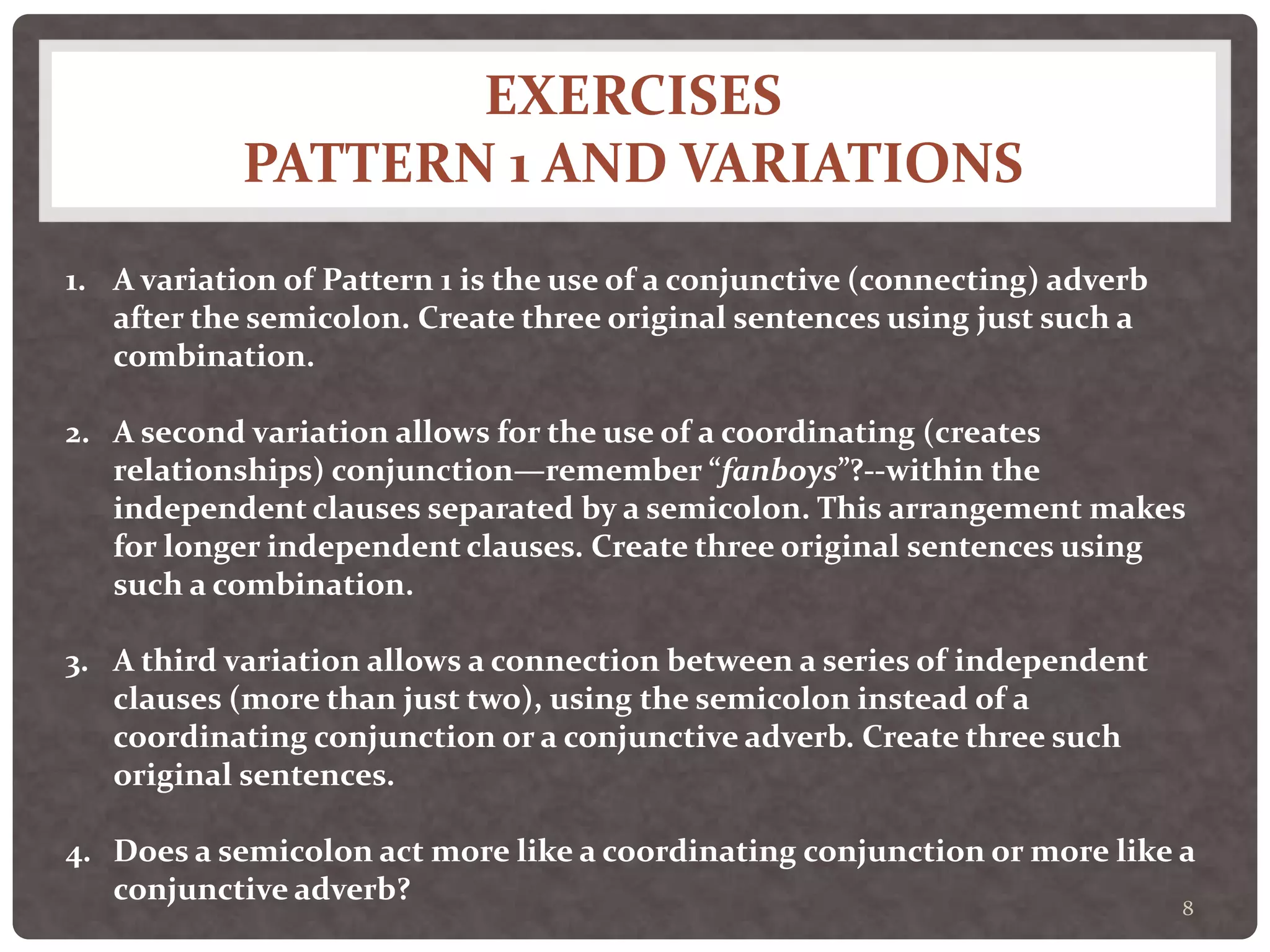
EXERCISES
PATTERN 1 AND VARIATIONS
8
1. A variation of Pattern 1 is the use of a conjunctive (connecting) adverb
after the semicolon. Create three original sentences using just such a
combination.
2. A second variation allows for the use of a coordinating (creates
relationships) conjunction—remember “fanboys”?--within the
independent clauses separated by a semicolon. This arrangement makes
for longer independent clauses. Create three original sentences using
such a combination.
3. A third variation allows a connection between a series of independent
clauses (more than just two), using the semicolon instead of a
coordinating conjunction or a conjunctive adverb. Create three such
original sentences.
4. Does a semicolon act more like a coordinating conjunction or more like a
conjunctive adverb?
9
PATTERN 2
CO M P O U N D S E N T E N C E W I T H E L L I P T I C A L CO N S T R U C T I O N
( CO M M A I N D I C AT E S T H E O M I T T E D V E R B )
DEFINITION OF TERMS
10
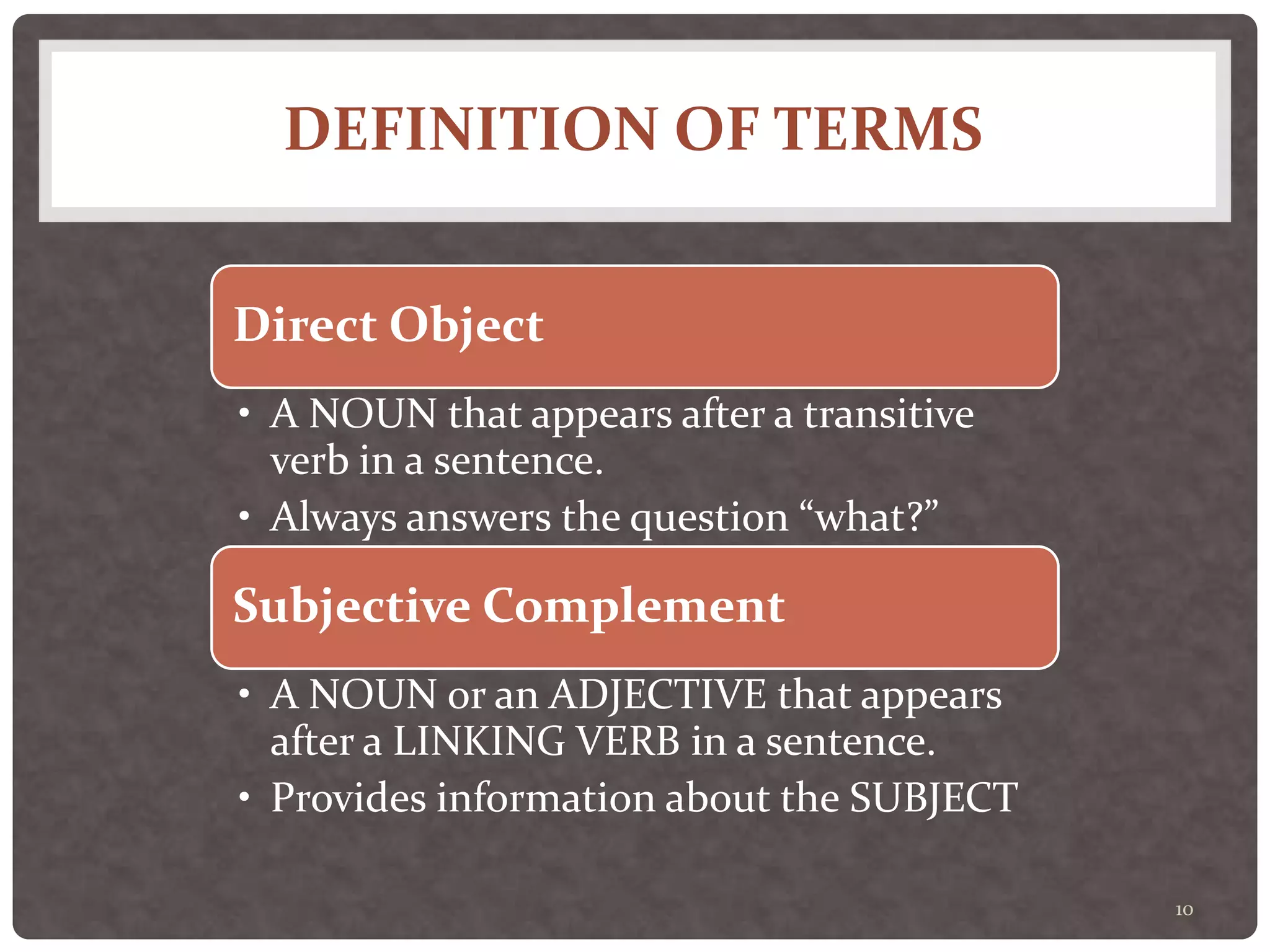
Direct Object
• A NOUN that appears after a transitive
verb in a sentence.
• Always answers the question “what?”
Subjective Complement
• A NOUN or an ADJECTIVE that appears
after a LINKING VERB in a sentence.
• Provides information about the SUBJECT
EXAMPLE OF A DIRECT OBJECT
11
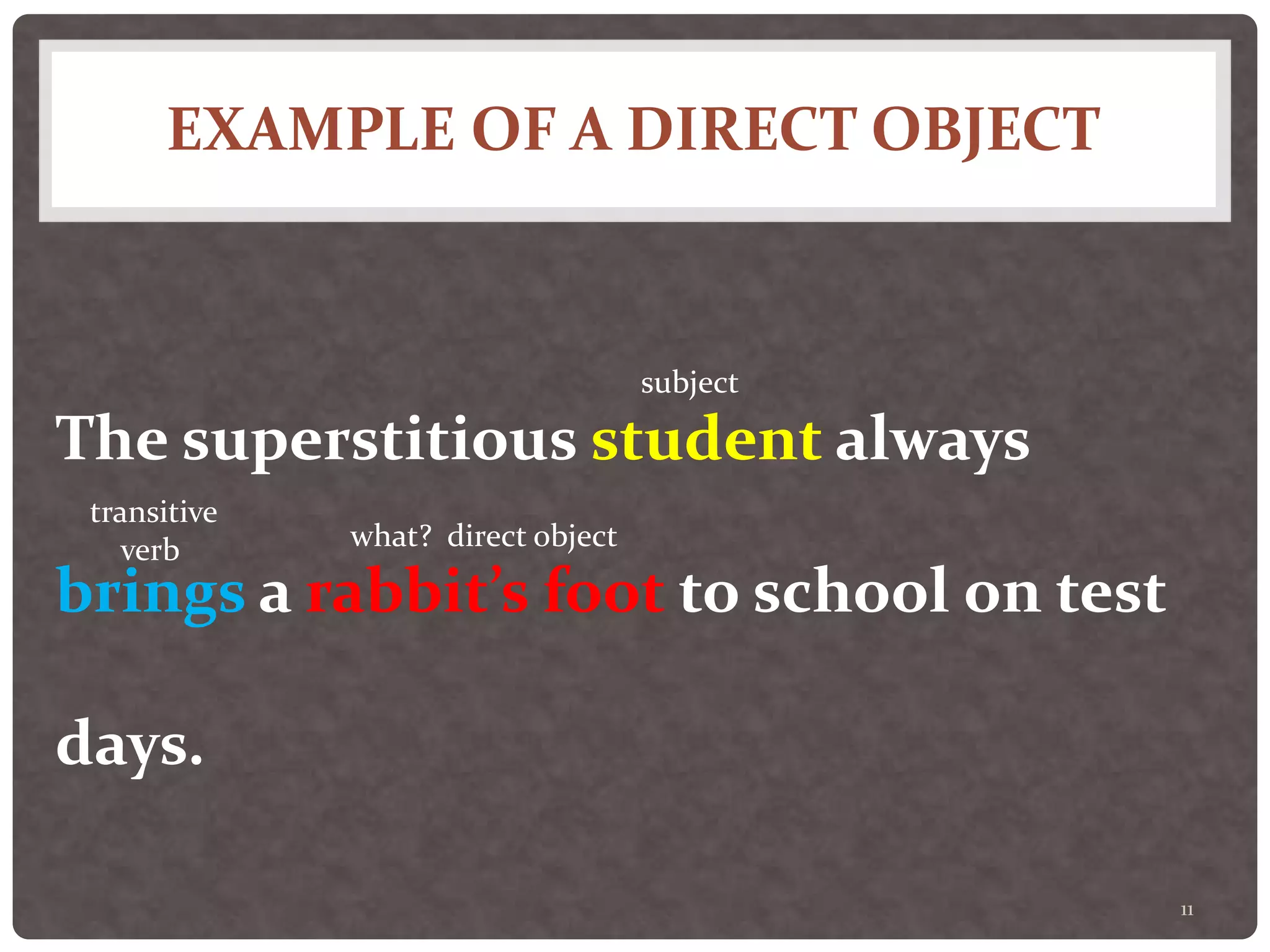
The superstitious student always
brings a rabbit’s foot to school on test
days.
subject
transitive
verb what? direct object
EXAMPLE OF
A SUBJECTIVE COMPLEMENT
12
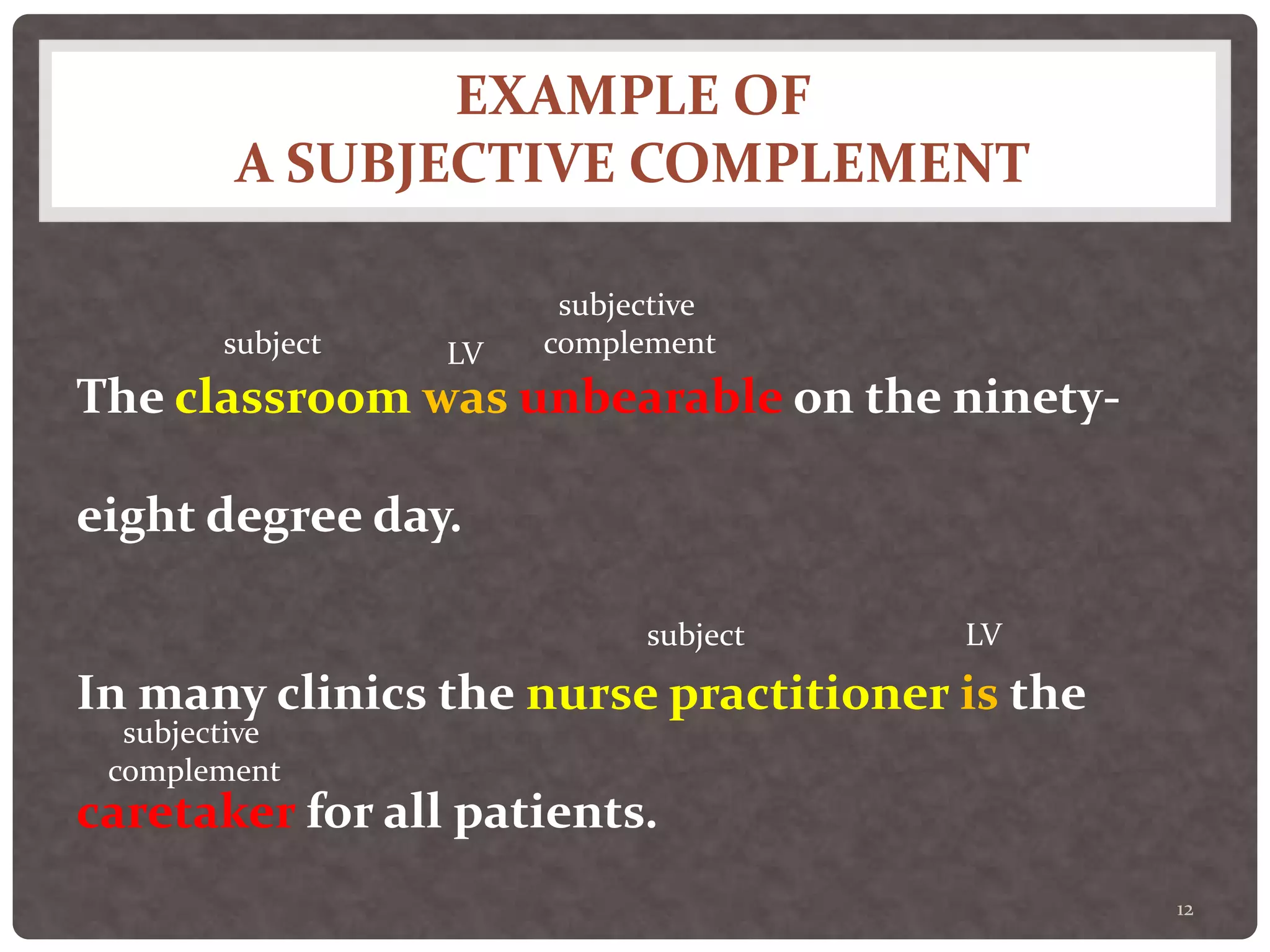
The classroom was unbearable on the ninety-
eight degree day.
In many clinics the nurse practitioner is the
caretaker for all patients.
subject LV
subjective
complement
subject LV
subjective
complement
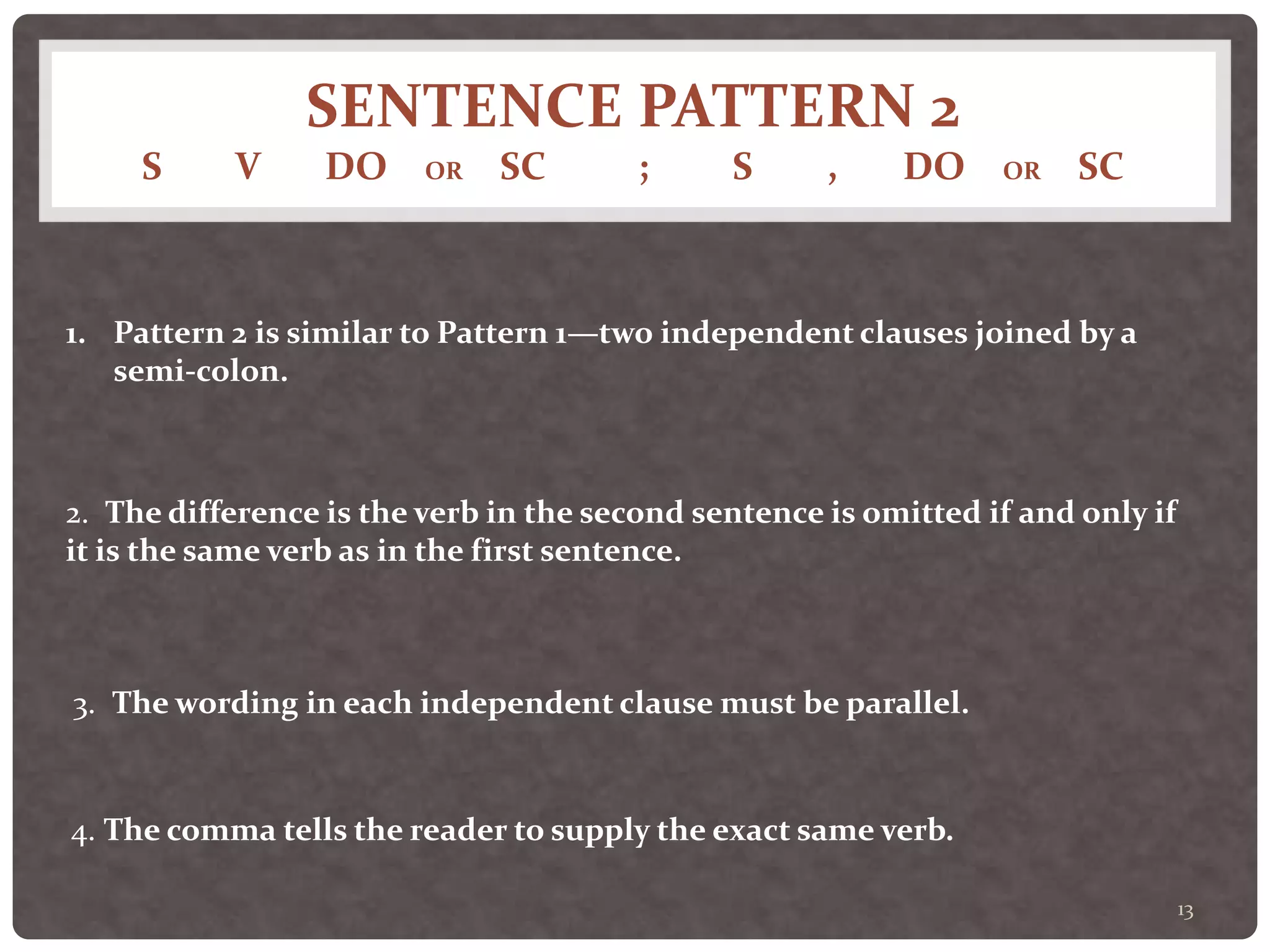
SENTENCE PATTERN 2
S V DO OR SC ; S , DO OR SC
13
1. Pattern 2 is similar to Pattern 1—two independent clauses joined by a
semi-colon.
2. The difference is the verb in the second sentence is omitted if and only if
it is the same verb as in the first sentence.
3. The wording in each independent clause must be parallel.
4. The comma tells the reader to supply the exact same verb.
BEFORE USING
14
Make sure the verbs in each sentence are
identical.
Say the new sentence to yourself: does it
sound rhythmical? Balanced?
Remember: a semi-colon NEVER goes with a
coordinating conjunction (FANBOYS).
15
PATTERN 3
CO M P O U N D S E N T E N C E W I T H E X P L A N AT O RY S TAT E M E N T
( C L A U S E S S E PA R AT E D BY A CO L O N )
DEFINITION OF TERMS
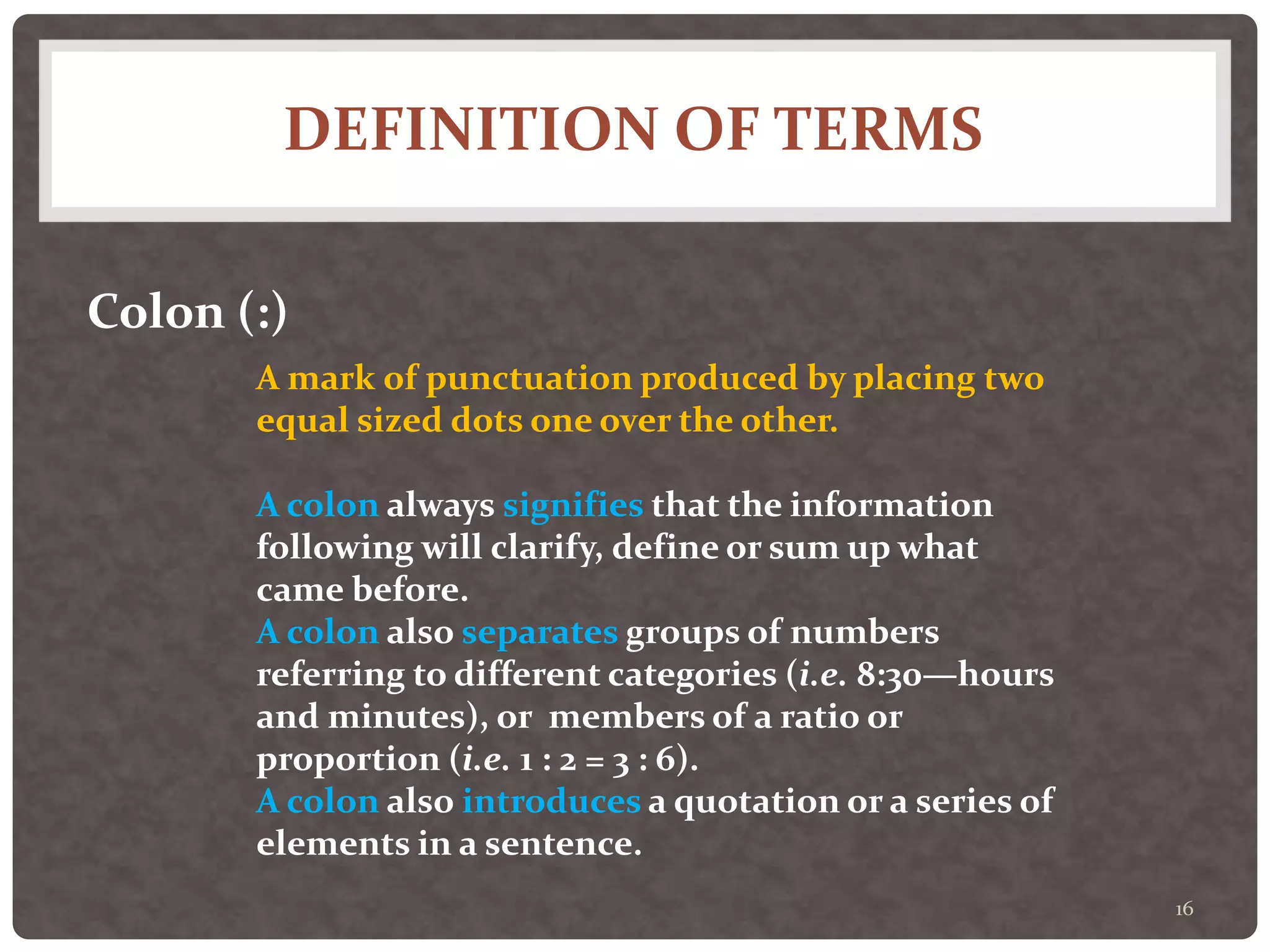
16
Colon (:)
A mark of punctuation produced by placing two
equal sized dots one over the other.
A colon always signifies that the information
following will clarify, define or sum up what
came before.
A colon also separates groups of numbers
referring to different categories (i.e. 8:30—hours
and minutes), or members of a ratio or
proportion (i.e. 1 : 2 = 3 : 6).
A colon also introduces a quotation or a series of
elements in a sentence.
SENTENCE PATTERN 3
GENERAL STATEMENT (IDEA) : SPECIFIC STATEMENT (EXAMPLE)
17
The first statement (before the colon) contains a
word or an idea that needs explaining.
The second statement (after the colon) provides an
example or more information about that word or
idea.
EXAMPLES
18
Darwin’s The Origin of Species forcibly states a harsh
truth: Only the fittest survive. (what harsh truth?)
Superman has extraordinary powers: He flies like a bird
and has X-ray vision. (what extraordinary powers?)
Note: capitalizing the first word after the colon is
optional.
REVIEW OF PATTERNS 1, 2, AND 3
19
Pattern 1 makes two closely related statements about the
same idea. The statements occur in two separate
sentences joined by a semi-colon.
Pattern 2 omits the exact same verb that occurs in the first
sentence from the second sentence by placing a comma
instead of the verb. A semi-colon joins the two clauses.
Pattern 3 states an idea in the first independent clause
and then amplifies or explains that idea in the second
independent clause. The clauses are joined by a colon.
20
PATTERNS DEALING WITH A
SERIES
PATTERNS 4 THROUGH 8
21
PATTERN 4
A S E R I E S W I T H O U T A CO N J U N C T I O N
( A S E R I E S I N A N Y P L A C E I N T H E S E N T E N C E )
DEFINITION OF TERMS
22
A series is a list, usually longer than two elements, of
words, phrases, or clauses related in content and form to
the main clause and to each other.
In pattern 4, the elements in a series are separated by
commas only. This construction is also known as
ASYNDETON, a rhetorical device.
SENTENCE PATTERN 4
23
When to use:
• to emphasize
• to eliminate wordiness
• to provide details
EXAMPLES
24
The United States has a government, of the people, by the
people, for the people.
I like burgers with everything on ‘em: pickles, onions,
tomato, lettuce, plenty of mustard.
I have come to you without sin, without guile, without
evil, without witness against me.
25
SENTENCE PATTERN 4A
A S E R I E S W I T H A V A R I A T I O N
A O R B O R C ( A N Y P L A C E I N T H E S E N T E N C E )
A A N D B A N D C ( A N Y P L A C E I N T H E S E N T E N C E )
RATIONALE
26
A series with a conjunction between each element in
the series creates a different effect with the reader.
The different effect is due to the change of rhythm.
This pattern is also called POLYSYNDETON, a specific
rhetorical technique.
EXAMPLES
27
“As long as rivers shall run down to the sea, or shadows
touch the mountains, or stars graze in the vault of
heaven [pattern 4a], so long as your honor, your
name, your praises endure [pattern 4].”
Many ice hockey games lead to broken ribs, or sprained
knees, or dislocated shoulders—or even worse.
PAY ATTENTION TO…
28
…the rhythm or sound or clarity
of your sentence
when using
patterns 4 and 4a.
29
SENTENCE PATTERN 5
A S E R I E S O F B A L A N C E D P A I R S
( A A N D B , C A N D D , E A N D F )
T H E P A I R S M A Y F U L F I L L A N Y F U N C T I O N I N T H E S E N T E N C E
LISTEN TO THE MUSIC
30
• A well crafted sentence draws attention to what is
communicated.
• The ear/brain pays attention to sound, especially
deliberately arranged sound.
• The patterns in series 4 through 8 allow the writer to
exert a definite influence on any reader.
CRAFTING PATTERN 5
31
1. What effect does a series of balanced pairs have on the
sentence?
2. Which function would the balanced pairs fill? (subject,
verb, object, complement?)
3. Are the elements in each pair progressing in an orderly
fashion?
4. Upon reading, do the pairs sound rhythmical?
5. What conjunction will tie the pairs together?
EXAMPLES
32
“The textbook clearly showed the distinctions between
prose and poetry, denotation and connotation, deduction
and induction.”
What is the function of the series of balanced pairs in the
above sentence?
“Great artists often seem to occur in pairs: Michelangelo
and da Vinci, Gaugin and van Gogh, Monet and Cezanne.”
Analyze the above sentence as to the function of the
balanced pairs.
33
SENTENCE PATTERN 6
A N I N T R O D U C T O R Y S E R I E S O F A P P O S I T I V E S
( W I T H A D A S H — A N D A S U M M A R I Z I N G S U B J E C T )
A P P O S I T I V E , A P P O S I T I V E , A P P O S I T I V E — S U M M A R Y W O R D S V
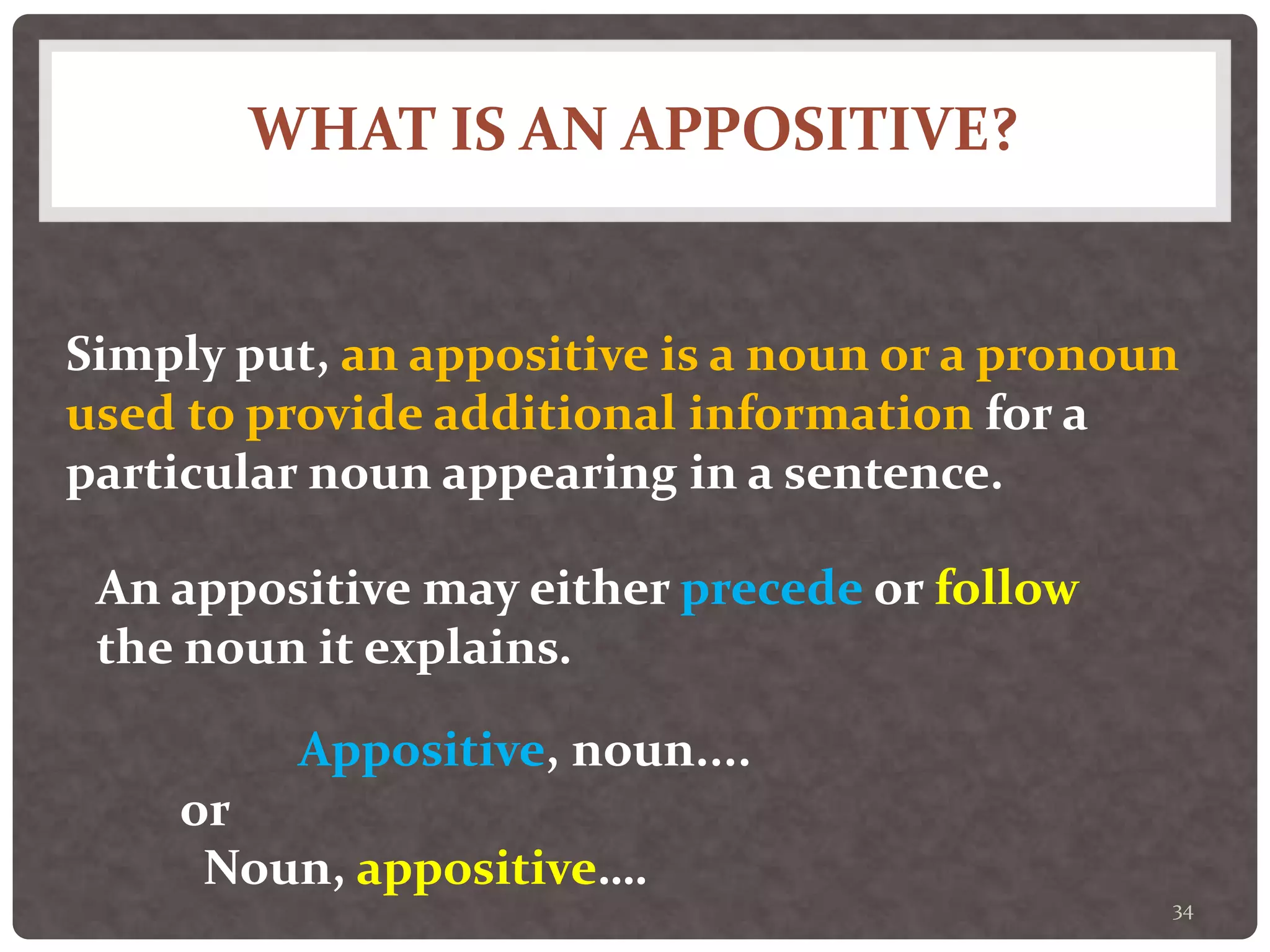
WHAT IS AN APPOSITIVE?
34
Simply put, an appositive is a noun or a pronoun
used to provide additional information for a
particular noun appearing in a sentence.
An appositive may either precede or follow
the noun it explains.
Appositive, noun....
Noun, appositive….
or
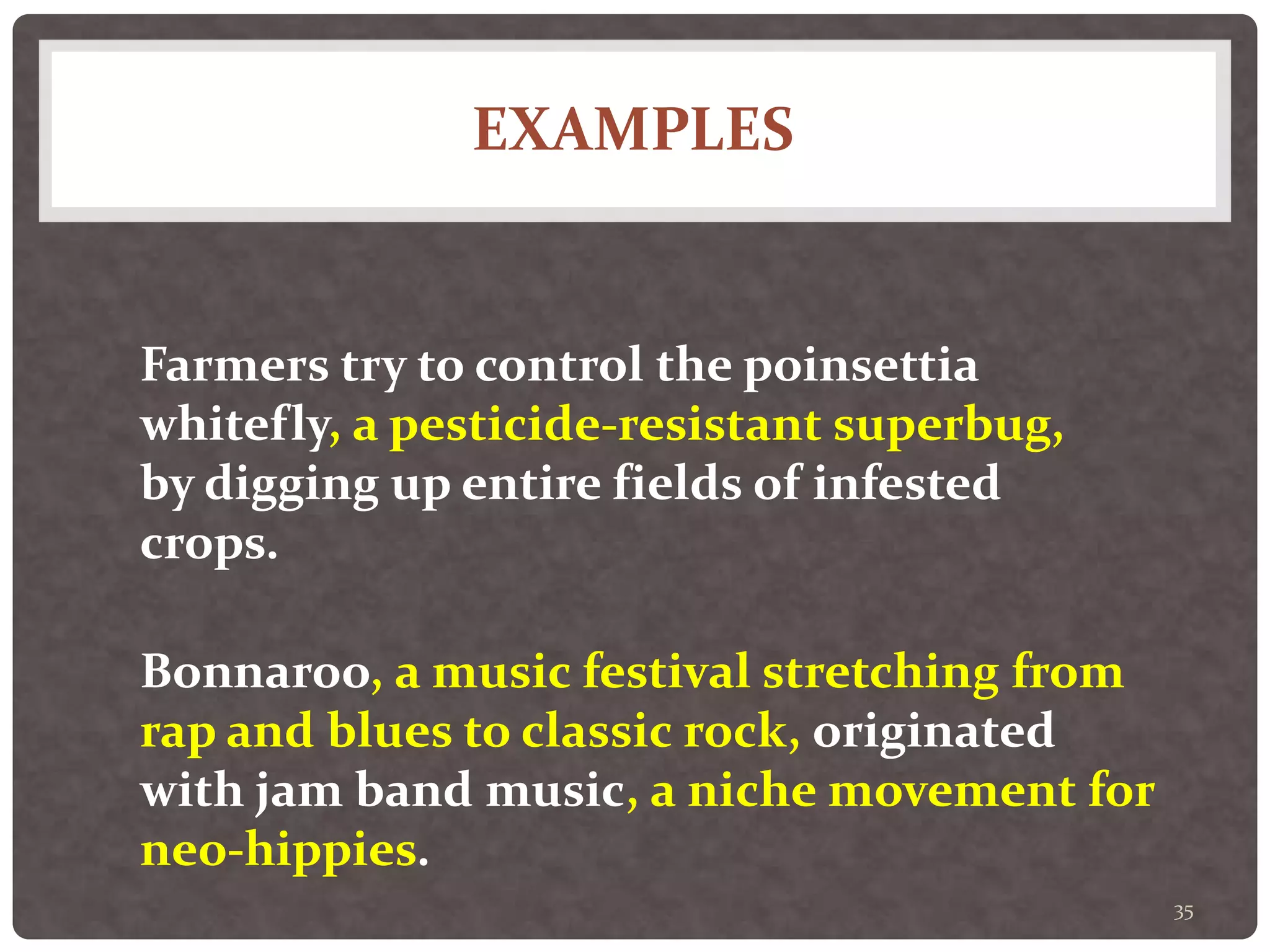
EXAMPLES
35
Farmers try to control the poinsettia
whitefly, a pesticide-resistant superbug,
by digging up entire fields of infested
crops.
Bonnaroo, a music festival stretching from
rap and blues to classic rock, originated
with jam band music, a niche movement for
neo-hippies.
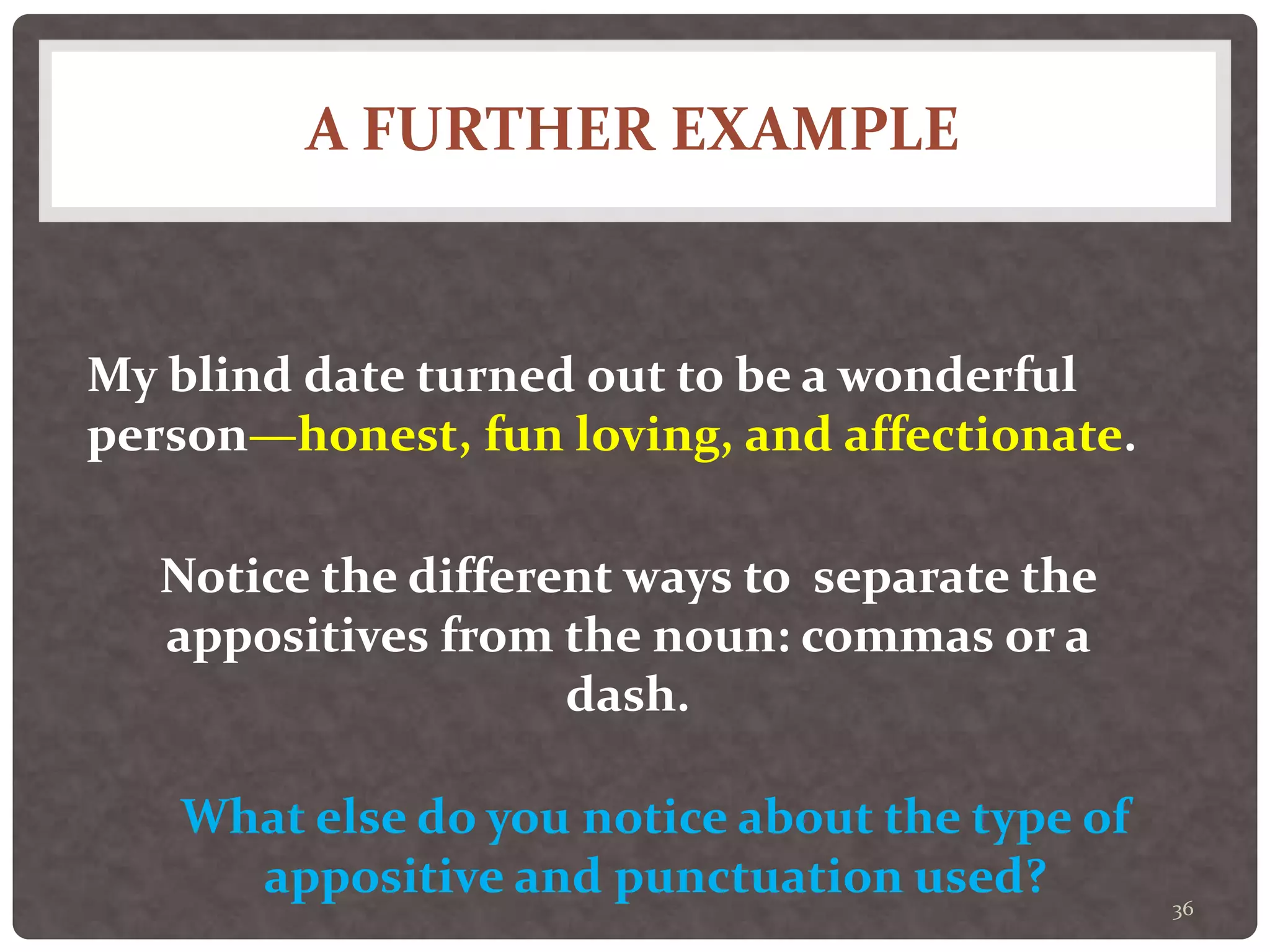
A FURTHER EXAMPLE
36
My blind date turned out to be a wonderful
person—honest, fun loving, and affectionate.
Notice the different ways to separate the
appositives from the noun: commas or a
dash.
What else do you notice about the type of
appositive and punctuation used?
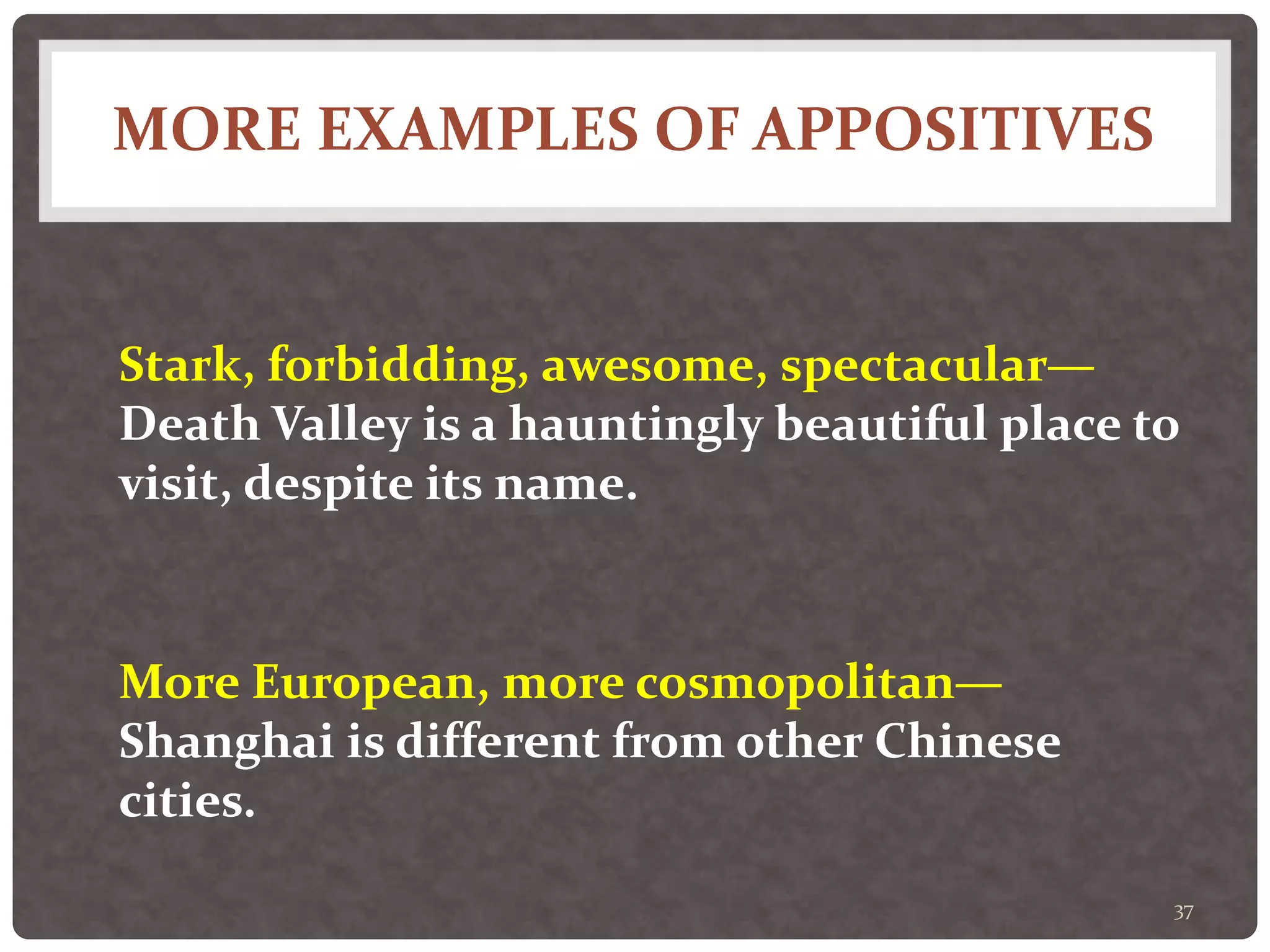
MORE EXAMPLES OF APPOSITIVES
37
Stark, forbidding, awesome, spectacular—
Death Valley is a hauntingly beautiful place to
visit, despite its name.
More European, more cosmopolitan—
Shanghai is different from other Chinese
cities.
APPOSITIVES USED TO LINK SENTENCES
38
High on the list of America’s most successful
food industries stands Duncan Hines. A man
who never baked a cake in his life, Hines
founded a multimillion-dollar food products
company that names its line of premium cake
mixes after him.
• Where is the appositive?
• How does the appositive link the sentences?
PATTERN 6
APPOSITIVE, APPOSITIVE, APPOSITIVE— SUMMARY WORD S V.
39
A summary word–-a specific pronoun that
comes before the subject--can be any of the
following:
such, all, those, this, many, each, which,
what, these, something, someone
The summary word may be the subject of
the sentence or may simply modify the
subject.
PATTERN 6
ANOTHER WAY TO PUT WORDS IN A SERIES
40
Use any of the previous patterns for a series:
• A series without a conjunction
(A, B, C)
• A series with a conjunction
(A or B or C)
• A series of balanced pairs
(A and B , C and D , E and F)
Bull riding, camel racing, bronc riding, roping—
these events mean rodeo to many people; they
mean money to the cowboys.
41
PATTERN 7
AN INTERNAL SERIES OF APPOSITIVES OR MODIFIERS
VARIATIONS ON A SERIES
42
Appositives can appear anywhere in a sentence—
as long as the noun that they rename is
immediately before or after.
In this pattern use appositives (“re-namers”) or
modifiers (“describers”) in a series anywhere in
the sentence (see above).
A DRAMATIC INTERRUPTION
43
Dramatic in the sense that an unexpected focus
is directed at a particular noun, the “Pattern 7”
series infuses a sentence with interest.
Keep in mind this distinction: appositives
RENAME; modifiers DESCRIBE.
PUNCTUATION IN PATTERN 7
SENTENCES
44
• This dramatic interruption is designed to be
a series.
• A series needs commas between each
element.
• Consequently, dashes (--) must set off the
appositives or modifiers.
• An option to the dash is the parenthesis.
• The parenthetical remark is stylistically
considered as less important information.
EXAMPLES OF APPOSITIVES
45
“Professor Knowsit described the political
climate in three countries—Germany, Italy,
Spain—that embraced the fascist movement.”
“Jason cited three major qualities—anticipation,
agility, fearlessness—that helped him as varsity
goalie this year.”
EXAMPLE OF APPOSITIVE WITH
PARENTHESIS
46
The parenthesis suggests that the information
is provided as a reminder, or is not required.
“Remember the three components of a strong
TES paragraph (topic, evidence, significance)
when writing your final assignments.”
47
PATTERN 7A
A SINGLE APPOSITIVE OR A PAIR
PUNCTUATING PATTERN 7A
48
• Instead of a full series, this pattern uses only
one or two appositives.
• The interruption occurs immediately after
the subject.
• The effect can be altered depending on the
punctuation used.
DASH, PARENTHESIS, OR COMMA?
49
Dashes indicate something dramatic.
Parenthesis suggest less important information
or an aside.
Commas surrounding appositives provide a
smoother connection to the rest of the sentence.
EXAMPLES
50
“Half an hour after the first diver surfaced
empty handed, the second police diver returned
with the same report—nothing.”
“Satirist Al Yankovic (known as “Weird Al”)
writes and performs many song and music
video parodies.”
In 1904, a St Louis doctor introduced peanut
butter, a favorite of children, as a health food
for the elderly.
51
PATTERN 8
DEPENDENT CLAUSES IN A PAIR OR SERIES
THE FINAL PATTERN USING SERIES
52
All the clauses in the pattern 8 series must be
• dependent,
• parallel, and
• related to the main clause either in condition,
situation, or provision.
The series may come at the beginning or at the
end of a sentence.
THE PATTERN 8 FORMAT
53
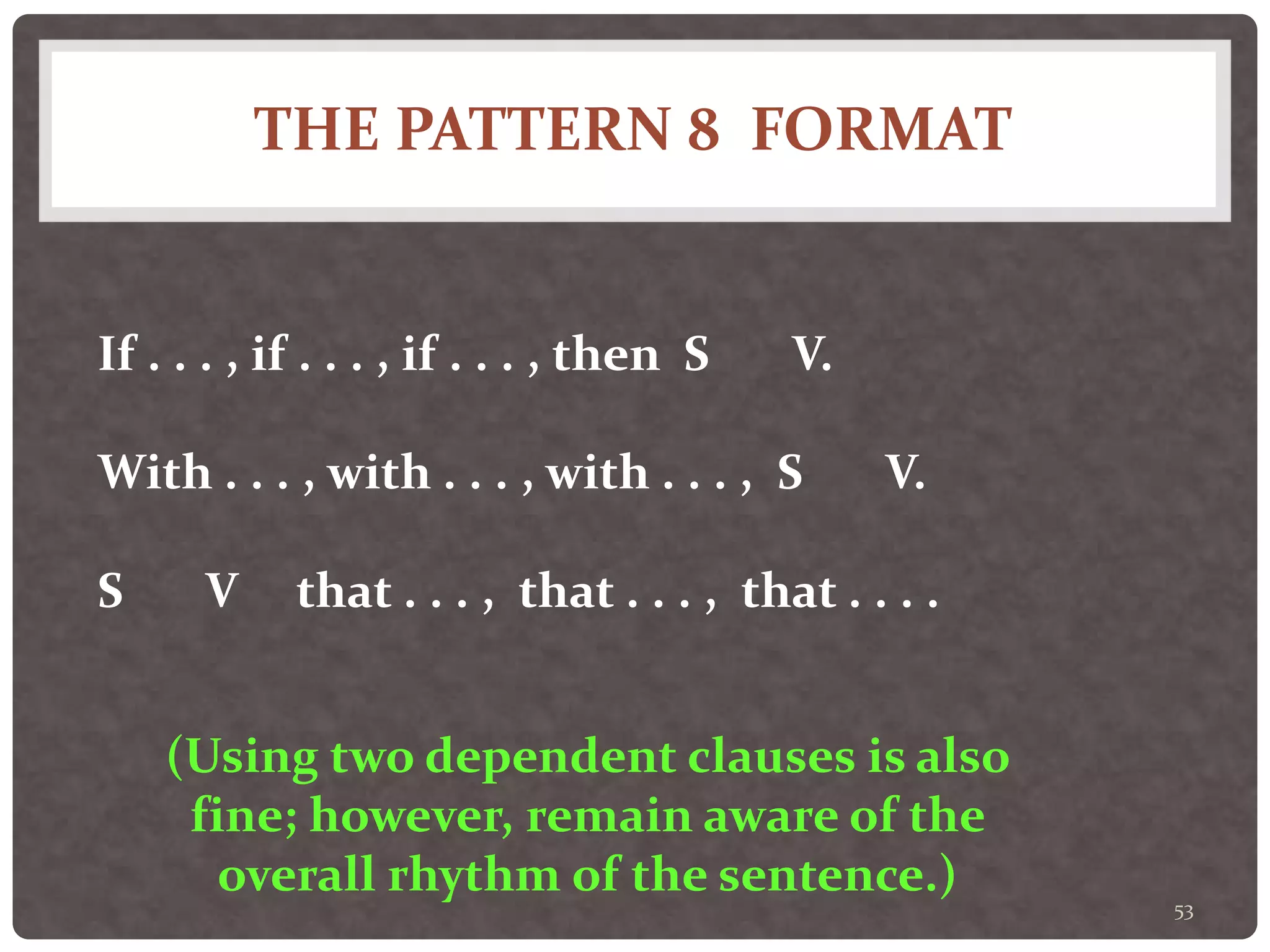
If . . . , if . . . , if . . . , then S V.
With . . . , with . . . , with . . . , S V.
S V that . . . , that . . . , that . . . .
(Using two dependent clauses is also
fine; however, remain aware of the
overall rhythm of the sentence.)
USE WITH SPECIAL OCCASIONS,
54
such as
• ending a paragraph to summarize major points;
• constructing a thesis containing two or three
points; or
• bringing together the main points of an essay in
one sentence (in the introduction or
conclusion).
Strive for a natural, relaxed , graceful, and
smooth sentence rhythm.
EXAMPLE
55
“Whether Orwell wanted to mock society,
whether he wanted to ridicule politicians, or
whether he wanted to criticize communism,
Animal Farm remains one of the best known
works of allegorical literature.”
(dependent, parallel, related in situation)
ANOTHER EXAMPLE
56
“When Napoleon took over, when Snowball
accepted exile, when Manor Farm fell, the
element of dictatorship reared its ugly head.”
(dependent, parallel, related in condition)
A FURTHER EXAMPLE
57
“With no equality, and with insufficient food,
the animals decided to revolt against the
humans.”
(dependent, parallel, related in condition)
58
PATTERNS DEALING WITH
REPETITION
WHAT, WHY, HOW, WHERE
WHAT ARE REPETITIONS?
59
Simply put, repetition is the restatement of a
particular element in a sentence.
The element may be repeated once or more than
once.
The repetition may occur in a sentence or within a
paragraph.
WHY REPEAT?
60
Repeated words emphasize ideas the writer
believes are important.
Done well, the repeated words serve as
echoic reminders for the reader, something
like “I have seen that word before, connected
with….”
Skillfully placed within a paragraph, the
repetitions serve to connect and emphasize
ideas, as well as achieve unity and coherence.
61
Careful!
Needless repetition suggests laziness on the
writer’s part (did not bother to think of a
synonymous word).
Needless repetition also suggests the writer
has a limited vocabulary (did not know a
synonymous word existed).
Both affect the credibility of the writer.
HOW TO REPEAT
62
Choose a word that bears repeating. The repeated
word should purposefully carry an important idea
through one or more paragraphs.
The repeated word may be used in any position in
the sentences: as subject, as verb, as adjective, as
adverb, as participle.
Obviously, if used in different situations, the
repeated word will change its form.
63
A repeated word that changes form adds
interest to the writing while still serving
the task.
WHERE TO REPEAT
64
• in the same sentence, but functioning
differently (The repeated word comes after a
dash [--] or a comma [,].)
The repeated word may have a different form
as a result of its different function in the
sentence. (For example, the repeated word is
first used as the subject, then as an adjective,
or participle, or adverb in the same sentence.)
65
• in the same sentence, but used in the
same function throughout (For
example, the repeated word is used as
the object of a series of prepositional
phrases.)
THE IMPACT OF PUNCTUATION
66
A comma signals a very brief pause.
A dash signifies a dramatic, purposeful
interruption. (use two hyphens --)
A semi colon signifies a connection between
two independent clauses.
A colon suggests a series of explanatory terms
or a defining or clarifying statement follows.
Parentheses suggest the information
contained within is more of a reminder than
something new.
67
PATTERN 9
REPETITION OF A KEY TERM IN A SENTENCE
S V KEY TERM --/, REPEATED KEY TERM
68
Select a term with high importance. The term
may be acting as the subject or as a modifier.
Following a dash (--) or a comma, the word
may change form depending on its use.
Be careful! A comma splice error is created by
separating two independent clauses with a
comma. Following the comma or dash, the
repeated term should be part of a dependent
clause.
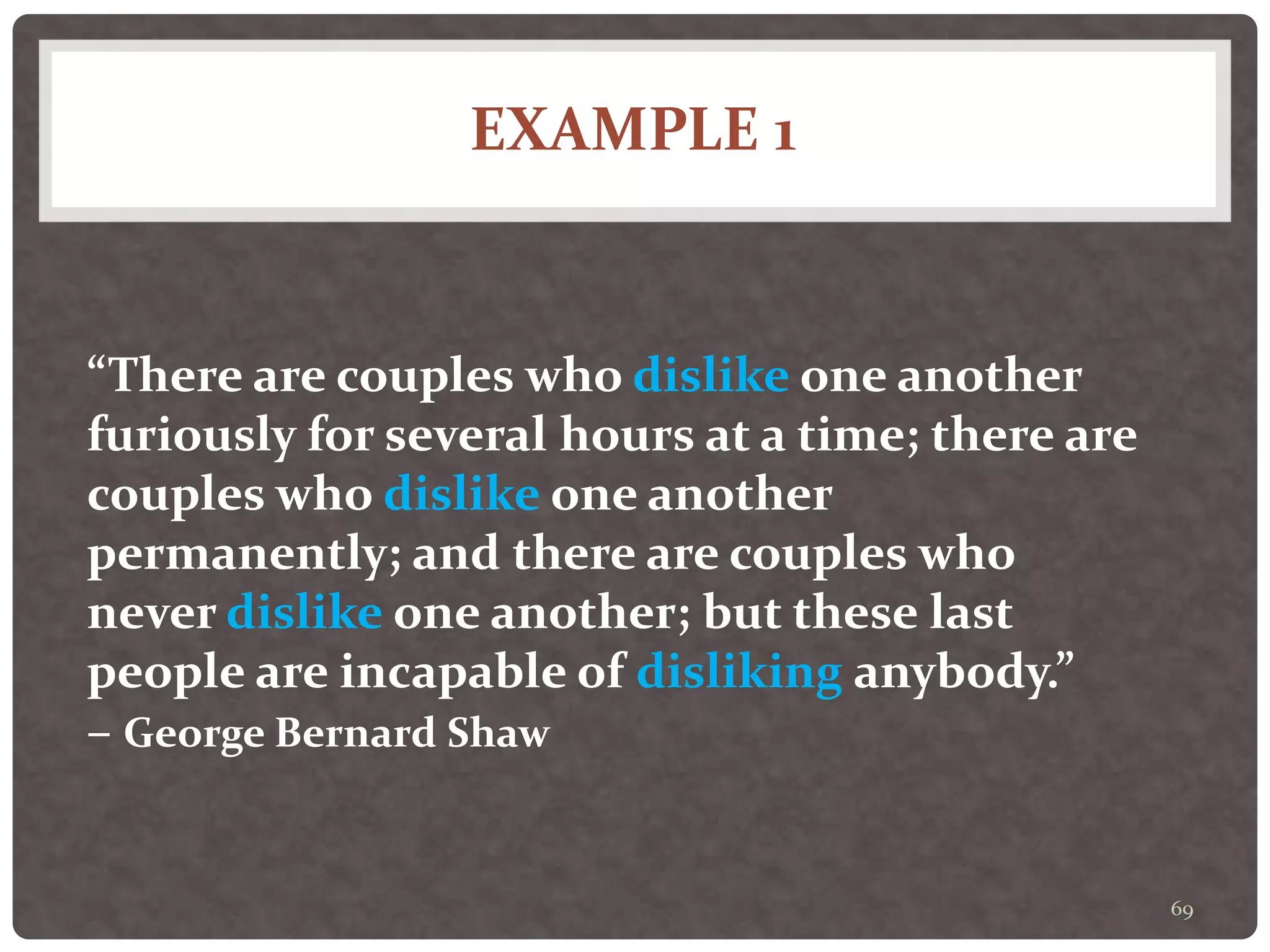
EXAMPLE 1
69
“There are couples who dislike one another
furiously for several hours at a time; there are
couples who dislike one another
permanently; and there are couples who
never dislike one another; but these last
people are incapable of disliking anybody.”
– George Bernard Shaw
EXAMPLE 2
70
“A kleptomaniac is a person who helps
himself because he can’t help himself.”
–Henry Morgan
EXAMPLE 3
71
“The man who stood, who stood on
sidewalks, who stood facing streets, who
stood with his back against store windows or
against the walls of buildings, never asked
for money, never begged, never put his hand
out.”
--Gordon Lish
AND FINALLY, EXAMPLE 4
72
“She’s safe, just like I promised. She’s all set
to marry Norrington, just like I promised.
And you get to die for her, just like you
promised.”
--Jack Sparrow, Pirates of the Caribbean
73
PATTERN 9A
SAME WORD REPEATED IN PARALLEL STRUCTURE
DIFFERENT FORMS OF REPETITION
S V REPEATED KEY WORD
(SAME FUNCTION IN THE SENTENCE)
74
1. Repeat an effective adjective or adverb in
parallel construction.
2. Repeat the same preposition in a series.
3. Repeat the same noun as objects of different
prepositions.
4. Repeat the same modifying word in phrases
beginning with different prepositions.
5. Repeat the same intensifiers.
6.Repeat the same verb in the same or alternate
forms.
EXAMPLES
75
1. Repeating an effective adjective or adverb in parallel
construction.
She has an incredibly satisfying life, satisfying because of her career
and satisfying because of her family.
2. Repeat the same preposition in a series.
He has known her for many years, before she went to college, before
she was a star, before she won the Oscar.
3. Repeat the same noun as objects of different prepositions.
The government is of the people, by the people, and for the people.
EXAMPLES, CONTINUED
76
4. Repeat the same modifying word in phrases with different
prepositions.
Sidney devoted his life to those selfish people, for their selfish
cause, but clearly with his own selfish motives dominating his every
action.
5. Repeat the same intensifiers.
The baseball game was very exciting, very enjoyable, but very long.
6. Repeat the same verb in the same or alternate forms.
In order to survive in a war, a person needs training, a person needs
courage, and, most of all, a person needs luck.
A LONGER EXAMPLE
77
Read the following excerpt from Ernest
Hemingway’s short story, “In Another Country”.
Locate instances of Hemingway’s use of
repetition.
78
“We were all at the hospital every afternoon, and there
were different ways of walking across the town through
the dusk to the hospital. Two of the ways were alongside
canals, but they were long. Always, though, you crossed
a bridge across a canal to enter the hospital. There was a
choice of three bridges. On one of them a woman was
selling roasted chestnuts. It was warm standing in front
of her charcoal fire, and the chestnuts were warm after-
ward in your pocket. The hospital was very cold and very
beautiful, and you entered through a gate and walked
across a courtyard and out a gate on the other side.
There were usually funerals starting from the courtyard.
Beyond the old hospital were the new brick pavilions,
and there we met every afternoon and were all very
polite and interested in what was the matter, and sat in
the machines that were to make so much difference.”
--Ernest Hemingway, In Another Country
79
What is the effect of the prose crafted
by Hemingway?
What is missing from Hemingway’s
prose?
What various examples of repetition
can you locate?
80
PATTERN 10
EMPHATIC APPOSITIVE AFTER A COLON
A COUPLE OF DEFINITIONS
81
Emphatic -- adjective: from the Greek, which
originally meant “to present” or “to show” and
later evolved to mean “giving extra stress to a
word or a phrase” to imply meaning beyond the
literal.
82
Appositive: a noun or a noun phrase
placed next to another noun in a
sentence. The appositive and the first
noun are syntactically related; that is,
they share the same function. The
appositive restates, or amplifies the
meaning of the first noun.
83
Colon: a mark of punctuation which
follows a word or a sentence.
The colon introduces additional
information in a sentence, information in
the form of a quotation, a definition, an
explanation, or a series.
84
Pattern 10 stylistically saves the additional
information until the end of a sentence.
The resulting delay creates a slightly
heightened sense of expectation. The delay
also emphasizes the word or phrase after the
colon.
85
When using a colon in Pattern 10,
remember that the colon functions as a
period, or “full stop.”
A complete sentence must precede the
colon.
The colon then alerts the reader to the
information that follows.
SIMILAR PATTERNS
86
Pattern 3 also uses a colon; however,
Pattern 3 requires a complete sentence after
the colon.
Pattern 10 allows for a single word or a phrase
after the colon .
EXAMPLES
87
“On the inside, the Valero store looked like a
cornucopia of imitation, heavily processed food
items: pink ‘Twinkies’, bright yellow corn chips,
neon orange ‘Cheetos’, steaming red ‘Red Hots’,
and other like entities that we eat too much of.”
“Her suitcases had been filled to the top
with what she considered necessities:
cosmetics, jewelry, and other expensive
accessories.”
88
PATTERN 10A
AN APPOSITIVE AFTER A DASH
A DASH OF EMPHASIS
89
• As in Pattern 9, the dash precedes a
repetition or a renaming of the key term or
noun in the independent clause.
• In Pattern 10a, the “renaming”
appositive, following the dash, is short and
emphatic.
• In a word processing program, always
construct a dash by using two hyphens (--).
CAREFUL!
90
• What precedes the dash is a full sentence.
• What follows the dash is a single word, a
phrase, or a series.
• A “dash-splice” error occurs by joining two
independent clauses (sentences) with a dash.
• A “comma-splice” error occurs by joining two
independent clauses (sentences) with a
comma.
EXAMPLES
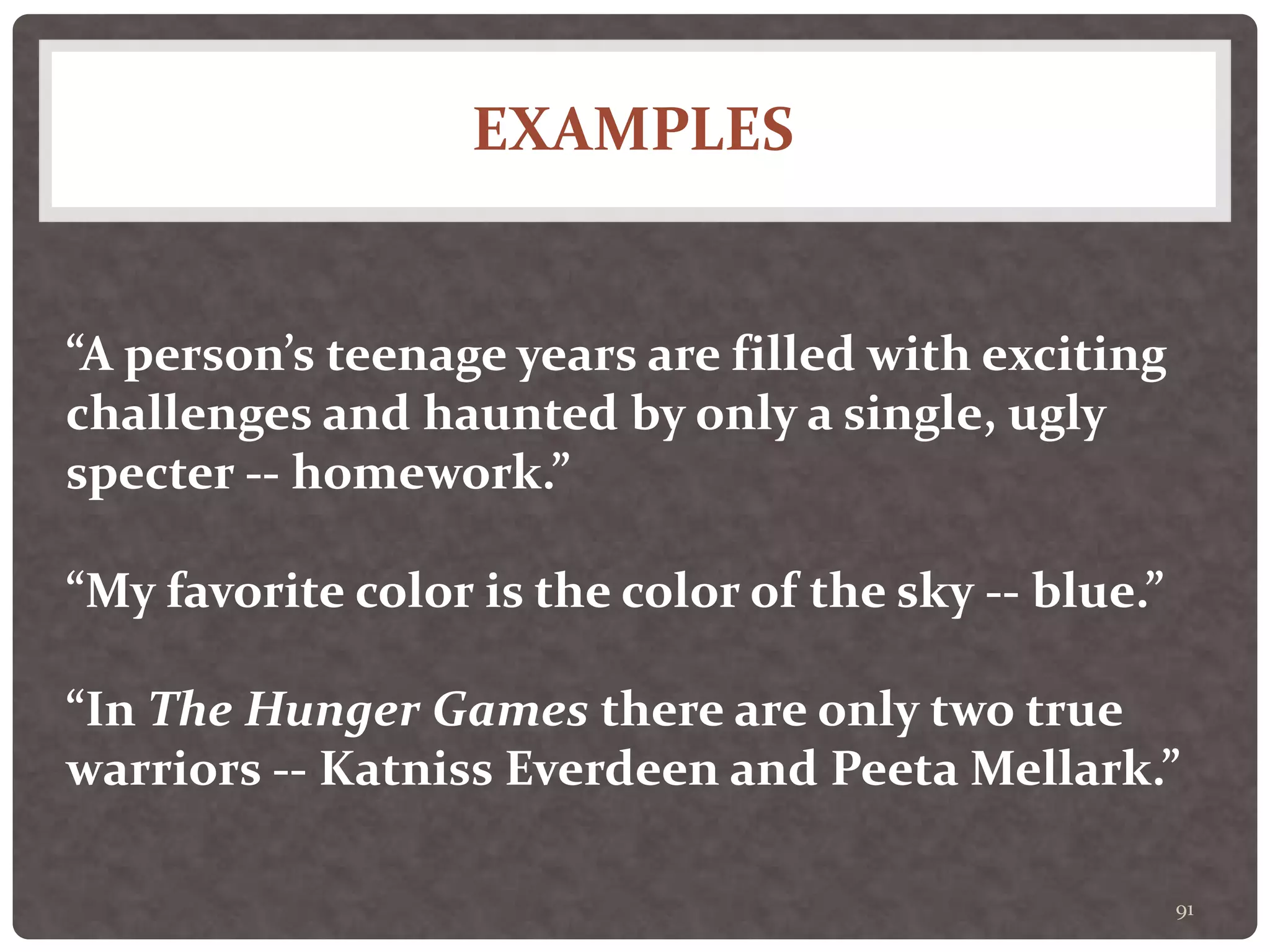
91
“A person’s teenage years are filled with exciting
challenges and haunted by only a single, ugly
specter -- homework.”
“My favorite color is the color of the sky -- blue.”
“In The Hunger Games there are only two true
warriors -- Katniss Everdeen and Peeta Mellark.”
92
PATTERNS DEALING WITH
MODIFIERS
ADDING CLARIT Y
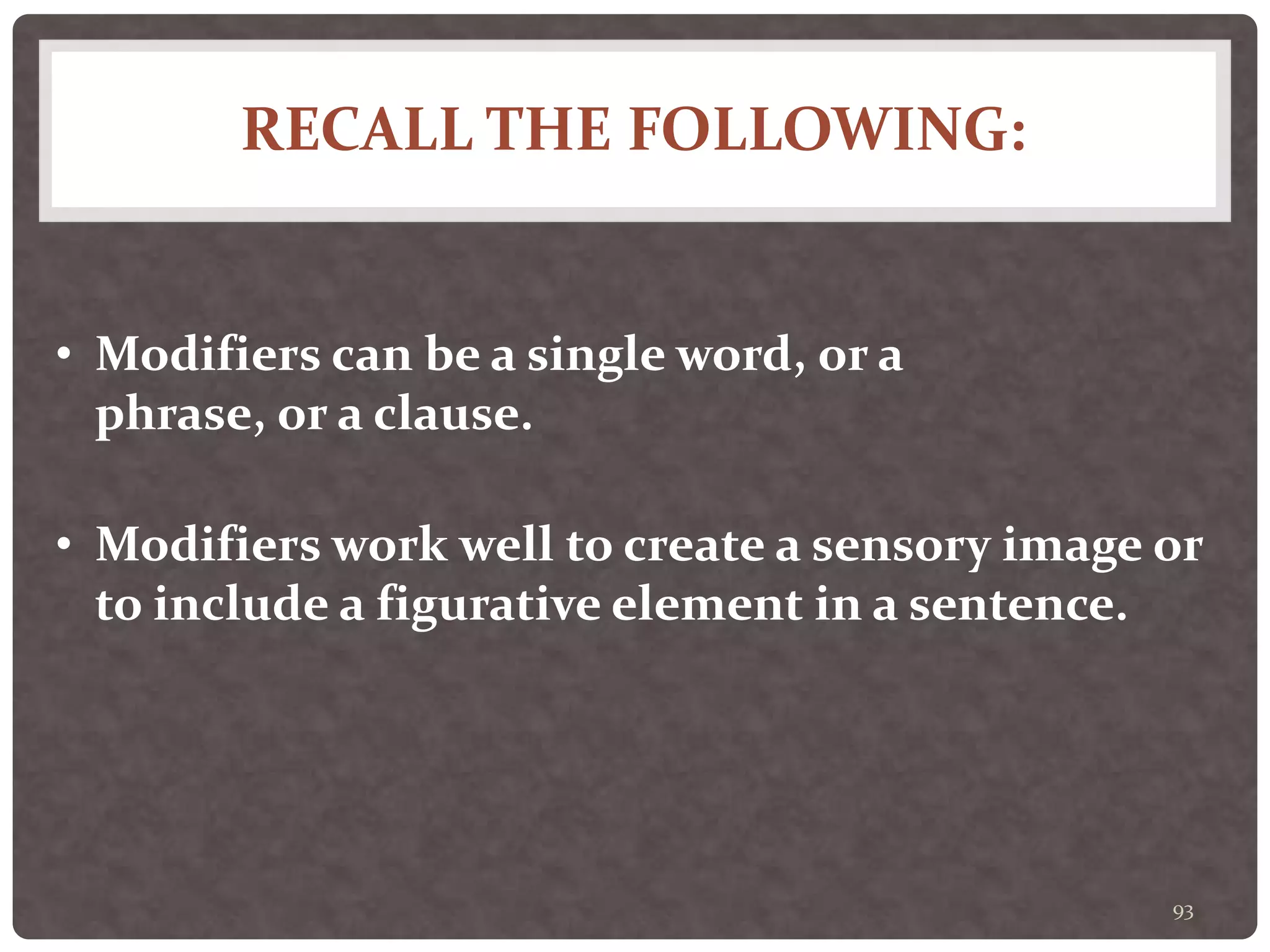
RECALL THE FOLLOWING:
93
• Modifiers can be a single word, or a
phrase, or a clause.
• Modifiers work well to create a sensory image or
to include a figurative element in a sentence.
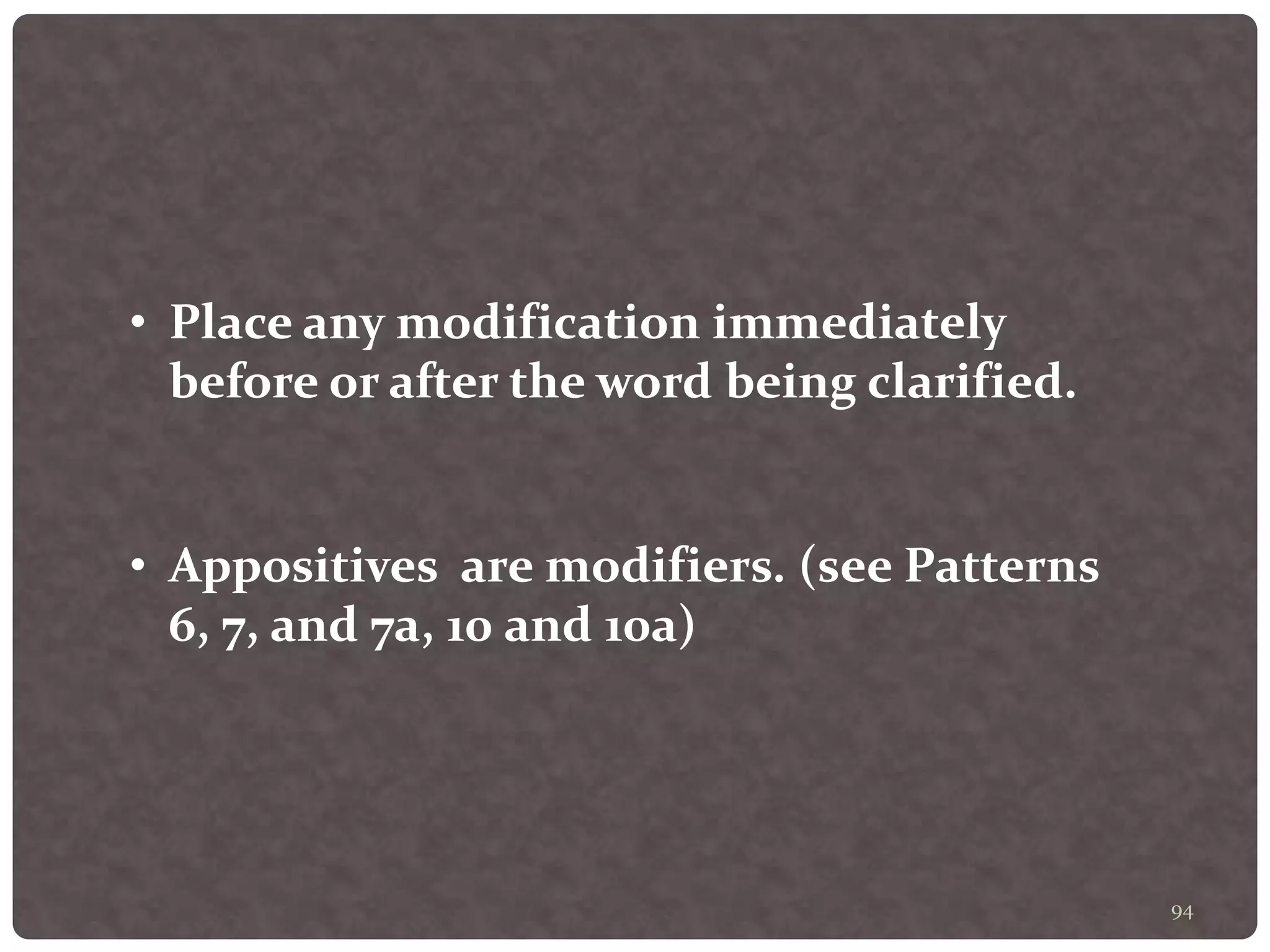
94
• Place any modification immediately
before or after the word being clarified.
• Appositives are modifiers. (see Patterns
6, 7, and 7a, 10 and 10a)
95
PATTERN 11
A N I N T E R R U P T I N G M O D I F I E R
B E T W E E N T H E S U B J E C T A N D T H E V E R B
DRAMATIC SIGNALING
S, MODIFIER, V
S –MODIFIER– V
S (WHISPERED MODIFIER) V
96
• This Pattern is similar to Patterns 10 and 10a;
however, in Pattern 11 a variety of possible
modifiers, rather than just appositives,
intensify the sentence.
• A choice of punctuation sets off the modifier:
a comma, a dash, or a pair of parentheses.
EXAMPLES
97
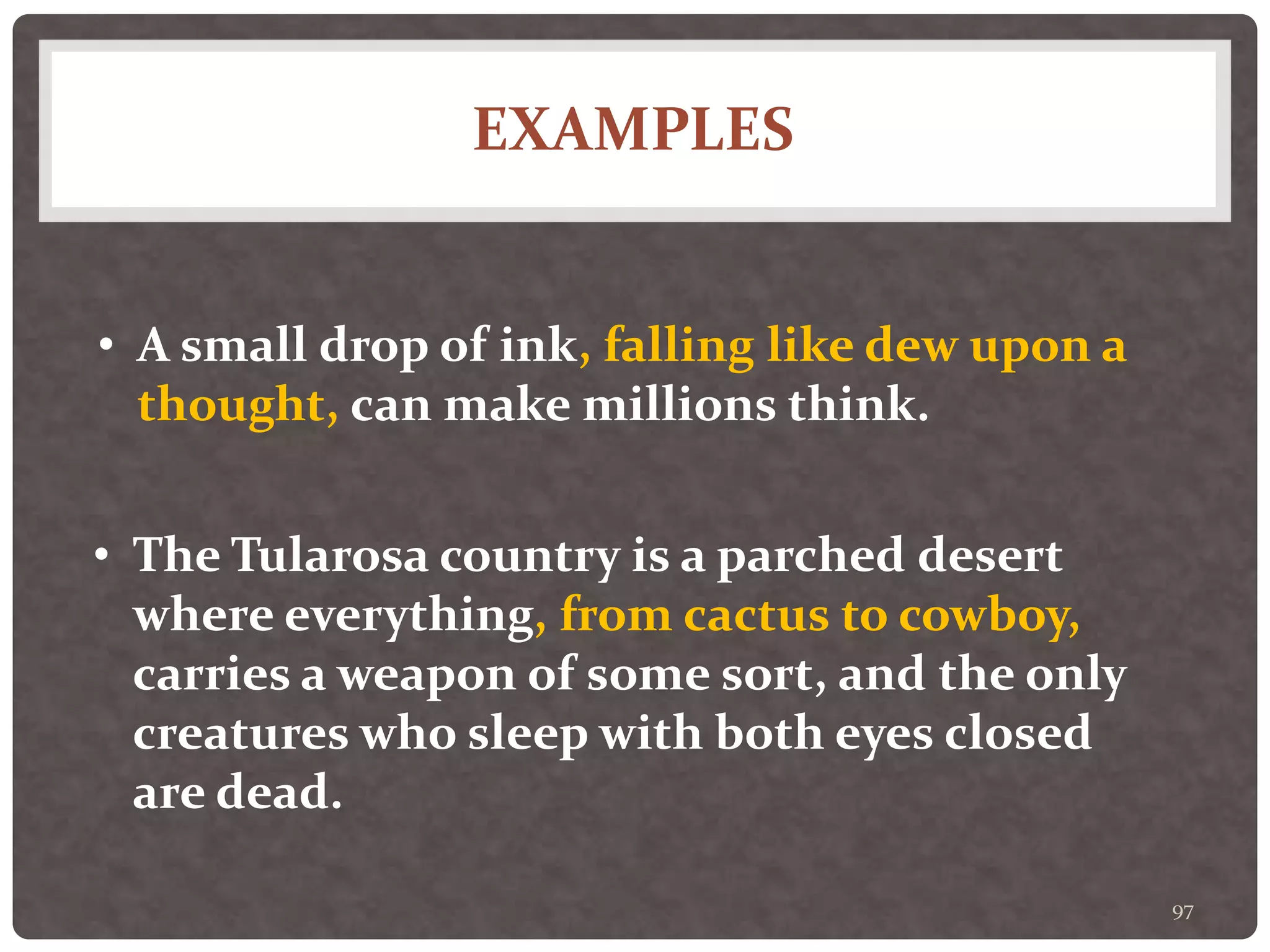
• A small drop of ink, falling like dew upon a
thought, can make millions think.
• The Tularosa country is a parched desert
where everything, from cactus to cowboy,
carries a weapon of some sort, and the only
creatures who sleep with both eyes closed
are dead.
98
PATTERN 11A
A FULL SENTENCE AS INTERRUPTING MODIFIER
INTERRUPTING WITH A STATEMENT, A
QUESTION, OR AN EXCLAMATION
99
• This variation does not require placement
between the subject and the verb.
• A full sentence question interrupter requires
a question mark; a full sentence exclamation
interrupter requires an exclamation mark (!).
• The comma, the dash, and the parenthesis--
each can be used with its different effect.
QUOTATIONS AS INTERRUPTERS
100
• A full quotation as interrupter is set off with
dashes, and requires quotation marks as well
as a period before the second dash.
• The captain's famous last words— “Iceberg? I
don’t see any iceberg.”—has gained notoriety
as a punch line in many a comedian’s
monologue.
101
PATTERN 12
INTRODUCTORY OR CONCLUDING PARTICIPLES
WHAT IS A PARTICIPLE?
102
• A participle is a word which is derived from a
verb
• A participle is a verb form used as an adjective
in a sentence.
• A participle may also be found together with a
non-inflected verb.
THE TASK OF AN ADJECTIVE
103
• An adjective provides information as to
“which one”, “how many”, or “what kind” of a
noun is in a phrase or clause.
Which one: the green book
How many: fifteen pencils
What kind: the marvelous dessert
PARTICIPLE AS ADJECTIVE
104
• Since a participle is derived from a verb, the
participle provides a little action along with
the job of an adjective.
• He ate a boiled egg for breakfast.
• I like to see smiling faces.
• The broken window was repaired.
PARTICIPIAL FORMS
105
• The participle/adjective requires one of two
endings:
an “ing” ending (present)
or
an “ed” or “en” (past)
• Use either ending, but remain consistent with
the main verb of the sentence.
PARTICIPLE PLUS VERB
106
• A verb and participle combination is common.
She is running.
He has eaten dinner already.
You are singing a good song.
• Notice that only certain verbs combine with
participles.
PARTICIPIAL PHRASE , S V
S V , PARTICIPIAL PHRASE
107
• A participle can be used alone or as a phrase.
• The single participle or participial phrase
modifies a noun.
• Exact placement in a sentence, therefore, is
important for two reasons:
--to make sure the reader understands
which noun is being modified
--to control the emphasis of the
modification in the sentence
EXAMPLES
108
Throwing rocks across the water, my
friend smiled.
• What is the participle?
• What noun is the participle modifying?
• What is “across the water”?
• Which word answers “what”? Which POS (part
of speech) answers the question “what”?
A FURTHER EXAMPLE
109
Food frozen for over five years tastes icky.
• What is the participial phrase?
• What is the main clause?
• What noun is the participial phrase
modifying?
FOR ANALYSIS
110
Appearing on television talk shows, crisscrossing
the country on the campus lecture circuit, invited
to be on important programs, fad theorists and
former criminals become the darlings of our
society before we forget and discard them for
others.
• Locate the participial modifiers.
• Determine their effectiveness.
111
PATTERN 13
A SINGLE MODIFIER OUT OF PL ACE FOR EMPHASIS
SENTENCE INVERSIONS
112
• The traditional format of beginning a sentence with a
subject and a verb followed by an object or a
complement is not cast in stone.
• Variations to this pattern add interest to writing.
• Variations include beginning a sentence with any
modifier, or with an object or complement.
• The inverted section can be a word, a phrase, or a
clause.
A WORD OF CAUTION
113
• Every sentence should conform to a writer’s
initial purpose.
• With purpose always in mind, the overuse of any
unique structure, including Pattern 13, is
minimized.
• Season your writing sparingly but effectively.
(MODIFIER…………., S V .)
THE MODIFIER MAY BE IN OTHER POSITIONS
114
Elfish green, the aurora borealis danced
hypnotically across the northern sky.
Empty, grotesque, the zombie’s eyes stared
directly at me.
PRECAUTIONS PUNCTUATING
115
• When inverting, a comma may be necessary
after the modifier to avoid ambiguity.
• Some words may appear as a different part
of speech than the one you intended.
116
“Inside the child was noisy.”
• The above is an example of a sentence
with an out of place modifier
•
• However, lacking a comma after “inside”,
the reader must determine if “inside” is
used as a preposition or as an adverb.
• Which did the writer mean?
THE INFINITIVE SPLIT
GOOD, BAD, INDIFFERENT?
117
“To be or not to be, that is the question.”
“To sometimes be, or not to always be, that is
the question.”
(The above infinitives are split.)
118
Rule of thumb: when writing with a
formal purpose, don’t split the infinitive.
(Don’t let a modifier get between “to”
and the verb form.)
To make quickly…
To ask politely…
To sever quickly…
To indulge completely…
To thank whole heartedly…
To mistake completely…
To walk stealthily…
To admonish critically…
To forsake utterly…
INVERSION ADDS RHYTHM
119
• Poets make judicious use of sentence
inversion.
• Check out this famous first line from
Robert Frost’s “Stopping By A Woods On
A Snowy Evening”:
120
“Whose woods these are I think
I know,
His house is in the village
though.”
I think I know whose woods these are,
(even) though his house is in the village.
121
PATTERN 14
A PREPOSITIONAL PHRASE BEFORE S AND V
PREPOSITION--
DEFINITION AND FUNCTION
122
• From the Greek: “to put in front” (pre-
position)
• A preposition shows the
connection/relationship between the noun that
follows it and other words in a sentence.
• The combination of a preposition and a noun
phrase is called a prepositional phrase.
DEFINITION AND FUNCTION,
CONTINUED
123
• Prepositions may be single words (simple) or
word groups (complex).
(after, against, behind, beyond, down, during, for, into, like, near, of,
over, through, under, with, etc.)
• Prepositional word groups may be two or three
words in length.
(along with, as well as, because of, by means of, close to, due to, in
back of, on account of, such as, together with, thanks to, up until,
with respect to, etc.)
EXAMPLES OF SENTENCES WITH
SINGLE WORD PREPOSITIONAL PHRASES
124
• “We must not confuse dissent with disloyalty.”
• “To this day, I remain impressed by the ability
of Britons of all ages and social backgrounds
to get genuinely excited by the prospect of a
hot beverage.”
• “For sixty years the ring lay quiet in Bilbo’s
keeping, prolonging his life, delaying old age.”
EXAMPLES OF SENTENCES WITH
COMPLEX PREPOSITIONS
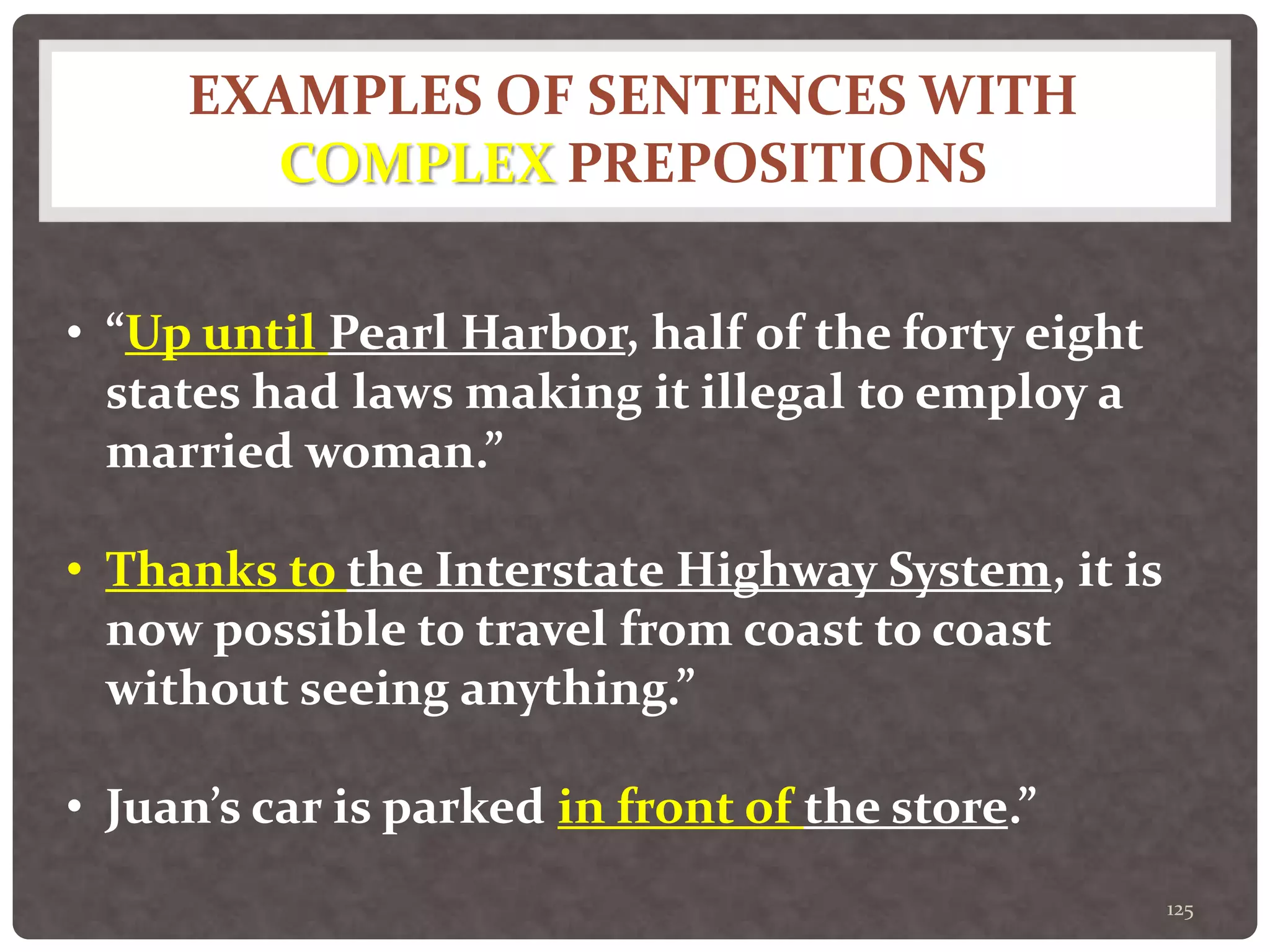
125
• “Up until Pearl Harbor, half of the forty eight
states had laws making it illegal to employ a
married woman.”
• Thanks to the Interstate Highway System, it is
now possible to travel from coast to coast
without seeing anything.”
• Juan’s car is parked in front of the store.”
FUNCTIONS OF PREPOSITIONAL
PHRASES
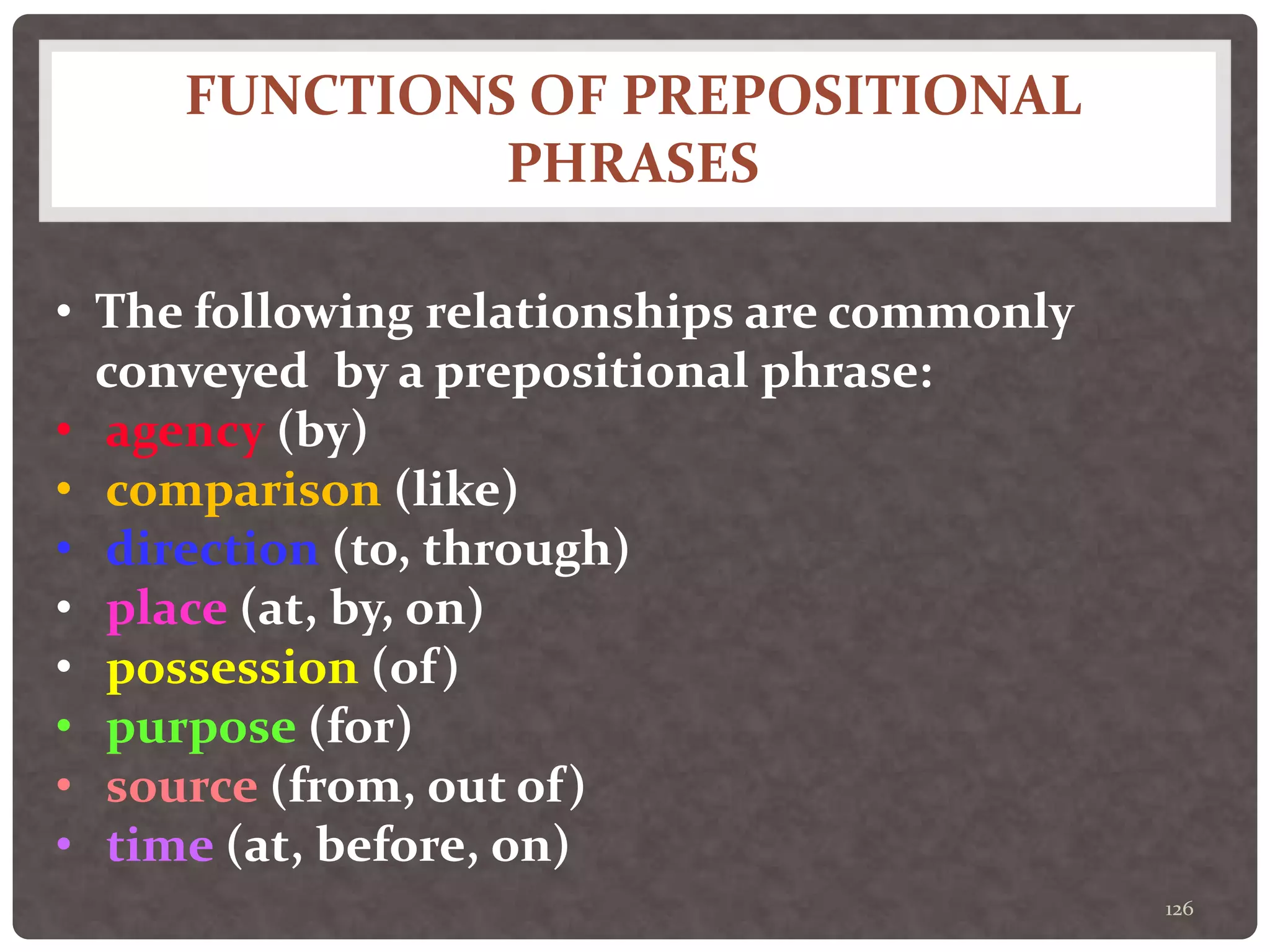
126
• The following relationships are commonly
conveyed by a prepositional phrase:
• agency (by)
• comparison (like)
• direction (to, through)
• place (at, by, on)
• possession (of)
• purpose (for)
• source (from, out of)
• time (at, before, on)
127
• Thus, one function of the
prepositional phrase is to modify or
provide additional information about
specific elements in a sentence.
PUNCTUATING PREPOSITIONAL
PHRASES
128
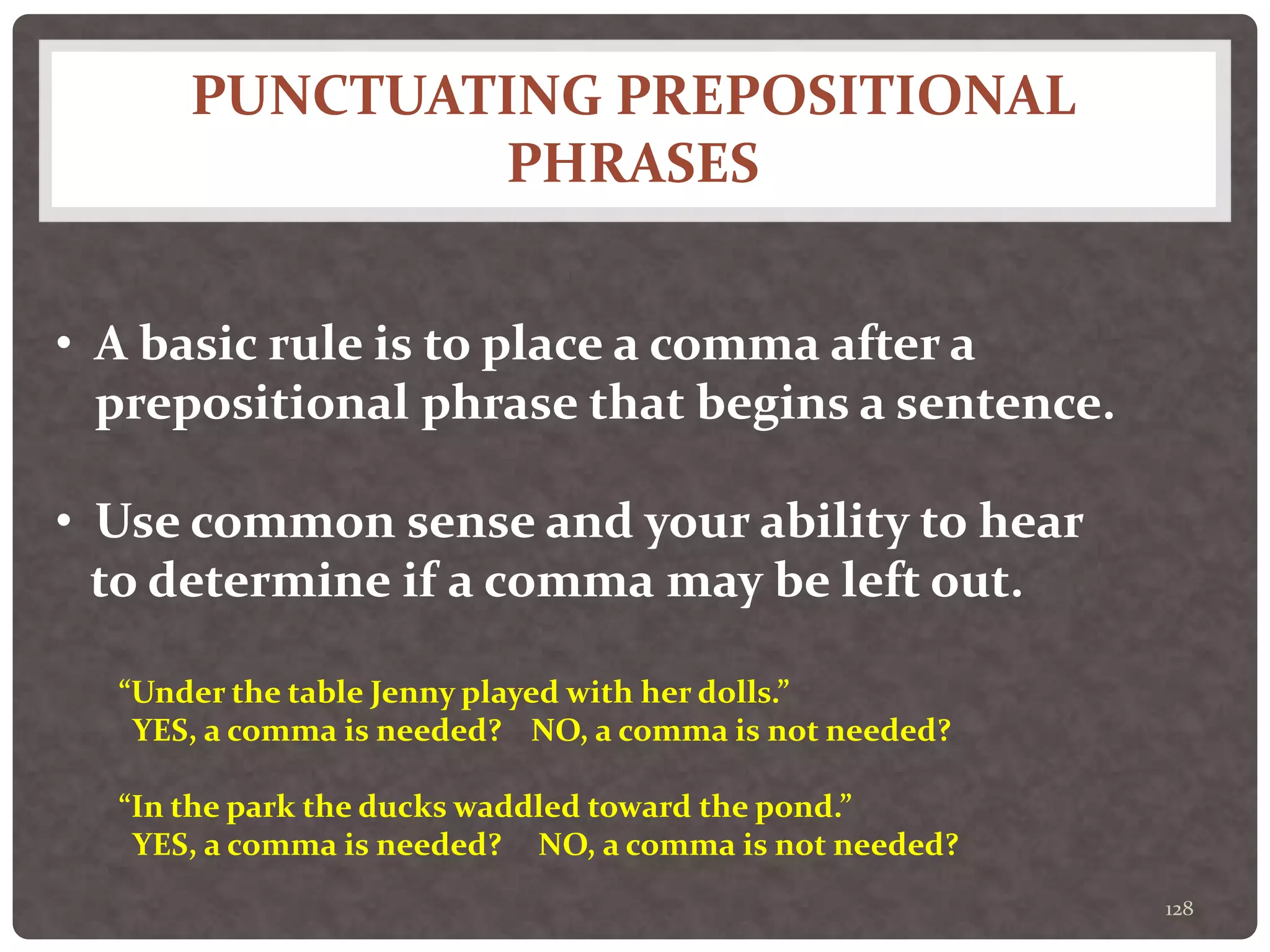
• A basic rule is to place a comma after a
prepositional phrase that begins a sentence.
• Use common sense and your ability to hear
to determine if a comma may be left out.
“Under the table Jenny played with her dolls.”
YES, a comma is needed? NO, a comma is not needed?
“In the park the ducks waddled toward the pond.”
YES, a comma is needed? NO, a comma is not needed?
129
PATTERN 15
OBJECTS OR COMPLEMENTS BEGINNING A SENTENCE
INVERTING THE NORMAL ORDER
130
• The first position in any sentence signifies
“highest importance”.
• Whichever sentence element appears first
emphasizes how the reader perceives that
element.
• Elements that normally appear after the verb,
when moved to the first position, create a
sentence inversion.
131
• Patterns 15 and 15a are similar to “Yoda
talk”*; always test the need as well as the
sound and rhythm of an inverted
sentence.
• Alongside euphony, the test will also
indicate if a comma is needed after the
inversion.
* allusion
EXAMPLES OF COMPLEMENTS BEFORE
THE SUBJECT AND VERB
132
• Lighter than air the dirigible is.
(Predicate Adjective)
• A mongrel that dog is.
(Predicate Nominative)
• Bruce she named the baby.
(Predicate Nominative)
Why is a comma not a good idea after “Bruce”?
What is the grammatical function of “Bruce” in the un-inverted
sentence? (She named the baby Bruce.)
133
PATTERN 15A
COMPLETE INVERSION OF NORMAL PATTERN
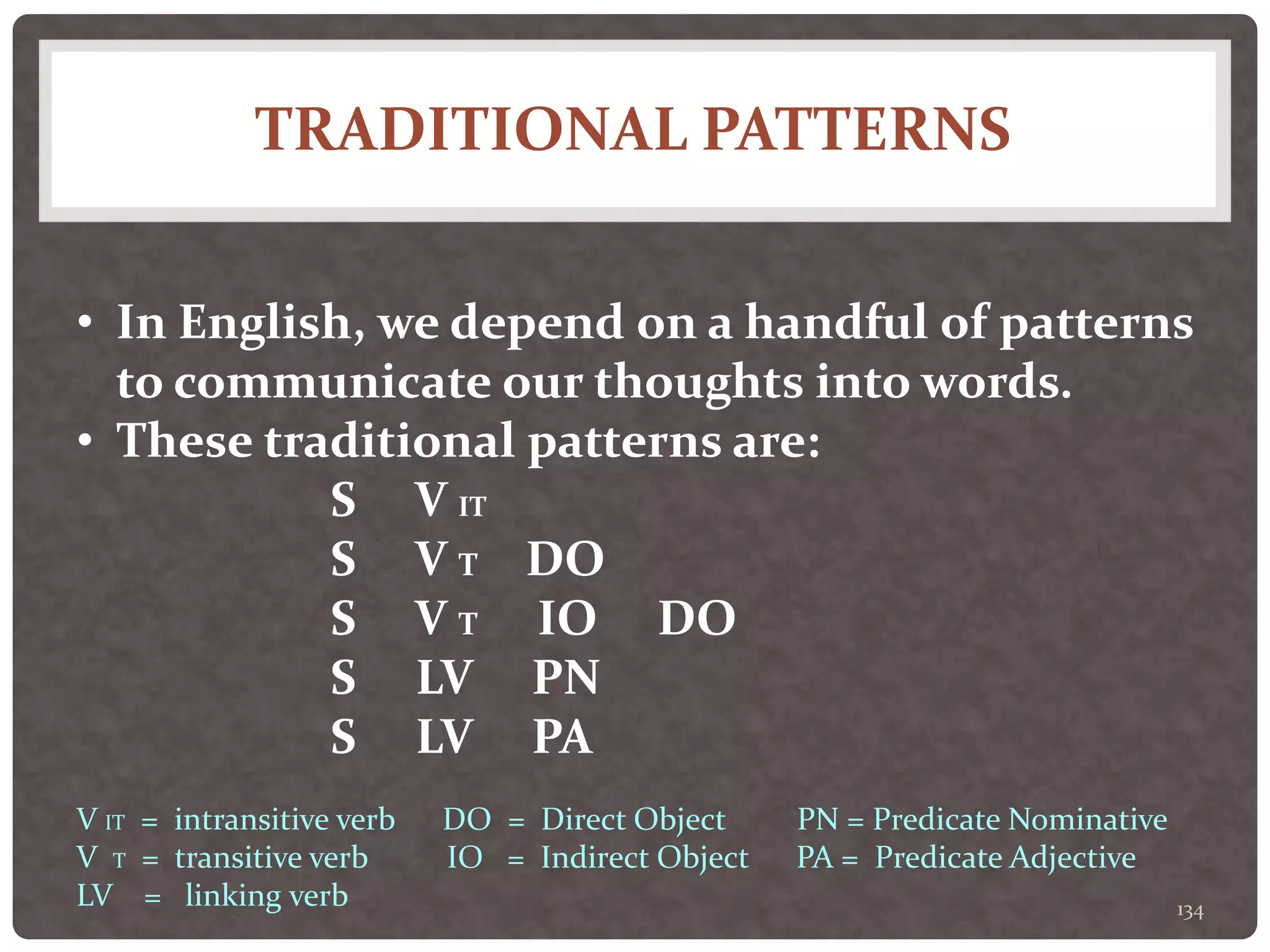
TRADITIONAL PATTERNS
134
• In English, we depend on a handful of patterns
to communicate our thoughts into words.
• These traditional patterns are:
S V IT
S V T DO
S V T IO DO
S LV PN
S LV PA
V IT = intransitive verb DO = Direct Object PN = Predicate Nominative
V T = transitive verb IO = Indirect Object PA = Predicate Adjective
LV = linking verb
135
• Changing the order of a traditional pattern
creates a unique emphasis
which cannot be overlooked by a
discerning reader.
• Remain aware that overuse of any novel
arrangement may create an undesired
response.
• Always test the sound and sense of this
pattern before publishing.
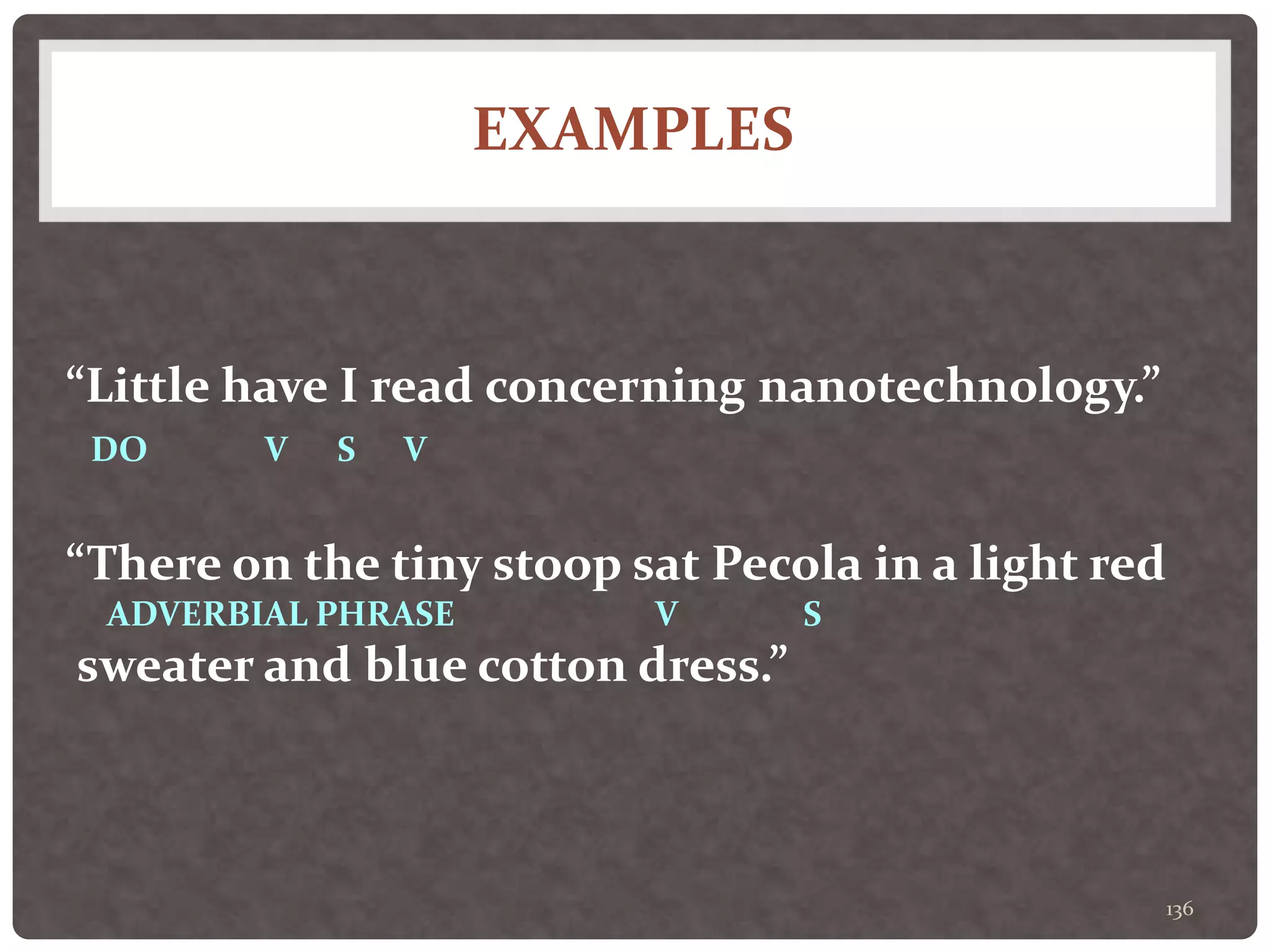
EXAMPLES
136
“Little have I read concerning nanotechnology.”
DO V S V
“There on the tiny stoop sat Pecola in a light red
ADVERBIAL PHRASE V S
sweater and blue cotton dress.”
137
PATTERN 16
PAIRED CONSTRUCTIONS
THE CORRELATIVE CONJUNCTION
138
• Recall that a single conjunction (FANBOYS)
joins two similar, grammatical structures:
two words (both the same part of speech)
two phrases (both grammatically similar)
two clauses (both dependent or independent)
139
Creating a paired construction
(useful in order to compare, to contrast, or to
compare/contrast in a single sentence)
requires a correlative conjunction.
140
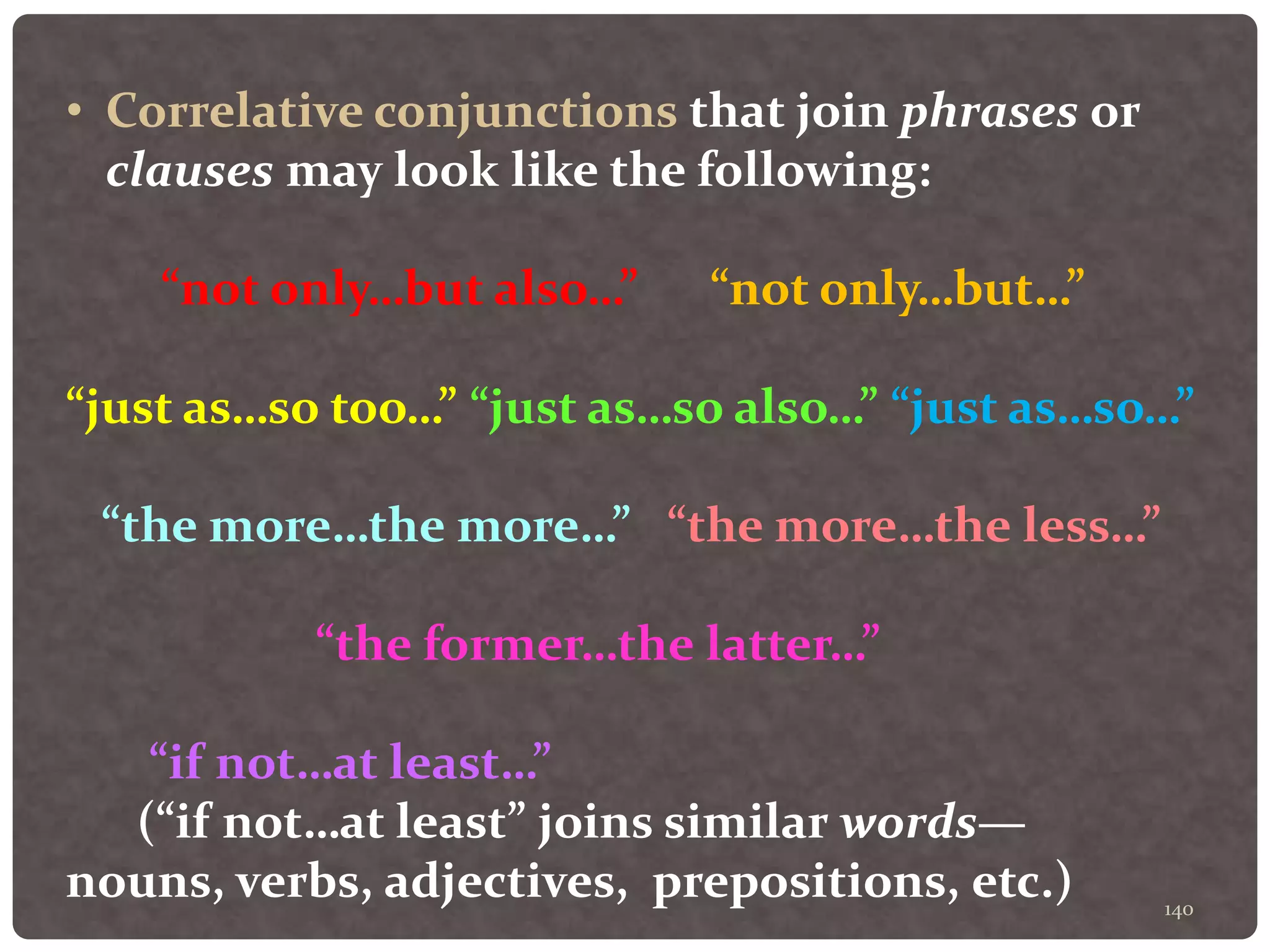
• Correlative conjunctions that join phrases or
clauses may look like the following:
“not only…but also…” “not only…but…”
“just as…so too…” “just as…so also…” “just as…so…”
“the more…the more…” “the more…the less…”
“the former…the latter…”
“if not…at least…”
(“if not…at least” joins similar words—
nouns, verbs, adjectives, prepositions, etc.)
141
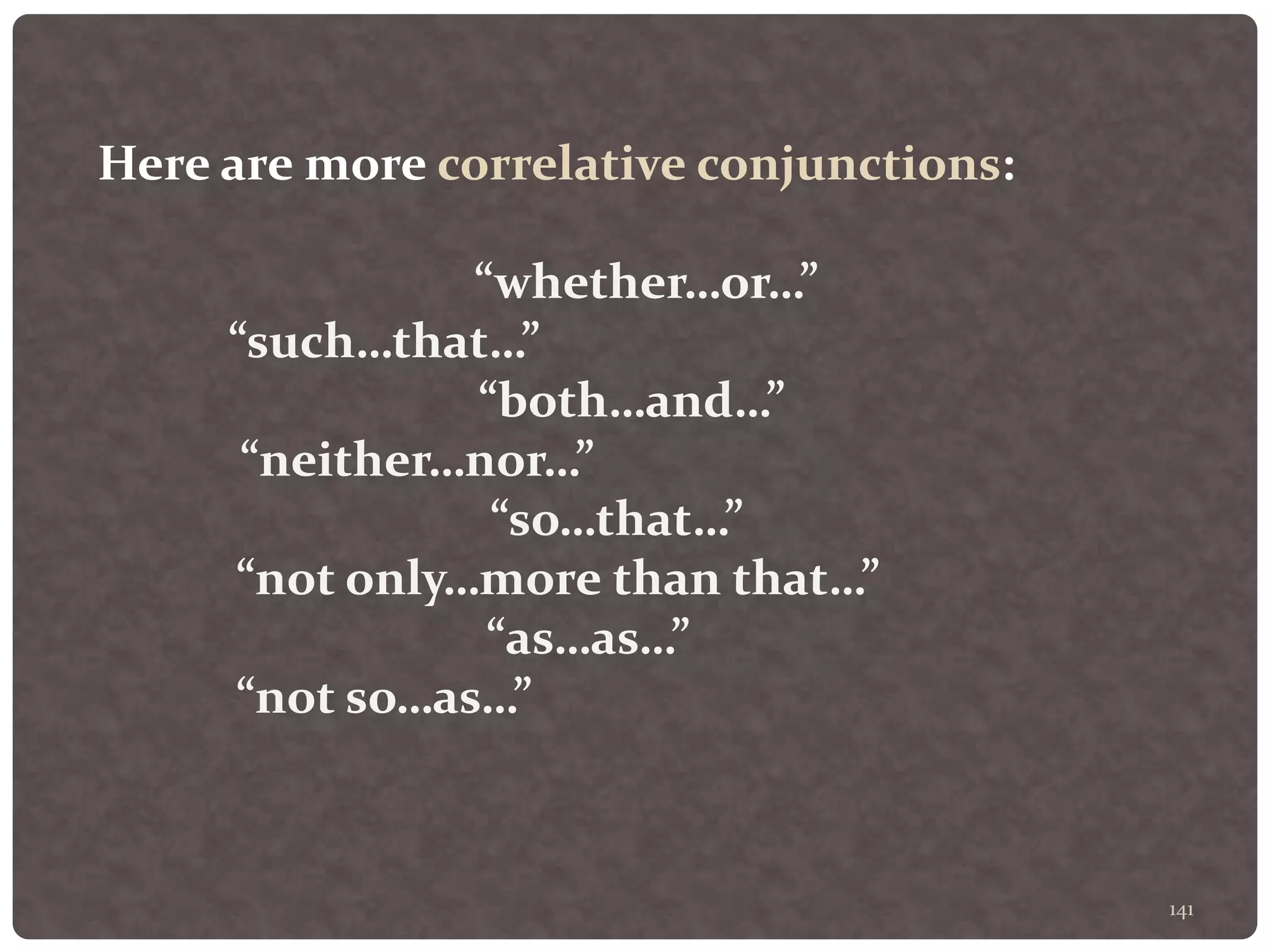
Here are more correlative conjunctions:
“whether…or…”
“such…that…”
“both…and…”
“neither…nor…”
“so…that…”
“not only…more than that…”
“as…as…”
“not so…as…”
EXAMPLES
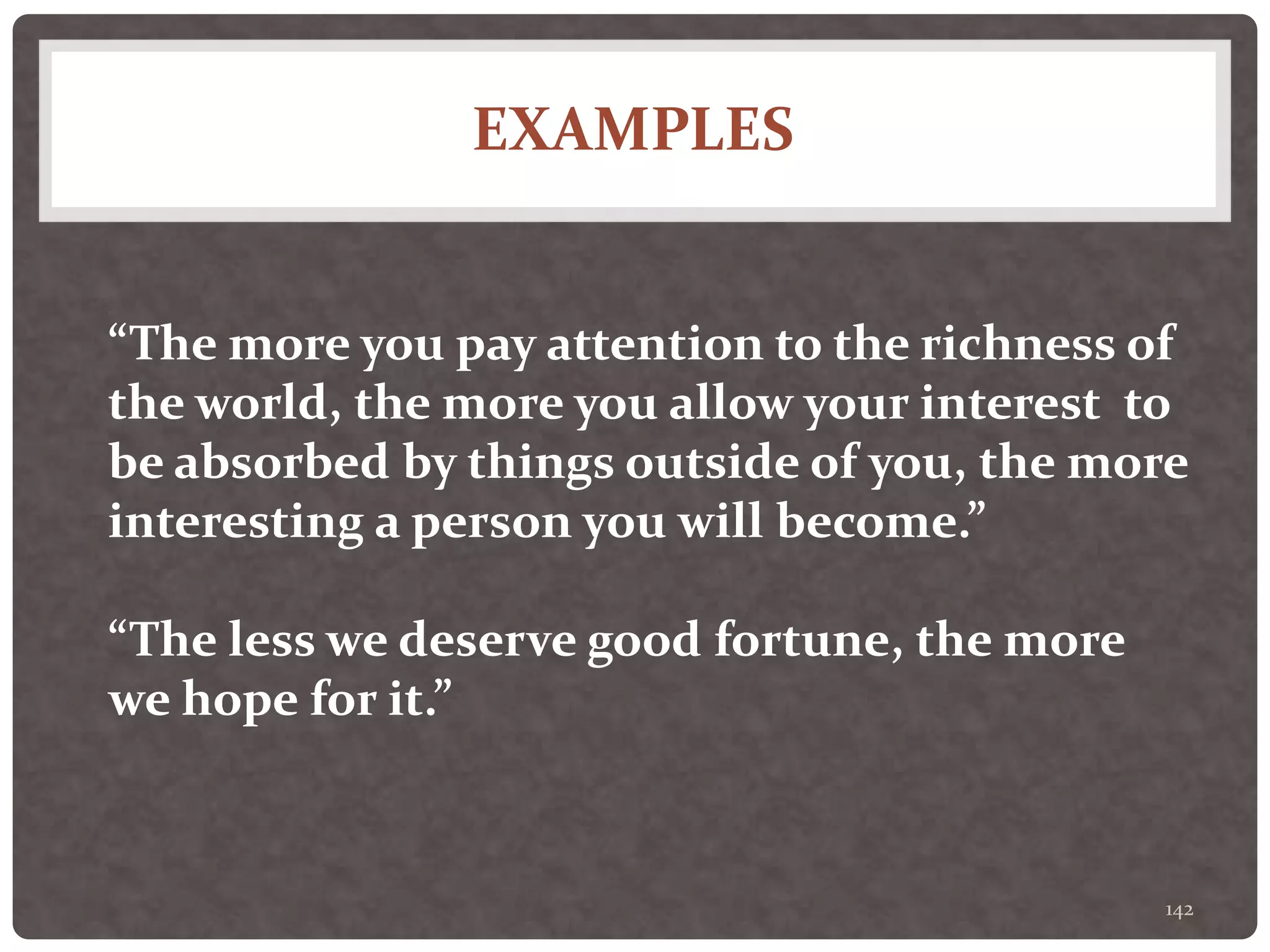
142
“The more you pay attention to the richness of
the world, the more you allow your interest to
be absorbed by things outside of you, the more
interesting a person you will become.”
“The less we deserve good fortune, the more
we hope for it.”
143
PATTERN 16A
A PAIRED CONSTRUCTION FOR CONTRAST ONLY
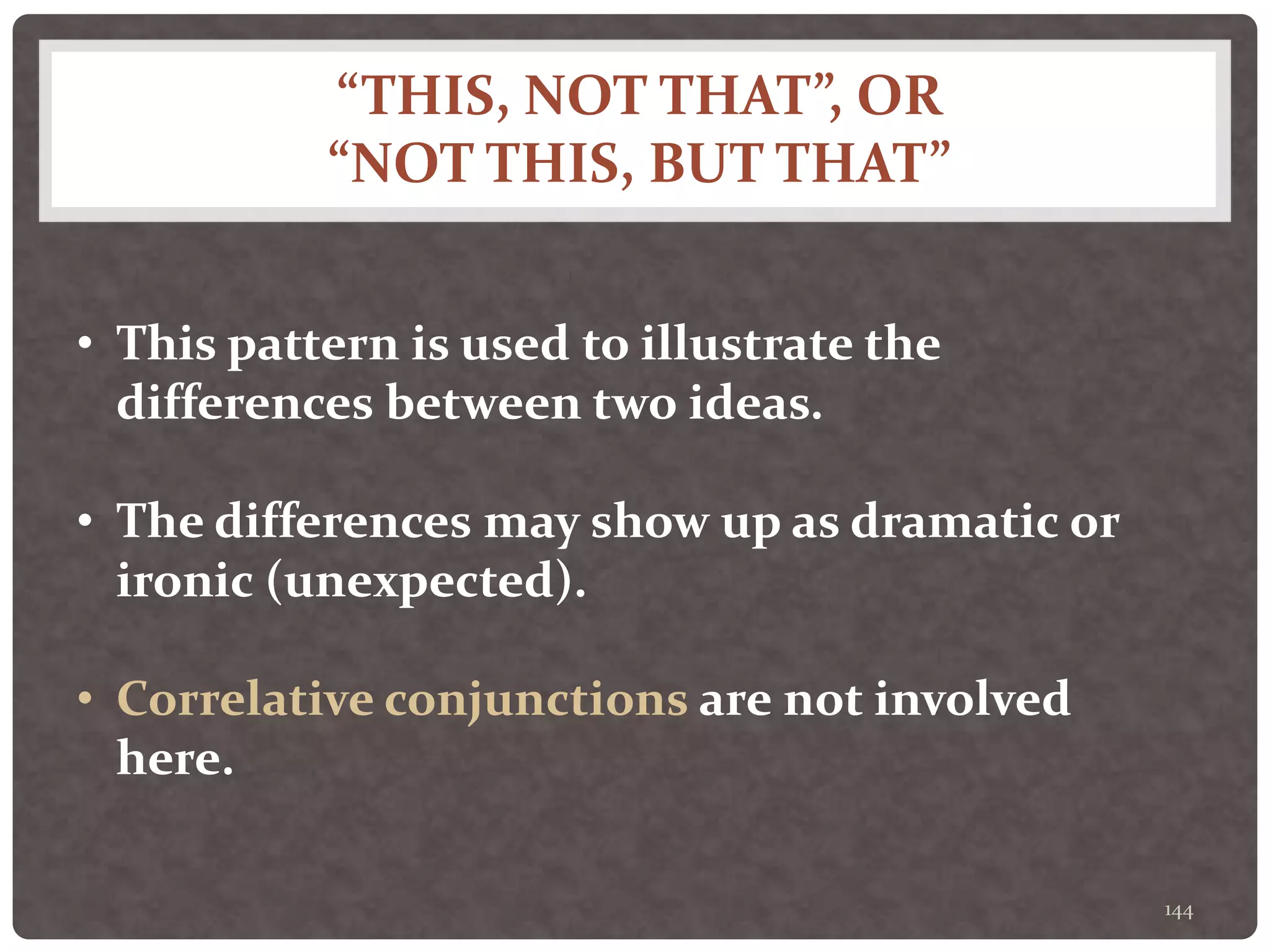
“THIS, NOT THAT”, OR
“NOT THIS, BUT THAT”
144
• This pattern is used to illustrate the
differences between two ideas.
• The differences may show up as dramatic or
ironic (unexpected).
• Correlative conjunctions are not involved
here.
EXAMPLES OF “THIS, NOT THIS”
CONSTRUCTIONS
145
“It was the best of times, it was the worst of
times, it was the age of wisdom, it was the age of
foolishness….”
“We must learn to live together as brothers or
perish together as fools.”
“The worst walls are never the ones you find in
your way. The worst walls are the ones you put
there—you build yourself.”

Twenty Sentence Patterns--a brief description of patterns 1 through 16a.

  • 1.
    CO N TRO L L I N G YO U R W R I T I N G W I T H S T Y L E TWENTY SENTENCE PATTERNS
  • 2.
    PATTERN 1 CO MP O U N D S E N T E N C E W I T H A S E M I CO L O N ( N O CO N J U N C T I O N ) 2
  • 3.
    DEFINITION OF TERMS IndependentClause—a group of words containing a subject and a verb; also known as a complete thought or a sentence Coordinating Conjunction—one of seven words which are used to join independent clauses; known by the acronym “fanboys”, they are “for, and, nor, but, or, yet, so”; always preceded by a comma (,)when joining clauses Semicolon (;)—a punctuation mark used instead of a conjunction when joining two independent clauses 3
  • 4.
    WHAT IS ACOMPOUND SENTENCE ? (ONE POSSIBLE ARRANGEMENT) combine to create a compound sentence 1. an independent clause followed by 2. either a comma (,) and one of seven possible conjunctions (for, and, nor, but, or, yet, so), 3. or a semicolon (;) without any conjunction 4. plus a second independent clause, related in idea to the first 4
  • 5.
    EXAMPLES OF COMPOUNDSENTENCES 5 “They may take our lives, but they will never take our freedom.”–Mel Gibson, Braveheart “The drought had lasted now for ten million years, and the reign of the terrible lizards had long since ended.” – Arthur C. Clark “Arguments are to be avoided; they are always vulgar and often convincing.”– Oscar Wilde • The compound sentence contains two ideas, each represented by an independent clause. • The ideas are balanced and of equal importance. • The relationship between the two ideas is suggested by the particular coordinating conjunction used.
  • 6.
    SENTENCE PATTERN 1 SV ; S V 6 1. Each sentence (independent clause) must be related in idea to the other. 2. Each sentence is joined to the other with a semicolon (;). 3. The resulting compound sentence matches the pattern symbolized above. “It was dawn outside, a glowing ray, and birds had plenty to say out in the bare trees; at the big window was a face and a windmill of arms.” How does the above sentence violate the rules of Pattern 1 while still managing to adhere to them?
  • 7.
    QUESTIONS 7 1. Explain therelationship created between two independent clauses joined by each of the following coordinating conjunctions: • and • but • or • a semicolon (;) 2. Explore the functional differences in a sentence between a colon (:) and a semicolon (;). • When would a colon be appropriate to join two independent clauses? • Speculate as to the origin of each mark based on the need to convey exact information in a sentence. 3. What is a conjunctive adverb? How does it allow for variation to Pattern 1?
  • 8.
    EXERCISES PATTERN 1 ANDVARIATIONS 8 1. A variation of Pattern 1 is the use of a conjunctive (connecting) adverb after the semicolon. Create three original sentences using just such a combination. 2. A second variation allows for the use of a coordinating (creates relationships) conjunction—remember “fanboys”?--within the independent clauses separated by a semicolon. This arrangement makes for longer independent clauses. Create three original sentences using such a combination. 3. A third variation allows a connection between a series of independent clauses (more than just two), using the semicolon instead of a coordinating conjunction or a conjunctive adverb. Create three such original sentences. 4. Does a semicolon act more like a coordinating conjunction or more like a conjunctive adverb?
  • 9.
    9 PATTERN 2 CO MP O U N D S E N T E N C E W I T H E L L I P T I C A L CO N S T R U C T I O N ( CO M M A I N D I C AT E S T H E O M I T T E D V E R B )
  • 10.
    DEFINITION OF TERMS 10 DirectObject • A NOUN that appears after a transitive verb in a sentence. • Always answers the question “what?” Subjective Complement • A NOUN or an ADJECTIVE that appears after a LINKING VERB in a sentence. • Provides information about the SUBJECT
  • 11.
    EXAMPLE OF ADIRECT OBJECT 11 The superstitious student always brings a rabbit’s foot to school on test days. subject transitive verb what? direct object
  • 12.
    EXAMPLE OF A SUBJECTIVECOMPLEMENT 12 The classroom was unbearable on the ninety- eight degree day. In many clinics the nurse practitioner is the caretaker for all patients. subject LV subjective complement subject LV subjective complement
  • 13.
    SENTENCE PATTERN 2 SV DO OR SC ; S , DO OR SC 13 1. Pattern 2 is similar to Pattern 1—two independent clauses joined by a semi-colon. 2. The difference is the verb in the second sentence is omitted if and only if it is the same verb as in the first sentence. 3. The wording in each independent clause must be parallel. 4. The comma tells the reader to supply the exact same verb.
  • 14.
    BEFORE USING 14 Make surethe verbs in each sentence are identical. Say the new sentence to yourself: does it sound rhythmical? Balanced? Remember: a semi-colon NEVER goes with a coordinating conjunction (FANBOYS).
  • 15.
    15 PATTERN 3 CO MP O U N D S E N T E N C E W I T H E X P L A N AT O RY S TAT E M E N T ( C L A U S E S S E PA R AT E D BY A CO L O N )
  • 16.
    DEFINITION OF TERMS 16 Colon(:) A mark of punctuation produced by placing two equal sized dots one over the other. A colon always signifies that the information following will clarify, define or sum up what came before. A colon also separates groups of numbers referring to different categories (i.e. 8:30—hours and minutes), or members of a ratio or proportion (i.e. 1 : 2 = 3 : 6). A colon also introduces a quotation or a series of elements in a sentence.
  • 17.
    SENTENCE PATTERN 3 GENERALSTATEMENT (IDEA) : SPECIFIC STATEMENT (EXAMPLE) 17 The first statement (before the colon) contains a word or an idea that needs explaining. The second statement (after the colon) provides an example or more information about that word or idea.
  • 18.
    EXAMPLES 18 Darwin’s The Originof Species forcibly states a harsh truth: Only the fittest survive. (what harsh truth?) Superman has extraordinary powers: He flies like a bird and has X-ray vision. (what extraordinary powers?) Note: capitalizing the first word after the colon is optional.
  • 19.
    REVIEW OF PATTERNS1, 2, AND 3 19 Pattern 1 makes two closely related statements about the same idea. The statements occur in two separate sentences joined by a semi-colon. Pattern 2 omits the exact same verb that occurs in the first sentence from the second sentence by placing a comma instead of the verb. A semi-colon joins the two clauses. Pattern 3 states an idea in the first independent clause and then amplifies or explains that idea in the second independent clause. The clauses are joined by a colon.
  • 20.
    20 PATTERNS DEALING WITHA SERIES PATTERNS 4 THROUGH 8
  • 21.
    21 PATTERN 4 A SE R I E S W I T H O U T A CO N J U N C T I O N ( A S E R I E S I N A N Y P L A C E I N T H E S E N T E N C E )
  • 22.
    DEFINITION OF TERMS 22 Aseries is a list, usually longer than two elements, of words, phrases, or clauses related in content and form to the main clause and to each other. In pattern 4, the elements in a series are separated by commas only. This construction is also known as ASYNDETON, a rhetorical device.
  • 23.
    SENTENCE PATTERN 4 23 Whento use: • to emphasize • to eliminate wordiness • to provide details
  • 24.
    EXAMPLES 24 The United Stateshas a government, of the people, by the people, for the people. I like burgers with everything on ‘em: pickles, onions, tomato, lettuce, plenty of mustard. I have come to you without sin, without guile, without evil, without witness against me.
  • 25.
    25 SENTENCE PATTERN 4A AS E R I E S W I T H A V A R I A T I O N A O R B O R C ( A N Y P L A C E I N T H E S E N T E N C E ) A A N D B A N D C ( A N Y P L A C E I N T H E S E N T E N C E )
  • 26.
    RATIONALE 26 A series witha conjunction between each element in the series creates a different effect with the reader. The different effect is due to the change of rhythm. This pattern is also called POLYSYNDETON, a specific rhetorical technique.
  • 27.
    EXAMPLES 27 “As long asrivers shall run down to the sea, or shadows touch the mountains, or stars graze in the vault of heaven [pattern 4a], so long as your honor, your name, your praises endure [pattern 4].” Many ice hockey games lead to broken ribs, or sprained knees, or dislocated shoulders—or even worse.
  • 28.
    PAY ATTENTION TO… 28 …therhythm or sound or clarity of your sentence when using patterns 4 and 4a.
  • 29.
    29 SENTENCE PATTERN 5 AS E R I E S O F B A L A N C E D P A I R S ( A A N D B , C A N D D , E A N D F ) T H E P A I R S M A Y F U L F I L L A N Y F U N C T I O N I N T H E S E N T E N C E
  • 30.
    LISTEN TO THEMUSIC 30 • A well crafted sentence draws attention to what is communicated. • The ear/brain pays attention to sound, especially deliberately arranged sound. • The patterns in series 4 through 8 allow the writer to exert a definite influence on any reader.
  • 31.
    CRAFTING PATTERN 5 31 1.What effect does a series of balanced pairs have on the sentence? 2. Which function would the balanced pairs fill? (subject, verb, object, complement?) 3. Are the elements in each pair progressing in an orderly fashion? 4. Upon reading, do the pairs sound rhythmical? 5. What conjunction will tie the pairs together?
  • 32.
    EXAMPLES 32 “The textbook clearlyshowed the distinctions between prose and poetry, denotation and connotation, deduction and induction.” What is the function of the series of balanced pairs in the above sentence? “Great artists often seem to occur in pairs: Michelangelo and da Vinci, Gaugin and van Gogh, Monet and Cezanne.” Analyze the above sentence as to the function of the balanced pairs.
  • 33.
    33 SENTENCE PATTERN 6 AN I N T R O D U C T O R Y S E R I E S O F A P P O S I T I V E S ( W I T H A D A S H — A N D A S U M M A R I Z I N G S U B J E C T ) A P P O S I T I V E , A P P O S I T I V E , A P P O S I T I V E — S U M M A R Y W O R D S V
  • 34.
    WHAT IS ANAPPOSITIVE? 34 Simply put, an appositive is a noun or a pronoun used to provide additional information for a particular noun appearing in a sentence. An appositive may either precede or follow the noun it explains. Appositive, noun.... Noun, appositive…. or
  • 35.
    EXAMPLES 35 Farmers try tocontrol the poinsettia whitefly, a pesticide-resistant superbug, by digging up entire fields of infested crops. Bonnaroo, a music festival stretching from rap and blues to classic rock, originated with jam band music, a niche movement for neo-hippies.
  • 36.
    A FURTHER EXAMPLE 36 Myblind date turned out to be a wonderful person—honest, fun loving, and affectionate. Notice the different ways to separate the appositives from the noun: commas or a dash. What else do you notice about the type of appositive and punctuation used?
  • 37.
    MORE EXAMPLES OFAPPOSITIVES 37 Stark, forbidding, awesome, spectacular— Death Valley is a hauntingly beautiful place to visit, despite its name. More European, more cosmopolitan— Shanghai is different from other Chinese cities.
  • 38.
    APPOSITIVES USED TOLINK SENTENCES 38 High on the list of America’s most successful food industries stands Duncan Hines. A man who never baked a cake in his life, Hines founded a multimillion-dollar food products company that names its line of premium cake mixes after him. • Where is the appositive? • How does the appositive link the sentences?
  • 39.
    PATTERN 6 APPOSITIVE, APPOSITIVE,APPOSITIVE— SUMMARY WORD S V. 39 A summary word–-a specific pronoun that comes before the subject--can be any of the following: such, all, those, this, many, each, which, what, these, something, someone The summary word may be the subject of the sentence or may simply modify the subject.
  • 40.
    PATTERN 6 ANOTHER WAYTO PUT WORDS IN A SERIES 40 Use any of the previous patterns for a series: • A series without a conjunction (A, B, C) • A series with a conjunction (A or B or C) • A series of balanced pairs (A and B , C and D , E and F) Bull riding, camel racing, bronc riding, roping— these events mean rodeo to many people; they mean money to the cowboys.
  • 41.
    41 PATTERN 7 AN INTERNALSERIES OF APPOSITIVES OR MODIFIERS
  • 42.
    VARIATIONS ON ASERIES 42 Appositives can appear anywhere in a sentence— as long as the noun that they rename is immediately before or after. In this pattern use appositives (“re-namers”) or modifiers (“describers”) in a series anywhere in the sentence (see above).
  • 43.
    A DRAMATIC INTERRUPTION 43 Dramaticin the sense that an unexpected focus is directed at a particular noun, the “Pattern 7” series infuses a sentence with interest. Keep in mind this distinction: appositives RENAME; modifiers DESCRIBE.
  • 44.
    PUNCTUATION IN PATTERN7 SENTENCES 44 • This dramatic interruption is designed to be a series. • A series needs commas between each element. • Consequently, dashes (--) must set off the appositives or modifiers. • An option to the dash is the parenthesis. • The parenthetical remark is stylistically considered as less important information.
  • 45.
    EXAMPLES OF APPOSITIVES 45 “ProfessorKnowsit described the political climate in three countries—Germany, Italy, Spain—that embraced the fascist movement.” “Jason cited three major qualities—anticipation, agility, fearlessness—that helped him as varsity goalie this year.”
  • 46.
    EXAMPLE OF APPOSITIVEWITH PARENTHESIS 46 The parenthesis suggests that the information is provided as a reminder, or is not required. “Remember the three components of a strong TES paragraph (topic, evidence, significance) when writing your final assignments.”
  • 47.
    47 PATTERN 7A A SINGLEAPPOSITIVE OR A PAIR
  • 48.
    PUNCTUATING PATTERN 7A 48 •Instead of a full series, this pattern uses only one or two appositives. • The interruption occurs immediately after the subject. • The effect can be altered depending on the punctuation used.
  • 49.
    DASH, PARENTHESIS, ORCOMMA? 49 Dashes indicate something dramatic. Parenthesis suggest less important information or an aside. Commas surrounding appositives provide a smoother connection to the rest of the sentence.
  • 50.
    EXAMPLES 50 “Half an hourafter the first diver surfaced empty handed, the second police diver returned with the same report—nothing.” “Satirist Al Yankovic (known as “Weird Al”) writes and performs many song and music video parodies.” In 1904, a St Louis doctor introduced peanut butter, a favorite of children, as a health food for the elderly.
  • 51.
    51 PATTERN 8 DEPENDENT CLAUSESIN A PAIR OR SERIES
  • 52.
    THE FINAL PATTERNUSING SERIES 52 All the clauses in the pattern 8 series must be • dependent, • parallel, and • related to the main clause either in condition, situation, or provision. The series may come at the beginning or at the end of a sentence.
  • 53.
    THE PATTERN 8FORMAT 53 If . . . , if . . . , if . . . , then S V. With . . . , with . . . , with . . . , S V. S V that . . . , that . . . , that . . . . (Using two dependent clauses is also fine; however, remain aware of the overall rhythm of the sentence.)
  • 54.
    USE WITH SPECIALOCCASIONS, 54 such as • ending a paragraph to summarize major points; • constructing a thesis containing two or three points; or • bringing together the main points of an essay in one sentence (in the introduction or conclusion). Strive for a natural, relaxed , graceful, and smooth sentence rhythm.
  • 55.
    EXAMPLE 55 “Whether Orwell wantedto mock society, whether he wanted to ridicule politicians, or whether he wanted to criticize communism, Animal Farm remains one of the best known works of allegorical literature.” (dependent, parallel, related in situation)
  • 56.
    ANOTHER EXAMPLE 56 “When Napoleontook over, when Snowball accepted exile, when Manor Farm fell, the element of dictatorship reared its ugly head.” (dependent, parallel, related in condition)
  • 57.
    A FURTHER EXAMPLE 57 “Withno equality, and with insufficient food, the animals decided to revolt against the humans.” (dependent, parallel, related in condition)
  • 58.
  • 59.
    WHAT ARE REPETITIONS? 59 Simplyput, repetition is the restatement of a particular element in a sentence. The element may be repeated once or more than once. The repetition may occur in a sentence or within a paragraph.
  • 60.
    WHY REPEAT? 60 Repeated wordsemphasize ideas the writer believes are important. Done well, the repeated words serve as echoic reminders for the reader, something like “I have seen that word before, connected with….” Skillfully placed within a paragraph, the repetitions serve to connect and emphasize ideas, as well as achieve unity and coherence.
  • 61.
    61 Careful! Needless repetition suggestslaziness on the writer’s part (did not bother to think of a synonymous word). Needless repetition also suggests the writer has a limited vocabulary (did not know a synonymous word existed). Both affect the credibility of the writer.
  • 62.
    HOW TO REPEAT 62 Choosea word that bears repeating. The repeated word should purposefully carry an important idea through one or more paragraphs. The repeated word may be used in any position in the sentences: as subject, as verb, as adjective, as adverb, as participle. Obviously, if used in different situations, the repeated word will change its form.
  • 63.
    63 A repeated wordthat changes form adds interest to the writing while still serving the task.
  • 64.
    WHERE TO REPEAT 64 •in the same sentence, but functioning differently (The repeated word comes after a dash [--] or a comma [,].) The repeated word may have a different form as a result of its different function in the sentence. (For example, the repeated word is first used as the subject, then as an adjective, or participle, or adverb in the same sentence.)
  • 65.
    65 • in thesame sentence, but used in the same function throughout (For example, the repeated word is used as the object of a series of prepositional phrases.)
  • 66.
    THE IMPACT OFPUNCTUATION 66 A comma signals a very brief pause. A dash signifies a dramatic, purposeful interruption. (use two hyphens --) A semi colon signifies a connection between two independent clauses. A colon suggests a series of explanatory terms or a defining or clarifying statement follows. Parentheses suggest the information contained within is more of a reminder than something new.
  • 67.
    67 PATTERN 9 REPETITION OFA KEY TERM IN A SENTENCE
  • 68.
    S V KEYTERM --/, REPEATED KEY TERM 68 Select a term with high importance. The term may be acting as the subject or as a modifier. Following a dash (--) or a comma, the word may change form depending on its use. Be careful! A comma splice error is created by separating two independent clauses with a comma. Following the comma or dash, the repeated term should be part of a dependent clause.
  • 69.
    EXAMPLE 1 69 “There arecouples who dislike one another furiously for several hours at a time; there are couples who dislike one another permanently; and there are couples who never dislike one another; but these last people are incapable of disliking anybody.” – George Bernard Shaw
  • 70.
    EXAMPLE 2 70 “A kleptomaniacis a person who helps himself because he can’t help himself.” –Henry Morgan
  • 71.
    EXAMPLE 3 71 “The manwho stood, who stood on sidewalks, who stood facing streets, who stood with his back against store windows or against the walls of buildings, never asked for money, never begged, never put his hand out.” --Gordon Lish
  • 72.
    AND FINALLY, EXAMPLE4 72 “She’s safe, just like I promised. She’s all set to marry Norrington, just like I promised. And you get to die for her, just like you promised.” --Jack Sparrow, Pirates of the Caribbean
  • 73.
    73 PATTERN 9A SAME WORDREPEATED IN PARALLEL STRUCTURE
  • 74.
    DIFFERENT FORMS OFREPETITION S V REPEATED KEY WORD (SAME FUNCTION IN THE SENTENCE) 74 1. Repeat an effective adjective or adverb in parallel construction. 2. Repeat the same preposition in a series. 3. Repeat the same noun as objects of different prepositions. 4. Repeat the same modifying word in phrases beginning with different prepositions. 5. Repeat the same intensifiers. 6.Repeat the same verb in the same or alternate forms.
  • 75.
    EXAMPLES 75 1. Repeating aneffective adjective or adverb in parallel construction. She has an incredibly satisfying life, satisfying because of her career and satisfying because of her family. 2. Repeat the same preposition in a series. He has known her for many years, before she went to college, before she was a star, before she won the Oscar. 3. Repeat the same noun as objects of different prepositions. The government is of the people, by the people, and for the people.
  • 76.
    EXAMPLES, CONTINUED 76 4. Repeatthe same modifying word in phrases with different prepositions. Sidney devoted his life to those selfish people, for their selfish cause, but clearly with his own selfish motives dominating his every action. 5. Repeat the same intensifiers. The baseball game was very exciting, very enjoyable, but very long. 6. Repeat the same verb in the same or alternate forms. In order to survive in a war, a person needs training, a person needs courage, and, most of all, a person needs luck.
  • 77.
    A LONGER EXAMPLE 77 Readthe following excerpt from Ernest Hemingway’s short story, “In Another Country”. Locate instances of Hemingway’s use of repetition.
  • 78.
    78 “We were allat the hospital every afternoon, and there were different ways of walking across the town through the dusk to the hospital. Two of the ways were alongside canals, but they were long. Always, though, you crossed a bridge across a canal to enter the hospital. There was a choice of three bridges. On one of them a woman was selling roasted chestnuts. It was warm standing in front of her charcoal fire, and the chestnuts were warm after- ward in your pocket. The hospital was very cold and very beautiful, and you entered through a gate and walked across a courtyard and out a gate on the other side. There were usually funerals starting from the courtyard. Beyond the old hospital were the new brick pavilions, and there we met every afternoon and were all very polite and interested in what was the matter, and sat in the machines that were to make so much difference.” --Ernest Hemingway, In Another Country
  • 79.
    79 What is theeffect of the prose crafted by Hemingway? What is missing from Hemingway’s prose? What various examples of repetition can you locate?
  • 80.
  • 81.
    A COUPLE OFDEFINITIONS 81 Emphatic -- adjective: from the Greek, which originally meant “to present” or “to show” and later evolved to mean “giving extra stress to a word or a phrase” to imply meaning beyond the literal.
  • 82.
    82 Appositive: a nounor a noun phrase placed next to another noun in a sentence. The appositive and the first noun are syntactically related; that is, they share the same function. The appositive restates, or amplifies the meaning of the first noun.
  • 83.
    83 Colon: a markof punctuation which follows a word or a sentence. The colon introduces additional information in a sentence, information in the form of a quotation, a definition, an explanation, or a series.
  • 84.
    84 Pattern 10 stylisticallysaves the additional information until the end of a sentence. The resulting delay creates a slightly heightened sense of expectation. The delay also emphasizes the word or phrase after the colon.
  • 85.
    85 When using acolon in Pattern 10, remember that the colon functions as a period, or “full stop.” A complete sentence must precede the colon. The colon then alerts the reader to the information that follows.
  • 86.
    SIMILAR PATTERNS 86 Pattern 3also uses a colon; however, Pattern 3 requires a complete sentence after the colon. Pattern 10 allows for a single word or a phrase after the colon .
  • 87.
    EXAMPLES 87 “On the inside,the Valero store looked like a cornucopia of imitation, heavily processed food items: pink ‘Twinkies’, bright yellow corn chips, neon orange ‘Cheetos’, steaming red ‘Red Hots’, and other like entities that we eat too much of.” “Her suitcases had been filled to the top with what she considered necessities: cosmetics, jewelry, and other expensive accessories.”
  • 88.
  • 89.
    A DASH OFEMPHASIS 89 • As in Pattern 9, the dash precedes a repetition or a renaming of the key term or noun in the independent clause. • In Pattern 10a, the “renaming” appositive, following the dash, is short and emphatic. • In a word processing program, always construct a dash by using two hyphens (--).
  • 90.
    CAREFUL! 90 • What precedesthe dash is a full sentence. • What follows the dash is a single word, a phrase, or a series. • A “dash-splice” error occurs by joining two independent clauses (sentences) with a dash. • A “comma-splice” error occurs by joining two independent clauses (sentences) with a comma.
  • 91.
    EXAMPLES 91 “A person’s teenageyears are filled with exciting challenges and haunted by only a single, ugly specter -- homework.” “My favorite color is the color of the sky -- blue.” “In The Hunger Games there are only two true warriors -- Katniss Everdeen and Peeta Mellark.”
  • 92.
  • 93.
    RECALL THE FOLLOWING: 93 •Modifiers can be a single word, or a phrase, or a clause. • Modifiers work well to create a sensory image or to include a figurative element in a sentence.
  • 94.
    94 • Place anymodification immediately before or after the word being clarified. • Appositives are modifiers. (see Patterns 6, 7, and 7a, 10 and 10a)
  • 95.
    95 PATTERN 11 A NI N T E R R U P T I N G M O D I F I E R B E T W E E N T H E S U B J E C T A N D T H E V E R B
  • 96.
    DRAMATIC SIGNALING S, MODIFIER,V S –MODIFIER– V S (WHISPERED MODIFIER) V 96 • This Pattern is similar to Patterns 10 and 10a; however, in Pattern 11 a variety of possible modifiers, rather than just appositives, intensify the sentence. • A choice of punctuation sets off the modifier: a comma, a dash, or a pair of parentheses.
  • 97.
    EXAMPLES 97 • A smalldrop of ink, falling like dew upon a thought, can make millions think. • The Tularosa country is a parched desert where everything, from cactus to cowboy, carries a weapon of some sort, and the only creatures who sleep with both eyes closed are dead.
  • 98.
    98 PATTERN 11A A FULLSENTENCE AS INTERRUPTING MODIFIER
  • 99.
    INTERRUPTING WITH ASTATEMENT, A QUESTION, OR AN EXCLAMATION 99 • This variation does not require placement between the subject and the verb. • A full sentence question interrupter requires a question mark; a full sentence exclamation interrupter requires an exclamation mark (!). • The comma, the dash, and the parenthesis-- each can be used with its different effect.
  • 100.
    QUOTATIONS AS INTERRUPTERS 100 •A full quotation as interrupter is set off with dashes, and requires quotation marks as well as a period before the second dash. • The captain's famous last words— “Iceberg? I don’t see any iceberg.”—has gained notoriety as a punch line in many a comedian’s monologue.
  • 101.
    101 PATTERN 12 INTRODUCTORY ORCONCLUDING PARTICIPLES
  • 102.
    WHAT IS APARTICIPLE? 102 • A participle is a word which is derived from a verb • A participle is a verb form used as an adjective in a sentence. • A participle may also be found together with a non-inflected verb.
  • 103.
    THE TASK OFAN ADJECTIVE 103 • An adjective provides information as to “which one”, “how many”, or “what kind” of a noun is in a phrase or clause. Which one: the green book How many: fifteen pencils What kind: the marvelous dessert
  • 104.
    PARTICIPLE AS ADJECTIVE 104 •Since a participle is derived from a verb, the participle provides a little action along with the job of an adjective. • He ate a boiled egg for breakfast. • I like to see smiling faces. • The broken window was repaired.
  • 105.
    PARTICIPIAL FORMS 105 • Theparticiple/adjective requires one of two endings: an “ing” ending (present) or an “ed” or “en” (past) • Use either ending, but remain consistent with the main verb of the sentence.
  • 106.
    PARTICIPLE PLUS VERB 106 •A verb and participle combination is common. She is running. He has eaten dinner already. You are singing a good song. • Notice that only certain verbs combine with participles.
  • 107.
    PARTICIPIAL PHRASE ,S V S V , PARTICIPIAL PHRASE 107 • A participle can be used alone or as a phrase. • The single participle or participial phrase modifies a noun. • Exact placement in a sentence, therefore, is important for two reasons: --to make sure the reader understands which noun is being modified --to control the emphasis of the modification in the sentence
  • 108.
    EXAMPLES 108 Throwing rocks acrossthe water, my friend smiled. • What is the participle? • What noun is the participle modifying? • What is “across the water”? • Which word answers “what”? Which POS (part of speech) answers the question “what”?
  • 109.
    A FURTHER EXAMPLE 109 Foodfrozen for over five years tastes icky. • What is the participial phrase? • What is the main clause? • What noun is the participial phrase modifying?
  • 110.
    FOR ANALYSIS 110 Appearing ontelevision talk shows, crisscrossing the country on the campus lecture circuit, invited to be on important programs, fad theorists and former criminals become the darlings of our society before we forget and discard them for others. • Locate the participial modifiers. • Determine their effectiveness.
  • 111.
    111 PATTERN 13 A SINGLEMODIFIER OUT OF PL ACE FOR EMPHASIS
  • 112.
    SENTENCE INVERSIONS 112 • Thetraditional format of beginning a sentence with a subject and a verb followed by an object or a complement is not cast in stone. • Variations to this pattern add interest to writing. • Variations include beginning a sentence with any modifier, or with an object or complement. • The inverted section can be a word, a phrase, or a clause.
  • 113.
    A WORD OFCAUTION 113 • Every sentence should conform to a writer’s initial purpose. • With purpose always in mind, the overuse of any unique structure, including Pattern 13, is minimized. • Season your writing sparingly but effectively.
  • 114.
    (MODIFIER…………., S V.) THE MODIFIER MAY BE IN OTHER POSITIONS 114 Elfish green, the aurora borealis danced hypnotically across the northern sky. Empty, grotesque, the zombie’s eyes stared directly at me.
  • 115.
    PRECAUTIONS PUNCTUATING 115 • Wheninverting, a comma may be necessary after the modifier to avoid ambiguity. • Some words may appear as a different part of speech than the one you intended.
  • 116.
    116 “Inside the childwas noisy.” • The above is an example of a sentence with an out of place modifier • • However, lacking a comma after “inside”, the reader must determine if “inside” is used as a preposition or as an adverb. • Which did the writer mean?
  • 117.
    THE INFINITIVE SPLIT GOOD,BAD, INDIFFERENT? 117 “To be or not to be, that is the question.” “To sometimes be, or not to always be, that is the question.” (The above infinitives are split.)
  • 118.
    118 Rule of thumb:when writing with a formal purpose, don’t split the infinitive. (Don’t let a modifier get between “to” and the verb form.) To make quickly… To ask politely… To sever quickly… To indulge completely… To thank whole heartedly… To mistake completely… To walk stealthily… To admonish critically… To forsake utterly…
  • 119.
    INVERSION ADDS RHYTHM 119 •Poets make judicious use of sentence inversion. • Check out this famous first line from Robert Frost’s “Stopping By A Woods On A Snowy Evening”:
  • 120.
    120 “Whose woods theseare I think I know, His house is in the village though.” I think I know whose woods these are, (even) though his house is in the village.
  • 121.
    121 PATTERN 14 A PREPOSITIONALPHRASE BEFORE S AND V
  • 122.
    PREPOSITION-- DEFINITION AND FUNCTION 122 •From the Greek: “to put in front” (pre- position) • A preposition shows the connection/relationship between the noun that follows it and other words in a sentence. • The combination of a preposition and a noun phrase is called a prepositional phrase.
  • 123.
    DEFINITION AND FUNCTION, CONTINUED 123 •Prepositions may be single words (simple) or word groups (complex). (after, against, behind, beyond, down, during, for, into, like, near, of, over, through, under, with, etc.) • Prepositional word groups may be two or three words in length. (along with, as well as, because of, by means of, close to, due to, in back of, on account of, such as, together with, thanks to, up until, with respect to, etc.)
  • 124.
    EXAMPLES OF SENTENCESWITH SINGLE WORD PREPOSITIONAL PHRASES 124 • “We must not confuse dissent with disloyalty.” • “To this day, I remain impressed by the ability of Britons of all ages and social backgrounds to get genuinely excited by the prospect of a hot beverage.” • “For sixty years the ring lay quiet in Bilbo’s keeping, prolonging his life, delaying old age.”
  • 125.
    EXAMPLES OF SENTENCESWITH COMPLEX PREPOSITIONS 125 • “Up until Pearl Harbor, half of the forty eight states had laws making it illegal to employ a married woman.” • Thanks to the Interstate Highway System, it is now possible to travel from coast to coast without seeing anything.” • Juan’s car is parked in front of the store.”
  • 126.
    FUNCTIONS OF PREPOSITIONAL PHRASES 126 •The following relationships are commonly conveyed by a prepositional phrase: • agency (by) • comparison (like) • direction (to, through) • place (at, by, on) • possession (of) • purpose (for) • source (from, out of) • time (at, before, on)
  • 127.
    127 • Thus, onefunction of the prepositional phrase is to modify or provide additional information about specific elements in a sentence.
  • 128.
    PUNCTUATING PREPOSITIONAL PHRASES 128 • Abasic rule is to place a comma after a prepositional phrase that begins a sentence. • Use common sense and your ability to hear to determine if a comma may be left out. “Under the table Jenny played with her dolls.” YES, a comma is needed? NO, a comma is not needed? “In the park the ducks waddled toward the pond.” YES, a comma is needed? NO, a comma is not needed?
  • 129.
    129 PATTERN 15 OBJECTS ORCOMPLEMENTS BEGINNING A SENTENCE
  • 130.
    INVERTING THE NORMALORDER 130 • The first position in any sentence signifies “highest importance”. • Whichever sentence element appears first emphasizes how the reader perceives that element. • Elements that normally appear after the verb, when moved to the first position, create a sentence inversion.
  • 131.
    131 • Patterns 15and 15a are similar to “Yoda talk”*; always test the need as well as the sound and rhythm of an inverted sentence. • Alongside euphony, the test will also indicate if a comma is needed after the inversion. * allusion
  • 132.
    EXAMPLES OF COMPLEMENTSBEFORE THE SUBJECT AND VERB 132 • Lighter than air the dirigible is. (Predicate Adjective) • A mongrel that dog is. (Predicate Nominative) • Bruce she named the baby. (Predicate Nominative) Why is a comma not a good idea after “Bruce”? What is the grammatical function of “Bruce” in the un-inverted sentence? (She named the baby Bruce.)
  • 133.
  • 134.
    TRADITIONAL PATTERNS 134 • InEnglish, we depend on a handful of patterns to communicate our thoughts into words. • These traditional patterns are: S V IT S V T DO S V T IO DO S LV PN S LV PA V IT = intransitive verb DO = Direct Object PN = Predicate Nominative V T = transitive verb IO = Indirect Object PA = Predicate Adjective LV = linking verb
  • 135.
    135 • Changing theorder of a traditional pattern creates a unique emphasis which cannot be overlooked by a discerning reader. • Remain aware that overuse of any novel arrangement may create an undesired response. • Always test the sound and sense of this pattern before publishing.
  • 136.
    EXAMPLES 136 “Little have Iread concerning nanotechnology.” DO V S V “There on the tiny stoop sat Pecola in a light red ADVERBIAL PHRASE V S sweater and blue cotton dress.”
  • 137.
  • 138.
    THE CORRELATIVE CONJUNCTION 138 •Recall that a single conjunction (FANBOYS) joins two similar, grammatical structures: two words (both the same part of speech) two phrases (both grammatically similar) two clauses (both dependent or independent)
  • 139.
    139 Creating a pairedconstruction (useful in order to compare, to contrast, or to compare/contrast in a single sentence) requires a correlative conjunction.
  • 140.
    140 • Correlative conjunctionsthat join phrases or clauses may look like the following: “not only…but also…” “not only…but…” “just as…so too…” “just as…so also…” “just as…so…” “the more…the more…” “the more…the less…” “the former…the latter…” “if not…at least…” (“if not…at least” joins similar words— nouns, verbs, adjectives, prepositions, etc.)
  • 141.
    141 Here are morecorrelative conjunctions: “whether…or…” “such…that…” “both…and…” “neither…nor…” “so…that…” “not only…more than that…” “as…as…” “not so…as…”
  • 142.
    EXAMPLES 142 “The more youpay attention to the richness of the world, the more you allow your interest to be absorbed by things outside of you, the more interesting a person you will become.” “The less we deserve good fortune, the more we hope for it.”
  • 143.
    143 PATTERN 16A A PAIREDCONSTRUCTION FOR CONTRAST ONLY
  • 144.
    “THIS, NOT THAT”,OR “NOT THIS, BUT THAT” 144 • This pattern is used to illustrate the differences between two ideas. • The differences may show up as dramatic or ironic (unexpected). • Correlative conjunctions are not involved here.
  • 145.
    EXAMPLES OF “THIS,NOT THIS” CONSTRUCTIONS 145 “It was the best of times, it was the worst of times, it was the age of wisdom, it was the age of foolishness….” “We must learn to live together as brothers or perish together as fools.” “The worst walls are never the ones you find in your way. The worst walls are the ones you put there—you build yourself.”