Writing 101


Conjunctions
Learning Objectives

    To learn about the use of conjunctions.

    To understand how to enhance sentences using
    conjunctions.
Introduction

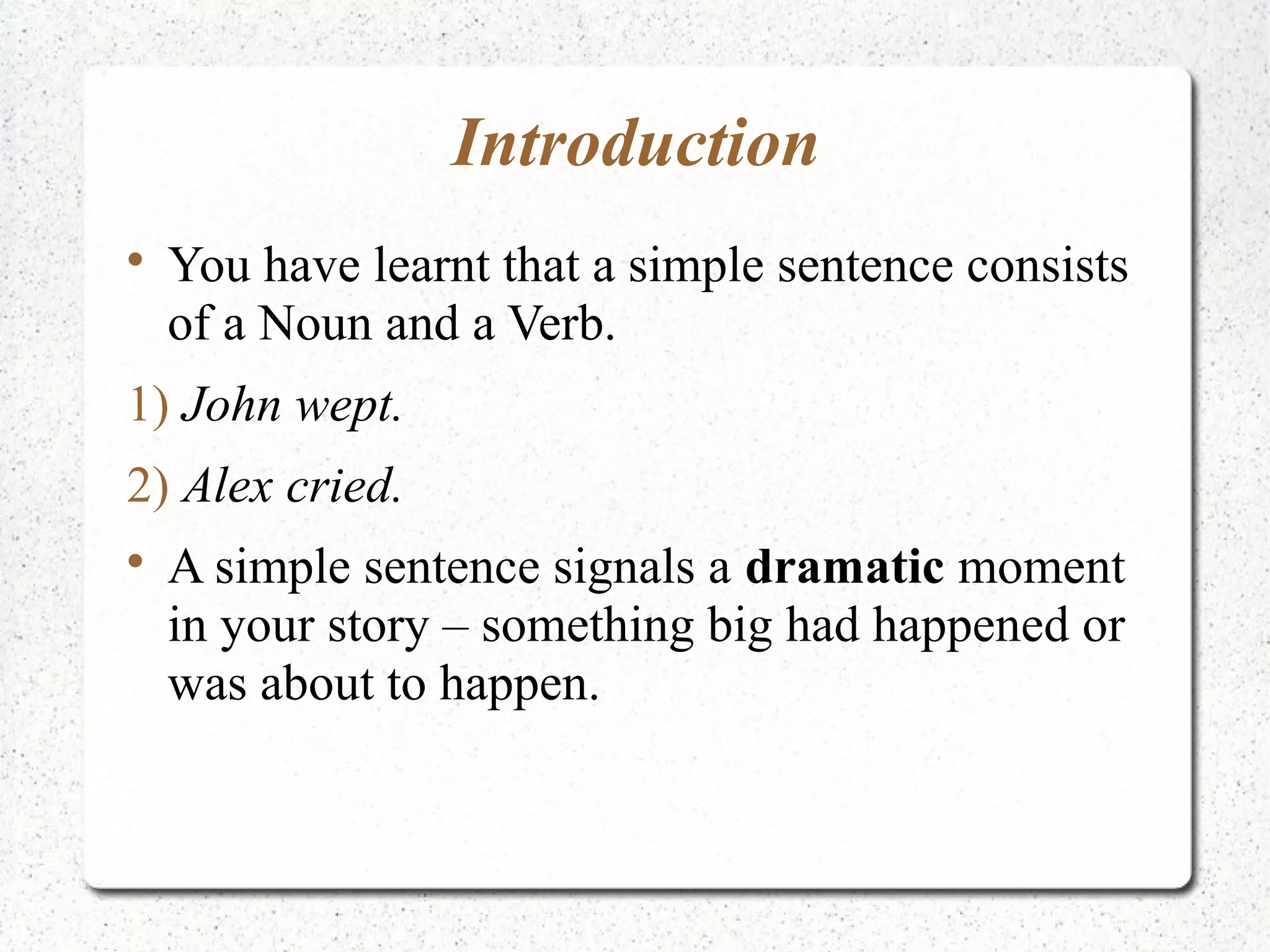
    You have learnt that a simple sentence consists
    of a Noun and a Verb.
1) John wept.
2) Alex cried.

    A simple sentence signals a dramatic moment
    in your story – something big had happened or
    was about to happen.
Simple Sentence

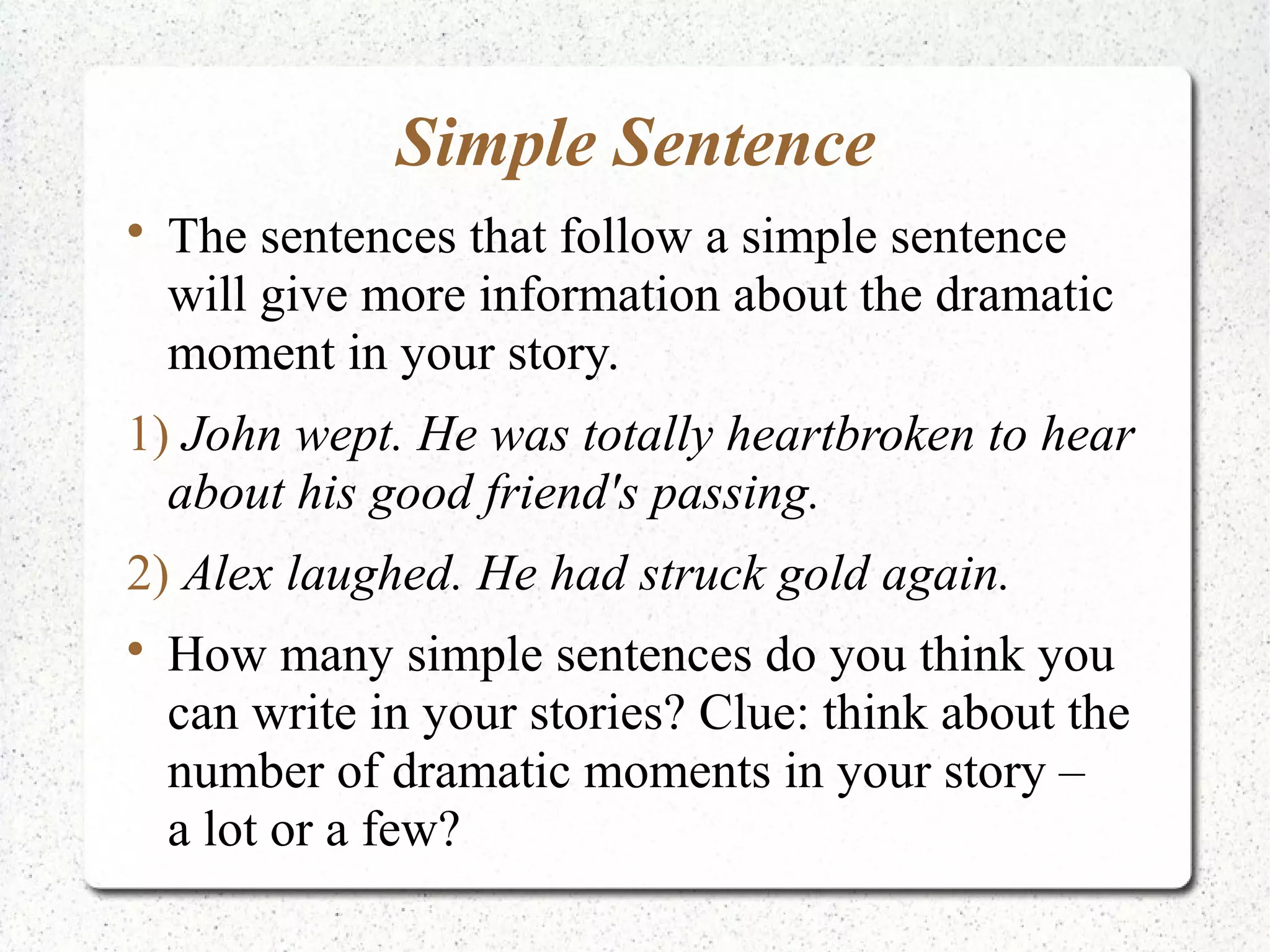
    The sentences that follow a simple sentence
    will give more information about the dramatic
    moment in your story.
1) John wept. He was totally heartbroken to hear
  about his good friend's passing.
2) Alex laughed. He had struck gold again.

    How many simple sentences do you think you
    can write in your stories? Clue: think about the
    number of dramatic moments in your story –
    a lot or a few?
Enhancing Sentences

    You have learnt that sentences can be enhanced
    with additional parts of speech in the form of
    Adjectives and Adverbs.
1) Poor John wept. (adjective)
2) Alex laughed non-stop. (adverb)

    It gives the sentence more meaning.

    What other adjectives and adverbs can you
    think of?
Enhancing Sentences

    You have learnt that sentences can be enhanced
    with phrases too.
1) Poor little John the orphan wept. (adjectival
  and noun phrase)
2) Alex laughed out loud in the classroom. (verb
  and adverbial phrase)

    A phrase gives a sentence more meaning. Like
    a single-word descriptive word, it enhances it.
Connecting Sentences

    Often, even with the help of descriptive words
    and phrases, a single sentence is insufficient.

    We use conjunctions to connect two sentences
    together.

    They are called Coordinating Conjunctions
    and Subordinating Conjunctions.
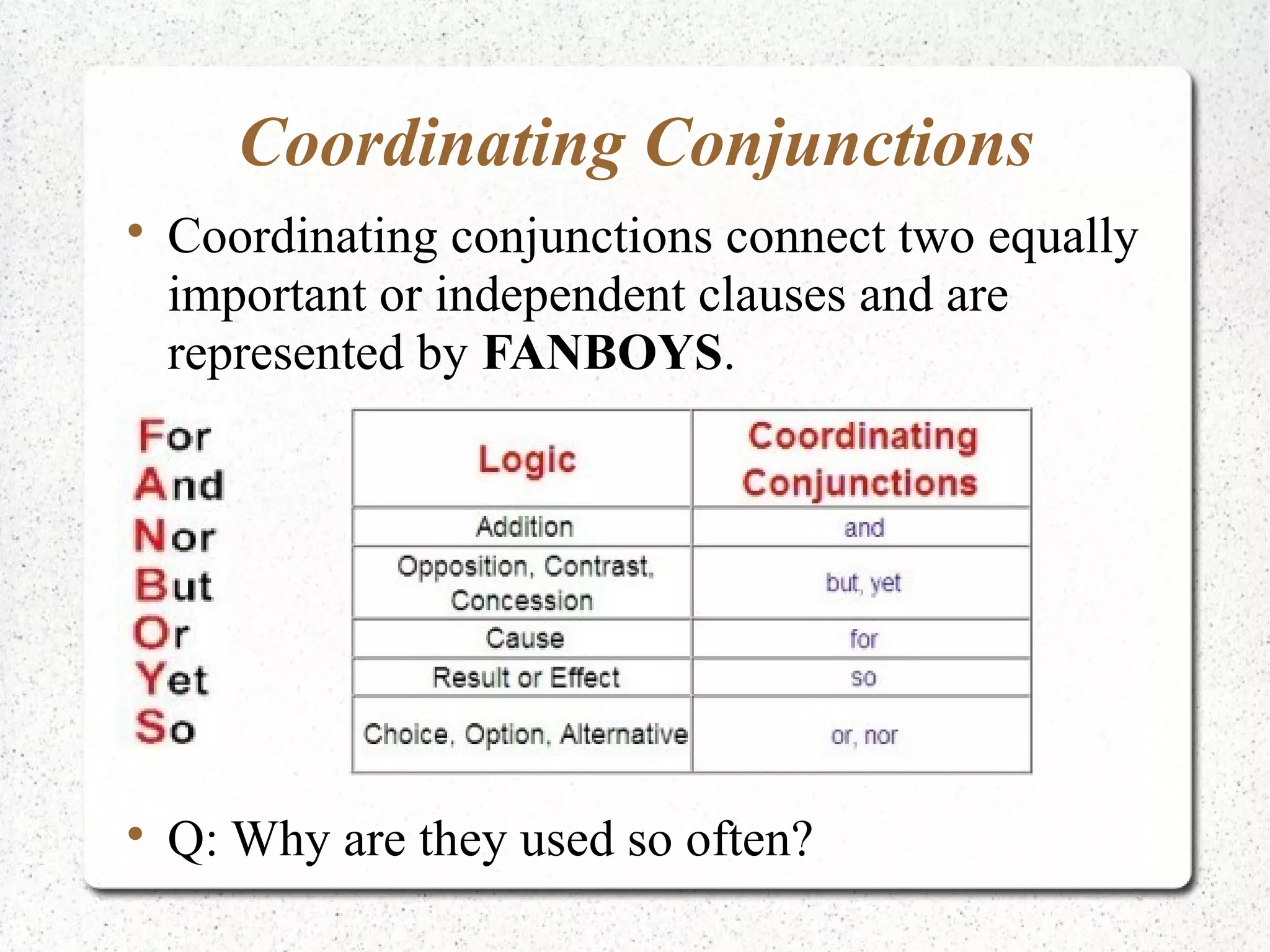
Coordinating Conjunctions

    Coordinating conjunctions connect two equally
    important or independent clauses and are
    represented by FANBOYS.



    Q: Why are they used so often?
Coordinating Conjunctions

    Coordinating conjunctions connect two
    different and equally important ideas.
1) Poor little John the orphan wept yet he was
  determined to live a great life.
2) Alex laughed out loud in the classroom but he
  was not punished for his action.

    Q: Which of the conjunction in FANBOYS do
    you use most often?
Subordinating Conjunctions

    Subordinating means 'following'. Subordinating
    conjunctions connect two sentences but one
    follows the other.

    This means one sentence carries the main idea
    and the other, a secondary idea.
1) Poor little John the orphan wept because he
  was sad.
2) Alex laughed out loud in the classroom
  although the teacher asked him not to.

    Q: Can you tell which is the main idea?
Learning Activity

    With either coordinating or subordinating
    conjunctions, complete the following sentences.
1) He walked off..
2) I laughed out loud...
3) Alex did not want to lose his toy gun...
4) He ran for shelter...

    Remember to include descriptive words and/or
    phrases in your sentences too.
Learning Activity Answers
Some suggested answers:
1) He walked off and he was never seen again.
2) I laughed out loud but in my heart, I was sad.
3) Alex did not want to lose his toy gun because it
  was a birthday gift from his grandmother.
4) He ran for shelter since it was about to rain.
Discussion

    Why do we need to enhance simple sentences?

    What do we use to enhance simple sentences?

    What do we do when a single sentence is not
    enough to say what we want to say?
In Summary

    A simple sentence with only a noun and verb is
    too simple to show any meaning.

    We use descriptive words and phrases to
    enhance simple sentences.

    When more information is needed, we use
    subordinating and coordinating conjunctions to
    connect two sentences

Lower Pri C - Fanboys

  • 1.
  • 2.
    Learning Objectives  To learn about the use of conjunctions.  To understand how to enhance sentences using conjunctions.
  • 3.
    Introduction  You have learnt that a simple sentence consists of a Noun and a Verb. 1) John wept. 2) Alex cried.  A simple sentence signals a dramatic moment in your story – something big had happened or was about to happen.
  • 4.
    Simple Sentence  The sentences that follow a simple sentence will give more information about the dramatic moment in your story. 1) John wept. He was totally heartbroken to hear about his good friend's passing. 2) Alex laughed. He had struck gold again.  How many simple sentences do you think you can write in your stories? Clue: think about the number of dramatic moments in your story – a lot or a few?
  • 5.
    Enhancing Sentences  You have learnt that sentences can be enhanced with additional parts of speech in the form of Adjectives and Adverbs. 1) Poor John wept. (adjective) 2) Alex laughed non-stop. (adverb)  It gives the sentence more meaning.  What other adjectives and adverbs can you think of?
  • 6.
    Enhancing Sentences  You have learnt that sentences can be enhanced with phrases too. 1) Poor little John the orphan wept. (adjectival and noun phrase) 2) Alex laughed out loud in the classroom. (verb and adverbial phrase)  A phrase gives a sentence more meaning. Like a single-word descriptive word, it enhances it.
  • 7.
    Connecting Sentences  Often, even with the help of descriptive words and phrases, a single sentence is insufficient.  We use conjunctions to connect two sentences together.  They are called Coordinating Conjunctions and Subordinating Conjunctions.
  • 8.
    Coordinating Conjunctions  Coordinating conjunctions connect two equally important or independent clauses and are represented by FANBOYS.  Q: Why are they used so often?
  • 9.
    Coordinating Conjunctions  Coordinating conjunctions connect two different and equally important ideas. 1) Poor little John the orphan wept yet he was determined to live a great life. 2) Alex laughed out loud in the classroom but he was not punished for his action.  Q: Which of the conjunction in FANBOYS do you use most often?
  • 10.
    Subordinating Conjunctions  Subordinating means 'following'. Subordinating conjunctions connect two sentences but one follows the other.  This means one sentence carries the main idea and the other, a secondary idea. 1) Poor little John the orphan wept because he was sad. 2) Alex laughed out loud in the classroom although the teacher asked him not to.  Q: Can you tell which is the main idea?
  • 11.
    Learning Activity  With either coordinating or subordinating conjunctions, complete the following sentences. 1) He walked off.. 2) I laughed out loud... 3) Alex did not want to lose his toy gun... 4) He ran for shelter...  Remember to include descriptive words and/or phrases in your sentences too.
  • 12.
    Learning Activity Answers Somesuggested answers: 1) He walked off and he was never seen again. 2) I laughed out loud but in my heart, I was sad. 3) Alex did not want to lose his toy gun because it was a birthday gift from his grandmother. 4) He ran for shelter since it was about to rain.
  • 13.
    Discussion  Why do we need to enhance simple sentences?  What do we use to enhance simple sentences?  What do we do when a single sentence is not enough to say what we want to say?
  • 14.
    In Summary  A simple sentence with only a noun and verb is too simple to show any meaning.  We use descriptive words and phrases to enhance simple sentences.  When more information is needed, we use subordinating and coordinating conjunctions to connect two sentences