Ancient Greek Theater The background and original purpose of our modern day popular entertainment.
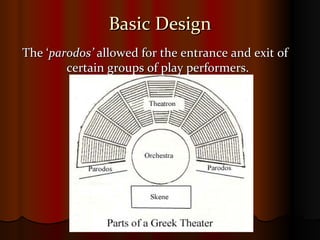
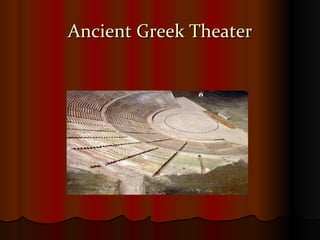
The “seeing place” The Greek word ‘ theatron’ (lit. “seeing place”) serves as the  basis of our  word “theater”. The Greek   theater   reveals three major parts 1. ‘orkestra’  (our  orchestra )—literally, “the dancing place” 2. ‘ skene’  (our  scene )—literally “backdrop” 3. ‘ theatron’ —semi-circular amphitheater seating
Basic Design The ‘ parodos’  allowed for the entrance and exit of    certain groups of play performers.
The challenges of presenting outdoor ancient theater No artificial lighting No electronic amplification Considerable distance from the performers--visibility Stone seats Maintaining audience interest—plays were performed all day
Ancient Greek Theater
Greek response to the limitations of their medium All performances were held in daylight Performers wore masks which served to amplify a  stentorian  voice. Masks often were larger than life—characters were more easily recognized from afar. Characters moved in an identifiable, stylized manner. Plays were written and performed for competition—who will win?
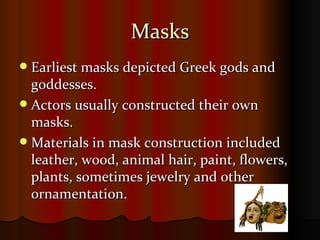
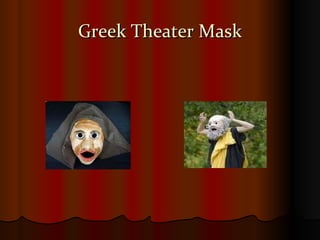
Masks Earliest masks depicted Greek gods and goddesses. Actors usually constructed their own masks. Materials in mask construction included leather, wood, animal hair, paint, flowers, plants, sometimes jewelry and other ornamentation.
Greek Theater Mask
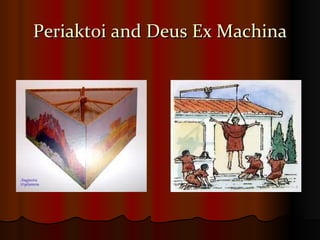
Further details of the Greek theater The ‘ skene ’ served many functions, from a palace or house to, in later years, a support for various backdrops. The backdrops, or ‘ pinakes ’, allowed changes in place to occur. Later, ‘ periaktois ’, or prism shaped devices, were revolved to reveal changes in location.  The ‘ skene ’ later concealed the ‘ mechane ’, the machine, or crane, (sometimes called  deus ex   machina)  that raised and lowered characters for dramatic effect.
Periaktoi and Deus Ex Machina
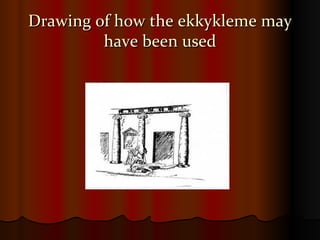
Additional Details “ Props” or physical properties were used to enhance the believability of place in the play. Drums were used to suggest thunder. Action was an important element in the plays. An ‘ ekkykleme ’, or “thing that rolls”, was used to bring in any “bodies” resulting from off stage killing. No deadly violence was ever depicted on stage during a Greek play.
Drawing of how the ekkykleme may have been used
Historical Details Ancient Greek theater flourished between about 550 and 220 BCE. (How many years ago was that?) “Flourished” means all the citizens expected to see plays at some point during the year. Athens, a city-state, was the center of Greek theater. During the theater event, businesses shut down, out of town visitors arrived, prisoners were temporarily released.
Types of Plays Performed Three major categories of drama competed for  prizes during the play festival: Comedic plays Tragic plays Satyr plays A drama (from the Dorian Greek,  drân,  “to do”) is a literary composition written to be performed by actors.
Comedy Comedies (from the Dorian Greek,  komodoi, “band of outcasts, wanderers”,  and  komoedia, “ song of the   outcasts, wanderers ”)  were short pieces performed between the longer tragic plays. The comedies originally crudely mocked just about any well known, unpopular political opponent or object of dislike. Comedies gradually evolved (450BCE-250BCE) from course mockery to more sophisticated attempts to showcase society’s foibles.
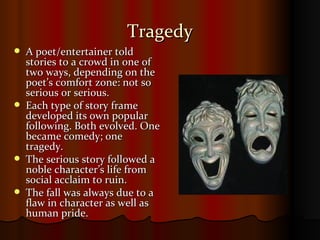
Tragedy A poet/entertainer told stories to a crowd in one of two ways, depending on the poet’s comfort zone: not so serious or serious. Each type of story frame developed its own popular following. Both evolved. One became comedy; one tragedy. The serious story followed a noble character’s life from social acclaim to ruin. The fall was always due to a flaw in character as well as human pride.
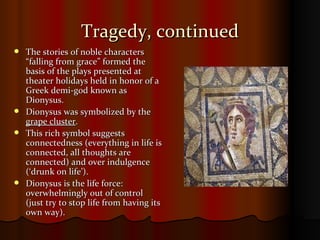
Tragedy, continued The stories of noble characters “falling from grace” formed the basis of the plays presented at theater holidays held in honor of a Greek demi-god known as Dionysus. Dionysus was symbolized by the  grape cluster . This rich symbol suggests connectedness (everything in life is connected, all thoughts are connected) and over indulgence (‘drunk on life’). Dionysus is the life force: overwhelmingly out of control (just try to stop life from having its own way).
Tragedy, continued (2) Theater holidays, as stated, were held in honor of Dionysus, the demi-god representing life’s indulgence, loss of control.  Dance was a form of movement considered representative of free style, free expression. Dancing was an integral part of the theater holidays.
Tragedy, continued (3) The goat was the animal totem (symbol) of Dionysus. Followers of Dionysus would dress in goat skins, dancing and singing (chanting) until all sense of self had been lost. They literally became someone else. Do you see how the theater and the role of the actor plausibly emerge from such an ancient belief?
Tragedy, continued (4) The word “tragedy” derives from the Greek  tragedoi, ‘goat-song’. Earliest “performances” (essentially spiritual celebrations) centered around the costumed Dionysian dancers (‘ tragos ’) leading a procession to a  threshing  place, a flat, circular space, suggested by some scholars to be the primitive start to the Greek chorus dancing and chanting in the  orkestra . “ threshing ” is an important function of separating edible grain from the rest of the plant
Tragedy, continued (5) The life force (Dionysus) is totally creative. The celebration of the life force, through disguise, chant/song (poetry), and dance leads us to a probable connection to the earliest origins of theater. From here on, things only get more structured. Complete abandon meets order and harmony (Dionysus + Apollo=Theater).
Chief Performers in a Greek Play The chorus, a group which could reach upwards of 50 men, wearing the same masks, originally sang/chanted a story as a group while dancing rhythmically forward and back within the orchestra, accompanied by flutes, lyres, drums, and bells. In time, one Greek playwright, Aeschylus, separated one chorus member (named Thespis) out from the group and wrote a call and response between them.  See why actors are called ‘thespians’?
Chief Performers, continued (2) Gradually, as the number of actors rose to three, the number in the chorus rounded out to about twelve. The chorus still spoke in unison, was accompanied by some sort of musical instrument, and represented only one character at a time. The chorus offered advice, spoke its mind on moral issues, and fretted over solutions to problems confronting the major characters.
Actors Began as a single responder to the chorus.  The actor was called ‘hypocrites'’, or “answerer”.   Only three actors (male) were ever used in any ancient Greek play. Additional roles were possible (ages, gender, emotional states) because of masks (made by the actor of linen, cork, maché, or wood; were ornately decorated).
Elements of Greek Drama Aristotle described the necessary elements of a successful Greek Tragedy The elements are six fold: Plot of Action Characters Verbal Expression Thought Visual Adornment Song Composition
A little more on the elements The writing had to be high class—no coarse language The dialogue between the chorus and the actor was standard prose, but the chorus itself “sang” and danced (remember?) to a poetic lyric The drama was tightly written with a specific length in mind. All the pieces of the plot had to come together by the end of the play.
Plot is the most important… One single theme Complex activity between characters Some  pathos  (“emotion”, but actually calamity) Reversal ( peripeteia ) of plot direction  Understanding ( anagnorisis ) occurs—usually quite painful
In addition… The main character is of high rank, respected by society The main character manifests a psychological flaw which proves to be his downfall The audience sees the fall coming before the character himself is aware—and by the time he is aware, it is too late.
General Structure of a Greek Tragedy Prologue Parode (entry chant of the chorus) Strophe —chorus chants/moves in one direction Antistrophe —chorus chants/moves in the  opposite   direction Epode —chorus chants and stands still Episode— interaction of actor/s  with chorus (typically 3 to 5 in a play) Stasimon— chorus   reacts to each previous episode Exodos— exit   song of the chorus after the last  Stasimon
Can you answer these questions? How was the ancient Greek theater structurally divided? Why did an actor need a stentorian voice despite wearing a mask? How does the  skene  contribute to the illusion of place during a performance? Why might the Greeks have omitted the actual “murder” of a character  on stage ?
More Questions Describe the evolution of a single stage actor. How is the chorus the actual genesis of performance theater? How did the  stasimon  allow for fuller development of a particular scene? In what way did the dancing of the earliest chorus remain intact in later Greek plays?

Ancient Greek Theater

  • 1.
    Ancient Greek TheaterThe background and original purpose of our modern day popular entertainment.
  • 2.
    The “seeing place”The Greek word ‘ theatron’ (lit. “seeing place”) serves as the basis of our word “theater”. The Greek theater reveals three major parts 1. ‘orkestra’ (our orchestra )—literally, “the dancing place” 2. ‘ skene’ (our scene )—literally “backdrop” 3. ‘ theatron’ —semi-circular amphitheater seating
  • 3.
    Basic Design The‘ parodos’ allowed for the entrance and exit of certain groups of play performers.
  • 4.
    The challenges ofpresenting outdoor ancient theater No artificial lighting No electronic amplification Considerable distance from the performers--visibility Stone seats Maintaining audience interest—plays were performed all day
  • 5.
  • 6.
    Greek response tothe limitations of their medium All performances were held in daylight Performers wore masks which served to amplify a stentorian voice. Masks often were larger than life—characters were more easily recognized from afar. Characters moved in an identifiable, stylized manner. Plays were written and performed for competition—who will win?
  • 7.
    Masks Earliest masksdepicted Greek gods and goddesses. Actors usually constructed their own masks. Materials in mask construction included leather, wood, animal hair, paint, flowers, plants, sometimes jewelry and other ornamentation.
  • 8.
  • 9.
    Further details ofthe Greek theater The ‘ skene ’ served many functions, from a palace or house to, in later years, a support for various backdrops. The backdrops, or ‘ pinakes ’, allowed changes in place to occur. Later, ‘ periaktois ’, or prism shaped devices, were revolved to reveal changes in location. The ‘ skene ’ later concealed the ‘ mechane ’, the machine, or crane, (sometimes called deus ex machina) that raised and lowered characters for dramatic effect.
  • 10.
  • 11.
    Additional Details “Props” or physical properties were used to enhance the believability of place in the play. Drums were used to suggest thunder. Action was an important element in the plays. An ‘ ekkykleme ’, or “thing that rolls”, was used to bring in any “bodies” resulting from off stage killing. No deadly violence was ever depicted on stage during a Greek play.
  • 12.
    Drawing of howthe ekkykleme may have been used
  • 13.
    Historical Details AncientGreek theater flourished between about 550 and 220 BCE. (How many years ago was that?) “Flourished” means all the citizens expected to see plays at some point during the year. Athens, a city-state, was the center of Greek theater. During the theater event, businesses shut down, out of town visitors arrived, prisoners were temporarily released.
  • 14.
    Types of PlaysPerformed Three major categories of drama competed for prizes during the play festival: Comedic plays Tragic plays Satyr plays A drama (from the Dorian Greek, drân, “to do”) is a literary composition written to be performed by actors.
  • 15.
    Comedy Comedies (fromthe Dorian Greek, komodoi, “band of outcasts, wanderers”, and komoedia, “ song of the outcasts, wanderers ”) were short pieces performed between the longer tragic plays. The comedies originally crudely mocked just about any well known, unpopular political opponent or object of dislike. Comedies gradually evolved (450BCE-250BCE) from course mockery to more sophisticated attempts to showcase society’s foibles.
  • 16.
    Tragedy A poet/entertainertold stories to a crowd in one of two ways, depending on the poet’s comfort zone: not so serious or serious. Each type of story frame developed its own popular following. Both evolved. One became comedy; one tragedy. The serious story followed a noble character’s life from social acclaim to ruin. The fall was always due to a flaw in character as well as human pride.
  • 17.
    Tragedy, continued Thestories of noble characters “falling from grace” formed the basis of the plays presented at theater holidays held in honor of a Greek demi-god known as Dionysus. Dionysus was symbolized by the grape cluster . This rich symbol suggests connectedness (everything in life is connected, all thoughts are connected) and over indulgence (‘drunk on life’). Dionysus is the life force: overwhelmingly out of control (just try to stop life from having its own way).
  • 18.
    Tragedy, continued (2)Theater holidays, as stated, were held in honor of Dionysus, the demi-god representing life’s indulgence, loss of control. Dance was a form of movement considered representative of free style, free expression. Dancing was an integral part of the theater holidays.
  • 19.
    Tragedy, continued (3)The goat was the animal totem (symbol) of Dionysus. Followers of Dionysus would dress in goat skins, dancing and singing (chanting) until all sense of self had been lost. They literally became someone else. Do you see how the theater and the role of the actor plausibly emerge from such an ancient belief?
  • 20.
    Tragedy, continued (4)The word “tragedy” derives from the Greek tragedoi, ‘goat-song’. Earliest “performances” (essentially spiritual celebrations) centered around the costumed Dionysian dancers (‘ tragos ’) leading a procession to a threshing place, a flat, circular space, suggested by some scholars to be the primitive start to the Greek chorus dancing and chanting in the orkestra . “ threshing ” is an important function of separating edible grain from the rest of the plant
  • 21.
    Tragedy, continued (5)The life force (Dionysus) is totally creative. The celebration of the life force, through disguise, chant/song (poetry), and dance leads us to a probable connection to the earliest origins of theater. From here on, things only get more structured. Complete abandon meets order and harmony (Dionysus + Apollo=Theater).
  • 22.
    Chief Performers ina Greek Play The chorus, a group which could reach upwards of 50 men, wearing the same masks, originally sang/chanted a story as a group while dancing rhythmically forward and back within the orchestra, accompanied by flutes, lyres, drums, and bells. In time, one Greek playwright, Aeschylus, separated one chorus member (named Thespis) out from the group and wrote a call and response between them. See why actors are called ‘thespians’?
  • 23.
    Chief Performers, continued(2) Gradually, as the number of actors rose to three, the number in the chorus rounded out to about twelve. The chorus still spoke in unison, was accompanied by some sort of musical instrument, and represented only one character at a time. The chorus offered advice, spoke its mind on moral issues, and fretted over solutions to problems confronting the major characters.
  • 24.
    Actors Began asa single responder to the chorus. The actor was called ‘hypocrites'’, or “answerer”. Only three actors (male) were ever used in any ancient Greek play. Additional roles were possible (ages, gender, emotional states) because of masks (made by the actor of linen, cork, maché, or wood; were ornately decorated).
  • 25.
    Elements of GreekDrama Aristotle described the necessary elements of a successful Greek Tragedy The elements are six fold: Plot of Action Characters Verbal Expression Thought Visual Adornment Song Composition
  • 26.
    A little moreon the elements The writing had to be high class—no coarse language The dialogue between the chorus and the actor was standard prose, but the chorus itself “sang” and danced (remember?) to a poetic lyric The drama was tightly written with a specific length in mind. All the pieces of the plot had to come together by the end of the play.
  • 27.
    Plot is themost important… One single theme Complex activity between characters Some pathos (“emotion”, but actually calamity) Reversal ( peripeteia ) of plot direction Understanding ( anagnorisis ) occurs—usually quite painful
  • 28.
    In addition… Themain character is of high rank, respected by society The main character manifests a psychological flaw which proves to be his downfall The audience sees the fall coming before the character himself is aware—and by the time he is aware, it is too late.
  • 29.
    General Structure ofa Greek Tragedy Prologue Parode (entry chant of the chorus) Strophe —chorus chants/moves in one direction Antistrophe —chorus chants/moves in the opposite direction Epode —chorus chants and stands still Episode— interaction of actor/s with chorus (typically 3 to 5 in a play) Stasimon— chorus reacts to each previous episode Exodos— exit song of the chorus after the last Stasimon
  • 30.
    Can you answerthese questions? How was the ancient Greek theater structurally divided? Why did an actor need a stentorian voice despite wearing a mask? How does the skene contribute to the illusion of place during a performance? Why might the Greeks have omitted the actual “murder” of a character on stage ?
  • 31.
    More Questions Describethe evolution of a single stage actor. How is the chorus the actual genesis of performance theater? How did the stasimon allow for fuller development of a particular scene? In what way did the dancing of the earliest chorus remain intact in later Greek plays?