DICTION: The Choice of Words
finding the   exact word that produces  the exact effect that a writer intends. What are you trying to do?   What is your purpose?
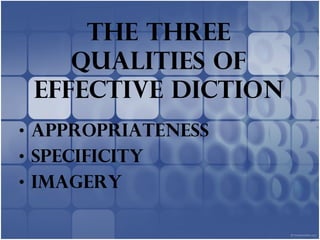
The Three Qualities of effective diction Appropriateness Specificity imagery
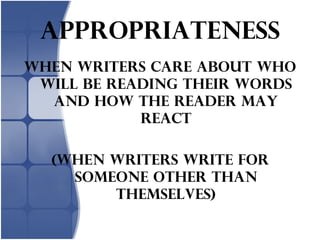
appropriateness When writers care about Who will be reading their words and how the reader may react (when writers write for someone other than themselves)
Language formality scale   Learned   popular   colloquial   slang   Most formal Least formal
The basic elements of everyday communication popular (common to the speech of the educated and the  uneducated alike) Agree ------------------------------------- Begin -------------------------------------- Clear ------------------------------------- Disagree -------------------------------- End- --------------------------------------- Help --------------------------------------- Make easy- ---------------------------- Secret ----------------------------------- Think ------------------------------------ Wordy ---------------------------------- Learned (used more widely by the educated and in more formal occasions) Concur -------------------------------------- Commence --------------------------------- Lucid ------------------------------------------- Remonstrate ---------------------------- Terminate --------------------------------- Succor --------------------------------------- Facilitate ---------------------------------- Esoteric ------------------------------------- Cogitate ------------------------------------ Verbose --------------------------------------
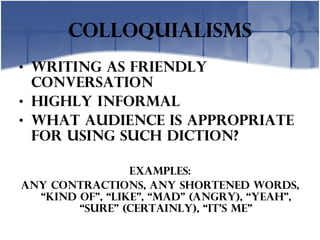
colloquialisms Writing as friendly conversation Highly informal What audience is appropriate for using such diction? Examples: Any Contractions, any shortened words, “kind of”, “like”, “mad” (angry), “yeah”, “Sure” (certainly), “it’s me”
Slang Least formal—its use is determined by the audience/occasion Satisfies a desire for novelty of expression Used by everyone at one time or another Shifting the diction to slang may create a humorous effect or the impression of a lack of control over the writing (usually the latter)
specificity Specific words refer to uniquely individual persons, events, or objects Concrete  specific words attract our senses Abstract  specific words relate to concepts that are mostly inferred
imagery One   meaning of this term suggests the pictures (images) that occur in our minds when specific diction is employed In another sense,  imagery  refers to tropes.
Revising diction What is your purpose? Who is your audience? Does the diction used consider each of the above?
Revising diction vagueness triteness jargon Ineffective imagery Watch for
Ineffective imagery Test every metaphor, every figure of speech by  seeing  the image—if no image appears in  your  mind—well… Mixed  metaphors confuse the mental image: “ The bill is mainly a stew of spending on existing programs, whatever their warts may be.”  ( New York Times) “ So now what we are dealing with is the rubber meeting the road, and instead of biting the bullet on these issues, we just want to punt.” (Chicago Tribune) “ This is awfully weak tea to hang your hat on.” (New York times) “ the moment that you walk into the bowels of the armpit of the cesspool of crime, you immediately cringe.” ( Our town , New York)
jargon The specialized language of a particular group or profession Characteristics of jargon include: 1. abstract, technical words (learned    instead of popular) 2. excessive use of the passive voice 3. wordiness
Examples of Jargon Computer field : RAM, backup, lol, gr8, gb Military : awol, sop, ied Law enforcement : apb, csi, perp, clean skin Common examples : poker face, ufo, shrink, ballpark figure, on cloud nine
vagueness Similar to ambiguity, a word is vague when, in context, it conveys more than one meaning Vague words belong to a group called “utility words” specify, name, clarify the general
Triteness Once upon a time a metaphor was new, fresh, colorful, and apt! Used countless times over the years by everyone, the sheen is dulled. The crack of dawn—do your own thing—crystal clear—good as gold—sly as a fox—lost in thought—commune with nature—it remains to be seen—it is what it is—don’t go there—diamond in the rough
END

Diction Powerpoint

  • 1.
  • 2.
    finding the exact word that produces the exact effect that a writer intends. What are you trying to do? What is your purpose?
  • 3.
    The Three Qualitiesof effective diction Appropriateness Specificity imagery
  • 4.
    appropriateness When writerscare about Who will be reading their words and how the reader may react (when writers write for someone other than themselves)
  • 5.
    Language formality scale Learned popular colloquial slang Most formal Least formal
  • 6.
    The basic elementsof everyday communication popular (common to the speech of the educated and the uneducated alike) Agree ------------------------------------- Begin -------------------------------------- Clear ------------------------------------- Disagree -------------------------------- End- --------------------------------------- Help --------------------------------------- Make easy- ---------------------------- Secret ----------------------------------- Think ------------------------------------ Wordy ---------------------------------- Learned (used more widely by the educated and in more formal occasions) Concur -------------------------------------- Commence --------------------------------- Lucid ------------------------------------------- Remonstrate ---------------------------- Terminate --------------------------------- Succor --------------------------------------- Facilitate ---------------------------------- Esoteric ------------------------------------- Cogitate ------------------------------------ Verbose --------------------------------------
  • 7.
    colloquialisms Writing asfriendly conversation Highly informal What audience is appropriate for using such diction? Examples: Any Contractions, any shortened words, “kind of”, “like”, “mad” (angry), “yeah”, “Sure” (certainly), “it’s me”
  • 8.
    Slang Least formal—itsuse is determined by the audience/occasion Satisfies a desire for novelty of expression Used by everyone at one time or another Shifting the diction to slang may create a humorous effect or the impression of a lack of control over the writing (usually the latter)
  • 9.
    specificity Specific wordsrefer to uniquely individual persons, events, or objects Concrete specific words attract our senses Abstract specific words relate to concepts that are mostly inferred
  • 10.
    imagery One meaning of this term suggests the pictures (images) that occur in our minds when specific diction is employed In another sense, imagery refers to tropes.
  • 11.
    Revising diction Whatis your purpose? Who is your audience? Does the diction used consider each of the above?
  • 12.
    Revising diction vaguenesstriteness jargon Ineffective imagery Watch for
  • 13.
    Ineffective imagery Testevery metaphor, every figure of speech by seeing the image—if no image appears in your mind—well… Mixed metaphors confuse the mental image: “ The bill is mainly a stew of spending on existing programs, whatever their warts may be.” ( New York Times) “ So now what we are dealing with is the rubber meeting the road, and instead of biting the bullet on these issues, we just want to punt.” (Chicago Tribune) “ This is awfully weak tea to hang your hat on.” (New York times) “ the moment that you walk into the bowels of the armpit of the cesspool of crime, you immediately cringe.” ( Our town , New York)
  • 14.
    jargon The specializedlanguage of a particular group or profession Characteristics of jargon include: 1. abstract, technical words (learned instead of popular) 2. excessive use of the passive voice 3. wordiness
  • 15.
    Examples of JargonComputer field : RAM, backup, lol, gr8, gb Military : awol, sop, ied Law enforcement : apb, csi, perp, clean skin Common examples : poker face, ufo, shrink, ballpark figure, on cloud nine
  • 16.
    vagueness Similar toambiguity, a word is vague when, in context, it conveys more than one meaning Vague words belong to a group called “utility words” specify, name, clarify the general
  • 17.
    Triteness Once upona time a metaphor was new, fresh, colorful, and apt! Used countless times over the years by everyone, the sheen is dulled. The crack of dawn—do your own thing—crystal clear—good as gold—sly as a fox—lost in thought—commune with nature—it remains to be seen—it is what it is—don’t go there—diamond in the rough
  • 18.