COHESIVE
DEVICES
INTRODUCTION
Cohesive devices are
words or phrases used to
connect ideas between
different parts of text.
There are three main
types of cohesive devices
Thomas
Chloe
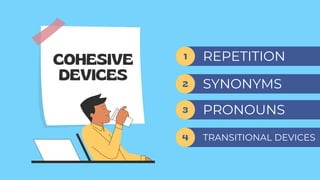
COHESIVE
DEVICES
REPETITION
1
SYNONYMS
2
PRONOUNS
3
TRANSITIONAL DEVICES
4
REPETITION OF
WORDS OR IDEAS.
Copy a sticky
note, then
write your
thoughts.
Copy a sticky
note, then
write your
thoughts.
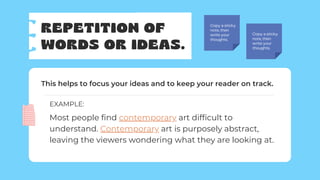
This helps to focus your ideas and to keep your reader on track.
Most people find contemporary art difficult to
understand. Contemporary art is purposely abstract,
leaving the viewers wondering what they are looking at.
EXAMPLE:
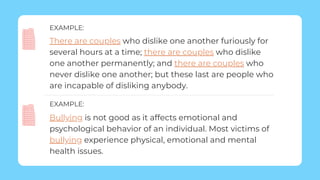
Bullying is not good as it affects emotional and
psychological behavior of an individual. Most victims of
bullying experience physical, emotional and mental
health issues.
EXAMPLE:
There are couples who dislike one another furiously for
several hours at a time; there are couples who dislike
one another permanently; and there are couples who
never dislike one another; but these last are people who
are incapable of disliking anybody.
EXAMPLE:
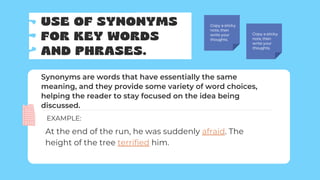
USE OF SYNONYMS
FOR KEY WORDS
AND PHRASES.
Copy a sticky
note, then
write your
thoughts.
Copy a sticky
note, then
write your
thoughts.
Synonyms are words that have essentially the same
meaning, and they provide some variety of word choices,
helping the reader to stay focused on the idea being
discussed.
At the end of the run, he was suddenly afraid. The
height of the tree terrified him.
EXAMPLE:
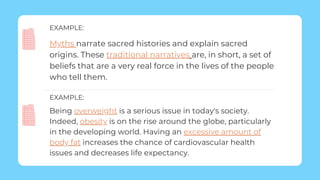
Being overweight is a serious issue in today's society.
Indeed, obesity is on the rise around the globe, particularly
in the developing world. Having an excessive amount of
body fat increases the chance of cardiovascular health
issues and decreases life expectancy.
EXAMPLE:
Myths narrate sacred histories and explain sacred
origins. These traditional narratives are, in short, a set of
beliefs that are a very real force in the lives of the people
who tell them.
EXAMPLE:
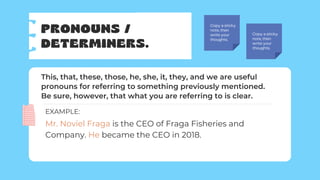
PRONOUNS /
DETERMINERS.
Copy a sticky
note, then
write your
thoughts.
Copy a sticky
note, then
write your
thoughts.
This, that, these, those, he, she, it, they, and we are useful
pronouns for referring to something previously mentioned.
Be sure, however, that what you are referring to is clear.
Mr. Noviel Fraga is the CEO of Fraga Fisheries and
Company. He became the CEO in 2018.
EXAMPLE:
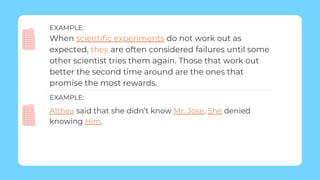
Althea said that she didn’t know Mr. Jose. She denied
knowing Him.
EXAMPLE:
When scientific experiments do not work out as
expected, they are often considered failures until some
other scientist tries them again. Those that work out
better the second time around are the ones that
promise the most rewards.
EXAMPLE:
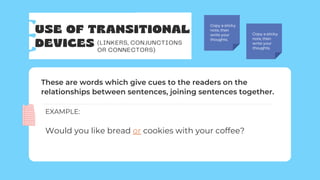
USE OF TRANSITIONAL
DEVICES
Copy a sticky
note, then
write your
thoughts.
Copy a sticky
note, then
write your
thoughts.
These are words which give cues to the readers on the
relationships between sentences, joining sentences together.
Would you like bread or cookies with your coffee?
EXAMPLE:
(LINKERS, CONJUNCTIONS
OR CONNECTORS)
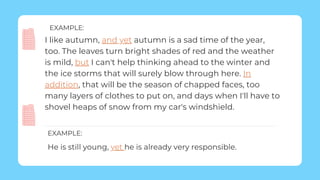
He is still young, yet he is already very responsible.
EXAMPLE:
I like autumn, and yet autumn is a sad time of the year,
too. The leaves turn bright shades of red and the weather
is mild, but I can't help thinking ahead to the winter and
the ice storms that will surely blow through here. In
addition, that will be the season of chapped faces, too
many layers of clothes to put on, and days when I'll have to
shovel heaps of snow from my car's windshield.
EXAMPLE:
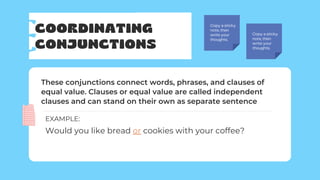
COORDINATING
CONJUNCTIONS
Copy a sticky
note, then
write your
thoughts.
Copy a sticky
note, then
write your
thoughts.
These conjunctions connect words, phrases, and clauses of
equal value. Clauses or equal value are called independent
clauses and can stand on their own as separate sentence
Would you like bread or cookies with your coffee?
EXAMPLE:
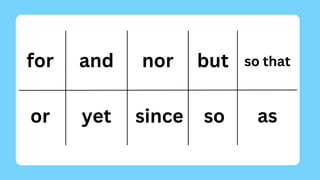
for and nor but
or yet since so
so that
as
SUBORDINATING
CONJUNCTIONS
Copy a sticky
note, then
write your
thoughts.
Copy a sticky
note, then
write your
thoughts.
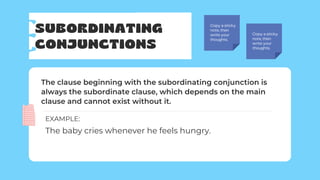
The clause beginning with the subordinating conjunction is
always the subordinate clause, which depends on the main
clause and cannot exist without it.
The baby cries whenever he feels hungry.
EXAMPLE:
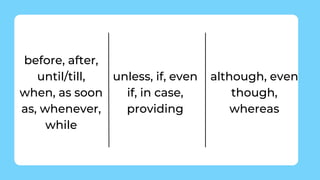
before, after,
until/till,
when, as soon
as, whenever,
while
unless, if, even
if, in case,
providing
although, even
though,
whereas
. ADVERBIAL
CONJUNCTIONS
Copy a sticky
note, then
write your
thoughts.
Copy a sticky
note, then
write your
thoughts.
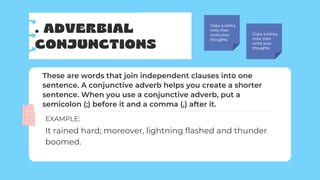
These are words that join independent clauses into one
sentence. A conjunctive adverb helps you create a shorter
sentence. When you use a conjunctive adverb, put a
semicolon (;) before it and a comma (,) after it.
It rained hard; moreover, lightning flashed and thunder
boomed.
EXAMPLE:
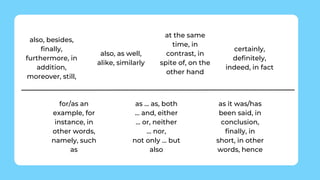
also, besides,
finally,
furthermore, in
addition,
moreover, still,
also, as well,
alike, similarly
at the same
time, in
contrast, in
spite of, on the
other hand
certainly,
definitely,
indeed, in fact
for/as an
example, for
instance, in
other words,
namely, such
as
as … as, both
… and, either
… or, neither
… nor,
not only … but
also
as it was/has
been said, in
conclusion,
finally, in
short, in other
words, hence
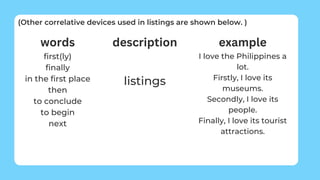
(Other correlative devices used in listings are shown below. )
first(ly)
finally
in the first place
then
to conclude
to begin
next
I love the Philippines a
lot.
Firstly, I love its
museums.
Secondly, I love its
people.
Finally, I love its tourist
attractions.
words description example
listings
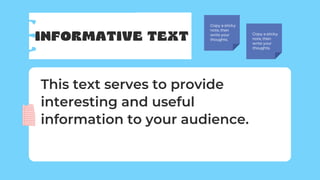
INFORMATIVE TEXT
Copy a sticky
note, then
write your
thoughts.
Copy a sticky
note, then
write your
thoughts.
This text serves to provide
interesting and useful
information to your audience.
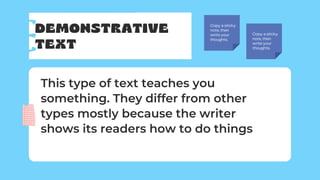
DEMONSTRATIVE
TEXT
Copy a sticky
note, then
write your
thoughts.
Copy a sticky
note, then
write your
thoughts.
This type of text teaches you
something. They differ from other
types mostly because the writer
shows its readers how to do things
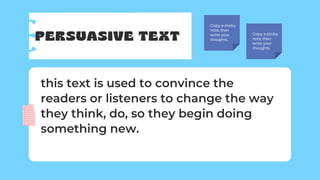
PERSUASIVE TEXT
Copy a sticky
note, then
write your
thoughts.
Copy a sticky
note, then
write your
thoughts.
this text is used to convince the
readers or listeners to change the way
they think, do, so they begin doing
something new.
NARRATIVE TEXT
Copy a sticky
note, then
write your
thoughts.
Copy a sticky
note, then
write your
thoughts.
A narrative text is used to tell a story,
often one that is based on personal
experience.
Cohesive Devices

Cohesive Devices

  • 2.
  • 3.
    INTRODUCTION Cohesive devices are wordsor phrases used to connect ideas between different parts of text. There are three main types of cohesive devices Thomas Chloe
  • 4.
  • 5.
    REPETITION OF WORDS ORIDEAS. Copy a sticky note, then write your thoughts. Copy a sticky note, then write your thoughts. This helps to focus your ideas and to keep your reader on track. Most people find contemporary art difficult to understand. Contemporary art is purposely abstract, leaving the viewers wondering what they are looking at. EXAMPLE:
  • 6.
    Bullying is notgood as it affects emotional and psychological behavior of an individual. Most victims of bullying experience physical, emotional and mental health issues. EXAMPLE: There are couples who dislike one another furiously for several hours at a time; there are couples who dislike one another permanently; and there are couples who never dislike one another; but these last are people who are incapable of disliking anybody. EXAMPLE:
  • 7.
    USE OF SYNONYMS FORKEY WORDS AND PHRASES. Copy a sticky note, then write your thoughts. Copy a sticky note, then write your thoughts. Synonyms are words that have essentially the same meaning, and they provide some variety of word choices, helping the reader to stay focused on the idea being discussed. At the end of the run, he was suddenly afraid. The height of the tree terrified him. EXAMPLE:
  • 8.
    Being overweight isa serious issue in today's society. Indeed, obesity is on the rise around the globe, particularly in the developing world. Having an excessive amount of body fat increases the chance of cardiovascular health issues and decreases life expectancy. EXAMPLE: Myths narrate sacred histories and explain sacred origins. These traditional narratives are, in short, a set of beliefs that are a very real force in the lives of the people who tell them. EXAMPLE:
  • 9.
    PRONOUNS / DETERMINERS. Copy asticky note, then write your thoughts. Copy a sticky note, then write your thoughts. This, that, these, those, he, she, it, they, and we are useful pronouns for referring to something previously mentioned. Be sure, however, that what you are referring to is clear. Mr. Noviel Fraga is the CEO of Fraga Fisheries and Company. He became the CEO in 2018. EXAMPLE:
  • 10.
    Althea said thatshe didn’t know Mr. Jose. She denied knowing Him. EXAMPLE: When scientific experiments do not work out as expected, they are often considered failures until some other scientist tries them again. Those that work out better the second time around are the ones that promise the most rewards. EXAMPLE:
  • 11.
    USE OF TRANSITIONAL DEVICES Copya sticky note, then write your thoughts. Copy a sticky note, then write your thoughts. These are words which give cues to the readers on the relationships between sentences, joining sentences together. Would you like bread or cookies with your coffee? EXAMPLE: (LINKERS, CONJUNCTIONS OR CONNECTORS)
  • 12.
    He is stillyoung, yet he is already very responsible. EXAMPLE: I like autumn, and yet autumn is a sad time of the year, too. The leaves turn bright shades of red and the weather is mild, but I can't help thinking ahead to the winter and the ice storms that will surely blow through here. In addition, that will be the season of chapped faces, too many layers of clothes to put on, and days when I'll have to shovel heaps of snow from my car's windshield. EXAMPLE:
  • 14.
    COORDINATING CONJUNCTIONS Copy a sticky note,then write your thoughts. Copy a sticky note, then write your thoughts. These conjunctions connect words, phrases, and clauses of equal value. Clauses or equal value are called independent clauses and can stand on their own as separate sentence Would you like bread or cookies with your coffee? EXAMPLE:
  • 15.
    for and norbut or yet since so so that as
  • 16.
    SUBORDINATING CONJUNCTIONS Copy a sticky note,then write your thoughts. Copy a sticky note, then write your thoughts. The clause beginning with the subordinating conjunction is always the subordinate clause, which depends on the main clause and cannot exist without it. The baby cries whenever he feels hungry. EXAMPLE:
  • 17.
    before, after, until/till, when, assoon as, whenever, while unless, if, even if, in case, providing although, even though, whereas
  • 18.
    . ADVERBIAL CONJUNCTIONS Copy asticky note, then write your thoughts. Copy a sticky note, then write your thoughts. These are words that join independent clauses into one sentence. A conjunctive adverb helps you create a shorter sentence. When you use a conjunctive adverb, put a semicolon (;) before it and a comma (,) after it. It rained hard; moreover, lightning flashed and thunder boomed. EXAMPLE:
  • 19.
    also, besides, finally, furthermore, in addition, moreover,still, also, as well, alike, similarly at the same time, in contrast, in spite of, on the other hand certainly, definitely, indeed, in fact for/as an example, for instance, in other words, namely, such as as … as, both … and, either … or, neither … nor, not only … but also as it was/has been said, in conclusion, finally, in short, in other words, hence
  • 20.
    (Other correlative devicesused in listings are shown below. ) first(ly) finally in the first place then to conclude to begin next I love the Philippines a lot. Firstly, I love its museums. Secondly, I love its people. Finally, I love its tourist attractions. words description example listings
  • 21.
    INFORMATIVE TEXT Copy asticky note, then write your thoughts. Copy a sticky note, then write your thoughts. This text serves to provide interesting and useful information to your audience.
  • 22.
    DEMONSTRATIVE TEXT Copy a sticky note,then write your thoughts. Copy a sticky note, then write your thoughts. This type of text teaches you something. They differ from other types mostly because the writer shows its readers how to do things
  • 23.
    PERSUASIVE TEXT Copy asticky note, then write your thoughts. Copy a sticky note, then write your thoughts. this text is used to convince the readers or listeners to change the way they think, do, so they begin doing something new.
  • 24.
    NARRATIVE TEXT Copy asticky note, then write your thoughts. Copy a sticky note, then write your thoughts. A narrative text is used to tell a story, often one that is based on personal experience.