Commas And Semicolons


 This time it’s going to stick!
COMMA USAGE
The Basics
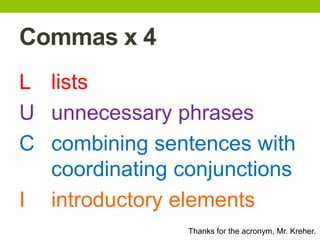
Commas x 4
L lists
U unnecessary phrases
C combining sentences with
  coordinating conjunctions
I introductory elements
                Thanks for the acronym, Mr. Kreher.
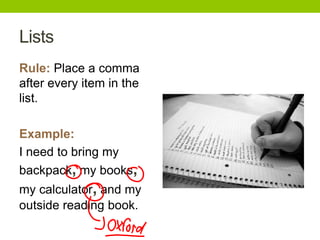
Lists
Rule: Place a comma
after every item in the
list.

Example:
I need to bring my
backpack, my books,
my calculator, and my
outside reading book.
Lists
Rule: Place a comma
after every item in the
list.

Example:
I need to bring my
backpack, my books,
my calculator, and my
outside reading book.
Lists
Rule: Place a comma
after every item in the
list.

Write your own
example.
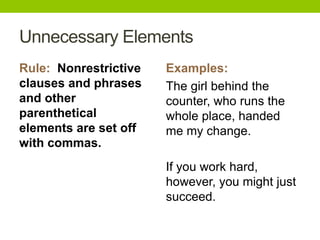
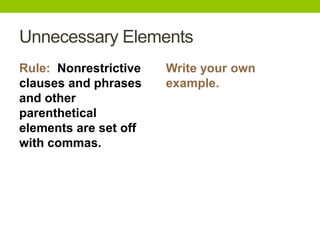
Unnecessary Elements
Rule: Nonrestrictive   Examples:
clauses and phrases    The girl behind the
and other              counter, who runs the
parenthetical          whole place, handed
elements are set off   me my change.
with commas.
                       If you work hard,
                       however, you might just
                       succeed.
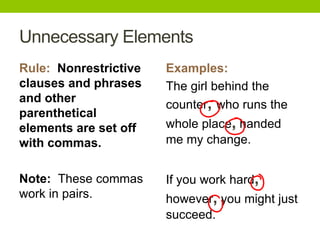
Unnecessary Elements
Rule: Nonrestrictive   Examples:
clauses and phrases    The girl behind the
and other
                       counter, who runs the
parenthetical
elements are set off   whole place, handed
with commas.           me my change.


Note: These commas     If you work hard,
work in pairs.         however, you might just
                       succeed.
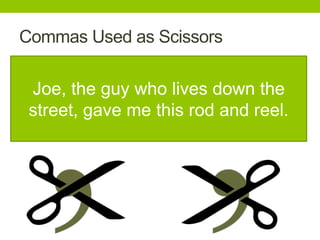
Commas Used as Scissors

 Joe, the guy who lives down the
 street, gave me this rod and reel.
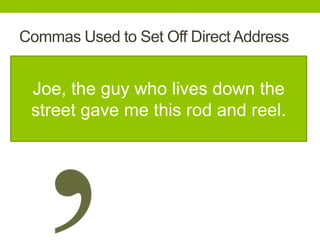
Commas Used to Set Off Direct Address


 Joe, the guy who lives down the
 street gave me this rod and reel.
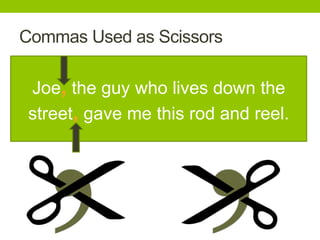
Commas Used as Scissors

 Joe, the guy who lives down the
 street, gave me this rod and reel.
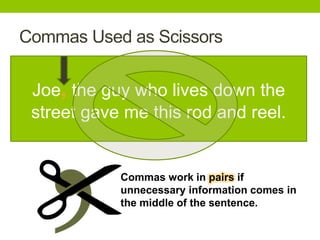
Commas Used as Scissors


 Joe, the guy who lives down the
 street gave me this rod and reel.


            Commas work in pairs if
            unnecessary information comes in
            the middle of the sentence.
Unnecessary Elements
Rule: Nonrestrictive   Write your own
clauses and phrases    example.
and other
parenthetical
elements are set off
with commas.
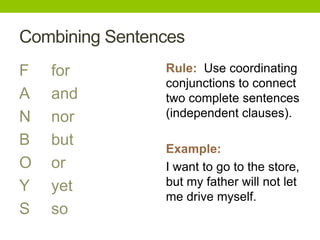
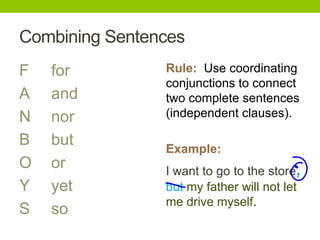
Combining Sentences
F   for         Rule: Use coordinating
                conjunctions to connect
A   and         two complete sentences
N   nor         (independent clauses).

B   but
                Example:
O   or          I want to go to the store,
Y   yet         but my father will not let
                me drive myself.
S   so
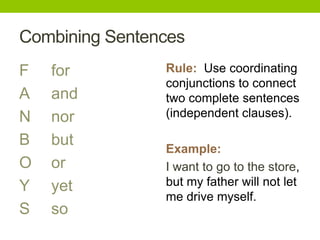
Combining Sentences
F   for         Rule: Use coordinating
                conjunctions to connect
A   and         two complete sentences
N   nor         (independent clauses).

B   but
                Example:
O   or          I want to go to the store,
Y   yet         but my father will not let
                me drive myself.
S   so
Combining Sentences
F   for         Rule: Use coordinating
                conjunctions to connect
A   and         two complete sentences
N   nor         (independent clauses).

B   but
                Example:
O   or          I want to go to the store,
Y   yet         but my father will not let
                me drive myself.
S   so
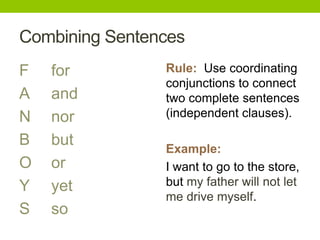
Combining Sentences
F   for         Rule: Use coordinating
                conjunctions to connect
A   and         two complete sentences
N   nor         (independent clauses).

B   but
                Example:
O   or          I want to go to the store,
Y   yet         but my father will not let
                me drive myself.
S   so
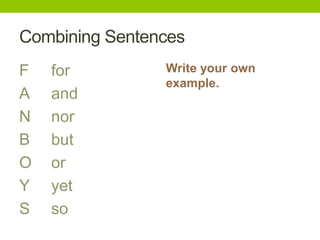
Combining Sentences
F   for         Write your own
                example.
A   and
N   nor
B   but
O   or
Y   yet
S   so
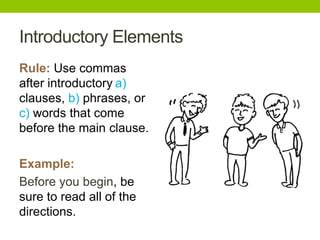
Introductory Elements
Rule: Use commas
after introductory a)
clauses, b) phrases, or
c) words that come
before the main clause.

Example:
Before you begin, be
sure to read all of the
directions.
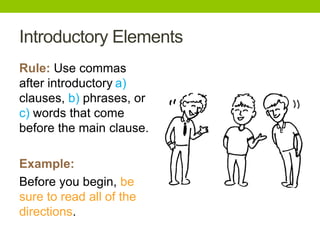
Introductory Elements
Rule: Use commas
after introductory a)
clauses, b) phrases, or
c) words that come
before the main clause.

Example:
Before you begin, be
sure to read all of the
directions.
Introductory Elements
Rule: Use commas
after introductory a)
clauses, b) phrases, or
c) words that come
before the main clause.

Example:
Before you begin, be
sure to read all of the
directions.
Introductory Elements
Write your own
example.
SEMICOLONS
The Basics
Semicolons Connect
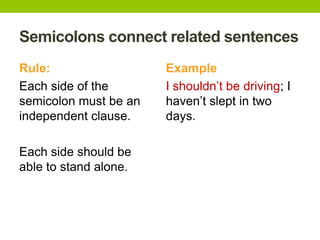
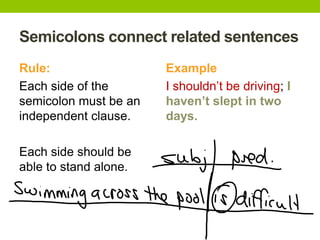
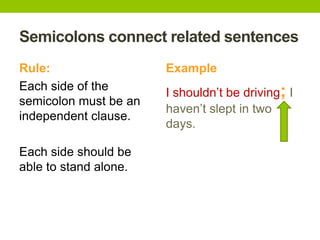
Semicolons connect related sentences
Rule:                  Example
Each side of the       I shouldn’t be driving; I
semicolon must be an   haven’t slept in two
independent clause.    days.

Each side should be
able to stand alone.
Semicolons connect related sentences
Rule:                  Example
Each side of the       I shouldn’t be driving; I
semicolon must be an   haven’t slept in two
independent clause.    days.

Each side should be
able to stand alone.
Semicolons connect related sentences
Rule:                  Example
Each side of the       I shouldn’t be driving; I
semicolon must be an   haven’t slept in two
independent clause.    days.

Each side should be
able to stand alone.
Semicolons connect related sentences
Rule:                  Example
Each side of the
                       I shouldn’t be driving; I
semicolon must be an
                       haven’t slept in two
independent clause.
                       days.

Each side should be
able to stand alone.
Semicolons connect related sentences
Rule:                  Now you write an
Each side of the       example.
semicolon must be an
independent clause.

Each side should be
able to stand alone.
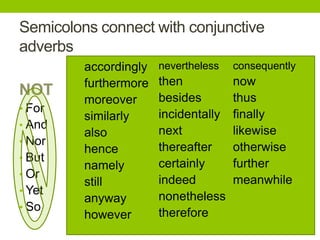
Semicolons connect with conjunctive
adverbs
        • accordingly • nevertheless • consequently
        • furthermore • then         • now
NOT                   • besides       • thus
        • moreover
• For
        • similarly   • incidentally • finally
• And
        • also        • next          • likewise
• Nor
        • hence       • thereafter    • otherwise
• But
        • namely      • certainly     • further
• Or
        • still       • indeed        • meanwhile
• Yet
        • anyway      • nonetheless
• So
        • however     • therefore
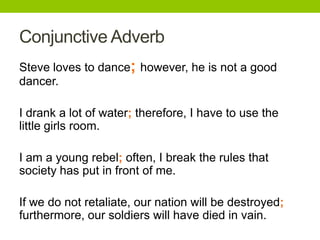
Conjunctive Adverb
Steve loves to dance; however, he is not a good
dancer.

I drank a lot of water; therefore, I have to use the
little girls room.

I am a young rebel; often, I break the rules that
society has put in front of me.

If we do not retaliate, our nation will be destroyed;
furthermore, our soldiers will have died in vain.

Comma usage

  • 1.
    Commas And Semicolons This time it’s going to stick!
  • 2.
  • 3.
    Commas x 4 Llists U unnecessary phrases C combining sentences with coordinating conjunctions I introductory elements Thanks for the acronym, Mr. Kreher.
  • 4.
    Lists Rule: Place acomma after every item in the list. Example: I need to bring my backpack, my books, my calculator, and my outside reading book.
  • 5.
    Lists Rule: Place acomma after every item in the list. Example: I need to bring my backpack, my books, my calculator, and my outside reading book.
  • 6.
    Lists Rule: Place acomma after every item in the list. Write your own example.
  • 7.
    Unnecessary Elements Rule: Nonrestrictive Examples: clauses and phrases The girl behind the and other counter, who runs the parenthetical whole place, handed elements are set off me my change. with commas. If you work hard, however, you might just succeed.
  • 8.
    Unnecessary Elements Rule: Nonrestrictive Examples: clauses and phrases The girl behind the and other counter, who runs the parenthetical elements are set off whole place, handed with commas. me my change. Note: These commas If you work hard, work in pairs. however, you might just succeed.
  • 9.
    Commas Used asScissors Joe, the guy who lives down the street, gave me this rod and reel.
  • 10.
    Commas Used toSet Off Direct Address Joe, the guy who lives down the street gave me this rod and reel.
  • 11.
    Commas Used asScissors Joe, the guy who lives down the street, gave me this rod and reel.
  • 12.
    Commas Used asScissors Joe, the guy who lives down the street gave me this rod and reel. Commas work in pairs if unnecessary information comes in the middle of the sentence.
  • 13.
    Unnecessary Elements Rule: Nonrestrictive Write your own clauses and phrases example. and other parenthetical elements are set off with commas.
  • 14.
    Combining Sentences F for Rule: Use coordinating conjunctions to connect A and two complete sentences N nor (independent clauses). B but Example: O or I want to go to the store, Y yet but my father will not let me drive myself. S so
  • 15.
    Combining Sentences F for Rule: Use coordinating conjunctions to connect A and two complete sentences N nor (independent clauses). B but Example: O or I want to go to the store, Y yet but my father will not let me drive myself. S so
  • 16.
    Combining Sentences F for Rule: Use coordinating conjunctions to connect A and two complete sentences N nor (independent clauses). B but Example: O or I want to go to the store, Y yet but my father will not let me drive myself. S so
  • 17.
    Combining Sentences F for Rule: Use coordinating conjunctions to connect A and two complete sentences N nor (independent clauses). B but Example: O or I want to go to the store, Y yet but my father will not let me drive myself. S so
  • 18.
    Combining Sentences F for Write your own example. A and N nor B but O or Y yet S so
  • 19.
    Introductory Elements Rule: Usecommas after introductory a) clauses, b) phrases, or c) words that come before the main clause. Example: Before you begin, be sure to read all of the directions.
  • 20.
    Introductory Elements Rule: Usecommas after introductory a) clauses, b) phrases, or c) words that come before the main clause. Example: Before you begin, be sure to read all of the directions.
  • 21.
    Introductory Elements Rule: Usecommas after introductory a) clauses, b) phrases, or c) words that come before the main clause. Example: Before you begin, be sure to read all of the directions.
  • 22.
  • 23.
  • 24.
  • 25.
    Semicolons connect relatedsentences Rule: Example Each side of the I shouldn’t be driving; I semicolon must be an haven’t slept in two independent clause. days. Each side should be able to stand alone.
  • 26.
    Semicolons connect relatedsentences Rule: Example Each side of the I shouldn’t be driving; I semicolon must be an haven’t slept in two independent clause. days. Each side should be able to stand alone.
  • 27.
    Semicolons connect relatedsentences Rule: Example Each side of the I shouldn’t be driving; I semicolon must be an haven’t slept in two independent clause. days. Each side should be able to stand alone.
  • 28.
    Semicolons connect relatedsentences Rule: Example Each side of the I shouldn’t be driving; I semicolon must be an haven’t slept in two independent clause. days. Each side should be able to stand alone.
  • 29.
    Semicolons connect relatedsentences Rule: Now you write an Each side of the example. semicolon must be an independent clause. Each side should be able to stand alone.
  • 30.
    Semicolons connect withconjunctive adverbs • accordingly • nevertheless • consequently • furthermore • then • now NOT • besides • thus • moreover • For • similarly • incidentally • finally • And • also • next • likewise • Nor • hence • thereafter • otherwise • But • namely • certainly • further • Or • still • indeed • meanwhile • Yet • anyway • nonetheless • So • however • therefore
  • 31.
    Conjunctive Adverb Steve lovesto dance; however, he is not a good dancer. I drank a lot of water; therefore, I have to use the little girls room. I am a young rebel; often, I break the rules that society has put in front of me. If we do not retaliate, our nation will be destroyed; furthermore, our soldiers will have died in vain.