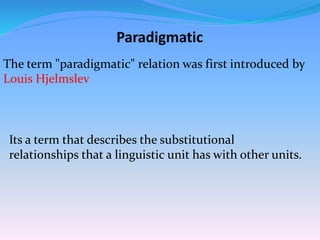
Its a term that describes the substitutional
relationships that a linguistic unit has with other units.
The term "paradigmatic" relation was first introduced by
Louis Hjelmslev
Paradigmatic
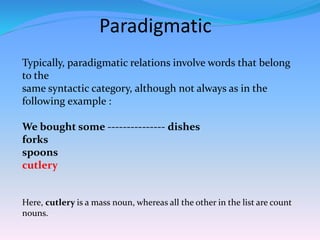
Typically, paradigmatic relations involve words that belong
to the
same syntactic category, although not always as in the
following example :
We bought some --------------- dishes
forks
spoons
cutlery
Here, cutlery is a mass noun, whereas all the other in the list are count
nouns.
syntagmatic
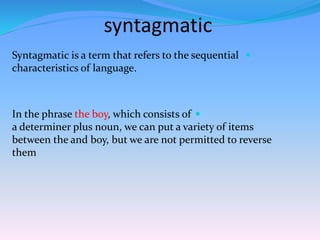
Syntagmatic is a term that refers to the sequential
characteristics of language.
In the phrase the boy, which consists of
a determiner plus noun, we can put a variety of items
between the and boy, but we are not permitted to reverse
them
Palmer (1976: 67- 8) states that de- Saussure was the first
to distinguish between paradigmatic and syntagmatic
relations. Syntagmatic
relations are those that a unit contrasts by virtue of its co-
occurrence with
similar units.
Hyponymy
Lyons (1968:453) explains that the term hyponymy is a recent
creation by analogy with synonymy and antonymy. Although, the
term maybe new, the notion of hyponymy is traditional enough, and it
has been for along time recognized as one of the constituent principles
in the organization of all languages .It is frequently referred to as
"inclusion".
the meaning of tulip is included in the
meaning of flower, and so on.
Synonymy
Palmer ( 1976: 88 ) states that synonymy is used to mean "
sameness of meaning " . It is obvious that for the dictionary
many sets of words have the same meaning, they aremaker,
synonymous, or synonyms of one another.
Lyons mentions that for instance, horse and mare are
synonymous
Aitcheson, Jean. (1999) .Linguistics. London: Hodder
Headline.
Cruse, Allan. (1986). Lexical Semantics. Cambridge: CUP
----------------. (2000). Meaning in Language .Oxford: OUP
Dixon, R.M.W (2005). A Semantic Approach to English
Grammar.2nd ed .Oxford: OUP.
Fillmore, Charles. "Topics in Lexical Semantics" In Cole,
Roger W . Ed. (1977) . Current Issues in Linguistic Theory.
Bloomington: Ind . University Press.
Thanks for your
!!!attention

Paradigmatic

  • 2.
    Its a termthat describes the substitutional relationships that a linguistic unit has with other units. The term "paradigmatic" relation was first introduced by Louis Hjelmslev
  • 3.
    Paradigmatic Typically, paradigmatic relationsinvolve words that belong to the same syntactic category, although not always as in the following example : We bought some --------------- dishes forks spoons cutlery Here, cutlery is a mass noun, whereas all the other in the list are count nouns.
  • 4.
    syntagmatic Syntagmatic is aterm that refers to the sequential characteristics of language. In the phrase the boy, which consists of a determiner plus noun, we can put a variety of items between the and boy, but we are not permitted to reverse them
  • 5.
    Palmer (1976: 67-8) states that de- Saussure was the first to distinguish between paradigmatic and syntagmatic relations. Syntagmatic relations are those that a unit contrasts by virtue of its co- occurrence with similar units.
  • 6.
    Hyponymy Lyons (1968:453) explainsthat the term hyponymy is a recent creation by analogy with synonymy and antonymy. Although, the term maybe new, the notion of hyponymy is traditional enough, and it has been for along time recognized as one of the constituent principles in the organization of all languages .It is frequently referred to as "inclusion". the meaning of tulip is included in the meaning of flower, and so on.
  • 7.
    Synonymy Palmer ( 1976:88 ) states that synonymy is used to mean " sameness of meaning " . It is obvious that for the dictionary many sets of words have the same meaning, they aremaker, synonymous, or synonyms of one another. Lyons mentions that for instance, horse and mare are synonymous
  • 8.
    Aitcheson, Jean. (1999).Linguistics. London: Hodder Headline. Cruse, Allan. (1986). Lexical Semantics. Cambridge: CUP ----------------. (2000). Meaning in Language .Oxford: OUP Dixon, R.M.W (2005). A Semantic Approach to English Grammar.2nd ed .Oxford: OUP. Fillmore, Charles. "Topics in Lexical Semantics" In Cole, Roger W . Ed. (1977) . Current Issues in Linguistic Theory. Bloomington: Ind . University Press.
  • 9.