Rhetorical Devices a short review leading to an analysis of a written text
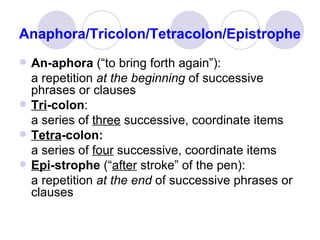
Anaphora/Tricolon/Tetracolon/Epistrophe An-aphora  (“to bring forth again”): a repetition  at the beginning  of successive phrases or clauses Tri -colon : a series of  three  successive, coordinate items Tetra -colon: a series of   four  successive, coordinate items Epi -strophe  (“ after  stroke” of the pen): a repetition  at the end  of successive phrases or clauses
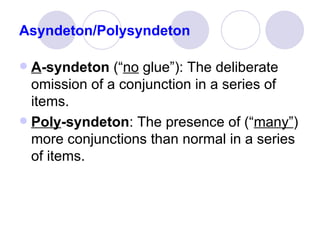
Asyndeton/Polysyndeton A -syndeton  (“ no  glue”): The deliberate omission of a conjunction in a series of items. Poly -syndeton : The presence of (“ many” ) more conjunctions than normal in a series of items.
Synchises/Chiasmus/Antithesis Synchises : A balanced pairing of items in similar and coordinate fashion (AB and AB); a combination that consists of repetition and balance. Chiasmus : A pair of elements on one side of a coordinator is reversed on the other side of the coordinator (AB ; BA)—the coordinator can be a conjunction, a semi-colon, a conjunctive adverb [therefore, however, nevertheless, etc], or a period. Antithesis : The balanced pairing of opposites, usually on either side of a coordinating conjunction (A and not A).
Oxymoron/Pun/Tautology Oxymoron : Two normally contradictory words placed side by side. Pun : (paronomasia) A word that is used in more than one sense simultaneously; one sense is literal, and the other is figurative. Tautology : The deliberate repetition of an idea for emphasis.
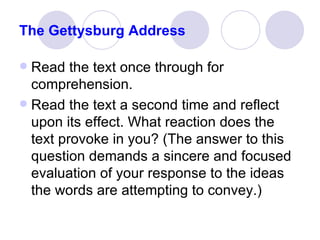
The Gettysburg Address Read the text once through for comprehension. Read the text a second time and reflect upon its effect. What reaction does the text provoke in you? (The answer to this question demands a sincere and focused evaluation of your response to the ideas the words are attempting to convey.)
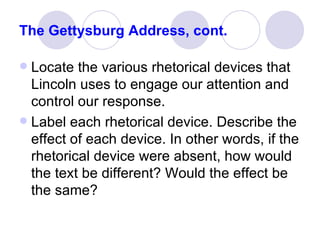
The Gettysburg Address, cont. Locate the various rhetorical devices that Lincoln uses to engage our attention and control our response. Label each rhetorical device. Describe the effect of each device. In other words, if the rhetorical device were absent, how would the text be different? Would the effect be the same?
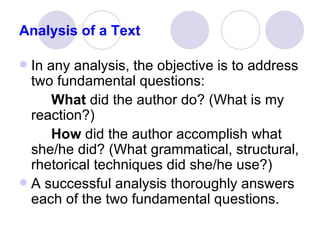
Analysis of a Text In any analysis, the objective is to address two fundamental questions: What  did the author do? (What is my reaction?) How  did the author accomplish what she/he did? (What grammatical, structural, rhetorical techniques did she/he use?) A successful analysis thoroughly answers each of the two fundamental questions.

Rhetorical Devices

  • 1.
    Rhetorical Devices ashort review leading to an analysis of a written text
  • 2.
    Anaphora/Tricolon/Tetracolon/Epistrophe An-aphora (“to bring forth again”): a repetition at the beginning of successive phrases or clauses Tri -colon : a series of three successive, coordinate items Tetra -colon: a series of four successive, coordinate items Epi -strophe (“ after stroke” of the pen): a repetition at the end of successive phrases or clauses
  • 3.
    Asyndeton/Polysyndeton A -syndeton (“ no glue”): The deliberate omission of a conjunction in a series of items. Poly -syndeton : The presence of (“ many” ) more conjunctions than normal in a series of items.
  • 4.
    Synchises/Chiasmus/Antithesis Synchises :A balanced pairing of items in similar and coordinate fashion (AB and AB); a combination that consists of repetition and balance. Chiasmus : A pair of elements on one side of a coordinator is reversed on the other side of the coordinator (AB ; BA)—the coordinator can be a conjunction, a semi-colon, a conjunctive adverb [therefore, however, nevertheless, etc], or a period. Antithesis : The balanced pairing of opposites, usually on either side of a coordinating conjunction (A and not A).
  • 5.
    Oxymoron/Pun/Tautology Oxymoron :Two normally contradictory words placed side by side. Pun : (paronomasia) A word that is used in more than one sense simultaneously; one sense is literal, and the other is figurative. Tautology : The deliberate repetition of an idea for emphasis.
  • 6.
    The Gettysburg AddressRead the text once through for comprehension. Read the text a second time and reflect upon its effect. What reaction does the text provoke in you? (The answer to this question demands a sincere and focused evaluation of your response to the ideas the words are attempting to convey.)
  • 7.
    The Gettysburg Address,cont. Locate the various rhetorical devices that Lincoln uses to engage our attention and control our response. Label each rhetorical device. Describe the effect of each device. In other words, if the rhetorical device were absent, how would the text be different? Would the effect be the same?
  • 8.
    Analysis of aText In any analysis, the objective is to address two fundamental questions: What did the author do? (What is my reaction?) How did the author accomplish what she/he did? (What grammatical, structural, rhetorical techniques did she/he use?) A successful analysis thoroughly answers each of the two fundamental questions.