wall structures
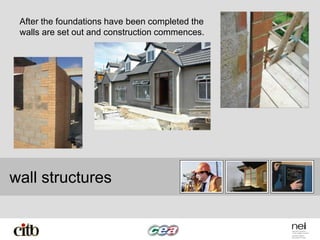
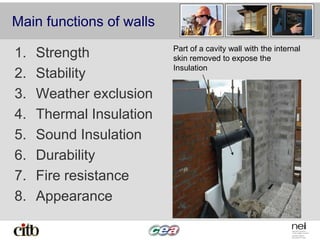
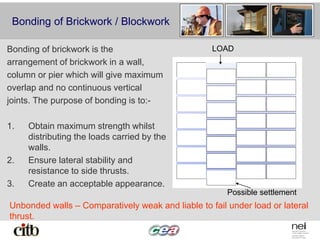
After the foundations have been completed the
walls are set out and construction commences.
Walls
Walls can be classified in a number of ways:-
Solid
Cavity
Internal
External
Load bearing or
Non load bearing
Load bearing – supporting roofs, floors etc.
Non load bearing – Dividing spaces
Main functions of walls
1. Strength
2. Stability
3. Weather exclusion
4. Thermal Insulation
5. Sound Insulation
6. Durability
7. Fire resistance
8. Appearance
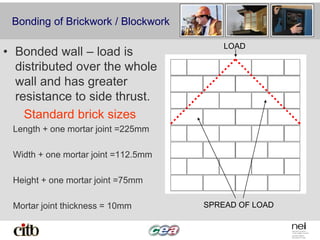
Part of a cavity wall with the internal
skin removed to expose the
Insulation
Bonding of Brickwork / Blockwork
Bonding of brickwork is the
arrangement of brickwork in a wall,
column or pier which will give maximum
overlap and no continuous vertical
joints. The purpose of bonding is to:-
1. Obtain maximum strength whilst
distributing the loads carried by the
walls.
2. Ensure lateral stability and
resistance to side thrusts.
3. Create an acceptable appearance.
LOAD
Possible settlement
Unbonded walls – Comparatively weak and liable to fail under load or lateral
thrust.
Bonding of Brickwork / Blockwork
• Bonded wall – load is
distributed over the whole
wall and has greater
resistance to side thrust.
Standard brick sizes
Length + one mortar joint =225mm
Width + one mortar joint =112.5mm
Height + one mortar joint =75mm
Mortar joint thickness = 10mm
LOAD
SPREAD OF LOAD
Stretcher Bond
This is the simplest and most widely used bond. It
is used for half brick walls and cavity walls. The
bricks must lap over each other in successive
courses in a fashion similar to the one shown
below.
Half lapped
Formation of a corner in
stretcher bond
½ bat to form
stopped end
Racking-back
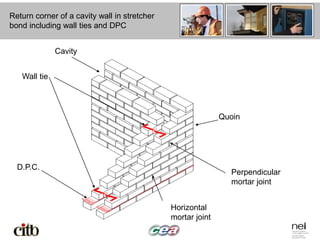
Wall tie
Quoin
Cavity
D.P.C.
Horizontal
mortar joint
Perpendicular
mortar joint
Return corner of a cavity wall in stretcher
bond including wall ties and DPC
Wall Ties
There are a large variety of
different types of wall ties,
but they all have two basic
requirements of:-
(a) Tieing the outer and inner
leaf of the cavity wall
together.
(b) Prevent moisture passing
from the outer to the inner
skin of brickwork.
Most wall ties are currently
made from stainless-steel or
nylon.
Stainless-steel wire
wall tie with plastic
disc to hold sheet
insulation in place.
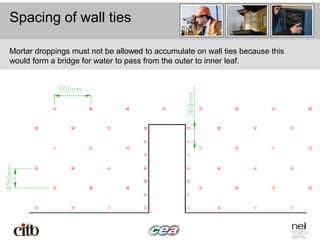
Spacing of wall ties
Mortar droppings must not be allowed to accumulate on wall ties because this
would form a bridge for water to pass from the outer to inner leaf.
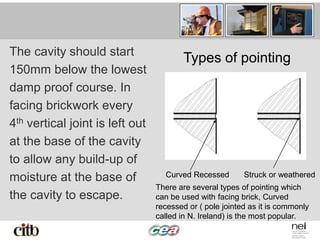
The cavity should start
150mm below the lowest
damp proof course. In
facing brickwork every
4th vertical joint is left out
at the base of the cavity
to allow any build-up of
moisture at the base of
the cavity to escape.
Types of pointing
Curved Recessed Struck or weathered
There are several types of pointing which
can be used with facing brick, Curved
recessed or ( pole jointed as it is commonly
called in N. Ireland) is the most popular.
Cavity walls in block
construction
A cavity wall consists of two ½
brick thick leaves with a cavity
between them. The outer leaf in
conjunction with the cavity acts
as a barrier to moisture. The
Inner leaf supports most of the load
from floors and the roof. If heavier
loads than usual have to be
supported the inner leaf can be built
one brick thick or more. There is no
need to increase the thickness of the
outer leaf.
Outer leaf
facing brick or
block and
render.
D.P.C.
Rain
Section through a Cavity Wall
Wall tie
The two leaves of the wall must be tied together with
Stainless-steel cavity wall ties.
Cavity walls in brick
construction with insulation
• This wall is similar in construction to the
first cavity wall, the only exception being
the inclusion of insulation.
• Wall ties are manufactured from
stainless steel.
60mm thick insulation
Plaster
Vertical DPC at
window and
door jambs
Insulation
Timber stud walls
Stud partitions are still
extensively used for internal
walls of domestic buildings.
These are non load bearing
internal dividing walls which
are easy to construct,
lightweight, adaptable and
can be clad and filled with
various materials to give
different finishes and
properties.
100 x 50 timber studs
Door opening
Timber stud walls
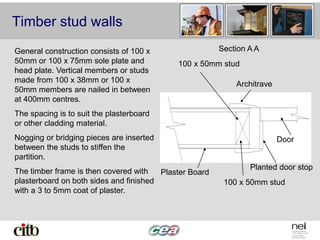
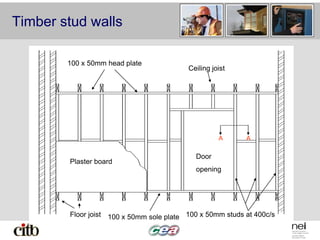
General construction consists of 100 x
50mm or 100 x 75mm sole plate and
head plate. Vertical members or studs
made from 100 x 38mm or 100 x
50mm members are nailed in between
at 400mm centres.
The spacing is to suit the plasterboard
or other cladding material.
Nogging or bridging pieces are inserted
between the studs to stiffen the
partition.
The timber frame is then covered with
plasterboard on both sides and finished
with a 3 to 5mm coat of plaster.
100 x 50mm stud
Architrave
Planted door stop
100 x 50mm stud
Door
Plaster Board
Section A A
Timber stud walls
A A
100 x 50mm sole plate
Ceiling joist
Door
opening
Plaster board
100 x 50mm studs at 400c/s
Floor joist
100 x 50mm head plate

walls Construction.ppt

  • 1.
    wall structures After thefoundations have been completed the walls are set out and construction commences.
  • 2.
    Walls Walls can beclassified in a number of ways:- Solid Cavity Internal External Load bearing or Non load bearing Load bearing – supporting roofs, floors etc. Non load bearing – Dividing spaces
  • 3.
    Main functions ofwalls 1. Strength 2. Stability 3. Weather exclusion 4. Thermal Insulation 5. Sound Insulation 6. Durability 7. Fire resistance 8. Appearance Part of a cavity wall with the internal skin removed to expose the Insulation
  • 4.
    Bonding of Brickwork/ Blockwork Bonding of brickwork is the arrangement of brickwork in a wall, column or pier which will give maximum overlap and no continuous vertical joints. The purpose of bonding is to:- 1. Obtain maximum strength whilst distributing the loads carried by the walls. 2. Ensure lateral stability and resistance to side thrusts. 3. Create an acceptable appearance. LOAD Possible settlement Unbonded walls – Comparatively weak and liable to fail under load or lateral thrust.
  • 5.
    Bonding of Brickwork/ Blockwork • Bonded wall – load is distributed over the whole wall and has greater resistance to side thrust. Standard brick sizes Length + one mortar joint =225mm Width + one mortar joint =112.5mm Height + one mortar joint =75mm Mortar joint thickness = 10mm LOAD SPREAD OF LOAD
  • 6.
    Stretcher Bond This isthe simplest and most widely used bond. It is used for half brick walls and cavity walls. The bricks must lap over each other in successive courses in a fashion similar to the one shown below. Half lapped
  • 7.
    Formation of acorner in stretcher bond ½ bat to form stopped end Racking-back
  • 8.
    Wall tie Quoin Cavity D.P.C. Horizontal mortar joint Perpendicular mortarjoint Return corner of a cavity wall in stretcher bond including wall ties and DPC
  • 9.
    Wall Ties There area large variety of different types of wall ties, but they all have two basic requirements of:- (a) Tieing the outer and inner leaf of the cavity wall together. (b) Prevent moisture passing from the outer to the inner skin of brickwork. Most wall ties are currently made from stainless-steel or nylon. Stainless-steel wire wall tie with plastic disc to hold sheet insulation in place.
  • 10.
    Spacing of wallties Mortar droppings must not be allowed to accumulate on wall ties because this would form a bridge for water to pass from the outer to inner leaf.
  • 11.
    The cavity shouldstart 150mm below the lowest damp proof course. In facing brickwork every 4th vertical joint is left out at the base of the cavity to allow any build-up of moisture at the base of the cavity to escape. Types of pointing Curved Recessed Struck or weathered There are several types of pointing which can be used with facing brick, Curved recessed or ( pole jointed as it is commonly called in N. Ireland) is the most popular.
  • 12.
    Cavity walls inblock construction A cavity wall consists of two ½ brick thick leaves with a cavity between them. The outer leaf in conjunction with the cavity acts as a barrier to moisture. The Inner leaf supports most of the load from floors and the roof. If heavier loads than usual have to be supported the inner leaf can be built one brick thick or more. There is no need to increase the thickness of the outer leaf. Outer leaf facing brick or block and render. D.P.C. Rain Section through a Cavity Wall Wall tie The two leaves of the wall must be tied together with Stainless-steel cavity wall ties.
  • 13.
    Cavity walls inbrick construction with insulation • This wall is similar in construction to the first cavity wall, the only exception being the inclusion of insulation. • Wall ties are manufactured from stainless steel. 60mm thick insulation Plaster Vertical DPC at window and door jambs Insulation
  • 14.
    Timber stud walls Studpartitions are still extensively used for internal walls of domestic buildings. These are non load bearing internal dividing walls which are easy to construct, lightweight, adaptable and can be clad and filled with various materials to give different finishes and properties. 100 x 50 timber studs Door opening
  • 15.
    Timber stud walls Generalconstruction consists of 100 x 50mm or 100 x 75mm sole plate and head plate. Vertical members or studs made from 100 x 38mm or 100 x 50mm members are nailed in between at 400mm centres. The spacing is to suit the plasterboard or other cladding material. Nogging or bridging pieces are inserted between the studs to stiffen the partition. The timber frame is then covered with plasterboard on both sides and finished with a 3 to 5mm coat of plaster. 100 x 50mm stud Architrave Planted door stop 100 x 50mm stud Door Plaster Board Section A A
  • 16.
    Timber stud walls AA 100 x 50mm sole plate Ceiling joist Door opening Plaster board 100 x 50mm studs at 400c/s Floor joist 100 x 50mm head plate