Tuning for PID Controllers
PID Controllers
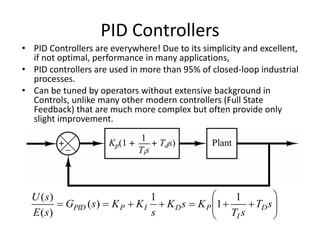
• PID Controllers are everywhere! Due to its simplicity and excellent,
if not optimal, performance in many applications,
• PID controllers are used in more than 95% of closed-loop industrial
processes.
• Can be tuned by operators without extensive background in
Controls, unlike many other modern controllers (Full State
Feedback) that are much more complex but often provide only
slight improvement.














 s
T
s
T
K
s
K
s
K
K
s
G
s
E
s
U
D
I
P
D
I
P
PID
1
1
1
)
(
)
(
)
(
Tuning a PID Controller
• System model is required for techniques we have
studied (Root Locus, Bode Plots)
• System models may be determined using system
identification techniques, such measuring output
for an impulse or step input.
• Traditional control design methods are less
appropriate if the system is unknown;
• Most PID controllers are tuned on-site due to
machine and process variations. The theoretical
calculations for an initial setting of PID
parameters can be by-passed using a few tuning
rules.
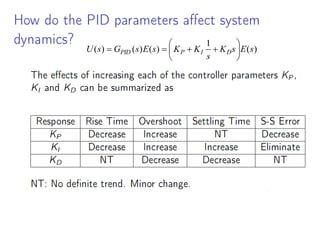
How do the PID parameters affect
system dynamics?
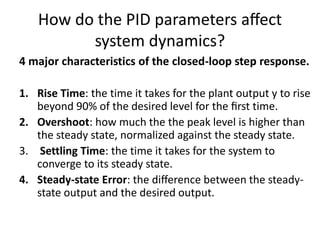
4 major characteristics of the closed-loop step response.
1. Rise Time: the time it takes for the plant output y to rise
beyond 90% of the desired level for the first time.
2. Overshoot: how much the the peak level is higher than
the steady state, normalized against the steady state.
3. Settling Time: the time it takes for the system to
converge to its steady state.
4. Steady-state Error: the difference between the steady-
state output and the desired output.
)
(
1
)
(
)
(
)
( s
E
s
K
s
K
K
s
E
s
G
s
U D
I
P
PID 









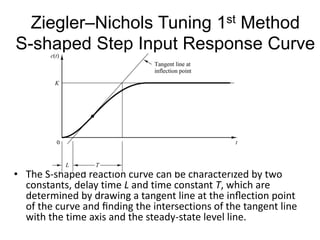
Ziegler–Nichols Tuning 1st Method
S-shaped Step Input Response Curve
• The S-shaped reaction curve can be characterized by two
constants, delay time L and time constant T, which are
determined by drawing a tangent line at the inflection point
of the curve and finding the intersections of the tangent line
with the time axis and the steady-state level line.
Ziegler–Nichols Tuning Rule Based on
Step Response of Plant (First Method)
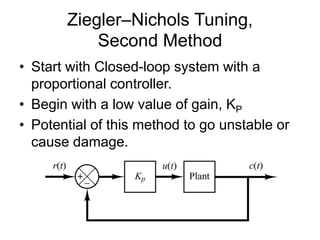
Ziegler–Nichols Tuning,
Second Method
• Start with Closed-loop system with a
proportional controller.
• Begin with a low value of gain, KP
• Potential of this method to go unstable or
cause damage.
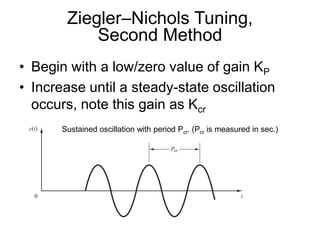
Ziegler–Nichols Tuning,
Second Method
• Begin with a low/zero value of gain KP
• Increase until a steady-state oscillation
occurs, note this gain as Kcr
Sustained oscillation with period Pcr. (Pcr is measured in sec.)
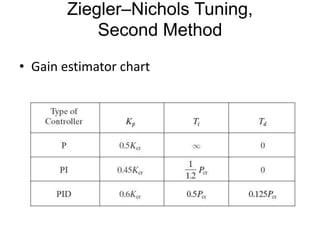
Ziegler–Nichols Tuning,
Second Method
• Gain estimator chart
Ziegler-Nichols Tuning Method
• Ziegler-Nichols tuning method to determine
an initial/estimated set of working PID
parameters for an unknown system
• Usually included with industrial process
controllers and motor controllers as part of
the set-up utilities
– Some controllers have additional autotune
routines.
Ziegler-Nichols Tuning Method
• These parameters will typically give you a
response with an overshoot on the order of
25% with a good settling time.
• We may then start fine-tuning the controller
using the basic rules that relate each
parameter to the response characteristics, as
noted earlier.
Summary
Two things to take away from this review of
Ziegler-Nichols tuning:

Tuning for PID Controllers.pdf

  • 1.
    Tuning for PIDControllers
  • 2.
    PID Controllers • PIDControllers are everywhere! Due to its simplicity and excellent, if not optimal, performance in many applications, • PID controllers are used in more than 95% of closed-loop industrial processes. • Can be tuned by operators without extensive background in Controls, unlike many other modern controllers (Full State Feedback) that are much more complex but often provide only slight improvement.                s T s T K s K s K K s G s E s U D I P D I P PID 1 1 1 ) ( ) ( ) (
  • 3.
    Tuning a PIDController • System model is required for techniques we have studied (Root Locus, Bode Plots) • System models may be determined using system identification techniques, such measuring output for an impulse or step input. • Traditional control design methods are less appropriate if the system is unknown; • Most PID controllers are tuned on-site due to machine and process variations. The theoretical calculations for an initial setting of PID parameters can be by-passed using a few tuning rules.
  • 4.
    How do thePID parameters affect system dynamics? 4 major characteristics of the closed-loop step response. 1. Rise Time: the time it takes for the plant output y to rise beyond 90% of the desired level for the first time. 2. Overshoot: how much the the peak level is higher than the steady state, normalized against the steady state. 3. Settling Time: the time it takes for the system to converge to its steady state. 4. Steady-state Error: the difference between the steady- state output and the desired output.
  • 5.
    ) ( 1 ) ( ) ( ) ( s E s K s K K s E s G s U D I P PID         
  • 8.
    Ziegler–Nichols Tuning 1stMethod S-shaped Step Input Response Curve • The S-shaped reaction curve can be characterized by two constants, delay time L and time constant T, which are determined by drawing a tangent line at the inflection point of the curve and finding the intersections of the tangent line with the time axis and the steady-state level line.
  • 9.
    Ziegler–Nichols Tuning RuleBased on Step Response of Plant (First Method)
  • 10.
    Ziegler–Nichols Tuning, Second Method •Start with Closed-loop system with a proportional controller. • Begin with a low value of gain, KP • Potential of this method to go unstable or cause damage.
  • 11.
    Ziegler–Nichols Tuning, Second Method •Begin with a low/zero value of gain KP • Increase until a steady-state oscillation occurs, note this gain as Kcr Sustained oscillation with period Pcr. (Pcr is measured in sec.)
  • 12.
  • 13.
    Ziegler-Nichols Tuning Method •Ziegler-Nichols tuning method to determine an initial/estimated set of working PID parameters for an unknown system • Usually included with industrial process controllers and motor controllers as part of the set-up utilities – Some controllers have additional autotune routines.
  • 14.
    Ziegler-Nichols Tuning Method •These parameters will typically give you a response with an overshoot on the order of 25% with a good settling time. • We may then start fine-tuning the controller using the basic rules that relate each parameter to the response characteristics, as noted earlier.
  • 15.
    Summary Two things totake away from this review of Ziegler-Nichols tuning: