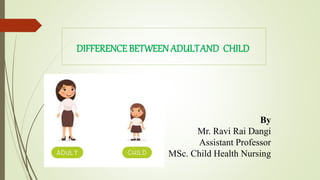
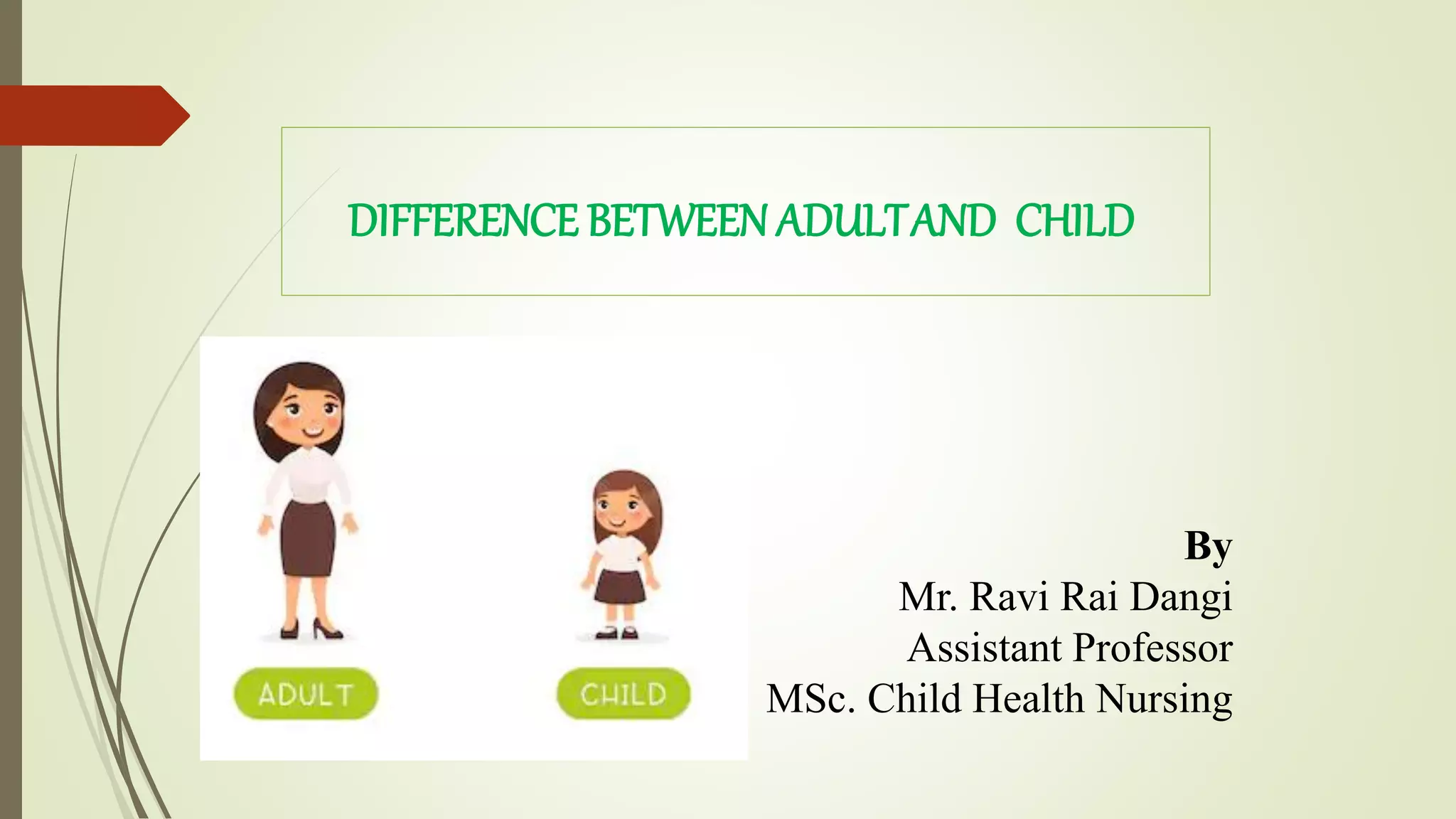
DIFFERENCE BETWEEN ADULTAND CHILD
By
Mr. Ravi Rai Dangi
Assistant Professor
MSc. Child Health Nursing
INTRODUCTION
• Children and adults differ physically and
mentally.
• As a nurses it is necessary to learn the
differences to deliver the care accordingly.
CLASSIFICATION
CLASSIFICATION:
• Anatomical differences
• Physiological differences
• Psychological differences
ANATOMICAL DIFFERENCES::
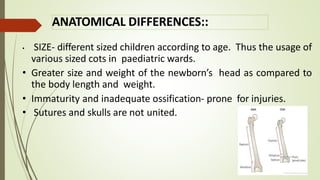
• SIZE- different sized children according to age. Thus the usage of
various sized cots in paediatric wards.
• Greater size and weight of the newborn’s head as compared to
the body length and weight.
• Immaturity and inadequate ossification- prone for injuries.
• Sutures and skulls are not united.
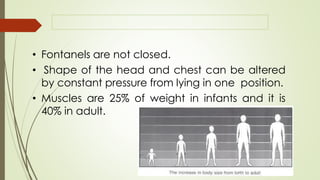
• Fontanels are not closed.
• Shape of the head and chest can be altered
by constant pressure from lying in one position.
• Muscles are 25% of weight in infants and it is
40% in adult.
DRUG DOSAGE::
• Excessive IV fluids and
medications easily causes pedal
edema.
• Hence rate of flow should be
adjusted.
• Dosage calculation of drug is also
necessary.
MOUTH
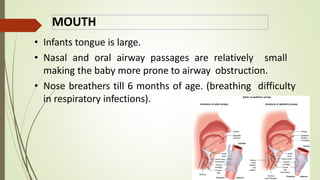
• Infants tongue is large.
• Nasal and oral airway passages are relatively small
making the baby more prone to airway obstruction.
• Nose breathers till 6 months of age. (breathing difficulty
in respiratory infections).
• EYES:
No tears in early infancy- due to
poor functional development
of lacrimal gland.
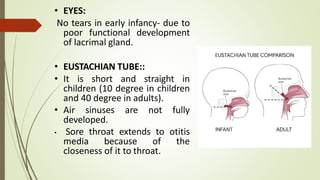
• EUSTACHIAN TUBE::
• It is short and straight in
children (10 degree in children
and 40 degree in adults).
• Air sinuses are not fully
developed.
• Sore throat extends to otitis
media because of the
closeness of it to throat.
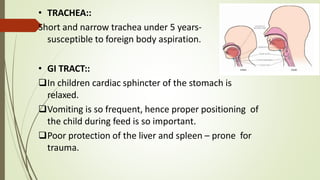
• TRACHEA::
Short and narrow trachea under 5 years-
susceptible to foreign body aspiration.
• GI TRACT::
In children cardiac sphincter of the stomach is
relaxed.
Vomiting is so frequent, hence proper positioning of
the child during feed is so important.
Poor protection of the liver and spleen – prone for
trauma.
• EXCRETION::
By utilizing energy substrate for the process of
growth, the load presented to the excretory
pathway is decreased.
PHYSIOLOGICAL DIFFERENCES::
ABSOLUTE MEASUREMENTS:
• Rapid loss of 35 ml of blood by a newborn
baby represents 10% of blood volume.
• This much loss can lead to circulatory failure.
• BASAL METABOLIC RATE::
 BMR rate is high in newborn.
In neonate 6-8ml of oxygen/ kg/ min is
normal whereas 2-4 ml of oxygen/kg/min is
normal in adults.
Increased CO2 due to more metabolic rate.
• TEMPERATURE REGULATION::
Poor thermo regulation is attributed to
immaturity of the hypothalamus.
Shivering and sweating mechanisms are
absent in newborn.
• Brown adipose tissue in newborn::
Reserve of brown fat from which heat can be
liberated by non shivering thermogenesis .
 Once used brown fat cannot be replaced.
• VOLUNTARY CONTROL::
o No voluntary control over the environment or
activity.
o ( Eg .) On cold day adult used to wear socks,
woolen clothes etc. but the child depends on
the care takers.
• PROPORTION OF WATER::
 ICF- Less
ECF- More (double than the adults)
 Easily fluctuates during the GI infections.
• BLOOD VOLUME::
 Neonate- 85 ml/kg of BW
 Adult- 60-70 ml/kg of BW.
• GLOMERULAR FILTRATION RATE::
mOsmol /L whereas in adults it is
Concentration of urine in newborn is 800
1400
mOsmol /L.
GFR and tubular functions are lower in
neonates than adult because low blood supply
to kidney, smaller pore size and less filtration
power across nephron .
GFR- 38 ml/ min (neonate)
 GFR- 125 ml/min (adult)
• ALIMENTARY TRACT::
o Water absorption is poor – faeces of the child
is watery.
o Dehydration leads to circulatory failure within
24 hours if treatment is inadequate.
• CARDIO VASCULAR SYSTEM::
 Change from fetal to normal circulation.
 Heart rate is more in children.
 Newborn – 110-160 beats/ min.
• RESPIRATION::
• Respiratory rate is 35-40 breaths/ min.
• HEPATIC FUNCTION::
• Immature- physiological jaundice.
• Production of albumin, clotting factors and
vitamin K are less.
• Iron reserve is less.
• CENTRAL NERVOUS SYSTEM::
90% of brain growth takes place by 2 years of
age.
Nerve endings in the retina (rods and cones)
are not fully developed. Thus the images are
blurred and colourless for few weeks.
PSYCHOLOGICAL DIFFERENCES::
• Fear , escape and avoid strangers till 5 years of
age. Explore the environment.
• INFANCY- more bonding with parents.
Seperation anxiety is very common.
• TODDLERS – Negativistic behaviours.
• PRE SCHOOLER- short attention span, easily
distractable .
• ADOLESCENTS- Identity of peer, confusion.
Some more difference
• Children are more prone to dehydration
than adults. At the same time, exposure
to many chemical agents and some
biological agents leads to vomiting and
diarrhea.
• As a result, children may be more
symptomatic and show symptoms earlier
than adults.
• Children have a higher proportion of
rapidly growing tissues than adults, and
some agents, including ionizing radiation
and mustard gas, significantly affect
rapidly growing tissues.
• As a result, children are more prone to
ionizing radiation and other agents that
affect rapidly growing tissue than adults.
• Children have relatively small airways
compared with adults. The smaller the
caliber of the airway, the greater the
reduction in airflow as a result of
increased pulmonary secretions that
occur following exposure to chemicals or
edema from inhalation of hot gases
• As a result, children suffer more
pulmonary pathology than adults at the
same level of exposure.
• While IV medications may be the
recommended prescription, vascular access in
children can be difficult. The smaller the child,
the more difficult vascular access becomes.
Managing the many size-related issues that
arise in acute emergencies presents problems;
the variation in children’s sizes further
complicates the issue.
• As a result, errors and delays in treatment,
and discomfort in drug dosing, may occur.
Thank You

Difference between adult and child

  • 1.
    DIFFERENCE BETWEEN ADULTANDCHILD By Mr. Ravi Rai Dangi Assistant Professor MSc. Child Health Nursing
  • 2.
    INTRODUCTION • Children andadults differ physically and mentally. • As a nurses it is necessary to learn the differences to deliver the care accordingly.
  • 3.
    CLASSIFICATION CLASSIFICATION: • Anatomical differences •Physiological differences • Psychological differences
  • 4.
    ANATOMICAL DIFFERENCES:: • SIZE-different sized children according to age. Thus the usage of various sized cots in paediatric wards. • Greater size and weight of the newborn’s head as compared to the body length and weight. • Immaturity and inadequate ossification- prone for injuries. • Sutures and skulls are not united.
  • 5.
    • Fontanels arenot closed. • Shape of the head and chest can be altered by constant pressure from lying in one position. • Muscles are 25% of weight in infants and it is 40% in adult.
  • 6.
    DRUG DOSAGE:: • ExcessiveIV fluids and medications easily causes pedal edema. • Hence rate of flow should be adjusted. • Dosage calculation of drug is also necessary.
  • 7.
    MOUTH • Infants tongueis large. • Nasal and oral airway passages are relatively small making the baby more prone to airway obstruction. • Nose breathers till 6 months of age. (breathing difficulty in respiratory infections).
  • 8.
    • EYES: No tearsin early infancy- due to poor functional development of lacrimal gland. • EUSTACHIAN TUBE:: • It is short and straight in children (10 degree in children and 40 degree in adults). • Air sinuses are not fully developed. • Sore throat extends to otitis media because of the closeness of it to throat.
  • 9.
    • TRACHEA:: Short andnarrow trachea under 5 years- susceptible to foreign body aspiration. • GI TRACT:: In children cardiac sphincter of the stomach is relaxed. Vomiting is so frequent, hence proper positioning of the child during feed is so important. Poor protection of the liver and spleen – prone for trauma.
  • 10.
    • EXCRETION:: By utilizingenergy substrate for the process of growth, the load presented to the excretory pathway is decreased.
  • 11.
    PHYSIOLOGICAL DIFFERENCES:: ABSOLUTE MEASUREMENTS: •Rapid loss of 35 ml of blood by a newborn baby represents 10% of blood volume. • This much loss can lead to circulatory failure.
  • 12.
    • BASAL METABOLICRATE::  BMR rate is high in newborn. In neonate 6-8ml of oxygen/ kg/ min is normal whereas 2-4 ml of oxygen/kg/min is normal in adults. Increased CO2 due to more metabolic rate. • TEMPERATURE REGULATION:: Poor thermo regulation is attributed to immaturity of the hypothalamus. Shivering and sweating mechanisms are absent in newborn.
  • 13.
    • Brown adiposetissue in newborn:: Reserve of brown fat from which heat can be liberated by non shivering thermogenesis .  Once used brown fat cannot be replaced. • VOLUNTARY CONTROL:: o No voluntary control over the environment or activity. o ( Eg .) On cold day adult used to wear socks, woolen clothes etc. but the child depends on the care takers.
  • 14.
    • PROPORTION OFWATER::  ICF- Less ECF- More (double than the adults)  Easily fluctuates during the GI infections. • BLOOD VOLUME::  Neonate- 85 ml/kg of BW  Adult- 60-70 ml/kg of BW.
  • 15.
    • GLOMERULAR FILTRATIONRATE:: mOsmol /L whereas in adults it is Concentration of urine in newborn is 800 1400 mOsmol /L. GFR and tubular functions are lower in neonates than adult because low blood supply to kidney, smaller pore size and less filtration power across nephron . GFR- 38 ml/ min (neonate)  GFR- 125 ml/min (adult)
  • 16.
    • ALIMENTARY TRACT:: oWater absorption is poor – faeces of the child is watery. o Dehydration leads to circulatory failure within 24 hours if treatment is inadequate. • CARDIO VASCULAR SYSTEM::  Change from fetal to normal circulation.  Heart rate is more in children.  Newborn – 110-160 beats/ min.
  • 17.
    • RESPIRATION:: • Respiratoryrate is 35-40 breaths/ min. • HEPATIC FUNCTION:: • Immature- physiological jaundice. • Production of albumin, clotting factors and vitamin K are less. • Iron reserve is less.
  • 18.
    • CENTRAL NERVOUSSYSTEM:: 90% of brain growth takes place by 2 years of age. Nerve endings in the retina (rods and cones) are not fully developed. Thus the images are blurred and colourless for few weeks.
  • 19.
    PSYCHOLOGICAL DIFFERENCES:: • Fear, escape and avoid strangers till 5 years of age. Explore the environment. • INFANCY- more bonding with parents. Seperation anxiety is very common. • TODDLERS – Negativistic behaviours. • PRE SCHOOLER- short attention span, easily distractable . • ADOLESCENTS- Identity of peer, confusion.
  • 20.
  • 21.
    • Children aremore prone to dehydration than adults. At the same time, exposure to many chemical agents and some biological agents leads to vomiting and diarrhea. • As a result, children may be more symptomatic and show symptoms earlier than adults.
  • 22.
    • Children havea higher proportion of rapidly growing tissues than adults, and some agents, including ionizing radiation and mustard gas, significantly affect rapidly growing tissues. • As a result, children are more prone to ionizing radiation and other agents that affect rapidly growing tissue than adults.
  • 23.
    • Children haverelatively small airways compared with adults. The smaller the caliber of the airway, the greater the reduction in airflow as a result of increased pulmonary secretions that occur following exposure to chemicals or edema from inhalation of hot gases • As a result, children suffer more pulmonary pathology than adults at the same level of exposure.
  • 24.
    • While IVmedications may be the recommended prescription, vascular access in children can be difficult. The smaller the child, the more difficult vascular access becomes. Managing the many size-related issues that arise in acute emergencies presents problems; the variation in children’s sizes further complicates the issue. • As a result, errors and delays in treatment, and discomfort in drug dosing, may occur.
  • 25.