Meningitis
By: Karunesh Kisan
Kumar
Meningitis Encephalitis
 Meningitis is an
inflammation
(swelling) of the
protective membranes
(meninges) covering
the brain and spinal
cord.
 A bacterial or viral
infection of the fluid
surrounding the brain
and spinal cord
usually causes the
 Inflammation of the
brain parenchyma,
presents as diffuse
and/or focal
neuropsychological
dysfunction
 Most commonly a viral
infection with
parenchymal damage
varying from mild to
profound
Aetiology
Bacterial Cause
 Common cause: Neisseria meningitidis
(In children 1 month to 12 month)
 Streptococcus pneumoniae and Haemophilus
influenzae type b.
 less common pathogens such as Pseudomonas
aeruginosa, Staphylococcus aureus, coagulase-
negative staphylococci, Salmonella spp., and
Listeria monocytogenes.
(Due to Alterations of host defence, anatomic
defects or immune deficits).
Neisseria meningitidis
- Gram negative, non motile,
non sporing
diplococcus
- Contains capsular antigens
(A, B, C, X, Y, W135)
responsible for immune
complex formation.
- Produces endotoxin
responsible for circulatory
collapse & DIC.
- IP: 3-4 days
(2- 10days average)
Viral Cause
 Viral meningitis comprises most aseptic
meningitis syndromes. The viral agents for
aseptic meningitis include the following:
 Enterovirus (polio virus, Echovirus,
Coxsackievirus )
 Herpesvirus (Hsv-1,2, Varicella.Z,EBV )
 Paramyxovirus (Mumps, Measles)
 Togavirus (Rubella)
 Rhabdovirus (Rabies)
 Retrovirus (HIV)
Fungal Cause
 It’s rare in healthy people, but is a
higher risk in those who have AIDS,
other forms of immunodeficiency or
immunosuppression.
 The most common agents are
Cryptococcus neoformans,
Candida, H capsulatum.
Acute Bacterial
Meningitis
Acute Bacterial Meningitis
 One of the most potentially serious
infections occurring in infants and
older children.
 The incidence of bacterial meningitis
is sufficiently high in febrile infants.
Epidemiology
 Major risk factor for meningitis- lack of immunity
to specific pathogens associated with young
age.
Additional risks:
 recent colonization with pathogenic bacteria close
contact (household, daycare centres) with
individuals having invasive disease caused by N.
meningitidis and H. influenzae type b, crowding,
poverty
Mode of transmission
 Probably person-to-person contact through
 Defects of the complement system (C5-
C8) have been associated with recurrent
meningococcal infection.
 Splenic dysfunction (sickle cell anemia) or
asplenia (due to trauma, or congenital
defect) is associated with an increased risk
of pneumococcal, H. influenzae type b (to
some extent), and, rarely, meningococcal
sepsis and meningitis.
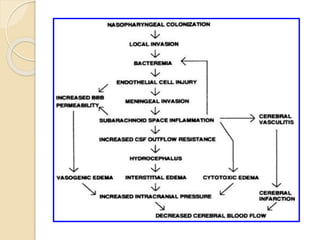
Pathogenesis
 Bacterial meningitis most commonly
results from haematogenous
dissemination of microorganisms
from a distant site of infection;
bacteremia usually precedes meningitis
or occurs concomitantly.
 Usual source of bacteremia: bacterial
colonisation of naso-pharynx with
potentially pathogenic microorganism.
N. meningitidis
and H. influenzae
type b attach to
mucosal
epithelial
Bacteria breach
the mucosa and
enter the
circulation
Bacteria survives
as it has large
bacterial capsule
that interfere with
Opsonic
Phagocytosis.
Bacteria enter
CSF via Choroid
Plexus of lateral
Ventricle & the
Meninges
Then circulate to
extra cerebral
CSF &
subarachnoid
plexus
Bacteria
Multiplication
Local
inflammatory
response
(Polymorph
nuclear cell
infiltration)
LPS (Endotoxin) in
cell wall stimulates a
marked inflammatory
response
Production of
TNF, cytokines
Subsequent
Inflammation
Neutrophilc
infiltration
- Increased vascular
permeability
- Alternation in BBB
- Vascular
thrombosis
Clinical Manifestations
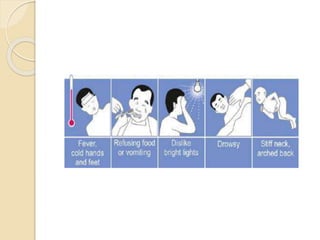
Common presentation is
• sudden onset
• rapidly progressive manifestations of shock
• Purpura
• disseminated intravascular coagulation (DIC)reduced
levels of consciousness often resulting in
progression to coma or death within 24 hr.
More often, meningitis is preceded by several days of
fever accompanied by upper respiratory tract or
gastrointestinal symptoms, followed by nonspecific
signs of CNS infection such as increasing lethargy
and irritability.
 The signs and symptoms of meningitis are related to the
nonspecific findings associated with a systemic infection
and to manifestations of meningeal irritation.
Nonspecific findings include:
• Fever
• Anorexia
• Poor feeding
• Headache
• Symptoms of upper respiratory tract infection
• Myalgias
• Arthralgias
• Tachycardia
• Hypotension
• Various cutaneous signs, such as petechiae, purpura, or
an erythematous macular rash
Meningeal irritation is manifested as:
 Nuchal rigidity- impaired neck flexion resulting from
muscle spasm (not actual rigidity) of the extensor
muscles of the neck; usually attributed to meningeal
irritation.
 Back pain
 Kernig sign (flexion of the hip 90 degrees with
subsequent pain with extension of the leg), and
 Brudzinski sign (involuntary flexion of the knees and
hips after passive flexion of the neck while supine)
Testing for meningeal irritation (neck rigidity)
Testing for meningeal irritation (Kernig’s test)
Meningococcal septicemia with purpuric
skin
rash with head retraction suggestive of
meningitis
Brudzinski’s contralateral reflex sign
The childs hip and knee are passively
flexed on one side
Contralateral leg bends in reflex response
Video
 Brudzinski neck/leg sign of Meningeal
irritation @AIIMS (New Delhi)
Pediatrics wards.mp4
https://www.youtube.com/watch?v=oMh
BVGJW9Cs
 Kernigs sign
https://www.youtube.com/watch?v=Ntus
x07WYfQ
 Alterations of mental status are
common among patients with
meningitis and may be the
consequence of increased ICP,
cerebritis, or hypotension;
manifestations include irritability,
lethargy, stupor, obtundation, and
coma.
Diagnosis
1. CSF Study
 Confirmed by analysis of the CSF, which typically
reveals microorganisms on Gram stain and
culture.
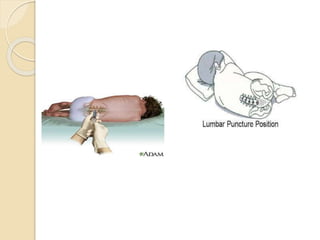
• Lumbar Puncture is done for CSF collection.
Contraindications for an immediate LP include
 evidence of increased ICP, HTN.
in patients in whom positioning for the LP would
further compromise cardiopulmonary function.
infection of the skin overlying the site of the LP.
 The CSF leukocyte count in bacterial
meningitis usually is elevated to
>1,000/mm3 and, typically, there is a
neutrophilic predominance (75-
95%).
 Turbid CSF is present when the CSF
leukocyte countexceeds 200-400/mm
3 . viral or bacterial meningitis have <5
leukocytes/mm3 in the CSF
2. Blood cultures
 Blood cultures reveal the responsible
bacteria in up to 80-90% of cases of
meningitis. Elevations of the C-
reactive protein,erythrocyte
sedimentation rate, and procalcitonin
have been used to differentiate
bacterial (usually elevated) from viral
causes of meningitis.
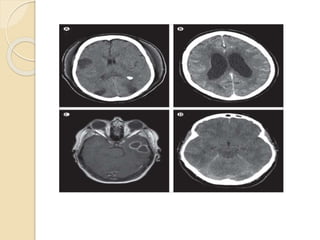
3. CT Scan
Cranial computed tomography (CT) is of
limited use in acute bacterial meningitis
. CT in cerebral oedema may show slit-
like lateral ventricle and areas of low
attenuation.
Symptoms and signs of BM
Check airway, breathing &circulation; gain vascular access
Signs of shock and raised ICP
Manage accordingly
Perform diagnostic tests
Contraindication to LP Perform LP
YES
YES
NO
NO
YES
<3 months old ? CSF s/o meningitis
Empiric antibiotics for suspected
meningitis:
i.v Cefotaxime + iv ampicillin
YES
YES NO
Do not delay antibiotic
Cont’d
Empiric antibiotic for suspected
meningitis : i.v Cefetriaxone.
No role of steroids.
Add vancomycin, if prolonged Or multiple antibiotic exposure within last 3
months
If HSV meningoencephalitis in differential diagnosis give i.v acyclovir
Differential Diagnosis
 Acute viral meningoencephalitis is
the most likely infection to be
confused with bacterial meningitis
Treatment
 A child with rapidly progressing
disease of less than 24 hr duration, in
the absence of increased ICP, should
receive antibiotics as soon as possible
after an LP is performed.
 If there are signs of increased ICP or
focal neurologic findings, antibiotics
should be given without performing an
LP and before obtaining a CT scan
Initial Empirical Therapy
 Vancomycin (60 mg/kg/24 hr, given every 6 hr)
Because of the efficacy of third-generation cephalosporins
in the therapy of meningitis caused by sensitive S.
pneumoniae, N. meningitidis, and H. influenzae type b:
 Cefotaxime (300 mg/kg/24 hr, given every 6 hr) or
 Ceftriaxone (100 mg/ kg/24 hr administered once per day
or 50 mg/kg/dose, given every 12 hr)
 Patients allergic to β-lactam antibiotics and >1 mo of age
can be treated with Chloramphenicol, 100 mg/kg/24 hr,
given every 6 hr.
 Another option for patients with allergy to β-lactam
antibiotics is a combination of Vancomycin and Rifampin.
Coticosteroids
 Use of intravenous dexamethasone
0.15 mg/kg/ dose given every 6 hr for 2 days, in the
treatment of children older than 6 wk with acute
bacterial meningitis caused by H. influenzae type b.
 Among children with meningitis caused by H.
influenzae type b, corticosteroid recipients
have a shorter duration of fever (inflammation
is reduced), lower CSF protein and lactate
levels, and a reduction in sensorineural
hearing loss (result of cochlear infection).
Complications
 During the treatment of meningitis, acute CNS
complications can include seizures, increased
ICP, cranial nerve palsies, stroke.
 Subdural effusions are especially common in
infants
 Prolonged fever (>10 days) is noted in
approximately 10% of patients. Prolonged fever
is usually caused by intercurrent viral infection,
nosocomial or secondary bacterial infection,
thrombophlebitis, or drug reaction.
Prevention
 Vaccination and antibiotic prophylaxis of susceptible at-
risk contacts represent the 2 available means of
reducing the likelihood of bacterial meningitis.
Neisseria meningitidis
 Two quadrivalent (A, C, Y, W-135), conjugated vaccines
(MCV-4; Menactra and Menveo) are licensed by the
FDA.
 Menactra is licensed for use in infants older than 9 mo
of age, and Menveo for use in children older than 2 yr of
age
Haemophilus influenzae Type B
 All children should be immunized
with H. influenzae type b conjugate
vaccine beginning at 2 mo of age.
Streptococcus pneumoniae
 Routine administration of conjugate
vaccine against S. pneumoniae is
recommended for children younger than
5 yr of age. The initial dose is given at
about 2 mo of age.
Prognosis
 Appropriate antibiotic therapy and supportive care have
reduced the mortality of bacterial meningitis after the
neonatal period to <10%.
 The highest mortality rates are observed with
pneumococcal meningitis.
 Sensorineural hearing loss is the most common sequela
of bacterial meningitis and, usually, is already present at
the time of initial presentation.
 It is a result of cochlear infection and occurs in as many as
30% of patients with pneumococcal meningitis, 10% with
meningococcal, and 5-20% of those with H. influenzae
type b meningitis
Reference
 NELSON TEXTBOOK OF
PEDIATRICS, TWENTIETH EDITION
 Illustrated Textbook of Pediatrics
 https://www.youtube.com/watch?v=oM
hBVGJW9Cs

Meningitis (Pediatrics Lecture)

  • 1.
  • 2.
    Meningitis Encephalitis  Meningitisis an inflammation (swelling) of the protective membranes (meninges) covering the brain and spinal cord.  A bacterial or viral infection of the fluid surrounding the brain and spinal cord usually causes the  Inflammation of the brain parenchyma, presents as diffuse and/or focal neuropsychological dysfunction  Most commonly a viral infection with parenchymal damage varying from mild to profound
  • 4.
  • 5.
    Bacterial Cause  Commoncause: Neisseria meningitidis (In children 1 month to 12 month)  Streptococcus pneumoniae and Haemophilus influenzae type b.  less common pathogens such as Pseudomonas aeruginosa, Staphylococcus aureus, coagulase- negative staphylococci, Salmonella spp., and Listeria monocytogenes. (Due to Alterations of host defence, anatomic defects or immune deficits).
  • 6.
    Neisseria meningitidis - Gramnegative, non motile, non sporing diplococcus - Contains capsular antigens (A, B, C, X, Y, W135) responsible for immune complex formation. - Produces endotoxin responsible for circulatory collapse & DIC. - IP: 3-4 days (2- 10days average)
  • 7.
    Viral Cause  Viralmeningitis comprises most aseptic meningitis syndromes. The viral agents for aseptic meningitis include the following:  Enterovirus (polio virus, Echovirus, Coxsackievirus )  Herpesvirus (Hsv-1,2, Varicella.Z,EBV )  Paramyxovirus (Mumps, Measles)  Togavirus (Rubella)  Rhabdovirus (Rabies)  Retrovirus (HIV)
  • 8.
    Fungal Cause  It’srare in healthy people, but is a higher risk in those who have AIDS, other forms of immunodeficiency or immunosuppression.  The most common agents are Cryptococcus neoformans, Candida, H capsulatum.
  • 9.
  • 10.
    Acute Bacterial Meningitis One of the most potentially serious infections occurring in infants and older children.  The incidence of bacterial meningitis is sufficiently high in febrile infants.
  • 11.
    Epidemiology  Major riskfactor for meningitis- lack of immunity to specific pathogens associated with young age. Additional risks:  recent colonization with pathogenic bacteria close contact (household, daycare centres) with individuals having invasive disease caused by N. meningitidis and H. influenzae type b, crowding, poverty Mode of transmission  Probably person-to-person contact through
  • 12.
     Defects ofthe complement system (C5- C8) have been associated with recurrent meningococcal infection.  Splenic dysfunction (sickle cell anemia) or asplenia (due to trauma, or congenital defect) is associated with an increased risk of pneumococcal, H. influenzae type b (to some extent), and, rarely, meningococcal sepsis and meningitis.
  • 13.
    Pathogenesis  Bacterial meningitismost commonly results from haematogenous dissemination of microorganisms from a distant site of infection; bacteremia usually precedes meningitis or occurs concomitantly.  Usual source of bacteremia: bacterial colonisation of naso-pharynx with potentially pathogenic microorganism.
  • 14.
    N. meningitidis and H.influenzae type b attach to mucosal epithelial Bacteria breach the mucosa and enter the circulation Bacteria survives as it has large bacterial capsule that interfere with Opsonic Phagocytosis. Bacteria enter CSF via Choroid Plexus of lateral Ventricle & the Meninges Then circulate to extra cerebral CSF & subarachnoid plexus Bacteria Multiplication Local inflammatory response (Polymorph nuclear cell infiltration) LPS (Endotoxin) in cell wall stimulates a marked inflammatory response Production of TNF, cytokines Subsequent Inflammation Neutrophilc infiltration - Increased vascular permeability - Alternation in BBB - Vascular thrombosis
  • 16.
    Clinical Manifestations Common presentationis • sudden onset • rapidly progressive manifestations of shock • Purpura • disseminated intravascular coagulation (DIC)reduced levels of consciousness often resulting in progression to coma or death within 24 hr. More often, meningitis is preceded by several days of fever accompanied by upper respiratory tract or gastrointestinal symptoms, followed by nonspecific signs of CNS infection such as increasing lethargy and irritability.
  • 17.
     The signsand symptoms of meningitis are related to the nonspecific findings associated with a systemic infection and to manifestations of meningeal irritation. Nonspecific findings include: • Fever • Anorexia • Poor feeding • Headache • Symptoms of upper respiratory tract infection • Myalgias • Arthralgias • Tachycardia • Hypotension • Various cutaneous signs, such as petechiae, purpura, or an erythematous macular rash
  • 19.
    Meningeal irritation ismanifested as:  Nuchal rigidity- impaired neck flexion resulting from muscle spasm (not actual rigidity) of the extensor muscles of the neck; usually attributed to meningeal irritation.  Back pain  Kernig sign (flexion of the hip 90 degrees with subsequent pain with extension of the leg), and  Brudzinski sign (involuntary flexion of the knees and hips after passive flexion of the neck while supine)
  • 20.
    Testing for meningealirritation (neck rigidity) Testing for meningeal irritation (Kernig’s test)
  • 21.
    Meningococcal septicemia withpurpuric skin rash with head retraction suggestive of meningitis Brudzinski’s contralateral reflex sign The childs hip and knee are passively flexed on one side Contralateral leg bends in reflex response
  • 22.
    Video  Brudzinski neck/legsign of Meningeal irritation @AIIMS (New Delhi) Pediatrics wards.mp4 https://www.youtube.com/watch?v=oMh BVGJW9Cs  Kernigs sign https://www.youtube.com/watch?v=Ntus x07WYfQ
  • 23.
     Alterations ofmental status are common among patients with meningitis and may be the consequence of increased ICP, cerebritis, or hypotension; manifestations include irritability, lethargy, stupor, obtundation, and coma.
  • 25.
    Diagnosis 1. CSF Study Confirmed by analysis of the CSF, which typically reveals microorganisms on Gram stain and culture. • Lumbar Puncture is done for CSF collection. Contraindications for an immediate LP include  evidence of increased ICP, HTN. in patients in whom positioning for the LP would further compromise cardiopulmonary function. infection of the skin overlying the site of the LP.
  • 27.
     The CSFleukocyte count in bacterial meningitis usually is elevated to >1,000/mm3 and, typically, there is a neutrophilic predominance (75- 95%).  Turbid CSF is present when the CSF leukocyte countexceeds 200-400/mm 3 . viral or bacterial meningitis have <5 leukocytes/mm3 in the CSF
  • 30.
    2. Blood cultures Blood cultures reveal the responsible bacteria in up to 80-90% of cases of meningitis. Elevations of the C- reactive protein,erythrocyte sedimentation rate, and procalcitonin have been used to differentiate bacterial (usually elevated) from viral causes of meningitis.
  • 31.
    3. CT Scan Cranialcomputed tomography (CT) is of limited use in acute bacterial meningitis . CT in cerebral oedema may show slit- like lateral ventricle and areas of low attenuation.
  • 33.
    Symptoms and signsof BM Check airway, breathing &circulation; gain vascular access Signs of shock and raised ICP Manage accordingly Perform diagnostic tests Contraindication to LP Perform LP YES YES NO NO YES <3 months old ? CSF s/o meningitis Empiric antibiotics for suspected meningitis: i.v Cefotaxime + iv ampicillin YES YES NO Do not delay antibiotic Cont’d Empiric antibiotic for suspected meningitis : i.v Cefetriaxone. No role of steroids. Add vancomycin, if prolonged Or multiple antibiotic exposure within last 3 months If HSV meningoencephalitis in differential diagnosis give i.v acyclovir
  • 34.
    Differential Diagnosis  Acuteviral meningoencephalitis is the most likely infection to be confused with bacterial meningitis
  • 35.
    Treatment  A childwith rapidly progressing disease of less than 24 hr duration, in the absence of increased ICP, should receive antibiotics as soon as possible after an LP is performed.  If there are signs of increased ICP or focal neurologic findings, antibiotics should be given without performing an LP and before obtaining a CT scan
  • 36.
    Initial Empirical Therapy Vancomycin (60 mg/kg/24 hr, given every 6 hr) Because of the efficacy of third-generation cephalosporins in the therapy of meningitis caused by sensitive S. pneumoniae, N. meningitidis, and H. influenzae type b:  Cefotaxime (300 mg/kg/24 hr, given every 6 hr) or  Ceftriaxone (100 mg/ kg/24 hr administered once per day or 50 mg/kg/dose, given every 12 hr)  Patients allergic to β-lactam antibiotics and >1 mo of age can be treated with Chloramphenicol, 100 mg/kg/24 hr, given every 6 hr.  Another option for patients with allergy to β-lactam antibiotics is a combination of Vancomycin and Rifampin.
  • 37.
    Coticosteroids  Use ofintravenous dexamethasone 0.15 mg/kg/ dose given every 6 hr for 2 days, in the treatment of children older than 6 wk with acute bacterial meningitis caused by H. influenzae type b.  Among children with meningitis caused by H. influenzae type b, corticosteroid recipients have a shorter duration of fever (inflammation is reduced), lower CSF protein and lactate levels, and a reduction in sensorineural hearing loss (result of cochlear infection).
  • 38.
    Complications  During thetreatment of meningitis, acute CNS complications can include seizures, increased ICP, cranial nerve palsies, stroke.  Subdural effusions are especially common in infants  Prolonged fever (>10 days) is noted in approximately 10% of patients. Prolonged fever is usually caused by intercurrent viral infection, nosocomial or secondary bacterial infection, thrombophlebitis, or drug reaction.
  • 39.
    Prevention  Vaccination andantibiotic prophylaxis of susceptible at- risk contacts represent the 2 available means of reducing the likelihood of bacterial meningitis. Neisseria meningitidis  Two quadrivalent (A, C, Y, W-135), conjugated vaccines (MCV-4; Menactra and Menveo) are licensed by the FDA.  Menactra is licensed for use in infants older than 9 mo of age, and Menveo for use in children older than 2 yr of age
  • 40.
    Haemophilus influenzae TypeB  All children should be immunized with H. influenzae type b conjugate vaccine beginning at 2 mo of age. Streptococcus pneumoniae  Routine administration of conjugate vaccine against S. pneumoniae is recommended for children younger than 5 yr of age. The initial dose is given at about 2 mo of age.
  • 41.
    Prognosis  Appropriate antibiotictherapy and supportive care have reduced the mortality of bacterial meningitis after the neonatal period to <10%.  The highest mortality rates are observed with pneumococcal meningitis.  Sensorineural hearing loss is the most common sequela of bacterial meningitis and, usually, is already present at the time of initial presentation.  It is a result of cochlear infection and occurs in as many as 30% of patients with pneumococcal meningitis, 10% with meningococcal, and 5-20% of those with H. influenzae type b meningitis
  • 42.
    Reference  NELSON TEXTBOOKOF PEDIATRICS, TWENTIETH EDITION  Illustrated Textbook of Pediatrics  https://www.youtube.com/watch?v=oM hBVGJW9Cs

Editor's Notes

  • #12 The risk of meningitis is increased among infants and young children with occult bacteremia; the odds ratio is greater for meningococcus (85 times) and H. influenzae type b (12 times) relative to that for pneumococcus.
  • #13 Defects of the complement system (C5-C8) have been associated with recurrent meningococcal infection, and defects of the properdin system have been associated with a significant risk of lethal meningococcal disease
  • #16 Bacterial meningitis most commonly results from hematogenous dissemination of microorganisms from a distant site of infection; bacteremia usually precedes meningitis or occurs concomitantly. Bacterial colonization of the nasopharynx with a potentially pathogenic microorganism is the usual source of the bacteremia. There may be prolonged carriage of the colonizing organisms without disease or, more likely, rapid invasion after recent colonization. Prior or concurrent viral upper respiratory tract infection may enhance the pathogenicity of bacteria producing meningitis. N. meningitidis and H. influenzae type b attach to mucosal epithelial cell receptors by pili. After attachment to epithelial cells, bacteria breach the mucosa and enter the circulation. N. meningitidis may be transported across the mucosal surface within a phagocytic vacuole after ingestion by the epithelial cell. Bacterial survival in the bloodstream is enhanced by large bacterial capsules that interfere with opsonic phagocytosis and are associated with increased virulence. Host-related developmental defects in bacterial opsonic phagocytosis also contribute to the bacteremia. In young, nonimmune hosts, the defect may be due to an absence of preformed IgM or IgG anticapsular antibodies, whereas in immunodeficient patients, various deficiencies of components of the complement or properdin system may interfere with effective opsonic phagocytosis. Splenic dysfunction may also reduce opsonic phagocytosis by the reticuloendothelial system. Bacteria gain entry to the CSF through the choroid plexus of the lateral ventricles and the meninges and then circulate to the extracerebral CSF and subarachnoid space. Bacteria rapidly multiply because the CSF concentrations of complement and antibody are inadequate to contain bacterial proliferation. Chemotactic factors then incite a local inflammatory response characterized by polymorphonuclear cell infiltration. The presence of bacterial cell wall lipopolysaccharide (endotoxin) of gram-negative bacteria (H. influenzae type b, N. meningitidis) and of pneumococcal cell wall components (teichoic acid, peptidoglycan) stimulates a marked inflammatory response, with local production of tumor necrosis factor, interleukin 1, prostaglandin E, and other inflammatory mediators. The subsequent inflammatory response is characterized by neutrophilic infiltration, increased vascular permeability, alterations of the blood-brain barrier, and vascular thrombosis. Meningitis-associated brain injury is not simply caused by viable bacteria but occurs as a consequence of the host reaction to the inflammatory cascade initiated by bacterial components. Rarely, meningitis may follow bacterial invasion from a contiguous focus of infection such as paranasal sinusitis, otitis media, mastoiditis, orbital cellulitis, or cranial or vertebral osteomyelitis or may occur after introduction of bacteria via penetrating cranial trauma, dermal sinus tracts, or meningomyeloceles.