
Travelling and Salesman Problem
Using Ant colony optimization
AKASH SETHIYA
ALGORITHMS FOR ARTIFICIAL INTELLIGENCE (SPRING 2017)
COMPUTER SCIENCE GRADUATE
MISSISSIPPI STATE UNIVERSITY
TSP (Travelling and Salesman)
 One salesman, visiting all cities in a route exactly once and come back to
same city where he started.
 Problem to find the path for salesman in which cost is minimum.
 TSP can be modelled as an undirected weighted graph, in which cities are
represent by vertices and path’s are graph edges and distance between
cities are edge weights.
 The goal in TSP is to find a minimum length Hamiltonian circuit of the
graph
 NP-hard problem (Permutation problem)
ACO (Ant colony optimization)
 Probabilistic technique for solving computation problem which can be
reduced to finding shortest path through graphs.
 Initially proposed by Marco Dorigo in 1992 in his PhD thesis.
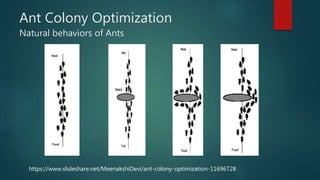
 Inspired by the approach of real ants to find the shortest path from nest to
food source.
 Ants communicate with each other via a chemical substance called
Pheromone.
 Trail which has high amount of pheromone, other ants follow the same
trail to find food otherwise use a random path to search for food source.
Ant Colony Optimization
Natural behaviors of Ants
https://www.slideshare.net/MeenakshiDevi/ant-colony-optimization-11696728
Pseudocode of ACO
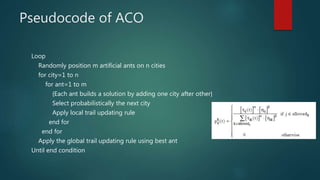
Loop
Randomly position m artificial ants on n cities
for city=1 to n
for ant=1 to m
{Each ant builds a solution by adding one city after other}
Select probabilistically the next city
Apply local trail updating rule
end for
end for
Apply the global trail updating rule using best ant
Until end condition
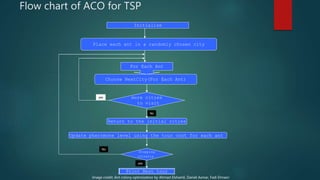
Flow chart of ACO for TSP
Initialize
Place each ant in a randomly chosen city
Choose NextCity(For Each Ant)
more cities
to visit
For Each Ant
Return to the initial cities
Update pheromone level using the tour cost for each ant
Print Best tour
yes
No
Stopping
criteria
yes
No
Image credit: Ant colony optimization by Ahmad Elshamli, Daniel Asmar, Fadi Elmasri
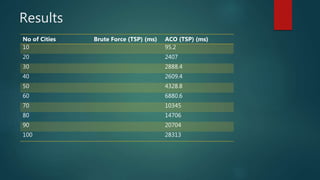
Results
No of Cities Brute Force (TSP) (ms) ACO (TSP) (ms)
10 95.2
20 2407
30 2888.4
40 2609.4
50 4328.8
60 6880.6
70 10345
80 14706
90 20704
100 28313
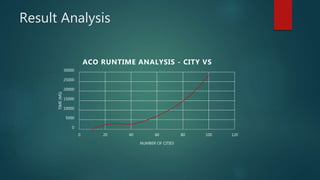
Result Analysis
0
5000
10000
15000
20000
25000
30000
0 20 40 60 80 100 120
TIME(MS)
NUMBER OF CITIES
ACO RUNTIME ANALYSIS - CITY VS
Complexities
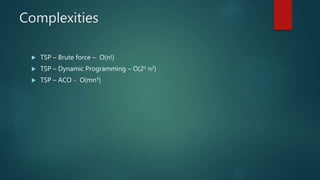
 TSP – Brute force – O(n!)
 TSP – Dynamic Programming – O(2n n2)
 TSP – ACO - O(mn3)
References
 The Ant System: Optimization by a colony of cooperating agents by Marco
Dorigo, Member, IEEE, Vittorio Maniezzo and Alberto Colorni
 An Ant colony optimization Algorithm for Solving Travelling Salesman
Problem, Krishna H. Hingrajiya, Ravindra Kumar Gupta, Gajendra Singh
Chandel
 https://github.com/lukedodd/ant-tsp
 https://en.wikipedia.org/wiki/Ant_colony_optimization_algorithms
 http://www.geeksforgeeks.org/travelling-salesman-problem-set-1/
 https://en.wikipedia.org/wiki/Travelling_salesman_problem
THANK YOU

Travelling and salesman problem using ant colony optimization

  • 1.
    Travelling and SalesmanProblem Using Ant colony optimization AKASH SETHIYA ALGORITHMS FOR ARTIFICIAL INTELLIGENCE (SPRING 2017) COMPUTER SCIENCE GRADUATE MISSISSIPPI STATE UNIVERSITY
  • 2.
    TSP (Travelling andSalesman)  One salesman, visiting all cities in a route exactly once and come back to same city where he started.  Problem to find the path for salesman in which cost is minimum.  TSP can be modelled as an undirected weighted graph, in which cities are represent by vertices and path’s are graph edges and distance between cities are edge weights.  The goal in TSP is to find a minimum length Hamiltonian circuit of the graph  NP-hard problem (Permutation problem)
  • 3.
    ACO (Ant colonyoptimization)  Probabilistic technique for solving computation problem which can be reduced to finding shortest path through graphs.  Initially proposed by Marco Dorigo in 1992 in his PhD thesis.  Inspired by the approach of real ants to find the shortest path from nest to food source.  Ants communicate with each other via a chemical substance called Pheromone.  Trail which has high amount of pheromone, other ants follow the same trail to find food otherwise use a random path to search for food source.
  • 4.
    Ant Colony Optimization Naturalbehaviors of Ants https://www.slideshare.net/MeenakshiDevi/ant-colony-optimization-11696728
  • 5.
    Pseudocode of ACO Loop Randomlyposition m artificial ants on n cities for city=1 to n for ant=1 to m {Each ant builds a solution by adding one city after other} Select probabilistically the next city Apply local trail updating rule end for end for Apply the global trail updating rule using best ant Until end condition
  • 6.
    Flow chart ofACO for TSP Initialize Place each ant in a randomly chosen city Choose NextCity(For Each Ant) more cities to visit For Each Ant Return to the initial cities Update pheromone level using the tour cost for each ant Print Best tour yes No Stopping criteria yes No Image credit: Ant colony optimization by Ahmad Elshamli, Daniel Asmar, Fadi Elmasri
  • 7.
    Results No of CitiesBrute Force (TSP) (ms) ACO (TSP) (ms) 10 95.2 20 2407 30 2888.4 40 2609.4 50 4328.8 60 6880.6 70 10345 80 14706 90 20704 100 28313
  • 8.
    Result Analysis 0 5000 10000 15000 20000 25000 30000 0 2040 60 80 100 120 TIME(MS) NUMBER OF CITIES ACO RUNTIME ANALYSIS - CITY VS
  • 9.
    Complexities  TSP –Brute force – O(n!)  TSP – Dynamic Programming – O(2n n2)  TSP – ACO - O(mn3)
  • 10.
    References  The AntSystem: Optimization by a colony of cooperating agents by Marco Dorigo, Member, IEEE, Vittorio Maniezzo and Alberto Colorni  An Ant colony optimization Algorithm for Solving Travelling Salesman Problem, Krishna H. Hingrajiya, Ravindra Kumar Gupta, Gajendra Singh Chandel  https://github.com/lukedodd/ant-tsp  https://en.wikipedia.org/wiki/Ant_colony_optimization_algorithms  http://www.geeksforgeeks.org/travelling-salesman-problem-set-1/  https://en.wikipedia.org/wiki/Travelling_salesman_problem
  • 11.