SEMINAR TOPIC:
ANT COLONY OPTIMIZATION
Submitted by: Submitted by:
Swetansh M Shrivastava Mr. Sandeep Bhatia
IIIrd year EC Asst. Professor
DEPARTMENT OF ELECTRONICS & COMM.
Raj Kumar Goel Institute of Technology
1
INTRODUCTION:
SWARM INTELLIGENCE
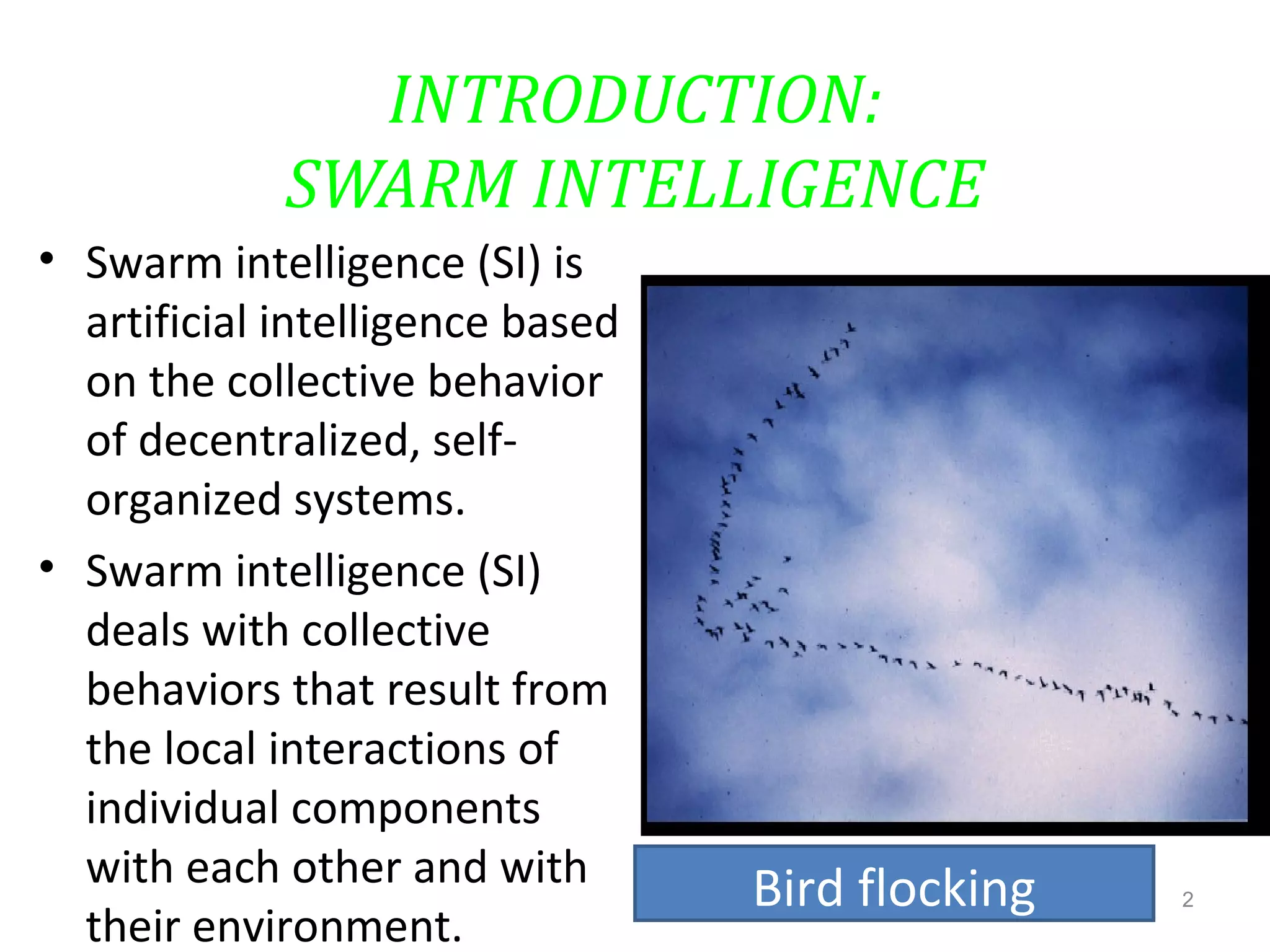
• Swarm intelligence (SI) is
artificial intelligence based
on the collective behavior
of decentralized, self-
organized systems.
• Swarm intelligence (SI)
deals with collective
behaviors that result from
the local interactions of
individual components
with each other and with
their environment.
2Bird flocking
SWARM INTELLIGENCE:
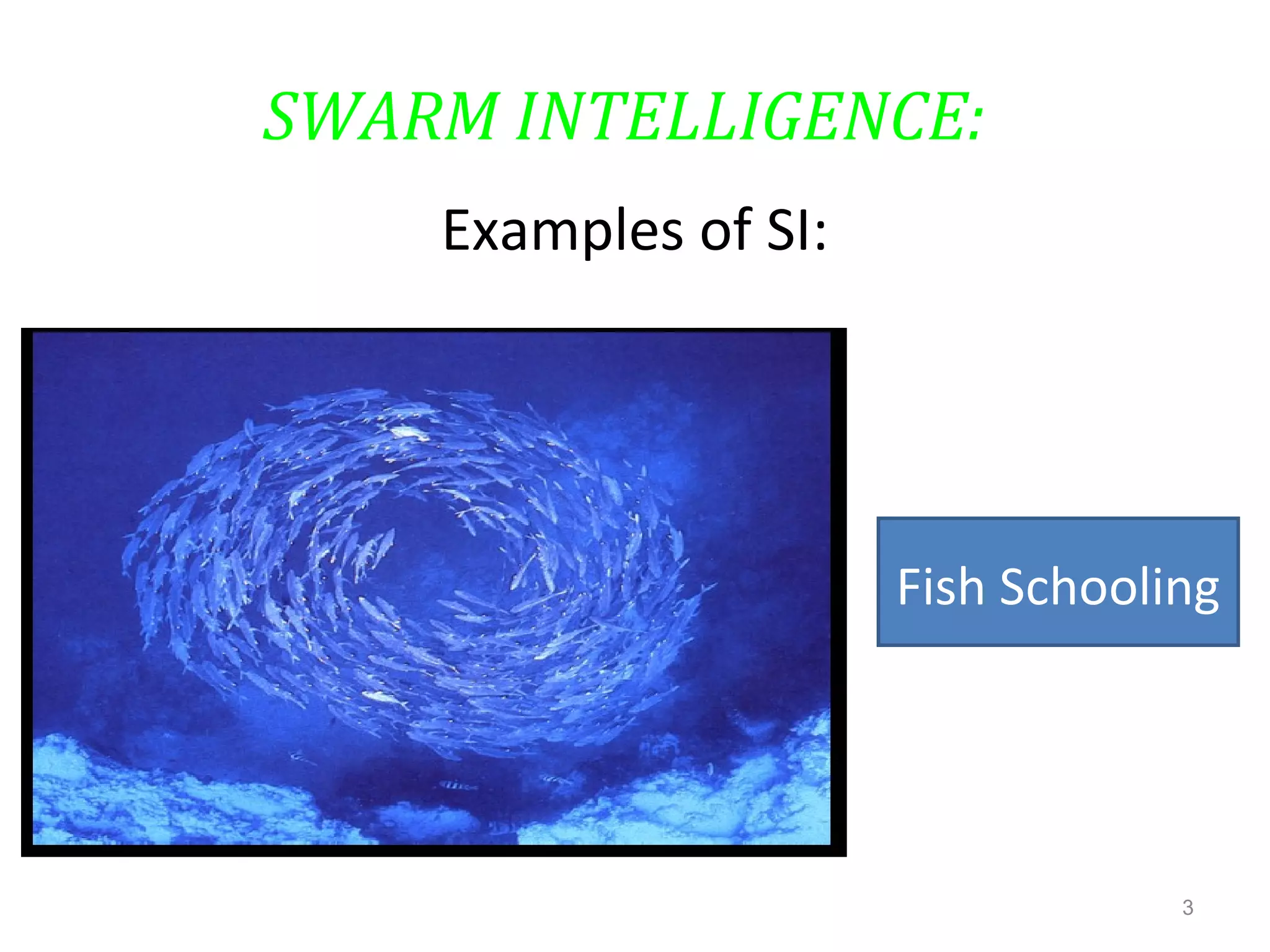
Examples of SI:
3
Fish Schooling
Cont’d:
4
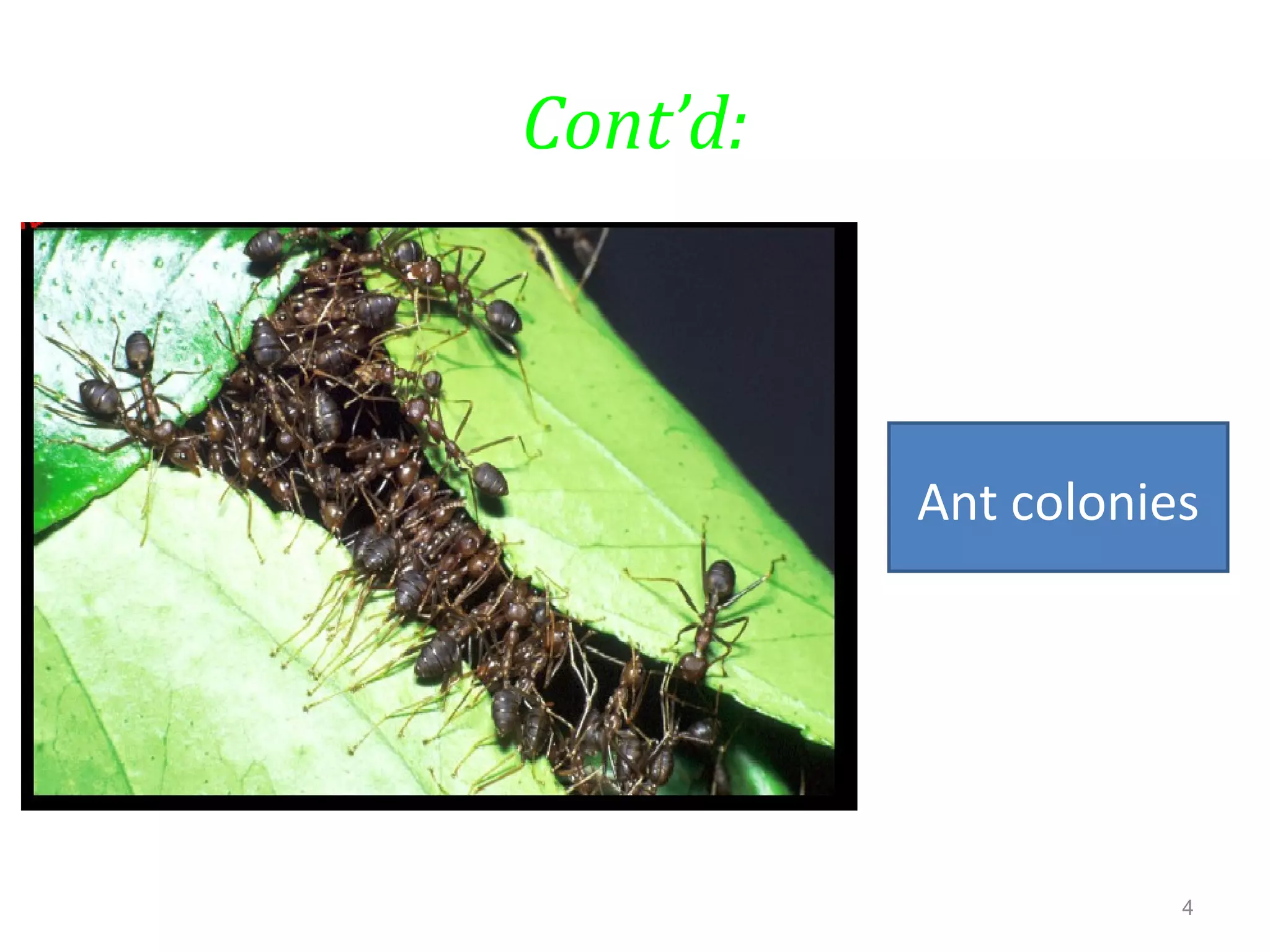
Ant colonies
Ant Colony Optimization:
•An adaptative nature inspired algorithm explained,
concretely implemented, and applied to routing protocols
in wired and wireless networks.
•Ant Colony Optimization (ACO) studies artificial systems
that take inspiration from the behavior of real ant
colonies and which are used to solve discrete
optimization problems.
•The first ACO system was introduced by Marco Dorigo in
his Ph.D. thesis (1992), and was called Ant System (AS).
5
The ants:
• Can explore vast areas without global view of the
ground.
• Can find the food and bring it back to the nest.
• Will converge to the shortest path.
6
How can they manage such great tasks ?
•By leaving pheromones behind them.
•Wherever they go, they let pheromones behind here,
marking the area as explored and communicating to the
other ants that the way is known.
7
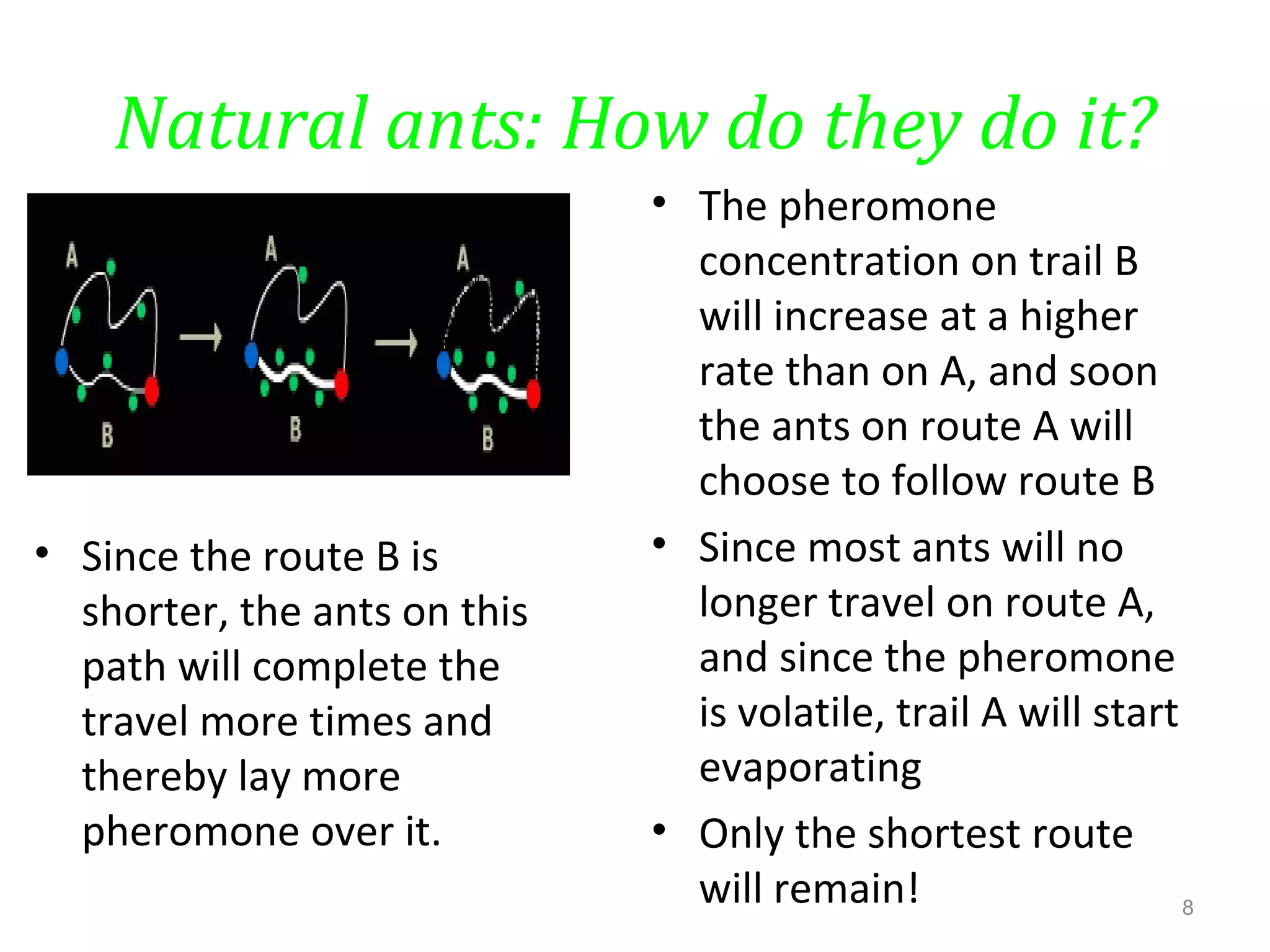
Natural ants: How do they do it?
• Since the route B is
shorter, the ants on this
path will complete the
travel more times and
thereby lay more
pheromone over it.
• The pheromone
concentration on trail B
will increase at a higher
rate than on A, and soon
the ants on route A will
choose to follow route B
• Since most ants will no
longer travel on route A,
and since the pheromone
is volatile, trail A will start
evaporating
• Only the shortest route
will remain! 8
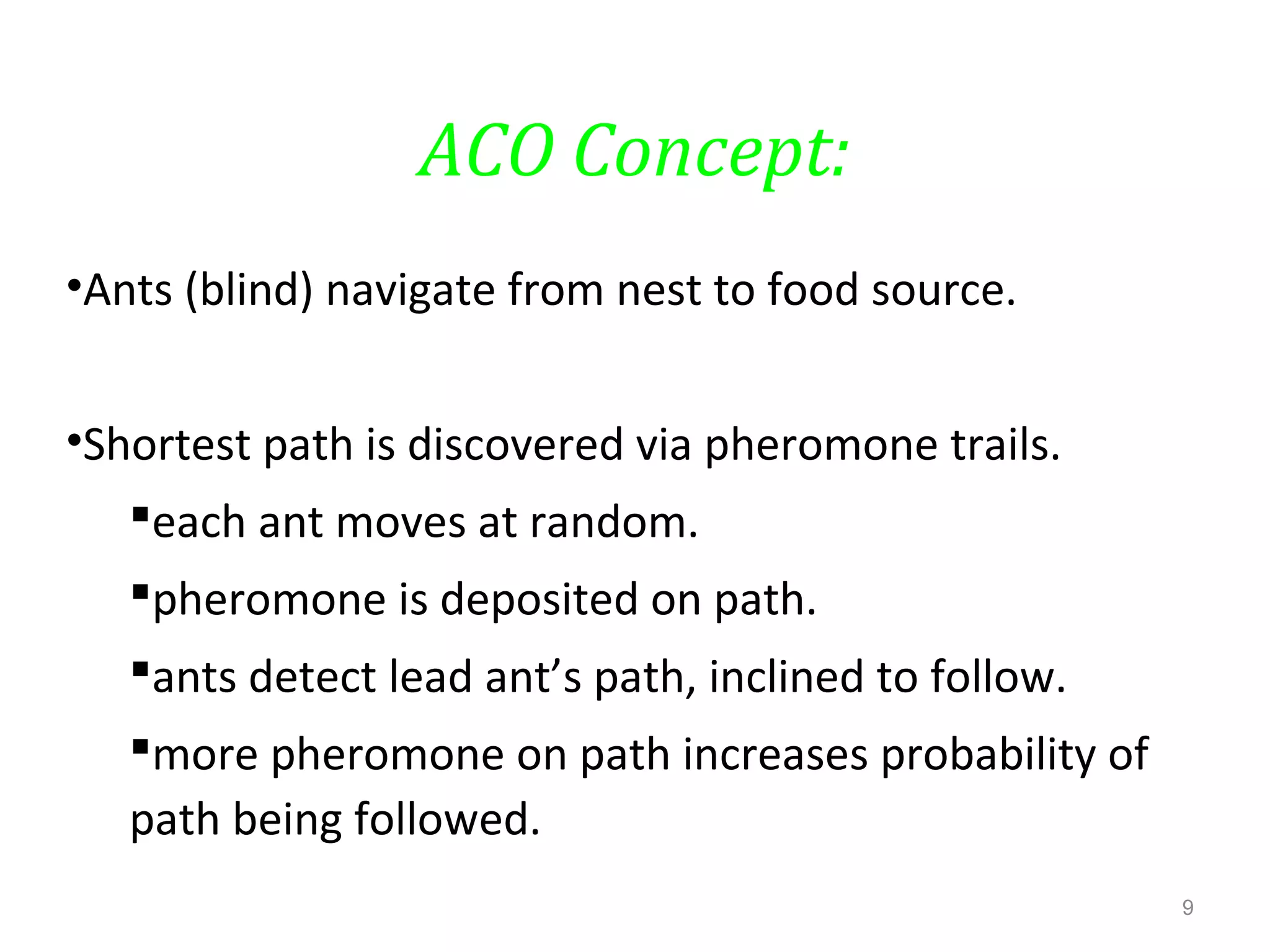
ACO Concept:
•Ants (blind) navigate from nest to food source.
•Shortest path is discovered via pheromone trails.
each ant moves at random.
pheromone is deposited on path.
ants detect lead ant’s path, inclined to follow.
more pheromone on path increases probability of
path being followed.
9
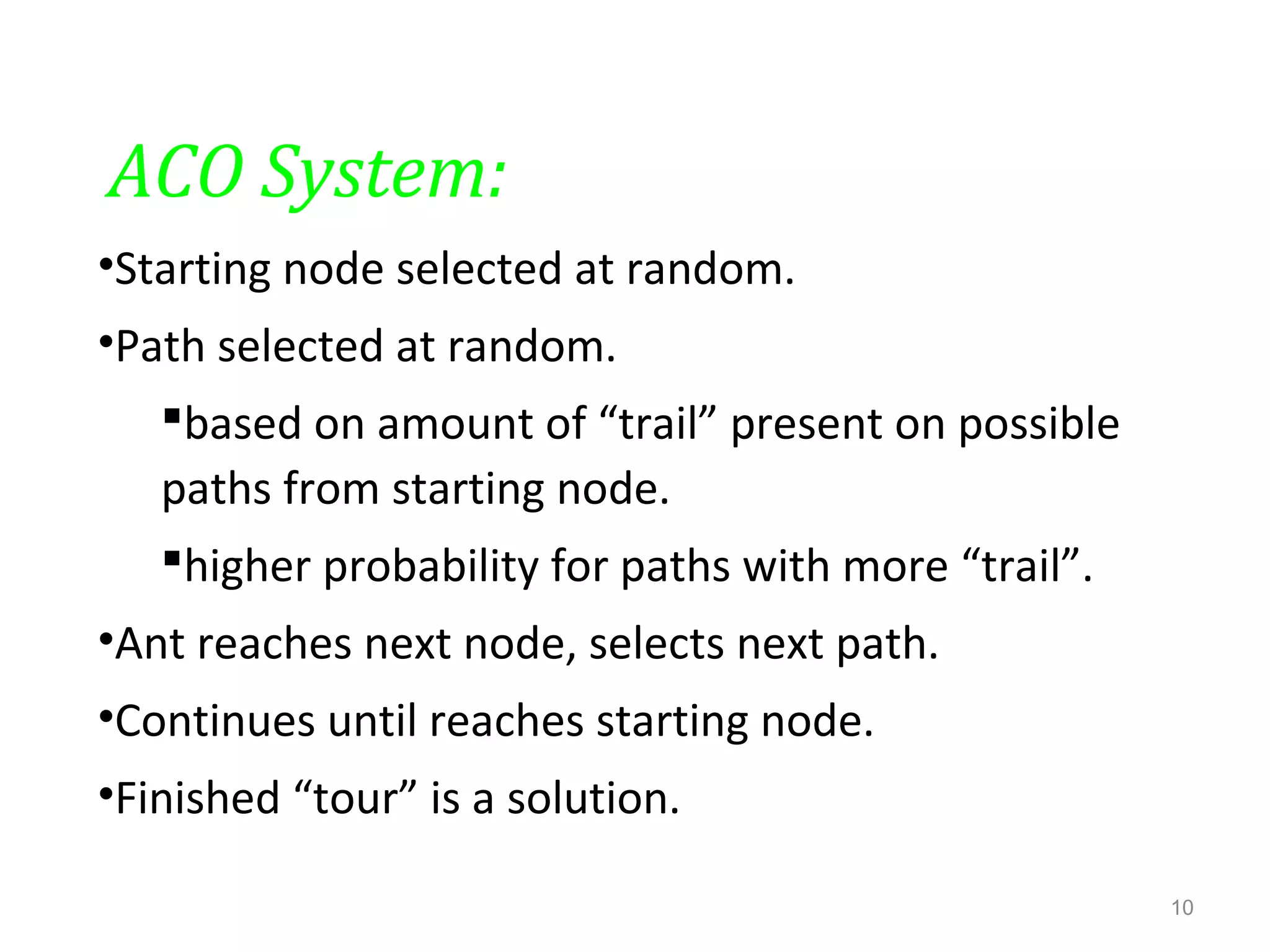
ACO System:
•Starting node selected at random.
•Path selected at random.
based on amount of “trail” present on possible
paths from starting node.
higher probability for paths with more “trail”.
•Ant reaches next node, selects next path.
•Continues until reaches starting node.
•Finished “tour” is a solution.
10
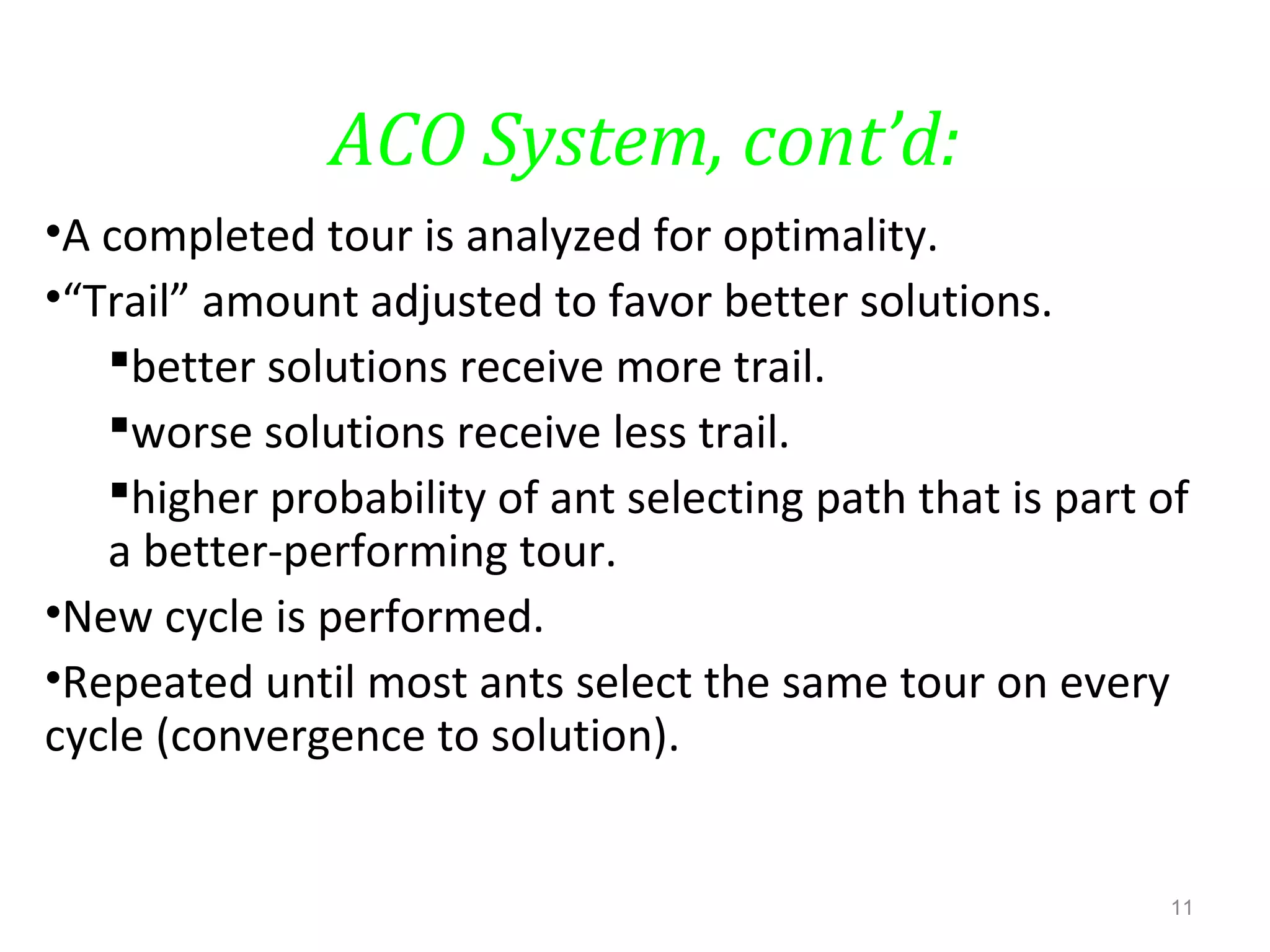
ACO System, cont’d:
•A completed tour is analyzed for optimality.
•“Trail” amount adjusted to favor better solutions.
better solutions receive more trail.
worse solutions receive less trail.
higher probability of ant selecting path that is part of
a better-performing tour.
•New cycle is performed.
•Repeated until most ants select the same tour on every
cycle (convergence to solution).
11
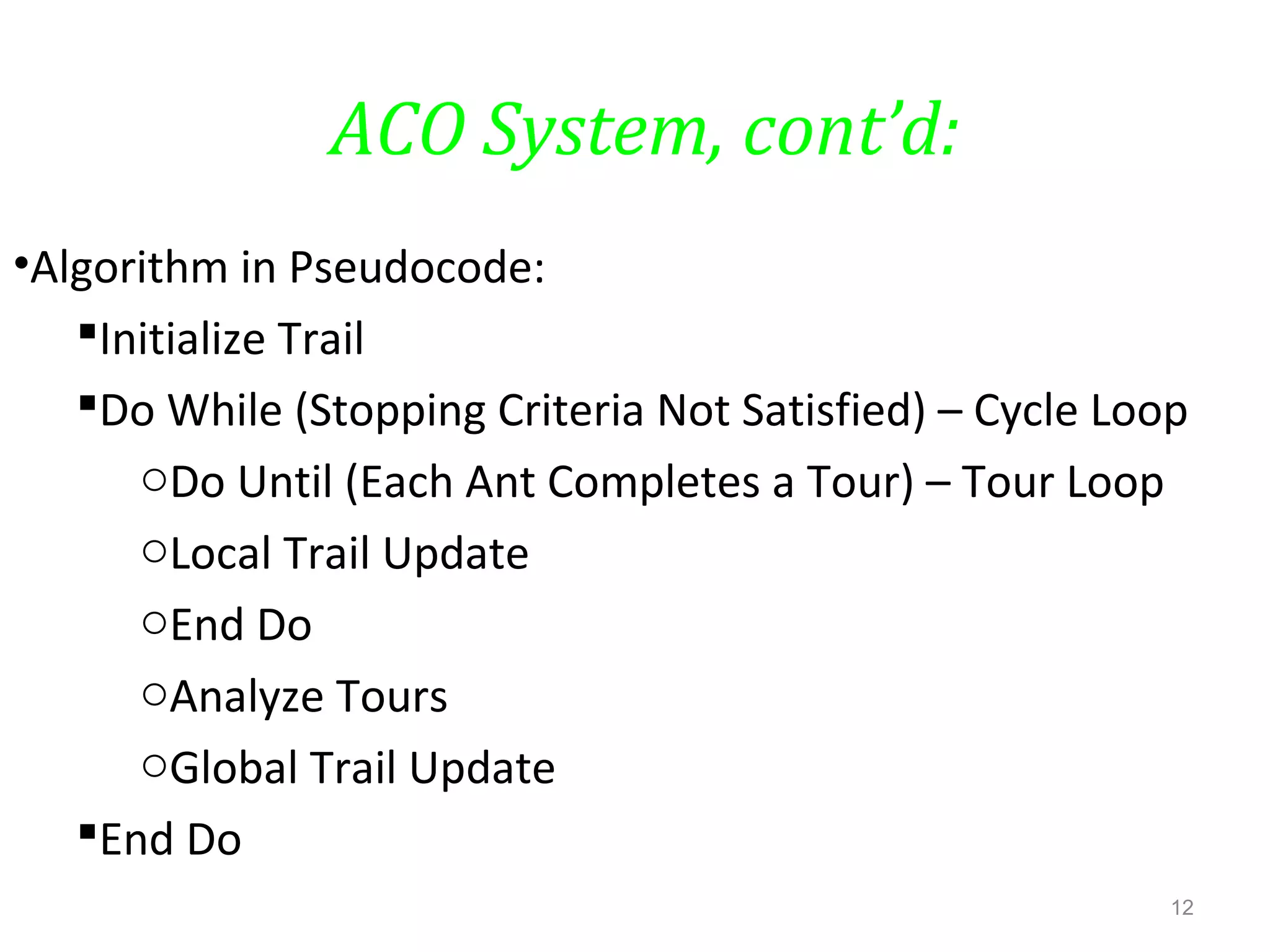
ACO System, cont’d:
•Algorithm in Pseudocode:
Initialize Trail
Do While (Stopping Criteria Not Satisfied) – Cycle Loop
oDo Until (Each Ant Completes a Tour) – Tour Loop
oLocal Trail Update
oEnd Do
oAnalyze Tours
oGlobal Trail Update
End Do
12
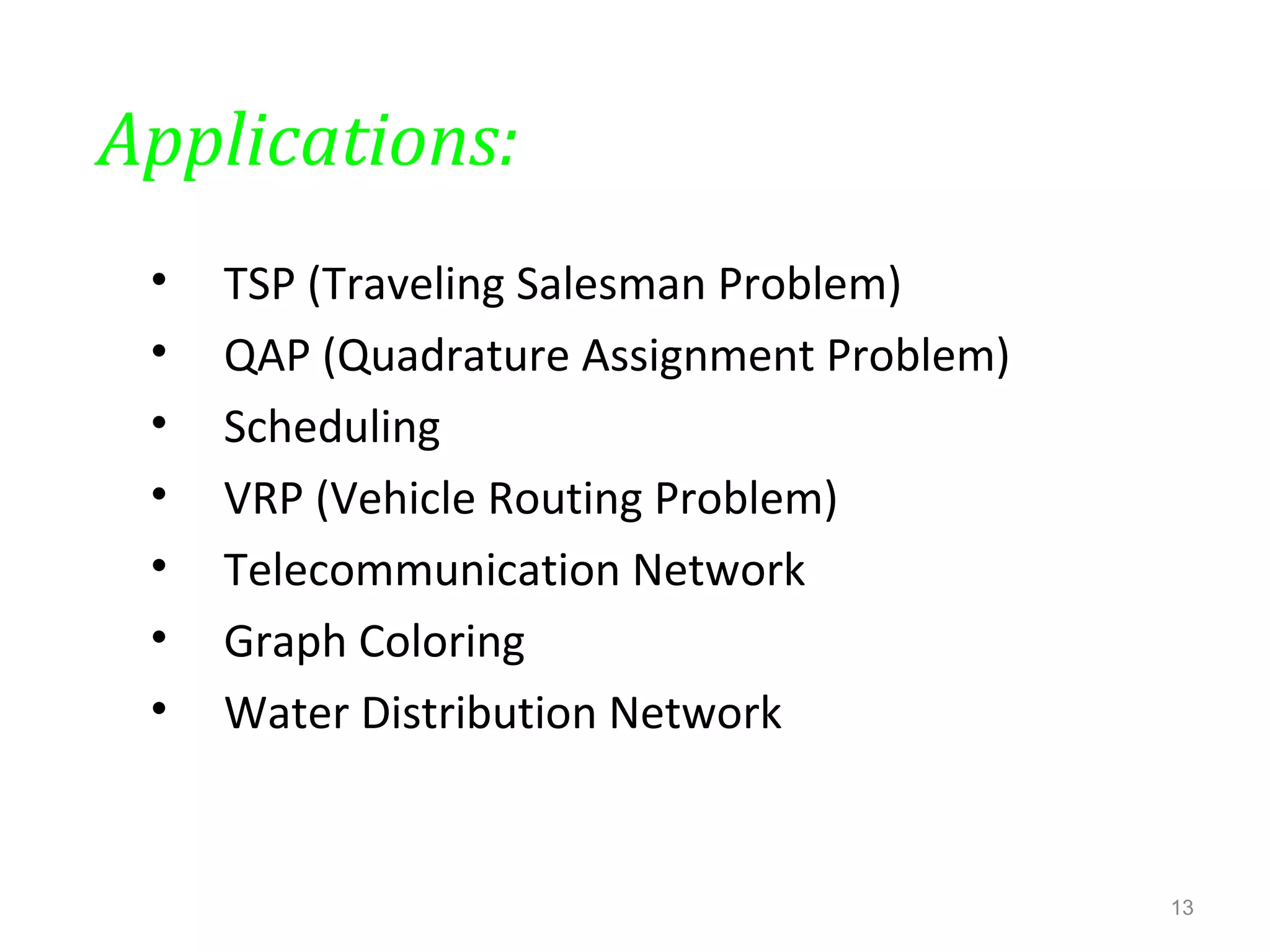
Applications:
• TSP (Traveling Salesman Problem)
• QAP (Quadrature Assignment Problem)
• Scheduling
• VRP (Vehicle Routing Problem)
• Telecommunication Network
• Graph Coloring
• Water Distribution Network
13
14
A simple TSP example:
A
E
D
C
B1
[]
4
[]
3
[]
2
[]
5
[]
dAB =100;dBC = 60…;dDE
=150
15
Iteration 1:
A
E
D
C
B
1
[A]
5
[E]
3
[C]
2
[B]
4
[D]
16
How to build next sub-solution?
A
E
D
C
B
1
[A]
1
[A]
1
[A]
1
[A]
1
[A,D]
otherwise0
allowedjif k






∈
∑=
∈ kallowedk
ikik
ijij
k
ij
][)]t([
][)]t([
)t(p
βα
βα
ητ
ητ
17
Iteration 2:
A
E
D
C
B
3
[C,B]
5
[E,A]
1
[A,D]
2
[B,C]
4
[D,E]
18
Iteration 3:
A
E
D
C
B
4
[D,E,A]
5
[E,A,B]
3
[C,B,E]
2
[B,C,D]
1
[A,D,C]
19
Iteration 4:
A
E
D
C
B
4
[D,E,A,B]
2
[B,C,D,A]
5
[E,A,B,C]
1
[A,DCE]
3
[C,B,E,D]
20
Iteration 5:
A
E
D
C
B
1
[A,D,C,E,B]
3
[C,B,E,D,A]
4
[D,E,A,B,C]
2
[B,C,D,A,E]
5
[E,A,B,C,D]
21
Path and Pheromone Evaluation:
1
[A,D,C,E,B]
5
[E,A,B,C,D]
L1 =300





∈
=
otherwise0
tour)j,i(if
L
Q
k
k
j,iτ∆
L2 =450
L3 =260
L4 =280
L5 =420
2
[B,C,D,A,E]
3
[C,B,E,D,A]
4
[D,E,A,B,C]
5
B,A
4
B,A
3
B,A
2
B,A
1
B,A
total
B,A τ∆τ∆τ∆τ∆τ∆τ∆ ++++=
22
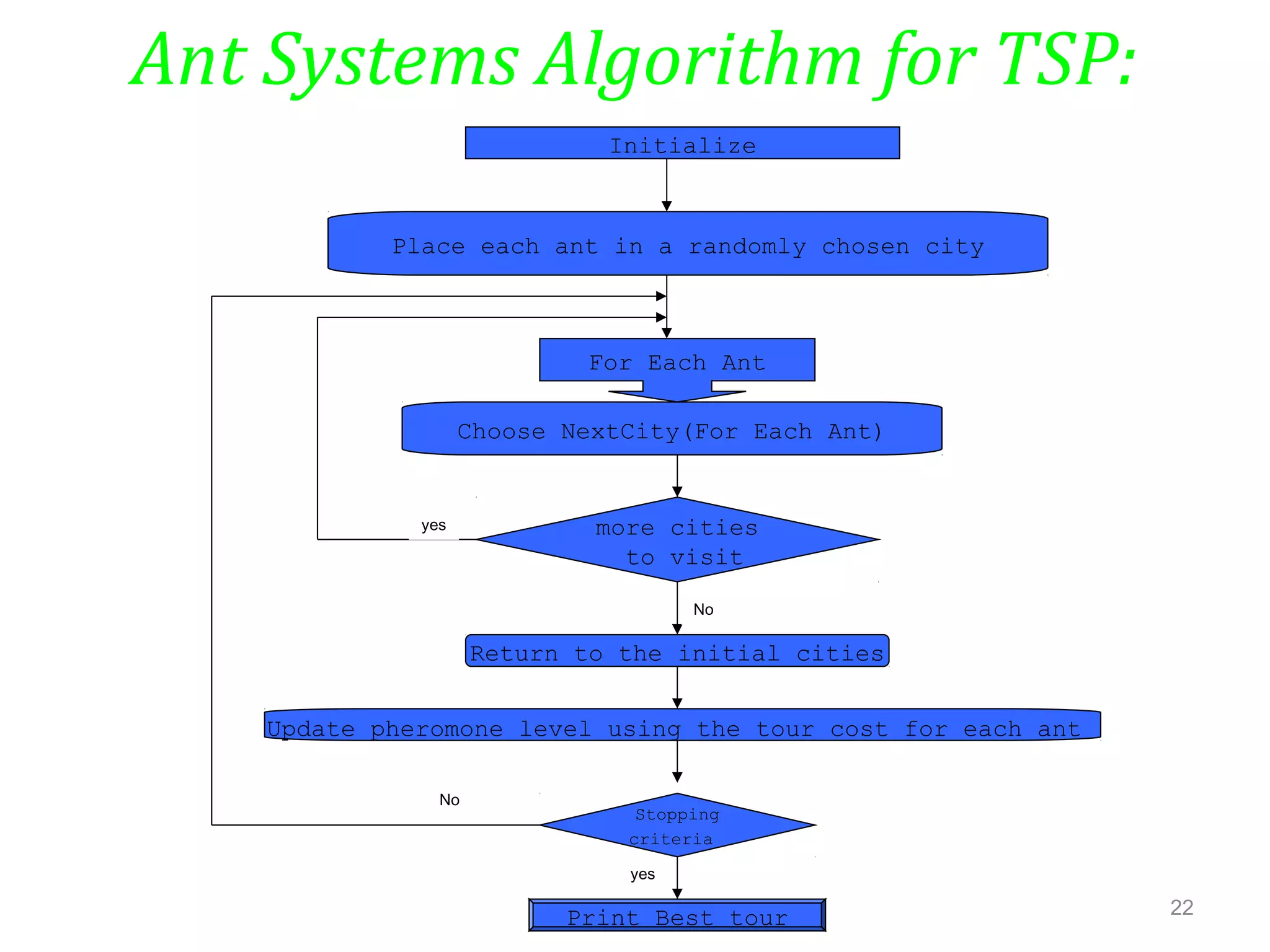
Ant Systems Algorithm for TSP:
Initialize
Place each ant in a randomly chosen city
Choose NextCity(For Each Ant)
more cities
to visit
For Each Ant
Return to the initial cities
Update pheromone level using the tour cost for each ant
Print Best tour
yes
No
Stopping
criteria
yes
No
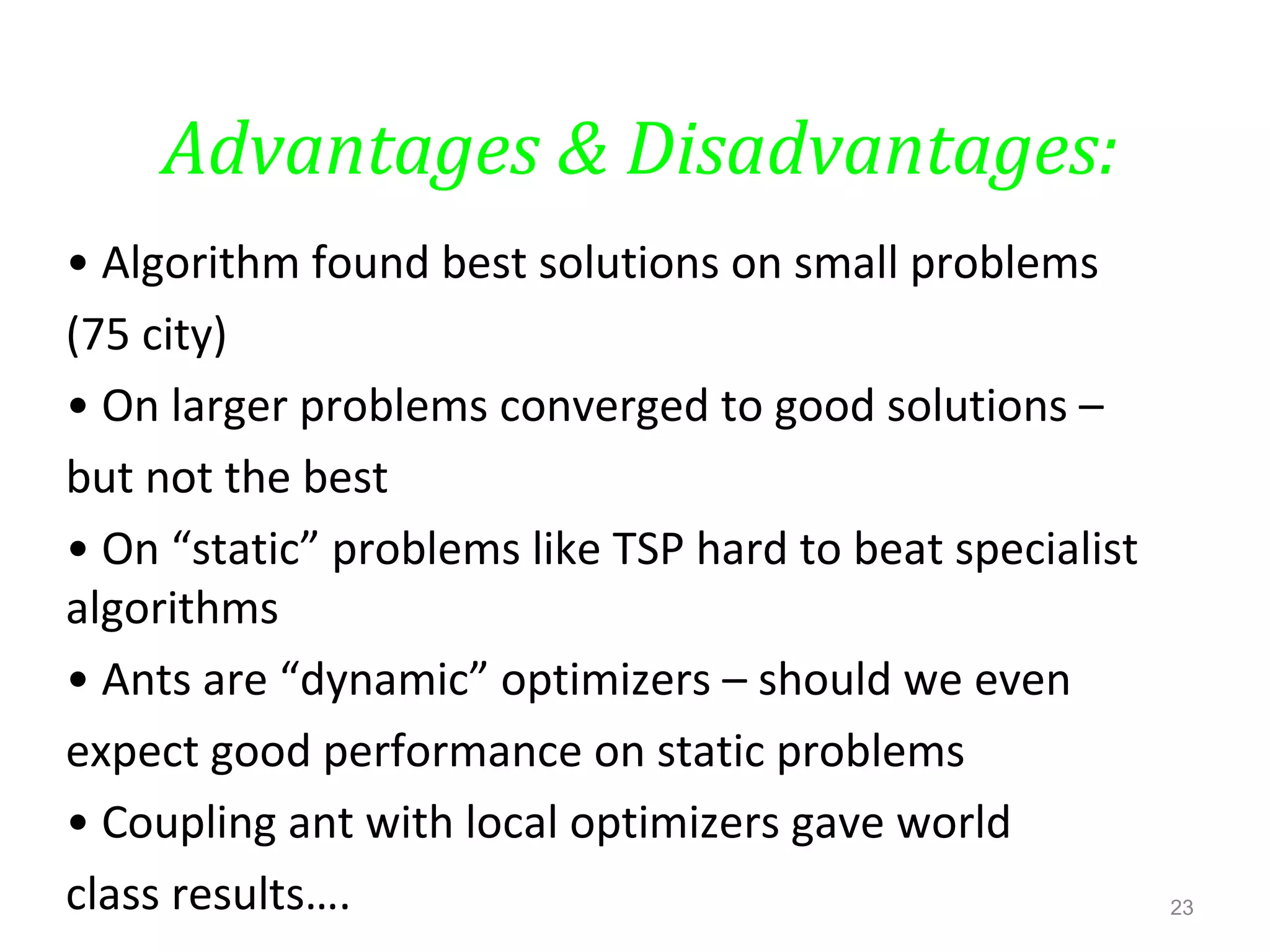
Advantages & Disadvantages:
• Algorithm found best solutions on small problems
(75 city)
• On larger problems converged to good solutions –
but not the best
• On “static” problems like TSP hard to beat specialist
algorithms
• Ants are “dynamic” optimizers – should we even
expect good performance on static problems
• Coupling ant with local optimizers gave world
class results…. 23
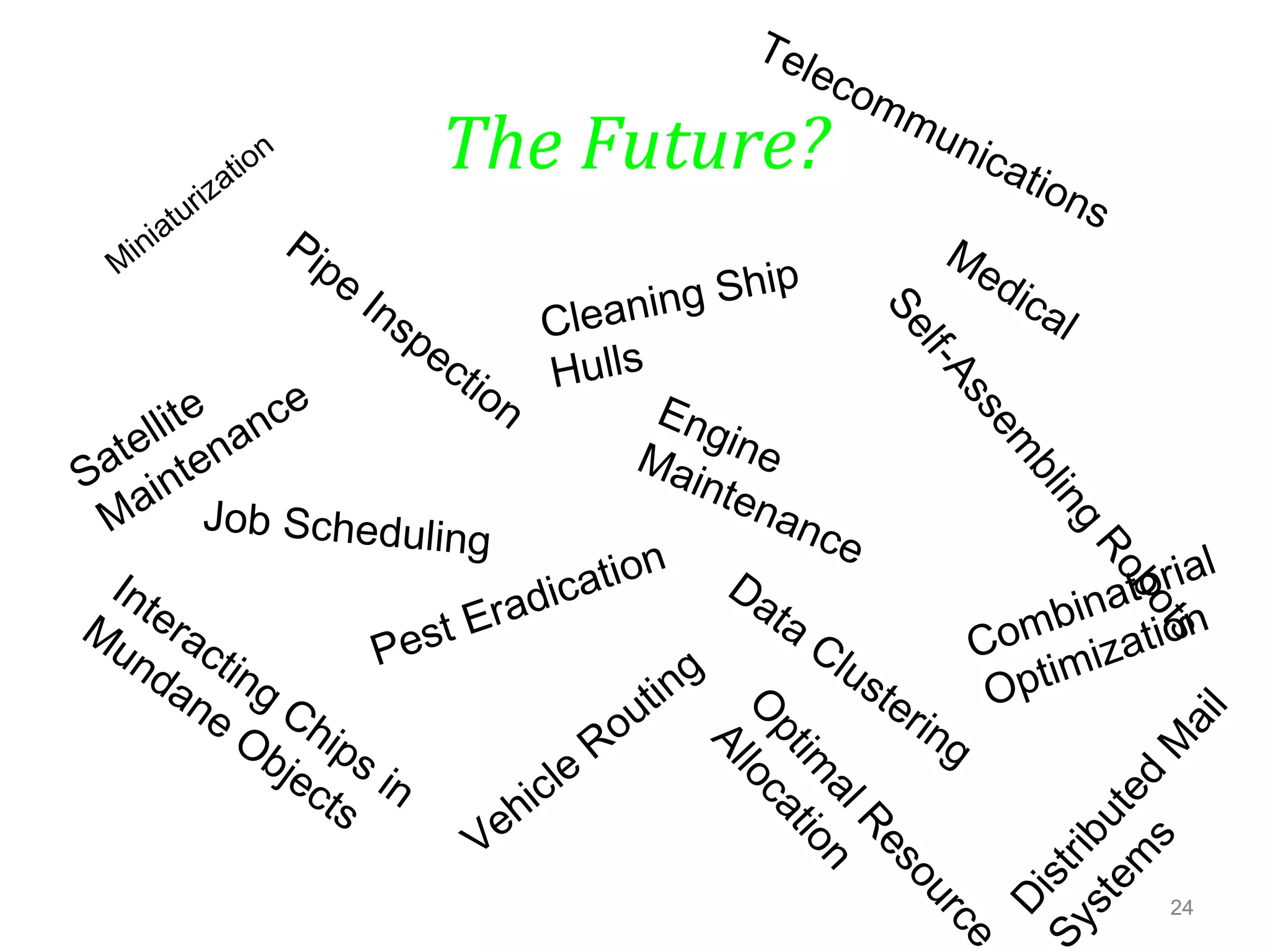
2424
Satellite
Maintenance
The Future?
Medical
Interacting Chips in
Mundane Objects
Cleaning Ship
Hulls
Pipe
Inspection
Pest Eradication
M
iniaturization
EngineMaintenance
Telecommunications
Self-Assem
bling
Robots
Job Scheduling
Vehicle
Routing
Data Clustering
Distributed
M
ail
System
s
O
ptim
alResource
Allocation
Combinatorial
Optimization
References:
•Marco Dorigo, 1992. Optimization, Learning and Natural Algorithms,
PhD thesis, Politecnico di Milano, Italy.
•“Swarm Intelligence” by James Kennedy and Russell Eberhart with
Yuhui Shi, Morgan Kauffmann Publishers, 2001
•“Data Mining: A Heuristic Approach” by Hussein Abbass, Ruhul
Sarker, and Charles Newton, IGI Publishing, 2002.
•“Ant Colony Optimization” Curatored by Marco Dorigo,
http://www.scholarpedia.org/article/Ant_Colony_Optimization
•“Ant Colony Optimization” by Marco Dorigo,
http://iridia.ulb.ac.be/~mdorigo/ACO/ACO.htm.
•“Particle Swarm Optimization” http://www.swarmintelligence.org
•“Swarm Intelligence”
http://en.wikipedia.org/wiki/Swarm_intelligence.
25
Ant colony Optimization

Ant colony Optimization

  • 1.
    SEMINAR TOPIC: ANT COLONYOPTIMIZATION Submitted by: Submitted by: Swetansh M Shrivastava Mr. Sandeep Bhatia IIIrd year EC Asst. Professor DEPARTMENT OF ELECTRONICS & COMM. Raj Kumar Goel Institute of Technology 1
  • 2.
    INTRODUCTION: SWARM INTELLIGENCE • Swarmintelligence (SI) is artificial intelligence based on the collective behavior of decentralized, self- organized systems. • Swarm intelligence (SI) deals with collective behaviors that result from the local interactions of individual components with each other and with their environment. 2Bird flocking
  • 3.
    SWARM INTELLIGENCE: Examples ofSI: 3 Fish Schooling
  • 4.
  • 5.
    Ant Colony Optimization: •Anadaptative nature inspired algorithm explained, concretely implemented, and applied to routing protocols in wired and wireless networks. •Ant Colony Optimization (ACO) studies artificial systems that take inspiration from the behavior of real ant colonies and which are used to solve discrete optimization problems. •The first ACO system was introduced by Marco Dorigo in his Ph.D. thesis (1992), and was called Ant System (AS). 5
  • 6.
    The ants: • Canexplore vast areas without global view of the ground. • Can find the food and bring it back to the nest. • Will converge to the shortest path. 6
  • 7.
    How can theymanage such great tasks ? •By leaving pheromones behind them. •Wherever they go, they let pheromones behind here, marking the area as explored and communicating to the other ants that the way is known. 7
  • 8.
    Natural ants: Howdo they do it? • Since the route B is shorter, the ants on this path will complete the travel more times and thereby lay more pheromone over it. • The pheromone concentration on trail B will increase at a higher rate than on A, and soon the ants on route A will choose to follow route B • Since most ants will no longer travel on route A, and since the pheromone is volatile, trail A will start evaporating • Only the shortest route will remain! 8
  • 9.
    ACO Concept: •Ants (blind)navigate from nest to food source. •Shortest path is discovered via pheromone trails. each ant moves at random. pheromone is deposited on path. ants detect lead ant’s path, inclined to follow. more pheromone on path increases probability of path being followed. 9
  • 10.
    ACO System: •Starting nodeselected at random. •Path selected at random. based on amount of “trail” present on possible paths from starting node. higher probability for paths with more “trail”. •Ant reaches next node, selects next path. •Continues until reaches starting node. •Finished “tour” is a solution. 10
  • 11.
    ACO System, cont’d: •Acompleted tour is analyzed for optimality. •“Trail” amount adjusted to favor better solutions. better solutions receive more trail. worse solutions receive less trail. higher probability of ant selecting path that is part of a better-performing tour. •New cycle is performed. •Repeated until most ants select the same tour on every cycle (convergence to solution). 11
  • 12.
    ACO System, cont’d: •Algorithmin Pseudocode: Initialize Trail Do While (Stopping Criteria Not Satisfied) – Cycle Loop oDo Until (Each Ant Completes a Tour) – Tour Loop oLocal Trail Update oEnd Do oAnalyze Tours oGlobal Trail Update End Do 12
  • 13.
    Applications: • TSP (TravelingSalesman Problem) • QAP (Quadrature Assignment Problem) • Scheduling • VRP (Vehicle Routing Problem) • Telecommunication Network • Graph Coloring • Water Distribution Network 13
  • 14.
    14 A simple TSPexample: A E D C B1 [] 4 [] 3 [] 2 [] 5 [] dAB =100;dBC = 60…;dDE =150
  • 15.
  • 16.
    16 How to buildnext sub-solution? A E D C B 1 [A] 1 [A] 1 [A] 1 [A] 1 [A,D] otherwise0 allowedjif k       ∈ ∑= ∈ kallowedk ikik ijij k ij ][)]t([ ][)]t([ )t(p βα βα ητ ητ
  • 17.
  • 18.
  • 19.
  • 20.
  • 21.
    21 Path and PheromoneEvaluation: 1 [A,D,C,E,B] 5 [E,A,B,C,D] L1 =300      ∈ = otherwise0 tour)j,i(if L Q k k j,iτ∆ L2 =450 L3 =260 L4 =280 L5 =420 2 [B,C,D,A,E] 3 [C,B,E,D,A] 4 [D,E,A,B,C] 5 B,A 4 B,A 3 B,A 2 B,A 1 B,A total B,A τ∆τ∆τ∆τ∆τ∆τ∆ ++++=
  • 22.
    22 Ant Systems Algorithmfor TSP: Initialize Place each ant in a randomly chosen city Choose NextCity(For Each Ant) more cities to visit For Each Ant Return to the initial cities Update pheromone level using the tour cost for each ant Print Best tour yes No Stopping criteria yes No
  • 23.
    Advantages & Disadvantages: •Algorithm found best solutions on small problems (75 city) • On larger problems converged to good solutions – but not the best • On “static” problems like TSP hard to beat specialist algorithms • Ants are “dynamic” optimizers – should we even expect good performance on static problems • Coupling ant with local optimizers gave world class results…. 23
  • 24.
    2424 Satellite Maintenance The Future? Medical Interacting Chipsin Mundane Objects Cleaning Ship Hulls Pipe Inspection Pest Eradication M iniaturization EngineMaintenance Telecommunications Self-Assem bling Robots Job Scheduling Vehicle Routing Data Clustering Distributed M ail System s O ptim alResource Allocation Combinatorial Optimization
  • 25.
    References: •Marco Dorigo, 1992.Optimization, Learning and Natural Algorithms, PhD thesis, Politecnico di Milano, Italy. •“Swarm Intelligence” by James Kennedy and Russell Eberhart with Yuhui Shi, Morgan Kauffmann Publishers, 2001 •“Data Mining: A Heuristic Approach” by Hussein Abbass, Ruhul Sarker, and Charles Newton, IGI Publishing, 2002. •“Ant Colony Optimization” Curatored by Marco Dorigo, http://www.scholarpedia.org/article/Ant_Colony_Optimization •“Ant Colony Optimization” by Marco Dorigo, http://iridia.ulb.ac.be/~mdorigo/ACO/ACO.htm. •“Particle Swarm Optimization” http://www.swarmintelligence.org •“Swarm Intelligence” http://en.wikipedia.org/wiki/Swarm_intelligence. 25