Ant Colony Optimization


By:
Sachin Agarwalla
Regd. No-0911012065
C.S.E(A)
                      Under Guidance Of:
                      Mr. Swadhin Ku. Barisal
                      B.E., M.Tech., CSE (IIT, Kharagpur)
                      Assistant Professor                   1
                      I.T.E.R
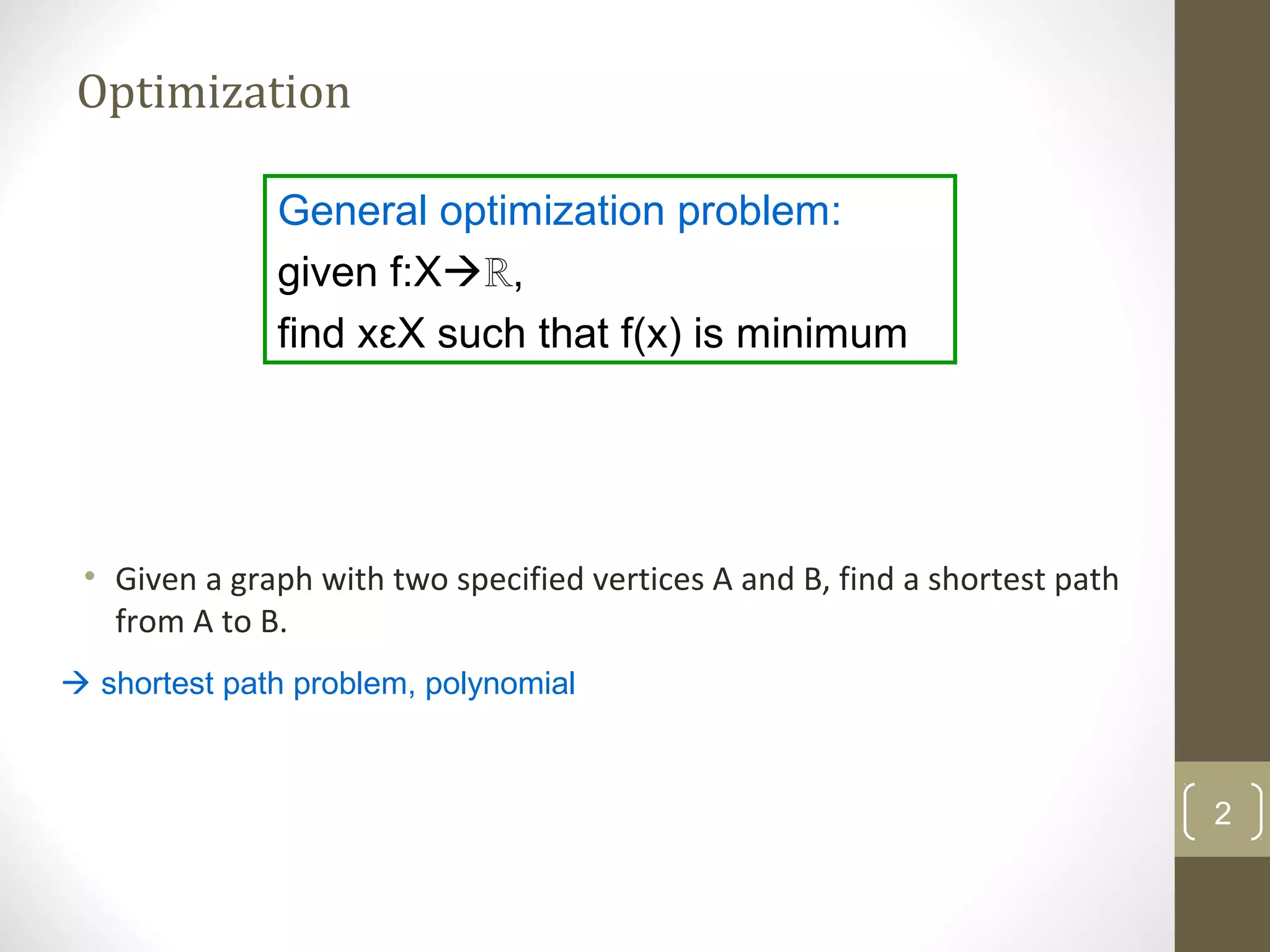
Optimization

              General optimization problem:
              given f:Xℝ,
              find xεX such that f(x) is minimum


 • Given a graph with two specified vertices A and B, find a shortest path
   from A to B.
 shortest path problem, polynomial


                                                                             2
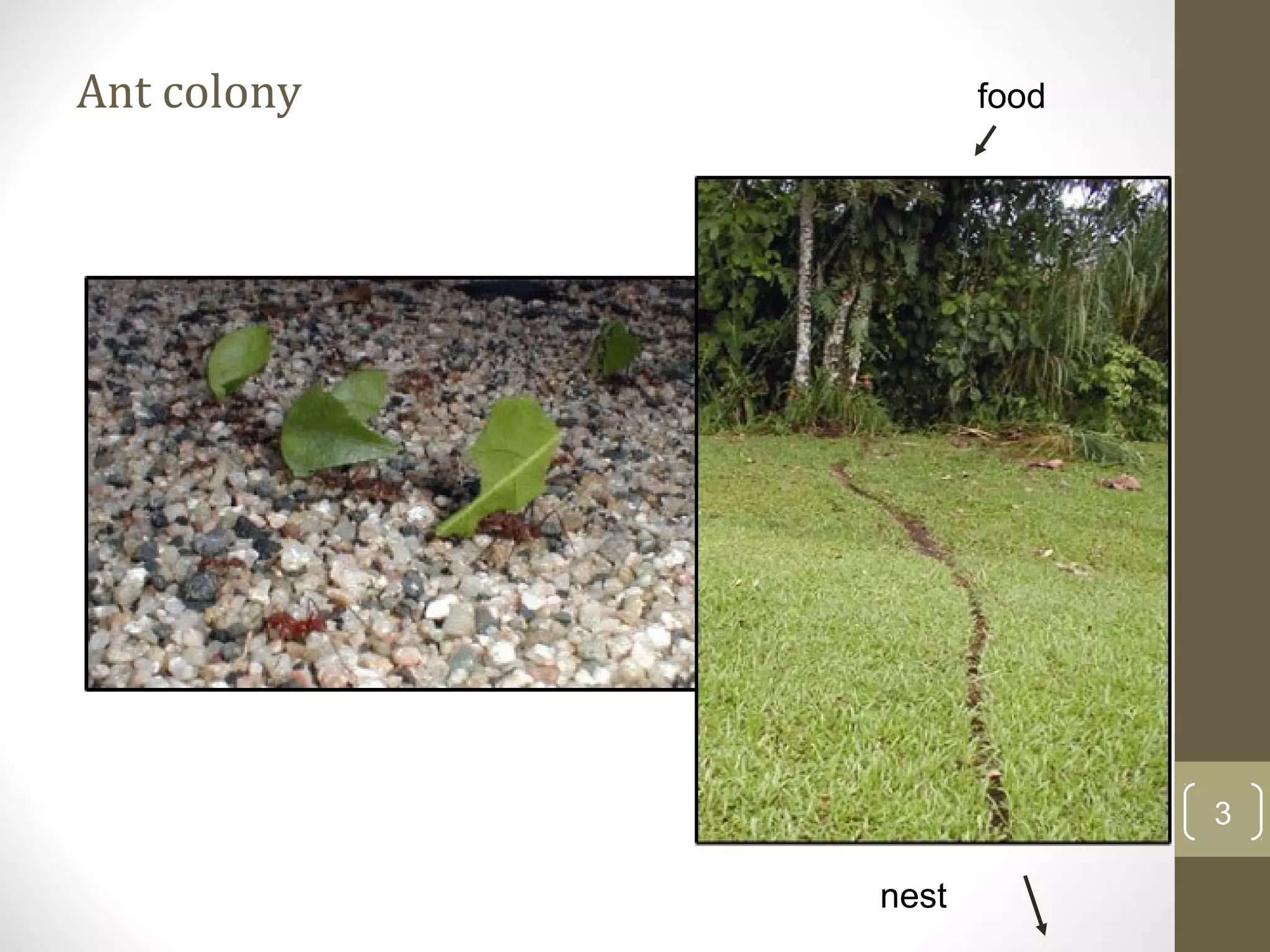
Ant colony          food


                           3

             nest
Ant Colony Optimization (ACO):
a heuristic optimization method for shortest path
  and other optimization problems which borrows
  ideas from biological ants


                                                    4
Ant Colony Optimization
Outline

•     History: ACO for shortest paths
•     ACO for shortest paths I: directed
•     ACO for shortest paths II: general
•     Advantages and Disadvantages
•     Summary
•     References


                                           5
History: ACO for shortest
paths …
                            6
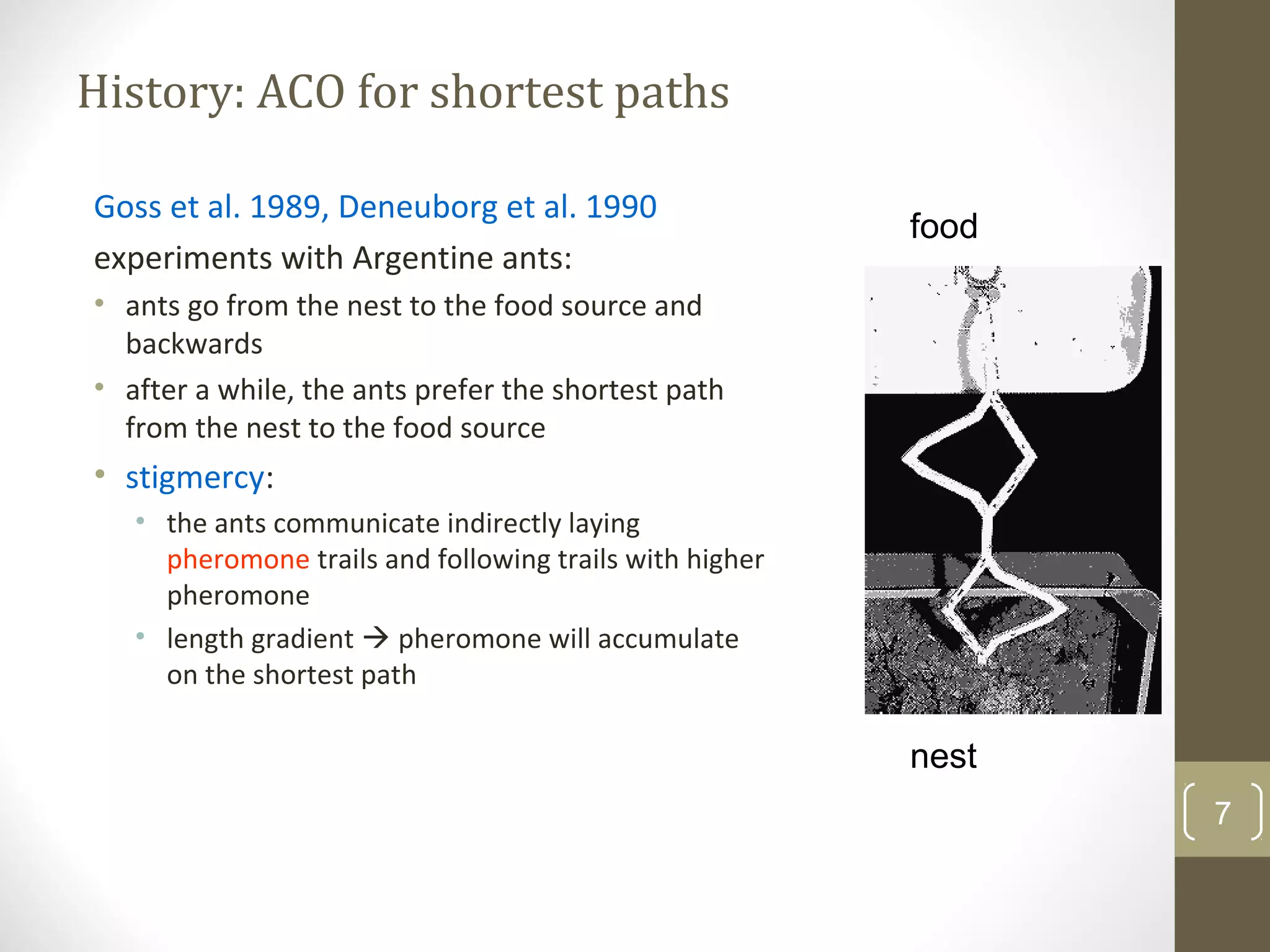
History: ACO for shortest paths

Goss et al. 1989, Deneuborg et al. 1990
                                                         food
experiments with Argentine ants:
• ants go from the nest to the food source and
  backwards
• after a while, the ants prefer the shortest path
  from the nest to the food source
• stigmercy:
   • the ants communicate indirectly laying
     pheromone trails and following trails with higher
     pheromone
   • length gradient  pheromone will accumulate
     on the shortest path

                                                         nest
                                                                7
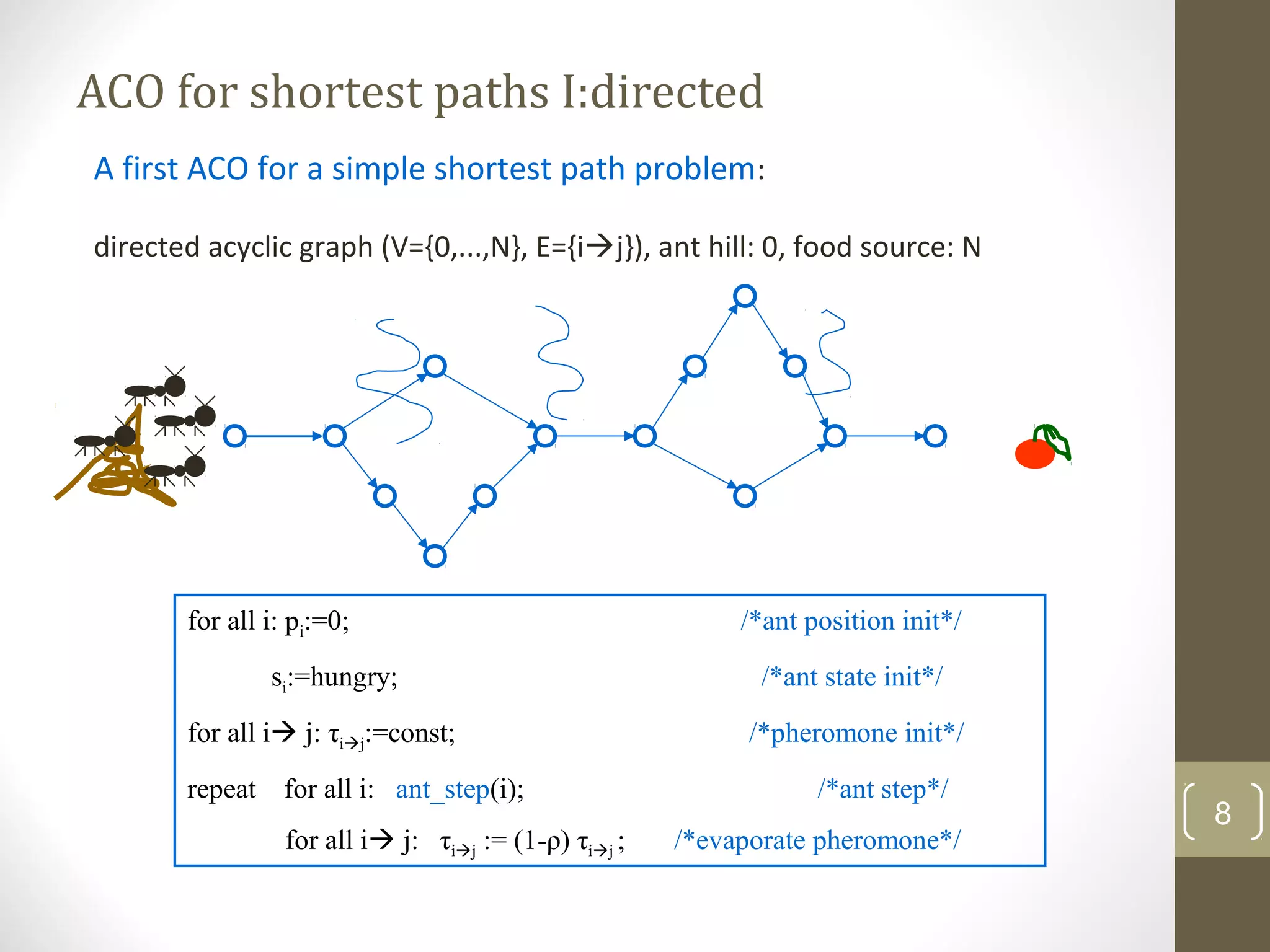
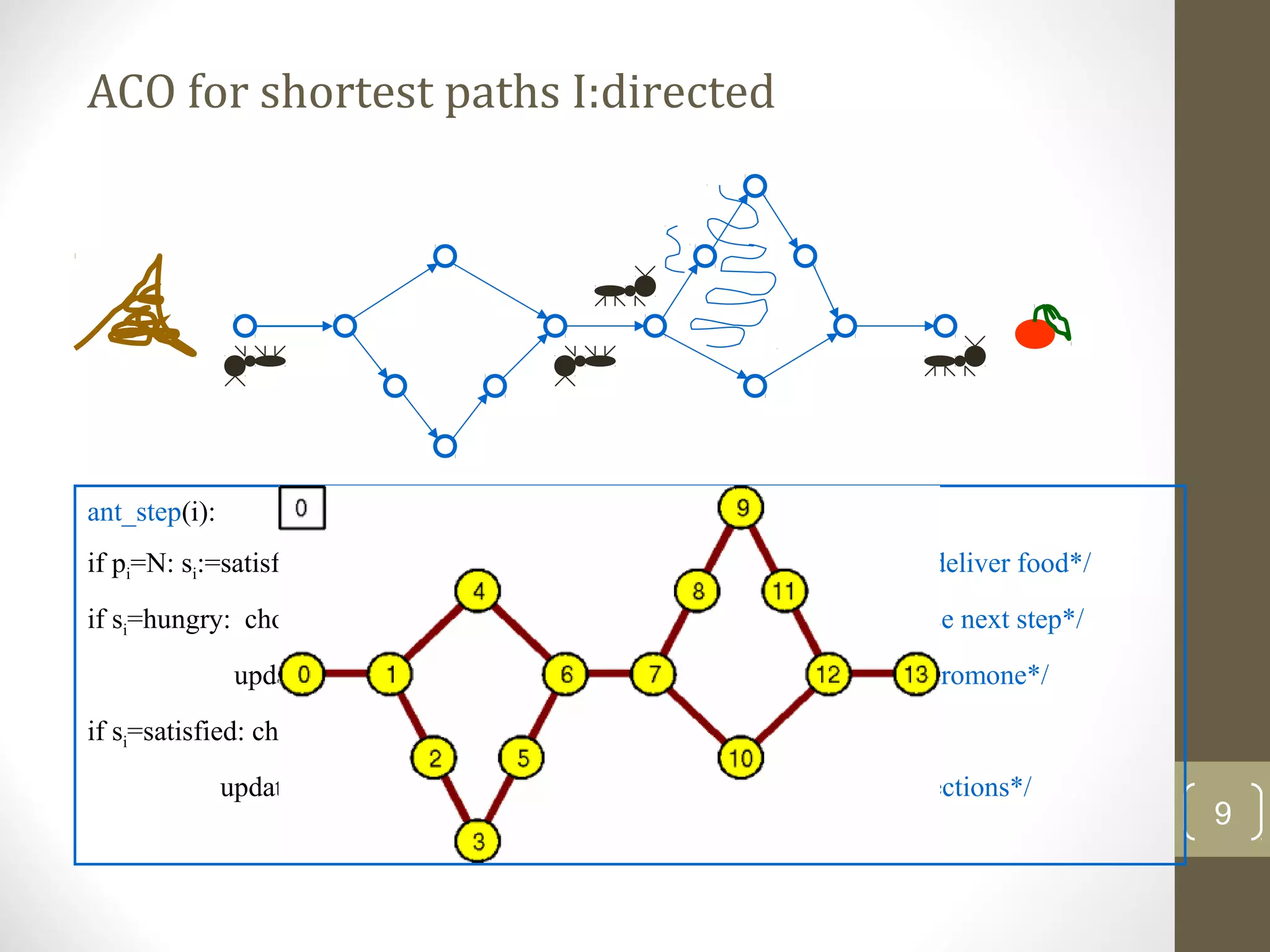
ACO for shortest paths I:directed
A first ACO for a simple shortest path problem:

directed acyclic graph (V={0,...,N}, E={ij}), ant hill: 0, food source: N


       for all i: pi:=0;                                   /*ant position init*/
               si:=hungry;                                   /*ant state init*/
       for all i j: τij:=const;                           /*pheromone init*/
       repeat for all i: ant_step(i);                             /*ant step*/
                                                                                   8
                 for all i j: τij := (1-ρ) τij ;   /*evaporate pheromone*/
ACO for shortest paths I:directed


ant_step(i):
if pi=N: si:=satisfied; if pi=0: si:=hungry;                     /*collect food/deliver food*/
if si=hungry: choose j with pij with probability τpi j/Σpij’τpij’     /*choose next step*/
                update Δτpi j := ε; pi:=j;                         /*update pheromone*/
if si=satisfied: choose j with jpi with probability τjpi/Σj’piτj’pi
               update Δτjpi:= ε; pj:=i;                         /* reversed directions*/
                                                                                                 9
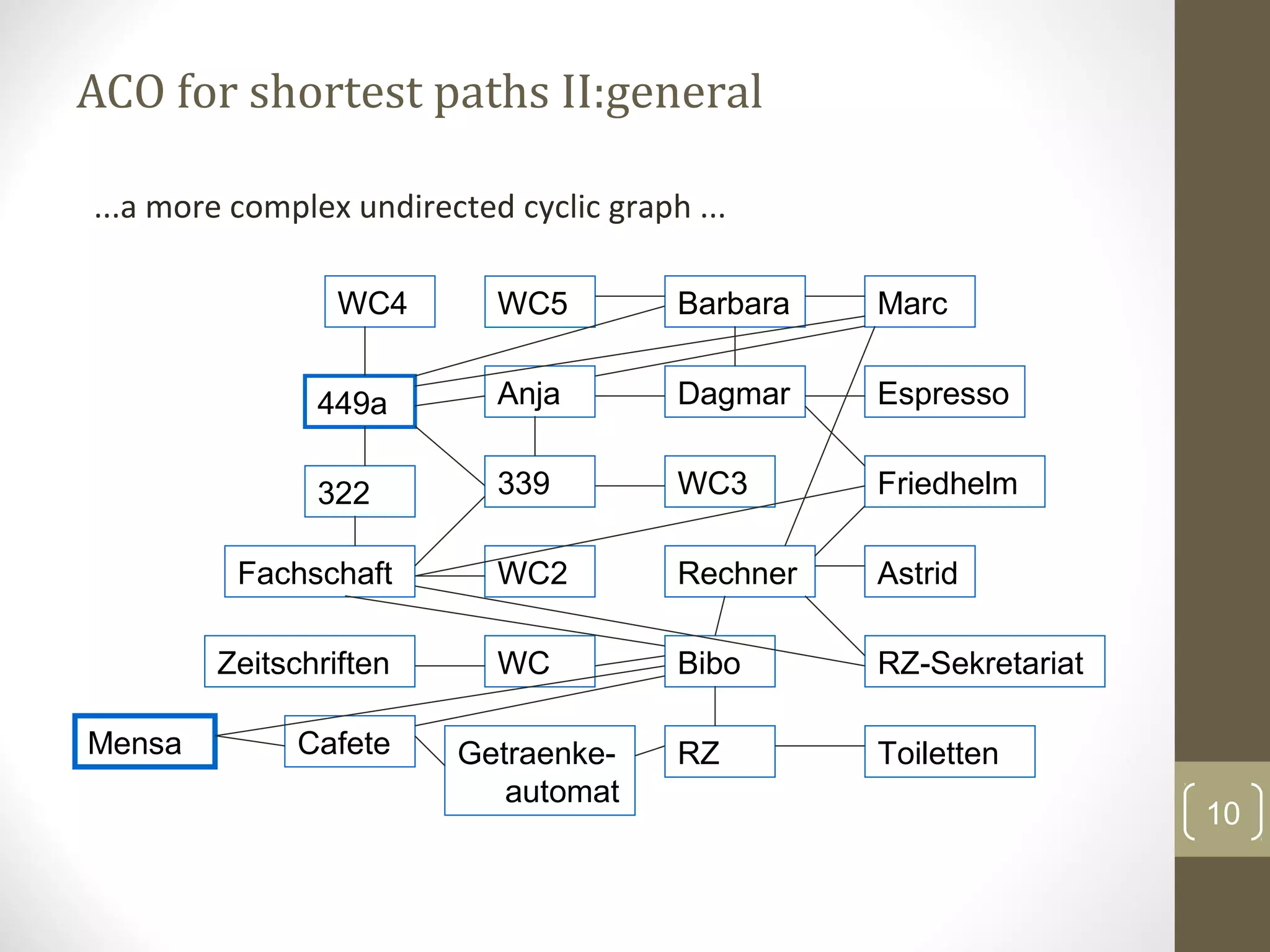
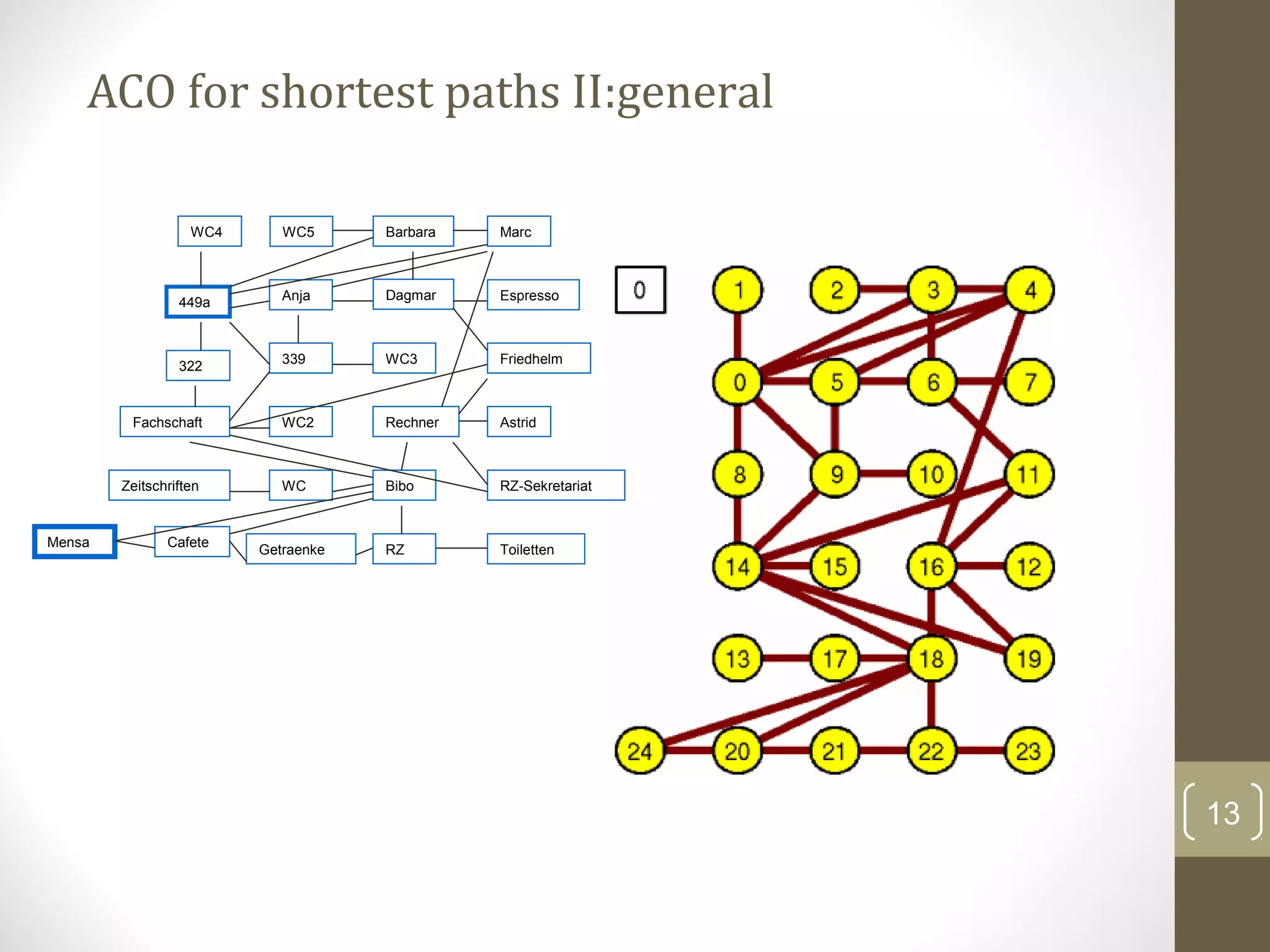
ACO for shortest paths II:general

...a more complex undirected cyclic graph ...

                 WC4        WC5          Barbara   Marc


               449a         Anja         Dagmar    Espresso


               322          339          WC3       Friedhelm

          Fachschaft        WC2          Rechner   Astrid

        Zeitschriften       WC           Bibo      RZ-Sekretariat

Mensa         Cafete     Getraenke-      RZ        Toiletten
                            automat
                                                                    10
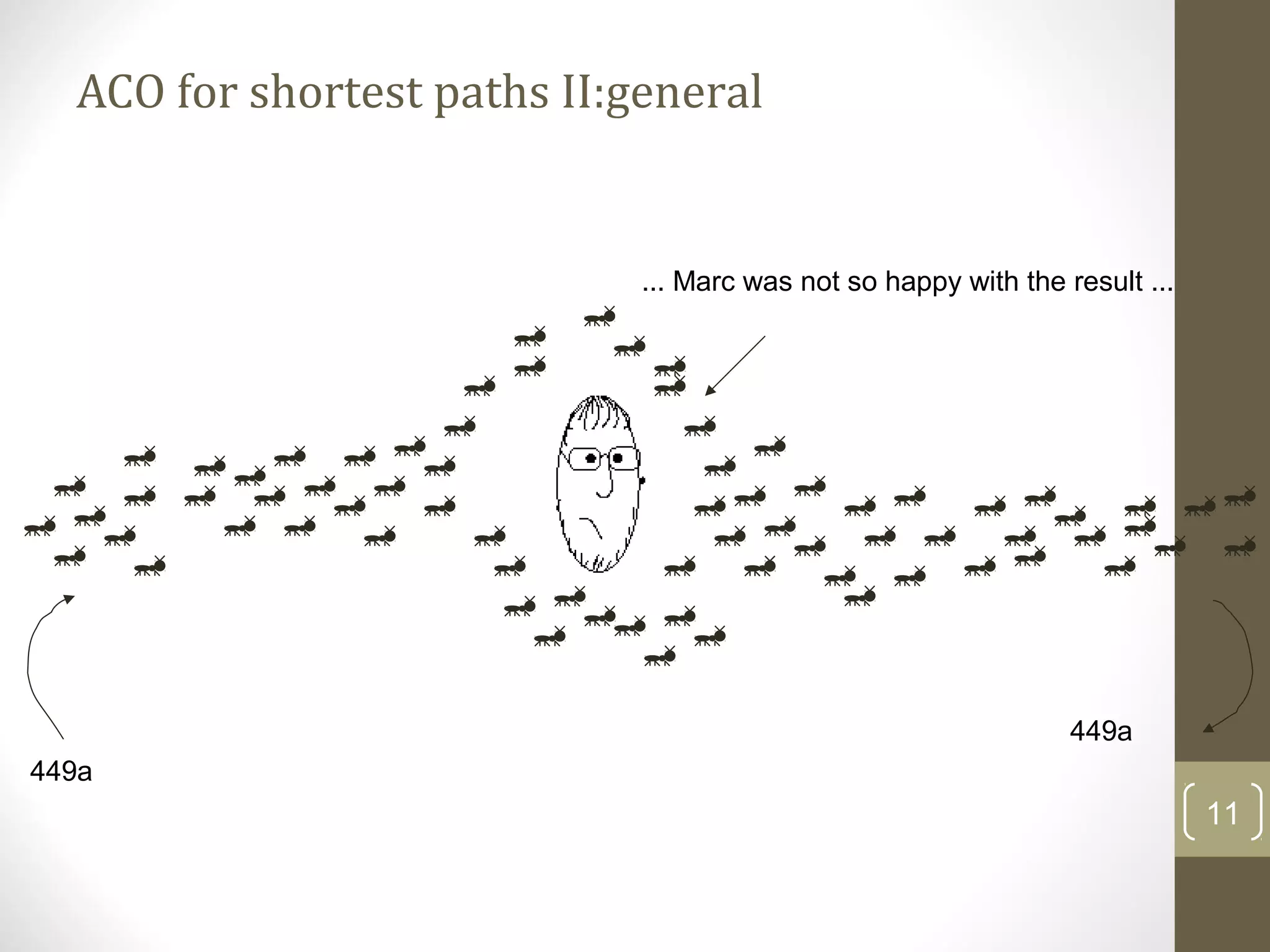
ACO for shortest paths II:general


                             ... Marc was not so happy with the result ...


                                                                 449a
449a
                                                                             11
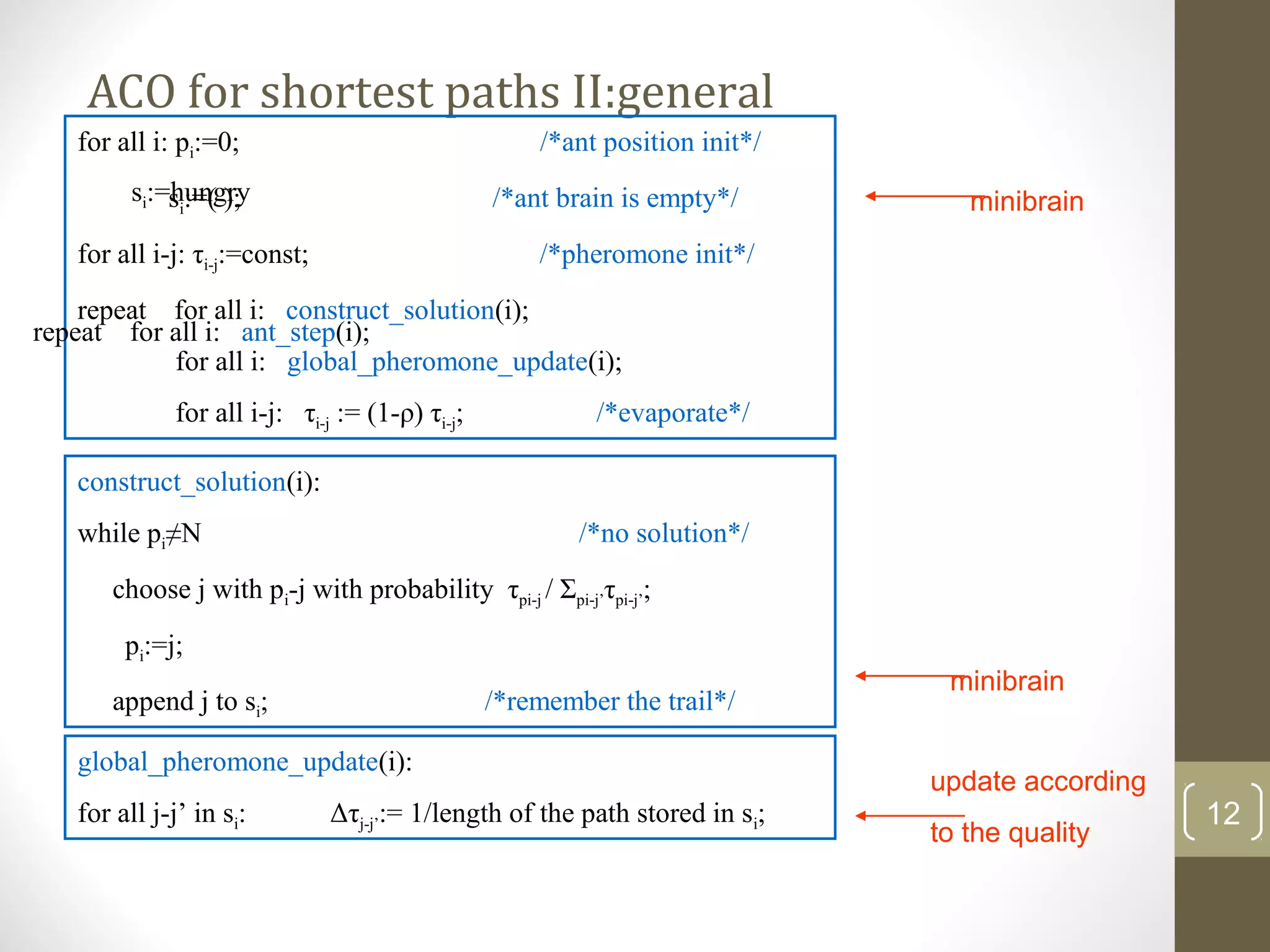
ACO for shortest paths II:general
   for all i: pi:=0;                                 /*ant position init*/
         si:=hungry
             si:=( );                            /*ant brain is empty*/         minibrain
   for all i-j: τi-j:=const;                         /*pheromone init*/
    repeat for all i: construct_solution(i);
repeat for all i: ant_step(i);
           for all i: global_pheromone_update(i);
              for all i-j: τi-j := (1-ρ) τi-j;            /*evaporate*/

   construct_solution(i):
   while pi≠N                                            /*no solution*/
      choose j with pi-j with probability τpi-j / Σpi-j’τpi-j’;
        pi:=j;
                                                                              minibrain
      append j to si;                            /*remember the trail*/

   global_pheromone_update(i):
                                                                             update according
   for all j-j’ in si:         Δτj-j’:= 1/length of the path stored in si;                      12
                                                                             to the quality
ACO for shortest paths II:general

                   WC4      WC5      Barbara   Marc


                            Anja     Dagmar    Espresso
                 449a


                            339      WC3       Friedhelm
                 322


         Fachschaft         WC2      Rechner   Astrid


        Zeitschriften       WC       Bibo      RZ-Sekretariat


Mensa          Cafete
                         Getraenke   RZ        Toiletten


                                                                13
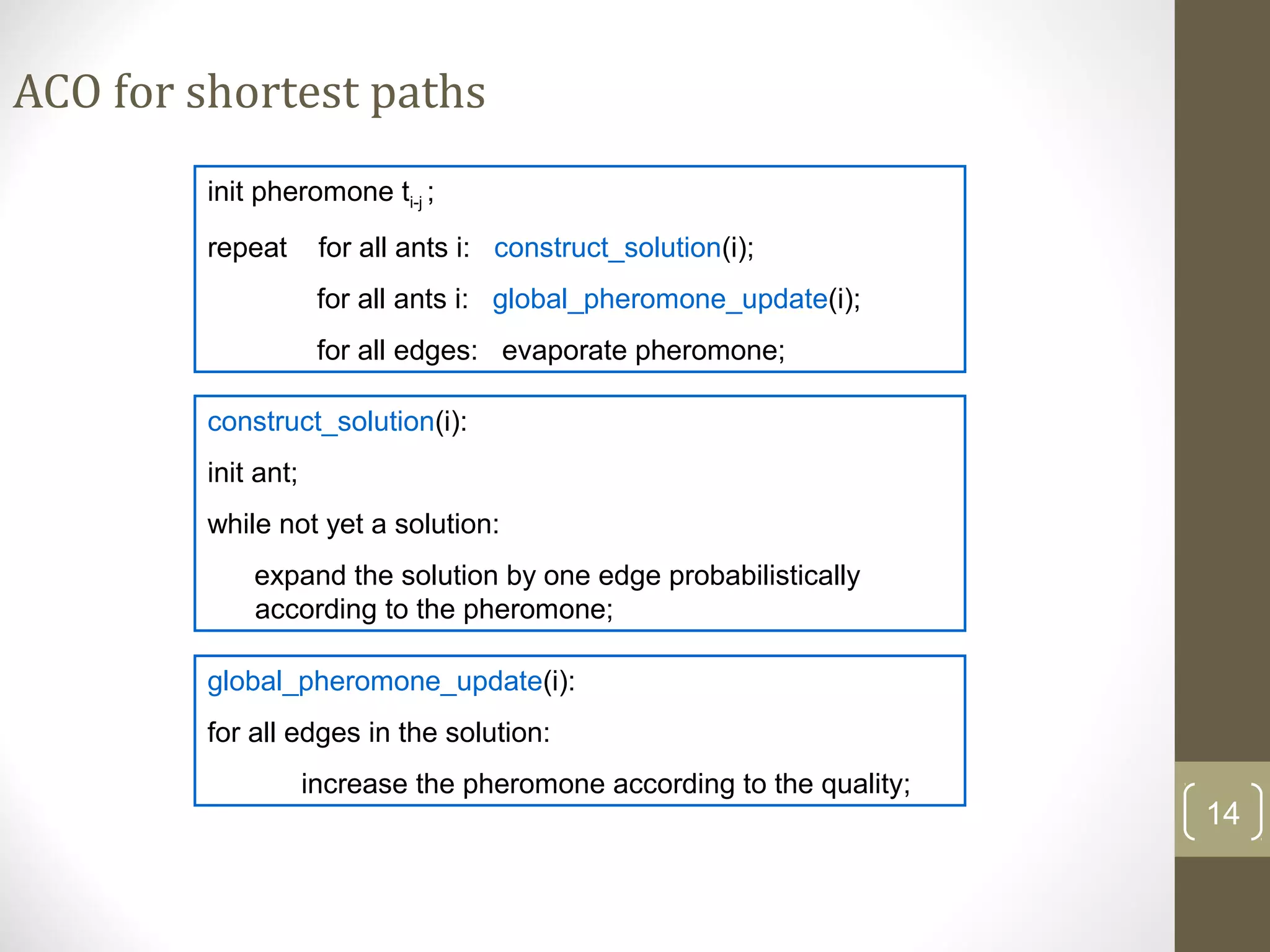
ACO for shortest paths
         init pheromone ti-j ;
         repeat       for all ants i: construct_solution(i);
                      for all ants i: global_pheromone_update(i);
                      for all edges: evaporate pheromone;

         construct_solution(i):
         init ant;
         while not yet a solution:
             expand the solution by one edge probabilistically
             according to the pheromone;

         global_pheromone_update(i):
         for all edges in the solution:
                     increase the pheromone according to the quality;
                                                                        14
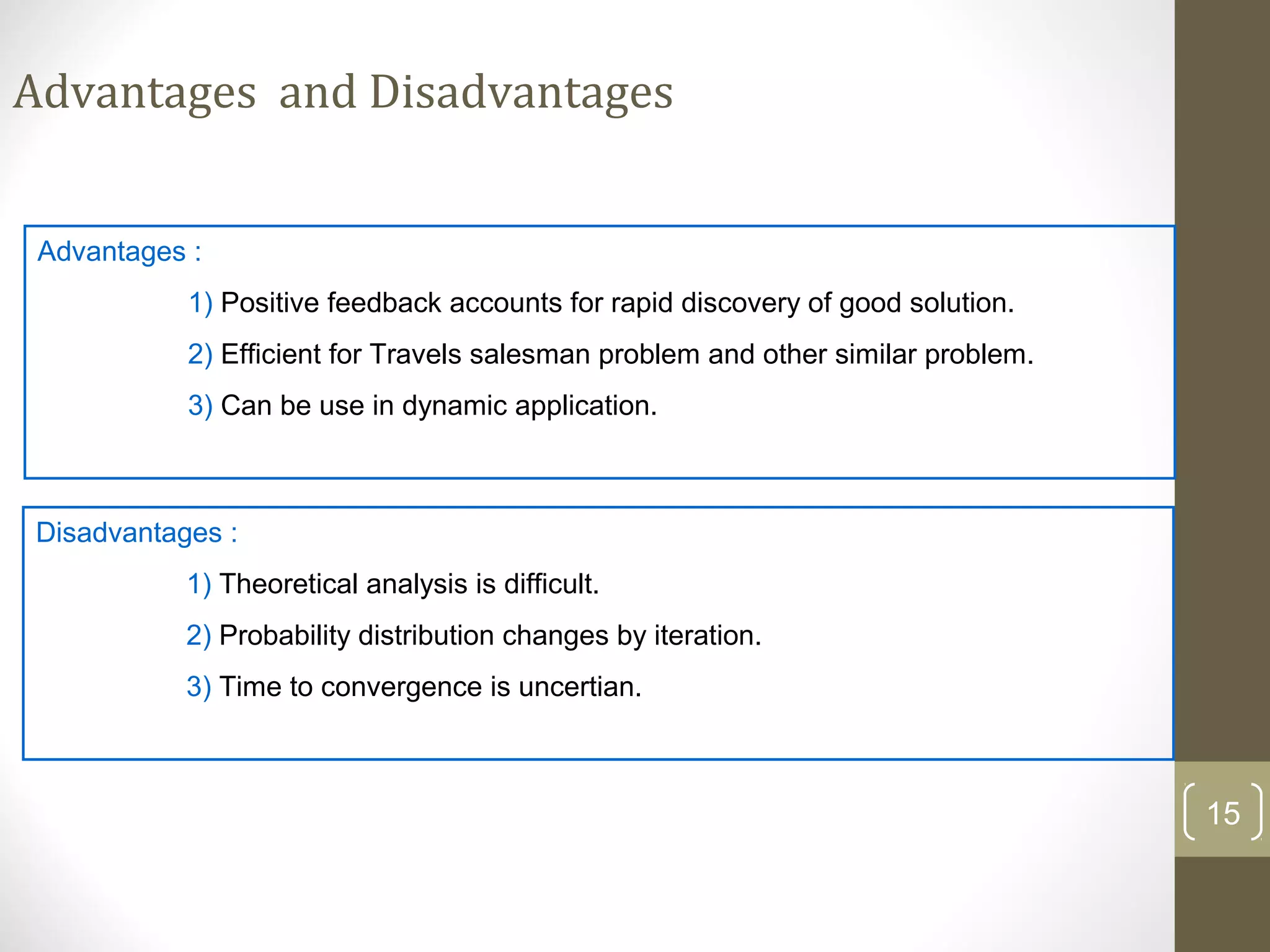
Advantages and Disadvantages


 Advantages :
           1) Positive feedback accounts for rapid discovery of good solution.
           2) Efficient for Travels salesman problem and other similar problem.
           3) Can be use in dynamic application.


Disadvantages :
           1) Theoretical analysis is difficult.
           2) Probability distribution changes by iteration.
           3) Time to convergence is uncertian.


                                                                                  15
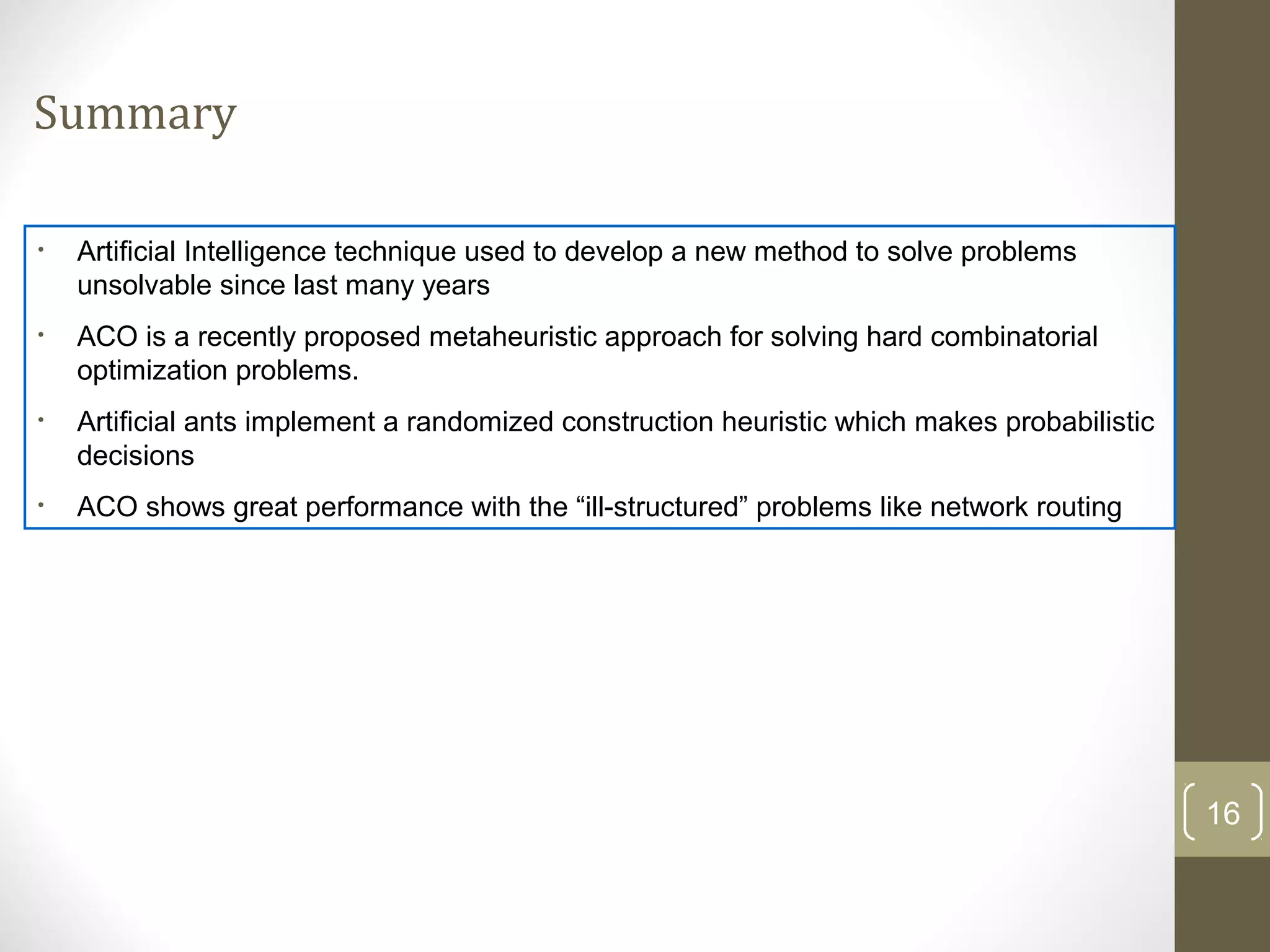
Summary

•   Artificial Intelligence technique used to develop a new method to solve problems
    unsolvable since last many years
•   ACO is a recently proposed metaheuristic approach for solving hard combinatorial
    optimization problems.
•   Artificial ants implement a randomized construction heuristic which makes probabilistic
    decisions
•   ACO shows great performance with the “ill-structured” problems like network routing


                                                                                              16
References

•   M. Dorigo, M. Birattari, T. Stützle, “Ant Colony Optimization – Artificial Ants as a
    Computational Intelligence Technique”, IEEE Computational Intelligence Magazine,
    2006
•   C. Blum, Theoretical and Practical Aspects of Ant Colony Optimization, Dissertations
    in Artificial Intelligence, Vol. 282, Akademische Verlagsgesellschaft Aka GmbH, Berlin,
    Germany, 2004.
•   Wikipedia.com


                                                                                              17
Questions ?


              18
Thank You !


              19

Ant colony optimization

  • 1.
    Ant Colony Optimization By: SachinAgarwalla Regd. No-0911012065 C.S.E(A) Under Guidance Of: Mr. Swadhin Ku. Barisal B.E., M.Tech., CSE (IIT, Kharagpur) Assistant Professor 1 I.T.E.R
  • 2.
    Optimization General optimization problem: given f:Xℝ, find xεX such that f(x) is minimum • Given a graph with two specified vertices A and B, find a shortest path from A to B.  shortest path problem, polynomial 2
  • 3.
    Ant colony food 3 nest
  • 4.
    Ant Colony Optimization(ACO): a heuristic optimization method for shortest path and other optimization problems which borrows ideas from biological ants 4
  • 5.
    Ant Colony Optimization Outline • History: ACO for shortest paths • ACO for shortest paths I: directed • ACO for shortest paths II: general • Advantages and Disadvantages • Summary • References 5
  • 6.
    History: ACO forshortest paths … 6
  • 7.
    History: ACO forshortest paths Goss et al. 1989, Deneuborg et al. 1990 food experiments with Argentine ants: • ants go from the nest to the food source and backwards • after a while, the ants prefer the shortest path from the nest to the food source • stigmercy: • the ants communicate indirectly laying pheromone trails and following trails with higher pheromone • length gradient  pheromone will accumulate on the shortest path nest 7
  • 8.
    ACO for shortestpaths I:directed A first ACO for a simple shortest path problem: directed acyclic graph (V={0,...,N}, E={ij}), ant hill: 0, food source: N for all i: pi:=0; /*ant position init*/ si:=hungry; /*ant state init*/ for all i j: τij:=const; /*pheromone init*/ repeat for all i: ant_step(i); /*ant step*/ 8 for all i j: τij := (1-ρ) τij ; /*evaporate pheromone*/
  • 9.
    ACO for shortestpaths I:directed ant_step(i): if pi=N: si:=satisfied; if pi=0: si:=hungry; /*collect food/deliver food*/ if si=hungry: choose j with pij with probability τpi j/Σpij’τpij’ /*choose next step*/ update Δτpi j := ε; pi:=j; /*update pheromone*/ if si=satisfied: choose j with jpi with probability τjpi/Σj’piτj’pi update Δτjpi:= ε; pj:=i; /* reversed directions*/ 9
  • 10.
    ACO for shortestpaths II:general ...a more complex undirected cyclic graph ... WC4 WC5 Barbara Marc 449a Anja Dagmar Espresso 322 339 WC3 Friedhelm Fachschaft WC2 Rechner Astrid Zeitschriften WC Bibo RZ-Sekretariat Mensa Cafete Getraenke- RZ Toiletten automat 10
  • 11.
    ACO for shortestpaths II:general ... Marc was not so happy with the result ... 449a 449a 11
  • 12.
    ACO for shortestpaths II:general for all i: pi:=0; /*ant position init*/ si:=hungry si:=( ); /*ant brain is empty*/ minibrain for all i-j: τi-j:=const; /*pheromone init*/ repeat for all i: construct_solution(i); repeat for all i: ant_step(i); for all i: global_pheromone_update(i); for all i-j: τi-j := (1-ρ) τi-j; /*evaporate*/ construct_solution(i): while pi≠N /*no solution*/ choose j with pi-j with probability τpi-j / Σpi-j’τpi-j’; pi:=j; minibrain append j to si; /*remember the trail*/ global_pheromone_update(i): update according for all j-j’ in si: Δτj-j’:= 1/length of the path stored in si; 12 to the quality
  • 13.
    ACO for shortestpaths II:general WC4 WC5 Barbara Marc Anja Dagmar Espresso 449a 339 WC3 Friedhelm 322 Fachschaft WC2 Rechner Astrid Zeitschriften WC Bibo RZ-Sekretariat Mensa Cafete Getraenke RZ Toiletten 13
  • 14.
    ACO for shortestpaths init pheromone ti-j ; repeat for all ants i: construct_solution(i); for all ants i: global_pheromone_update(i); for all edges: evaporate pheromone; construct_solution(i): init ant; while not yet a solution: expand the solution by one edge probabilistically according to the pheromone; global_pheromone_update(i): for all edges in the solution: increase the pheromone according to the quality; 14
  • 15.
    Advantages and Disadvantages Advantages : 1) Positive feedback accounts for rapid discovery of good solution. 2) Efficient for Travels salesman problem and other similar problem. 3) Can be use in dynamic application. Disadvantages : 1) Theoretical analysis is difficult. 2) Probability distribution changes by iteration. 3) Time to convergence is uncertian. 15
  • 16.
    Summary • Artificial Intelligence technique used to develop a new method to solve problems unsolvable since last many years • ACO is a recently proposed metaheuristic approach for solving hard combinatorial optimization problems. • Artificial ants implement a randomized construction heuristic which makes probabilistic decisions • ACO shows great performance with the “ill-structured” problems like network routing 16
  • 17.
    References • M. Dorigo, M. Birattari, T. Stützle, “Ant Colony Optimization – Artificial Ants as a Computational Intelligence Technique”, IEEE Computational Intelligence Magazine, 2006 • C. Blum, Theoretical and Practical Aspects of Ant Colony Optimization, Dissertations in Artificial Intelligence, Vol. 282, Akademische Verlagsgesellschaft Aka GmbH, Berlin, Germany, 2004. • Wikipedia.com 17
  • 18.
  • 19.