Ant Colony Optimization
For Adaptive Routing
Presented by
Thushara Urumbil
December 7th 2012
What we will see today
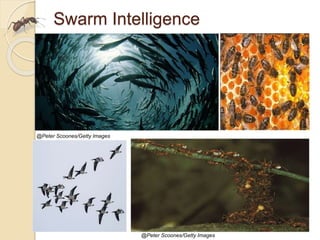
Swarm Intelligence
@Peter Scoones/Getty Images
Swarm Intelligence
 Collective effort
 Group of homogeneous members
 Simple interaction methodology
 Self organization
 Distributed problem solving by
dynamically constituting a natural
model
Intelligent Ants !!
Scientific approach
 Double Bridge Experiment by Jean-
Louis Deneubourg [BDG93]
He concluded that ants chooses the shortest path
How do these Blind Deaf Dumb
insects do this ?
 Ants starts to walk random
 They form pheromone trail
 Ants choosing shortest path return home
depositing more pheromone on shorter
path
 Followers choose path with higher
pheromone density
 Pheromone evaporation occurs on less
used path
 Shortest path emerges !!
Mathematical modeling of
Ants’ "technique"
The probability of ant choosing the short
branch
𝑃𝑖𝑠(𝑡) =
(𝑡𝑠+ɸ𝑖𝑠(𝑡) 𝜶
(𝑡𝑠+ɸ𝑖𝑠(𝑡) 𝜶+ (𝑡𝑠+ɸ𝑖𝑙(𝑡) 𝜶
𝑡𝑠- Time to travel the shortest branch
ɸ𝑖𝑎- function of pheromone used until
time t where a ∈(s,l)
𝜶 –Derived from Monte Carlo simulations
and the best suited value was 2 [DS04]
Moving onto Artificial ants
 Makes use of graphical modeling
Experimental model with 2 nodes
Building blocks ..
 The long branch is r times longer than
the short one
 Time is discrete(1,2,3..)
 At each time step ant moves one step
in constant speed
 Ant add one unit of pheromone in one
unit of time in one edge
 Ant starts moving on the graph
probabilistically
More on probability
 Pis(t) – Probability for an ant at node i to
choose shortest path at time t
𝑃𝑖𝑠(𝑡) =
(ɸ𝑖𝑠(𝑡) 𝜶
[ɸ𝑖𝑠 𝑡 ] 𝜶+[ɸ𝑖𝑙 𝑡 ] 𝜶
 Pil(t) - Probability for an ant at node i to
choose longest path at time t
𝑃𝑖𝑙(𝑡) =
(ɸ𝑖𝑙(𝑡) 𝜶
[ɸ𝑖𝑠 𝑡 ] 𝜶+[ɸ𝑖𝑙 𝑡 ] 𝜶
Maths contd..
Consider mi(t) be the number of ants on node
i at time t
mi(t)= Pjs(t-1)mj(t-1)+𝑃j𝑙(t-r)mj(t-r)
 The pheromone trail on the short branch is
ɸis(t)= ɸis(t-1)+ Pis(t-1) mi(t-1)+ Pj𝑠(t-1) mi(t-1)
 The pheromone trail on the long branch is
ɸi𝑙(t)= ɸi𝑙(t-1)+ Pi𝑙(t-1) mi(t-1)+ Pj𝑙(t-r) m𝑗(t-r)
Ant Colony Optimization
Algorithm
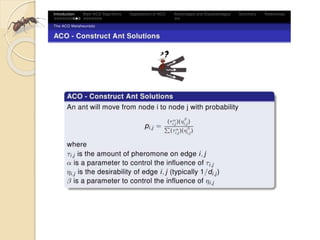
 Ant Colony optimization algorithm is developed on the basis of
Deneubourg’s double bridge experiment.
 Designed to work on more complex multinode graphs/networks.
 G = (V , E) where V is the set of vertices (nodes) and E is the
undirected edges connecting the vertices
 When a minimum cost path between source and destination
needs to be done, the modeling is based on the nest and food
source solution from real ants.
Properties of ant k
 Ant k explores the network graph G = (V, E) results in optimal
solution s* ∈ S*
 All the ants has a stored memory 𝑀 𝑘 about the path. Ants uses
this memory for computing heuristic values ή for building the
feasible solution and evaluating.
 Ant uses the stored memory 𝑀 𝑘 to retrace the path it has
already traveled
 The start state is 𝑋 𝑠
𝑘 and the termination state is 𝑒 𝑘
 when 𝑒 𝑘 is not satisfied ant moves form state Xr = < Xr−1,i > to
a state < Xr , j > where j is a neighboring node
 The neighboring node j is determined based on the
probabilistic decision rule which is a combination of ant’s
private memory, local pheromone trail and the problem
constraints.
 Once the ants reached destination it is able to retrace the path
back to source.
Components of ACO
Probabilistic forward ants and
solution construction
◦ Ants when travelling from source to
destination is in forward motion.
◦ The movement in forward mode is
determined probabilistically and it is
biased by the pheromone intensity of the
preceding ants.
◦ Local information stored on the node is
read by the ant and used in a stochastic
way to decide which node to move to
next
Components of ACO
Deterministic backward ants and
pheromone update
◦ After reaching the destination node, the ant
switches from the forward mode to the backward
mode and then retraces step by step the same path
backward to the source node
◦ An explicit local memory is assigned to ants which
will allow it to retrace the path it traveled.
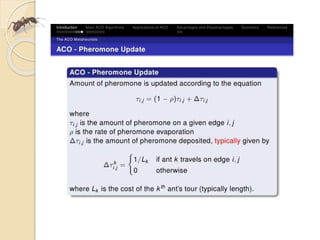
◦ If ant ‘k’ is in the backward mode through edge (i,j),
it changes the pheromone value as
τij = τij + Δ τk
Components of ACO
 Pheromone updates based on solution
quality
o Ants which have detected a shorter path deposit
pheromone earlier than ants traveling on a longer
path
oBy making Δ τk to be a function of the path length,
shorter the path will have more amount of
pheromone deposited(biasing future ants to take
shorter paths)
oBy the end of the forward mode ants will be capable
of calculating the best cost path. This result will bias
the quantity of pheromone update during backward
mode. This approach will help in acquiring a faster
best solution
Components of ACO
Pheromone evaporation
◦ The pheromone evaporation which happens
naturally in ant colonies is implemented by a
set of pheromone evaporation rules
◦ If there is a better route found then the effect
on the pheromone already deposited on the
existing paths will decay in time
◦ This mechanism, by favoring the forgetting
of errors or of poor choices done in the past,
provides scope for continuous improvement
of the ‘‘learned’’ problem structure
ACO Meta-heuristics
Step 1
• Pheromone Information
Step 2
• Solution Construction
Step 3
• Pheromone Update
Step 4
• Stopping Criterion
Antnet
 Major challenges of an effective
routing in a communication network
are
 Distributed property:
 Non-deterministic and fluctuating with
time
 Conflicting performance evaluation
criteria
 Balancing reliability and quality
Antnet Algorithm
 Data structures
Antnet Algorithm: Network
routing
Implementation of Antnet
using OMNeT
OMNet network module layout
Experimental setup of
OMNeT++
Structure of NED
Questions ?
Thank you
Ok..Class listen !!
This problem might seem
trivial to you , but believe me ,
there are inferior species
existing who still thinks
it’s a hard problem
Bibliography
 [BDG93] R. Beckers,J. L. Deneubourg,and S. Goss. Modulation of trail laying in
the ant lasius niger (hymenoptera: Formicidae) and its role in the collective
selection of a food source. Journal of InsectBehavior,1993.
 [CBTT92] Robert F. Cohen,G. Di Battista,R. Tamassia,and Ioannis G. Tollis.A
framework for dynamic graph drawing. CONGRESSUS NUMERANTIUM,42:149--
160,1992.
 [CD97] Gianni Di Caro and Marco Dorigo. Antnet: A mobile agents approach to
adaptive routing. Technical report,1997.
 [CD98] Gianni Di Caro and Marco Dorigo. Antnet: Distributed stigmergetic control
for communications networks. Journal of Artificial Intelligence Research,1998.
 [Com12] OMNeT++ Community. 2001-2012. www.omnetpp.org/.
 [DBB04] Marco Dorigo,Mauro Birattari,and Christian Blum. Ant Colony
Optimization and Swarm Intelligence 4th International Workshop,ANTS
2004,Brussels,Belgium,September 5-8,2004,Proceeding. Springer,2004.
Bibliography
 [DS04] Marco Dorigo and Thomas Stützle. Ant Colony Optimization. Bradford
Company,Scituate,MA,USA,2004.
 [DC99] Marco Dorigo and Gianni Di Caro. The ant colony optimization meta-
heuristic. In in New Ideas in Optimization,pages 11--32. McGraw-Hill,1999.
 [DS04] Marco Dorigo and Thomas Stützle. Ant Colony Optimization. Bradford
Company,Scituate,MA,USA,2004.
 [Far12] Muddassar Farooq. 2001-2012.
http://www.omnetpp.org/omnetpp/doc_details/2119unhboxvoidb@xkernz@char
‘discretionary{}{}{}antnetunhboxvoidb@xkernz@char‘discretionary{-}{}{}40.
 [JLDP] S. Goss J.-L. Deneubourg,S. Aron and J. M. Pasteels. The selforganizing
exploratory pattern of the argentine ant. Journal of Insect Behavior.
 [JLDP90] S. Goss J.-L. Deneubourg,S. Aron and J. M. Pasteels. The
selforganizing exploratory pattern of the argentine ant. Journal of Insect
Behavior,3:159â168,1990.
Bibliography
 [MDC91] V. Maniezzo M. Dorigo and A. Colorni. The ant system: An autocatalytic
optimizing process. Technical Report ,Dipartimento di Elettronica,Politecnico di
Milano,pages 91--016 Revised,1991.
 [MM89] J. Moy and Group J. Moy. The ospf specification. Technical
report,RFC,1989.
 [Rap02] Theodore S Rappaport. Wireless Communications,Principles and
Practice. Prentice Hall,2 edition,2002. [Sym12] Dave Symonds. omnetpp
inetframework. 2006-2012.
 [WFP+05] Horst F. Wedde,Muddassar Farooq,Thorsten Pannenbaecker, Bjoern
Vogel,Christian Mueller,Johannes Meth,and Rene Jeruschkat. Beeadhoc: an
energy efficient routing algorithm for mobile ad hoc networks inspired by bee
behavior. In GECCO,pages 153--160,2005.
 [yCMZ+04] Baek young Choi,Sue Moon,Zhi-Li Zhang,Konstantina Papagiannaki,
and Christophe Diot. Analysis of point-to-point packet delay in an operational
network. In IEEE INFOCOM,2004.

Final project

  • 1.
    Ant Colony Optimization ForAdaptive Routing Presented by Thushara Urumbil December 7th 2012
  • 2.
    What we willsee today
  • 3.
    Swarm Intelligence @Peter Scoones/GettyImages @Peter Scoones/Getty Images
  • 4.
    Swarm Intelligence  Collectiveeffort  Group of homogeneous members  Simple interaction methodology  Self organization  Distributed problem solving by dynamically constituting a natural model
  • 5.
  • 6.
    Scientific approach  DoubleBridge Experiment by Jean- Louis Deneubourg [BDG93] He concluded that ants chooses the shortest path
  • 7.
    How do theseBlind Deaf Dumb insects do this ?  Ants starts to walk random  They form pheromone trail  Ants choosing shortest path return home depositing more pheromone on shorter path  Followers choose path with higher pheromone density  Pheromone evaporation occurs on less used path  Shortest path emerges !!
  • 8.
    Mathematical modeling of Ants’"technique" The probability of ant choosing the short branch 𝑃𝑖𝑠(𝑡) = (𝑡𝑠+ɸ𝑖𝑠(𝑡) 𝜶 (𝑡𝑠+ɸ𝑖𝑠(𝑡) 𝜶+ (𝑡𝑠+ɸ𝑖𝑙(𝑡) 𝜶 𝑡𝑠- Time to travel the shortest branch ɸ𝑖𝑎- function of pheromone used until time t where a ∈(s,l) 𝜶 –Derived from Monte Carlo simulations and the best suited value was 2 [DS04]
  • 9.
    Moving onto Artificialants  Makes use of graphical modeling Experimental model with 2 nodes
  • 10.
    Building blocks .. The long branch is r times longer than the short one  Time is discrete(1,2,3..)  At each time step ant moves one step in constant speed  Ant add one unit of pheromone in one unit of time in one edge  Ant starts moving on the graph probabilistically
  • 11.
    More on probability Pis(t) – Probability for an ant at node i to choose shortest path at time t 𝑃𝑖𝑠(𝑡) = (ɸ𝑖𝑠(𝑡) 𝜶 [ɸ𝑖𝑠 𝑡 ] 𝜶+[ɸ𝑖𝑙 𝑡 ] 𝜶  Pil(t) - Probability for an ant at node i to choose longest path at time t 𝑃𝑖𝑙(𝑡) = (ɸ𝑖𝑙(𝑡) 𝜶 [ɸ𝑖𝑠 𝑡 ] 𝜶+[ɸ𝑖𝑙 𝑡 ] 𝜶
  • 12.
    Maths contd.. Consider mi(t)be the number of ants on node i at time t mi(t)= Pjs(t-1)mj(t-1)+𝑃j𝑙(t-r)mj(t-r)  The pheromone trail on the short branch is ɸis(t)= ɸis(t-1)+ Pis(t-1) mi(t-1)+ Pj𝑠(t-1) mi(t-1)  The pheromone trail on the long branch is ɸi𝑙(t)= ɸi𝑙(t-1)+ Pi𝑙(t-1) mi(t-1)+ Pj𝑙(t-r) m𝑗(t-r)
  • 13.
    Ant Colony Optimization Algorithm Ant Colony optimization algorithm is developed on the basis of Deneubourg’s double bridge experiment.  Designed to work on more complex multinode graphs/networks.  G = (V , E) where V is the set of vertices (nodes) and E is the undirected edges connecting the vertices  When a minimum cost path between source and destination needs to be done, the modeling is based on the nest and food source solution from real ants.
  • 14.
    Properties of antk  Ant k explores the network graph G = (V, E) results in optimal solution s* ∈ S*  All the ants has a stored memory 𝑀 𝑘 about the path. Ants uses this memory for computing heuristic values ή for building the feasible solution and evaluating.  Ant uses the stored memory 𝑀 𝑘 to retrace the path it has already traveled  The start state is 𝑋 𝑠 𝑘 and the termination state is 𝑒 𝑘  when 𝑒 𝑘 is not satisfied ant moves form state Xr = < Xr−1,i > to a state < Xr , j > where j is a neighboring node  The neighboring node j is determined based on the probabilistic decision rule which is a combination of ant’s private memory, local pheromone trail and the problem constraints.  Once the ants reached destination it is able to retrace the path back to source.
  • 15.
    Components of ACO Probabilisticforward ants and solution construction ◦ Ants when travelling from source to destination is in forward motion. ◦ The movement in forward mode is determined probabilistically and it is biased by the pheromone intensity of the preceding ants. ◦ Local information stored on the node is read by the ant and used in a stochastic way to decide which node to move to next
  • 16.
    Components of ACO Deterministicbackward ants and pheromone update ◦ After reaching the destination node, the ant switches from the forward mode to the backward mode and then retraces step by step the same path backward to the source node ◦ An explicit local memory is assigned to ants which will allow it to retrace the path it traveled. ◦ If ant ‘k’ is in the backward mode through edge (i,j), it changes the pheromone value as τij = τij + Δ τk
  • 17.
    Components of ACO Pheromone updates based on solution quality o Ants which have detected a shorter path deposit pheromone earlier than ants traveling on a longer path oBy making Δ τk to be a function of the path length, shorter the path will have more amount of pheromone deposited(biasing future ants to take shorter paths) oBy the end of the forward mode ants will be capable of calculating the best cost path. This result will bias the quantity of pheromone update during backward mode. This approach will help in acquiring a faster best solution
  • 18.
    Components of ACO Pheromoneevaporation ◦ The pheromone evaporation which happens naturally in ant colonies is implemented by a set of pheromone evaporation rules ◦ If there is a better route found then the effect on the pheromone already deposited on the existing paths will decay in time ◦ This mechanism, by favoring the forgetting of errors or of poor choices done in the past, provides scope for continuous improvement of the ‘‘learned’’ problem structure
  • 19.
    ACO Meta-heuristics Step 1 •Pheromone Information Step 2 • Solution Construction Step 3 • Pheromone Update Step 4 • Stopping Criterion
  • 23.
    Antnet  Major challengesof an effective routing in a communication network are  Distributed property:  Non-deterministic and fluctuating with time  Conflicting performance evaluation criteria  Balancing reliability and quality
  • 24.
  • 25.
  • 27.
  • 28.
  • 29.
  • 30.
  • 32.
    Questions ? Thank you Ok..Classlisten !! This problem might seem trivial to you , but believe me , there are inferior species existing who still thinks it’s a hard problem
  • 33.
    Bibliography  [BDG93] R.Beckers,J. L. Deneubourg,and S. Goss. Modulation of trail laying in the ant lasius niger (hymenoptera: Formicidae) and its role in the collective selection of a food source. Journal of InsectBehavior,1993.  [CBTT92] Robert F. Cohen,G. Di Battista,R. Tamassia,and Ioannis G. Tollis.A framework for dynamic graph drawing. CONGRESSUS NUMERANTIUM,42:149-- 160,1992.  [CD97] Gianni Di Caro and Marco Dorigo. Antnet: A mobile agents approach to adaptive routing. Technical report,1997.  [CD98] Gianni Di Caro and Marco Dorigo. Antnet: Distributed stigmergetic control for communications networks. Journal of Artificial Intelligence Research,1998.  [Com12] OMNeT++ Community. 2001-2012. www.omnetpp.org/.  [DBB04] Marco Dorigo,Mauro Birattari,and Christian Blum. Ant Colony Optimization and Swarm Intelligence 4th International Workshop,ANTS 2004,Brussels,Belgium,September 5-8,2004,Proceeding. Springer,2004.
  • 34.
    Bibliography  [DS04] MarcoDorigo and Thomas Stützle. Ant Colony Optimization. Bradford Company,Scituate,MA,USA,2004.  [DC99] Marco Dorigo and Gianni Di Caro. The ant colony optimization meta- heuristic. In in New Ideas in Optimization,pages 11--32. McGraw-Hill,1999.  [DS04] Marco Dorigo and Thomas Stützle. Ant Colony Optimization. Bradford Company,Scituate,MA,USA,2004.  [Far12] Muddassar Farooq. 2001-2012. http://www.omnetpp.org/omnetpp/doc_details/2119unhboxvoidb@xkernz@char ‘discretionary{}{}{}antnetunhboxvoidb@xkernz@char‘discretionary{-}{}{}40.  [JLDP] S. Goss J.-L. Deneubourg,S. Aron and J. M. Pasteels. The selforganizing exploratory pattern of the argentine ant. Journal of Insect Behavior.  [JLDP90] S. Goss J.-L. Deneubourg,S. Aron and J. M. Pasteels. The selforganizing exploratory pattern of the argentine ant. Journal of Insect Behavior,3:159â168,1990.
  • 35.
    Bibliography  [MDC91] V.Maniezzo M. Dorigo and A. Colorni. The ant system: An autocatalytic optimizing process. Technical Report ,Dipartimento di Elettronica,Politecnico di Milano,pages 91--016 Revised,1991.  [MM89] J. Moy and Group J. Moy. The ospf specification. Technical report,RFC,1989.  [Rap02] Theodore S Rappaport. Wireless Communications,Principles and Practice. Prentice Hall,2 edition,2002. [Sym12] Dave Symonds. omnetpp inetframework. 2006-2012.  [WFP+05] Horst F. Wedde,Muddassar Farooq,Thorsten Pannenbaecker, Bjoern Vogel,Christian Mueller,Johannes Meth,and Rene Jeruschkat. Beeadhoc: an energy efficient routing algorithm for mobile ad hoc networks inspired by bee behavior. In GECCO,pages 153--160,2005.  [yCMZ+04] Baek young Choi,Sue Moon,Zhi-Li Zhang,Konstantina Papagiannaki, and Christophe Diot. Analysis of point-to-point packet delay in an operational network. In IEEE INFOCOM,2004.

Editor's Notes

  • #13 The equations above is as derived by Marco Dorigo and Thomas Stützle in their book "Ant Colony Optimization" [DS04]