By
RACHANA KAFLE
BOVS,NAMS,NEH
 Lenses are refracting medium consisting of at two refracting surface out of which
at least one is curved.
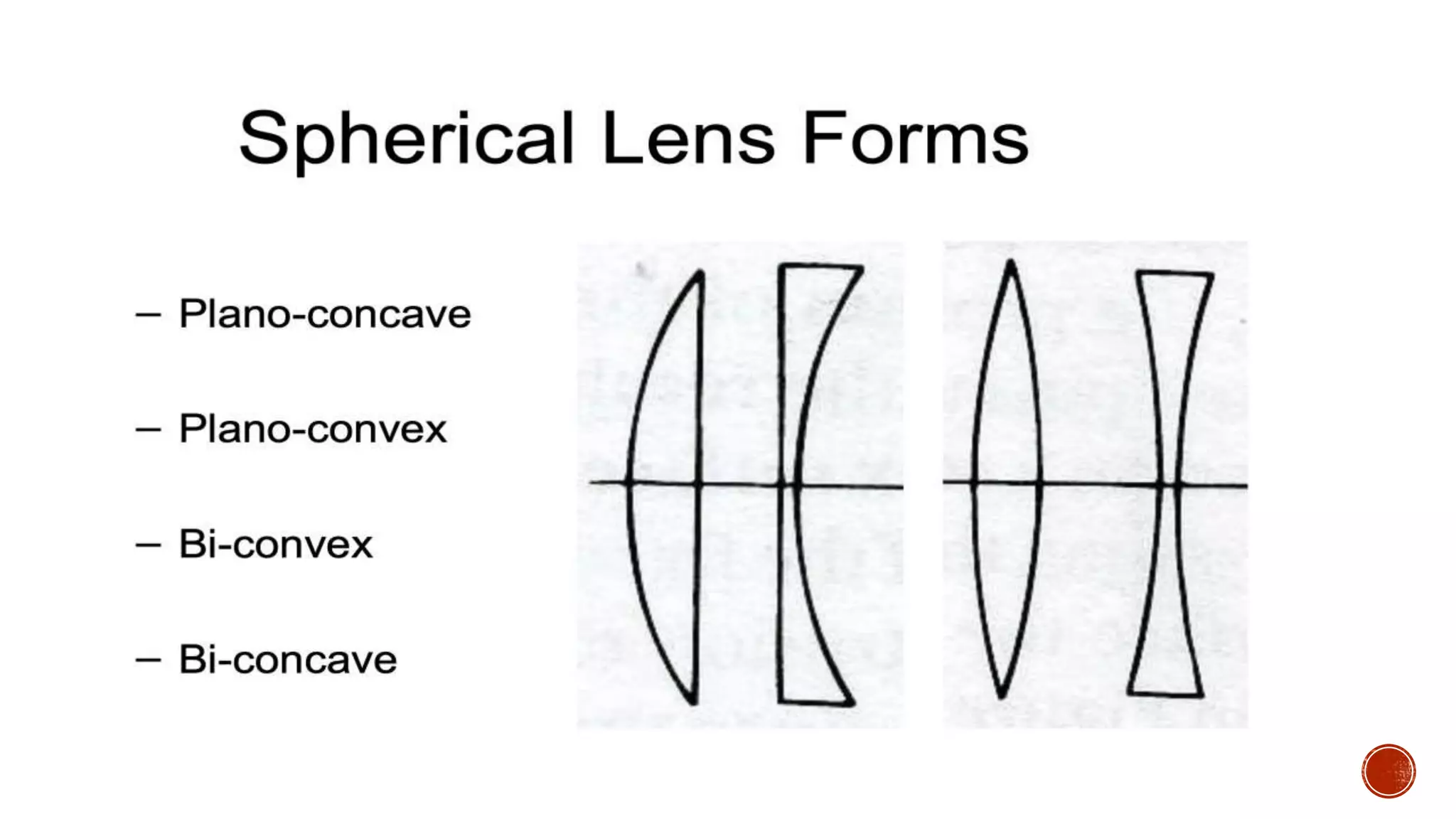
 Lens which is a part of sphere is sspherical lens.
 Earliest ophthalmoscopic lens is biconvex
 Biconcave and Biconvex aare popular
 So far,our consideration of lenses has been with those having surfaces of
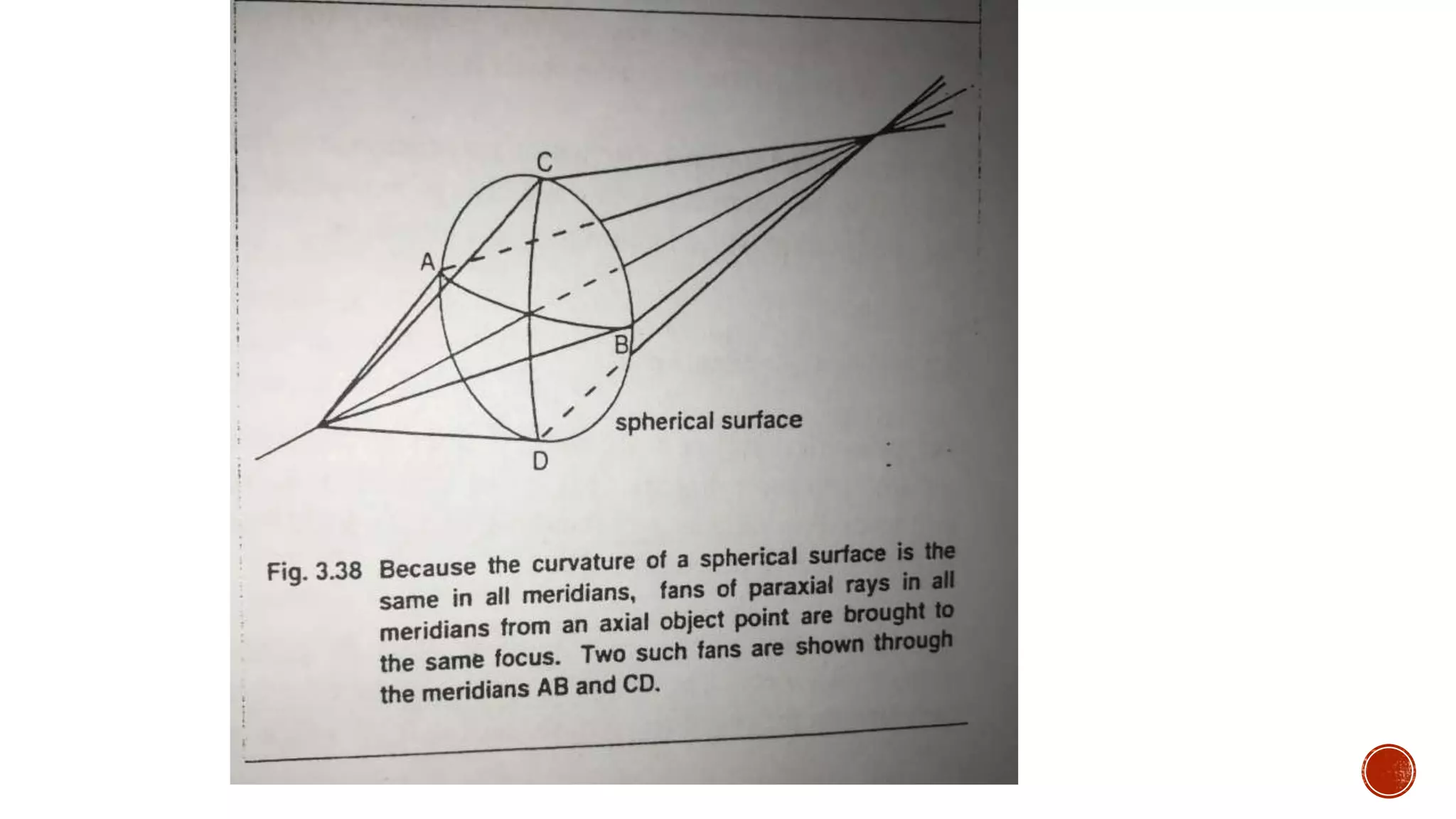
spheres.With such lenses the refraction of light from an axial object point takes
place in asymmetrical fashion around the optical axis.
 Hence,we know that rays of light which are not in the same plane as the diagram
behave in a similar fashion to those paraxial rays in the plane of the diagram and
will all intersect in the image.This is due to the fact that the curvature of a
spherical surface is the same in alll meridians.
 It is sometimes necessary for a lens surface to have different ccurvatures in different
meridians.However,in such cases there are two mutually perpendicular meridians which will
bring an incident pencil of rays to a focus such thaat the power may be defined for those
meridians.
 Considering a single surface,those meridians with maximum and minimum curvature define the
two mutually perpendicular meridians of the surface.
 When such a surface forms one surface of a lens,the other being a spherical surface,the principal
meridians of the surface become the principal meridian of the lens.such a lens does not form a
point image of a point object but forms two focal lines which image pencil is known as
ASTIGMATIC PENCIL.
 A common example of this requirement is in the case of a lens used to correct ocular
astigmatism.This eye defect is mainly the result of the cornea of the eye having two principal
meridians of curvature with the consequent formation of an astigmatic pencil when an incident
pencil from a point object is refracted byy the eye.
 This results in an indistinct retinal image which can only be made astigmatic by theapplication
of a correcting lens whichncombined with the eye’s refraction,produces astigmatic pencil
eventually focusing as apoint on the retina when the object is a point.
LENSES INTENTED FOR THE CORRECTION OF ASTIGMATISM ARE OFTEN
REFERRED AS ASTIGMATIC LENES AT LEAST ONE SURFACE WHICH HAS-
TWO PRINCIPAL MERIDIANS.
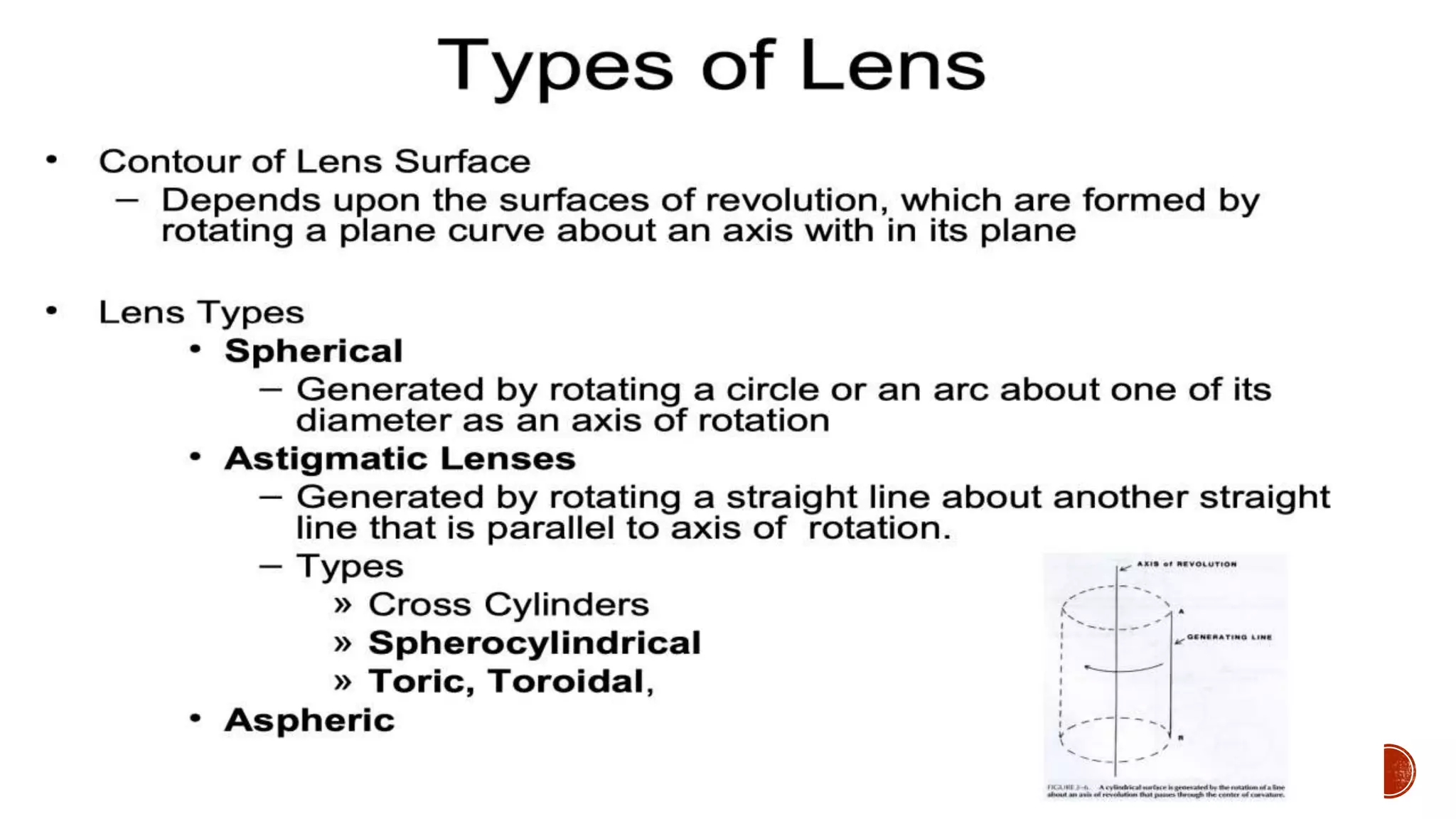
 Lenses that can be made by the combination of a cylindrical surface with a plano
or a spherical surface are known as astigmatic lenses.
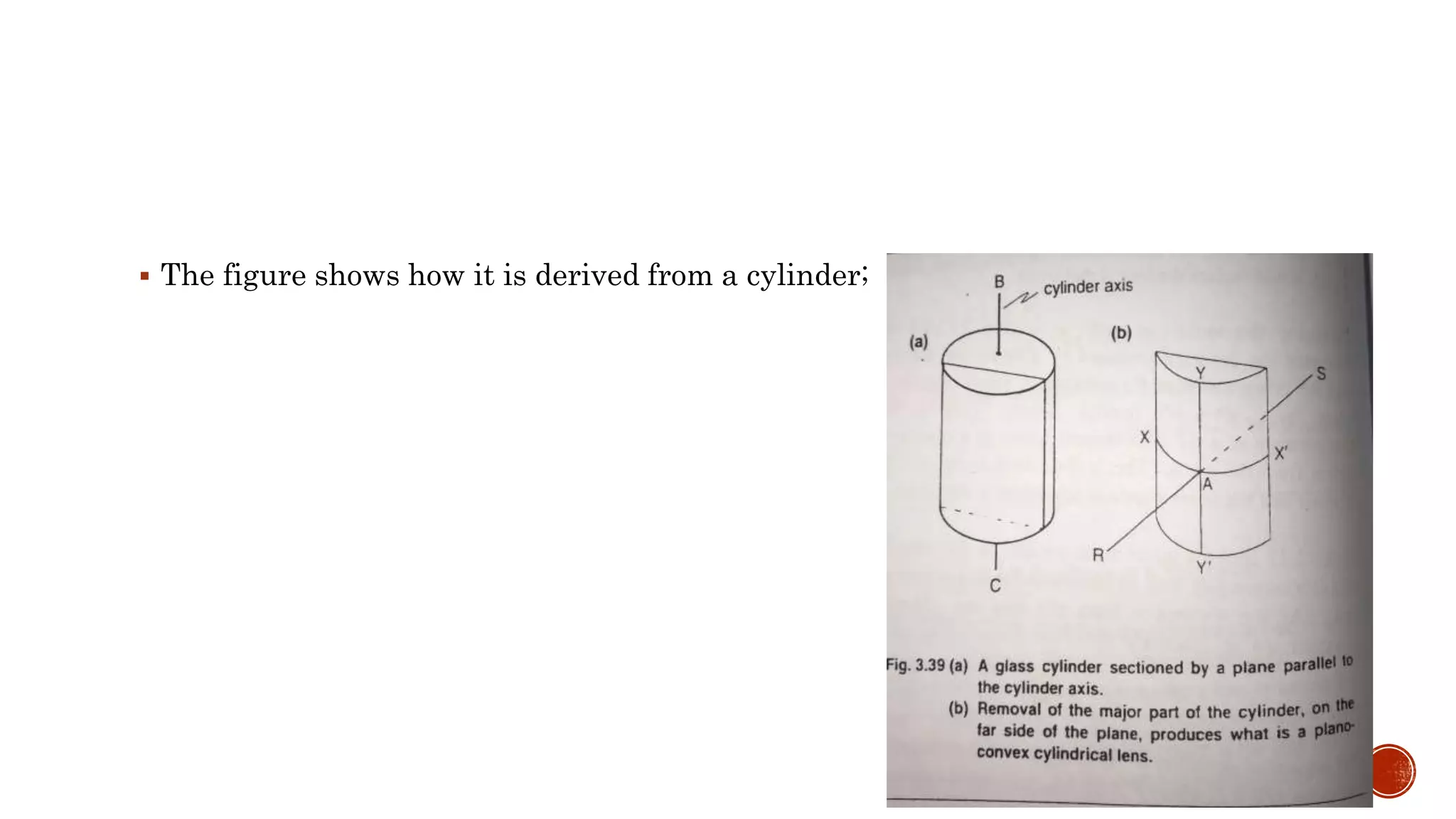
 Cylindrical lenses are obtained by cutting a section from. A cylinder of a glass and
are produced by rotating a straight line around an axis parallel to first.
 An astigmatic lens consists of two principal meridians:
a) POWER MERIDIAN
b)AXIS MERIDIAN
 In an astigmatic lens,all the meridians do not have the same curvature and a
point image of a point object cannot be formed.
Astigmatic lens effectively gives a minimum power in one direction,gradually
changing to a maximum powerin the other,at right angle to the first.
• A)Cylinderical lenses:
i) sphero-cylinder
ii)Planocylinder
iii)cross cylinder
• B)Toric lenses
• C)Bitoric lenses
• D)Atoric lenses(latest)
 Lenses that have one plane surface and the other forms the part of a cylinder.
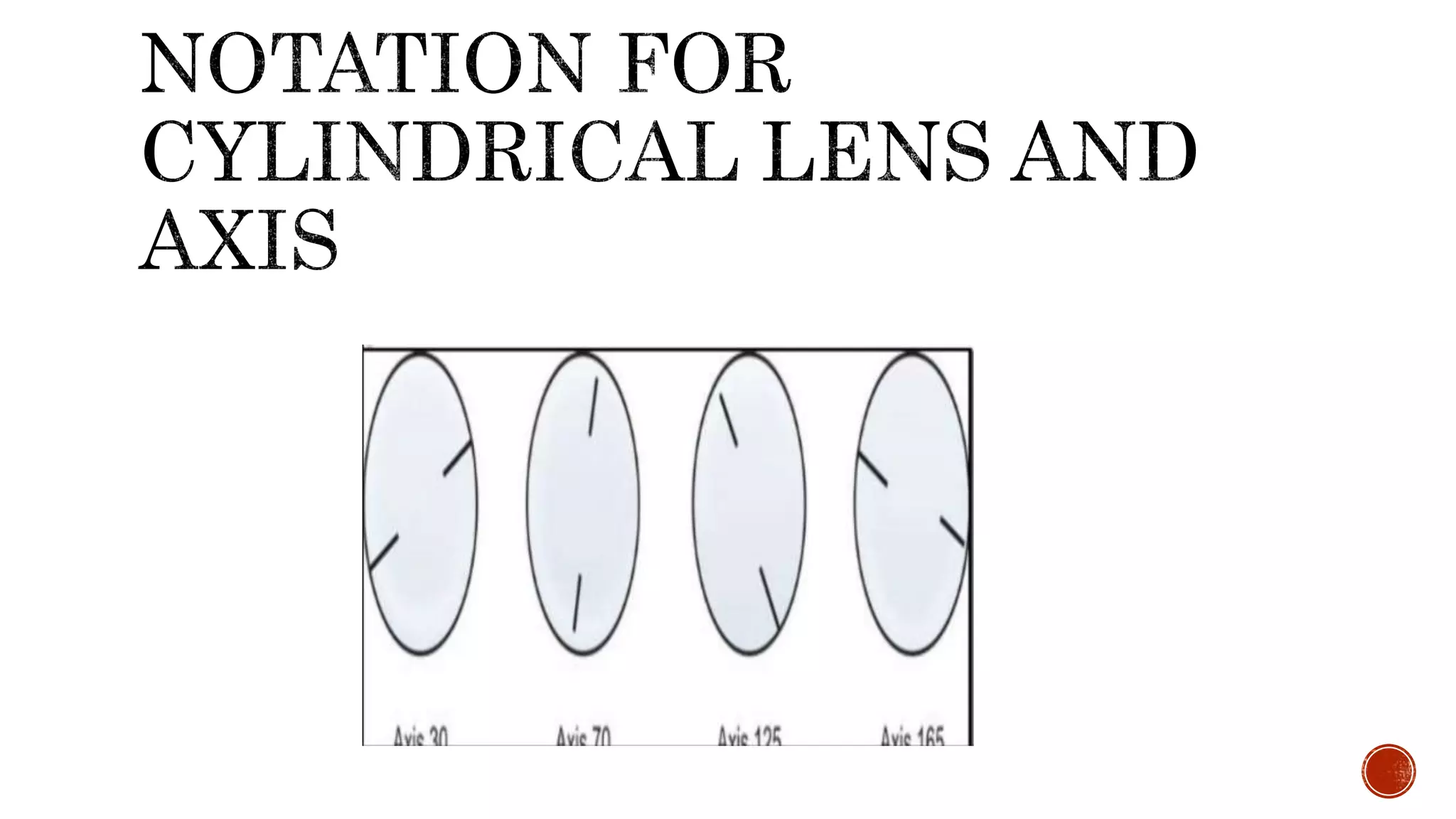
Thus,in one meridian the lens has no vergence power and this is called the axis of
the cylinder.
 In the meridian at right angles to the axis,the cylinder acts as a spherical lens.
 The total effect is the formation of a line image of a point object.This is called the
focal line.It is parallel to the axis of cylinder.
 The cylindrical surface is the simplest form of astigmatic surface ,and the
cylindrical lens is the simplest asrigmatic lens.
 The figure shows how it is derived from a cylinder;
 A. Plano cylindrical lens:
lens which has one plano surface and one cylindrical surface.
plano
plano
plano
-2.00
plano
-2.00
Final Rx= plano-2.00@90’
 B) sphero cylindrical lens
lens which has one spherical surface and one cylindrical surface.
+5.00
+5.00
plano
-2.00
+5.00
+3.00
Final Rx;+5.oo-2.00@90’
 As the name suggests, a sphero cylindrical lens is one which posses both spherical
and cylindrical surfaces and typically may be used to provide spherical power
correction for astigmatism.
 The principal meridian of sphero-cylindrical lens is the direction parallel to the
axis of the cylinder ,whilst the power meridian is perpendicular to this.
 However a spherocylindrical lens posses power in both of these meridians either of
which may be posiitive or negative.
 C)Cross cylinder
lens which has plus cylinder ground on the front surface and minus cylinder
ground on the backsurface with the axis 90’ apart.
 Example: +|- 0.25,+|- 0.50,+|- o.75 etc.
 When the cylindrical lens is rotated around its optical axis ,the object seen
through it becomes distorted.
 The cylindrical lens acts in only one axis ,so when it is movedup and down or
sideways,the objects will move with the lens (in concsve cylinder)or opposite to the
lens (in convex cylinder)only in one direction.
 Prescribed to correct astigmatism
 As a cross cylinder used to check the refraction subjectively
 Maddox rod consists of a series of powerful convex cyinderical lenses mounted
together in atrial lens
Cylindrical or astigmatic lens may be of three types
A. Simple (curved in one meridian only,either concave or convex)
B. Compound(curved unequally in both the meridia,either convex or concave).The
compound cylindrical lens is also called spherocylinder.
C. Mixed cylinder,one meridian is convex and other is concave.
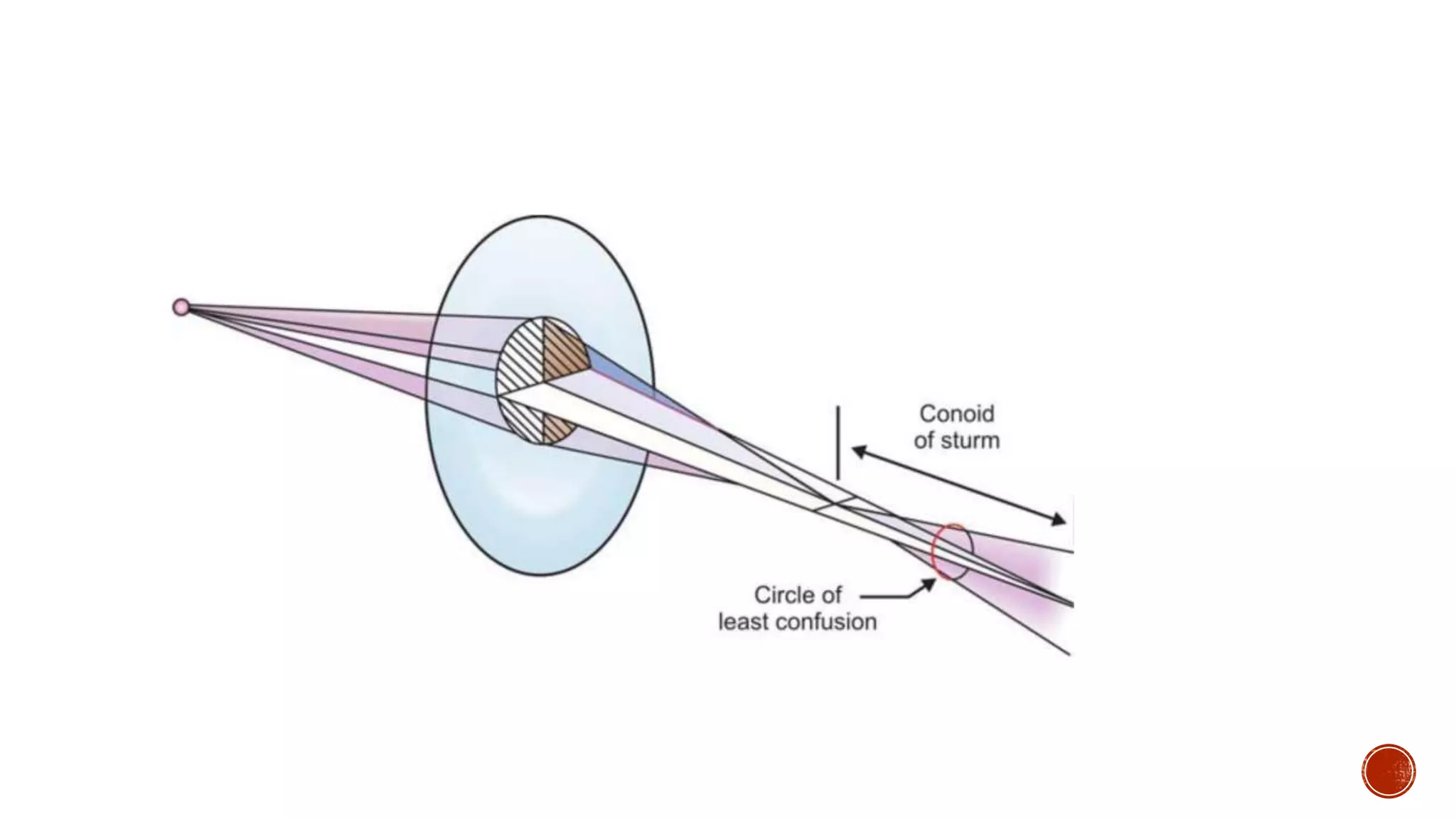
The images formed by different types of cylindrical lenses are best understood
by sturm’s conoid.
 As described above,in a toric surface,one principal meridian is more curved than
another principal meridian .The principal meridian with minimum curvature and
therefore minimum power,is called base curve of a toric lens.
 The configuration of rays refracted through atoric surface is called the Sturm’s Conoid.
 The shape of bundle of the light rays at different levels in Sturm’s conoid are;
A. At point A
B. At point B
C.
D.
E.
F.
G.
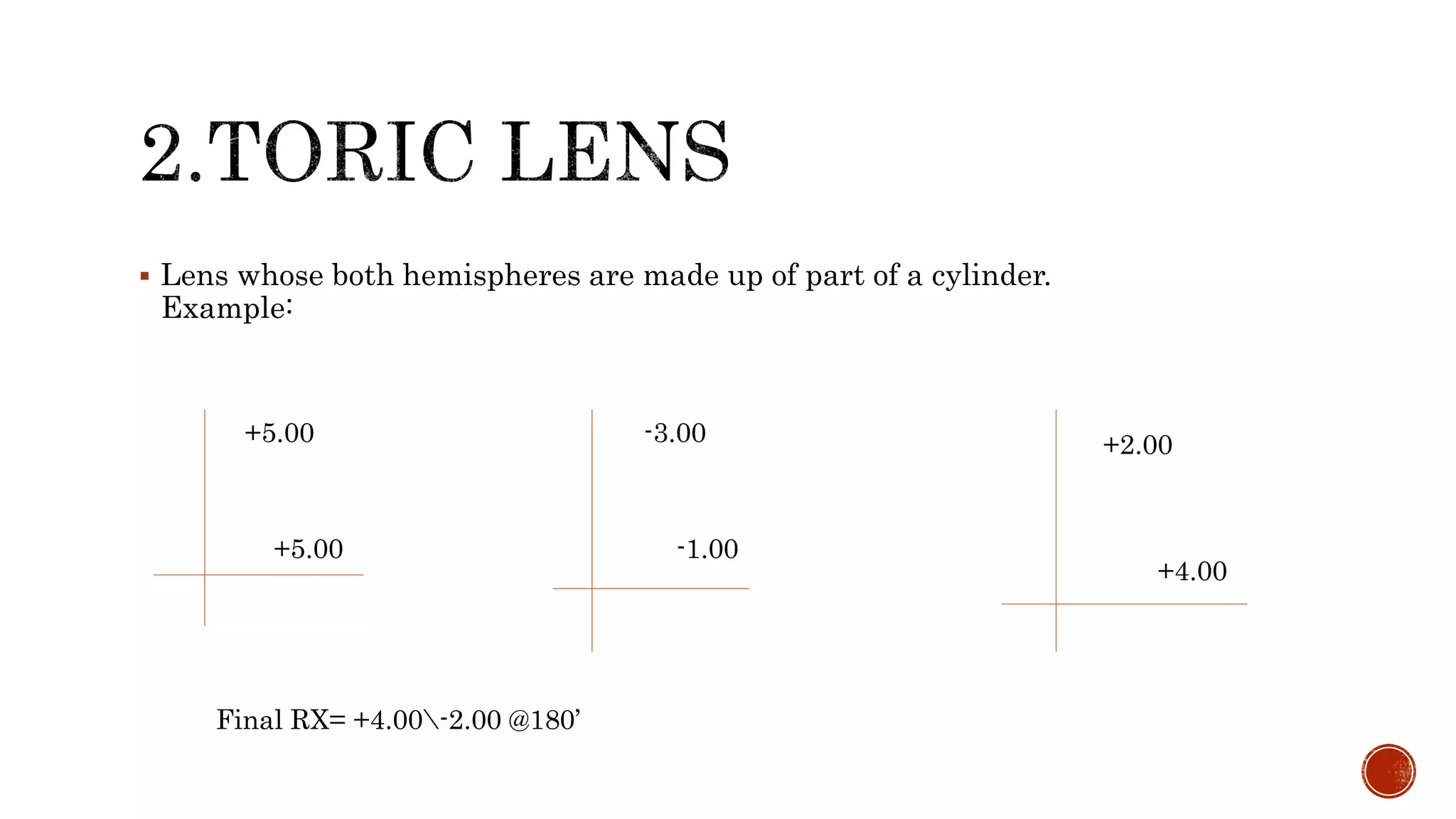
 Lens whose both hemispheres are made up of part of a cylinder.
Example:
+5.00
+5.00
-3.00
-1.00
+2.00
+4.00
Final RX= +4.00-2.00 @180’
 Toric lenses are produced to provide a choiceof form for astigmatic lenses in an
analogus way to which meniscus forms are often a more suitable form of spherical
powered lens that a flat form for correcting visual field defects.
 Most often then, atoric spectacle lens is a curved rather than a flat lens although
it should be borne in mind that a toric lens may be of flat form.
 Since a plano-cylinder lens has no power along its axis meridian, the power along
the axis meridian of the combination must result from spherical element alone.
 The power along the other principal meridian of the lens, at right angles to the
axis meridian of the cylinder surface, is the sum of the sphere and cylinder.
 Under the rotation test, it exhibits scissor movement in the same way as a plano
cylindrical lens and under the movement test;it exhibits movement along each of
its principal meridians.
 The power of a sphero-cylindrical lens is expressed by stating the power of the
spherical component first, followed by the power of the cylindrical component, and
finally the direction of the cylindrical axis.
 Thus, the specification +4.00/– 2.00 × 180o
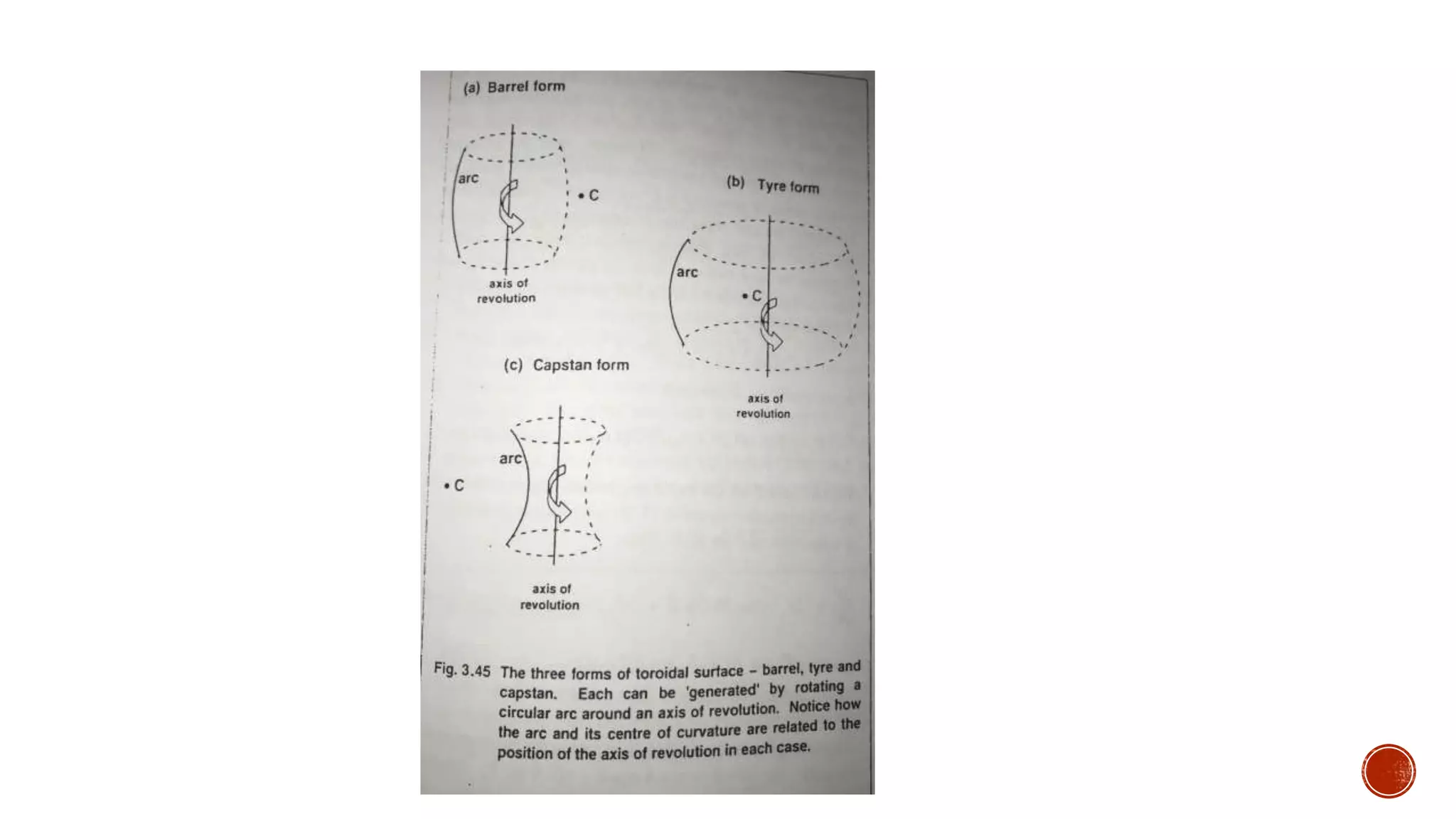
 A toroidal surface is defined as the surface generated by the revolution of an arc of
a circle about an axis in the same plane as the arc in the given fig.
 Three forms of just such a centre of curvature C of the arc lies to the right of the
arc and the axis of revolution as in barallel form or between the arc and the axis of
revolutionas in the tyre form,or to the left of the arc and the axis of revolution as
in the capstan form.
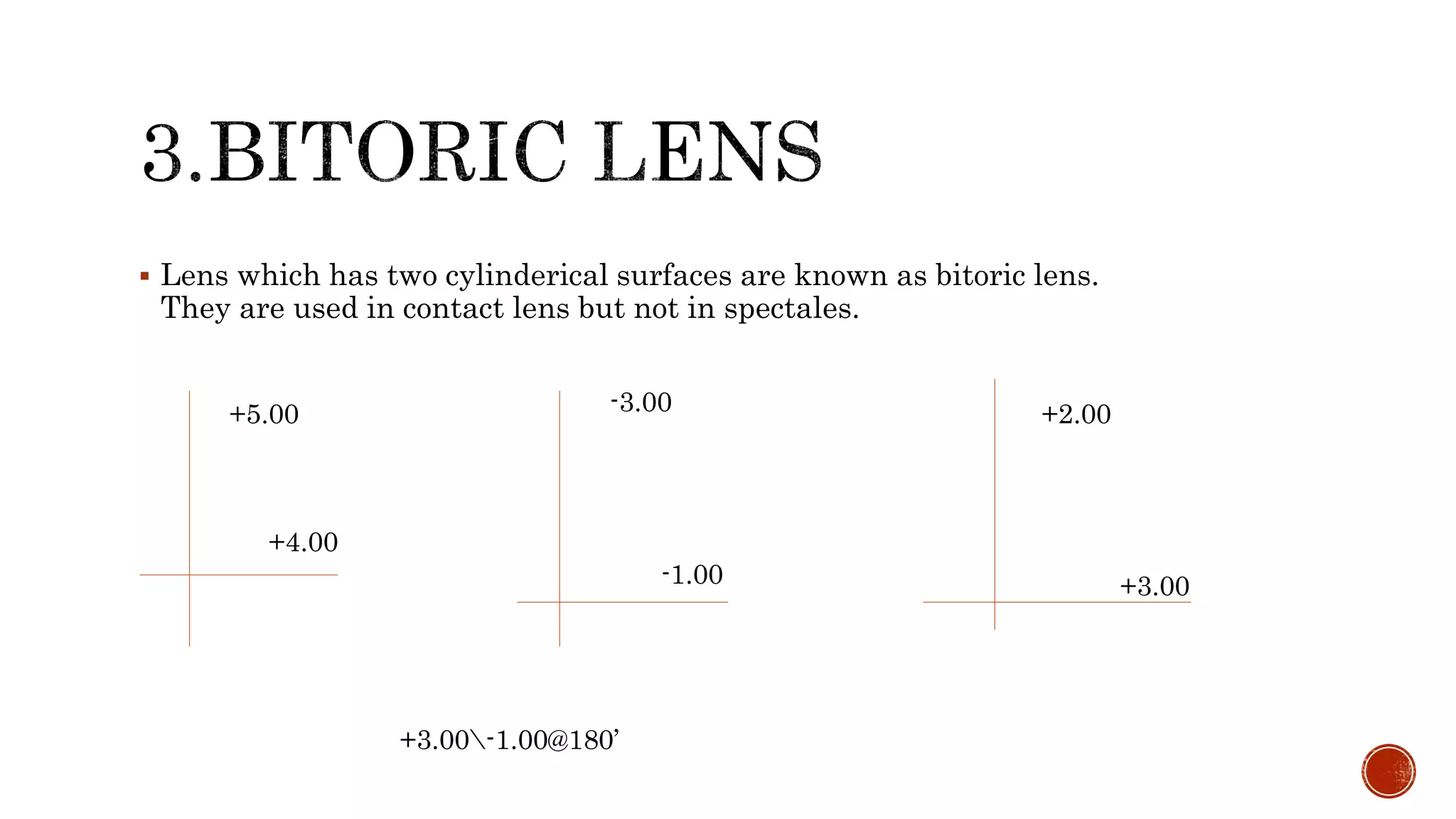
 Lens which has two cylinderical surfaces are known as bitoric lens.
They are used in contact lens but not in spectales.
+5.00 -3.00
-1.00
+4.00
+2.00
+3.00
+3.00-1.00@180’
 Bitoric lenses are a great option for optical correction in patients with the
appropriate amount of astigmatism. The lenses can drastically reduce the amount
of rotation seen with soft torics to provide stable vision for the patient. It is
important to educate a new GP patient on the transition period for adjusting to
lens awareness, wearing and disinfecting schedule, and proper insertion and
removal techniques.

https://www.gpli.info/pdf/2013-q3-case-smith-stephen.pdf
 Atoric lenses have a spherical front surface and aspherized cylinder curves on the
back surface. Lens designers can precisely optimize both the sphere meridian and
the cylinder meridian to the base curve on the front lens surface. Atoricity offers a
significantly wider field of vision
 Cylinders that are not 90’ and 180’ apart and require special solutions.
 Two cylindrical lenses combined together with their axes neither parallel nor
perpendicular. The combination can be replaced by a single sphero-cylindrical lens
in which the two focal lines are perpendicular to each other. The powers and axis
of this new lens can be determined graphically or mathematically. An analogous
situation obtains when the cylindrical correction of an eye is corrected by a
cylindrical lens placed at an incorrect axis before the eye.
https://medical-dictionary.thefreedictionary.com/obliquely+crossed+cylinder
 Trial lens hand neutralization
 Lensometer / Focimeter
 Geneva lens measure or Lens clock
 In order to determine the cylinder lens and to detect its dioptric strength.
 Hold the lens a few inches away from your eyes.
 sight a straight lined object, such as window or the door frame.
 Rotate the lens slowly as you would turn a steering wheel – first to the right
(clockwise), then to the left (anti-clockwise)
 If a section of the door frame appears slanted, it establishes that the lens under
examination is a cylindrical lens. This is called “scissors like movement.
 PLANO-CYLINDRICAL
 Now, neutralize both the meridians separately.
 If the movement in one meridian is nil, it is a plano-cylindrical lens and nil
movement meridian is taken as the axis of the lens.
 SPHERO-CYLINDRICAL LENS
 If both the meridians show movement, it is a sphero - cylindrical lens.
 The weaker movement meridian is taken as the axis of the lens under
observation.
 Neutralize both the meridians as before to determine exact spherical and
cylindrical elements.
 For a toric lens, rotational movement is used to find the axis
 If observe “against movement” - use minus cylinder axis.
 If observe “with movement” - use plus cylinder axis.
 For a toric lens, rotational movement is used to find the axis
 Used primarily in eyeglasses,contact lenses to correct astigmatism(either
regular,corneal or lenticular)
 Cross cylinder examination (otherwise known as Jackson's cross cylinder) is an
examination used for the final fine-tuning of the axis and strength of astigmatism
after its determination through retinoscopy, stellate cycle or automatic
refractometry.
 With the advent of technology, techniques like retinoscopy and cross cylinder
examination might seem outdated and useful only to the personnel of
humanitarian missions. They do however provide an accurate alternative and
their use gives a thorough understanding of the principles of refraction.

https://eyewiki.aao.org/Cross-Cylinder_Technique_for_Subjective_Refraction
 A typical JCC is a spherocylinderical lens having a spherical power component
combined with a cylinder power component of twice the power of the sphere and of
opposite sign.
Eg;+0.50-1.00 @90’
 Determination of astigmatism
 Refinement of axis
 Refinement of power
 It is based on the principle of dissociation
 Maddox rod consists of aseries of plano cylinder lenses about 3 mm in diameter
,mounted in atrial frane or in a refractor head
 A spot of light viewed through the Maddox Rod appears as an elongated streak
 The maddox Rod is often colored usually red
 Used ti find the presence of heterophoria or heterotropia
 Esy for patient to understand
 Easy for examiner
 Useful for vertical deviations
 A.H Tunacliffee
 Theory and practice and refraction by AK Khurana
 http://dailytradingschool.com/eagle-eye-911-review
 https://www.essiloracademy.eu/sites/default/files/4.Astigmatic_lenses.pdf
 https://www.aao.org/eye-health/ask-ophthalmologist-q/why-are-glasses-better-
than-contacts-astigmatism
 https://eyewiki.aao.org/Cross-Cylinder_Technique_for_Subjective_Refraction
 https://medical-dictionary.thefreedictionary.com/obliquely+crossed+cylinder
 Clinical Visual optics
 Internet resources
Astigmatic lens used in ophthalmology and eye

Astigmatic lens used in ophthalmology and eye

  • 1.
  • 2.
     Lenses arerefracting medium consisting of at two refracting surface out of which at least one is curved.
  • 4.
     Lens whichis a part of sphere is sspherical lens.  Earliest ophthalmoscopic lens is biconvex  Biconcave and Biconvex aare popular
  • 6.
     So far,ourconsideration of lenses has been with those having surfaces of spheres.With such lenses the refraction of light from an axial object point takes place in asymmetrical fashion around the optical axis.  Hence,we know that rays of light which are not in the same plane as the diagram behave in a similar fashion to those paraxial rays in the plane of the diagram and will all intersect in the image.This is due to the fact that the curvature of a spherical surface is the same in alll meridians.
  • 8.
     It issometimes necessary for a lens surface to have different ccurvatures in different meridians.However,in such cases there are two mutually perpendicular meridians which will bring an incident pencil of rays to a focus such thaat the power may be defined for those meridians.  Considering a single surface,those meridians with maximum and minimum curvature define the two mutually perpendicular meridians of the surface.  When such a surface forms one surface of a lens,the other being a spherical surface,the principal meridians of the surface become the principal meridian of the lens.such a lens does not form a point image of a point object but forms two focal lines which image pencil is known as ASTIGMATIC PENCIL.  A common example of this requirement is in the case of a lens used to correct ocular astigmatism.This eye defect is mainly the result of the cornea of the eye having two principal meridians of curvature with the consequent formation of an astigmatic pencil when an incident pencil from a point object is refracted byy the eye.  This results in an indistinct retinal image which can only be made astigmatic by theapplication of a correcting lens whichncombined with the eye’s refraction,produces astigmatic pencil eventually focusing as apoint on the retina when the object is a point.
  • 9.
    LENSES INTENTED FORTHE CORRECTION OF ASTIGMATISM ARE OFTEN REFERRED AS ASTIGMATIC LENES AT LEAST ONE SURFACE WHICH HAS- TWO PRINCIPAL MERIDIANS.
  • 10.
     Lenses thatcan be made by the combination of a cylindrical surface with a plano or a spherical surface are known as astigmatic lenses.  Cylindrical lenses are obtained by cutting a section from. A cylinder of a glass and are produced by rotating a straight line around an axis parallel to first.
  • 11.
     An astigmaticlens consists of two principal meridians: a) POWER MERIDIAN b)AXIS MERIDIAN
  • 12.
     In anastigmatic lens,all the meridians do not have the same curvature and a point image of a point object cannot be formed. Astigmatic lens effectively gives a minimum power in one direction,gradually changing to a maximum powerin the other,at right angle to the first.
  • 13.
    • A)Cylinderical lenses: i)sphero-cylinder ii)Planocylinder iii)cross cylinder • B)Toric lenses • C)Bitoric lenses • D)Atoric lenses(latest)
  • 14.
     Lenses thathave one plane surface and the other forms the part of a cylinder. Thus,in one meridian the lens has no vergence power and this is called the axis of the cylinder.  In the meridian at right angles to the axis,the cylinder acts as a spherical lens.  The total effect is the formation of a line image of a point object.This is called the focal line.It is parallel to the axis of cylinder.  The cylindrical surface is the simplest form of astigmatic surface ,and the cylindrical lens is the simplest asrigmatic lens.
  • 15.
     The figureshows how it is derived from a cylinder;
  • 20.
     A. Planocylindrical lens: lens which has one plano surface and one cylindrical surface. plano plano plano -2.00 plano -2.00 Final Rx= plano-2.00@90’
  • 21.
     B) spherocylindrical lens lens which has one spherical surface and one cylindrical surface. +5.00 +5.00 plano -2.00 +5.00 +3.00 Final Rx;+5.oo-2.00@90’
  • 22.
     As thename suggests, a sphero cylindrical lens is one which posses both spherical and cylindrical surfaces and typically may be used to provide spherical power correction for astigmatism.  The principal meridian of sphero-cylindrical lens is the direction parallel to the axis of the cylinder ,whilst the power meridian is perpendicular to this.  However a spherocylindrical lens posses power in both of these meridians either of which may be posiitive or negative.
  • 24.
     C)Cross cylinder lenswhich has plus cylinder ground on the front surface and minus cylinder ground on the backsurface with the axis 90’ apart.  Example: +|- 0.25,+|- 0.50,+|- o.75 etc.
  • 26.
     When thecylindrical lens is rotated around its optical axis ,the object seen through it becomes distorted.  The cylindrical lens acts in only one axis ,so when it is movedup and down or sideways,the objects will move with the lens (in concsve cylinder)or opposite to the lens (in convex cylinder)only in one direction.
  • 27.
     Prescribed tocorrect astigmatism  As a cross cylinder used to check the refraction subjectively  Maddox rod consists of a series of powerful convex cyinderical lenses mounted together in atrial lens
  • 28.
    Cylindrical or astigmaticlens may be of three types A. Simple (curved in one meridian only,either concave or convex) B. Compound(curved unequally in both the meridia,either convex or concave).The compound cylindrical lens is also called spherocylinder. C. Mixed cylinder,one meridian is convex and other is concave. The images formed by different types of cylindrical lenses are best understood by sturm’s conoid.
  • 29.
     As describedabove,in a toric surface,one principal meridian is more curved than another principal meridian .The principal meridian with minimum curvature and therefore minimum power,is called base curve of a toric lens.  The configuration of rays refracted through atoric surface is called the Sturm’s Conoid.  The shape of bundle of the light rays at different levels in Sturm’s conoid are; A. At point A B. At point B C. D. E. F. G.
  • 32.
     Lens whoseboth hemispheres are made up of part of a cylinder. Example: +5.00 +5.00 -3.00 -1.00 +2.00 +4.00 Final RX= +4.00-2.00 @180’
  • 33.
     Toric lensesare produced to provide a choiceof form for astigmatic lenses in an analogus way to which meniscus forms are often a more suitable form of spherical powered lens that a flat form for correcting visual field defects.  Most often then, atoric spectacle lens is a curved rather than a flat lens although it should be borne in mind that a toric lens may be of flat form.
  • 34.
     Since aplano-cylinder lens has no power along its axis meridian, the power along the axis meridian of the combination must result from spherical element alone.  The power along the other principal meridian of the lens, at right angles to the axis meridian of the cylinder surface, is the sum of the sphere and cylinder.  Under the rotation test, it exhibits scissor movement in the same way as a plano cylindrical lens and under the movement test;it exhibits movement along each of its principal meridians.
  • 35.
     The powerof a sphero-cylindrical lens is expressed by stating the power of the spherical component first, followed by the power of the cylindrical component, and finally the direction of the cylindrical axis.  Thus, the specification +4.00/– 2.00 × 180o
  • 36.
     A toroidalsurface is defined as the surface generated by the revolution of an arc of a circle about an axis in the same plane as the arc in the given fig.  Three forms of just such a centre of curvature C of the arc lies to the right of the arc and the axis of revolution as in barallel form or between the arc and the axis of revolutionas in the tyre form,or to the left of the arc and the axis of revolution as in the capstan form.
  • 38.
     Lens whichhas two cylinderical surfaces are known as bitoric lens. They are used in contact lens but not in spectales. +5.00 -3.00 -1.00 +4.00 +2.00 +3.00 +3.00-1.00@180’
  • 39.
     Bitoric lensesare a great option for optical correction in patients with the appropriate amount of astigmatism. The lenses can drastically reduce the amount of rotation seen with soft torics to provide stable vision for the patient. It is important to educate a new GP patient on the transition period for adjusting to lens awareness, wearing and disinfecting schedule, and proper insertion and removal techniques.  https://www.gpli.info/pdf/2013-q3-case-smith-stephen.pdf
  • 40.
     Atoric lenseshave a spherical front surface and aspherized cylinder curves on the back surface. Lens designers can precisely optimize both the sphere meridian and the cylinder meridian to the base curve on the front lens surface. Atoricity offers a significantly wider field of vision
  • 41.
     Cylinders thatare not 90’ and 180’ apart and require special solutions.  Two cylindrical lenses combined together with their axes neither parallel nor perpendicular. The combination can be replaced by a single sphero-cylindrical lens in which the two focal lines are perpendicular to each other. The powers and axis of this new lens can be determined graphically or mathematically. An analogous situation obtains when the cylindrical correction of an eye is corrected by a cylindrical lens placed at an incorrect axis before the eye. https://medical-dictionary.thefreedictionary.com/obliquely+crossed+cylinder
  • 42.
     Trial lenshand neutralization  Lensometer / Focimeter  Geneva lens measure or Lens clock
  • 43.
     In orderto determine the cylinder lens and to detect its dioptric strength.  Hold the lens a few inches away from your eyes.  sight a straight lined object, such as window or the door frame.  Rotate the lens slowly as you would turn a steering wheel – first to the right (clockwise), then to the left (anti-clockwise)  If a section of the door frame appears slanted, it establishes that the lens under examination is a cylindrical lens. This is called “scissors like movement.
  • 44.
     PLANO-CYLINDRICAL  Now,neutralize both the meridians separately.  If the movement in one meridian is nil, it is a plano-cylindrical lens and nil movement meridian is taken as the axis of the lens.
  • 45.
     SPHERO-CYLINDRICAL LENS If both the meridians show movement, it is a sphero - cylindrical lens.  The weaker movement meridian is taken as the axis of the lens under observation.  Neutralize both the meridians as before to determine exact spherical and cylindrical elements.
  • 46.
     For atoric lens, rotational movement is used to find the axis  If observe “against movement” - use minus cylinder axis.  If observe “with movement” - use plus cylinder axis.
  • 47.
     For atoric lens, rotational movement is used to find the axis
  • 49.
     Used primarilyin eyeglasses,contact lenses to correct astigmatism(either regular,corneal or lenticular)
  • 50.
     Cross cylinderexamination (otherwise known as Jackson's cross cylinder) is an examination used for the final fine-tuning of the axis and strength of astigmatism after its determination through retinoscopy, stellate cycle or automatic refractometry.  With the advent of technology, techniques like retinoscopy and cross cylinder examination might seem outdated and useful only to the personnel of humanitarian missions. They do however provide an accurate alternative and their use gives a thorough understanding of the principles of refraction.  https://eyewiki.aao.org/Cross-Cylinder_Technique_for_Subjective_Refraction
  • 51.
     A typicalJCC is a spherocylinderical lens having a spherical power component combined with a cylinder power component of twice the power of the sphere and of opposite sign. Eg;+0.50-1.00 @90’
  • 52.
     Determination ofastigmatism  Refinement of axis  Refinement of power
  • 53.
     It isbased on the principle of dissociation  Maddox rod consists of aseries of plano cylinder lenses about 3 mm in diameter ,mounted in atrial frane or in a refractor head  A spot of light viewed through the Maddox Rod appears as an elongated streak  The maddox Rod is often colored usually red
  • 54.
     Used tifind the presence of heterophoria or heterotropia  Esy for patient to understand  Easy for examiner  Useful for vertical deviations
  • 55.
     A.H Tunacliffee Theory and practice and refraction by AK Khurana  http://dailytradingschool.com/eagle-eye-911-review  https://www.essiloracademy.eu/sites/default/files/4.Astigmatic_lenses.pdf  https://www.aao.org/eye-health/ask-ophthalmologist-q/why-are-glasses-better- than-contacts-astigmatism  https://eyewiki.aao.org/Cross-Cylinder_Technique_for_Subjective_Refraction  https://medical-dictionary.thefreedictionary.com/obliquely+crossed+cylinder  Clinical Visual optics  Internet resources