Glass prescription
Md Anisur Rahman (Anjum)
Professor & Head (Ophthalmology)
Dhaka Medical College, Dhaka.
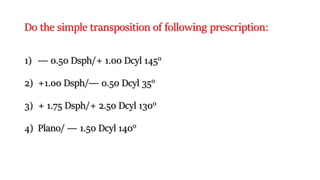
Do the simple transposition of following prescription:
1) ― 0.50 Dsph/+ 1.00 Dcyl 1450
2) +1.00 Dsph/― 0.50 Dcyl 350
3) + 1.75 Dsph/+ 2.50 Dcyl 1300
4) Plano/ ― 1.50 Dcyl 1400
Rules of Simple transposition
a) Sum Algebraic addition of sphere and cylinder gives new power of
sphere.
b) Sign Change sign of cylinder, retaining numerical power.
c) Axis: Rotate axis of cylinder through 900 (Add 900 if the original is at or
less than 900. Subtract 900 from any axis figure greater than 900)
Clinical optics 3rd edition Elkington p 76}
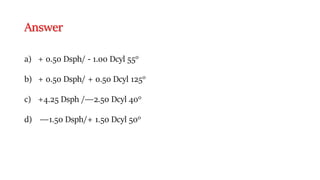
Answer
a) + 0.50 Dsph/ - 1.00 Dcyl 550
b) + 0.50 Dsph/ + 0.50 Dcyl 1250
c) +4.25 Dsph /―2.50 Dcyl 400
d) ―1.50 Dsph/+ 1.50 Dcyl 500
Glass power has given you write down the retinoscopic finding:
Step: 1. Find the spherical power: Add the working distance (1 for 1meter
and 1.5 for 2/3 meter) with the spherical power.
Step: 2 Find the cylinder power: Add spherical and cylinder power and also
add the working distance
Step: 3. Now draw your figure and put the spherical power at said axis
Step: 4. Cylinder power 90 degree away
This is the retinoscopic finding. Make the glass (WD: 1 meter)
After deduct WD
After deduction of
working distance
it is better to take
common which
one is less power.
Here -2.0 is
smaller than -4.0
So, the glass will be, -2.0 Dsph/-2.00 Dcyl 90
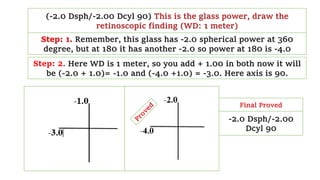
(-2.0 Dsph/-2.00 Dcyl 90) This is the glass power, draw the
retinoscopic finding (WD: 1 meter)
Step: 1. Remember, this glass has -2.0 spherical power at 360
degree, but at 180 it has another -2.0 so power at 180 is -4.0
Step: 2. Here WD is 1 meter, so you add + 1.00 in both now it will
be (-2.0 + 1.0)= -1.0 and (-4.0 +1.0) = -3.0. Here axis is 90.
-2.0 Dsph/-2.00
Dcyl 90
Final Proved
(-1.50 Dsph/+2.00 Dcyl 90) This is the glass power draw the
retinoscopic finding (WD: 1 meter)
Step: 1. Remember, it has -1.50 spherical power at 360 degree, but
at 180 it has another +2.0 so power at 180 is +0.50
Step: 2. Here WD is 1 meter, so you add + 1.00 in both now it will
be (-1.5 + 1.0)= -0.50 and (+0.50 +1.0) = +1.50. Here axis is 90.
-1.50 Dsph/+2.00
Dcyl 90
Final Proved
(-1.50 Dsph/+2.00 Dcyl 90) This is the glass power draw the
retinoscopic finding (WD: 2/3 meter)
Step: 1. Remember, it has -1.50 spherical power at 360 degree, but
at 180 it has another +2.0 so power at 180 is +0.50
Step: 2. Here WD is 2/3 meter, so you add + 1.50 in both now it
will be (-1.5 + 1.5)= 0 and (+0.50 +1.5) = +2.0. Here axis is 90.
-1.50 Dsph/+2.00
Dcyl 90
Final Proved
(+0.50 Dsph/+1.00 Dcyl 90) This is the glass power draw the
retinoscopic finding (WD: 2/3 meter)
Step: 1. Remember, it has +0.50 spherical power at 360 degree,
but at 180 it has another +1.0 so power at 180 is +1.50
Step: 2. Here WD is 2/3 meter, so you add + 1.50 in both now it
will be, (+0.5 + 1.5)=+2.0 and (+1.5 +1.5) = +3.0. Here axis is 90.
+0.50 Dsph/+1.0
Dcyl 90
Final Proved
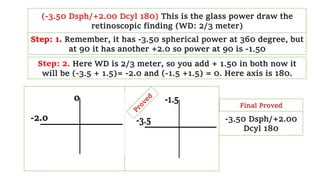
(-3.50 Dsph/+2.00 Dcyl 180) This is the glass power draw the
retinoscopic finding (WD: 2/3 meter)
Step: 1. Remember, it has -3.50 spherical power at 360 degree, but
at 90 it has another +2.0 so power at 90 is -1.50
Step: 2. Here WD is 2/3 meter, so you add + 1.50 in both now it
will be (-3.5 + 1.5)= -2.0 and (-1.5 +1.5) = 0. Here axis is 180.
-3.50 Dsph/+2.00
Dcyl 180
Final Proved
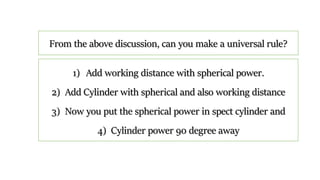
1) Add working distance with spherical power.
2) Add Cylinder with spherical and also working distance
3) Now you put the spherical power in spect cylinder and
4) Cylinder power 90 degree away
From the above discussion, can you make a universal rule?
No more chaos. Follow the rule of thumb for the diagnosis
of astigmatism
Rule: 1. When spherical power is plano or when the
spherical and cylinder power is same but opposite sign, it
is absolutely simple astigmatism
Rule: 2. When spherical and cylinder sign is same means both are plus or
minus, it is absolutely compound type, but sign is opposite cylinder
power is less than spherical it is also compound
Rule: 3. When spherical and cylinder sign is opposite but cylinder power
is more than spherical power it is absolutely mixed type
Rule: 1. When spherical power is plano or when the spherical
and cylinder power is same but opposite sign, it is absolutely
simple astigmatism
Example: 1. Plano/-1.50 Dcyl 45. Simple Myopic Astigmatism
Example: 2. Plano/+1.50 Dcyl 45. Simple Hypermetropic Astigmatism
Example: 3. +1.50/-1.50 Dcyl 45. Simple Hypermetropic Astigmatism
Example: 4. -1.50/+1.50 Dcyl 45. Simple Myopic Astigmatism
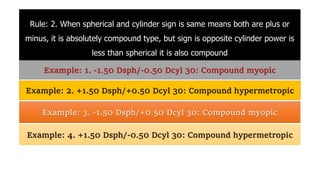
Rule: 2. When spherical and cylinder sign is same means both are plus or
minus, it is absolutely compound type, but sign is opposite cylinder power is
less than spherical it is also compound
Example: 1. -1.50 Dsph/-0.50 Dcyl 30: Compound myopic
Example: 2. +1.50 Dsph/+0.50 Dcyl 30: Compound hypermetropic
Example: 3. -1.50 Dsph/+0.50 Dcyl 30: Compound myopic
Example: 4. +1.50 Dsph/-0.50 Dcyl 30: Compound hypermetropic
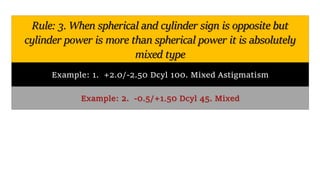
Rule: 3. When spherical and cylinder sign is opposite but
cylinder power is more than spherical power it is absolutely
mixed type
Example: 1. +2.0/-2.50 Dcyl 100. Mixed Astigmatism
Example: 2. -0.5/+1.50 Dcyl 45. Mixed
Ospe optics
Ospe optics
Ospe optics
Ospe optics
Ospe optics
Ospe optics
Ospe optics
Ospe optics

Ospe optics

  • 1.
    Glass prescription Md AnisurRahman (Anjum) Professor & Head (Ophthalmology) Dhaka Medical College, Dhaka.
  • 2.
    Do the simpletransposition of following prescription: 1) ― 0.50 Dsph/+ 1.00 Dcyl 1450 2) +1.00 Dsph/― 0.50 Dcyl 350 3) + 1.75 Dsph/+ 2.50 Dcyl 1300 4) Plano/ ― 1.50 Dcyl 1400
  • 3.
    Rules of Simpletransposition a) Sum Algebraic addition of sphere and cylinder gives new power of sphere. b) Sign Change sign of cylinder, retaining numerical power. c) Axis: Rotate axis of cylinder through 900 (Add 900 if the original is at or less than 900. Subtract 900 from any axis figure greater than 900) Clinical optics 3rd edition Elkington p 76}
  • 4.
    Answer a) + 0.50Dsph/ - 1.00 Dcyl 550 b) + 0.50 Dsph/ + 0.50 Dcyl 1250 c) +4.25 Dsph /―2.50 Dcyl 400 d) ―1.50 Dsph/+ 1.50 Dcyl 500
  • 5.
    Glass power hasgiven you write down the retinoscopic finding: Step: 1. Find the spherical power: Add the working distance (1 for 1meter and 1.5 for 2/3 meter) with the spherical power. Step: 2 Find the cylinder power: Add spherical and cylinder power and also add the working distance Step: 3. Now draw your figure and put the spherical power at said axis Step: 4. Cylinder power 90 degree away
  • 6.
    This is theretinoscopic finding. Make the glass (WD: 1 meter) After deduct WD After deduction of working distance it is better to take common which one is less power. Here -2.0 is smaller than -4.0 So, the glass will be, -2.0 Dsph/-2.00 Dcyl 90
  • 7.
    (-2.0 Dsph/-2.00 Dcyl90) This is the glass power, draw the retinoscopic finding (WD: 1 meter) Step: 1. Remember, this glass has -2.0 spherical power at 360 degree, but at 180 it has another -2.0 so power at 180 is -4.0 Step: 2. Here WD is 1 meter, so you add + 1.00 in both now it will be (-2.0 + 1.0)= -1.0 and (-4.0 +1.0) = -3.0. Here axis is 90. -2.0 Dsph/-2.00 Dcyl 90 Final Proved
  • 8.
    (-1.50 Dsph/+2.00 Dcyl90) This is the glass power draw the retinoscopic finding (WD: 1 meter) Step: 1. Remember, it has -1.50 spherical power at 360 degree, but at 180 it has another +2.0 so power at 180 is +0.50 Step: 2. Here WD is 1 meter, so you add + 1.00 in both now it will be (-1.5 + 1.0)= -0.50 and (+0.50 +1.0) = +1.50. Here axis is 90. -1.50 Dsph/+2.00 Dcyl 90 Final Proved
  • 9.
    (-1.50 Dsph/+2.00 Dcyl90) This is the glass power draw the retinoscopic finding (WD: 2/3 meter) Step: 1. Remember, it has -1.50 spherical power at 360 degree, but at 180 it has another +2.0 so power at 180 is +0.50 Step: 2. Here WD is 2/3 meter, so you add + 1.50 in both now it will be (-1.5 + 1.5)= 0 and (+0.50 +1.5) = +2.0. Here axis is 90. -1.50 Dsph/+2.00 Dcyl 90 Final Proved
  • 10.
    (+0.50 Dsph/+1.00 Dcyl90) This is the glass power draw the retinoscopic finding (WD: 2/3 meter) Step: 1. Remember, it has +0.50 spherical power at 360 degree, but at 180 it has another +1.0 so power at 180 is +1.50 Step: 2. Here WD is 2/3 meter, so you add + 1.50 in both now it will be, (+0.5 + 1.5)=+2.0 and (+1.5 +1.5) = +3.0. Here axis is 90. +0.50 Dsph/+1.0 Dcyl 90 Final Proved
  • 11.
    (-3.50 Dsph/+2.00 Dcyl180) This is the glass power draw the retinoscopic finding (WD: 2/3 meter) Step: 1. Remember, it has -3.50 spherical power at 360 degree, but at 90 it has another +2.0 so power at 90 is -1.50 Step: 2. Here WD is 2/3 meter, so you add + 1.50 in both now it will be (-3.5 + 1.5)= -2.0 and (-1.5 +1.5) = 0. Here axis is 180. -3.50 Dsph/+2.00 Dcyl 180 Final Proved
  • 12.
    1) Add workingdistance with spherical power. 2) Add Cylinder with spherical and also working distance 3) Now you put the spherical power in spect cylinder and 4) Cylinder power 90 degree away From the above discussion, can you make a universal rule?
  • 13.
    No more chaos.Follow the rule of thumb for the diagnosis of astigmatism Rule: 1. When spherical power is plano or when the spherical and cylinder power is same but opposite sign, it is absolutely simple astigmatism Rule: 2. When spherical and cylinder sign is same means both are plus or minus, it is absolutely compound type, but sign is opposite cylinder power is less than spherical it is also compound Rule: 3. When spherical and cylinder sign is opposite but cylinder power is more than spherical power it is absolutely mixed type
  • 14.
    Rule: 1. Whenspherical power is plano or when the spherical and cylinder power is same but opposite sign, it is absolutely simple astigmatism Example: 1. Plano/-1.50 Dcyl 45. Simple Myopic Astigmatism Example: 2. Plano/+1.50 Dcyl 45. Simple Hypermetropic Astigmatism Example: 3. +1.50/-1.50 Dcyl 45. Simple Hypermetropic Astigmatism Example: 4. -1.50/+1.50 Dcyl 45. Simple Myopic Astigmatism
  • 15.
    Rule: 2. Whenspherical and cylinder sign is same means both are plus or minus, it is absolutely compound type, but sign is opposite cylinder power is less than spherical it is also compound Example: 1. -1.50 Dsph/-0.50 Dcyl 30: Compound myopic Example: 2. +1.50 Dsph/+0.50 Dcyl 30: Compound hypermetropic Example: 3. -1.50 Dsph/+0.50 Dcyl 30: Compound myopic Example: 4. +1.50 Dsph/-0.50 Dcyl 30: Compound hypermetropic
  • 16.
    Rule: 3. Whenspherical and cylinder sign is opposite but cylinder power is more than spherical power it is absolutely mixed type Example: 1. +2.0/-2.50 Dcyl 100. Mixed Astigmatism Example: 2. -0.5/+1.50 Dcyl 45. Mixed