Objective Structured Practical
Question (OSPE)
Topic: Optics
According to the course curriculum of
Bangladesh College of Physician &
Surgeon (BCPS)
AUTHOR:
Dr Md Anisur Rahman Anjum.
MBBS (Dhaka Medical College). DO (Dhaka
University) FCPS (EYE)
Associate Professor
National Institute of Ophthalmology
Dhaka, Bangladesh.
Chamber: Mojibunnessa Eye Hospital
House: 18 Road: 6. Dhanmondi, Dhaka, 1205.
Bangladesh.
Email: anjumk38dmc@gmail.com
Cell: 01711-832397
7/14/2014 2anjumk38dmc@gmail.com
OSPE:1
7/14/2014 3anjumk38dmc@gmail.com
Question
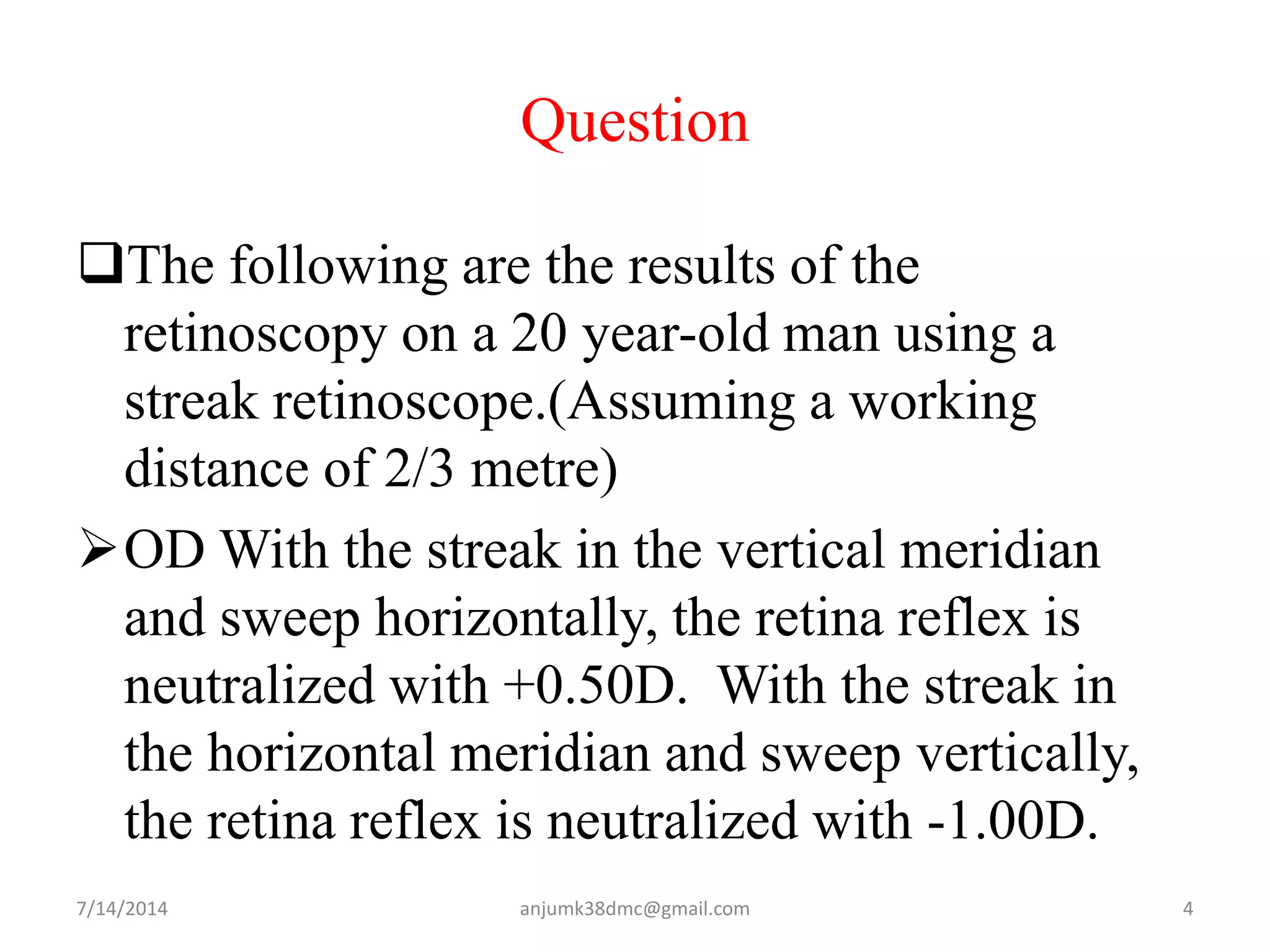
The following are the results of the
retinoscopy on a 20 year-old man using a
streak retinoscope.(Assuming a working
distance of 2/3 metre)
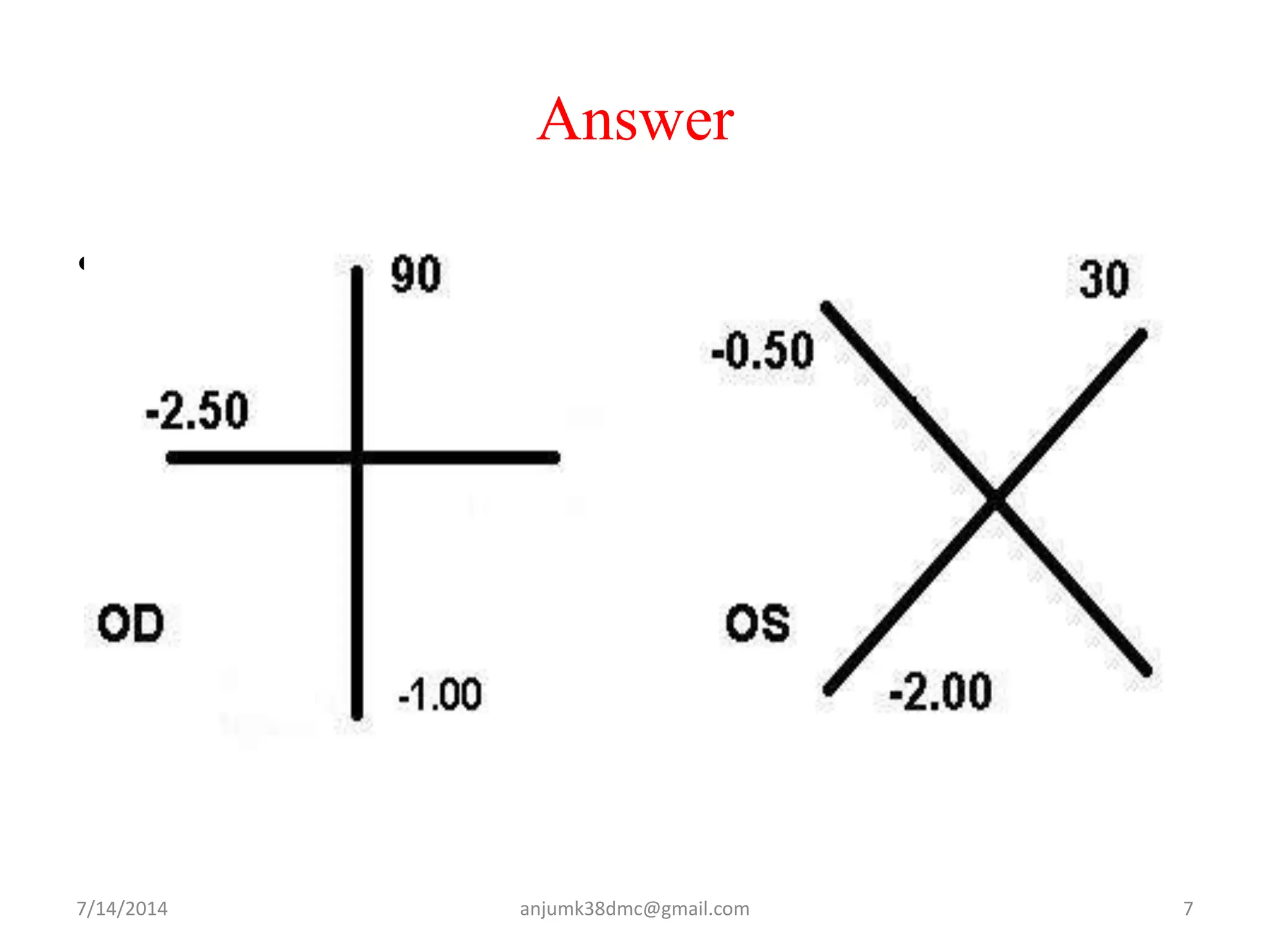
OD With the streak in the vertical meridian
and sweep horizontally, the retina reflex is
neutralized with +0.50D. With the streak in
the horizontal meridian and sweep vertically,
the retina reflex is neutralized with -1.00D.
7/14/2014 4anjumk38dmc@gmail.com
Question
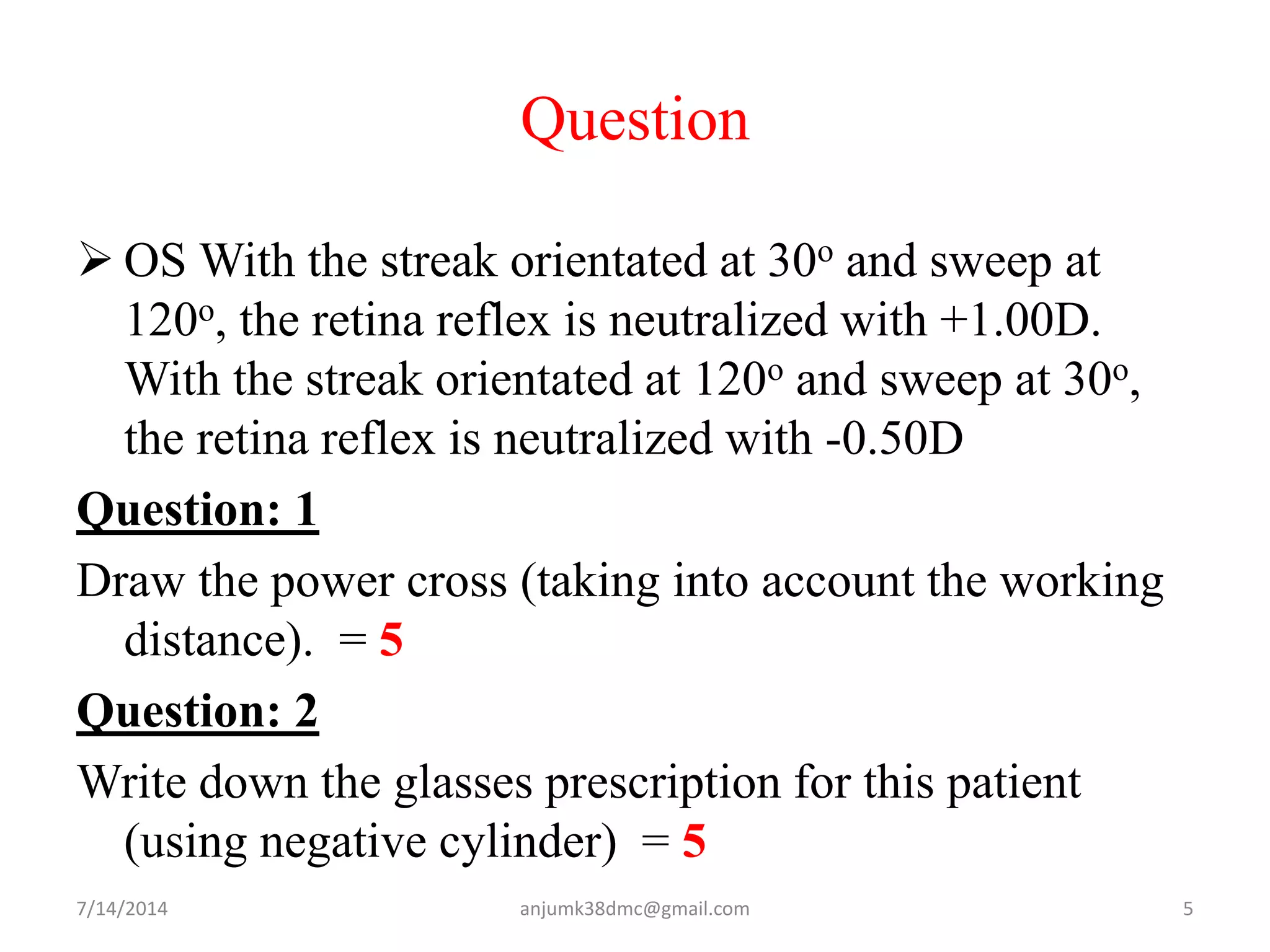
 OS With the streak orientated at 30o and sweep at
120o, the retina reflex is neutralized with +1.00D.
With the streak orientated at 120o and sweep at 30o,
the retina reflex is neutralized with -0.50D
Question: 1
Draw the power cross (taking into account the working
distance). = 5
Question: 2
Write down the glasses prescription for this patient
(using negative cylinder) = 5
7/14/2014 5anjumk38dmc@gmail.com
Answer
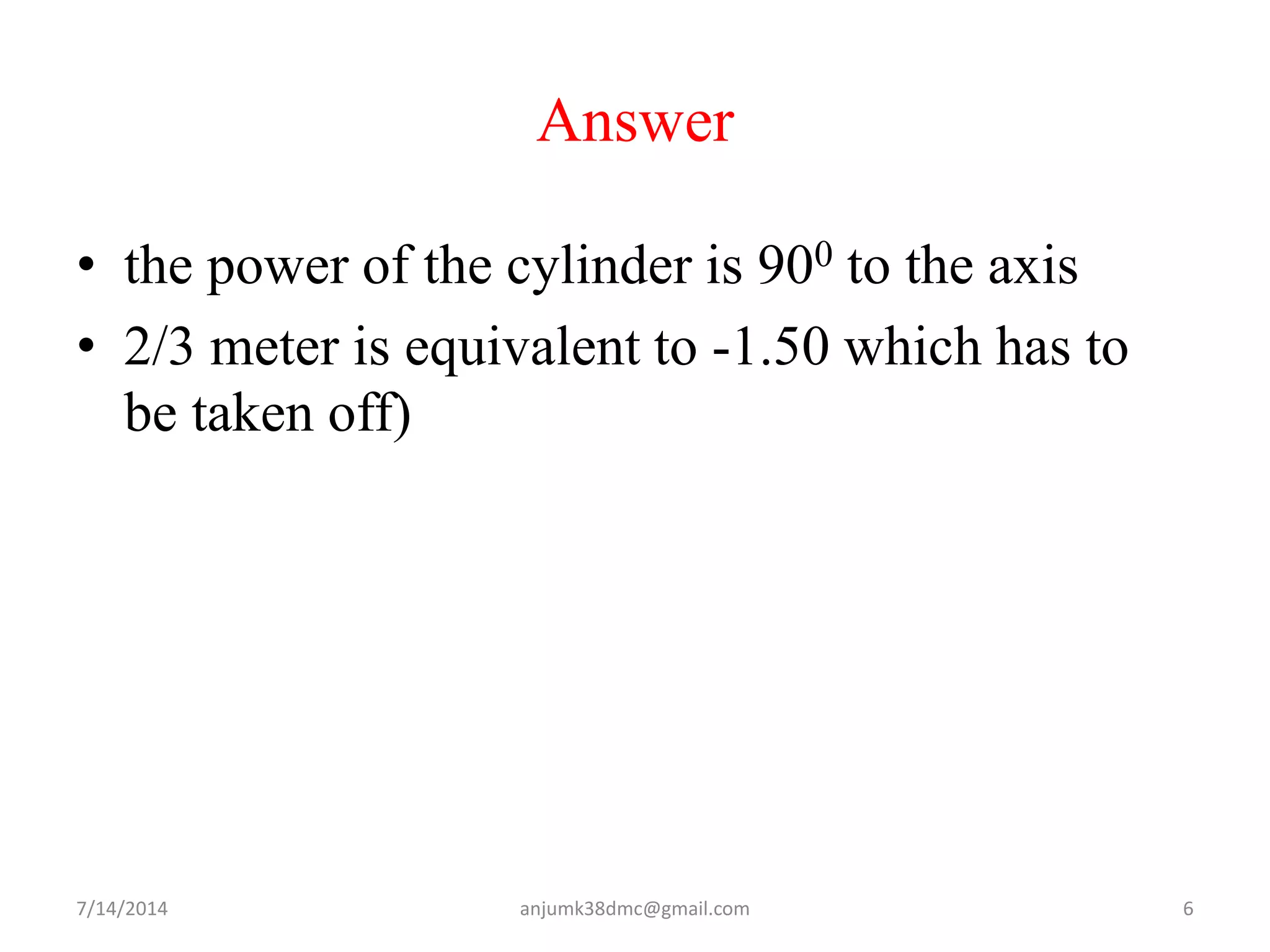
• the power of the cylinder is 900 to the axis
• 2/3 meter is equivalent to -1.50 which has to
be taken off)
7/14/2014 6anjumk38dmc@gmail.com
Answer
•
7/14/2014 7anjumk38dmc@gmail.com
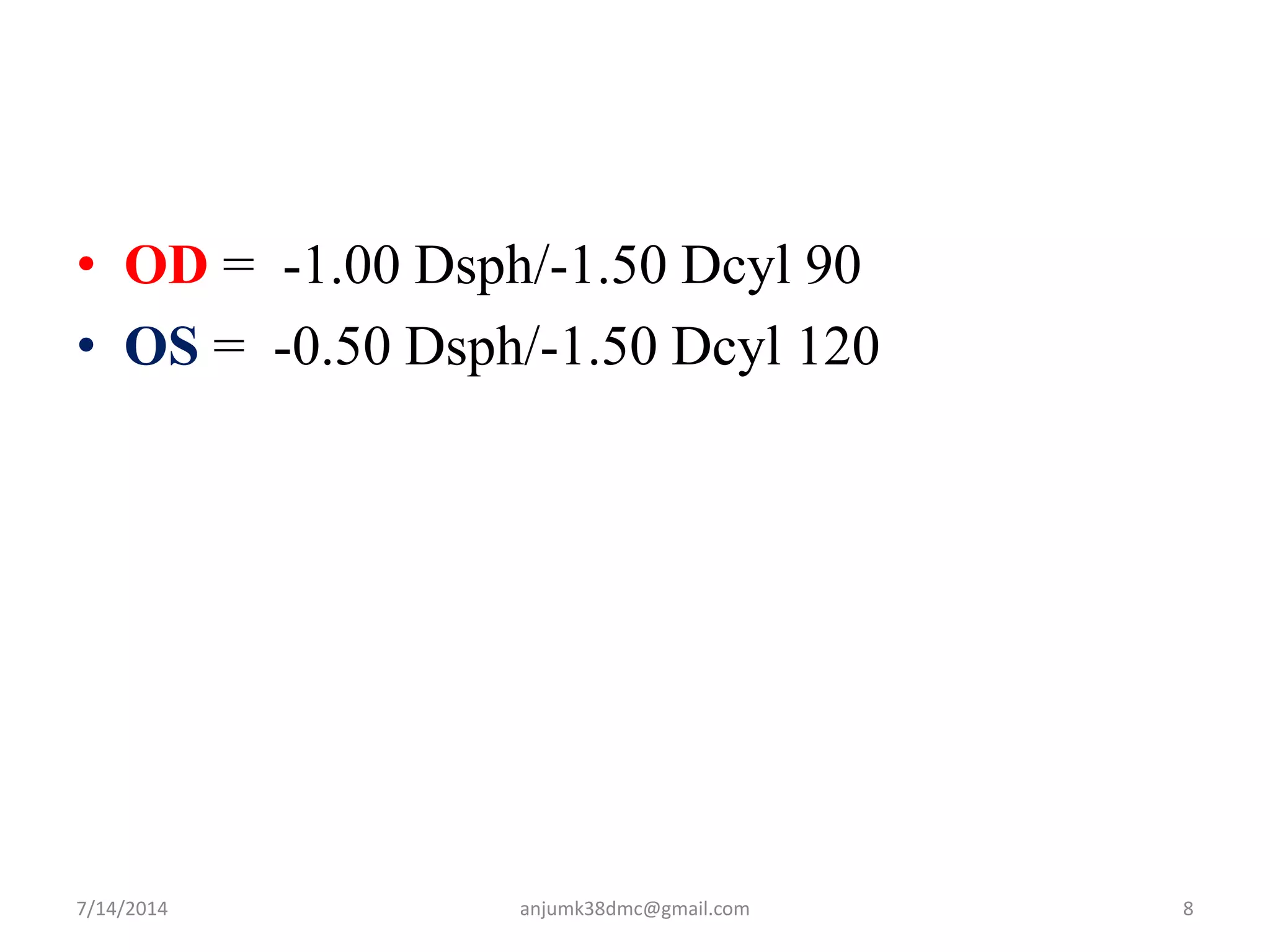
• OD = -1.00 Dsph/-1.50 Dcyl 90
• OS = -0.50 Dsph/-1.50 Dcyl 120
7/14/2014 8anjumk38dmc@gmail.com
OSPE:2
7/14/2014 9anjumk38dmc@gmail.com
Question
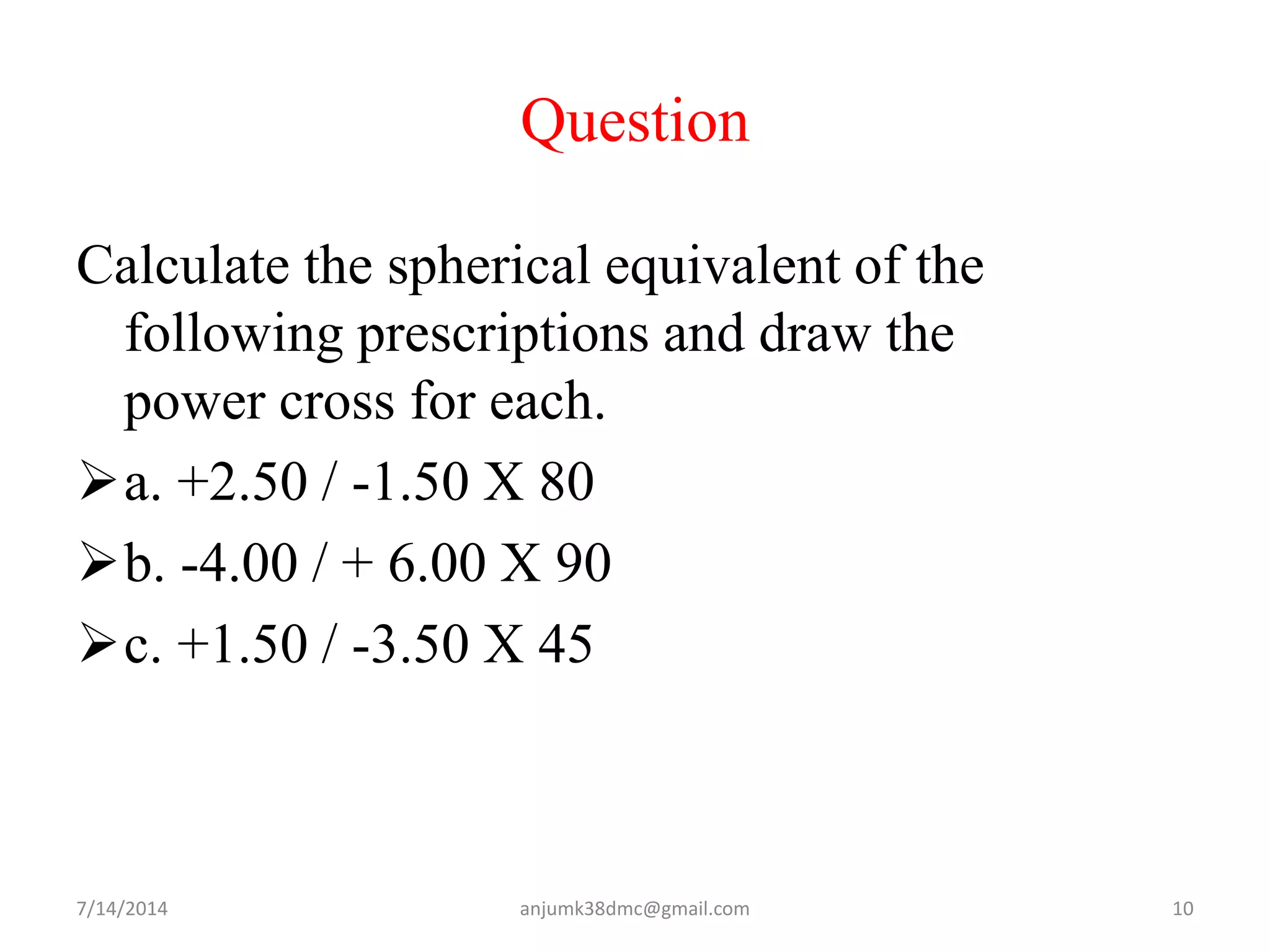
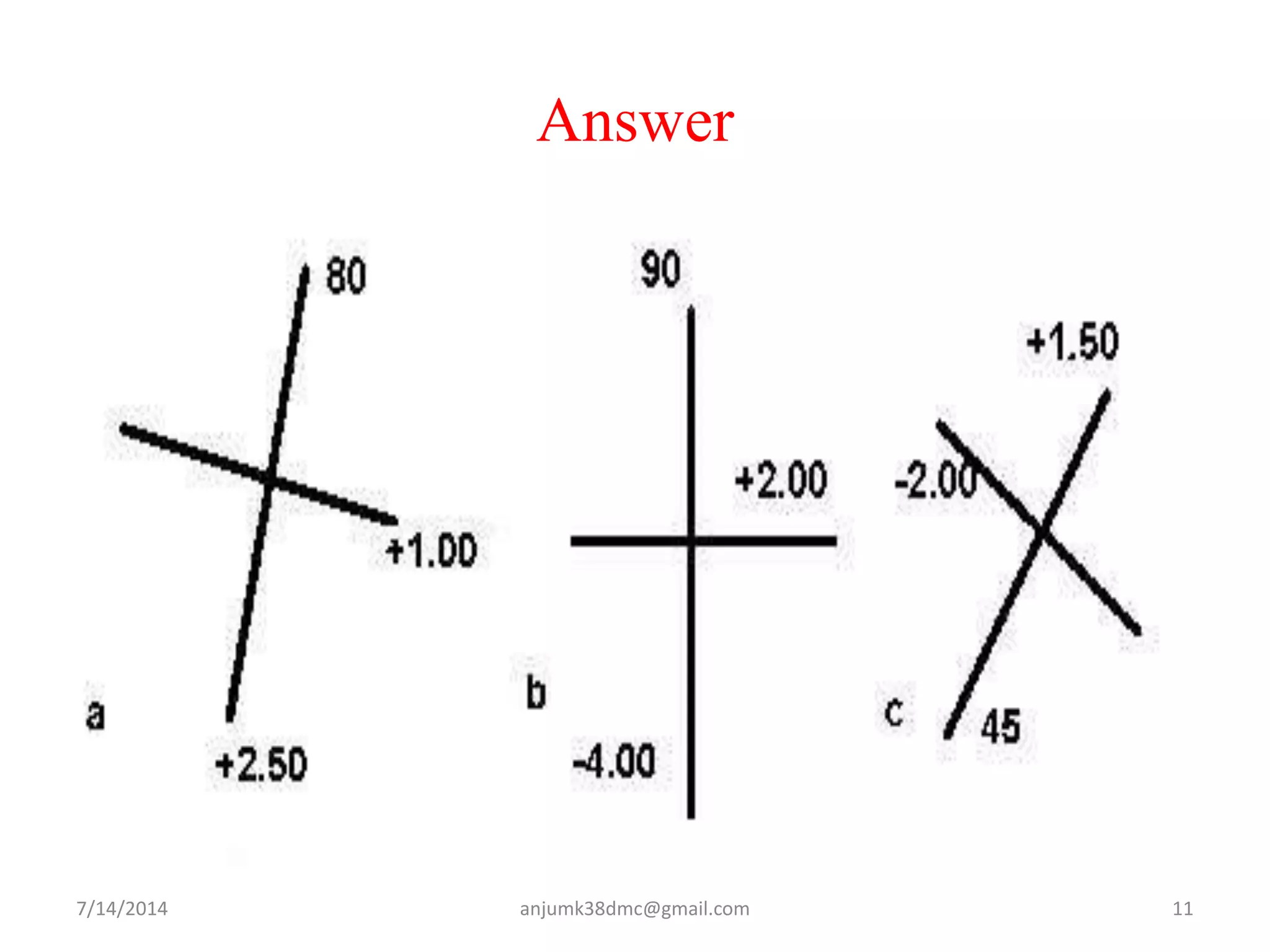
Calculate the spherical equivalent of the
following prescriptions and draw the
power cross for each.
a. +2.50 / -1.50 X 80
b. -4.00 / + 6.00 X 90
c. +1.50 / -3.50 X 45
7/14/2014 10anjumk38dmc@gmail.com
Answer
7/14/2014 11anjumk38dmc@gmail.com
Answer
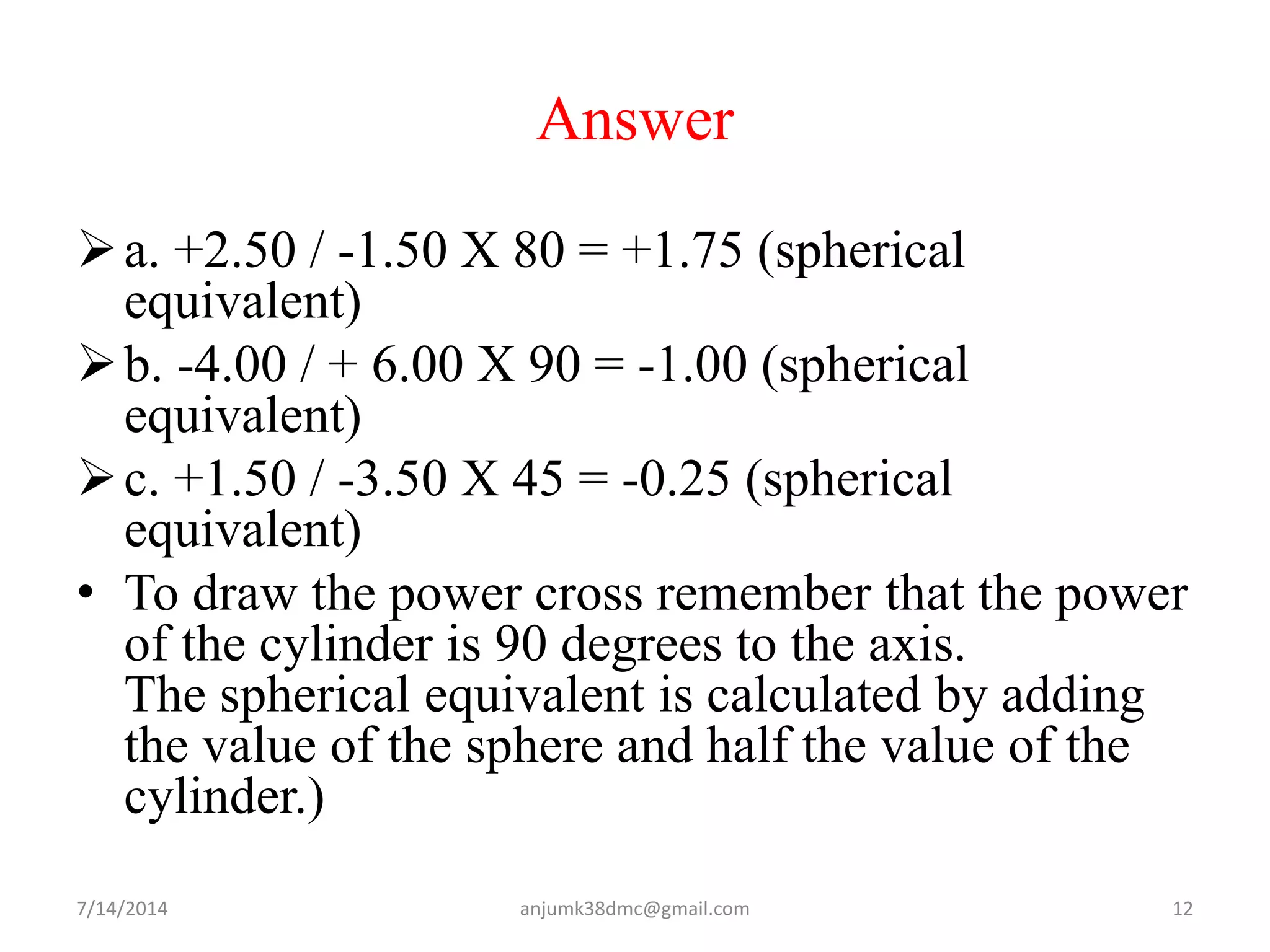
a. +2.50 / -1.50 X 80 = +1.75 (spherical
equivalent)
b. -4.00 / + 6.00 X 90 = -1.00 (spherical
equivalent)
c. +1.50 / -3.50 X 45 = -0.25 (spherical
equivalent)
• To draw the power cross remember that the power
of the cylinder is 90 degrees to the axis.
The spherical equivalent is calculated by adding
the value of the sphere and half the value of the
cylinder.)
7/14/2014 12anjumk38dmc@gmail.com
OSPE:3
7/14/2014 13anjumk38dmc@gmail.com
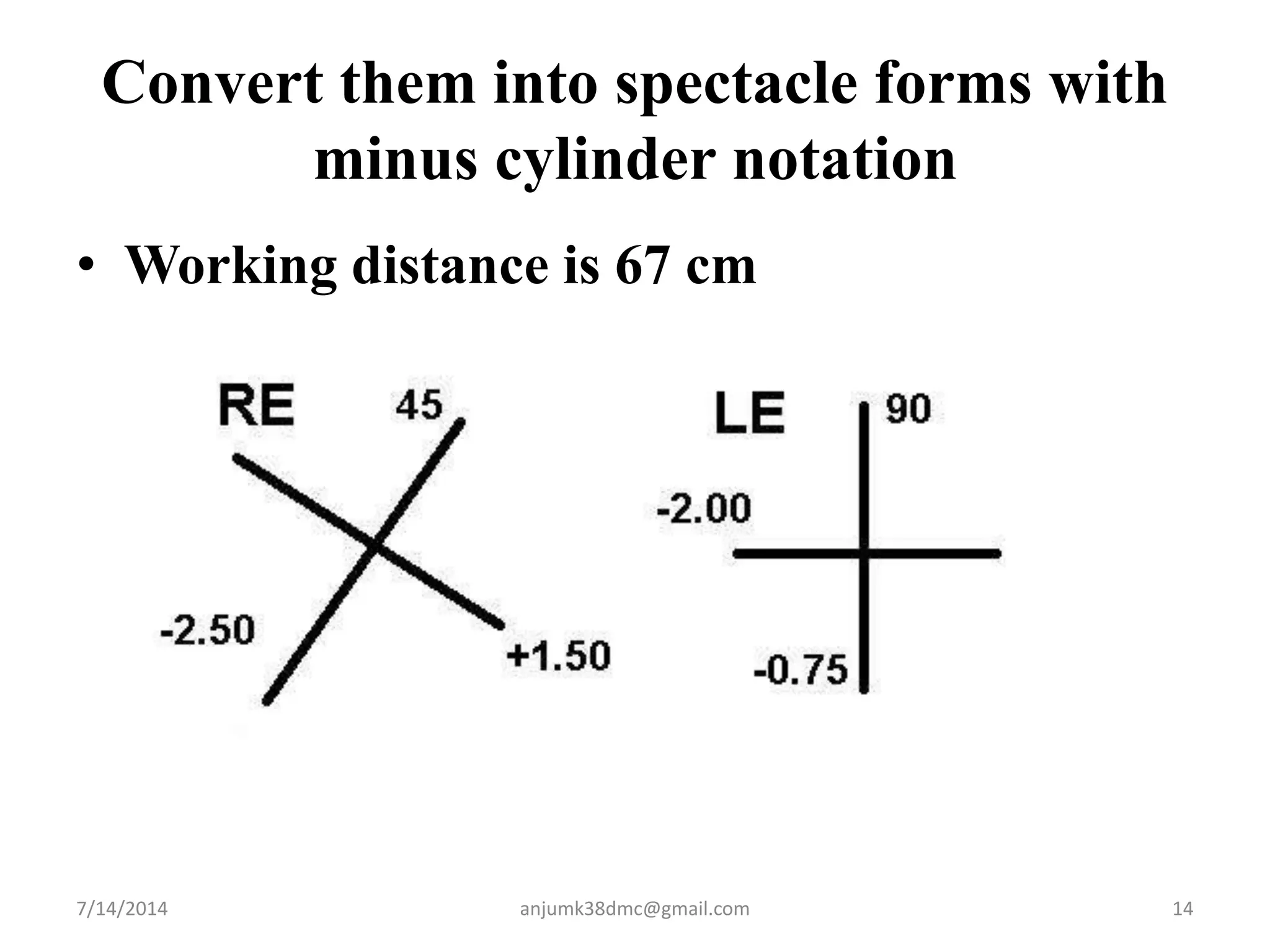
Convert them into spectacle forms with
minus cylinder notation
• Working distance is 67 cm
7/14/2014 14anjumk38dmc@gmail.com
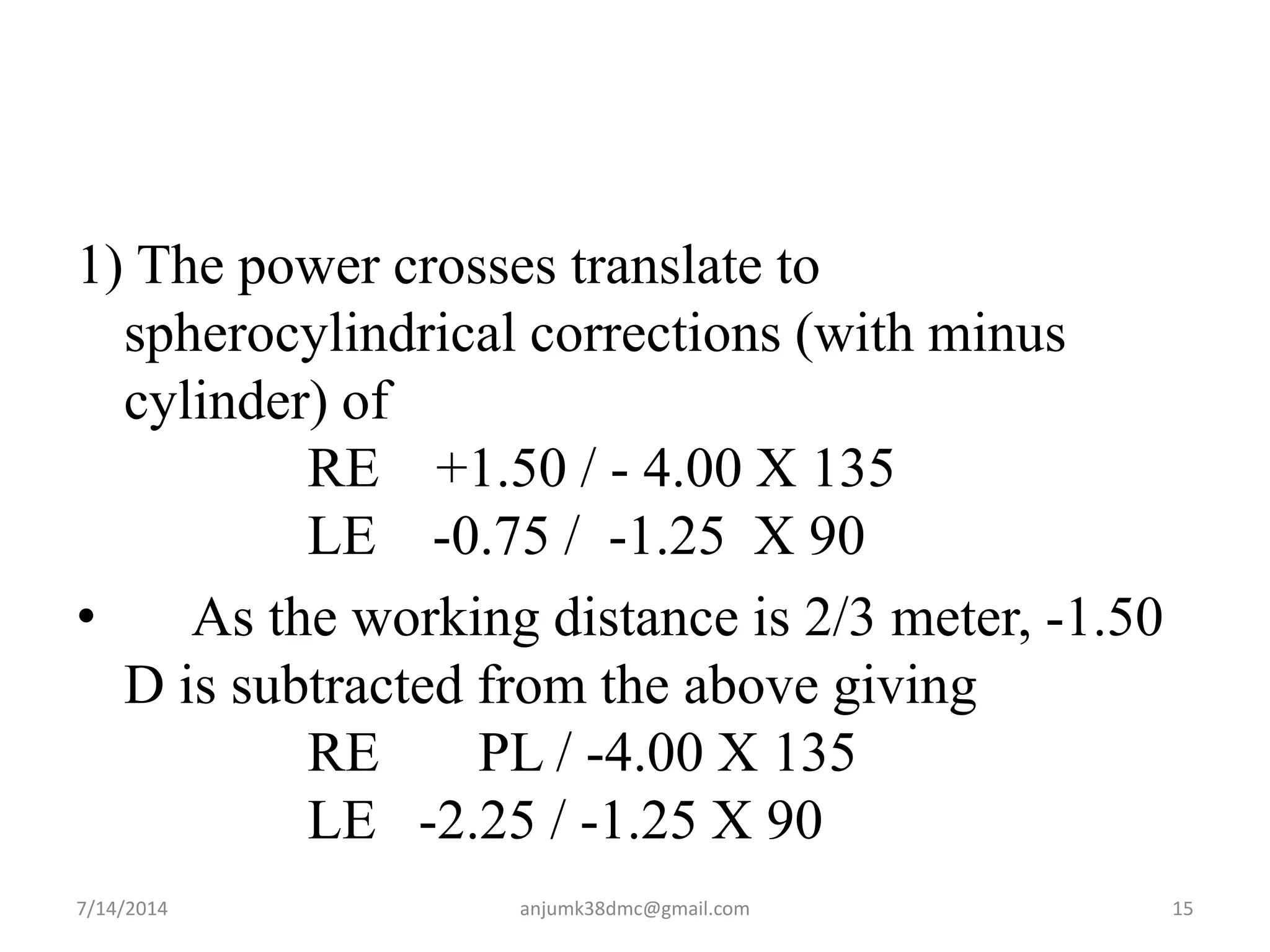
1) The power crosses translate to
spherocylindrical corrections (with minus
cylinder) of
RE +1.50 / - 4.00 X 135
LE -0.75 / -1.25 X 90
• As the working distance is 2/3 meter, -1.50
D is subtracted from the above giving
RE PL / -4.00 X 135
LE -2.25 / -1.25 X 90
7/14/2014 15anjumk38dmc@gmail.com
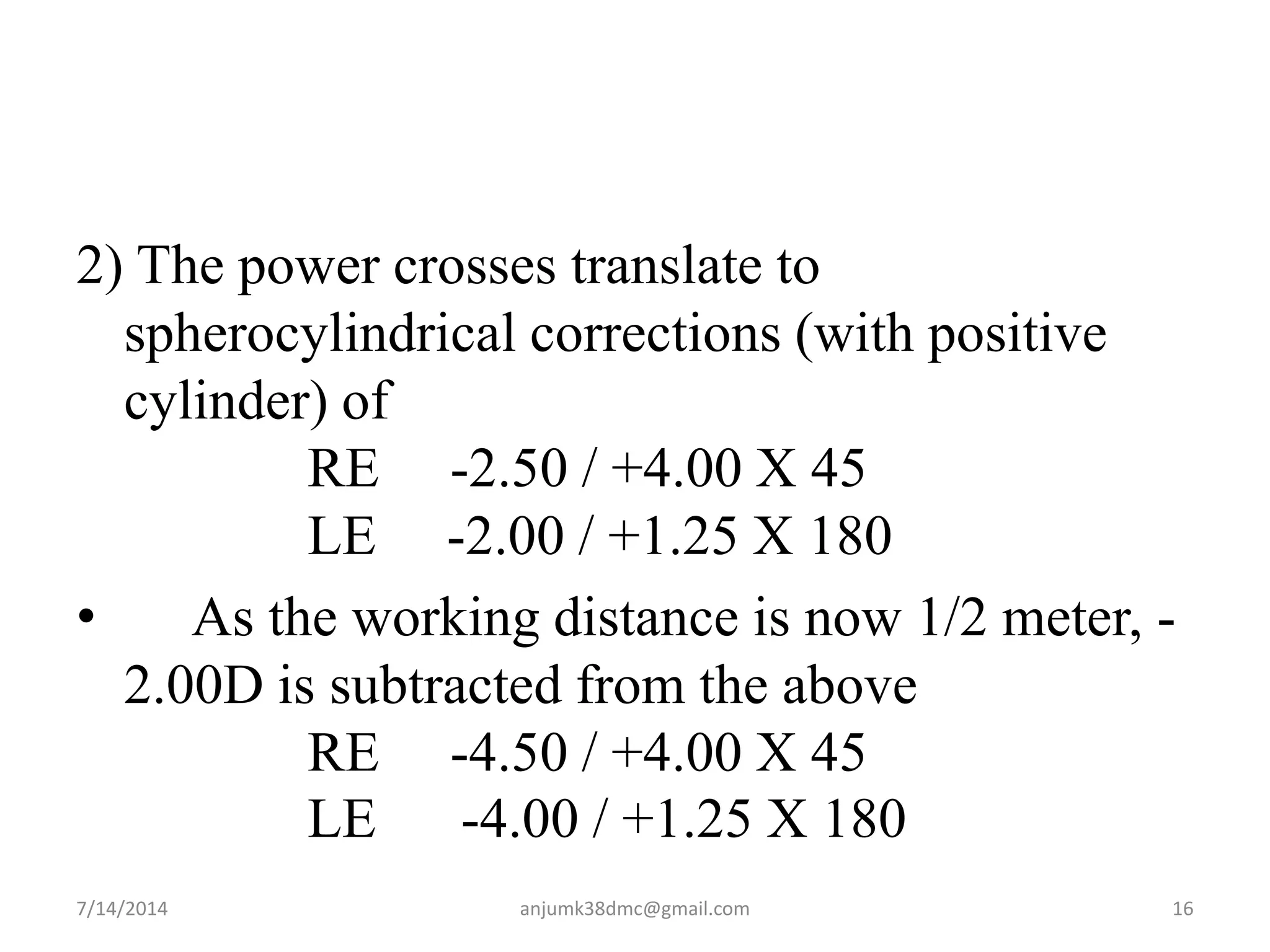
2) The power crosses translate to
spherocylindrical corrections (with positive
cylinder) of
RE -2.50 / +4.00 X 45
LE -2.00 / +1.25 X 180
• As the working distance is now 1/2 meter, -
2.00D is subtracted from the above
RE -4.50 / +4.00 X 45
LE -4.00 / +1.25 X 180
7/14/2014 16anjumk38dmc@gmail.com
OSPE:4
7/14/2014 17anjumk38dmc@gmail.com
Question
A 18 year-old university student presents to the
optician one week before his final examination
complaining of intermittent double vision and
poor distance vision. He was seen one month
earlier and the refraction was emmetropic.
Q: 1 What is the most likely diagnosis?
Q: 2 What treatment would you prescribe?
7/14/2014 18anjumk38dmc@gmail.com
Question
A 40 year-old myopic woman is recently prescribed soft
contact lenses for the first time. She returned two
weeks later and complains that her reading vision is
not as good as with her glasses. Retest shows her
visual acuity to be 6/6 in both eyes with the contact
lenses and the lenses were of the right prescription
and well-fitted.
Q: 3 Why does she have problem reading with her
contact lenses but not with her glasses?
7/14/2014 19anjumk38dmc@gmail.com
Answer
Ans: 1 Accommodation spasm. (When the symptoms occurs the
patient is likely to have constricted pupils and esotropia. The
spasm can be broken with cyloplegia.)
Ans: 2 The following treatment is useful:
Frequent looking up from work or
Prescription of reading glasses
Ans: 3.The patient is pre-presbyopic. Myopes require less
accommodation with glasses than contact lenses. In addition,
the prismatic effect (base-in prism) offered by the
concave glasses assist convergence during reading.
•
7/14/2014 20anjumk38dmc@gmail.com
OSPE:5
7/14/2014 21anjumk38dmc@gmail.com
Question
A 15 year-old emmetropic boy has an amplitude of
accommodation is 30 D.
Q: 1. What is his range of accommodation?
Another 20 year-old man has a +10 D hypermetropia
with 20 D amplitude of accommodation.
Q: 2. What is his near point and the range of
accommodation when he is not wearing the spectacle
correction?
Q:3 What is his near point and the range of
accommodation when he is wearing his +10.00
dioptres?7/14/2014 22anjumk38dmc@gmail.com
Answer
Answer: 1 Infinity to 3.3cm. =3
(The range of accommodation is the linear distance
between the far point and the near point. In the
absence of accommodation, the boy is in focus at
infinity. With maximal accommodation, he is in focus
at 1/30 = 0.033m = 3.3cm)
Answer:2. 10cm = 3
(To be in focus in infinity, the man needs to use up
+10.00D of his accommodation amplitude. As a
result, he has only 20 - 10 = 10 D for near vision. His
near point is 1/10 = 0.10 m = 10 cm)
7/14/2014 23anjumk38dmc@gmail.com
Answer
Answer: 3. The near point is 5 cm and the range of
accommodation is infinity to 5 cm.
= 4
(With hypermetropic correction he does not need to use up any
of his accommodation and can therefore use all the 20 D for
near vision. The near point is therefore 1/20 = 0.05m = 5cm.
The range of accommodation is therefore from infinity to 5
cm)
7/14/2014 24anjumk38dmc@gmail.com
OSPE:6
7/14/2014 25anjumk38dmc@gmail.com
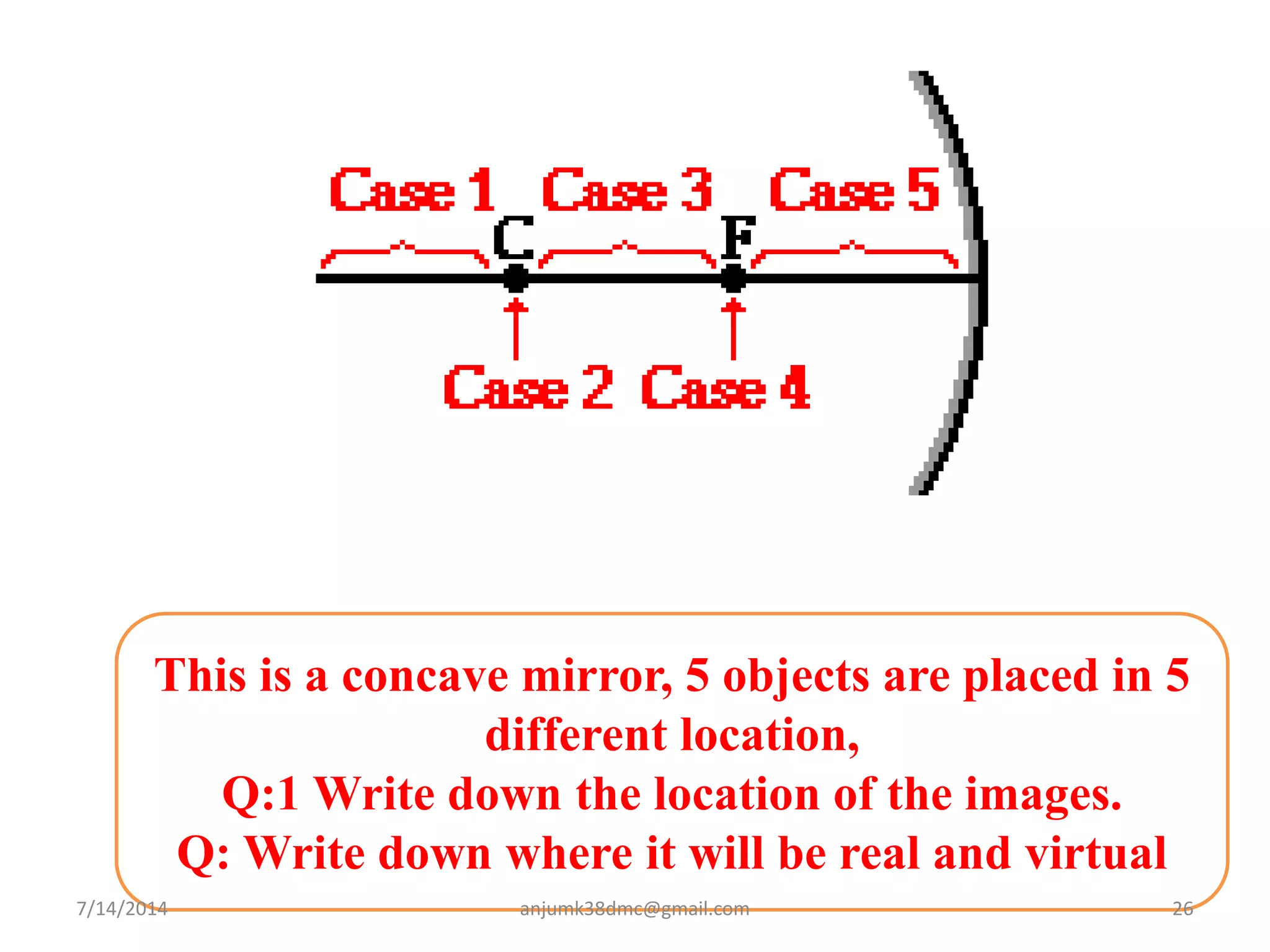
This is a concave mirror, 5 objects are placed in 5
different location,
Q:1 Write down the location of the images.
Q: Write down where it will be real and virtual
7/14/2014 26anjumk38dmc@gmail.com
Answer
• Case 1: Between C and F. REAL IMAGE
• Case 2: Image will be at C. REAL IMAGE
• Case 3: Image will be beyond C. REAL
IMAGE
• Case 4: No image will be form
• Case 5: the image will always be located
somewhere on the opposite side of the mirror.
• VIRTUAL IMAGE
7/14/2014 27anjumk38dmc@gmail.com

Objective structured practical question (ospe)

  • 1.
    Objective Structured Practical Question(OSPE) Topic: Optics According to the course curriculum of Bangladesh College of Physician & Surgeon (BCPS)
  • 2.
    AUTHOR: Dr Md AnisurRahman Anjum. MBBS (Dhaka Medical College). DO (Dhaka University) FCPS (EYE) Associate Professor National Institute of Ophthalmology Dhaka, Bangladesh. Chamber: Mojibunnessa Eye Hospital House: 18 Road: 6. Dhanmondi, Dhaka, 1205. Bangladesh. Email: anjumk38dmc@gmail.com Cell: 01711-832397 7/14/2014 2anjumk38dmc@gmail.com
  • 3.
  • 4.
    Question The following arethe results of the retinoscopy on a 20 year-old man using a streak retinoscope.(Assuming a working distance of 2/3 metre) OD With the streak in the vertical meridian and sweep horizontally, the retina reflex is neutralized with +0.50D. With the streak in the horizontal meridian and sweep vertically, the retina reflex is neutralized with -1.00D. 7/14/2014 4anjumk38dmc@gmail.com
  • 5.
    Question  OS Withthe streak orientated at 30o and sweep at 120o, the retina reflex is neutralized with +1.00D. With the streak orientated at 120o and sweep at 30o, the retina reflex is neutralized with -0.50D Question: 1 Draw the power cross (taking into account the working distance). = 5 Question: 2 Write down the glasses prescription for this patient (using negative cylinder) = 5 7/14/2014 5anjumk38dmc@gmail.com
  • 6.
    Answer • the powerof the cylinder is 900 to the axis • 2/3 meter is equivalent to -1.50 which has to be taken off) 7/14/2014 6anjumk38dmc@gmail.com
  • 7.
  • 8.
    • OD =-1.00 Dsph/-1.50 Dcyl 90 • OS = -0.50 Dsph/-1.50 Dcyl 120 7/14/2014 8anjumk38dmc@gmail.com
  • 9.
  • 10.
    Question Calculate the sphericalequivalent of the following prescriptions and draw the power cross for each. a. +2.50 / -1.50 X 80 b. -4.00 / + 6.00 X 90 c. +1.50 / -3.50 X 45 7/14/2014 10anjumk38dmc@gmail.com
  • 11.
  • 12.
    Answer a. +2.50 /-1.50 X 80 = +1.75 (spherical equivalent) b. -4.00 / + 6.00 X 90 = -1.00 (spherical equivalent) c. +1.50 / -3.50 X 45 = -0.25 (spherical equivalent) • To draw the power cross remember that the power of the cylinder is 90 degrees to the axis. The spherical equivalent is calculated by adding the value of the sphere and half the value of the cylinder.) 7/14/2014 12anjumk38dmc@gmail.com
  • 13.
  • 14.
    Convert them intospectacle forms with minus cylinder notation • Working distance is 67 cm 7/14/2014 14anjumk38dmc@gmail.com
  • 15.
    1) The powercrosses translate to spherocylindrical corrections (with minus cylinder) of RE +1.50 / - 4.00 X 135 LE -0.75 / -1.25 X 90 • As the working distance is 2/3 meter, -1.50 D is subtracted from the above giving RE PL / -4.00 X 135 LE -2.25 / -1.25 X 90 7/14/2014 15anjumk38dmc@gmail.com
  • 16.
    2) The powercrosses translate to spherocylindrical corrections (with positive cylinder) of RE -2.50 / +4.00 X 45 LE -2.00 / +1.25 X 180 • As the working distance is now 1/2 meter, - 2.00D is subtracted from the above RE -4.50 / +4.00 X 45 LE -4.00 / +1.25 X 180 7/14/2014 16anjumk38dmc@gmail.com
  • 17.
  • 18.
    Question A 18 year-olduniversity student presents to the optician one week before his final examination complaining of intermittent double vision and poor distance vision. He was seen one month earlier and the refraction was emmetropic. Q: 1 What is the most likely diagnosis? Q: 2 What treatment would you prescribe? 7/14/2014 18anjumk38dmc@gmail.com
  • 19.
    Question A 40 year-oldmyopic woman is recently prescribed soft contact lenses for the first time. She returned two weeks later and complains that her reading vision is not as good as with her glasses. Retest shows her visual acuity to be 6/6 in both eyes with the contact lenses and the lenses were of the right prescription and well-fitted. Q: 3 Why does she have problem reading with her contact lenses but not with her glasses? 7/14/2014 19anjumk38dmc@gmail.com
  • 20.
    Answer Ans: 1 Accommodationspasm. (When the symptoms occurs the patient is likely to have constricted pupils and esotropia. The spasm can be broken with cyloplegia.) Ans: 2 The following treatment is useful: Frequent looking up from work or Prescription of reading glasses Ans: 3.The patient is pre-presbyopic. Myopes require less accommodation with glasses than contact lenses. In addition, the prismatic effect (base-in prism) offered by the concave glasses assist convergence during reading. • 7/14/2014 20anjumk38dmc@gmail.com
  • 21.
  • 22.
    Question A 15 year-oldemmetropic boy has an amplitude of accommodation is 30 D. Q: 1. What is his range of accommodation? Another 20 year-old man has a +10 D hypermetropia with 20 D amplitude of accommodation. Q: 2. What is his near point and the range of accommodation when he is not wearing the spectacle correction? Q:3 What is his near point and the range of accommodation when he is wearing his +10.00 dioptres?7/14/2014 22anjumk38dmc@gmail.com
  • 23.
    Answer Answer: 1 Infinityto 3.3cm. =3 (The range of accommodation is the linear distance between the far point and the near point. In the absence of accommodation, the boy is in focus at infinity. With maximal accommodation, he is in focus at 1/30 = 0.033m = 3.3cm) Answer:2. 10cm = 3 (To be in focus in infinity, the man needs to use up +10.00D of his accommodation amplitude. As a result, he has only 20 - 10 = 10 D for near vision. His near point is 1/10 = 0.10 m = 10 cm) 7/14/2014 23anjumk38dmc@gmail.com
  • 24.
    Answer Answer: 3. Thenear point is 5 cm and the range of accommodation is infinity to 5 cm. = 4 (With hypermetropic correction he does not need to use up any of his accommodation and can therefore use all the 20 D for near vision. The near point is therefore 1/20 = 0.05m = 5cm. The range of accommodation is therefore from infinity to 5 cm) 7/14/2014 24anjumk38dmc@gmail.com
  • 25.
  • 26.
    This is aconcave mirror, 5 objects are placed in 5 different location, Q:1 Write down the location of the images. Q: Write down where it will be real and virtual 7/14/2014 26anjumk38dmc@gmail.com
  • 27.
    Answer • Case 1:Between C and F. REAL IMAGE • Case 2: Image will be at C. REAL IMAGE • Case 3: Image will be beyond C. REAL IMAGE • Case 4: No image will be form • Case 5: the image will always be located somewhere on the opposite side of the mirror. • VIRTUAL IMAGE 7/14/2014 27anjumk38dmc@gmail.com