Transposition
 Presentation by
 Saroj sah
 Rama university
 Kanpur, UP
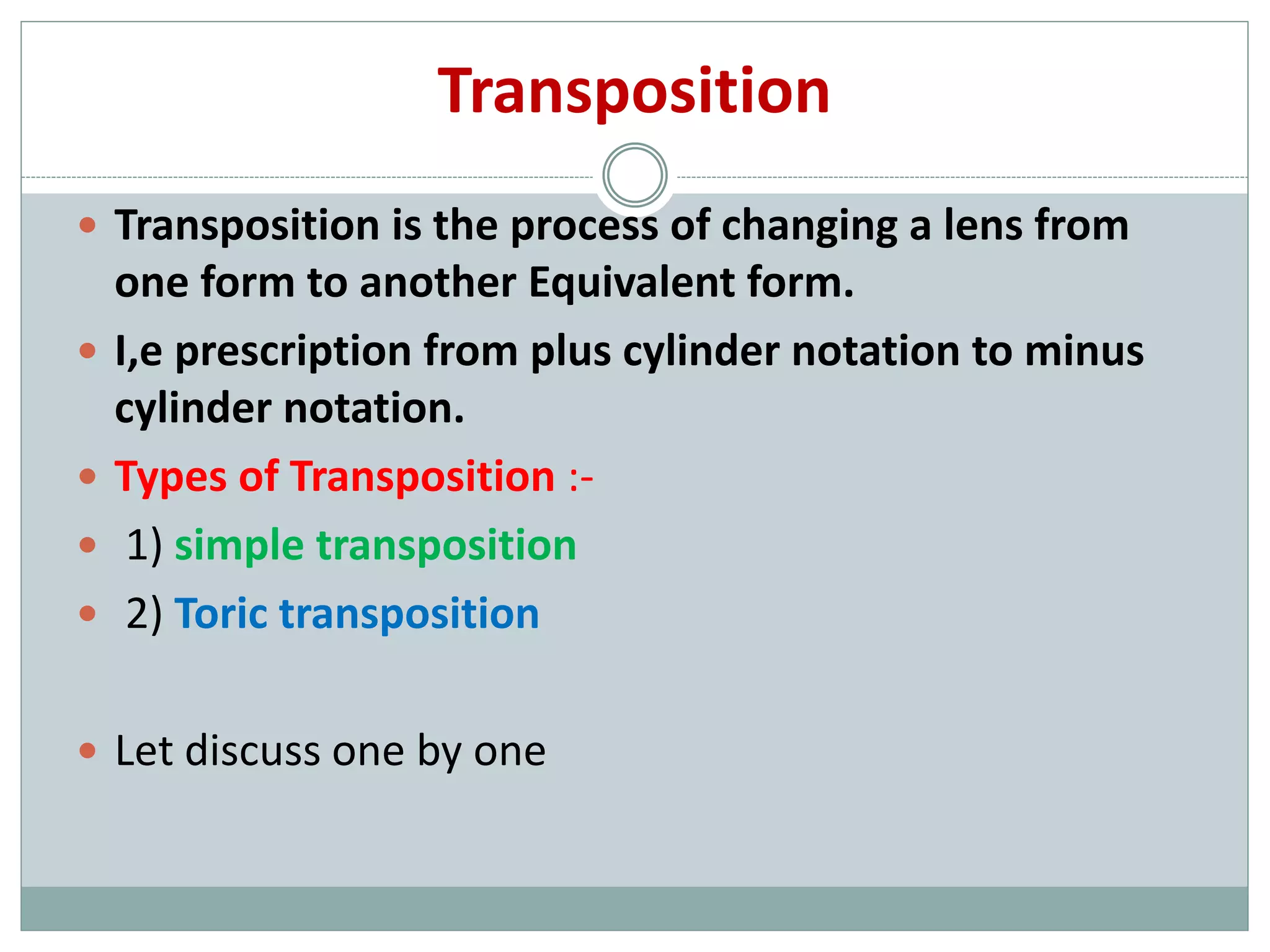
Transposition
 Transposition is the process of changing a lens from
one form to another Equivalent form.
 I,e prescription from plus cylinder notation to minus
cylinder notation.
 Types of Transposition :-
 1) simple transposition
 2) Toric transposition
 Let discuss one by one
Simple transposition
 Three simple step:-
 A) SUM :-Algebric sum of sphere and cylinder to get a
new shpere
 Example :- +1.0Dsph/-3.0Dcyl×90
 -2.0 Dsph
 B) SIGNS :-Retain the power of the cylinder but change the sign.
 +3DC
 C) AXIS :- Rotate the axis of the cylinder through 90 degree.
 ( add 90 if ≤90 )
 ( subtract 90 if ≥90 )
 -2.0 Dsph/+3.0 Dcyl ×180
 Different method of simple transposition:-
 1) –ve sphero cylinder
 +3.00/-2.00x90
 2) +ve sphero cylinder :-
 +2.00/+1.50x90
 3) Crossed cylinder forms :-
 +1.00x90/+1.00x180
 Example :-
 +1.00/-0.50x180
 Step-1 +0.50/
 Step-2 +0.50/+0.50
 Step-3 +0.50/+0.50x90
 Final power +0.50/+0.50x90
Example of simple transposition
 1) +2.00DS/+1.00DC×180
 Ans +3.0 DS/-1.0 DC X90
 2) -3.0 DS/ -2.0 DC X 50
 Ans -5.0 DS / +2.0 DC x 140
 3) +3.50 DS / -4.0 DC x 60
 Ans -0.50 DS / +4.0 DC x 150
Cross cylinderical form
 Example :- +3.00/+2.00x90
 +3.00
 +3.00
 +2.00 = +5.00
 +3.00x90/ +5.00x180
Toric transposition
 Toric lens is one in which one surface is spherical and other is
cylindrical.and surface in which both meridians having
different power is called ‘toric surface”
 The principal meridian of weaker power of the toric surface is
known as Base curve of the lens.
 Toric forms = Sphere curve
 Base curve / Cylinder curve
 RULES:-
 1) Choose the base curve first for proper curvature.
 2) Do simple transposition if sign of base curve and cylinder is
not same.
 3) To find spherical surface power
 - subtract base curve from sphere
 4) To find out the cylinder surface power
 - fix the base curve at the right angle to the
axis of cylinder.
 - Add the base curve with cylinder
 5) Then both the spherical and cylinder surface
determines the lens power.
 Example of toric transposition :-
 1) +2.0 DS / +3.0 DC x 90 ( Base curve -6.0)
 Step -1 Simple transposition because Base curve and
cylinder value is not same.
 +5.0 DS / -3.0 DC X 180
 Step-2 Subtracting Base curve from sphere to get
spherical surface power.
 +5.0-(-6.0)= +11.0 Ds
 Step-3 Finding Cylinder surface power
 - Fixing Base curve at right angle to the axis of
cylinder i,e -6.0 DC X 90
 Step-4 Adding Base curve to the Cylinder.
 -3.0 + ( -6.0 ) = - 9.0 DC X 180
 Toric form = +11.0 DS
 - 6.0 DC X90 / -9.0 DC X 180
SPHERICAL EQUIVALENT
 A Spherocylinder lens wil correct for Astigmatism and
myopia or Hyperopia.
 It was necessary to correcrt a near or far- sighted who
has no astigmatism.
 If there is no cylinder lens avaliable.
 Uses of spherical equivalent :-
 It is use for the spherical lens which would convert a case
of simple.coumpound,or unequally mixwd astigmatism
into case of eually mixed astigmastism.
How to find the spherical equivalent
 Step-1 Take half of the value of the cylinder
 Step-2 Add it to the sphere power.
 Formula :-
 Spherical equivalent :- Sphere + Cylinder
 2
 Example :- +2.0 / 3.0 X180
 Spherical equivalent :- +2.0 + 3.0 =3.5 D
 2
 Hy friends if you are not understand my slideshare, then
go my Youtube channel “Optometrist Nepal” I have
present same slide on my channel.And also please like
and subscribe my youtube channel.
Thank you all of you

Transposition

  • 1.
    Transposition  Presentation by Saroj sah  Rama university  Kanpur, UP
  • 2.
    Transposition  Transposition isthe process of changing a lens from one form to another Equivalent form.  I,e prescription from plus cylinder notation to minus cylinder notation.  Types of Transposition :-  1) simple transposition  2) Toric transposition  Let discuss one by one
  • 3.
    Simple transposition  Threesimple step:-  A) SUM :-Algebric sum of sphere and cylinder to get a new shpere  Example :- +1.0Dsph/-3.0Dcyl×90  -2.0 Dsph  B) SIGNS :-Retain the power of the cylinder but change the sign.  +3DC  C) AXIS :- Rotate the axis of the cylinder through 90 degree.  ( add 90 if ≤90 )  ( subtract 90 if ≥90 )  -2.0 Dsph/+3.0 Dcyl ×180
  • 4.
     Different methodof simple transposition:-  1) –ve sphero cylinder  +3.00/-2.00x90  2) +ve sphero cylinder :-  +2.00/+1.50x90  3) Crossed cylinder forms :-  +1.00x90/+1.00x180  Example :-  +1.00/-0.50x180  Step-1 +0.50/  Step-2 +0.50/+0.50  Step-3 +0.50/+0.50x90  Final power +0.50/+0.50x90
  • 5.
    Example of simpletransposition  1) +2.00DS/+1.00DC×180  Ans +3.0 DS/-1.0 DC X90  2) -3.0 DS/ -2.0 DC X 50  Ans -5.0 DS / +2.0 DC x 140  3) +3.50 DS / -4.0 DC x 60  Ans -0.50 DS / +4.0 DC x 150
  • 6.
    Cross cylinderical form Example :- +3.00/+2.00x90  +3.00  +3.00  +2.00 = +5.00  +3.00x90/ +5.00x180
  • 7.
    Toric transposition  Toriclens is one in which one surface is spherical and other is cylindrical.and surface in which both meridians having different power is called ‘toric surface”  The principal meridian of weaker power of the toric surface is known as Base curve of the lens.  Toric forms = Sphere curve  Base curve / Cylinder curve  RULES:-  1) Choose the base curve first for proper curvature.  2) Do simple transposition if sign of base curve and cylinder is not same.  3) To find spherical surface power  - subtract base curve from sphere
  • 8.
     4) Tofind out the cylinder surface power  - fix the base curve at the right angle to the axis of cylinder.  - Add the base curve with cylinder  5) Then both the spherical and cylinder surface determines the lens power.  Example of toric transposition :-  1) +2.0 DS / +3.0 DC x 90 ( Base curve -6.0)  Step -1 Simple transposition because Base curve and cylinder value is not same.  +5.0 DS / -3.0 DC X 180
  • 9.
     Step-2 SubtractingBase curve from sphere to get spherical surface power.  +5.0-(-6.0)= +11.0 Ds  Step-3 Finding Cylinder surface power  - Fixing Base curve at right angle to the axis of cylinder i,e -6.0 DC X 90  Step-4 Adding Base curve to the Cylinder.  -3.0 + ( -6.0 ) = - 9.0 DC X 180  Toric form = +11.0 DS  - 6.0 DC X90 / -9.0 DC X 180
  • 10.
    SPHERICAL EQUIVALENT  ASpherocylinder lens wil correct for Astigmatism and myopia or Hyperopia.  It was necessary to correcrt a near or far- sighted who has no astigmatism.  If there is no cylinder lens avaliable.  Uses of spherical equivalent :-  It is use for the spherical lens which would convert a case of simple.coumpound,or unequally mixwd astigmatism into case of eually mixed astigmastism.
  • 11.
    How to findthe spherical equivalent  Step-1 Take half of the value of the cylinder  Step-2 Add it to the sphere power.  Formula :-  Spherical equivalent :- Sphere + Cylinder  2  Example :- +2.0 / 3.0 X180  Spherical equivalent :- +2.0 + 3.0 =3.5 D  2
  • 12.
     Hy friendsif you are not understand my slideshare, then go my Youtube channel “Optometrist Nepal” I have present same slide on my channel.And also please like and subscribe my youtube channel. Thank you all of you