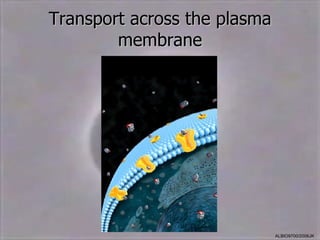
Transport across the plasma
        membrane


                              ALBIO9700/2006JK
Diffusion and facilitated diffusion
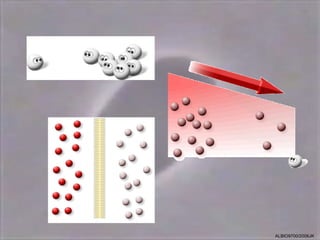
• Diffusion – the net movement of molecules (or ions) from a
  region of their higher concentration to a region of their lower
  concentration (molecules move down a concentration
  gradient)
• Molecules tend to reach an equilibrium where evenly spread
• The rate at which substance diffuses across a membrane
  depends on:
   – The ‘steepness’ of the concentration gradient. The greater
     the difference in concentration, the greater the difference in
     the number of molecules passing in the 2 directions and
     hence the faster the net rate of diffusion
   – Temperature. Diffusion takes place faster in high
     temperatures due to higher kinetic energy
   – The surface area. The greater the surface area, the more
     molecules or ions can cross it at any one moment (faster
     diffusion)
   – The nature of the molecules or ions. Substances with large
     molecules tend to diffuse more slowly. Non-polar molecules
     diffuse more easily through cell membranes as they are
     soluble in non-polar phospholipid tails
                                                              ALBIO9700/2006JK
ALBIO9700/2006JK
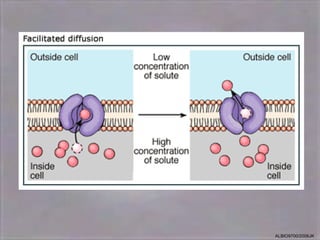
• Facilitated diffusion – diffusion of a
  substance through protein channels in a
  cell membrane
• The proteins provide hydrophilic areas
  that allow the molecules or ions to pass
  through a membrane that would otherwise
  be less permeable to them
• Rate depends on how many appropriate
  channels there are in the membrane and
  on whether they are open or not

                                      ALBIO9700/2006JK
ALBIO9700/2006JK
Active transport
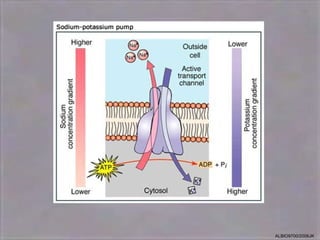
• The energy-consuming transport of molecules or
  ions across a membrane against a concentration
  gradient made possible by transferring energy
  from respiration
• Like facilitated diffusion, active transport is
  achieved by special transport proteins, each of
  which is specific for a particular type of molecule
  or ion
• However, it requires energy (molecule ATP)
  because movement occurs up a concentration
  gradient
• Energy used to make the transport protein
  (carrier protein) change its 3D shape,
  transferring the molecules or ions across the
  membrane in the process
                                                ALBIO9700/2006JK
ALBIO9700/2006JK
Bulk transport
• Transport of large quantities of materials
  into cells (endocytosis) or out of cells
  (exocytosis)
• Exocytosis – process by which materials
  are removed from cells
• Endocytosis – engulfing of the material
  by the plasma membrane to form a small
  sac or ‘endocytotic vacuole’
  – Phagocytosis: bulk uptake of solid material
  – Pinocytosis: bulk uptake of liquid
                                              ALBIO9700/2006JK
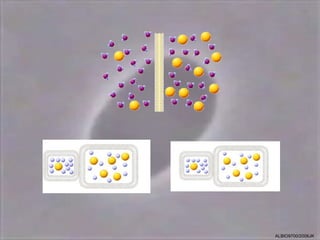
Osmosis
• Solution = solute + solvent
• Partially permeable membrane – membrane
  which allows only certain molecules through
• If solution B has higher concentration of solute
  molecules than solution A – solution B is more
  concentrated than solution A/solution A is more
  dilute than solution B
• Osmosis involves net movement of water
  molecules only


                                             ALBIO9700/2006JK
ALBIO9700/2006JK
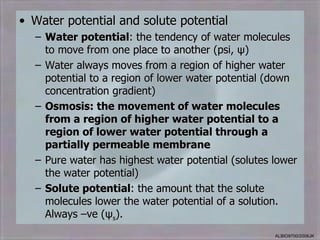
• Water potential and solute potential
  – Water potential: the tendency of water molecules
    to move from one place to another (psi, ψ)
  – Water always moves from a region of higher water
    potential to a region of lower water potential (down
    concentration gradient)
  – Osmosis: the movement of water molecules
    from a region of higher water potential to a
    region of lower water potential through a
    partially permeable membrane
  – Pure water has highest water potential (solutes lower
    the water potential)
  – Solute potential: the amount that the solute
    molecules lower the water potential of a solution.
    Always –ve (ψs).
                                                    ALBIO9700/2006JK
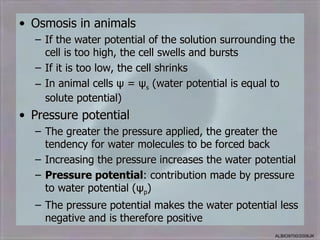
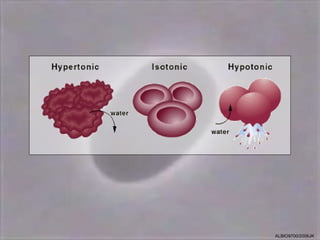
• Osmosis in animals
  – If the water potential of the solution surrounding the
    cell is too high, the cell swells and bursts
  – If it is too low, the cell shrinks
  – In animal cells ψ = ψs (water potential is equal to
    solute potential)
• Pressure potential
  – The greater the pressure applied, the greater the
    tendency for water molecules to be forced back
  – Increasing the pressure increases the water potential
  – Pressure potential: contribution made by pressure
    to water potential (ψp)
  – The pressure potential makes the water potential less
    negative and is therefore positive
                                                     ALBIO9700/2006JK
ALBIO9700/2006JK
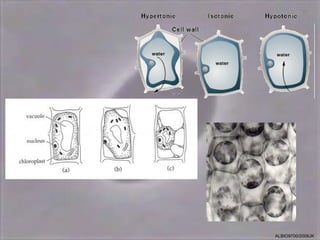
• Osmosis in plant cells
  – Different from animal cells because of rigid
    and strong cell wall
  – Cell wall prevents the cell from bursting (lysis)
  – When fully inflated with water: turgid
  – Water potential is a combination of solute
    potential and pressure potential (ψ = ψs + ψp)
  – When protoplast shrinks and pulls away from
    the cell wall: plasmolysis
  – Incipient plasmolysis: the point at which
    pressure potential has just reached zero and
    plasmolysis is about to occur


                                                ALBIO9700/2006JK
ALBIO9700/2006JK
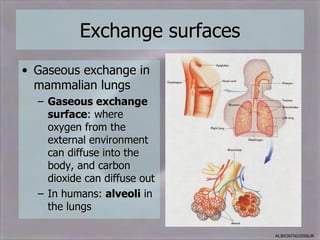
Exchange surfaces
• Gaseous exchange in
  mammalian lungs
  – Gaseous exchange
    surface: where
    oxygen from the
    external environment
    can diffuse into the
    body, and carbon
    dioxide can diffuse out
  – In humans: alveoli in
    the lungs

                              ALBIO9700/2006JK
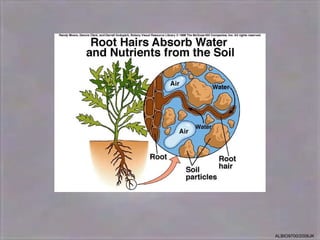
• Uptake of mineral ions in a plant root
  – Specialised exchange surface: root hairs (very thin
    extensions of the cells that make up the outer layer
    or epidermis of a root)
  – Root hairs make contact with thin layer of water
    coating each soil particle and absorbs it by osmosis
  – Lower concentration of solutes in the water in the soil
    than there is inside the root hair cell
  – Water potential higher outside the root hair and
    water moves passively down the water potential
    gradient into the cells
  – Mineral ions also absorbed by facilitated diffusion if
    concentration is higher outside root hair
  – By active transport (carrier proteins and energy)
    when concentration is relatively low in soil
                                                     ALBIO9700/2006JK
ALBIO9700/2006JK

Transport across plasma membrane

  • 1.
    Transport across theplasma membrane ALBIO9700/2006JK
  • 2.
    Diffusion and facilitateddiffusion • Diffusion – the net movement of molecules (or ions) from a region of their higher concentration to a region of their lower concentration (molecules move down a concentration gradient) • Molecules tend to reach an equilibrium where evenly spread • The rate at which substance diffuses across a membrane depends on: – The ‘steepness’ of the concentration gradient. The greater the difference in concentration, the greater the difference in the number of molecules passing in the 2 directions and hence the faster the net rate of diffusion – Temperature. Diffusion takes place faster in high temperatures due to higher kinetic energy – The surface area. The greater the surface area, the more molecules or ions can cross it at any one moment (faster diffusion) – The nature of the molecules or ions. Substances with large molecules tend to diffuse more slowly. Non-polar molecules diffuse more easily through cell membranes as they are soluble in non-polar phospholipid tails ALBIO9700/2006JK
  • 3.
  • 4.
    • Facilitated diffusion– diffusion of a substance through protein channels in a cell membrane • The proteins provide hydrophilic areas that allow the molecules or ions to pass through a membrane that would otherwise be less permeable to them • Rate depends on how many appropriate channels there are in the membrane and on whether they are open or not ALBIO9700/2006JK
  • 5.
  • 6.
    Active transport • Theenergy-consuming transport of molecules or ions across a membrane against a concentration gradient made possible by transferring energy from respiration • Like facilitated diffusion, active transport is achieved by special transport proteins, each of which is specific for a particular type of molecule or ion • However, it requires energy (molecule ATP) because movement occurs up a concentration gradient • Energy used to make the transport protein (carrier protein) change its 3D shape, transferring the molecules or ions across the membrane in the process ALBIO9700/2006JK
  • 7.
  • 8.
    Bulk transport • Transportof large quantities of materials into cells (endocytosis) or out of cells (exocytosis) • Exocytosis – process by which materials are removed from cells • Endocytosis – engulfing of the material by the plasma membrane to form a small sac or ‘endocytotic vacuole’ – Phagocytosis: bulk uptake of solid material – Pinocytosis: bulk uptake of liquid ALBIO9700/2006JK
  • 9.
    Osmosis • Solution =solute + solvent • Partially permeable membrane – membrane which allows only certain molecules through • If solution B has higher concentration of solute molecules than solution A – solution B is more concentrated than solution A/solution A is more dilute than solution B • Osmosis involves net movement of water molecules only ALBIO9700/2006JK
  • 10.
  • 11.
    • Water potentialand solute potential – Water potential: the tendency of water molecules to move from one place to another (psi, ψ) – Water always moves from a region of higher water potential to a region of lower water potential (down concentration gradient) – Osmosis: the movement of water molecules from a region of higher water potential to a region of lower water potential through a partially permeable membrane – Pure water has highest water potential (solutes lower the water potential) – Solute potential: the amount that the solute molecules lower the water potential of a solution. Always –ve (ψs). ALBIO9700/2006JK
  • 12.
    • Osmosis inanimals – If the water potential of the solution surrounding the cell is too high, the cell swells and bursts – If it is too low, the cell shrinks – In animal cells ψ = ψs (water potential is equal to solute potential) • Pressure potential – The greater the pressure applied, the greater the tendency for water molecules to be forced back – Increasing the pressure increases the water potential – Pressure potential: contribution made by pressure to water potential (ψp) – The pressure potential makes the water potential less negative and is therefore positive ALBIO9700/2006JK
  • 13.
  • 14.
    • Osmosis inplant cells – Different from animal cells because of rigid and strong cell wall – Cell wall prevents the cell from bursting (lysis) – When fully inflated with water: turgid – Water potential is a combination of solute potential and pressure potential (ψ = ψs + ψp) – When protoplast shrinks and pulls away from the cell wall: plasmolysis – Incipient plasmolysis: the point at which pressure potential has just reached zero and plasmolysis is about to occur ALBIO9700/2006JK
  • 15.
  • 16.
    Exchange surfaces • Gaseousexchange in mammalian lungs – Gaseous exchange surface: where oxygen from the external environment can diffuse into the body, and carbon dioxide can diffuse out – In humans: alveoli in the lungs ALBIO9700/2006JK
  • 17.
    • Uptake ofmineral ions in a plant root – Specialised exchange surface: root hairs (very thin extensions of the cells that make up the outer layer or epidermis of a root) – Root hairs make contact with thin layer of water coating each soil particle and absorbs it by osmosis – Lower concentration of solutes in the water in the soil than there is inside the root hair cell – Water potential higher outside the root hair and water moves passively down the water potential gradient into the cells – Mineral ions also absorbed by facilitated diffusion if concentration is higher outside root hair – By active transport (carrier proteins and energy) when concentration is relatively low in soil ALBIO9700/2006JK
  • 18.