CELL PHYSIOLOGY
CELL PHYSIOLOGY
 The the processes or functions of the cell
CELL TRANSPORT
2 ways that the molecules move through the
membrane:
1. Active transport requires that the cell use
energy that it has obtained from food to move
the molecules (or larger particles) through the
cell membrane.
2. Passive transport does not require such energy
expenditure, and occurs spontaneously
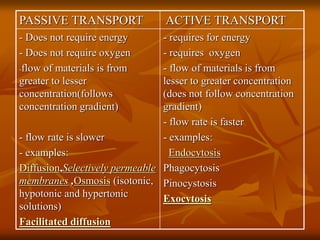
PASSIVE TRANSPORT ACTIVE TRANSPORT
- Does not require energy
- Does not require oxygen
-flow of materials is from
greater to lesser
concentration(follows
concentration gradient)
- flow rate is slower
- examples:
Diffusion,Selectively permeable
membranes ,Osmosis (isotonic,
hypotonic and hypertonic
solutions)
Facilitated diffusion
- requires for energy
- requires oxygen
- flow of materials is from
lesser to greater concentration
(does not follow concentration
gradient)
- flow rate is faster
- examples:
Endocytosis
Phagocytosis
Pinocystosis
Exocytosis
SOLUTION, SOLVENT AND
SOLUTE
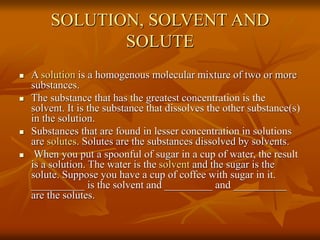
 A solution is a homogenous molecular mixture of two or more
substances.
 The substance that has the greatest concentration is the
solvent. It is the substance that dissolves the other substance(s)
in the solution.
 Substances that are found in lesser concentration in solutions
are solutes. Solutes are the substances dissolved by solvents.
 When you put a spoonful of sugar in a cup of water, the result
is a solution. The water is the solvent and the sugar is the
solute. Suppose you have a cup of coffee with sugar in it.
__________ is the solvent and _________ and __________
are the solutes.
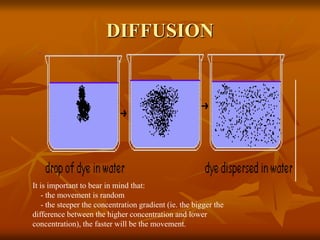
DIFFUSION
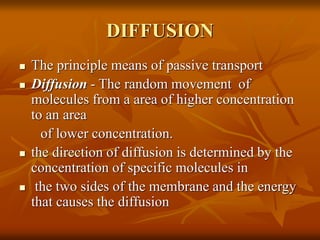
 The principle means of passive transport
 Diffusion - The random movement of
molecules from a area of higher concentration
to an area
of lower concentration.
 the direction of diffusion is determined by the
concentration of specific molecules in
 the two sides of the membrane and the energy
that causes the diffusion
DIFFUSION
It is important to bear in mind that:
- the movement is random
- the steeper the concentration gradient (ie. the bigger the
difference between the higher concentration and lower
concentration), the faster will be the movement.
What factors can influence the rate of
diffusion?
 Temperature.
 The state of the solvent; i.e. whether the solvent is a solid,
liquid or gas.
 The size of the molecules.
 The steepness of the diffusion gradient.
 Permeability
 Size of molecules
 Size of pores
 Solubility
 Electrical charges
 Membrane structure
Property of Diffusion
 The greater the space between these molecules
the greater the ability for the molecular
particles to spread out from one another.
 The more packed the molecules are in the
substance the less space to maneuver, and
therefore, the more difficult for diffusion to
occur.
 Requires diffusion pressure
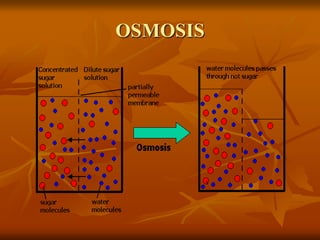
OSMOSIS
 is the movement of water molecules from a region of
their higher concentration to a
 region of their lower concentration, through a
partially permeable membrane
 Water will move by osmosis into and out of cells due
to differences in water potential between the cell and
its surroundings.
 Water potential is the chemical potential of water and
is a measure of the energy available for reaction or
movement.
.
Some Basic Principles of Osmosis
 Water always moves from high water potential to low
water potential.
 Water potential is a measure of the tendency of water
to move from high free energy to lower free energy.
 Distilled water in an open beaker has a water
potential of 0 (zero).
 The addition of solute decreases water potential.
 The addition of pressure increases water potential.
 In cells, water moves by osmosis to areas where
water potential is lower.
 A hypertonic solution has lower water potential.
 A hypotonic solution has higher water potential
OSMOSIS
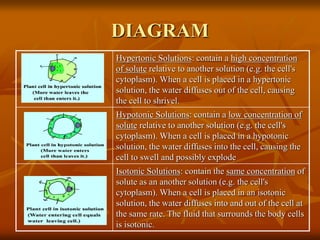
DIAGRAM
Hypertonic Solutions: contain a high concentration
of solute relative to another solution (e.g. the cell's
cytoplasm). When a cell is placed in a hypertonic
solution, the water diffuses out of the cell, causing
the cell to shrivel.
Hypotonic Solutions: contain a low concentration of
solute relative to another solution (e.g. the cell's
cytoplasm). When a cell is placed in a hypotonic
solution, the water diffuses into the cell, causing the
cell to swell and possibly explode
Isotonic Solutions: contain the same concentration of
solute as an another solution (e.g. the cell's
cytoplasm). When a cell is placed in an isotonic
solution, the water diffuses into and out of the cell at
the same rate. The fluid that surrounds the body cells
is isotonic.
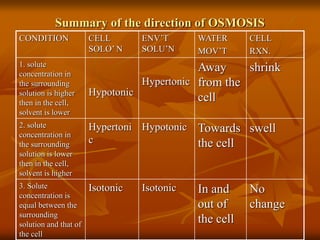
Summary of the direction of OSMOSIS
CONDITION CELL
SOLO’ N
ENV’T
SOLU’N
WATER
MOV’T
CELL
RXN.
1. solute
concentration in
the surrounding
solution is higher
then in the cell,
solvent is lower
Hypotonic
Hypertonic
Away
from the
cell
shrink
2. solute
concentration in
the surrounding
solution is lower
then in the cell,
solvent is higher
Hypertoni
c
Hypotonic Towards
the cell
swell
3. Solute
concentration is
equal between the
surrounding
solution and that of
the cell
Isotonic Isotonic In and
out of
the cell
No
change
ACTIVE TRANSPORT
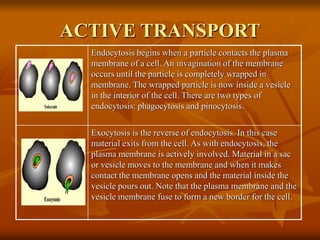
Endocytosis begins when a particle contacts the plasma
membrane of a cell. An invagination of the membrane
occurs until the particle is completely wrapped in
membrane. The wrapped particle is now inside a vesicle
in the interior of the cell. There are two types of
endocytosis: phagocytosis and pinocytosis.
Exocytosis is the reverse of endocytosis. In this case
material exits from the cell. As with endocytosis, the
plasma membrane is actively involved. Material in a sac
or vesicle moves to the membrane and when it makes
contact the membrane opens and the material inside the
vesicle pours out. Note that the plasma membrane and the
vesicle membrane fuse to form a new border for the cell.
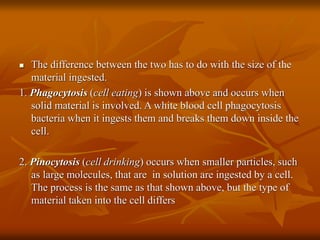
 The difference between the two has to do with the size of the
material ingested.
1. Phagocytosis (cell eating) is shown above and occurs when
solid material is involved. A white blood cell phagocytosis
bacteria when it ingests them and breaks them down inside the
cell.
2. Pinocytosis (cell drinking) occurs when smaller particles, such
as large molecules, that are in solution are ingested by a cell.
The process is the same as that shown above, but the type of
material taken into the cell differs

CELL DRINKING, CELL EATING.ppt

  • 1.
  • 2.
    CELL PHYSIOLOGY  Thethe processes or functions of the cell CELL TRANSPORT 2 ways that the molecules move through the membrane: 1. Active transport requires that the cell use energy that it has obtained from food to move the molecules (or larger particles) through the cell membrane. 2. Passive transport does not require such energy expenditure, and occurs spontaneously
  • 3.
    PASSIVE TRANSPORT ACTIVETRANSPORT - Does not require energy - Does not require oxygen -flow of materials is from greater to lesser concentration(follows concentration gradient) - flow rate is slower - examples: Diffusion,Selectively permeable membranes ,Osmosis (isotonic, hypotonic and hypertonic solutions) Facilitated diffusion - requires for energy - requires oxygen - flow of materials is from lesser to greater concentration (does not follow concentration gradient) - flow rate is faster - examples: Endocytosis Phagocytosis Pinocystosis Exocytosis
  • 4.
    SOLUTION, SOLVENT AND SOLUTE A solution is a homogenous molecular mixture of two or more substances.  The substance that has the greatest concentration is the solvent. It is the substance that dissolves the other substance(s) in the solution.  Substances that are found in lesser concentration in solutions are solutes. Solutes are the substances dissolved by solvents.  When you put a spoonful of sugar in a cup of water, the result is a solution. The water is the solvent and the sugar is the solute. Suppose you have a cup of coffee with sugar in it. __________ is the solvent and _________ and __________ are the solutes.
  • 5.
    DIFFUSION  The principlemeans of passive transport  Diffusion - The random movement of molecules from a area of higher concentration to an area of lower concentration.  the direction of diffusion is determined by the concentration of specific molecules in  the two sides of the membrane and the energy that causes the diffusion
  • 6.
    DIFFUSION It is importantto bear in mind that: - the movement is random - the steeper the concentration gradient (ie. the bigger the difference between the higher concentration and lower concentration), the faster will be the movement.
  • 7.
    What factors caninfluence the rate of diffusion?  Temperature.  The state of the solvent; i.e. whether the solvent is a solid, liquid or gas.  The size of the molecules.  The steepness of the diffusion gradient.  Permeability  Size of molecules  Size of pores  Solubility  Electrical charges  Membrane structure
  • 8.
    Property of Diffusion The greater the space between these molecules the greater the ability for the molecular particles to spread out from one another.  The more packed the molecules are in the substance the less space to maneuver, and therefore, the more difficult for diffusion to occur.  Requires diffusion pressure
  • 9.
    OSMOSIS  is themovement of water molecules from a region of their higher concentration to a  region of their lower concentration, through a partially permeable membrane  Water will move by osmosis into and out of cells due to differences in water potential between the cell and its surroundings.  Water potential is the chemical potential of water and is a measure of the energy available for reaction or movement. .
  • 10.
    Some Basic Principlesof Osmosis  Water always moves from high water potential to low water potential.  Water potential is a measure of the tendency of water to move from high free energy to lower free energy.  Distilled water in an open beaker has a water potential of 0 (zero).  The addition of solute decreases water potential.  The addition of pressure increases water potential.  In cells, water moves by osmosis to areas where water potential is lower.  A hypertonic solution has lower water potential.  A hypotonic solution has higher water potential
  • 11.
  • 12.
    DIAGRAM Hypertonic Solutions: containa high concentration of solute relative to another solution (e.g. the cell's cytoplasm). When a cell is placed in a hypertonic solution, the water diffuses out of the cell, causing the cell to shrivel. Hypotonic Solutions: contain a low concentration of solute relative to another solution (e.g. the cell's cytoplasm). When a cell is placed in a hypotonic solution, the water diffuses into the cell, causing the cell to swell and possibly explode Isotonic Solutions: contain the same concentration of solute as an another solution (e.g. the cell's cytoplasm). When a cell is placed in an isotonic solution, the water diffuses into and out of the cell at the same rate. The fluid that surrounds the body cells is isotonic.
  • 13.
    Summary of thedirection of OSMOSIS CONDITION CELL SOLO’ N ENV’T SOLU’N WATER MOV’T CELL RXN. 1. solute concentration in the surrounding solution is higher then in the cell, solvent is lower Hypotonic Hypertonic Away from the cell shrink 2. solute concentration in the surrounding solution is lower then in the cell, solvent is higher Hypertoni c Hypotonic Towards the cell swell 3. Solute concentration is equal between the surrounding solution and that of the cell Isotonic Isotonic In and out of the cell No change
  • 14.
    ACTIVE TRANSPORT Endocytosis beginswhen a particle contacts the plasma membrane of a cell. An invagination of the membrane occurs until the particle is completely wrapped in membrane. The wrapped particle is now inside a vesicle in the interior of the cell. There are two types of endocytosis: phagocytosis and pinocytosis. Exocytosis is the reverse of endocytosis. In this case material exits from the cell. As with endocytosis, the plasma membrane is actively involved. Material in a sac or vesicle moves to the membrane and when it makes contact the membrane opens and the material inside the vesicle pours out. Note that the plasma membrane and the vesicle membrane fuse to form a new border for the cell.
  • 15.
     The differencebetween the two has to do with the size of the material ingested. 1. Phagocytosis (cell eating) is shown above and occurs when solid material is involved. A white blood cell phagocytosis bacteria when it ingests them and breaks them down inside the cell. 2. Pinocytosis (cell drinking) occurs when smaller particles, such as large molecules, that are in solution are ingested by a cell. The process is the same as that shown above, but the type of material taken into the cell differs