Translation
• Translation is the third stage of protein
biosynthesis after DNA replication and
transcription.
• During translation, (mRNA) produced by
transcription is decoded by the ribosome to
produce a specific amino acid chain, or
polypeptide, that will later fold into an active
protein i.e.
mRNA Protein
• In Bacteria, translation occurs in the cell's
cytoplasm, where the large and small subunits of
the ribosome are located, and bind to the mRNA.
• In Eukaryotes, translation occurs across the
membrane of the endoplasmic reticulum in a
process called vectorial synthesis.
Steps of Translation
(i) Initiation:
• The small subunit of the ribosome binds to a site
"upstream" (on the 5' side) of the start of the
message. It proceeds downstream (5' -> 3') until
it encounters the start codon AUG. (The region
between the cap and the AUG is known as the 5'-
untranslated region (5'-UTR).
• Here it is joined by the large subunit and a
special initiator tRNA.
• The initiator tRNA binds to the P site on
the ribosome.
• In eukaryotes, initiator tRNA carries
methionine (Met) but bacteria use a
modified methionine called formylated
methionine (fMet).
(ii) Chain Elongation:
• An aminoacyl-tRNA (aa-tRNA covalently bound
to its amino acid) able to base pair with the next
codon on the mRNA arrives at the A site
associated with:
– an elongation factor (called EF-Tu in bacteria)
– GTP (is the source energy)
• The first amino acid (Met at the start of
translation) is covalently linked to the second or
incoming amino acid via a peptide bond.
• The initiator tRNA is released from the P
site.
• The ribosome moves one codon
downstream.
• This shifts the more recently-arrived
tRNA, with its attached peptide, to the P
site and opens the A site for the arrival
of a new aminoacyl-tRNA.
• This last step is promoted by another
protein elongation factor (EF-G in
bacteria) and the energy of another
molecule of GTP.
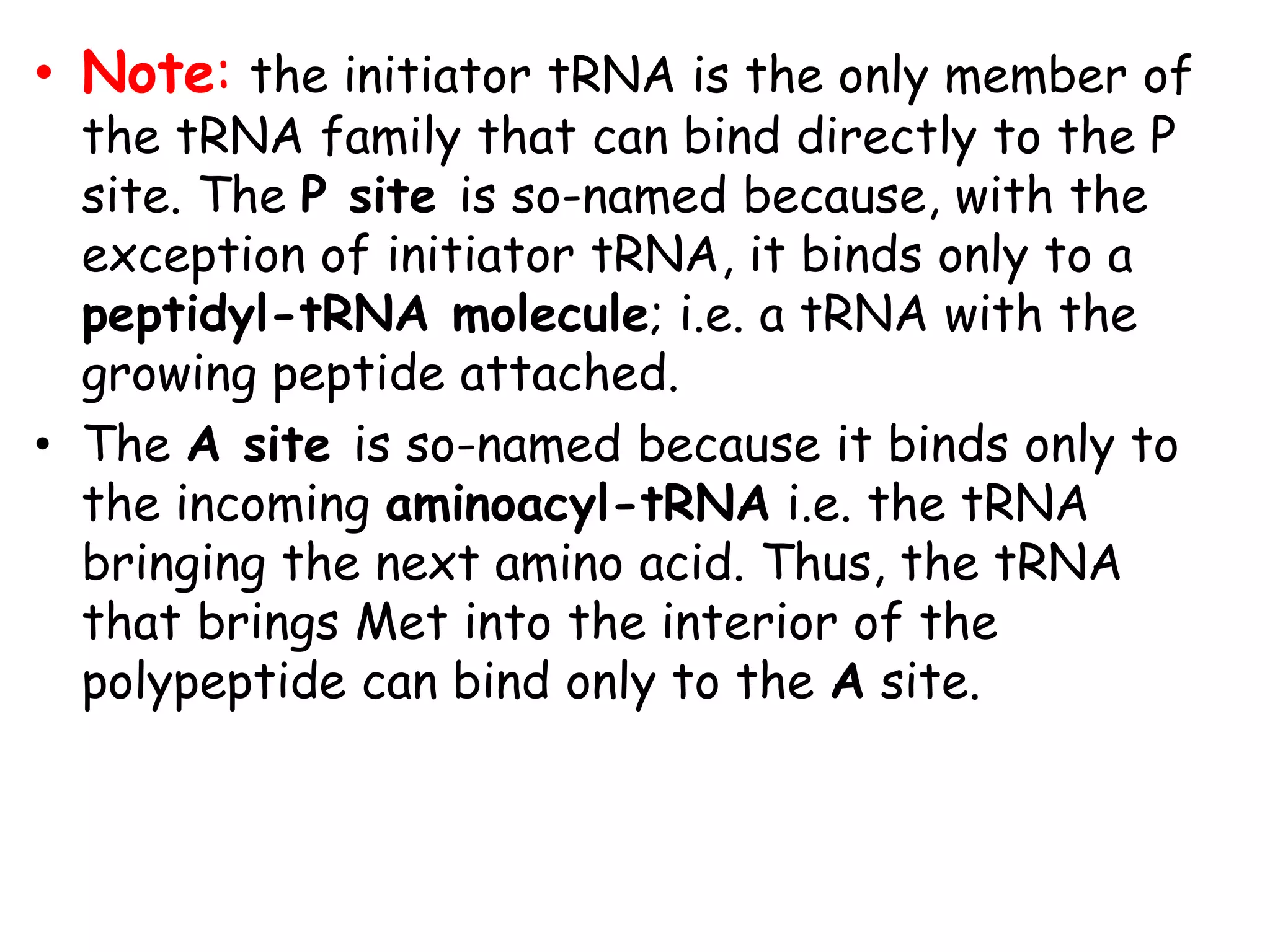
• Note: the initiator tRNA is the only member of
the tRNA family that can bind directly to the P
site. The P site is so-named because, with the
exception of initiator tRNA, it binds only to a
peptidyl-tRNA molecule; i.e. a tRNA with the
growing peptide attached.
• The A site is so-named because it binds only to
the incoming aminoacyl-tRNA i.e. the tRNA
bringing the next amino acid. Thus, the tRNA
that brings Met into the interior of the
polypeptide can bind only to the A site.
(iii) Termination:
• The end of translation occurs when the ribosome
reaches one or more STOP codons (UAA, UAG,
UGA). (The nucleotides from this point to the
poly(A) tail make up the 3'-untranslated region
[3'-UTR] of the mRNA.)
• There are no tRNA molecules with anticodons
for STOP codons. (With a few special
exceptions: to mitochondrial genes and to non-
standard amino acids.)
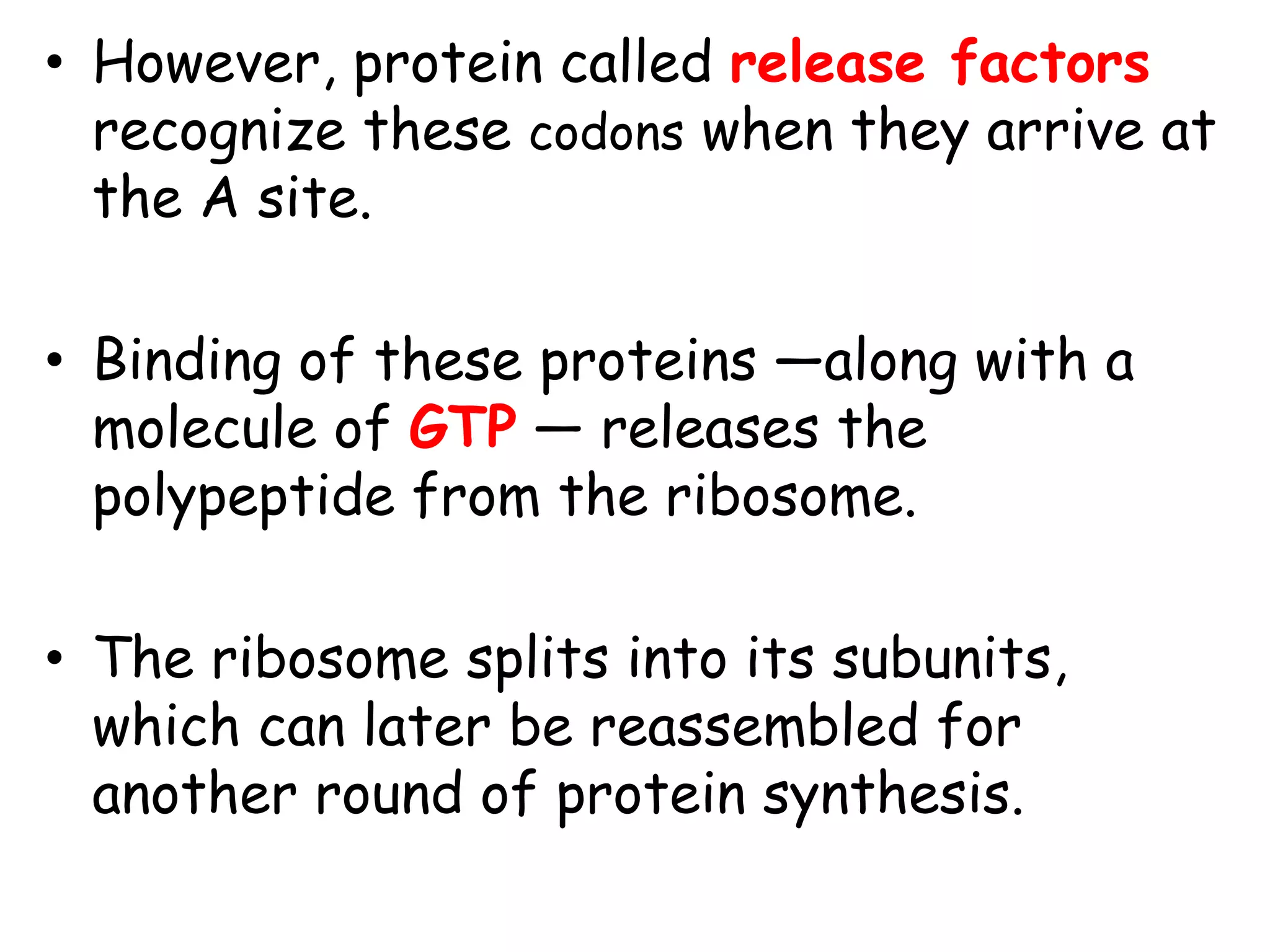
• However, protein called release factors
recognize these codons when they arrive at
the A site.
• Binding of these proteins —along with a
molecule of GTP — releases the
polypeptide from the ribosome.
• The ribosome splits into its subunits,
which can later be reassembled for
another round of protein synthesis.
Protein Synthesis
This is a molecule of messenger RNA.
It was made in the nucleus by
transcription from a DNA molecule.
A U G G G C U U A A A G C A G U G C A C G U U
mRNA molecule
codon
A U G G G C U U A A A G C A G U G C A C G U U
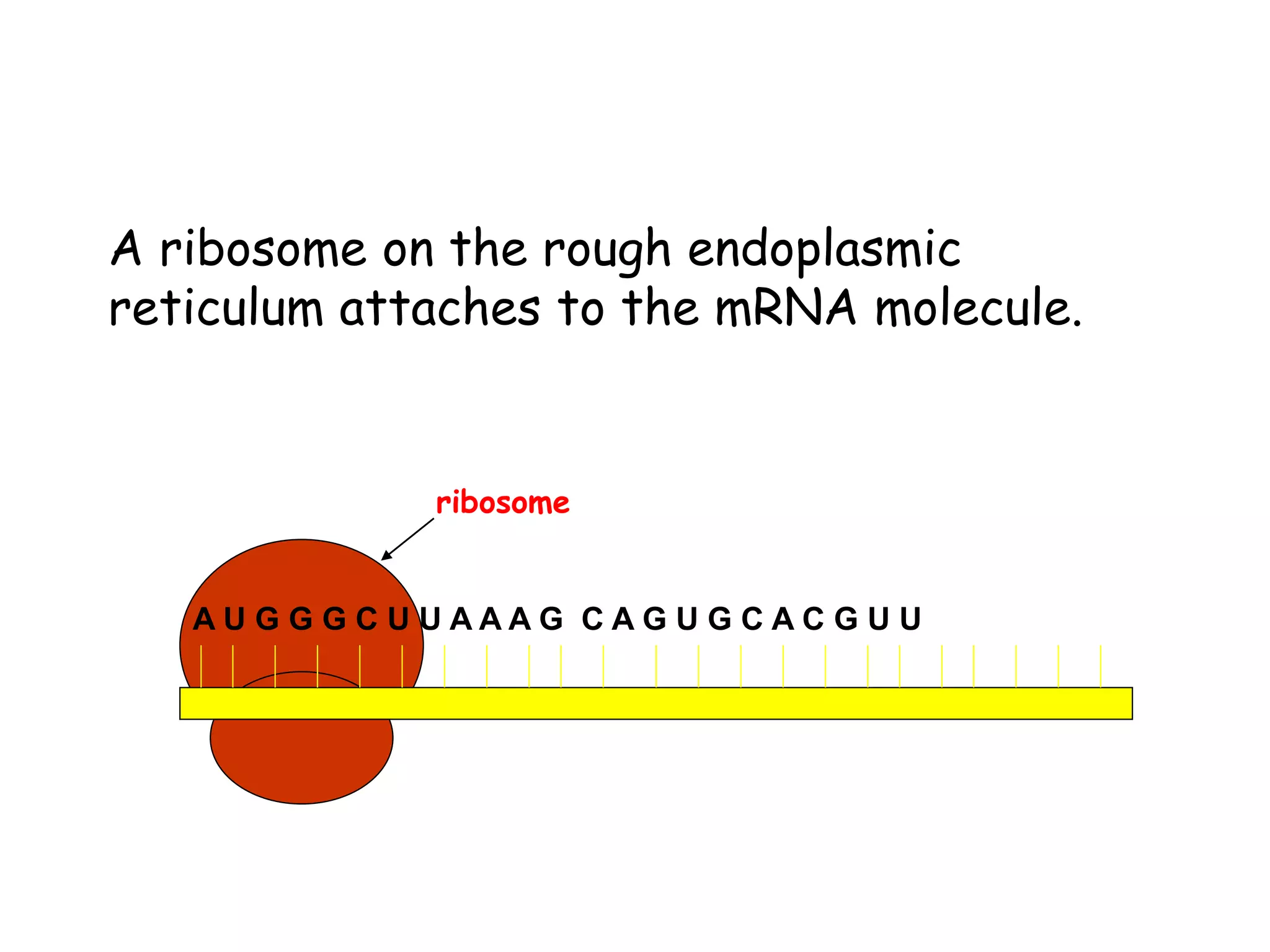
A ribosome on the rough endoplasmic
reticulum attaches to the mRNA molecule.
ribosome
A U G G G C U U A A A G C A G U G C A C G U U
It brings an amino acid to the first three
bases (codon) on the mRNA.
Amino acid
tRNA molecule
anticodon
U A C
A transfer RNA molecule arrives.
The three unpaired bases (anticodon) on the
tRNA link up with the codon.
A U G G G C U U A A A G C A G U G C A C G U U
Another tRNA molecule comes into place,
bringing a second amino acid.
U A C
Its anticodon links up with the second codon
on the mRNA.
A U G G G C U U A A A G C A G U G C A C G U U
A peptide bond forms between the two
amino acids.
Peptide bond
A U G G G C U U A A A G C A G U G C A C G U U
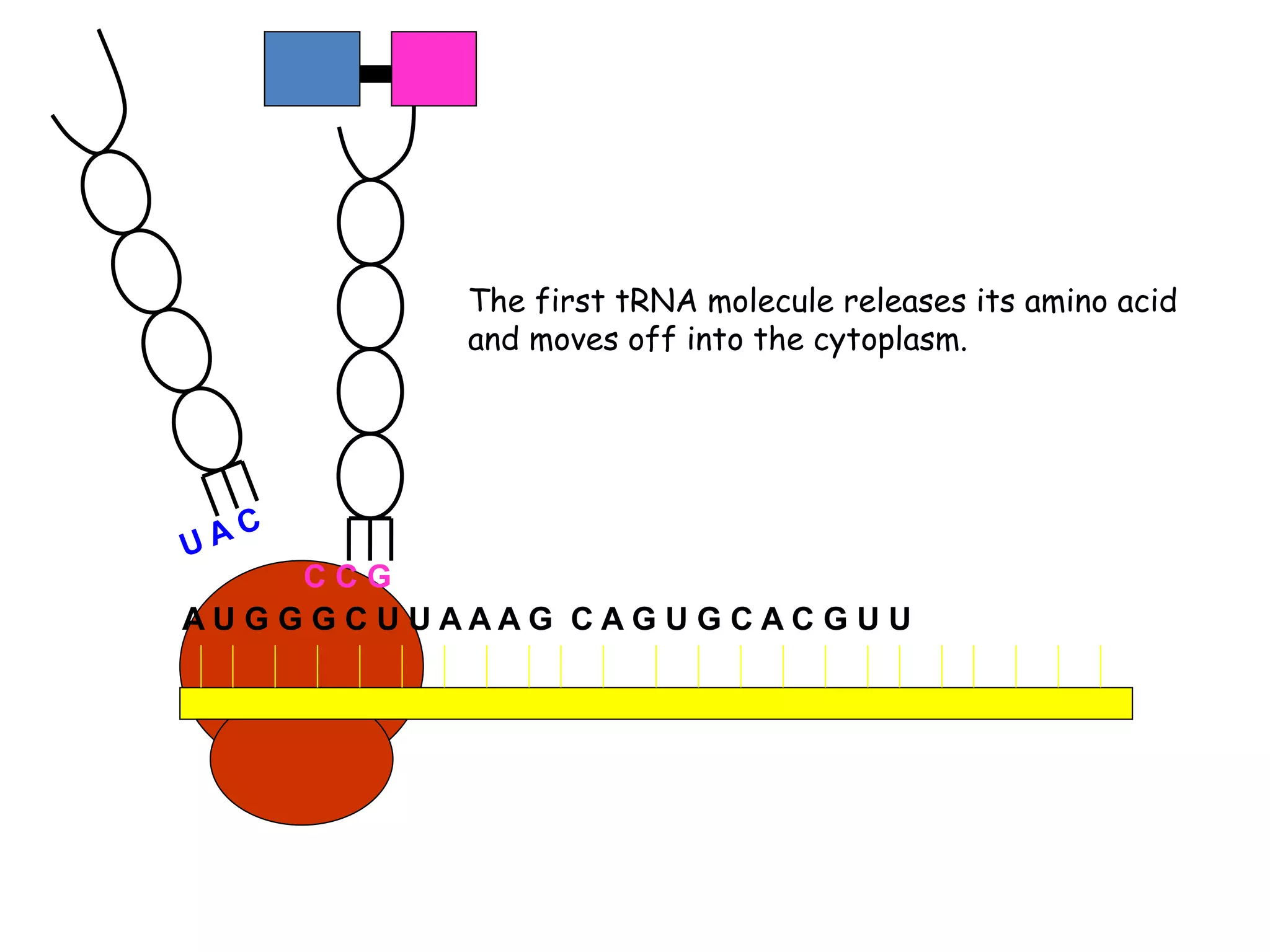
The first tRNA molecule releases its amino acid
and moves off into the cytoplasm.
A U G G G C U U A A A G C A G U G C A C G U U
The ribosome moves along the mRNA to the
next codon.
A U G G G C U U A A A G C A G U G C A C G U U
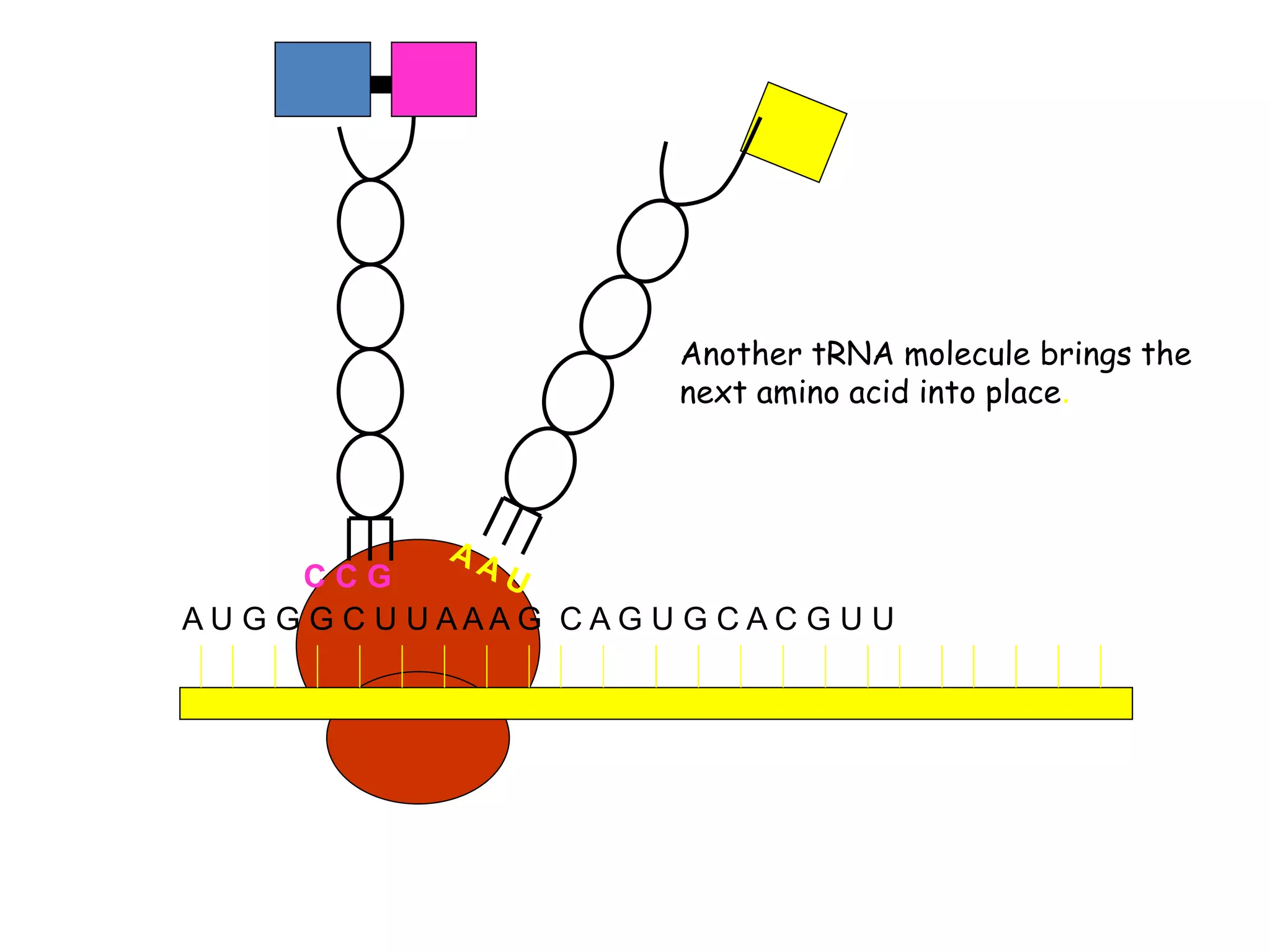
Another tRNA molecule brings the
next amino acid into place.
A U G G G C U U A A A G C A G U G C A C G U U
A peptide bond joins the second and
third amino acids to form a polypeptide
chain.
A U G G G C U U A A A G C A G U G C A C G U U
The polypeptide chain gets longer.
The process continues.
This continues until a termination (stop)
codon is reached.
The polypeptide is then complete.
Protein synthesis
STEP 1: Transcription
The first step in protein synthesis is the
transcription of mRNA from a DNA gene in the
nucleus. (DNA mRNA).
• At some other prior time, the various other
types of RNA (e.g. tRNA, rRNA etc.) have been
synthesized using the appropriate DNA. These
RNAs migrate from the nucleus into the
cytoplasm to participate in process of protein
synthesis.
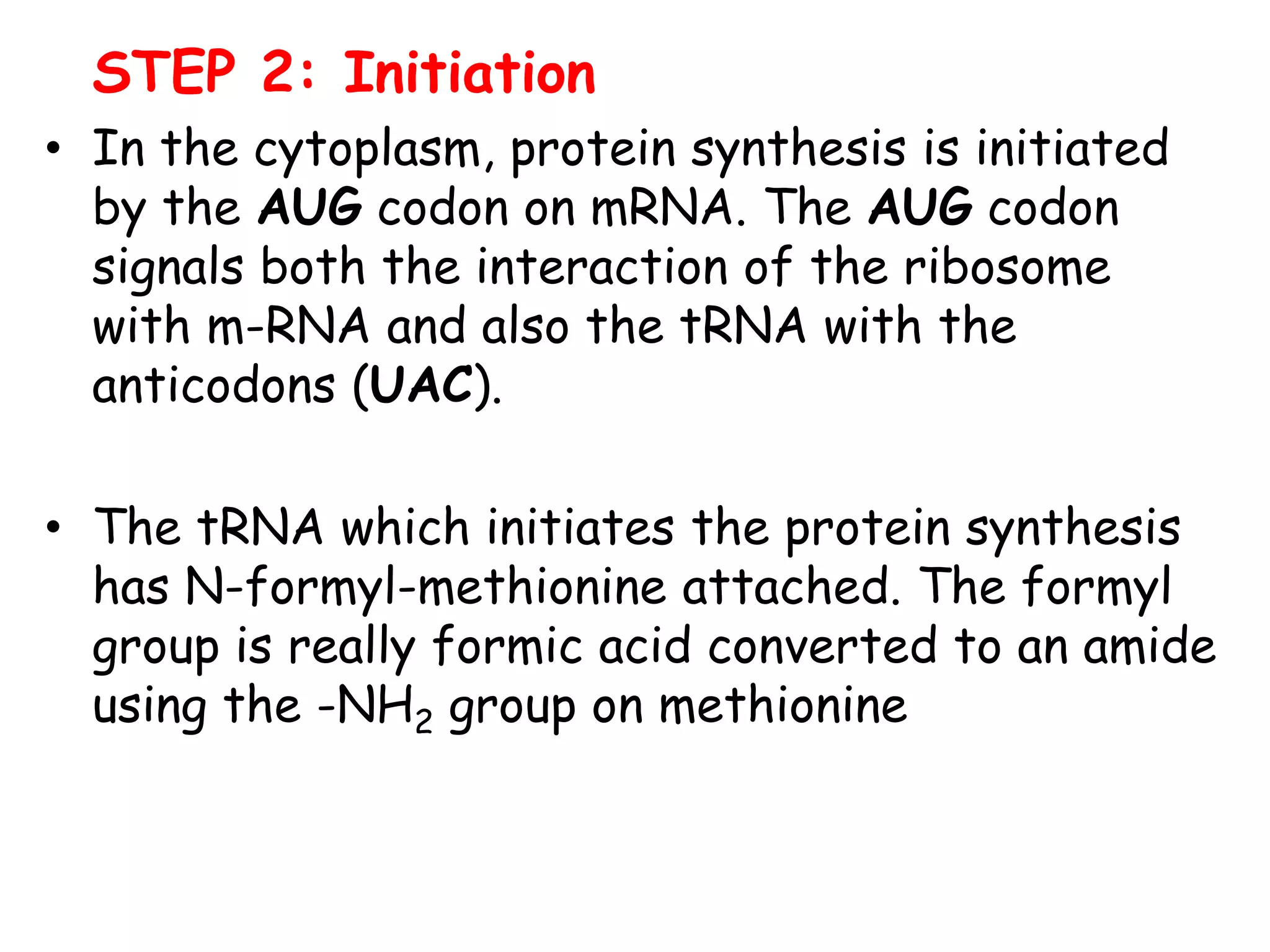
STEP 2: Initiation
• In the cytoplasm, protein synthesis is initiated
by the AUG codon on mRNA. The AUG codon
signals both the interaction of the ribosome
with m-RNA and also the tRNA with the
anticodons (UAC).
• The tRNA which initiates the protein synthesis
has N-formyl-methionine attached. The formyl
group is really formic acid converted to an amide
using the -NH2 group on methionine
STEP 3: Elongation
• The next step is for a second tRNA to
approach the mRNA (codon -CCG), the
code for proline. The anticodon of the
proline tRNA which reads this is GGC.
• The final process is to start growing
peptide chain by forming a bond between
the amino group of proline and the
carboxyl acid group of methinone (met) in
order to elongate the peptide chain.
STEP 4: Termination
• Translation ends when the ribosome reaches one
or more STOP codons (UAA, UAG, UGA). (The
nucleotides from this point to the poly(A) tail
make up the 3'-untranslated region [3'-UTR] of
the mRNA.)
• There are no tRNAs with anticodons for STOP
codons. However, protein release factors
recognize these codons when they arrive at the
A site.
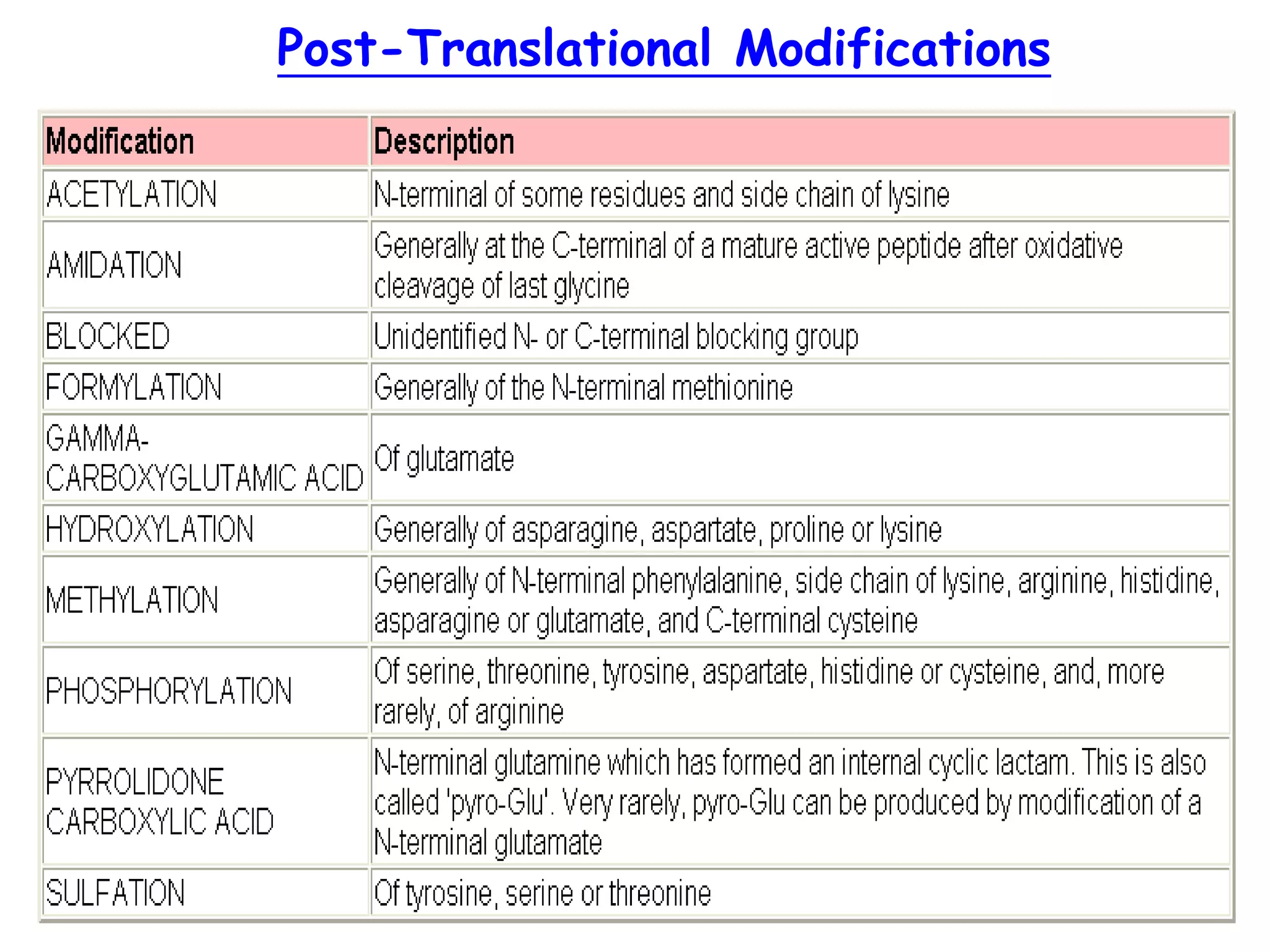
Post-Translational Modifications
Glycosylation: O- linked oligosaccharides bound to Ser and Thr; N –
linked oligosaccharide bound to Asp Varies with number of sugar
moieties; up to several thousands
Phosphorylation: Ser, Thr and Tyr, a phosphoester is formed, typical
modification of allosteric proteins involved in regulation (signal
transduction)
Sulfation: Addition of sulfate to Arg and Tyr, a C-O-SO3 bond
Amidation: Addition of -NH2 to C-terminus
Acetylation: Addition of CH3 CO- to N- or C-terminus
Hydroxylation: Addition of -OH to Lys, Pro and Phe
Cyclization: Formation of Pyroglutamate at N - terminal Glu.
Complexation of metals: Cys-CH2-S-Fe complexes in Ferrodoxins.
Selenium - complexes with Cys and Met, Copper - complexes with
backbone of peptide bond.
Halogenation: Iodination and bromination of Tyr (3-chloro, 3-bromo)
Desmosin formation: Desmosin is formed by condensation of Lys,
frequent in Elastin
γ–Carboxylation: In prothrombin and blood coagulation factor VII
Hydroxyproline: Hydroxyproline formation in collagen responsible for
mechanical stability
Adenylation: Tyr residue of glutamine synthetase is adenylated 209
Methylation: Addition of methyl group to Asp, Gln, His, Lys und Arg of
flagella protein.
Deamidation: Asn und Gln are susceptible; both biological and
processing deamidation are observed
Summary on Transcription
• Transcription occurs in nucleus.
• RNA polymerase is the enzyme that reads the
DNA and creates the RNA intermediary.
• Transcription requires: DNA, RNA polymerase,
ribonucleotides, and some ATP for energy.
• Uracil (U) is substituted for thymine (T) in RNA.
• Transcription initiation is the main point of
regulation of gene expression.
DNA, RNA, Protein
• DNA is long-term storage. It is stable, packaged,
and inert.
•
• RNA is short-term storage. It is unstable and
lacks secondary structure. Some RNA has
enzymatic activity.
• Proteins are the 'programs' of the cells. They
are the physical manifestations of the abstract
information recorded in the genome.
Inhibitors of Translation
• Many of the antibiotics utilized for the
treatment of bacterial infections as well as
certain toxins act through the inhibition of
translation. Inhibition can be effected at all
stages of translation from initiation to elongation
to termination.
Example: some
• Chloramphenicol -inhibits peptidyltransferase in prokaryotes
• Streptomycin -inhibits peptide chain initiation in prokarotes
• Tetracycline -inhibits amino acyl-tRNA binding to ribosome small
subunit.
• Neomycin -as in streptomycin
• Erythromycin -inhibits translocation of ribosome large subunit in
prokarotes
• Fusidic acid-similar to erytromycin by preventing EFG
dissociating from large subunit
• Puromycin-resemble aminoacyl- tRNA, interferes with peptide transfer
resulting in premature termination in both prokaryotes and eukaryotes
• Ricin- found in castor beans, catalyzes cleavage of the eukaryotic
large subunit rRNA
• Cycloheximide- inhibits eukaryotic peptidyltransferase
Common antibiotics that inhibit translation

Protein synthesis 2022.pdf

  • 1.
    Translation • Translation isthe third stage of protein biosynthesis after DNA replication and transcription. • During translation, (mRNA) produced by transcription is decoded by the ribosome to produce a specific amino acid chain, or polypeptide, that will later fold into an active protein i.e. mRNA Protein
  • 2.
    • In Bacteria,translation occurs in the cell's cytoplasm, where the large and small subunits of the ribosome are located, and bind to the mRNA. • In Eukaryotes, translation occurs across the membrane of the endoplasmic reticulum in a process called vectorial synthesis.
  • 3.
    Steps of Translation (i)Initiation: • The small subunit of the ribosome binds to a site "upstream" (on the 5' side) of the start of the message. It proceeds downstream (5' -> 3') until it encounters the start codon AUG. (The region between the cap and the AUG is known as the 5'- untranslated region (5'-UTR). • Here it is joined by the large subunit and a special initiator tRNA.
  • 4.
    • The initiatortRNA binds to the P site on the ribosome. • In eukaryotes, initiator tRNA carries methionine (Met) but bacteria use a modified methionine called formylated methionine (fMet).
  • 5.
    (ii) Chain Elongation: •An aminoacyl-tRNA (aa-tRNA covalently bound to its amino acid) able to base pair with the next codon on the mRNA arrives at the A site associated with: – an elongation factor (called EF-Tu in bacteria) – GTP (is the source energy) • The first amino acid (Met at the start of translation) is covalently linked to the second or incoming amino acid via a peptide bond.
  • 6.
    • The initiatortRNA is released from the P site. • The ribosome moves one codon downstream. • This shifts the more recently-arrived tRNA, with its attached peptide, to the P site and opens the A site for the arrival of a new aminoacyl-tRNA. • This last step is promoted by another protein elongation factor (EF-G in bacteria) and the energy of another molecule of GTP.
  • 7.
    • Note: theinitiator tRNA is the only member of the tRNA family that can bind directly to the P site. The P site is so-named because, with the exception of initiator tRNA, it binds only to a peptidyl-tRNA molecule; i.e. a tRNA with the growing peptide attached. • The A site is so-named because it binds only to the incoming aminoacyl-tRNA i.e. the tRNA bringing the next amino acid. Thus, the tRNA that brings Met into the interior of the polypeptide can bind only to the A site.
  • 8.
    (iii) Termination: • Theend of translation occurs when the ribosome reaches one or more STOP codons (UAA, UAG, UGA). (The nucleotides from this point to the poly(A) tail make up the 3'-untranslated region [3'-UTR] of the mRNA.) • There are no tRNA molecules with anticodons for STOP codons. (With a few special exceptions: to mitochondrial genes and to non- standard amino acids.)
  • 9.
    • However, proteincalled release factors recognize these codons when they arrive at the A site. • Binding of these proteins —along with a molecule of GTP — releases the polypeptide from the ribosome. • The ribosome splits into its subunits, which can later be reassembled for another round of protein synthesis.
  • 10.
  • 11.
    This is amolecule of messenger RNA. It was made in the nucleus by transcription from a DNA molecule. A U G G G C U U A A A G C A G U G C A C G U U mRNA molecule codon
  • 12.
    A U GG G C U U A A A G C A G U G C A C G U U A ribosome on the rough endoplasmic reticulum attaches to the mRNA molecule. ribosome
  • 13.
    A U GG G C U U A A A G C A G U G C A C G U U It brings an amino acid to the first three bases (codon) on the mRNA. Amino acid tRNA molecule anticodon U A C A transfer RNA molecule arrives. The three unpaired bases (anticodon) on the tRNA link up with the codon.
  • 14.
    A U GG G C U U A A A G C A G U G C A C G U U Another tRNA molecule comes into place, bringing a second amino acid. U A C Its anticodon links up with the second codon on the mRNA.
  • 15.
    A U GG G C U U A A A G C A G U G C A C G U U A peptide bond forms between the two amino acids. Peptide bond
  • 16.
    A U GG G C U U A A A G C A G U G C A C G U U The first tRNA molecule releases its amino acid and moves off into the cytoplasm.
  • 17.
    A U GG G C U U A A A G C A G U G C A C G U U The ribosome moves along the mRNA to the next codon.
  • 18.
    A U GG G C U U A A A G C A G U G C A C G U U Another tRNA molecule brings the next amino acid into place.
  • 19.
    A U GG G C U U A A A G C A G U G C A C G U U A peptide bond joins the second and third amino acids to form a polypeptide chain.
  • 20.
    A U GG G C U U A A A G C A G U G C A C G U U The polypeptide chain gets longer. The process continues. This continues until a termination (stop) codon is reached. The polypeptide is then complete.
  • 21.
    Protein synthesis STEP 1:Transcription The first step in protein synthesis is the transcription of mRNA from a DNA gene in the nucleus. (DNA mRNA). • At some other prior time, the various other types of RNA (e.g. tRNA, rRNA etc.) have been synthesized using the appropriate DNA. These RNAs migrate from the nucleus into the cytoplasm to participate in process of protein synthesis.
  • 22.
    STEP 2: Initiation •In the cytoplasm, protein synthesis is initiated by the AUG codon on mRNA. The AUG codon signals both the interaction of the ribosome with m-RNA and also the tRNA with the anticodons (UAC). • The tRNA which initiates the protein synthesis has N-formyl-methionine attached. The formyl group is really formic acid converted to an amide using the -NH2 group on methionine
  • 23.
    STEP 3: Elongation •The next step is for a second tRNA to approach the mRNA (codon -CCG), the code for proline. The anticodon of the proline tRNA which reads this is GGC. • The final process is to start growing peptide chain by forming a bond between the amino group of proline and the carboxyl acid group of methinone (met) in order to elongate the peptide chain.
  • 24.
    STEP 4: Termination •Translation ends when the ribosome reaches one or more STOP codons (UAA, UAG, UGA). (The nucleotides from this point to the poly(A) tail make up the 3'-untranslated region [3'-UTR] of the mRNA.) • There are no tRNAs with anticodons for STOP codons. However, protein release factors recognize these codons when they arrive at the A site.
  • 25.
  • 26.
    Glycosylation: O- linkedoligosaccharides bound to Ser and Thr; N – linked oligosaccharide bound to Asp Varies with number of sugar moieties; up to several thousands Phosphorylation: Ser, Thr and Tyr, a phosphoester is formed, typical modification of allosteric proteins involved in regulation (signal transduction) Sulfation: Addition of sulfate to Arg and Tyr, a C-O-SO3 bond Amidation: Addition of -NH2 to C-terminus Acetylation: Addition of CH3 CO- to N- or C-terminus Hydroxylation: Addition of -OH to Lys, Pro and Phe Cyclization: Formation of Pyroglutamate at N - terminal Glu. Complexation of metals: Cys-CH2-S-Fe complexes in Ferrodoxins. Selenium - complexes with Cys and Met, Copper - complexes with backbone of peptide bond.
  • 27.
    Halogenation: Iodination andbromination of Tyr (3-chloro, 3-bromo) Desmosin formation: Desmosin is formed by condensation of Lys, frequent in Elastin γ–Carboxylation: In prothrombin and blood coagulation factor VII Hydroxyproline: Hydroxyproline formation in collagen responsible for mechanical stability Adenylation: Tyr residue of glutamine synthetase is adenylated 209 Methylation: Addition of methyl group to Asp, Gln, His, Lys und Arg of flagella protein. Deamidation: Asn und Gln are susceptible; both biological and processing deamidation are observed
  • 28.
    Summary on Transcription •Transcription occurs in nucleus. • RNA polymerase is the enzyme that reads the DNA and creates the RNA intermediary. • Transcription requires: DNA, RNA polymerase, ribonucleotides, and some ATP for energy. • Uracil (U) is substituted for thymine (T) in RNA. • Transcription initiation is the main point of regulation of gene expression.
  • 29.
    DNA, RNA, Protein •DNA is long-term storage. It is stable, packaged, and inert. • • RNA is short-term storage. It is unstable and lacks secondary structure. Some RNA has enzymatic activity. • Proteins are the 'programs' of the cells. They are the physical manifestations of the abstract information recorded in the genome.
  • 30.
    Inhibitors of Translation •Many of the antibiotics utilized for the treatment of bacterial infections as well as certain toxins act through the inhibition of translation. Inhibition can be effected at all stages of translation from initiation to elongation to termination. Example: some
  • 31.
    • Chloramphenicol -inhibitspeptidyltransferase in prokaryotes • Streptomycin -inhibits peptide chain initiation in prokarotes • Tetracycline -inhibits amino acyl-tRNA binding to ribosome small subunit. • Neomycin -as in streptomycin • Erythromycin -inhibits translocation of ribosome large subunit in prokarotes • Fusidic acid-similar to erytromycin by preventing EFG dissociating from large subunit • Puromycin-resemble aminoacyl- tRNA, interferes with peptide transfer resulting in premature termination in both prokaryotes and eukaryotes • Ricin- found in castor beans, catalyzes cleavage of the eukaryotic large subunit rRNA • Cycloheximide- inhibits eukaryotic peptidyltransferase Common antibiotics that inhibit translation