DRUG PROTEIN INTERACTIONS
SUBJECT : MEDICAL BIOTECHNOLOGY
BY –
S. DASH
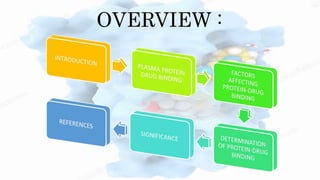
OVERVIEW :
INTRODUCTION
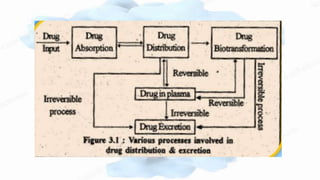
• The binding of drugs with proteins in the blood stream is an
important process in determining the eventual activity, and fate
of such drugs once they have entered the circulation.
• These interactions, in turn, help control the distribution, rate of
excretion, and toxicity of drugs in the body.
• Protein-binding may affect drug activity in one of the two ways :
i. By changing the effective concentration of the drug at its site of
action
ii. Changing the rate at which the drug is eliminated, thus affecting
the length of time for which effective concentrations are
• A drug in a body can interact with several tissue components in
which two major categories are :
 Blood Components
i. Plasma Protein
ii. Blood Cell
 Extravascular Tissue
i. Liver
ii. Kidney
iii. Bones
• The drugs generally interact with biomolecules such as protein, DNA
etc., but protein-drug interactions are found in abundance in the
human body.
• The phenomenon of complex formation with protein is called protein-
drug binding.
• The drug-protein interactions are mainly of two types :
 Intracellular binding
Drugs bind to cell protein.
 Extracellular binding
Drugs bind to extracellular protein.
• Binding of drugs to proteins is generally either reversible or
• Reversible drug-protein binding usually involves weak chemical
bond such as :
i. Hydrogen bonds
ii. Hydrophobic bonds
iii. Vander waal’s forces
iv. Ionic bonds
• Irreversible drug-protein binding though rare, arises as a result of
covalent binding and is often a reason for carcinogenicity or
tissue toxicity by the drug.
PLASMA PROTEIN-DRUG BINDING
• The main interaction of drug in the blood compartment is with the plasma
protein which are present in abundant amounts and in large variety. This is
reversible in nature.
• The extent or order of binding of drug to plasma protein is :-
Albumin > α-1 Acid glycoprotein > Lipoproteins >
Globulins
 TYPES :
i. BINDING OF DRUG TO HUMAN SERUM ALBUMIN (HAS)
ii. BINDING OF DRUG TO α-1 ACID GLYCOPROTEIN
iii. BINDING OF DRUG TO LIPOPROTEINS
iv. BINDING OF DRUG TO GLOBULINS
 BINDING OF DRUG TO HUMAN SERUM ALBUMIN (HAS)
• It is the most abundant plasma protein, having a molecular weight of 65,000
with a large binding capacity.
• Four different site on Albumin have been identifies for drug-binding.
Site-1 : Warfarin and azapropazone binding site.
Site-2 : Diazepam binding site
Site-3 : Digitoxin binding site
Site-4 : Tamoxifen binding site
 BINDING OF DRUG TO α-1 ACID GLYCOPROTEIN
• It has molecular weight of 44,000 Daltons and plasma concentration range
of 0.04 g% to 0.1g%.
• It binds to number of basic drugs like imipramine, lidocaine, propranolol,
quinidine.
 BINDING OF DRUG TO LIPOPROTEINS
• Lipoproteins are amphiphilic in nature. It contains combination of lipid and apoproteins.
• The lipophilic lipid consist of triglycerides and cholesteryl esters and hydrophilic apoprotein
consists of free cholesterol and proteins.
 BINDING OF DRUG TO GLOBULINS
• It mainly binds to endogenous substances. In plasma, several globulins have been
identified.
 α -1 Globulin (Transcortin)
Corticosteroid binding globulins
 α -2 Globulin (Ceruloplasmin)
It binds to Vitamin-A, D, E, K and cupric ions.
 β -1 Globulin
It binds to ferrous ions
 β-2 Globulin
Binds to carotenoids.
 γ-Globulin
Binds specifically to antigens
FACTORS AFFECTING PROTEIN-
DRUG BINDING
 DRUG RELATED FACTORS
 Physio-chemical characteristics of drug
• Protein binding is directly related to the lipophilicity and stereo selectivity of
drug.
 Concentration of drug in the body.
• The extent of protein-drug binding can change with both changes in drug
as well as protein concentration.
 Affinity of a drug for a particular binding component
• Drug having their own higher specific protein binding site.
 PROTEIN/TISSUE RELATED FACTORS
 Physiochemical characteristics of protein or binding agent.
• Lipoproteins and adipose tissue tend to bind lipophilic drug by dissolving
them in their lipid core. The physiological pH determines the presence of
active anionic and cationic groups of drugs to bind on the albumin.
 Concentration of protein or binding component.
• The amount of several proteins and tissue components available for
binding, changes during disease state.
 Number of binding sites on the binding agent.
• Albumin has a large number of the binding sites as compared to other
proteins and is a high capacity binding component.
 DETERMINATION OF PROTEIN-DRUG
BINDING
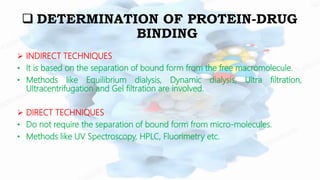
 INDIRECT TECHNIQUES
• It is based on the separation of bound form from the free macromolecule.
• Methods like Equilibrium dialysis, Dynamic dialysis, Ultra filtration,
Ultracentrifugation and Gel filtration are involved.
 DIRECT TECHNIQUES
• Do not require the separation of bound form from micro-molecules.
• Methods like UV Spectroscopy, HPLC, Fluorimetry etc.
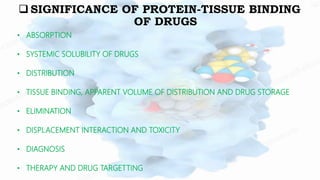
 SIGNIFICANCE OF PROTEIN-TISSUE BINDING
OF DRUGS
• ABSORPTION
• SYSTEMIC SOLUBILITY OF DRUGS
• DISTRIBUTION
• TISSUE BINDING, APPARENT VOLUME OF DISTRIBUTION AND DRUG STORAGE
• ELIMINATION
• DISPLACEMENT INTERACTION AND TOXICITY
• DIAGNOSIS
• THERAPY AND DRUG TARGETTING
REFERENCES
• Brahmankar D.M. , Jaiswal S.B. (2009) Biopharmaceutics and
pharmacokinetics : A treatise (Edition-II)
• Tripathi K.D. Essential of Medical Pharmacology (Edition-VI)
• Barar F.S.K. Essential of Pharmacotherapeutics (Edition-V)
• Madan P
.L. Biopharmaceutics and Pharmacokinetics (Edition-
I)
THANK YOU

Drug protein interactions

  • 1.
    DRUG PROTEIN INTERACTIONS SUBJECT: MEDICAL BIOTECHNOLOGY BY – S. DASH
  • 2.
  • 3.
    INTRODUCTION • The bindingof drugs with proteins in the blood stream is an important process in determining the eventual activity, and fate of such drugs once they have entered the circulation. • These interactions, in turn, help control the distribution, rate of excretion, and toxicity of drugs in the body. • Protein-binding may affect drug activity in one of the two ways : i. By changing the effective concentration of the drug at its site of action ii. Changing the rate at which the drug is eliminated, thus affecting the length of time for which effective concentrations are
  • 4.
    • A drugin a body can interact with several tissue components in which two major categories are :  Blood Components i. Plasma Protein ii. Blood Cell  Extravascular Tissue i. Liver ii. Kidney iii. Bones
  • 5.
    • The drugsgenerally interact with biomolecules such as protein, DNA etc., but protein-drug interactions are found in abundance in the human body. • The phenomenon of complex formation with protein is called protein- drug binding. • The drug-protein interactions are mainly of two types :  Intracellular binding Drugs bind to cell protein.  Extracellular binding Drugs bind to extracellular protein. • Binding of drugs to proteins is generally either reversible or
  • 6.
    • Reversible drug-proteinbinding usually involves weak chemical bond such as : i. Hydrogen bonds ii. Hydrophobic bonds iii. Vander waal’s forces iv. Ionic bonds • Irreversible drug-protein binding though rare, arises as a result of covalent binding and is often a reason for carcinogenicity or tissue toxicity by the drug.
  • 7.
    PLASMA PROTEIN-DRUG BINDING •The main interaction of drug in the blood compartment is with the plasma protein which are present in abundant amounts and in large variety. This is reversible in nature. • The extent or order of binding of drug to plasma protein is :- Albumin > α-1 Acid glycoprotein > Lipoproteins > Globulins  TYPES : i. BINDING OF DRUG TO HUMAN SERUM ALBUMIN (HAS) ii. BINDING OF DRUG TO α-1 ACID GLYCOPROTEIN iii. BINDING OF DRUG TO LIPOPROTEINS iv. BINDING OF DRUG TO GLOBULINS
  • 8.
     BINDING OFDRUG TO HUMAN SERUM ALBUMIN (HAS) • It is the most abundant plasma protein, having a molecular weight of 65,000 with a large binding capacity. • Four different site on Albumin have been identifies for drug-binding. Site-1 : Warfarin and azapropazone binding site. Site-2 : Diazepam binding site Site-3 : Digitoxin binding site Site-4 : Tamoxifen binding site  BINDING OF DRUG TO α-1 ACID GLYCOPROTEIN • It has molecular weight of 44,000 Daltons and plasma concentration range of 0.04 g% to 0.1g%. • It binds to number of basic drugs like imipramine, lidocaine, propranolol, quinidine.
  • 9.
     BINDING OFDRUG TO LIPOPROTEINS • Lipoproteins are amphiphilic in nature. It contains combination of lipid and apoproteins. • The lipophilic lipid consist of triglycerides and cholesteryl esters and hydrophilic apoprotein consists of free cholesterol and proteins.  BINDING OF DRUG TO GLOBULINS • It mainly binds to endogenous substances. In plasma, several globulins have been identified.  α -1 Globulin (Transcortin) Corticosteroid binding globulins  α -2 Globulin (Ceruloplasmin) It binds to Vitamin-A, D, E, K and cupric ions.  β -1 Globulin It binds to ferrous ions  β-2 Globulin Binds to carotenoids.  γ-Globulin Binds specifically to antigens
  • 10.
    FACTORS AFFECTING PROTEIN- DRUGBINDING  DRUG RELATED FACTORS  Physio-chemical characteristics of drug • Protein binding is directly related to the lipophilicity and stereo selectivity of drug.  Concentration of drug in the body. • The extent of protein-drug binding can change with both changes in drug as well as protein concentration.  Affinity of a drug for a particular binding component • Drug having their own higher specific protein binding site.
  • 11.
     PROTEIN/TISSUE RELATEDFACTORS  Physiochemical characteristics of protein or binding agent. • Lipoproteins and adipose tissue tend to bind lipophilic drug by dissolving them in their lipid core. The physiological pH determines the presence of active anionic and cationic groups of drugs to bind on the albumin.  Concentration of protein or binding component. • The amount of several proteins and tissue components available for binding, changes during disease state.  Number of binding sites on the binding agent. • Albumin has a large number of the binding sites as compared to other proteins and is a high capacity binding component.
  • 13.
     DETERMINATION OFPROTEIN-DRUG BINDING  INDIRECT TECHNIQUES • It is based on the separation of bound form from the free macromolecule. • Methods like Equilibrium dialysis, Dynamic dialysis, Ultra filtration, Ultracentrifugation and Gel filtration are involved.  DIRECT TECHNIQUES • Do not require the separation of bound form from micro-molecules. • Methods like UV Spectroscopy, HPLC, Fluorimetry etc.
  • 14.
     SIGNIFICANCE OFPROTEIN-TISSUE BINDING OF DRUGS • ABSORPTION • SYSTEMIC SOLUBILITY OF DRUGS • DISTRIBUTION • TISSUE BINDING, APPARENT VOLUME OF DISTRIBUTION AND DRUG STORAGE • ELIMINATION • DISPLACEMENT INTERACTION AND TOXICITY • DIAGNOSIS • THERAPY AND DRUG TARGETTING
  • 15.
    REFERENCES • Brahmankar D.M., Jaiswal S.B. (2009) Biopharmaceutics and pharmacokinetics : A treatise (Edition-II) • Tripathi K.D. Essential of Medical Pharmacology (Edition-VI) • Barar F.S.K. Essential of Pharmacotherapeutics (Edition-V) • Madan P .L. Biopharmaceutics and Pharmacokinetics (Edition- I)
  • 16.