TRANSLATION
J.THOUFIGA KATHIJA
I – BNYS “A” SECTION
SRKMC
G.SUBHIKSHA
I – BNYS “A” SECTION
SRKMC
Genetic code.
Mutation.
Translation.
Basic Requirements.
Stages of Translation.
Post translation modification.
Inhibitors.
Protein targeting and sorting.
SESSION’S OVERVIEW
GENETIC CODE
DNA - Genetic material (present inside nucleus)
Carries genetic information from one generation
to another generation.
Marshell Nirenberg.
Severo Ochoa.
Hargobind Khorana.
Francis Crick.
Contributed to
decipher the
genetic code.
CODON :
Four letter A, G, C, T corresponds to the nucleotides
found in DNA within protein coding gene these nucleotides
are organized into three letter code words called codons.
GENETIC CODE :
The genetic code is the arrangement of nucleotide
sequences of mRNA that designates particular amino
acid sequence in the process of translation.
SALIENT FEATURES OF GENETIC CODE
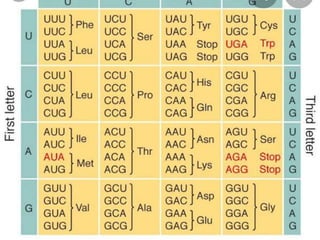
1) Number of Codons : 64 Codon sequences.
2) Directionality : 5’ – 3’
3) Stop/Termination/
Nonsense codons : # UAA
# UAG
# UGA
*Terminate polypeptide chain.
*Stops protein synthesis
4) Initiation Codon : [AUG] Initiates protein synthesis.
Dual function
of AUG : Initiator of codon
Synthesis of amino acid
methionine
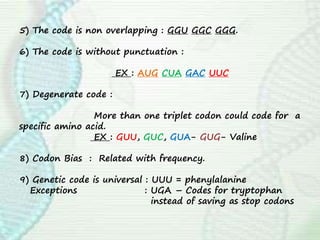
5) The code is non overlapping : GGU GGC GGG.
6) The code is without punctuation :
EX : AUG CUA GAC UUC
7) Degenerate code :
More than one triplet codon could code for a
specific amino acid.
EX : GUU, GUC, GUA- GUG- Valine
8) Codon Bias : Related with frequency.
9) Genetic code is universal : UUU = phenylalanine
Exceptions : UGA – Codes for tryptophan
instead of saving as stop codons
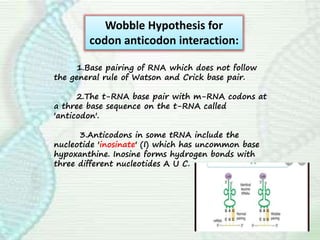
1.Base pairing of RNA which does not follow
the general rule of Watson and Crick base pair.
2.The t-RNA base pair with m-RNA codons at
a three base sequence on the t-RNA called
'anticodon'.
3.Anticodons in some tRNA include the
nucleotide 'inosinate' (I) which has uncommon base
hypoxanthine. Inosine forms hydrogen bonds with
three different nucleotides A U C.
Wobble Hypothesis for
codon anticodon interaction:
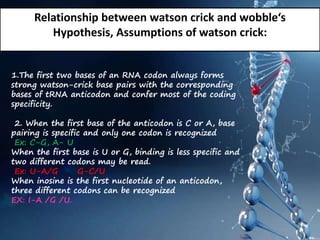
1.The first two bases of an RNA codon always forms
strong watson-crick base pairs with the corresponding
bases of tRNA anticodon and confer most of the coding
specificity.
2. When the first base of the anticodon is C or A, base
pairing is specific and only one codon is recognized
Ex: C-G, A- U
When the first base is U or G, binding is less specific and
two different codons may be read.
Ex: U-A/G G-C/U
When inosine is the first nucleotide of an anticodon,
three different codons can be recognized
EX: I-A /G /U.
Relationship between watson crick and wobble‘s
Hypothesis, Assumptions of watson crick:
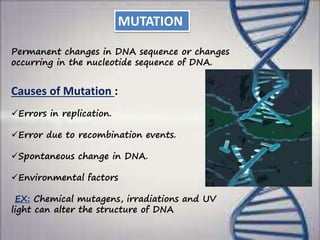
Permanent changes in DNA sequence or changes
occurring in the nucleotide sequence of DNA.
Causes of Mutation :
Errors in replication.
Error due to recombination events.
Spontaneous change in DNA.
Environmental factors
EX: Chemical mutagens, irradiations and UV
light can alter the structure of DNA
MUTATION
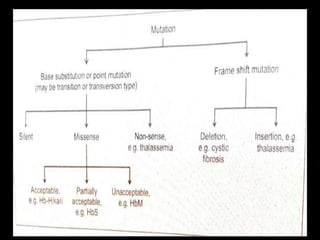
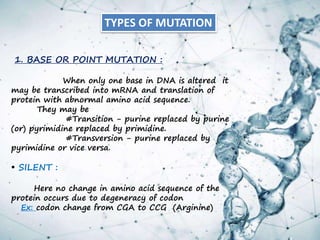
1. BASE OR POINT MUTATION :
When only one base in DNA is altered it
may be transcribed into mRNA and translation of
protein with abnormal amino acid sequence.
They may be
#Transition - purine replaced by purine
(or) pyrimidine replaced by primidine.
#Transversion - purine replaced by
pyrimidine or vice versa.
• SILENT :
Here no change in amino acid sequence of the
protein occurs due to degeneracy of codon
Ex: codon change from CGA to CCG (Arginine)
TYPES OF MUTATION
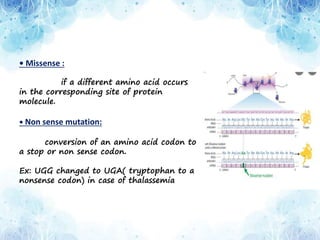
• Missense :
if a different amino acid occurs
in the corresponding site of protein
molecule.
• Non sense mutation:
conversion of an amino acid codon to
a stop or non sense codon.
Ex: UGG changed to UGA( tryptophan to a
nonsense codon) in case of thalassemia
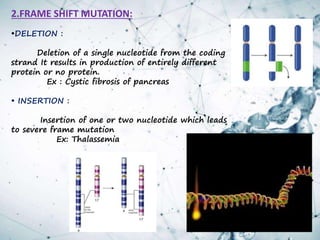
2.FRAME SHIFT MUTATION:
•DELETION :
Deletion of a single nucleotide from the coding
strand It results in production of entirely different
protein or no protein.
Ex : Cystic fibrosis of pancreas
• INSERTION :
Insertion of one or two nucleotide which leads
to severe frame mutation
Ex: Thalassemia
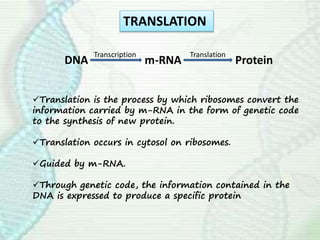
TRANSLATION
DNA m-RNA Protein
Transcription Translation
Translation is the process by which ribosomes convert the
information carried by m-RNA in the form of genetic code
to the synthesis of new protein.
Translation occurs in cytosol on ribosomes.
Guided by m-RNA.
Through genetic code, the information contained in the
DNA is expressed to produce a specific protein
BASIC REQUIREMENTS :
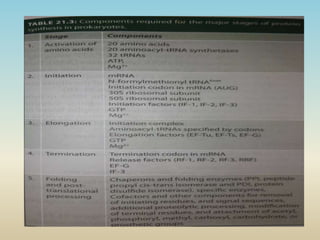
m-RNA to be translated.
t-RNAs .
Ribosomes.
Energy.
Enzymes.
Specific factors.
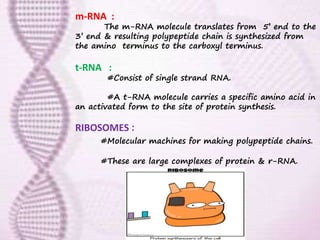
m-RNA :
The m-RNA molecule translates from 5’ end to the
3’ end & resulting polypeptide chain is synthesized from
the amino terminus to the carboxyl terminus.
t-RNA :
#Consist of single strand RNA.
#A t-RNA molecule carries a specific amino acid in
an activated form to the site of protein synthesis.
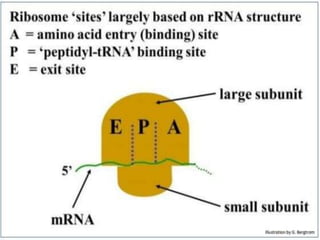
RIBOSOMES :
#Molecular machines for making polypeptide chains.
#These are large complexes of protein & r-RNA.
STAGES OF TRANSLATION
Activation of Amino acids.
Initiation.
Elongation.
Termination.
Folding and processing.
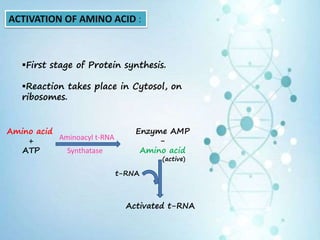
ACTIVATION OF AMINO ACID :
First stage of Protein synthesis.
Reaction takes place in Cytosol, on
ribosomes.
Amino acid
+
ATP
Enzyme AMP
-
Amino acid
(active)
Activated t-RNA
t-RNA
Aminoacyl t-RNA
Synthatase
INITIATION :
m-RNA activation.
Ribosomal dissociation.
Formation of :
# 43s PIC
# 48s IC
# 80s Unit
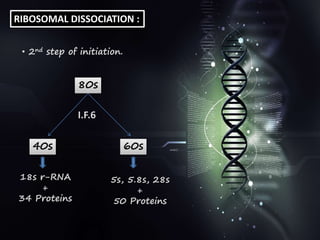
RIBOSOMAL DISSOCIATION :
• 2nd step of initiation.
80s
40s 60s
18s r-RNA
+
34 Proteins
5s, 5.8s, 28s
+
50 Proteins
I.F.6
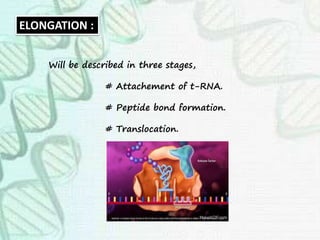
ELONGATION :
Will be described in three stages,
# Attachement of t-RNA.
# Peptide bond formation.
# Translocation.
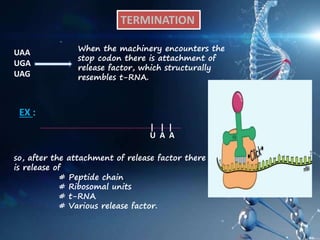
TERMINATION
UAA
UGA
UAG
When the machinery encounters the
stop codon there is attachment of
release factor, which structurally
resembles t-RNA.
so, after the attachment of release factor there
is release of
# Peptide chain,
# Ribosomal units
# t-RNA
# Various release factor.
EX :
| | |
U A A
To achieve its biologically active form,
# New Polypeptide must fold into its
proper 3 dimensional conformations.
# Before & after folding, new
polypeptide may undergo enzymatic processing
including,
-Removal of 1 or more Amino acids.
-Addition of *Acetyl
*Phosphoryl
*Methyl
*Carboxyl
#Attachment of Oligosaccharides or
Prosthetic groups.
FOLDING & POST TRANSLATION PROCESSING
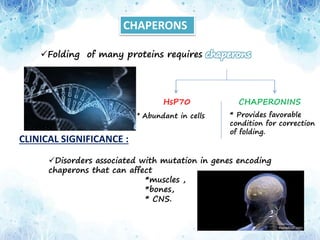
CHAPERONS
Folding of many proteins requires
HsP70 CHAPERONINS
* Abundant in cells * Provides favorable
condition for correction
of folding.
CLINICAL SIGNIFICANCE :
Disorders associated with mutation in genes encoding
chaperons that can affect
*muscles ,
*bones,
* CNS.
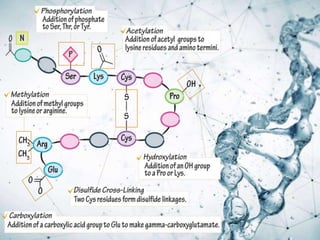
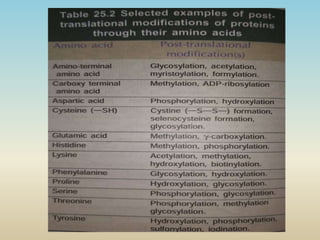
POST TRANSLATION MODIFICATION
Chemical modification of protein after
its translation.
Include Removal of part of the
translated amino acid sequence
or
The covalent addition of one or more
chemical groups required for activity.
TYPES OF POST TRANSLATION MODIFICATION :
 Amino Terminal & Carboxyl Terminal
Modifications.
 Loss of Signal Sequence.
 Attachment of Carbohydrate side chains.
 Modifications of individual amino acids.
 Addition of Isoprenyl Groups.
 Addition of Prosthetic Groups.
 Proteolytic processing.
 Formation of disulfide cross Links.
Number of variety of antibiotics acts by inhibiting selectively
the process of prokaryotic translation.
Examples:
1.puromycin
2.Cycloheximide
3.Streotomycin - inhibits initiation.
4. Colicin- inhibits eukaryotic protein synthesis.
5. Diptheria toxin - inactivates an elongation factor
in eukaryote
6.puromycin- causes premature chain
termination.
INHIBITORS OF PROTEIN SYNTHESIS
Mechanism by which a cell transport protein to the
appropriate position in the cell or outside of it.
PROTEIN PATHWAYS:
* Inner space of an organelle.
* Plasma membrane .
* Intracellular membrane
* Through secretion
MECHANISM OF PROTEIN SORTING:
1. The protein is synthesized in cytoplasm and then completed
protein is delivered into intracellular. (Nucleus, chloroplast,
mitochondria, peroxisome )
2. 2.secretory pathways: directs protein into ER (Lysosome,
Golgi complex)
PROTEIN TARGETING
AND SORTING
CYTOSOLIC PROTEIN TARGETING:
Protein is synthesized in cytosol and reaches
after translation
•mitochondria
• peroxisome
• nuclei
This occurs before transportation called as post
translational translocation.
NUCLEAR LOCALIZATION SEQUENCE:
A variety of nuclear protein like
# RNA
# DNA
# Polymerase
# Histones
# Topoisomerase
That regulates gene expression are synthesized
in the cytosol and imported into nucleus.
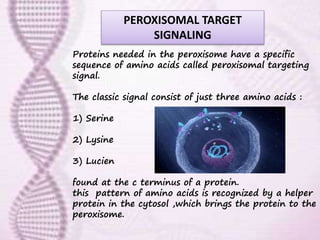
Proteins needed in the peroxisome have a specific
sequence of amino acids called peroxisomal targeting
signal.
The classic signal consist of just three amino acids :
1) Serine
2) Lysine
3) Lucien
found at the c terminus of a protein.
this pattern of amino acids is recognized by a helper
protein in the cytosol ,which brings the protein to the
peroxisome.
PEROXISOMAL TARGET
SIGNALING
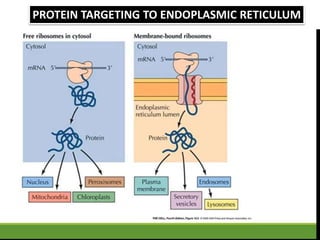
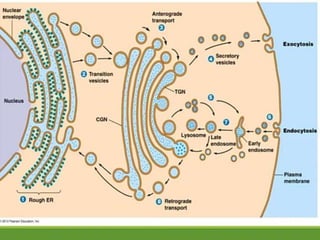
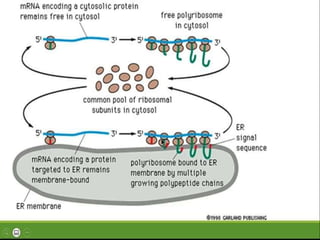
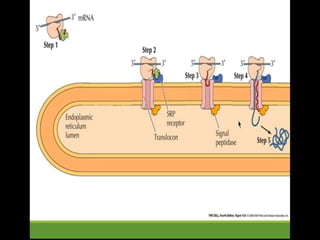
PROTEIN TARGETING TO ENDOPLASMIC RETICULUM
Disorders associated with protein targeting and sorting :
Neurogenerative diseases.
Metabolic disorders.
Oxidative stress.
Disorders due to mitochondrial targeting signals:
1.Primary hyperoxaluria type 1 :
Deficiency of alanine/glyoxalate
aminotransferase 1 ( AGT) Leads to kidney failure
and deposition of calcium oxalate.
2.Pyruvate dehydrogenase deficiency:
Pyruvate dehydrogenase deficiency
Leads to primary lactic acidosis in infant and
children.
In addition PBD patients shows deficient levels of
plasmalogens ,ether phospholipid necessary for normal
brain and lung function.
Collectively , PBDs are developmental brain disorders
that also result in,
1) skeletal and craniofacial dysmorphism
2) liver dysfunction
3) progressive sensorineural hearing loss
4) retinopathy.
5) zellweger syndrome
6) neonatal adrenoleuko dystrophy
7) infantile Refson's recessive metabolic disorder
DISORDERS DUE TO DEFECTS IN
MITOCHONDRIAL TARGETING SIGNAL
Translation in eukaryotes

Translation in eukaryotes

  • 1.
    TRANSLATION J.THOUFIGA KATHIJA I –BNYS “A” SECTION SRKMC G.SUBHIKSHA I – BNYS “A” SECTION SRKMC
  • 2.
    Genetic code. Mutation. Translation. Basic Requirements. Stagesof Translation. Post translation modification. Inhibitors. Protein targeting and sorting. SESSION’S OVERVIEW
  • 3.
    GENETIC CODE DNA -Genetic material (present inside nucleus) Carries genetic information from one generation to another generation. Marshell Nirenberg. Severo Ochoa. Hargobind Khorana. Francis Crick. Contributed to decipher the genetic code.
  • 4.
    CODON : Four letterA, G, C, T corresponds to the nucleotides found in DNA within protein coding gene these nucleotides are organized into three letter code words called codons. GENETIC CODE : The genetic code is the arrangement of nucleotide sequences of mRNA that designates particular amino acid sequence in the process of translation.
  • 5.
    SALIENT FEATURES OFGENETIC CODE 1) Number of Codons : 64 Codon sequences. 2) Directionality : 5’ – 3’ 3) Stop/Termination/ Nonsense codons : # UAA # UAG # UGA *Terminate polypeptide chain. *Stops protein synthesis 4) Initiation Codon : [AUG] Initiates protein synthesis. Dual function of AUG : Initiator of codon Synthesis of amino acid methionine
  • 6.
    5) The codeis non overlapping : GGU GGC GGG. 6) The code is without punctuation : EX : AUG CUA GAC UUC 7) Degenerate code : More than one triplet codon could code for a specific amino acid. EX : GUU, GUC, GUA- GUG- Valine 8) Codon Bias : Related with frequency. 9) Genetic code is universal : UUU = phenylalanine Exceptions : UGA – Codes for tryptophan instead of saving as stop codons
  • 8.
    1.Base pairing ofRNA which does not follow the general rule of Watson and Crick base pair. 2.The t-RNA base pair with m-RNA codons at a three base sequence on the t-RNA called 'anticodon'. 3.Anticodons in some tRNA include the nucleotide 'inosinate' (I) which has uncommon base hypoxanthine. Inosine forms hydrogen bonds with three different nucleotides A U C. Wobble Hypothesis for codon anticodon interaction:
  • 9.
    1.The first twobases of an RNA codon always forms strong watson-crick base pairs with the corresponding bases of tRNA anticodon and confer most of the coding specificity. 2. When the first base of the anticodon is C or A, base pairing is specific and only one codon is recognized Ex: C-G, A- U When the first base is U or G, binding is less specific and two different codons may be read. Ex: U-A/G G-C/U When inosine is the first nucleotide of an anticodon, three different codons can be recognized EX: I-A /G /U. Relationship between watson crick and wobble‘s Hypothesis, Assumptions of watson crick:
  • 10.
    Permanent changes inDNA sequence or changes occurring in the nucleotide sequence of DNA. Causes of Mutation : Errors in replication. Error due to recombination events. Spontaneous change in DNA. Environmental factors EX: Chemical mutagens, irradiations and UV light can alter the structure of DNA MUTATION
  • 12.
    1. BASE ORPOINT MUTATION : When only one base in DNA is altered it may be transcribed into mRNA and translation of protein with abnormal amino acid sequence. They may be #Transition - purine replaced by purine (or) pyrimidine replaced by primidine. #Transversion - purine replaced by pyrimidine or vice versa. • SILENT : Here no change in amino acid sequence of the protein occurs due to degeneracy of codon Ex: codon change from CGA to CCG (Arginine) TYPES OF MUTATION
  • 13.
    • Missense : ifa different amino acid occurs in the corresponding site of protein molecule. • Non sense mutation: conversion of an amino acid codon to a stop or non sense codon. Ex: UGG changed to UGA( tryptophan to a nonsense codon) in case of thalassemia
  • 14.
    2.FRAME SHIFT MUTATION: •DELETION: Deletion of a single nucleotide from the coding strand It results in production of entirely different protein or no protein. Ex : Cystic fibrosis of pancreas • INSERTION : Insertion of one or two nucleotide which leads to severe frame mutation Ex: Thalassemia
  • 15.
    TRANSLATION DNA m-RNA Protein TranscriptionTranslation Translation is the process by which ribosomes convert the information carried by m-RNA in the form of genetic code to the synthesis of new protein. Translation occurs in cytosol on ribosomes. Guided by m-RNA. Through genetic code, the information contained in the DNA is expressed to produce a specific protein
  • 16.
    BASIC REQUIREMENTS : m-RNAto be translated. t-RNAs . Ribosomes. Energy. Enzymes. Specific factors.
  • 17.
    m-RNA : The m-RNAmolecule translates from 5’ end to the 3’ end & resulting polypeptide chain is synthesized from the amino terminus to the carboxyl terminus. t-RNA : #Consist of single strand RNA. #A t-RNA molecule carries a specific amino acid in an activated form to the site of protein synthesis. RIBOSOMES : #Molecular machines for making polypeptide chains. #These are large complexes of protein & r-RNA.
  • 19.
    STAGES OF TRANSLATION Activationof Amino acids. Initiation. Elongation. Termination. Folding and processing.
  • 21.
    ACTIVATION OF AMINOACID : First stage of Protein synthesis. Reaction takes place in Cytosol, on ribosomes. Amino acid + ATP Enzyme AMP - Amino acid (active) Activated t-RNA t-RNA Aminoacyl t-RNA Synthatase
  • 22.
    INITIATION : m-RNA activation. Ribosomaldissociation. Formation of : # 43s PIC # 48s IC # 80s Unit
  • 23.
    RIBOSOMAL DISSOCIATION : •2nd step of initiation. 80s 40s 60s 18s r-RNA + 34 Proteins 5s, 5.8s, 28s + 50 Proteins I.F.6
  • 24.
    ELONGATION : Will bedescribed in three stages, # Attachement of t-RNA. # Peptide bond formation. # Translocation.
  • 25.
    TERMINATION UAA UGA UAG When the machineryencounters the stop codon there is attachment of release factor, which structurally resembles t-RNA. so, after the attachment of release factor there is release of # Peptide chain, # Ribosomal units # t-RNA # Various release factor. EX : | | | U A A
  • 26.
    To achieve itsbiologically active form, # New Polypeptide must fold into its proper 3 dimensional conformations. # Before & after folding, new polypeptide may undergo enzymatic processing including, -Removal of 1 or more Amino acids. -Addition of *Acetyl *Phosphoryl *Methyl *Carboxyl #Attachment of Oligosaccharides or Prosthetic groups. FOLDING & POST TRANSLATION PROCESSING
  • 27.
    CHAPERONS Folding of manyproteins requires HsP70 CHAPERONINS * Abundant in cells * Provides favorable condition for correction of folding. CLINICAL SIGNIFICANCE : Disorders associated with mutation in genes encoding chaperons that can affect *muscles , *bones, * CNS.
  • 28.
    POST TRANSLATION MODIFICATION Chemicalmodification of protein after its translation. Include Removal of part of the translated amino acid sequence or The covalent addition of one or more chemical groups required for activity.
  • 29.
    TYPES OF POSTTRANSLATION MODIFICATION :  Amino Terminal & Carboxyl Terminal Modifications.  Loss of Signal Sequence.  Attachment of Carbohydrate side chains.  Modifications of individual amino acids.  Addition of Isoprenyl Groups.  Addition of Prosthetic Groups.  Proteolytic processing.  Formation of disulfide cross Links.
  • 32.
    Number of varietyof antibiotics acts by inhibiting selectively the process of prokaryotic translation. Examples: 1.puromycin 2.Cycloheximide 3.Streotomycin - inhibits initiation. 4. Colicin- inhibits eukaryotic protein synthesis. 5. Diptheria toxin - inactivates an elongation factor in eukaryote 6.puromycin- causes premature chain termination. INHIBITORS OF PROTEIN SYNTHESIS
  • 33.
    Mechanism by whicha cell transport protein to the appropriate position in the cell or outside of it. PROTEIN PATHWAYS: * Inner space of an organelle. * Plasma membrane . * Intracellular membrane * Through secretion MECHANISM OF PROTEIN SORTING: 1. The protein is synthesized in cytoplasm and then completed protein is delivered into intracellular. (Nucleus, chloroplast, mitochondria, peroxisome ) 2. 2.secretory pathways: directs protein into ER (Lysosome, Golgi complex) PROTEIN TARGETING AND SORTING
  • 34.
    CYTOSOLIC PROTEIN TARGETING: Proteinis synthesized in cytosol and reaches after translation •mitochondria • peroxisome • nuclei This occurs before transportation called as post translational translocation. NUCLEAR LOCALIZATION SEQUENCE: A variety of nuclear protein like # RNA # DNA # Polymerase # Histones # Topoisomerase That regulates gene expression are synthesized in the cytosol and imported into nucleus.
  • 35.
    Proteins needed inthe peroxisome have a specific sequence of amino acids called peroxisomal targeting signal. The classic signal consist of just three amino acids : 1) Serine 2) Lysine 3) Lucien found at the c terminus of a protein. this pattern of amino acids is recognized by a helper protein in the cytosol ,which brings the protein to the peroxisome. PEROXISOMAL TARGET SIGNALING
  • 36.
    PROTEIN TARGETING TOENDOPLASMIC RETICULUM
  • 40.
    Disorders associated withprotein targeting and sorting : Neurogenerative diseases. Metabolic disorders. Oxidative stress. Disorders due to mitochondrial targeting signals: 1.Primary hyperoxaluria type 1 : Deficiency of alanine/glyoxalate aminotransferase 1 ( AGT) Leads to kidney failure and deposition of calcium oxalate. 2.Pyruvate dehydrogenase deficiency: Pyruvate dehydrogenase deficiency Leads to primary lactic acidosis in infant and children.
  • 41.
    In addition PBDpatients shows deficient levels of plasmalogens ,ether phospholipid necessary for normal brain and lung function. Collectively , PBDs are developmental brain disorders that also result in, 1) skeletal and craniofacial dysmorphism 2) liver dysfunction 3) progressive sensorineural hearing loss 4) retinopathy. 5) zellweger syndrome 6) neonatal adrenoleuko dystrophy 7) infantile Refson's recessive metabolic disorder DISORDERS DUE TO DEFECTS IN MITOCHONDRIAL TARGETING SIGNAL