Rolando Tellez, MSc.
Translator, Teacher & Writer
Rolando2@fulbrightmail.org

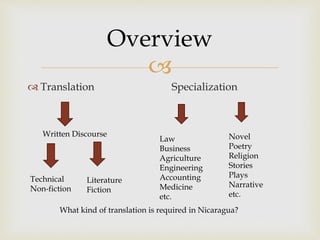
 Translation Specialization
Overview
Written Discourse
Law
Business
Agriculture
Engineering
Accounting
Medicine
etc.
Technical
Non-fiction
Literature
Fiction
Novel
Poetry
Religion
Stories
Plays
Narrative
etc.
What kind of translation is required in Nicaragua?

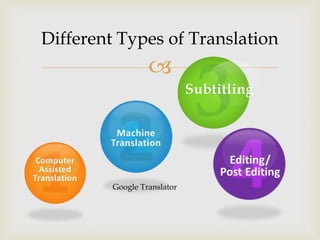
Different Types of Translation
Subtitling
Google Translator

 In practice, Computer-Assisted Translation is a complex
process involving specific tools and technology adaptable to the
needs of the translator, who is involved in the whole process
and not just in the editing stage. The computer becomes a
workstation where the translator has access to a variety of texts,
tools and programs: for example, monolingual and bilingual
dictionaries, parallel texts, translated texts in a variety of source
and target languages, and terminology databases. Each
translator can create a personal work environment and
transform it according to the needs of the specific task. Thus
computer-assisted translation gives the translator on-the-spot
flexibility and freedom of movement, together with immediate
access to an astonishing range of up-to-date information. The
result is an enormous saving of time.
Computer-Assisted
Translation (CAT)

 To solve translation issues
 To save money
 To enrich your resume internationally
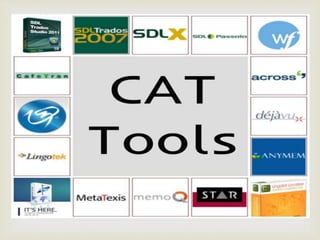
 Translation software http://www.my-
across.net/en/features/ (Across)
 Trados, Wordfast with cloud editions,
https://www.memoq.com/memoq-translator-free
(MemoQ), OmegaT, Google Translator Toolkit, etc.
Why to use CAT-Tools?


 You can exchange glossaries with colleagues (TM).
 Access to specific data bases (search engines)
 Editing tools, visual editors, validators
 You can translate automatically large amount of
repetitive information (Terminology mangt.)
 There is file management tool (interactive, crowd)
 If you want to be certified, check
http://translatorcertification.com/
CAT Advantages

Editing/Post Editing

 Substantive editors work with you once you have a full
text. They will help you get it into its final form, which
may involve reordering or rewriting segments of it to
improve readability, clarity, or accuracy.
 Copyeditors work with your text when it is in final or
nearly final form. They read each sentence carefully,
seeking to fix all errors of spelling, punctuation,
capitalization, grammar, and word usage while
preserving your meaning and voice.
 Proofreading is the reading of a text or an electronic copy
of a publication to detect and correct production errors of
text or art.
Editing

 https://www.linkedin.com/in/rolandotellez
 https://www.facebook.com/Nicaraguan-
Translators-1548010295440656/
 To connect social network, use hootsuit
Translator’ Localization
and Ads

 As a translator you will need to convert files in
different types or formats. For example, PDF, Word,
odt. OpenOffice
 Zamzar is a good converter
 Sometimes you need to convert audio, video, images.
 European systems are different from American
system
 Also currency converter.
 There are some free online converters Online-
Convert
Converters

 You may need to send and receive large files, you
can use a google drive, or wetransfer.com up to 2 GB
and it is in the cloud, mailbox or other options to
send heavy documents.
 A professional translator must have a very good
computer, to be able to handle large amount of data,
so there is no delay in delivering the work.
Large Files

 Google itself is a powerful tool since it allows us not
only to search for information on webpages, but also
it indexes *.doc and *.pdf files stored on servers,
allowing us to browse through their contents in
search for a context.
 WinZip, WinRAR. PDF and multimedia files readers
(images, audio)
 web.word.count (quotes)
 TMServe Tools
 TMBuilder 1.0 Word and Excel converted to TM
 Voice recognition, e.g. Naturally Speaking
Other Translator’s Tools

 TRANSLATION as an academic subject is only about
60 years old. Master’s & Ph.D
 Toward a Science of Translating, 1964 MT.
 Translation Studies concept in Third International
Congress of Applied Linguistics 1972
 Translation Theory vs. Application
 Is translation theory relevant for practising
translators?
Brief History of Translation

 Is a graduate or a postgraduate qualification a
prerequisite for working as a professional translator
in Nicaragua?
 Should we have a translation school in Nicaragua?
Why we don´t have such school?
Translators’ Issues in Nicaragua

Terminology of Translators
 Borrowing, lexical calque, literal translation, oblique
translation, adaptation, back translation,
transposition, modulation, prepositions, collocations,
equivalence, paraphrasing, idomatic translation, free
translation, Source lg. Target lg. pre-editing, post-
editing, cultural equivalence, colloquialism, machine
translation, etc.

The intent of message = sender
and receiver

• To translate and edit commonly used documents from
English into Spanish. This includes:
• Blended learning plus 4 or 5 hour classroom learning per
week.
• Practical work, the more you translate the more proficient you
become. (Free-lance)
• Group work, but highly personalized support when needed, via
internet or other media.
• Some translation concepts or theory, but more practice, one of my
projects.
Proposal for Translation Course

 To have a computer and internet connectivity
 To be willing to dedicate as much time as required to
complete homework on time.
 To take notes and discuss the remarks made by
facilitator, in order to avoid future mistakes.
 To be open to read and understand different topics
(current international articles), or to work on a
particular project.
 To pass a test, where your translations skills will be
shown on your translation work.
Requirements

 A professional translator has to read a lot of bilingual
publications. Bilingual Books
 Your questions or comments in English or Spanish
 Thank you very much for your attention.
 Contact Rolando2@fulbrightmail.org
Q&A

Translation Resources

  • 1.
    Rolando Tellez, MSc. Translator,Teacher & Writer Rolando2@fulbrightmail.org
  • 2.
      Translation Specialization Overview WrittenDiscourse Law Business Agriculture Engineering Accounting Medicine etc. Technical Non-fiction Literature Fiction Novel Poetry Religion Stories Plays Narrative etc. What kind of translation is required in Nicaragua?
  • 3.
     Different Types ofTranslation Subtitling Google Translator
  • 4.
      In practice,Computer-Assisted Translation is a complex process involving specific tools and technology adaptable to the needs of the translator, who is involved in the whole process and not just in the editing stage. The computer becomes a workstation where the translator has access to a variety of texts, tools and programs: for example, monolingual and bilingual dictionaries, parallel texts, translated texts in a variety of source and target languages, and terminology databases. Each translator can create a personal work environment and transform it according to the needs of the specific task. Thus computer-assisted translation gives the translator on-the-spot flexibility and freedom of movement, together with immediate access to an astonishing range of up-to-date information. The result is an enormous saving of time. Computer-Assisted Translation (CAT)
  • 5.
      To solvetranslation issues  To save money  To enrich your resume internationally  Translation software http://www.my- across.net/en/features/ (Across)  Trados, Wordfast with cloud editions, https://www.memoq.com/memoq-translator-free (MemoQ), OmegaT, Google Translator Toolkit, etc. Why to use CAT-Tools?
  • 6.
  • 7.
      You canexchange glossaries with colleagues (TM).  Access to specific data bases (search engines)  Editing tools, visual editors, validators  You can translate automatically large amount of repetitive information (Terminology mangt.)  There is file management tool (interactive, crowd)  If you want to be certified, check http://translatorcertification.com/ CAT Advantages
  • 8.
  • 9.
      Substantive editorswork with you once you have a full text. They will help you get it into its final form, which may involve reordering or rewriting segments of it to improve readability, clarity, or accuracy.  Copyeditors work with your text when it is in final or nearly final form. They read each sentence carefully, seeking to fix all errors of spelling, punctuation, capitalization, grammar, and word usage while preserving your meaning and voice.  Proofreading is the reading of a text or an electronic copy of a publication to detect and correct production errors of text or art. Editing
  • 10.
  • 11.
      As atranslator you will need to convert files in different types or formats. For example, PDF, Word, odt. OpenOffice  Zamzar is a good converter  Sometimes you need to convert audio, video, images.  European systems are different from American system  Also currency converter.  There are some free online converters Online- Convert Converters
  • 12.
      You mayneed to send and receive large files, you can use a google drive, or wetransfer.com up to 2 GB and it is in the cloud, mailbox or other options to send heavy documents.  A professional translator must have a very good computer, to be able to handle large amount of data, so there is no delay in delivering the work. Large Files
  • 13.
      Google itselfis a powerful tool since it allows us not only to search for information on webpages, but also it indexes *.doc and *.pdf files stored on servers, allowing us to browse through their contents in search for a context.  WinZip, WinRAR. PDF and multimedia files readers (images, audio)  web.word.count (quotes)  TMServe Tools  TMBuilder 1.0 Word and Excel converted to TM  Voice recognition, e.g. Naturally Speaking Other Translator’s Tools
  • 14.
      TRANSLATION asan academic subject is only about 60 years old. Master’s & Ph.D  Toward a Science of Translating, 1964 MT.  Translation Studies concept in Third International Congress of Applied Linguistics 1972  Translation Theory vs. Application  Is translation theory relevant for practising translators? Brief History of Translation
  • 15.
      Is agraduate or a postgraduate qualification a prerequisite for working as a professional translator in Nicaragua?  Should we have a translation school in Nicaragua? Why we don´t have such school? Translators’ Issues in Nicaragua
  • 16.
     Terminology of Translators Borrowing, lexical calque, literal translation, oblique translation, adaptation, back translation, transposition, modulation, prepositions, collocations, equivalence, paraphrasing, idomatic translation, free translation, Source lg. Target lg. pre-editing, post- editing, cultural equivalence, colloquialism, machine translation, etc.
  • 17.
     The intent ofmessage = sender and receiver
  • 18.
     • To translateand edit commonly used documents from English into Spanish. This includes: • Blended learning plus 4 or 5 hour classroom learning per week. • Practical work, the more you translate the more proficient you become. (Free-lance) • Group work, but highly personalized support when needed, via internet or other media. • Some translation concepts or theory, but more practice, one of my projects. Proposal for Translation Course
  • 19.
      To havea computer and internet connectivity  To be willing to dedicate as much time as required to complete homework on time.  To take notes and discuss the remarks made by facilitator, in order to avoid future mistakes.  To be open to read and understand different topics (current international articles), or to work on a particular project.  To pass a test, where your translations skills will be shown on your translation work. Requirements
  • 20.
      A professionaltranslator has to read a lot of bilingual publications. Bilingual Books  Your questions or comments in English or Spanish  Thank you very much for your attention.  Contact Rolando2@fulbrightmail.org Q&A