Translation
Jerrylyn Bacroya-Magbuo, Ph.D
College of Education
SY 2020-2021
ENGEL1 - Translation (3 units)
This course provides the application of rules of discourse and rhetoric in translation of various
types of written material in consideration with the principles and strategies in translating texts
of various types from English to Filipino Language. To accomplish that, it will tackle
fundamental notions, theories and empirical groundings of the translation studies.
Course Credits : 3
Contact Hours : 3 hours/week
Pre - Req. : None
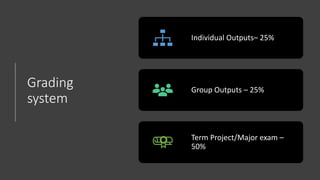
Grading
system
Individual Outputs– 25%
Group Outputs – 25%
Term Project/Major exam –
50%
Prelims: A Brief Introduction to Translation
This module discusses why translation matters, what is translation, and
what is good translation. It also gives an overview of the content of the
entire course.
• Why Translate
• What Is Translation
• What Is Good Translation
Prelims: The Process of Translation
This module discusses the four-step process of translation. Each step is
discussed in detail.
• Four-Step Translation Process
• Gathering Background Information
• Deciding on the Word Meaning
• Looking for Appropriate Expressions
Midterms:
Understanding and Expressing Word Meaning
This module discusses how to understand word meaning in the source
language and how to express word meaning in the target language.
• Identifying Specialized Vocabulary
• Analyzing Grammar and Logic
• Making Conversions
• Adding or Omitting Words, Phrases, Clauses
• Considering Connotations and Tones
• Being Flexible
Finals:
Sentence Translation:
Word Order, Division, and Combination
This module discusses the techniques often used in the translation of
sentences: keeping/changing the original word order and
dividing/combining sentences.
• Changing the Word Order
• Keeping the Word Order
• Dividing a Sentence
• Combining Sentences
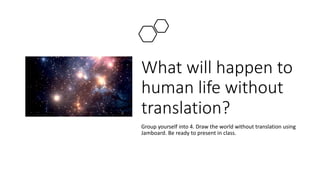
What will happen to
human life without
translation?
Group yourself into 4. Draw the world without translation using
Jamboard. Be ready to present in class.
Introduction to Translation
Module 1
Why do we need to
learn translation?
Because translation
matters.
Why do translation
matters?
Without translation, what would
happen to our life, to the technologies
we're so use to, to literature and arts
that we enjoy? To our religious and
spiritual experiences, to our political,
social, professional, and personal life?
• There are more than 6,000 human languages in the world
• Without translation, it would be impossible for even the most gifted linguists who
read, and through reading, to learn any facts, thoughts, feelings, written in any
language they don't know.
Results of academic's research in one language
and made available to researchers of other
languages through translation, who may then
advance the study.
Without that translation, the English-speaking people would
not have had the opportunity to bathe in the light or to come
by the water. Similarly, Martin Luther's translation of the Bible
into German in the 16th century, brought about not only the
religious reform in Germany, but also the revival of the German
language and even the German nation.
What is Translation?
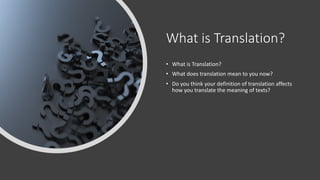
• What is Translation?
• What does translation mean to you now?
• Do you think your definition of translation affects
how you translate the meaning of texts?
Without translation, we cannot be
inspired and touched by the thoughts,
perspectives, experiences and feelings
in them. To become ever more open-
minded, learned, sympathetic, to know
the world and ourselves better.
Today’s life is run by translation
• for nations to interact..
• for companies to operate..
• for students and teachers to learn the latest development in their
fields of study..
• For everyone of us to be informed about the news in the world..
• to travel..
• to read..
• to watch films..
• To be come better humans
But even with the importance of translation,
translators are just waste of space.
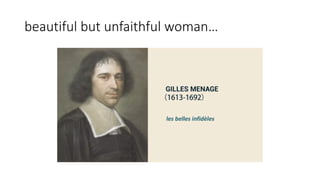
beautiful but unfaithful woman…
The translator in whole words is a servant
who serves both the original work and the
reader at the same time.. And is expected
to be faithful to both.
In other words, the job of the translator is to accelerate and
deeply understand the meaning of the original work,
faithfully express the meaning of the target language and
express it in such a way that a target readers would feel as
if that were really a work written in their native language.
"I like to think of the original work as an ice cube.
During the process of translation the Cube is melted.
While in its liquid state, every molecule changes place;
none remains in its original relationship to the others.
Then begins the process of forming the work in a
second language. Molecules escape, new molecules
are poured in to fill in the spaces, but the lines of
molding and mending are virtually invisible. The work
exists in a second language as a new ice cube-
different, but to all appearances the same.” - -
Margaret Sayers Peden
What is the role of a translator?
What do you think are your
responsibilities as future translators?
Group your self into 4 groups.
Create a list of answers to these questions.
Be ready to present this in class next week
(ppt, 5 mins per group).
The Good Translation
Week 3
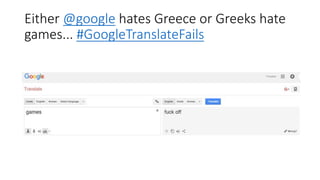
Either @google hates Greece or Greeks hate
games... #GoogleTranslateFails
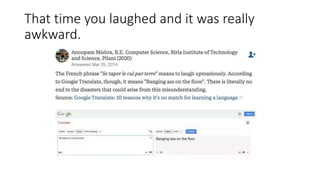
That time you laughed and it was really
awkward.
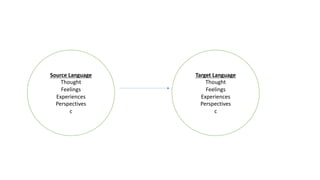
Source Language
Thought
Feelings
Experiences
Perspectives
c
Target Language
Thought
Feelings
Experiences
Perspectives
c
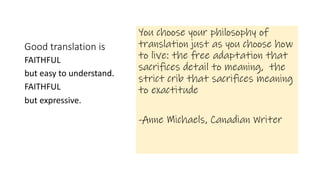
Good translation is
You choose your philosophy of
translation just as you choose how
to live: the free adaptation that
sacrifices detail to meaning, the
strict crib that sacrifices meaning
to exactitude
-Anne Michaels, Canadian Writer
FAITHFUL
but easy to understand.
FAITHFUL
but expressive.
It will be great if the translation can be truthful and expressive,
but in reality, it's very difficult to be both.
When we do translations, we may not consciously think about making a choice between the two.
But when we are in difficulty or dilemma,
we realize that we have to make a choice.
Are we going to be faithful to the original text or to the reader?
Are we going to create a beautiful but unfaithful translation?
Or are we going to create a faithful but not beautiful translation?
If we want our translation to be exactly the same as the original text,
we may cause barriers in understanding to the readers.
If we want the readers to enjoy reading,
we may take the risk of misrepresenting the original text.
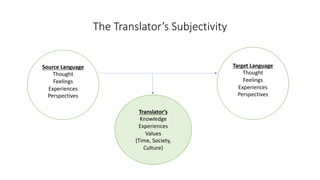
Source Language
Thought
Feelings
Experiences
Perspectives
Target Language
Thought
Feelings
Experiences
Perspectives
The Translator’s Subjectivity
Translator’s
Knowledge
Experiences
Values
(Time, Society,
Culture)
Cocktail lounge, Norway: “Ladies are Requested Not to have Children in the Bar”
At a Budapest zoo: “PLEASE DO NOT FEED THE ANIMALS. If you have any suitable food, give it to the
guard on duty”
Hotel in Acapulco: “The Manager has Personally Passed All the Water Served Here” Car rental
brochure, Tokyo: “When passenger of foot heave in sight, tootle the horn. Trumpet him melodiously
at first, but if he still obstacles your passage then tootle him with vigor.”
On an Athi River highway: “TAKE NOTICE: When this sign is under water, this road is impassable.”
Tokyo hotel’s rules and regulations: “Guests are requested NOT to smoke or do other disgusting
behaviors in bed.”
In an East African newspaper: “A new swimming pool is rapidly taking shape since the contractors
have thrown in the bulk of their workers.”
Hotel lobby, Bucharest: “The lift is being fixed for the next day. During that time we regret that you
will be unbearable.
In Nairobi restaurant: “Customers who find our waitresses rude ought to see the manager.”
A sign on a car in Manila, Philippines: “Car and owner for sale.”
Hotel in Zurich: “Because of the impropriety of entertaining guests of the opposite sex in the
bedroom, is it suggested that the lobby be used for this purpose.”
Airline ticket office, Copenhagen: “We take your bags and send them in all directions.”
War museum on the River Kwai, Thailand: “The Museum is building now — sorry for the visitor”
In a Bangkok dry cleaner’s: “Drop your trousers here for best results.”
In an advertisement by a Hong Kong dentist: “Teeth extracted by the latest Methodists.”
Instructions for a soap bubble gun: “While solution is not toxic it will not make child edible.”
Detour sign in Kyushu, Japan: “Stop: Drive Sideways.”
Sign at Mexican disco: “Members and non-members only.”
A sign posted in Germany’s Black Forest: “It is strictly forbidden on our black forest camping site that
people of different sex, for instance, men and women, live together in one tent unless they are
married with each other for that purpose.”
Japanese hotel room: “Please to bathe inside the tub.”
On a South African building: “Mental health prevention centre.”
The Translation Process
THE PRE-TRANSLATION PROCESS – what is it
and why is it useful?
• There is a lot more to translation than meets the eye. The essence of
the translation process is to transform a piece of text from one
language, the source language (SL), into another, the target language
(TL). However, there is far more to consider than many people realize:
there is so much to contemplate and decide before the actual
‘translation process’ can begin.
• There is an entire process to consider first. With multiple factors to
contemplate and points to clarify, the following pre-translation steps
are essential for ensuring a smooth translation process, avoiding
delays and producing an accurate end result.
Read the whole ST through
• Although seemingly obvious, this is a step that is often skipped either
due to laziness or over-eagerness to start translating. Without reading
the entire text through first, it would be all too easy to misinterpret
the meaning in the beginning and thus make inaccurate translations.
To fully understand and grasp the significance of what is written, you
need to first asses the text as one whole entity before breaking it
down into smaller portions.
Do your research
• Having the ability to speak two languages does not mean the
translator can understand everything in either language, even their
native language. English is my native language, yet if I was given a
medical document to read in English, I know there is a high
probability that I would fail to understand everything because I have
no complex understanding of medical terms. Therefore, if given a text
to translate on a subject which you are not an expert in, it is crucial to
conduct thorough research of the domain and any complex terms.
Failure to do this would result in inaccurate work
Who and what is the text for?
• Rarely is the target audience (TA) of the target text (TT) the same as
that of the source text (ST). There are nearly always differences
between them, such as a different culture, age or level of domain
knowledge. Depending on the differences of the TA, the translator
will then have to adjust and be mindful of the register, tone and
complexity of the text. Equally so these things will also need to be
considered when assessing the purposes of the TT. If the translated
text will be used for a purpose different from that of the original text,
it again may be necessary to adjust the text’s register, tone or
complexity.
Assess what changes to make
• Now, based on the research carried out and on the text assessment
the translator can be clear on what strategy to take when translating.
Understanding the changes that need to be made helps to construct a
consistent and focused final translation.
•
Now we translate!
• Only after all these stages have been thoroughly conducted can the
translator begin the process of translating the text. Having a
meticulous pre-translation ritual prepares the translator for any
potential difficulties and ensures the best possible quality result.
Task
qForm a group with three
members. Meet and record
your meeting.
qTranslate the poem of Lang
leav.
qPresent your answer in class.
J
The first step in translation, is to understand the source language. This
is the key to good translation. If we do not understand the source
language, or if we do not understand it deeply and thoroughly, our
translation will be dissatisfactory.
To understand a source language text means to understand, first of all
of course, the language. Including not only the surface meaning, the
underlying meaning, the implications, and the overtones. But also the
structures of the sentences, and the logical relationship between
sentences and paragraphs.
Over tones vs Undertones
What was said and how it is said.
“Leave me.
Yes. Its fine.”
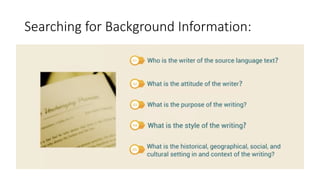
Searching for Background Information:
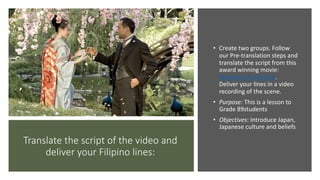
Translate the script of the video and
deliver your Filipino lines:
• Create two groups. Follow
our Pre-translation steps and
translate the script from this
award winning movie:
Memoirs of a Geisha.
Deliver your lines in a video
recording of the scene.
• Purpose: This is a lesson to
Grade 89students
• Objectives: Introduce Japan,
Japanese culture and beliefs
General Translation Principles
There are some general translation principles
which are relevant to all types of translation.
1) Meaning :
The translation should reflect accurately the
meaning of the original text. Nothing should
be arbitrarily added or removed, though
occsionally part of the meaning can be
transposed.
2) Form :
The ordering of words and ideas in the
translation should match the original
as closely as possible. This is
particularly important in translating
legal documents, guarantees,
contracts, etc. But differences in
language structure often require
changes in the form and order of
words. When in doubt, underline in
the original text the words on which
the main stress falls.
3) Register :
Languages often differ greatly in
their levels of formality in a given
context, for example, the
business letter. To resolve these
differences, the translator must
distinguish between formal or
fixed expressions and personal
expressions, in which the writer
or speaker sets the tone.
4) Source language influence
One of the most frequent criticism of translation
is that it does not sound natural. This is because
the translator's thoughts and choice of words are
too strongly molded by the original text. A good
way of shaking off the source language influence
is to set the text aside and translate a few
sentences aloud, from memory. This will suggest
natural patterns of thought in the first language,
which may not come to mind when the eye is
fixed on the source language text.
5) Style and clarity :
The translator should not
change the style of the
original. But if the text is
sloppily written, or full of
tedious repetitions, the
translator may, for the reader's
sake, correct the defects.
6) Idiom:
Idiomatic expressions are notoriously untranslatable.
These include similes, metaphors, proverbs and sayings,
jargon, slang, and colloquialisms and ( in English ) phrasal
verbs. If the expressions cannot be directly translated, try
any of the following :
a. retain the original word, in inverted commas.
b. retain the original expression, with a literal
explanation in brackets.
c. use a close equivalent.
d. use a non-idiomatic or plain prose translation.
The golden rule is : if the idiom
does not work in the L1, do not
force it into the translation.

Translation Module 1.pdf

  • 1.
  • 2.
    ENGEL1 - Translation(3 units) This course provides the application of rules of discourse and rhetoric in translation of various types of written material in consideration with the principles and strategies in translating texts of various types from English to Filipino Language. To accomplish that, it will tackle fundamental notions, theories and empirical groundings of the translation studies. Course Credits : 3 Contact Hours : 3 hours/week Pre - Req. : None
  • 3.
    Grading system Individual Outputs– 25% GroupOutputs – 25% Term Project/Major exam – 50%
  • 4.
    Prelims: A BriefIntroduction to Translation This module discusses why translation matters, what is translation, and what is good translation. It also gives an overview of the content of the entire course. • Why Translate • What Is Translation • What Is Good Translation
  • 5.
    Prelims: The Processof Translation This module discusses the four-step process of translation. Each step is discussed in detail. • Four-Step Translation Process • Gathering Background Information • Deciding on the Word Meaning • Looking for Appropriate Expressions
  • 6.
    Midterms: Understanding and ExpressingWord Meaning This module discusses how to understand word meaning in the source language and how to express word meaning in the target language. • Identifying Specialized Vocabulary • Analyzing Grammar and Logic • Making Conversions • Adding or Omitting Words, Phrases, Clauses • Considering Connotations and Tones • Being Flexible
  • 7.
    Finals: Sentence Translation: Word Order,Division, and Combination This module discusses the techniques often used in the translation of sentences: keeping/changing the original word order and dividing/combining sentences. • Changing the Word Order • Keeping the Word Order • Dividing a Sentence • Combining Sentences
  • 8.
    What will happento human life without translation? Group yourself into 4. Draw the world without translation using Jamboard. Be ready to present in class.
  • 9.
  • 10.
    Why do weneed to learn translation? Because translation matters. Why do translation matters?
  • 11.
    Without translation, whatwould happen to our life, to the technologies we're so use to, to literature and arts that we enjoy? To our religious and spiritual experiences, to our political, social, professional, and personal life?
  • 12.
    • There aremore than 6,000 human languages in the world • Without translation, it would be impossible for even the most gifted linguists who read, and through reading, to learn any facts, thoughts, feelings, written in any language they don't know.
  • 14.
    Results of academic'sresearch in one language and made available to researchers of other languages through translation, who may then advance the study.
  • 16.
    Without that translation,the English-speaking people would not have had the opportunity to bathe in the light or to come by the water. Similarly, Martin Luther's translation of the Bible into German in the 16th century, brought about not only the religious reform in Germany, but also the revival of the German language and even the German nation.
  • 22.
    What is Translation? •What is Translation? • What does translation mean to you now? • Do you think your definition of translation affects how you translate the meaning of texts?
  • 23.
    Without translation, wecannot be inspired and touched by the thoughts, perspectives, experiences and feelings in them. To become ever more open- minded, learned, sympathetic, to know the world and ourselves better.
  • 24.
    Today’s life isrun by translation • for nations to interact.. • for companies to operate.. • for students and teachers to learn the latest development in their fields of study.. • For everyone of us to be informed about the news in the world.. • to travel.. • to read.. • to watch films.. • To be come better humans
  • 26.
    But even withthe importance of translation, translators are just waste of space.
  • 28.
  • 29.
    The translator inwhole words is a servant who serves both the original work and the reader at the same time.. And is expected to be faithful to both.
  • 30.
    In other words,the job of the translator is to accelerate and deeply understand the meaning of the original work, faithfully express the meaning of the target language and express it in such a way that a target readers would feel as if that were really a work written in their native language.
  • 31.
    "I like tothink of the original work as an ice cube. During the process of translation the Cube is melted. While in its liquid state, every molecule changes place; none remains in its original relationship to the others. Then begins the process of forming the work in a second language. Molecules escape, new molecules are poured in to fill in the spaces, but the lines of molding and mending are virtually invisible. The work exists in a second language as a new ice cube- different, but to all appearances the same.” - - Margaret Sayers Peden
  • 32.
    What is therole of a translator? What do you think are your responsibilities as future translators? Group your self into 4 groups. Create a list of answers to these questions. Be ready to present this in class next week (ppt, 5 mins per group).
  • 33.
  • 36.
    Either @google hatesGreece or Greeks hate games... #GoogleTranslateFails
  • 37.
    That time youlaughed and it was really awkward.
  • 38.
  • 39.
    Good translation is Youchoose your philosophy of translation just as you choose how to live: the free adaptation that sacrifices detail to meaning, the strict crib that sacrifices meaning to exactitude -Anne Michaels, Canadian Writer FAITHFUL but easy to understand. FAITHFUL but expressive.
  • 40.
    It will begreat if the translation can be truthful and expressive, but in reality, it's very difficult to be both. When we do translations, we may not consciously think about making a choice between the two. But when we are in difficulty or dilemma, we realize that we have to make a choice. Are we going to be faithful to the original text or to the reader? Are we going to create a beautiful but unfaithful translation? Or are we going to create a faithful but not beautiful translation? If we want our translation to be exactly the same as the original text, we may cause barriers in understanding to the readers. If we want the readers to enjoy reading, we may take the risk of misrepresenting the original text.
  • 41.
    Source Language Thought Feelings Experiences Perspectives Target Language Thought Feelings Experiences Perspectives TheTranslator’s Subjectivity Translator’s Knowledge Experiences Values (Time, Society, Culture)
  • 42.
    Cocktail lounge, Norway:“Ladies are Requested Not to have Children in the Bar” At a Budapest zoo: “PLEASE DO NOT FEED THE ANIMALS. If you have any suitable food, give it to the guard on duty” Hotel in Acapulco: “The Manager has Personally Passed All the Water Served Here” Car rental brochure, Tokyo: “When passenger of foot heave in sight, tootle the horn. Trumpet him melodiously at first, but if he still obstacles your passage then tootle him with vigor.” On an Athi River highway: “TAKE NOTICE: When this sign is under water, this road is impassable.” Tokyo hotel’s rules and regulations: “Guests are requested NOT to smoke or do other disgusting behaviors in bed.” In an East African newspaper: “A new swimming pool is rapidly taking shape since the contractors have thrown in the bulk of their workers.” Hotel lobby, Bucharest: “The lift is being fixed for the next day. During that time we regret that you will be unbearable. In Nairobi restaurant: “Customers who find our waitresses rude ought to see the manager.”
  • 43.
    A sign ona car in Manila, Philippines: “Car and owner for sale.” Hotel in Zurich: “Because of the impropriety of entertaining guests of the opposite sex in the bedroom, is it suggested that the lobby be used for this purpose.” Airline ticket office, Copenhagen: “We take your bags and send them in all directions.” War museum on the River Kwai, Thailand: “The Museum is building now — sorry for the visitor” In a Bangkok dry cleaner’s: “Drop your trousers here for best results.” In an advertisement by a Hong Kong dentist: “Teeth extracted by the latest Methodists.” Instructions for a soap bubble gun: “While solution is not toxic it will not make child edible.” Detour sign in Kyushu, Japan: “Stop: Drive Sideways.” Sign at Mexican disco: “Members and non-members only.” A sign posted in Germany’s Black Forest: “It is strictly forbidden on our black forest camping site that people of different sex, for instance, men and women, live together in one tent unless they are married with each other for that purpose.” Japanese hotel room: “Please to bathe inside the tub.” On a South African building: “Mental health prevention centre.”
  • 44.
  • 45.
    THE PRE-TRANSLATION PROCESS– what is it and why is it useful? • There is a lot more to translation than meets the eye. The essence of the translation process is to transform a piece of text from one language, the source language (SL), into another, the target language (TL). However, there is far more to consider than many people realize: there is so much to contemplate and decide before the actual ‘translation process’ can begin. • There is an entire process to consider first. With multiple factors to contemplate and points to clarify, the following pre-translation steps are essential for ensuring a smooth translation process, avoiding delays and producing an accurate end result.
  • 46.
    Read the wholeST through • Although seemingly obvious, this is a step that is often skipped either due to laziness or over-eagerness to start translating. Without reading the entire text through first, it would be all too easy to misinterpret the meaning in the beginning and thus make inaccurate translations. To fully understand and grasp the significance of what is written, you need to first asses the text as one whole entity before breaking it down into smaller portions.
  • 47.
    Do your research •Having the ability to speak two languages does not mean the translator can understand everything in either language, even their native language. English is my native language, yet if I was given a medical document to read in English, I know there is a high probability that I would fail to understand everything because I have no complex understanding of medical terms. Therefore, if given a text to translate on a subject which you are not an expert in, it is crucial to conduct thorough research of the domain and any complex terms. Failure to do this would result in inaccurate work
  • 48.
    Who and whatis the text for? • Rarely is the target audience (TA) of the target text (TT) the same as that of the source text (ST). There are nearly always differences between them, such as a different culture, age or level of domain knowledge. Depending on the differences of the TA, the translator will then have to adjust and be mindful of the register, tone and complexity of the text. Equally so these things will also need to be considered when assessing the purposes of the TT. If the translated text will be used for a purpose different from that of the original text, it again may be necessary to adjust the text’s register, tone or complexity.
  • 49.
    Assess what changesto make • Now, based on the research carried out and on the text assessment the translator can be clear on what strategy to take when translating. Understanding the changes that need to be made helps to construct a consistent and focused final translation. •
  • 50.
    Now we translate! •Only after all these stages have been thoroughly conducted can the translator begin the process of translating the text. Having a meticulous pre-translation ritual prepares the translator for any potential difficulties and ensures the best possible quality result.
  • 51.
    Task qForm a groupwith three members. Meet and record your meeting. qTranslate the poem of Lang leav. qPresent your answer in class. J
  • 52.
    The first stepin translation, is to understand the source language. This is the key to good translation. If we do not understand the source language, or if we do not understand it deeply and thoroughly, our translation will be dissatisfactory. To understand a source language text means to understand, first of all of course, the language. Including not only the surface meaning, the underlying meaning, the implications, and the overtones. But also the structures of the sentences, and the logical relationship between sentences and paragraphs.

  • 53.
    Over tones vsUndertones What was said and how it is said. “Leave me. Yes. Its fine.”
  • 54.
  • 57.
    Translate the scriptof the video and deliver your Filipino lines: • Create two groups. Follow our Pre-translation steps and translate the script from this award winning movie: Memoirs of a Geisha. Deliver your lines in a video recording of the scene. • Purpose: This is a lesson to Grade 89students • Objectives: Introduce Japan, Japanese culture and beliefs
  • 58.
  • 59.
    There are somegeneral translation principles which are relevant to all types of translation. 1) Meaning : The translation should reflect accurately the meaning of the original text. Nothing should be arbitrarily added or removed, though occsionally part of the meaning can be transposed.
  • 60.
    2) Form : Theordering of words and ideas in the translation should match the original as closely as possible. This is particularly important in translating legal documents, guarantees, contracts, etc. But differences in language structure often require changes in the form and order of words. When in doubt, underline in the original text the words on which the main stress falls.
  • 61.
    3) Register : Languagesoften differ greatly in their levels of formality in a given context, for example, the business letter. To resolve these differences, the translator must distinguish between formal or fixed expressions and personal expressions, in which the writer or speaker sets the tone.
  • 62.
    4) Source languageinfluence One of the most frequent criticism of translation is that it does not sound natural. This is because the translator's thoughts and choice of words are too strongly molded by the original text. A good way of shaking off the source language influence is to set the text aside and translate a few sentences aloud, from memory. This will suggest natural patterns of thought in the first language, which may not come to mind when the eye is fixed on the source language text.
  • 63.
    5) Style andclarity : The translator should not change the style of the original. But if the text is sloppily written, or full of tedious repetitions, the translator may, for the reader's sake, correct the defects.
  • 64.
    6) Idiom: Idiomatic expressionsare notoriously untranslatable. These include similes, metaphors, proverbs and sayings, jargon, slang, and colloquialisms and ( in English ) phrasal verbs. If the expressions cannot be directly translated, try any of the following : a. retain the original word, in inverted commas. b. retain the original expression, with a literal explanation in brackets. c. use a close equivalent. d. use a non-idiomatic or plain prose translation.
  • 65.
    The golden ruleis : if the idiom does not work in the L1, do not force it into the translation.