UNIVERSIDAD TECNOLOGICA OTEIMA
ENGLISH SCHOOL
INTRODUCTION TO TRANSLATION
TRANSLATION
7TH QUARTER
PROFESSOR:
ELENA GOMEZ
DATE:
JANUARY 10TH 2012
WHAT IS TRANSLATION
The term "translation" can be generally
defined as the action of interpretation of
the meaning of a text, and production of
an equivalent text that communicates the
same message in another language.
Story of Translation
There is the story of an old missionary out in the field who needed an
assistant. They sent him a young scholar with a Ph.D in theology. When he
arrived, the young man had to speak to the natives through the old man
because he didn't know the language yet. In his first talk to these simple, but
wonderful people, the young man delved deep into his learning and
said,"Truth is absolute and relative. The Gospel is absolute truth but its
application is relative to immediate needs." When the old missionary heard
this, a frown came over his face for a moment. Then he rose to translate and
said,"He says he's glad to be here."
Translation is the communication of the
meaning of a source-language text by
means of an equivalent target-language
text.
The word translation derives from the
Latin translation (which itself comes from
trans- and fero, together meaning "to
carry across" or "to bring across").
TRANSLATION
Translation is the action of interpretation of the
meaning of a text, and subsequent production of
an equivalent text, also called a translation, that
communicates the same message in another
language. The text to be translated is called the
source text, and the language it is to be
translated into is called the target language; the
final product is sometimes called the "target
text."
Translation must take into account constraints that
include context, the rules of grammar of the two
languages, their writing conventions, and their idioms.
A common misconception is that there exists a simple
word-for-word correspondence between any two
languages, and that translation is a straightforward
mechanical process. A word-for-word translation does
not take into account context, grammar, conventions,
and idioms.
MISCONCEPTION
Another common misconception is that anyone who can speak a
second language will make a good translator. In the translation
community, it is generally accepted that the best translations are
produced by persons who are translating into their own native
languages, as it is rare for someone who has learned a second language
to have total fluency in that language. A good translator understands
the source language well, has specific experience in the subject matter
of the text, and is a good writer in the target language. Moreover, he is
not only bilingual but bicultural.
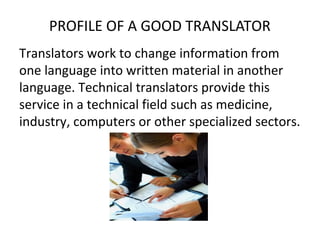
PROFILE OF A GOOD TRANSLATOR
Translators work to change information from
one language into written material in another
language. Technical translators provide this
service in a technical field such as medicine,
industry, computers or other specialized sectors.
TRANSLATOR
Since accuracy is very important in technical
writing and technical translation it requires an
extreme attention to detail as well as an
understanding of both of the languages as well
as the subject matter.
Technical translators that are not fluent in the
language are likely to create flawed translations
that are of no use to the consumer or the client.
TECHNICAL TRANSLATOR
Translator may work from home using the internet to
receive and send projects. Some translators may also work
in publishing companies, libraries or other government
agencies.
Most translators are fluent in using several word processing,
publishing, and even graphic design programs if required,
excellent communication skills, time management skills an
ability to work under pressure for deadlines is part of the
requirements of a technical translator.
Common work Activities for Translator
Researching information on a given subject area and keeping up with the latest technologies and
advancements in the area.
Receiving original documentation in one language and reading through to ensure understanding.
Translating the document into the required language ensuring accuracy and completeness of the
translated document.
Proofreading and editing the translated version, submitting it to the client by the deadline.
Revising or editing the document as needed, changing formats or adding graphics if needed.
Invoicing and collecting fees for translation services provided. Entering into contracts with
companies on an ongoing basis or a contract-by-contract basis for translation services.

traduccion

  • 1.
    UNIVERSIDAD TECNOLOGICA OTEIMA ENGLISHSCHOOL INTRODUCTION TO TRANSLATION TRANSLATION 7TH QUARTER PROFESSOR: ELENA GOMEZ DATE: JANUARY 10TH 2012
  • 2.
    WHAT IS TRANSLATION Theterm "translation" can be generally defined as the action of interpretation of the meaning of a text, and production of an equivalent text that communicates the same message in another language.
  • 3.
    Story of Translation Thereis the story of an old missionary out in the field who needed an assistant. They sent him a young scholar with a Ph.D in theology. When he arrived, the young man had to speak to the natives through the old man because he didn't know the language yet. In his first talk to these simple, but wonderful people, the young man delved deep into his learning and said,"Truth is absolute and relative. The Gospel is absolute truth but its application is relative to immediate needs." When the old missionary heard this, a frown came over his face for a moment. Then he rose to translate and said,"He says he's glad to be here."
  • 4.
    Translation is thecommunication of the meaning of a source-language text by means of an equivalent target-language text. The word translation derives from the Latin translation (which itself comes from trans- and fero, together meaning "to carry across" or "to bring across").
  • 5.
    TRANSLATION Translation is theaction of interpretation of the meaning of a text, and subsequent production of an equivalent text, also called a translation, that communicates the same message in another language. The text to be translated is called the source text, and the language it is to be translated into is called the target language; the final product is sometimes called the "target text."
  • 6.
    Translation must takeinto account constraints that include context, the rules of grammar of the two languages, their writing conventions, and their idioms. A common misconception is that there exists a simple word-for-word correspondence between any two languages, and that translation is a straightforward mechanical process. A word-for-word translation does not take into account context, grammar, conventions, and idioms.
  • 7.
    MISCONCEPTION Another common misconceptionis that anyone who can speak a second language will make a good translator. In the translation community, it is generally accepted that the best translations are produced by persons who are translating into their own native languages, as it is rare for someone who has learned a second language to have total fluency in that language. A good translator understands the source language well, has specific experience in the subject matter of the text, and is a good writer in the target language. Moreover, he is not only bilingual but bicultural.
  • 8.
    PROFILE OF AGOOD TRANSLATOR Translators work to change information from one language into written material in another language. Technical translators provide this service in a technical field such as medicine, industry, computers or other specialized sectors.
  • 9.
    TRANSLATOR Since accuracy isvery important in technical writing and technical translation it requires an extreme attention to detail as well as an understanding of both of the languages as well as the subject matter. Technical translators that are not fluent in the language are likely to create flawed translations that are of no use to the consumer or the client.
  • 10.
    TECHNICAL TRANSLATOR Translator maywork from home using the internet to receive and send projects. Some translators may also work in publishing companies, libraries or other government agencies. Most translators are fluent in using several word processing, publishing, and even graphic design programs if required, excellent communication skills, time management skills an ability to work under pressure for deadlines is part of the requirements of a technical translator.
  • 11.
    Common work Activitiesfor Translator Researching information on a given subject area and keeping up with the latest technologies and advancements in the area. Receiving original documentation in one language and reading through to ensure understanding. Translating the document into the required language ensuring accuracy and completeness of the translated document. Proofreading and editing the translated version, submitting it to the client by the deadline. Revising or editing the document as needed, changing formats or adding graphics if needed. Invoicing and collecting fees for translation services provided. Entering into contracts with companies on an ongoing basis or a contract-by-contract basis for translation services.