






Diversity In Localization
Olga Melnikova
Summer School For Novice Translators And Interpreters
July 4, 2017
About The Speaker: Russian Experience
 Degrees: MA in Creative Writing from Gorky
Literature Institute and MA in Teaching French and
English from Kaluga State University
 2007-2014 – translator for Russian Translation
Company (Ru, En, Fr)
 2010-2012 – court interpreter (Ru, Fr)
 2010-now – futureactually.com - volunteer
About The Speaker: US Experience
 May 2015 – MA in Translation and Localization
Management, Middlebury Institute (MIIS), Monterey,
CA, US
 May 2015 – August 2016: Localization Project
Management Intern at Venga Global, Inc.
 September 2016 – now: Localization Project Manager
at Moravia, Monterey office
About The Speaker: US Experience
 2015 – Amateur Winner of LocJAM, a non-profit
worldwide game localization contest
(www.locjam.org)
 2016 – Pro Winner of LocJAM
 2015 – now – performs with the O’NO band that
plays songs in 10 languages.
Send Your Questions To:
• Email: olgamelnikoff@gmail.com
• Website: olgamelnikoff.com
Resources
• Multilingual.com
• Slator.com
• CommonSenseAdvisory.com (CSA)
• TAUS.com
• Companies blogs (e.g., Moravia)
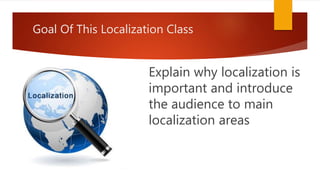
Goal Of This Localization Class
Explain why localization is
important and introduce
the audience to main
localization areas
Agenda
1. What is Localization and Why Is It
Important?
2. Patchwork Localization (CAT Tools and TMS;
Websites, Software And Mobile Apps;
Games, Videos and Voice Recognition;
Machine Translation and Crowdsourcing)
3. How To Become Successful Translator In The
Modern World
Part 1: What Is Localization
And Why Is It
Important?
Is localization a part of translation or T9n is a
part of L10n?
Localization involves taking a product or service and making it linguistically and
culturally appropriate to the target locale (country / region and language) where it
will be used and sold. It can mean “translation”, but not always. Localization is bigger
than translation and it is related to technology.
(M. Troyer, L10n Professor)
Key words:
- product or service (business)
- culturally appropriate (take into consideration who are target users)
- technology (we live in the age of technology)
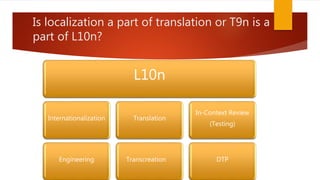
Is localization a part of translation or T9n is a
part of L10n?
L10n
Internationalization
Engineering
Translation
Transcreation
In-Context Review
(Testing)
DTP
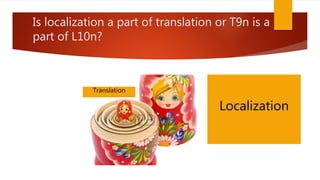
Is localization a part of translation or T9n is a
part of L10n?
Translation
Localization
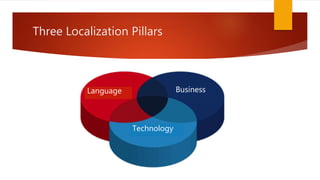
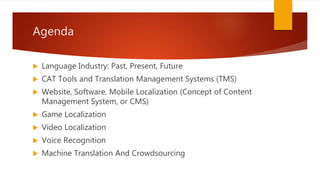
Three Localization Pillars
Language Business
Technology
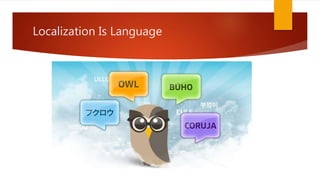
Localization Is Language
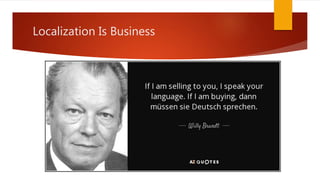
Localization Is Business
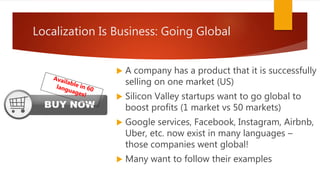
 A company has a product that it is successfully
selling on one market (US)
 Silicon Valley startups want to go global to
boost profits (1 market vs 50 markets)
 Google services, Facebook, Instagram, Airbnb,
Uber, etc. now exist in many languages –
those companies went global!
 Many want to follow their examples
Localization Is Business: Going Global
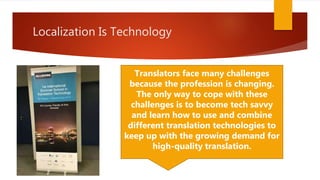
Localization Is Technology
Translators face many challenges
because the profession is changing.
The only way to cope with these
challenges is to become tech savvy
and learn how to use and combine
different translation technologies to
keep up with the growing demand for
high-quality translation.
 The key term is Technology; we now live in a
world of technology
 Today’s reality: if you do not know how to use
technology as a professional, you will not be
successful at the translation market
 L10n is where language (arts) and programming
(science) meet
 Do NOT divide people into 2 groups of
‘humanities-bent’ and ‘science-bent’
Localization Is Technology
Overview Of Part 1 (What Is Localization And
Why Is It Important?)
Language Business
Technology
L10N
Part 2: Patchwork
Localization
Agenda
 Language Industry: Past, Present, Future
 CAT Tools and Translation Management Systems (TMS)
 Website, Software, Mobile Localization (Concept of Content
Management System, or CMS)
 Game Localization
 Video Localization
 Voice Recognition
 Machine Translation And Crowdsourcing
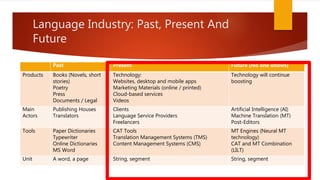
Language Industry: Past, Present And
Future
Past Present Future (No one knows)
Products Books (Novels, short
stories)
Poetry
Press
Documents / Legal
Technology:
Websites, desktop and mobile apps
Marketing Materials (online / printed)
Cloud-based services
Videos
Technology will continue
boosting
Main
Actors
Publishing Houses
Translators
Clients
Language Service Providers
Freelancers
Artificial Intelligence (AI)
Machine Translation (MT)
Post-Editors
Tools Paper Dictionaries
Typewriter
Online Dictionaries
MS Word
CAT Tools
Translation Management Systems (TMS)
Content Management Systems (CMS)
MT Engines (Neural MT
technology)
CAT and MT Combination
(LILT)
Unit A word, a page String, segment String, segment
1. CAT Tools And Translation Management
Systems (TMS)
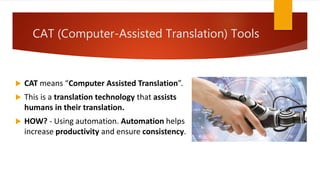
CAT (Computer-Assisted Translation) Tools
 CAT means “Computer Assisted Translation”.
 This is a translation technology that assists
humans in their translation.
 HOW? - Using automation. Automation helps
increase productivity and ensure consistency.
CAT Tools Are Based On Two Main Concepts
 Translation Memory (TM)
 Terminology Database /
Base (TD or TB)
CAT Tools: How It Works
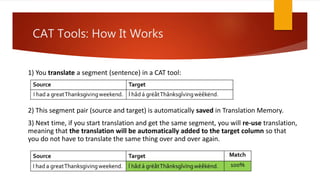
1) You translate a segment (sentence) in a CAT tool:
2) This segment pair (source and target) is automatically saved in Translation Memory.
3) Next time, if you start translation and get the same segment, you will re-use translation,
meaning that the translation will be automatically added to the target column so that
you do not have to translate the same thing over and over again.
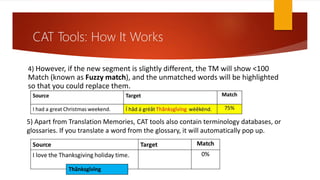
4) However, if the new segment is slightly different, the TM will show <100
Match (known as Fuzzy match), and the unmatched words will be highlighted
so that you could replace them.
5) Apart from Translation Memories, CAT tools also contain terminology databases, or
glossaries. If you translate a word from the glossary, it will automatically pop up.
Thãnksgîvïng
CAT Tools: How It Works
 Never translate the same thing twice
 Consistency (of translation, terminology,
style across projects, products, translators)
 You can finish your translations sooner
(=time saving)
 Cost saving: if you outsource translation to
someone, you will pay less (exact matches
pay only 0-25%, fuzzy matches pay 25-75%
compared to the basic 100% per-word rate)
Main Benefits Of TMs And TDs
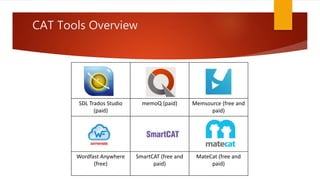
CAT Tools Overview
SDL Trados Studio
(paid)
memoQ (paid) Memsource (free and
paid)
Wordfast Anywhere
(free)
SmartCAT (free and
paid)
MateCat (free and
paid)
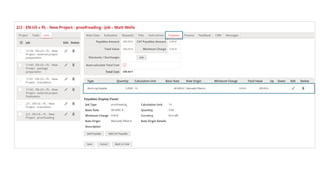
 Project creation
 Analytics
 Vendors DB
 Communication
 Status management
 File exchange
 Finances (POs, Invoices)
Translation Management Systems (TMS)
Example: XTRF
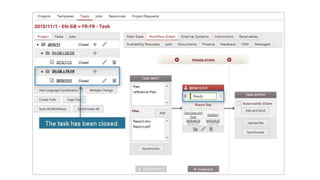
Translation Management System
TMS Overview: Only Few Examples
SDL Worldserver XTRF
Plunet Crowdin
2. Websites, Software, Mobile Apps
(Concept Of CMS)
 Before: Websites, Software (desktop apps, or clients), Mobile
Apps – different things
 Now, those are just “different platforms”, but each product is
existing on all the three platforms
 Two separate worlds: online (servers, websites) and offline
(desktop, mobile) are now being synchronized
 Localization is being done in Content Management System
(CMS), and then the translated strings get pushed to all the
platforms
Concept Of CMS
 Websites, desktop apps and mobile apps are managed via Content
Management Systems, or CMS (the ”engines”), examples:
WordPress, Drupal
 CMS is where you manage the content that gets pushed to all the
platforms
 You can manage content (of your website, for example) even
without being a programmer
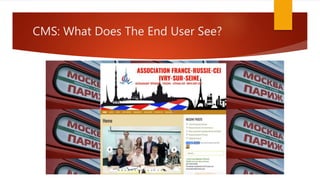
CMS: What Does The End User See?
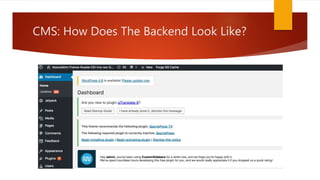
CMS: How Does The Backend Look Like?
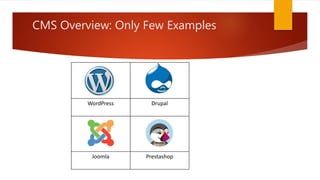
CMS Overview: Only Few Examples
WordPress Drupal
Joomla Prestashop
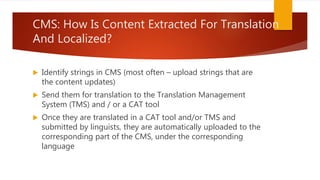
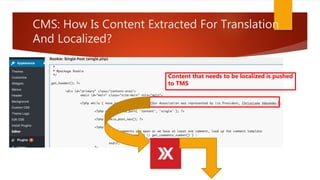
CMS: How Is Content Extracted For Translation
And Localized?
 Identify strings in CMS (most often – upload strings that are
the content updates)
 Send them for translation to the Translation Management
System (TMS) and / or a CAT tool
 Once they are translated in a CAT tool and/or TMS and
submitted by linguists, they are automatically uploaded to the
corresponding part of the CMS, under the corresponding
language
CMS: How Is Content Extracted For Translation
And Localized?
Content that needs to be localized is pushed
to TMS
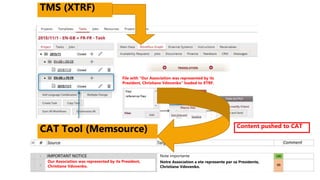
Translation Management System
Our Association was represented by its President,
Christiane Vdovenko.
Notre Association a ete represente par sa Presidente,
Christiane Vdovenko.
Note importante
TMS (XTRF)
Content pushed to CAT
CAT Tool (Memsource)
File with “Our Association was represented by its
President, Christiane Vdovenko” loaded to XTRF.
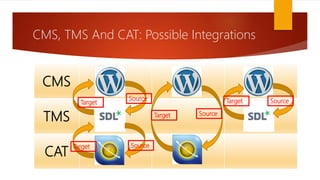
CMS
TMS
CAT
CMS, TMS And CAT: Possible Integrations
Source
SourceSource
Source
Target
Target
Target Target
3. Patchwork Localization: Games
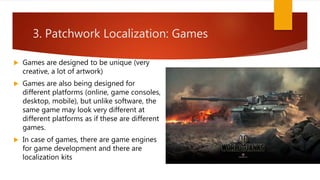
 Games are designed to be unique (very
creative, a lot of artwork)
 Games are also being designed for
different platforms (online, game consoles,
desktop, mobile), but unlike software, the
same game may look very different at
different platforms as if these are different
games.
 In case of games, there are game engines
for game development and there are
localization kits
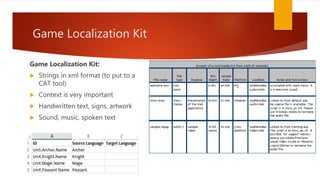
Game Localization Kit
Game Localization Kit:
 Strings in xml format (to put to a
CAT tool)
 Context is very important
 Handwritten text, signs, artwork
 Sound, music, spoken text
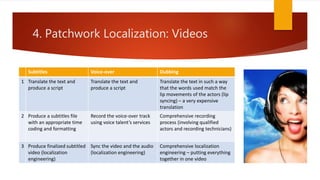
4. Patchwork Localization: Videos
Subtitles Voice-over Dubbing
1 Translate the text and
produce a script
Translate the text and
produce a script
Translate the text in such a way
that the words used match the
lip movements of the actors (lip
syncing) – a very expensive
translation
2 Produce a subtitles file
with an appropriate time
coding and formatting
Record the voice-over track
using voice talent’s services
Comprehensive recording
process (involving qualified
actors and recording technicians)
3 Produce finalized subtitled
video (localization
engineering)
Sync the video and the audio
(localization engineering)
Comprehensive localization
engineering – putting everything
together in one video
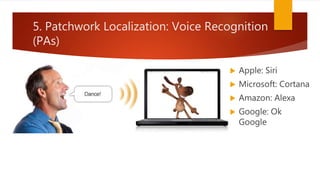
5. Patchwork Localization: Voice Recognition
(PAs)
 Apple: Siri
 Microsoft: Cortana
 Amazon: Alexa
 Google: Ok
Google
6. Machine Translation And Crowdsourcing: Are
They Enemies Of Professional Translators?
 Neural Machine Translation (NMT) - a giant leap in quality improvement compared
to SMT
 MT engine – any company and even a person can train their MT engine
 Big companies each have their MT engine trained (Google, Facebook, Amazon,
eBay)
 99% of all the translation volume is being done by the machine
 Will translators disappear soon?
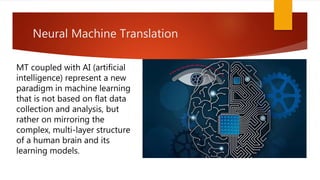
Neural Machine Translation
MT coupled with AI (artificial
intelligence) represent a new
paradigm in machine learning
that is not based on flat data
collection and analysis, but
rather on mirroring the
complex, multi-layer structure
of a human brain and its
learning models.
Machine Translation Is Not Your Enemy!
 Ray Kurzweil and the concept of singularity (human levels of MT by
2029)
 To the question of whether or not NMT means the end of the
translation profession, the answer is “Not Yet”
 Business / Marketing content still needs to be localized / transcreated
by human beings who are experts in target culture and its nuances
(and how to make people buyers)
 MT can be a powerful tool to make you highly productive; it is a base
for emerging technology like LILT (adaptive machine translation,
combination of MT and CAT tool).
Crowdsourcing
 Crowdsourcing –
what is it?
 Examples: Skype,
YouTube
 Voting system
 Impact on Quality
 It is not your enemy because
the contributors are not
professionals, thus cannot
ensure a high level of quality
 In modern world, quality is
important as corporations
do not want their products
to look bad or funny to
other markets (which can
have huge negative impact
on their reputation and
profit)
Part 3: How To Become A
Successful Translator In
Modern World
7. How To Become A Successful Translator In
Modern World
 Platforms: LinkedIn, ProZ
 Credentials (degrees, certifications)
 Specializations (marketing, legal, HR)
 Resume (detailed experience)
 Tools (CMS, TMS, CAT Tools, good with technology, ready to learn)
 Skills (hard skills and soft skills)
 Endorsements and Mentions (including clients reviews)
 Keeping names of your clients confidential
 Membership in Professional Associations, networking
 Readiness to take many non-paid tests and spend a lot of time on self-
promotion
What Matters To USA Companies (Your
Clients)?
 4 main things:
• Excellent target language skills
• Excellent English skills (to
understand the source correctly)
• In-country, not out-of-country:
culture nuances, transcreation
• Excellent product knowledge
 Some other considerations:
• Work hard while you are a student
• Use business language (know how to
write good emails in English)
• Be responsive
• Be reliable
• Be flexible
• Be professional
Conclusion: Where Art Meets Science
 As far as the language industry goes,
there is nothing but localization in
modern world, and if you combine
old-fashioned love for words (arts)
with being strong in technology and
CAT tools (science) and reinforce this
combination with great business
skills, you will be successful in-
demand professional.
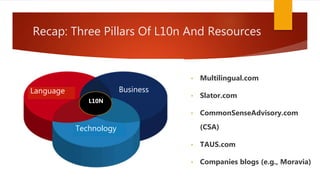
Recap: Three Pillars Of L10n And Resources
Language Business
Technology
L10N
• Multilingual.com
• Slator.com
• CommonSenseAdvisory.com
(CSA)
• TAUS.com
• Companies blogs (e.g., Moravia)
Questions
• Email:
olgamelnikoff@gmail.com
• Website: olgamelnikoff.com

Diversity In Localization (Olga Melnikova)

  • 1.
    Diversity In Localization OlgaMelnikova Summer School For Novice Translators And Interpreters July 4, 2017
  • 2.
    About The Speaker:Russian Experience  Degrees: MA in Creative Writing from Gorky Literature Institute and MA in Teaching French and English from Kaluga State University  2007-2014 – translator for Russian Translation Company (Ru, En, Fr)  2010-2012 – court interpreter (Ru, Fr)  2010-now – futureactually.com - volunteer
  • 3.
    About The Speaker:US Experience  May 2015 – MA in Translation and Localization Management, Middlebury Institute (MIIS), Monterey, CA, US  May 2015 – August 2016: Localization Project Management Intern at Venga Global, Inc.  September 2016 – now: Localization Project Manager at Moravia, Monterey office
  • 4.
    About The Speaker:US Experience  2015 – Amateur Winner of LocJAM, a non-profit worldwide game localization contest (www.locjam.org)  2016 – Pro Winner of LocJAM  2015 – now – performs with the O’NO band that plays songs in 10 languages.
  • 5.
    Send Your QuestionsTo: • Email: olgamelnikoff@gmail.com • Website: olgamelnikoff.com
  • 6.
    Resources • Multilingual.com • Slator.com •CommonSenseAdvisory.com (CSA) • TAUS.com • Companies blogs (e.g., Moravia)
  • 7.
    Goal Of ThisLocalization Class Explain why localization is important and introduce the audience to main localization areas
  • 8.
    Agenda 1. What isLocalization and Why Is It Important? 2. Patchwork Localization (CAT Tools and TMS; Websites, Software And Mobile Apps; Games, Videos and Voice Recognition; Machine Translation and Crowdsourcing) 3. How To Become Successful Translator In The Modern World
  • 9.
    Part 1: WhatIs Localization And Why Is It Important?
  • 10.
    Is localization apart of translation or T9n is a part of L10n? Localization involves taking a product or service and making it linguistically and culturally appropriate to the target locale (country / region and language) where it will be used and sold. It can mean “translation”, but not always. Localization is bigger than translation and it is related to technology. (M. Troyer, L10n Professor) Key words: - product or service (business) - culturally appropriate (take into consideration who are target users) - technology (we live in the age of technology)
  • 11.
    Is localization apart of translation or T9n is a part of L10n? L10n Internationalization Engineering Translation Transcreation In-Context Review (Testing) DTP
  • 12.
    Is localization apart of translation or T9n is a part of L10n? Translation Localization
  • 13.
  • 14.
  • 15.
  • 16.
     A companyhas a product that it is successfully selling on one market (US)  Silicon Valley startups want to go global to boost profits (1 market vs 50 markets)  Google services, Facebook, Instagram, Airbnb, Uber, etc. now exist in many languages – those companies went global!  Many want to follow their examples Localization Is Business: Going Global
  • 17.
    Localization Is Technology Translatorsface many challenges because the profession is changing. The only way to cope with these challenges is to become tech savvy and learn how to use and combine different translation technologies to keep up with the growing demand for high-quality translation.
  • 18.
     The keyterm is Technology; we now live in a world of technology  Today’s reality: if you do not know how to use technology as a professional, you will not be successful at the translation market  L10n is where language (arts) and programming (science) meet  Do NOT divide people into 2 groups of ‘humanities-bent’ and ‘science-bent’ Localization Is Technology
  • 19.
    Overview Of Part1 (What Is Localization And Why Is It Important?) Language Business Technology L10N
  • 20.
  • 21.
    Agenda  Language Industry:Past, Present, Future  CAT Tools and Translation Management Systems (TMS)  Website, Software, Mobile Localization (Concept of Content Management System, or CMS)  Game Localization  Video Localization  Voice Recognition  Machine Translation And Crowdsourcing
  • 22.
    Language Industry: Past,Present And Future Past Present Future (No one knows) Products Books (Novels, short stories) Poetry Press Documents / Legal Technology: Websites, desktop and mobile apps Marketing Materials (online / printed) Cloud-based services Videos Technology will continue boosting Main Actors Publishing Houses Translators Clients Language Service Providers Freelancers Artificial Intelligence (AI) Machine Translation (MT) Post-Editors Tools Paper Dictionaries Typewriter Online Dictionaries MS Word CAT Tools Translation Management Systems (TMS) Content Management Systems (CMS) MT Engines (Neural MT technology) CAT and MT Combination (LILT) Unit A word, a page String, segment String, segment
  • 23.
    1. CAT ToolsAnd Translation Management Systems (TMS)
  • 24.
    CAT (Computer-Assisted Translation)Tools  CAT means “Computer Assisted Translation”.  This is a translation technology that assists humans in their translation.  HOW? - Using automation. Automation helps increase productivity and ensure consistency.
  • 25.
    CAT Tools AreBased On Two Main Concepts  Translation Memory (TM)  Terminology Database / Base (TD or TB)
  • 26.
    CAT Tools: HowIt Works 1) You translate a segment (sentence) in a CAT tool: 2) This segment pair (source and target) is automatically saved in Translation Memory. 3) Next time, if you start translation and get the same segment, you will re-use translation, meaning that the translation will be automatically added to the target column so that you do not have to translate the same thing over and over again.
  • 27.
    4) However, ifthe new segment is slightly different, the TM will show <100 Match (known as Fuzzy match), and the unmatched words will be highlighted so that you could replace them. 5) Apart from Translation Memories, CAT tools also contain terminology databases, or glossaries. If you translate a word from the glossary, it will automatically pop up. Thãnksgîvïng CAT Tools: How It Works
  • 28.
     Never translatethe same thing twice  Consistency (of translation, terminology, style across projects, products, translators)  You can finish your translations sooner (=time saving)  Cost saving: if you outsource translation to someone, you will pay less (exact matches pay only 0-25%, fuzzy matches pay 25-75% compared to the basic 100% per-word rate) Main Benefits Of TMs And TDs
  • 29.
    CAT Tools Overview SDLTrados Studio (paid) memoQ (paid) Memsource (free and paid) Wordfast Anywhere (free) SmartCAT (free and paid) MateCat (free and paid)
  • 30.
     Project creation Analytics  Vendors DB  Communication  Status management  File exchange  Finances (POs, Invoices) Translation Management Systems (TMS) Example: XTRF
  • 31.
  • 34.
    TMS Overview: OnlyFew Examples SDL Worldserver XTRF Plunet Crowdin
  • 35.
    2. Websites, Software,Mobile Apps (Concept Of CMS)  Before: Websites, Software (desktop apps, or clients), Mobile Apps – different things  Now, those are just “different platforms”, but each product is existing on all the three platforms  Two separate worlds: online (servers, websites) and offline (desktop, mobile) are now being synchronized  Localization is being done in Content Management System (CMS), and then the translated strings get pushed to all the platforms
  • 36.
    Concept Of CMS Websites, desktop apps and mobile apps are managed via Content Management Systems, or CMS (the ”engines”), examples: WordPress, Drupal  CMS is where you manage the content that gets pushed to all the platforms  You can manage content (of your website, for example) even without being a programmer
  • 37.
    CMS: What DoesThe End User See?
  • 38.
    CMS: How DoesThe Backend Look Like?
  • 39.
    CMS Overview: OnlyFew Examples WordPress Drupal Joomla Prestashop
  • 40.
    CMS: How IsContent Extracted For Translation And Localized?  Identify strings in CMS (most often – upload strings that are the content updates)  Send them for translation to the Translation Management System (TMS) and / or a CAT tool  Once they are translated in a CAT tool and/or TMS and submitted by linguists, they are automatically uploaded to the corresponding part of the CMS, under the corresponding language
  • 41.
    CMS: How IsContent Extracted For Translation And Localized? Content that needs to be localized is pushed to TMS
  • 42.
    Translation Management System OurAssociation was represented by its President, Christiane Vdovenko. Notre Association a ete represente par sa Presidente, Christiane Vdovenko. Note importante TMS (XTRF) Content pushed to CAT CAT Tool (Memsource) File with “Our Association was represented by its President, Christiane Vdovenko” loaded to XTRF.
  • 43.
    CMS TMS CAT CMS, TMS AndCAT: Possible Integrations Source SourceSource Source Target Target Target Target
  • 44.
    3. Patchwork Localization:Games  Games are designed to be unique (very creative, a lot of artwork)  Games are also being designed for different platforms (online, game consoles, desktop, mobile), but unlike software, the same game may look very different at different platforms as if these are different games.  In case of games, there are game engines for game development and there are localization kits
  • 45.
    Game Localization Kit GameLocalization Kit:  Strings in xml format (to put to a CAT tool)  Context is very important  Handwritten text, signs, artwork  Sound, music, spoken text
  • 46.
    4. Patchwork Localization:Videos Subtitles Voice-over Dubbing 1 Translate the text and produce a script Translate the text and produce a script Translate the text in such a way that the words used match the lip movements of the actors (lip syncing) – a very expensive translation 2 Produce a subtitles file with an appropriate time coding and formatting Record the voice-over track using voice talent’s services Comprehensive recording process (involving qualified actors and recording technicians) 3 Produce finalized subtitled video (localization engineering) Sync the video and the audio (localization engineering) Comprehensive localization engineering – putting everything together in one video
  • 47.
    5. Patchwork Localization:Voice Recognition (PAs)  Apple: Siri  Microsoft: Cortana  Amazon: Alexa  Google: Ok Google
  • 48.
    6. Machine TranslationAnd Crowdsourcing: Are They Enemies Of Professional Translators?  Neural Machine Translation (NMT) - a giant leap in quality improvement compared to SMT  MT engine – any company and even a person can train their MT engine  Big companies each have their MT engine trained (Google, Facebook, Amazon, eBay)  99% of all the translation volume is being done by the machine  Will translators disappear soon?
  • 49.
    Neural Machine Translation MTcoupled with AI (artificial intelligence) represent a new paradigm in machine learning that is not based on flat data collection and analysis, but rather on mirroring the complex, multi-layer structure of a human brain and its learning models.
  • 50.
    Machine Translation IsNot Your Enemy!  Ray Kurzweil and the concept of singularity (human levels of MT by 2029)  To the question of whether or not NMT means the end of the translation profession, the answer is “Not Yet”  Business / Marketing content still needs to be localized / transcreated by human beings who are experts in target culture and its nuances (and how to make people buyers)  MT can be a powerful tool to make you highly productive; it is a base for emerging technology like LILT (adaptive machine translation, combination of MT and CAT tool).
  • 51.
    Crowdsourcing  Crowdsourcing – whatis it?  Examples: Skype, YouTube  Voting system  Impact on Quality  It is not your enemy because the contributors are not professionals, thus cannot ensure a high level of quality  In modern world, quality is important as corporations do not want their products to look bad or funny to other markets (which can have huge negative impact on their reputation and profit)
  • 52.
    Part 3: HowTo Become A Successful Translator In Modern World
  • 53.
    7. How ToBecome A Successful Translator In Modern World  Platforms: LinkedIn, ProZ  Credentials (degrees, certifications)  Specializations (marketing, legal, HR)  Resume (detailed experience)  Tools (CMS, TMS, CAT Tools, good with technology, ready to learn)  Skills (hard skills and soft skills)  Endorsements and Mentions (including clients reviews)  Keeping names of your clients confidential  Membership in Professional Associations, networking  Readiness to take many non-paid tests and spend a lot of time on self- promotion
  • 54.
    What Matters ToUSA Companies (Your Clients)?  4 main things: • Excellent target language skills • Excellent English skills (to understand the source correctly) • In-country, not out-of-country: culture nuances, transcreation • Excellent product knowledge  Some other considerations: • Work hard while you are a student • Use business language (know how to write good emails in English) • Be responsive • Be reliable • Be flexible • Be professional
  • 55.
    Conclusion: Where ArtMeets Science  As far as the language industry goes, there is nothing but localization in modern world, and if you combine old-fashioned love for words (arts) with being strong in technology and CAT tools (science) and reinforce this combination with great business skills, you will be successful in- demand professional.
  • 56.
    Recap: Three PillarsOf L10n And Resources Language Business Technology L10N • Multilingual.com • Slator.com • CommonSenseAdvisory.com (CSA) • TAUS.com • Companies blogs (e.g., Moravia)
  • 57.

Editor's Notes

  • #12 Can include many more