T R A N S L A T I O N.

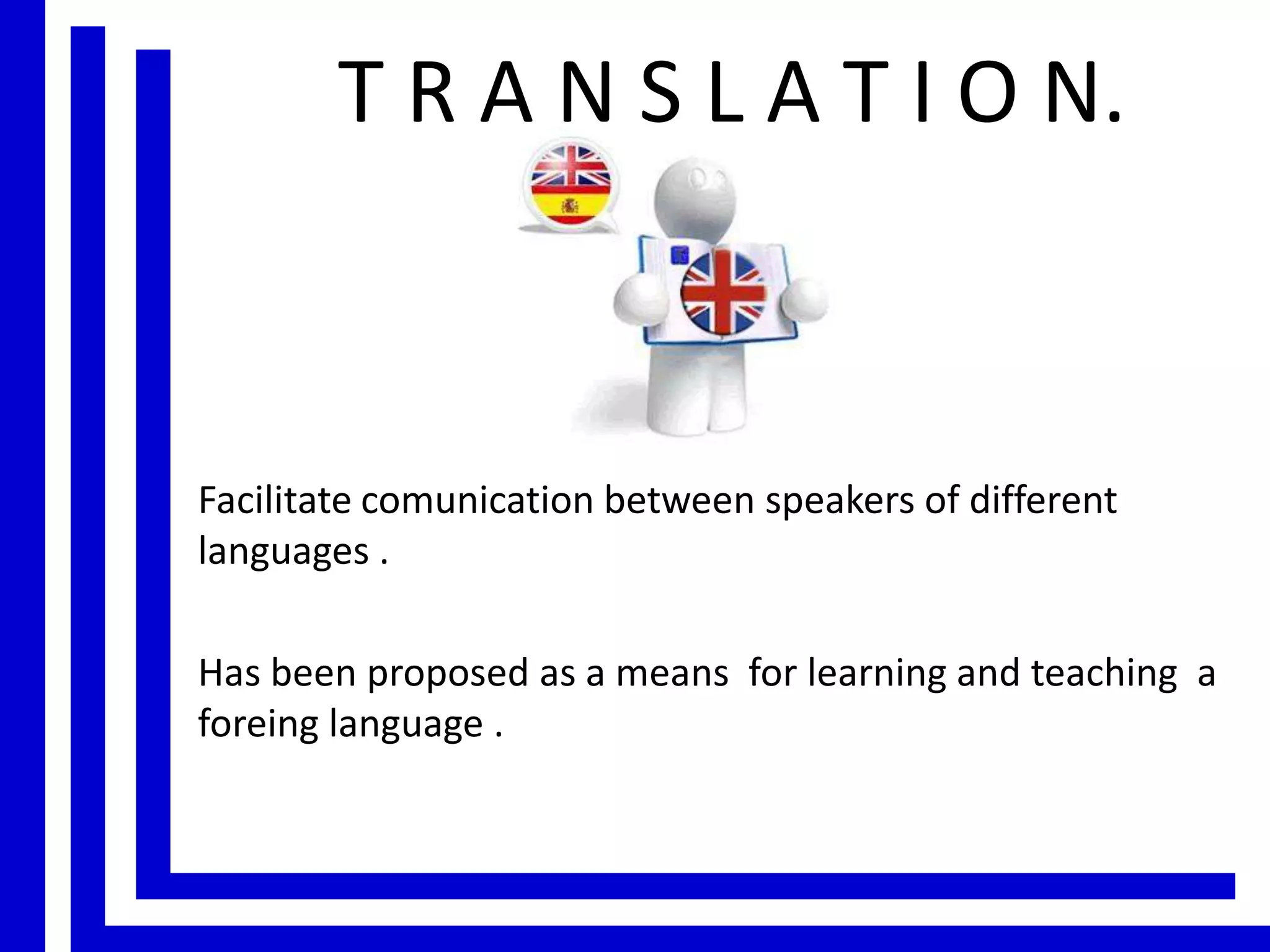
Facilitate comunication between speakers of different
languages .
Has been proposed as a means for learning and teaching a
foreing language .
Translation into the foreing language was also frecuently used. It was the
most common form of speech production in the foreing language
because the student’s mother tongue was spoken in the classroom.
The uses of translation provoked
fierce opposition in the later half of
the
nineteenth
century
by
members
of
the
Reform
Movement. They emphasized the
importance of the spoken mode of
foreing language and took a
decided
stance
agains
the
dominating role of translation in
foreing language teaching

This criticism of
translation as an
excercise
in
the
foreing
language
The opponents of the use of translation in classroom
gained
foreing languages learning claimed that further ground whit
translation into the foreing language interfere the advent of the
audiolingual method.
with the natural process of learning.
Despite this overwhelmingly negative view translation both into the
foreing language and the foreing language has alway been widely
employed as a teaching tecnique in foreing language departements in
secondarty an tiertiary education.

Translation helps in development of
proficiency by economically and ambiguosly
explaing the meaning of foreing language
items
Translation promotes explicit knowledge
about the foreing language and help develop
awareness of differences and similitaries
between native and foreing language system.
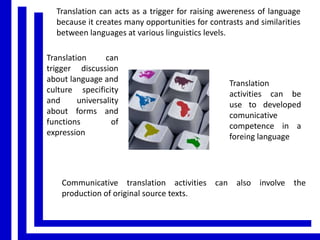
Translation can acts as a trigger for raising awereness of language
because it creates many opportunities for contrasts and similarities
between languages at various linguistics levels.
Translation
can
trigger discussion
about language and
culture specificity
and
universality
about forms and
functions
of
expression

Translation
activities can be
use to developed
comunicative
competence in a
foreing language

Communicative translation activities can also involve the
production of original source texts.
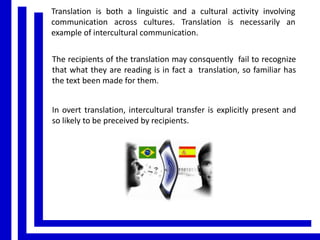
Translation is both a linguistic and a cultural activity involving
communication across cultures. Translation is necessarily an
example of intercultural communication.
The recipients of the translation may consquently fail to recognize
that what they are reading is in fact a translation, so familiar has
the text been made for them.

In overt translation, intercultural transfer is explicitly present and
so likely to be preceived by recipients.
Translation is an ambiguos term; is a countable noun, it is used to
denote a product; as an uncountable noun, it denotes a
process, namely how you arrive at the product.

To translate one method use is in internal way; this is know as
thinking aloudor introspection.
One can also ask translators immediately afther the finish
translating about difficulties, reasons for this hesitations and delay
, a partircular choice of words, and so on: this is known as
restrospection.
In using the term procces of translation, we must bear in mind that
we are here dealing not just with one particular unitary process but
with a complex series of problem-solving and decision making
operations.

The use of corpora in translation studies as a tool for tranlsators is
becoming one of the fastest-growing and most promising areas of
empirical translation work.

Corpus: A collection of actually produced language in the form of
written texts or transcription of spoken usage.
Parallel Corpora: consist of a corpus in a language and a corpus of
their translation in another.
Comparable Corpora: contain both sets of translated texts and nontranslated texts in the same language for the purpose of
comparison
Globalization:
Global
process
of
economic, political, social, cultural, and
information distribution across the
globle.
Localization: Process of adapting products or
information technology to local markets.
Glocalization: Combination of globalization and localization: the
process of tailoring products to meet the diverse needs of many
specifics local markets

Translating process

  • 1.
    T R AN S L A T I O N. Facilitate comunication between speakers of different languages . Has been proposed as a means for learning and teaching a foreing language .
  • 2.
    Translation into theforeing language was also frecuently used. It was the most common form of speech production in the foreing language because the student’s mother tongue was spoken in the classroom. The uses of translation provoked fierce opposition in the later half of the nineteenth century by members of the Reform Movement. They emphasized the importance of the spoken mode of foreing language and took a decided stance agains the dominating role of translation in foreing language teaching This criticism of translation as an excercise in the foreing language The opponents of the use of translation in classroom gained foreing languages learning claimed that further ground whit translation into the foreing language interfere the advent of the audiolingual method. with the natural process of learning.
  • 3.
    Despite this overwhelminglynegative view translation both into the foreing language and the foreing language has alway been widely employed as a teaching tecnique in foreing language departements in secondarty an tiertiary education. Translation helps in development of proficiency by economically and ambiguosly explaing the meaning of foreing language items Translation promotes explicit knowledge about the foreing language and help develop awareness of differences and similitaries between native and foreing language system.
  • 4.
    Translation can actsas a trigger for raising awereness of language because it creates many opportunities for contrasts and similarities between languages at various linguistics levels. Translation can trigger discussion about language and culture specificity and universality about forms and functions of expression Translation activities can be use to developed comunicative competence in a foreing language Communicative translation activities can also involve the production of original source texts.
  • 5.
    Translation is botha linguistic and a cultural activity involving communication across cultures. Translation is necessarily an example of intercultural communication. The recipients of the translation may consquently fail to recognize that what they are reading is in fact a translation, so familiar has the text been made for them. In overt translation, intercultural transfer is explicitly present and so likely to be preceived by recipients.
  • 6.
    Translation is anambiguos term; is a countable noun, it is used to denote a product; as an uncountable noun, it denotes a process, namely how you arrive at the product. To translate one method use is in internal way; this is know as thinking aloudor introspection. One can also ask translators immediately afther the finish translating about difficulties, reasons for this hesitations and delay , a partircular choice of words, and so on: this is known as restrospection.
  • 7.
    In using theterm procces of translation, we must bear in mind that we are here dealing not just with one particular unitary process but with a complex series of problem-solving and decision making operations. The use of corpora in translation studies as a tool for tranlsators is becoming one of the fastest-growing and most promising areas of empirical translation work. Corpus: A collection of actually produced language in the form of written texts or transcription of spoken usage.
  • 8.
    Parallel Corpora: consistof a corpus in a language and a corpus of their translation in another. Comparable Corpora: contain both sets of translated texts and nontranslated texts in the same language for the purpose of comparison Globalization: Global process of economic, political, social, cultural, and information distribution across the globle. Localization: Process of adapting products or information technology to local markets. Glocalization: Combination of globalization and localization: the process of tailoring products to meet the diverse needs of many specifics local markets