Translation Studies
for
Intermediate
Spanish Language Courses
SOUTHWEST CENTER FOR LANGUAGE
Compiled by Mrs. J. Vaughn & Dr. R. Baker
Final Objective
To be able to work autonomously in the
task of rendering an accurate English
translation of a given Spanish text. To
include authoring, self critiquing for
errors in translation and English
grammar, as well as, correctly
modifying and revising to improve the
quality and accuracy of the translation.
What is the definition of TRANSLATION?
Translation n.
1 the act or an instance of translating.
2 a written or spoken expression of the
meaning of a word, speech, book, etc. in
another language.
(The Concise Oxford English Dictionary)
Translation is an idea that can be
understood in many different ways.
Translation is a process of decoding and
recoding
to create a product.
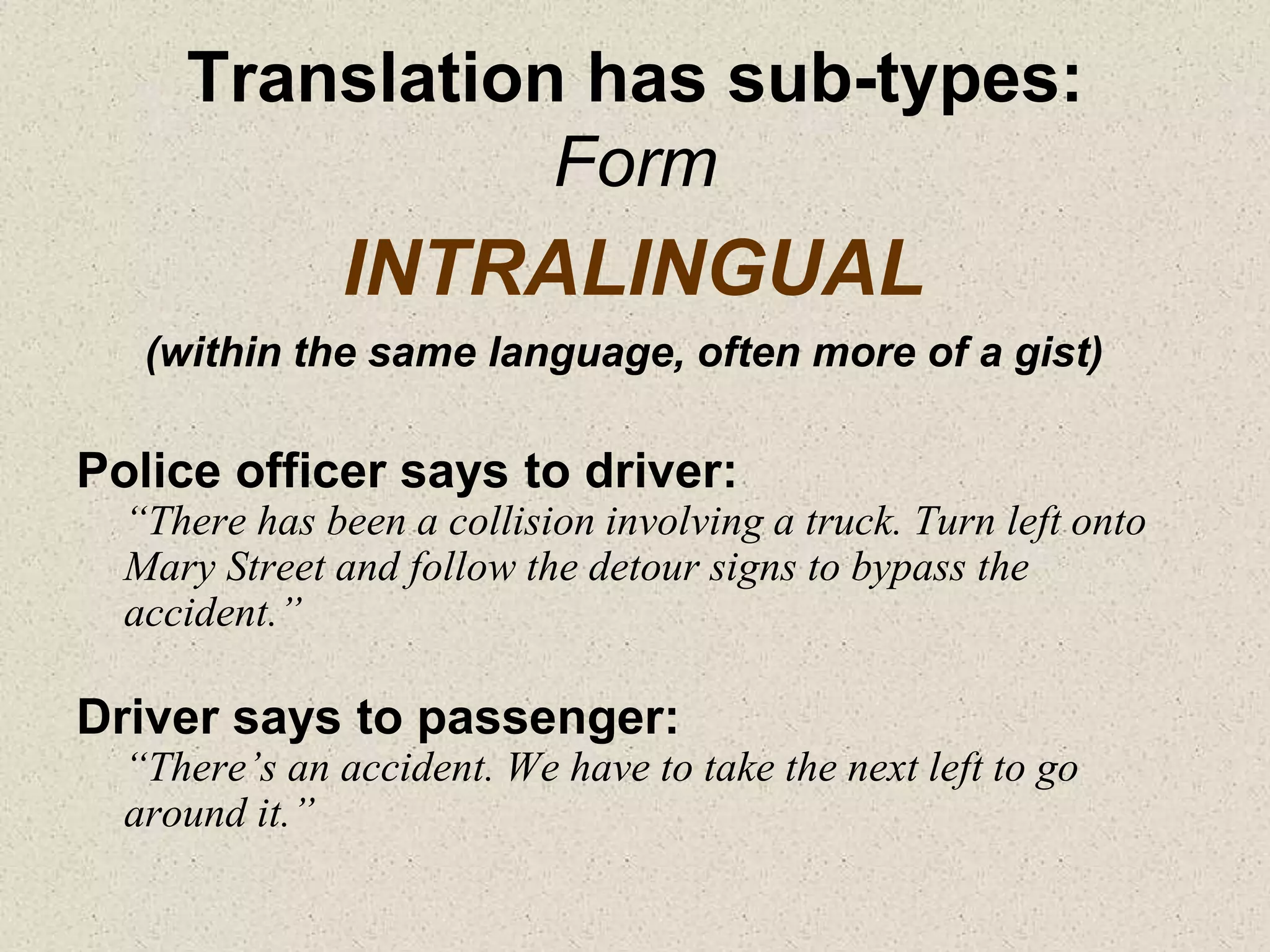
Translation has sub-types:
Form
INTRALINGUAL
(within the same language, often more of a gist)
Police officer says to driver:
“There has been a collision involving a truck. Turn left onto
Mary Street and follow the detour signs to bypass the
accident.”
Driver says to passenger:
“There’s an accident. We have to take the next left to go
around it.”
Interlingual
(between languages)
i.e. Spanish to English
Intersemiotic
(non-verbal language to verbal language)
“go”
• Written texts
• Literary (novels, plays)
• Technical (manuals, instructions)
• Legal (contracts)
• Medical, Scientific & Pharmaceutical (specialized)
• Audiovisual
Subtitling, dubbing
Translation has sub-types:
Type
Translation has sub-types:
Type
> Word-for-Word
> Literal
> Balanced (idiomatic)
> Free
> Gist
Balanced IdiomaticTranslation
• Respect the author’s intentions.
Use the style given.
Express the thoughts of someone else,
using that person’s style and words.
Use the words provided—don’t be too free
in your decision about English
equivalents.
• Preserve the content, sense & format.
Don’t add information that is not in the text.
• Design for your audience.
When you create a translation,
what are your objectives?

Translation principles

  • 1.
    Translation Studies for Intermediate Spanish LanguageCourses SOUTHWEST CENTER FOR LANGUAGE Compiled by Mrs. J. Vaughn & Dr. R. Baker
  • 2.
    Final Objective To beable to work autonomously in the task of rendering an accurate English translation of a given Spanish text. To include authoring, self critiquing for errors in translation and English grammar, as well as, correctly modifying and revising to improve the quality and accuracy of the translation.
  • 3.
    What is thedefinition of TRANSLATION? Translation n. 1 the act or an instance of translating. 2 a written or spoken expression of the meaning of a word, speech, book, etc. in another language. (The Concise Oxford English Dictionary)
  • 4.
    Translation is anidea that can be understood in many different ways. Translation is a process of decoding and recoding to create a product.
  • 5.
    Translation has sub-types: Form INTRALINGUAL (withinthe same language, often more of a gist) Police officer says to driver: “There has been a collision involving a truck. Turn left onto Mary Street and follow the detour signs to bypass the accident.” Driver says to passenger: “There’s an accident. We have to take the next left to go around it.”
  • 6.
  • 7.
    Intersemiotic (non-verbal language toverbal language) “go”
  • 8.
    • Written texts •Literary (novels, plays) • Technical (manuals, instructions) • Legal (contracts) • Medical, Scientific & Pharmaceutical (specialized) • Audiovisual Subtitling, dubbing Translation has sub-types: Type
  • 9.
    Translation has sub-types: Type >Word-for-Word > Literal > Balanced (idiomatic) > Free > Gist
  • 10.
    Balanced IdiomaticTranslation • Respectthe author’s intentions. Use the style given. Express the thoughts of someone else, using that person’s style and words. Use the words provided—don’t be too free in your decision about English equivalents. • Preserve the content, sense & format. Don’t add information that is not in the text. • Design for your audience. When you create a translation, what are your objectives?