TRANSLATION TECHNIQUES
Task 5: Collaborative Activity 2
PRESENTED BY:
VIANA ANDREA VACA REMICIO
CODE: 1.110.176.197
Group: 551037A-362
PRESENTED TO:
CAMILO CENDALES
NATIONAL UNIVERSITY OPEN AND DISTANCE – UNAD
BACHELOR IN TEACHING ENGLISH AS A FOREIGN LANGUAGE
AUGUST OF 2017
Essay
Postulate:
Later Duff, (1989) identifies three essential purposes of translation as an activity in
language learning: accuracy, clarity and flexibility. He argues that translation "trains the
learner to search (flexibility) for the most appropriate words (accuracy) to convey what
is meant (clarity).
Translation is an increasingly practical and useful activity in the world increasingly
globalized in which we live.
When the student embarks on the search for satisfactory solutions to the challenges that
arise in the translation, it promotes a deeper understanding of the meaning, structure and
use of the language - both of the mother and of what is being learned.
The translation sensitizes the student to the semantic, syntactic, style and cultural
differences that exist between the two languages.
Reflection with the student on the differences and similarities between the languages he
/ she translates will help you to understand the interaction between the two and therefore
avoid certain frequent mistakes. The more limited use of passive voice and pronouns of
subjects in Spanish, compared to English, constitute two examples of the frequent errors
of the English-speaking student, whose incidence can be minimized through the practice
of communicative translation.
Through their exercise, students learn that translation is not more word-for-word
substitution. This leads them to disprove for themselves the myth of the existence of an
exact equivalence of words and expressions between the two languages.
In addition to these points, and although it is important to distinguish between of
translation to future translators and the teaching of translation as pedagogical tool in the
class of ELE, during the practice of translation in either of these two modalities the
student will adopt the role of mediator between cultures, which will lead him to develop
valuable intercultural skills. It is important to emphasize a greater sensitivity to identify
cultural differences and a greater tolerance for the customs and culture of the other,
rooted in their understanding of them.
Finally, although the data available so far are limited, they indicate that students
consider translation exercises useful for learning a foreign language.
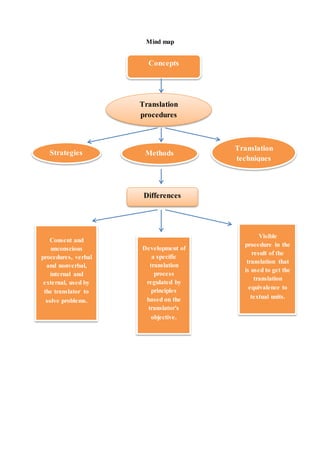
Mind map
Concepts
Translation
procedures
Strategies Methods
Translation
techniques
Visible
procedure in the
result of the
translation that
is used to get the
translation
equivalence to
textual units.
Consent and
unconscious
procedures, verbal
and nonverbal,
internal and
external, used by
the translator to
solve problems.
Development of
a specific
translation
process
regulated by
principles
based on the
translator's
objective.
Differences

Word document complete_andreavaca

  • 1.
    TRANSLATION TECHNIQUES Task 5:Collaborative Activity 2 PRESENTED BY: VIANA ANDREA VACA REMICIO CODE: 1.110.176.197 Group: 551037A-362 PRESENTED TO: CAMILO CENDALES NATIONAL UNIVERSITY OPEN AND DISTANCE – UNAD BACHELOR IN TEACHING ENGLISH AS A FOREIGN LANGUAGE AUGUST OF 2017
  • 2.
    Essay Postulate: Later Duff, (1989)identifies three essential purposes of translation as an activity in language learning: accuracy, clarity and flexibility. He argues that translation "trains the learner to search (flexibility) for the most appropriate words (accuracy) to convey what is meant (clarity). Translation is an increasingly practical and useful activity in the world increasingly globalized in which we live. When the student embarks on the search for satisfactory solutions to the challenges that arise in the translation, it promotes a deeper understanding of the meaning, structure and use of the language - both of the mother and of what is being learned. The translation sensitizes the student to the semantic, syntactic, style and cultural differences that exist between the two languages. Reflection with the student on the differences and similarities between the languages he / she translates will help you to understand the interaction between the two and therefore avoid certain frequent mistakes. The more limited use of passive voice and pronouns of subjects in Spanish, compared to English, constitute two examples of the frequent errors of the English-speaking student, whose incidence can be minimized through the practice of communicative translation. Through their exercise, students learn that translation is not more word-for-word substitution. This leads them to disprove for themselves the myth of the existence of an exact equivalence of words and expressions between the two languages. In addition to these points, and although it is important to distinguish between of translation to future translators and the teaching of translation as pedagogical tool in the class of ELE, during the practice of translation in either of these two modalities the student will adopt the role of mediator between cultures, which will lead him to develop valuable intercultural skills. It is important to emphasize a greater sensitivity to identify cultural differences and a greater tolerance for the customs and culture of the other, rooted in their understanding of them. Finally, although the data available so far are limited, they indicate that students consider translation exercises useful for learning a foreign language.
  • 3.
    Mind map Concepts Translation procedures Strategies Methods Translation techniques Visible procedurein the result of the translation that is used to get the translation equivalence to textual units. Consent and unconscious procedures, verbal and nonverbal, internal and external, used by the translator to solve problems. Development of a specific translation process regulated by principles based on the translator's objective. Differences