THE PROCESS OF
TRANSLATION
Prof. Ivette Sánchez
THE PROCESS OF
TRANSLATION
 INTRODUCTION:
 The basic elements in a translation are:
The text
The source language
The target language
The translator
SPECIFIC ELEMENTS IN THE
COMMUNICATIVE PROCESS:
 SENDER (SPEAKER / WRITER)
 RECEIVER (HEARER / READER)
 TOPIC (INFORMATION)
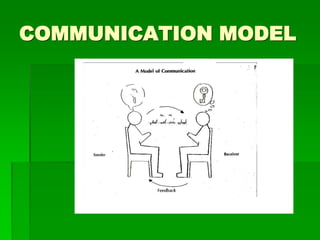
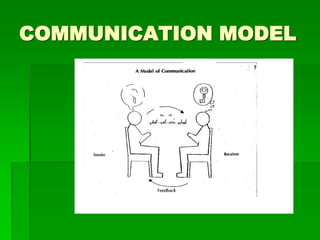
COMMUNICATION MODEL
Analysis of the previous example of
a communicative model
 Is there a situation in
which you have a
person transmitting a
message?
 Is there a person
receiving the
message?
 Are they
communicating?
 Is it oral or written
communication?
 If oral, is there a
dialogue going on?
 Can dialogues
happen only in oral
communication?
 How can one solve
oral or written
miscommunication?
GRASPING MEANING WHEN
TRANSLATING A TEXT
 There is immediate feedback in oral
communication, right?
 How do we start solving this in written
communication? How do we know if we understand
the written message to interpret it into another
language?
 Is it fundamental to grasp meaning when translating
a text?
 What do we do to solve “real” communication, to
minimize miscommunication in written texts?
 Remember! There is no instant feedback for
instant verification!
LANGUAGE FUNCTIONS
 The use of language to
communicate for specific
purposes; the “real” meaning
behind a word or grammatical
structure when placed in a
context, i.e. language used
strategically, for specific
purposes.
Examples of the use of language
for specific purposes
 When translating from English into
Spanish or vice versa:
The many linguistic, formal or informal,
ways to “agree” or “disagree,” to express
“likes” and “dislikes ,” to “predict,” “to
summarize,” to greet and to introduce,”
“to ask questions,” “to persuade,” “to
compare or contrast,” “to express cause
and effect” and “to sequence events.”
LANGUAGE FUNCTIONS
CLASSIFICATION
 INFORMATIVE FUNCTION: To convey information
to convince the reader. To use descriptive, declarative
or informative language forms. The main object is to
provide information about a given topic.
 EXPRESSIVE FUNCTION: To use effective or
emotive forms, mainly expressing the speaker's state
of mind or feeling.
 VOCATIVE/DIRECTIVE FUNCTION: imperative
form, primarily seeking to bring out certain behavior in
the hearer
OTHER CONSIDERATIONS:
 Together with a study of the elements
found in the Model of Communication
and language functions previously
discussed here, the understanding of text
types greatly contributes to pinpointing a
text’s meaning through an analysis of
“the seven standards of textuality –
Cohesion, Coherence, Intentionality,
Acceptability, Informativity, Situationality
and Intertextuality” of a specific text.
TEXT-TYPE No. 1: NARRATIVE
This text is used to talk
about characters,
plots, settings,
themes through
vocabulary, idioms
figures of speech,
different registers,
etc. all contributing to
transmitting an
experience, real or
imaginary.
 Examples:
Literary genres:
adventures,
mysteries, fiction,
non-fiction, myths,
playscripts, fables,
tales, film narratives,
poetry and others.
TEXT-TYPE No. 2: DESCRIPTIVE
 This text-type describes
the characteristics of a
person, object, image or
place. This type of text
enables the reader to
see, to feel, to hear, to
smell and to taste what
the author has seen,
felt, heard, smelt and
tasted.
 Examples: A
descriptive essay may
talk about a physical
appearance, appeal to
our sense of smell
before moving on to
describe the layout and
contents of the room or
to any number of things.
TEXT TYPE No. 3: Argumentative
 It uses reasoned,
logical evidence
provided as proof for
assertions or claims.
The author’s
intention is to
persuade the reader
to change his/her
mind, to agree with
him/her.
 Examples: Claim
letters, legal
documents, debates,
ads.
TEXT TYPE No. 4:
EXPLANATORY /INSTRUCTIVE
 It is a text that gives
procedures, talks about
processes, tells the
reader what to do and
how to do it, includes
information about
causes, motives or
reasons.
 Examples:
 Manuals, summaries,
reports, recipes,
addresses, letters of
instructions,
commercial and
political propaganda,
regulations, rules etc.
TEXT TYPES No. 5: EXPOSITIVE
 Objects and ideas
are explained in
their
interrelationships. It
is information-
based;
 details and steps
are given in
chronological order.
 Some common
examples are:
 Textbooks
 News articles
 Instruction manuals
 Recipes
 City or country guides
 Language books
 Self-help books
3 BASIC LANGUAGE FUNCTIONS +
TEXT TYPES:
 INFORMATIVE: Translated into prose with expansions
and explanations where necessary (paraphrasing) to
include its level of reality to complete or secure the
reader’s understanding. The text is structured primarily
on the semantic-syntactic level.
 Naturalness is essential.
- REFERENCE BOOK REPORTS
- TECHNICAL TEXTS: OPERATING INSTRUCTIONS
(MANUALS)
- LECTURES
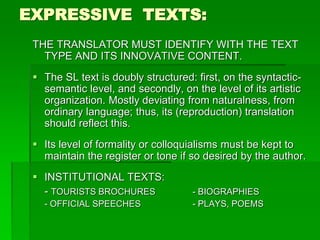
EXPRESSIVE TEXTS:
THE TRANSLATOR MUST IDENTIFY WITH THE TEXT
TYPE AND ITS INNOVATIVE CONTENT.
 The SL text is doubly structured: first, on the syntactic-
semantic level, and secondly, on the level of its artistic
organization. Mostly deviating from naturalness, from
ordinary language; thus, its (reproduction) translation
should reflect this.
 Its level of formality or colloquialisms must be kept to
maintain the register or tone if so desired by the author.
 INSTITUTIONAL TEXTS:
- TOURISTS BROCHURES - BIOGRAPHIES
- OFFICIAL SPEECHES - PLAYS, POEMS
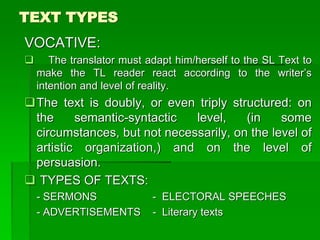
TEXT TYPES
VOCATIVE:
 The translator must adapt him/herself to the SL Text to
make the TL reader react according to the writer’s
intention and level of reality.
The text is doubly, or even triply structured: on
the semantic-syntactic level, (in some
circumstances, but not necessarily, on the level of
artistic organization,) and on the level of
persuasion.
 TYPES OF TEXTS:
- SERMONS - ELECTORAL SPEECHES
- ADVERTISEMENTS - Literary texts
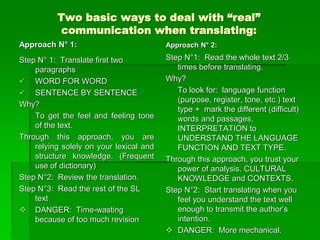
Two basic ways to deal with “real”
communication when translating:
Approach N° 1:
Step N° 1: Translate first two
paragraphs
 WORD FOR WORD
 SENTENCE BY SENTENCE
Why?
To get the feel and feeling tone
of the text.
Through this approach, you are
relying solely on your lexical and
structure knowledge. (Frequent
use of dictionary)
Step N°2: Review the translation.
Step N°3: Read the rest of the SL
text
 DANGER: Time-wasting
because of too much revision
Approach N° 2:
Step N°1: Read the whole text 2/3
times before translating.
Why?
To look for: language function
(purpose, register, tone, etc.) text
type + mark the different (difficult)
words and passages,
INTERPRETATION to
UNDERSTAND THE LANGUAGE
FUNCTION AND TEXT TYPE.
Through this approach, you trust your
power of analysis, CULTURAL
KNOWLEDGE and CONTEXTS.
Step N°2: Start translating when you
feel you understand the text well
enough to transmit the author’s
intention.
 DANGER: More mechanical.
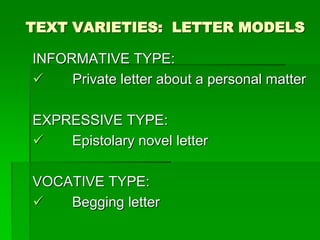
TEXT VARIETIES: LETTER MODELS
INFORMATIVE TYPE:
 Private letter about a personal matter
EXPRESSIVE TYPE:
 Epistolary novel letter
VOCATIVE TYPE:
 Begging letter
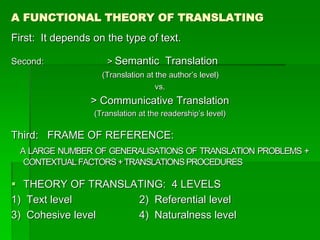
A FUNCTIONAL THEORY OF TRANSLATING
First: It depends on the type of text.
Second: > Semantic Translation
(Translation at the author’s level)
vs.
> Communicative Translation
(Translation at the readership’s level)
Third: FRAME OF REFERENCE:
A LARGE NUMBER OF GENERALISATIONS OF TRANSLATION PROBLEMS +
CONTEXTUALFACTORS+TRANSLATIONSPROCEDURES
 THEORY OF TRANSLATING: 4 LEVELS
1) Text level 2) Referential level
3) Cohesive level 4) Naturalness level
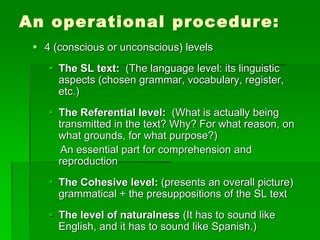
An operational procedure:
 4 (conscious or unconscious) levels
 The SL text: (The language level: its linguistic
aspects (chosen grammar, vocabulary, register,
etc.)
 The Referential level: (What is actually being
transmitted in the text? Why? For what reason, on
what grounds, for what purpose?)
An essential part for comprehension and
reproduction
 The Cohesive level: (presents an overall picture)
grammatical + the presuppositions of the SL text
 The level of naturalness (It has to sound like
English, and it has to sound like Spanish.)
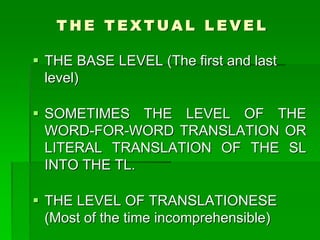
T H E T E X T U A L L E V E L
 THE BASE LEVEL (The first and last
level)
 SOMETIMES THE LEVEL OF THE
WORD-FOR-WORD TRANSLATION OR
LITERAL TRANSLATION OF THE SL
INTO THE TL.
 THE LEVEL OF TRANSLATIONESE
(Most of the time incomprehensible)
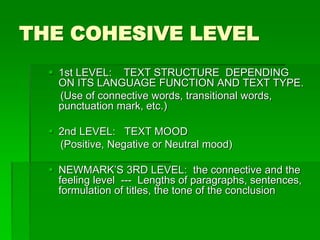
THE COHESIVE LEVEL
 1st LEVEL: TEXT STRUCTURE DEPENDING
ON ITS LANGUAGE FUNCTION AND TEXT TYPE.
(Use of connective words, transitional words,
punctuation mark, etc.)
 2nd LEVEL: TEXT MOOD
(Positive, Negative or Neutral mood)
 NEWMARK’S 3RD LEVEL: the connective and the
feeling level --- Lengths of paragraphs, sentences,
formulation of titles, the tone of the conclusion
THE LEVEL OF NATURALNESS
 TRANSLATIONS MUST MAKE SENSE
 TRANSLATIONS MUST READ NATURALLY
AS A TRANSLATOR:
 MAKE DECISIONS ON TYPE OF LANGUAGE
ACCORDING TO THE ELEMENTS OF THE
COMMUNICATION MODEL, LANGUAGE
LEVEL AND TYPE OF TEXT OR TOPIC.
 USE OF VOCABULARY AND GRAMMAR TO
TRANSMIT “EXACT” MESSAGE.
COMMUNICATION MODEL
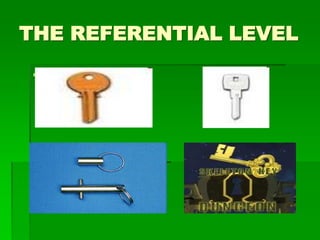
THE REFERENTIAL LEVEL
 THREE BASIC
LANGUAGE
FUNCTIONS:
-What’s going on in these
pictures?
-What do you see that makes
you say that?
-What more can you find?
-Which one is it?
-What other information do we
need to determine what the
topic is about?
How do you get the feeling for
naturalness, both as a foreigner and as a
native speaker? (Peter Newmark)
1) Read
representative
texts.
3) Check and cross-
check words and
expressions in an
updated dictionary
2) Talk with
representative TL
speakers.
4) Note any
suspicious word or
half-taken for
granted.
Natural usage comprises a variety of
idioms/styles/registers determined by:
1) The ‘setting’: the place it is
published or found.
 Which variety of language is it—natural,
ordinary or basic? The quality of the
language used?
 ‘Would you ever see this type of usage
in The Times?’ (Natural usage)
 Ordinary usage: plain non-technical
idiom.
 Basic usage: easily understood,
between formal and informal, most
frequent syntax and lexie.
2) The author, topic
and readership
 The individual style or
idiolect of the author,
his/her standards
 The intention of the text
and the manner of
development of the topic
 The type of readership:
the expert, the educated,
middle-class layman or
the uninformed reader
THE APPROACHES:
APPROACH No. 1 (2 ways)
1) Word-for-word translation, where each
word has an equivalent linguistic unit with
its sometimes numerous equivalent lexical
entries. (Word equivalence)
2) Literal translation, where sentence-for-
sentence is translated and the syntax is
adapted to the TT. (Grammatical
equivalence)
APPROACH NO. 2
1) Holistic translation, where the whole text is
first read and analyzed looking for
intention, register, tone and marking
cultural and linguistic differences/
difficulties in words and passages
(a total communicative event content,
meaning + effect equivalence)
Let’s apply what has been
discussed here to the
following example.
Chapter 3 The Process of Translation Chapter 3

Chapter 3 The Process of Translation Chapter 3

  • 1.
  • 2.
    THE PROCESS OF TRANSLATION INTRODUCTION:  The basic elements in a translation are: The text The source language The target language The translator
  • 3.
    SPECIFIC ELEMENTS INTHE COMMUNICATIVE PROCESS:  SENDER (SPEAKER / WRITER)  RECEIVER (HEARER / READER)  TOPIC (INFORMATION)
  • 4.
  • 5.
    Analysis of theprevious example of a communicative model  Is there a situation in which you have a person transmitting a message?  Is there a person receiving the message?  Are they communicating?  Is it oral or written communication?  If oral, is there a dialogue going on?  Can dialogues happen only in oral communication?  How can one solve oral or written miscommunication?
  • 6.
    GRASPING MEANING WHEN TRANSLATINGA TEXT  There is immediate feedback in oral communication, right?  How do we start solving this in written communication? How do we know if we understand the written message to interpret it into another language?  Is it fundamental to grasp meaning when translating a text?  What do we do to solve “real” communication, to minimize miscommunication in written texts?  Remember! There is no instant feedback for instant verification!
  • 7.
    LANGUAGE FUNCTIONS  Theuse of language to communicate for specific purposes; the “real” meaning behind a word or grammatical structure when placed in a context, i.e. language used strategically, for specific purposes.
  • 8.
    Examples of theuse of language for specific purposes  When translating from English into Spanish or vice versa: The many linguistic, formal or informal, ways to “agree” or “disagree,” to express “likes” and “dislikes ,” to “predict,” “to summarize,” to greet and to introduce,” “to ask questions,” “to persuade,” “to compare or contrast,” “to express cause and effect” and “to sequence events.”
  • 9.
    LANGUAGE FUNCTIONS CLASSIFICATION  INFORMATIVEFUNCTION: To convey information to convince the reader. To use descriptive, declarative or informative language forms. The main object is to provide information about a given topic.  EXPRESSIVE FUNCTION: To use effective or emotive forms, mainly expressing the speaker's state of mind or feeling.  VOCATIVE/DIRECTIVE FUNCTION: imperative form, primarily seeking to bring out certain behavior in the hearer
  • 10.
    OTHER CONSIDERATIONS:  Togetherwith a study of the elements found in the Model of Communication and language functions previously discussed here, the understanding of text types greatly contributes to pinpointing a text’s meaning through an analysis of “the seven standards of textuality – Cohesion, Coherence, Intentionality, Acceptability, Informativity, Situationality and Intertextuality” of a specific text.
  • 11.
    TEXT-TYPE No. 1:NARRATIVE This text is used to talk about characters, plots, settings, themes through vocabulary, idioms figures of speech, different registers, etc. all contributing to transmitting an experience, real or imaginary.  Examples: Literary genres: adventures, mysteries, fiction, non-fiction, myths, playscripts, fables, tales, film narratives, poetry and others.
  • 12.
    TEXT-TYPE No. 2:DESCRIPTIVE  This text-type describes the characteristics of a person, object, image or place. This type of text enables the reader to see, to feel, to hear, to smell and to taste what the author has seen, felt, heard, smelt and tasted.  Examples: A descriptive essay may talk about a physical appearance, appeal to our sense of smell before moving on to describe the layout and contents of the room or to any number of things.
  • 13.
    TEXT TYPE No.3: Argumentative  It uses reasoned, logical evidence provided as proof for assertions or claims. The author’s intention is to persuade the reader to change his/her mind, to agree with him/her.  Examples: Claim letters, legal documents, debates, ads.
  • 14.
    TEXT TYPE No.4: EXPLANATORY /INSTRUCTIVE  It is a text that gives procedures, talks about processes, tells the reader what to do and how to do it, includes information about causes, motives or reasons.  Examples:  Manuals, summaries, reports, recipes, addresses, letters of instructions, commercial and political propaganda, regulations, rules etc.
  • 15.
    TEXT TYPES No.5: EXPOSITIVE  Objects and ideas are explained in their interrelationships. It is information- based;  details and steps are given in chronological order.  Some common examples are:  Textbooks  News articles  Instruction manuals  Recipes  City or country guides  Language books  Self-help books
  • 16.
    3 BASIC LANGUAGEFUNCTIONS + TEXT TYPES:  INFORMATIVE: Translated into prose with expansions and explanations where necessary (paraphrasing) to include its level of reality to complete or secure the reader’s understanding. The text is structured primarily on the semantic-syntactic level.  Naturalness is essential. - REFERENCE BOOK REPORTS - TECHNICAL TEXTS: OPERATING INSTRUCTIONS (MANUALS) - LECTURES
  • 17.
    EXPRESSIVE TEXTS: THE TRANSLATORMUST IDENTIFY WITH THE TEXT TYPE AND ITS INNOVATIVE CONTENT.  The SL text is doubly structured: first, on the syntactic- semantic level, and secondly, on the level of its artistic organization. Mostly deviating from naturalness, from ordinary language; thus, its (reproduction) translation should reflect this.  Its level of formality or colloquialisms must be kept to maintain the register or tone if so desired by the author.  INSTITUTIONAL TEXTS: - TOURISTS BROCHURES - BIOGRAPHIES - OFFICIAL SPEECHES - PLAYS, POEMS
  • 18.
    TEXT TYPES VOCATIVE:  Thetranslator must adapt him/herself to the SL Text to make the TL reader react according to the writer’s intention and level of reality. The text is doubly, or even triply structured: on the semantic-syntactic level, (in some circumstances, but not necessarily, on the level of artistic organization,) and on the level of persuasion.  TYPES OF TEXTS: - SERMONS - ELECTORAL SPEECHES - ADVERTISEMENTS - Literary texts
  • 19.
    Two basic waysto deal with “real” communication when translating: Approach N° 1: Step N° 1: Translate first two paragraphs  WORD FOR WORD  SENTENCE BY SENTENCE Why? To get the feel and feeling tone of the text. Through this approach, you are relying solely on your lexical and structure knowledge. (Frequent use of dictionary) Step N°2: Review the translation. Step N°3: Read the rest of the SL text  DANGER: Time-wasting because of too much revision Approach N° 2: Step N°1: Read the whole text 2/3 times before translating. Why? To look for: language function (purpose, register, tone, etc.) text type + mark the different (difficult) words and passages, INTERPRETATION to UNDERSTAND THE LANGUAGE FUNCTION AND TEXT TYPE. Through this approach, you trust your power of analysis, CULTURAL KNOWLEDGE and CONTEXTS. Step N°2: Start translating when you feel you understand the text well enough to transmit the author’s intention.  DANGER: More mechanical.
  • 20.
    TEXT VARIETIES: LETTERMODELS INFORMATIVE TYPE:  Private letter about a personal matter EXPRESSIVE TYPE:  Epistolary novel letter VOCATIVE TYPE:  Begging letter
  • 21.
    A FUNCTIONAL THEORYOF TRANSLATING First: It depends on the type of text. Second: > Semantic Translation (Translation at the author’s level) vs. > Communicative Translation (Translation at the readership’s level) Third: FRAME OF REFERENCE: A LARGE NUMBER OF GENERALISATIONS OF TRANSLATION PROBLEMS + CONTEXTUALFACTORS+TRANSLATIONSPROCEDURES  THEORY OF TRANSLATING: 4 LEVELS 1) Text level 2) Referential level 3) Cohesive level 4) Naturalness level
  • 22.
    An operational procedure: 4 (conscious or unconscious) levels  The SL text: (The language level: its linguistic aspects (chosen grammar, vocabulary, register, etc.)  The Referential level: (What is actually being transmitted in the text? Why? For what reason, on what grounds, for what purpose?) An essential part for comprehension and reproduction  The Cohesive level: (presents an overall picture) grammatical + the presuppositions of the SL text  The level of naturalness (It has to sound like English, and it has to sound like Spanish.)
  • 23.
    T H ET E X T U A L L E V E L  THE BASE LEVEL (The first and last level)  SOMETIMES THE LEVEL OF THE WORD-FOR-WORD TRANSLATION OR LITERAL TRANSLATION OF THE SL INTO THE TL.  THE LEVEL OF TRANSLATIONESE (Most of the time incomprehensible)
  • 24.
    THE COHESIVE LEVEL 1st LEVEL: TEXT STRUCTURE DEPENDING ON ITS LANGUAGE FUNCTION AND TEXT TYPE. (Use of connective words, transitional words, punctuation mark, etc.)  2nd LEVEL: TEXT MOOD (Positive, Negative or Neutral mood)  NEWMARK’S 3RD LEVEL: the connective and the feeling level --- Lengths of paragraphs, sentences, formulation of titles, the tone of the conclusion
  • 25.
    THE LEVEL OFNATURALNESS  TRANSLATIONS MUST MAKE SENSE  TRANSLATIONS MUST READ NATURALLY AS A TRANSLATOR:  MAKE DECISIONS ON TYPE OF LANGUAGE ACCORDING TO THE ELEMENTS OF THE COMMUNICATION MODEL, LANGUAGE LEVEL AND TYPE OF TEXT OR TOPIC.  USE OF VOCABULARY AND GRAMMAR TO TRANSMIT “EXACT” MESSAGE.
  • 26.
  • 27.
    THE REFERENTIAL LEVEL THREE BASIC LANGUAGE FUNCTIONS:
  • 28.
    -What’s going onin these pictures? -What do you see that makes you say that? -What more can you find? -Which one is it? -What other information do we need to determine what the topic is about?
  • 29.
    How do youget the feeling for naturalness, both as a foreigner and as a native speaker? (Peter Newmark) 1) Read representative texts. 3) Check and cross- check words and expressions in an updated dictionary 2) Talk with representative TL speakers. 4) Note any suspicious word or half-taken for granted.
  • 30.
    Natural usage comprisesa variety of idioms/styles/registers determined by: 1) The ‘setting’: the place it is published or found.  Which variety of language is it—natural, ordinary or basic? The quality of the language used?  ‘Would you ever see this type of usage in The Times?’ (Natural usage)  Ordinary usage: plain non-technical idiom.  Basic usage: easily understood, between formal and informal, most frequent syntax and lexie. 2) The author, topic and readership  The individual style or idiolect of the author, his/her standards  The intention of the text and the manner of development of the topic  The type of readership: the expert, the educated, middle-class layman or the uninformed reader
  • 31.
    THE APPROACHES: APPROACH No.1 (2 ways) 1) Word-for-word translation, where each word has an equivalent linguistic unit with its sometimes numerous equivalent lexical entries. (Word equivalence) 2) Literal translation, where sentence-for- sentence is translated and the syntax is adapted to the TT. (Grammatical equivalence)
  • 32.
    APPROACH NO. 2 1)Holistic translation, where the whole text is first read and analyzed looking for intention, register, tone and marking cultural and linguistic differences/ difficulties in words and passages (a total communicative event content, meaning + effect equivalence)
  • 33.
    Let’s apply whathas been discussed here to the following example.