AUTOTRANSFORMERS
Made By : Prankit Mishra
141CC00007
Submitted To: Mr. Gaurav Bhandari
Contents:
1. Transformers
2. Principle Of Operation
3. Types Of Transformers
4. Autotransformers
5. Theory Of Autotransformers
6. Types Of Autotransformers
7. Step Up Autotransformers
8. Step Down Autotransformers
9. Advantages Of Autotransformers
10. Disadvantages Of Autotransformers
11. Applications Of Autotransformers
12. Limitations Of Autotransformers
Transformers
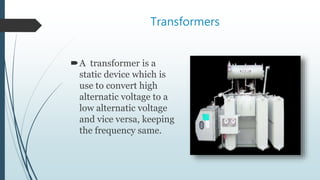
A transformer is a
static device which is
use to convert high
alternatic voltage to a
low alternatic voltage
and vice versa, keeping
the frequency same.
Principle Of Operation
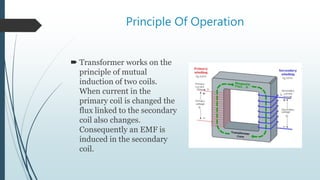
 Transformer works on the
principle of mutual
induction of two coils.
When current in the
primary coil is changed the
flux linked to the secondary
coil also changes.
Consequently an EMF is
induced in the secondary
coil.
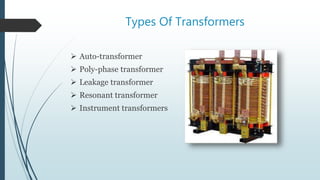
Types Of Transformers
 Auto-transformer
 Poly-phase transformer
 Leakage transformer
 Resonant transformer
 Instrument transformers
Autotransformers
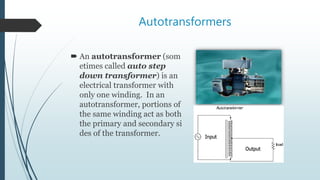
 An autotransformer (som
etimes called auto step
down transformer) is an
electrical transformer with
only one winding. In an
autotransformer, portions of
the same winding act as both
the primary and secondary si
des of the transformer.
Theory of Autotransformer
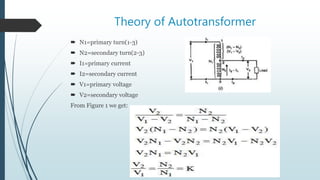
 N1=primary turn(1-3)
 N2=secondary turn(2-3)
 I1=primary current
 I2=secondary current
 V1=primary voltage
 V2=secondary voltage
From Figure 1 we get:
Cont.….
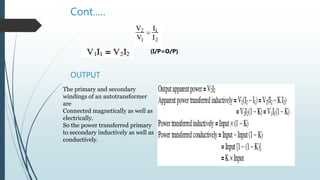
(I/P=O/P)
OUTPUT
The primary and secondary
windings of an autotransformer
are
Connected magnetically as well as
electrically.
So the power transferred primary
to secondary inductively as well as
conductively.
Types Of Autotransformers
 Step Up Auto-Transformer
 Step Down Auto-Transformer
Step Up Auto-Transformer
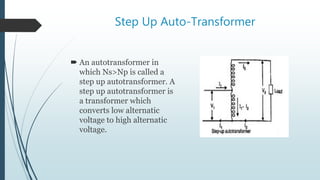
 An autotransformer in
which Ns>Np is called a
step up autotransformer. A
step up autotransformer is
a transformer which
converts low alternatic
voltage to high alternatic
voltage.
Step Down Auto-Transformer
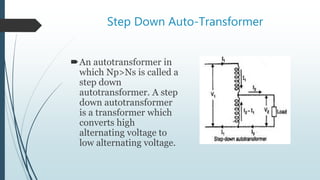
An autotransformer in
which Np>Ns is called a
step down
autotransformer. A step
down autotransformer
is a transformer which
converts high
alternating voltage to
low alternating voltage.
Advantages Of Autotransformers
 An autotransformer requires less Cu than a two-winding transformer
of similar rating.
 An autotransformer operates at a higher efficiency than a two-winding
transformer of similar rating.
 An autotransformer has better voltage regulation than a two-winding
transformer of the same rating.
 An autotransformer has smaller size than a two-winding transformer
of the same rating.
 An autotransformer requires smaller exciting current than a two-winding
transformer of the same rating.
Disadvantages Of Autotransformers
 There is a direct connection between the primary and secondary.
Therefore, the output is no longer D.C. isolated from the input.
 An autotransformer is not safe for stepping down a high voltage to a low
voltage.
 If an open circuit develops in the common portion of the winding, then
full-primary voltage will appear across the load. In such a case, any one
coming in contact with the secondary is subjected to high voltage. This
could be dangerous to both the persons and equipment. For this reason,
autotransformers are prohibited for general use.
 The short-circuit current is much larger than for the two-winding
transformer of the same rating. So that a short-circuited secondary causes
part of the primary also to be short-circuited. This reduces the effective
resistance and reactance.
Applications Of Autotransformers
 Autotransformers are used to compensate for voltage drops in
transmission and distribution lines. When used for this purpose, they are
known as booster transformers.
 Autotransformers are used for reducing the voltage supplied to a.c.motors
during the starting period.
 Autotransformers are used for continuously variable supply.
 On long rural power distribution lines, special autotransformers with
automatic tap-changing equipment are inserted as voltage regulators, so
that customers at the far end of the line receive the same average voltage
as those closer to the source. The variable ratio of the autotransformer
compensates for the voltage drop along the line.
 In control equipment for 1-phase and 3-phase electrical locomotives.
Limitations Of Autotransformers
 Because it requires both fewer windings and a smaller core, an
autotransformer for power applications is typically lighter and less costly
than a two-winding transformer, up to a voltage ratio of about 3:1; beyond
that range, a two-winding transformer is usually more economical.
 Like multiple-winding transformers, autotransformers operate on time-
varying magnetic fields and so will not function with DC.
 A failure of the insulation of the windings of an autotransformer can result
in full input voltage applied to the output. Also, a break in the part of the
winding that is used as both primary and secondary will result in the
transformer acting as an inductor in series with the load.
THANKYOU

Autotransformers

  • 1.
    AUTOTRANSFORMERS Made By :Prankit Mishra 141CC00007 Submitted To: Mr. Gaurav Bhandari
  • 2.
    Contents: 1. Transformers 2. PrincipleOf Operation 3. Types Of Transformers 4. Autotransformers 5. Theory Of Autotransformers 6. Types Of Autotransformers 7. Step Up Autotransformers 8. Step Down Autotransformers 9. Advantages Of Autotransformers 10. Disadvantages Of Autotransformers 11. Applications Of Autotransformers 12. Limitations Of Autotransformers
  • 3.
    Transformers A transformer isa static device which is use to convert high alternatic voltage to a low alternatic voltage and vice versa, keeping the frequency same.
  • 4.
    Principle Of Operation Transformer works on the principle of mutual induction of two coils. When current in the primary coil is changed the flux linked to the secondary coil also changes. Consequently an EMF is induced in the secondary coil.
  • 5.
    Types Of Transformers Auto-transformer  Poly-phase transformer  Leakage transformer  Resonant transformer  Instrument transformers
  • 6.
    Autotransformers  An autotransformer(som etimes called auto step down transformer) is an electrical transformer with only one winding. In an autotransformer, portions of the same winding act as both the primary and secondary si des of the transformer.
  • 7.
    Theory of Autotransformer N1=primary turn(1-3)  N2=secondary turn(2-3)  I1=primary current  I2=secondary current  V1=primary voltage  V2=secondary voltage From Figure 1 we get:
  • 8.
    Cont.…. (I/P=O/P) OUTPUT The primary andsecondary windings of an autotransformer are Connected magnetically as well as electrically. So the power transferred primary to secondary inductively as well as conductively.
  • 9.
    Types Of Autotransformers Step Up Auto-Transformer  Step Down Auto-Transformer
  • 10.
    Step Up Auto-Transformer An autotransformer in which Ns>Np is called a step up autotransformer. A step up autotransformer is a transformer which converts low alternatic voltage to high alternatic voltage.
  • 11.
    Step Down Auto-Transformer Anautotransformer in which Np>Ns is called a step down autotransformer. A step down autotransformer is a transformer which converts high alternating voltage to low alternating voltage.
  • 12.
    Advantages Of Autotransformers An autotransformer requires less Cu than a two-winding transformer of similar rating.  An autotransformer operates at a higher efficiency than a two-winding transformer of similar rating.  An autotransformer has better voltage regulation than a two-winding transformer of the same rating.  An autotransformer has smaller size than a two-winding transformer of the same rating.  An autotransformer requires smaller exciting current than a two-winding transformer of the same rating.
  • 13.
    Disadvantages Of Autotransformers There is a direct connection between the primary and secondary. Therefore, the output is no longer D.C. isolated from the input.  An autotransformer is not safe for stepping down a high voltage to a low voltage.  If an open circuit develops in the common portion of the winding, then full-primary voltage will appear across the load. In such a case, any one coming in contact with the secondary is subjected to high voltage. This could be dangerous to both the persons and equipment. For this reason, autotransformers are prohibited for general use.  The short-circuit current is much larger than for the two-winding transformer of the same rating. So that a short-circuited secondary causes part of the primary also to be short-circuited. This reduces the effective resistance and reactance.
  • 14.
    Applications Of Autotransformers Autotransformers are used to compensate for voltage drops in transmission and distribution lines. When used for this purpose, they are known as booster transformers.  Autotransformers are used for reducing the voltage supplied to a.c.motors during the starting period.  Autotransformers are used for continuously variable supply.  On long rural power distribution lines, special autotransformers with automatic tap-changing equipment are inserted as voltage regulators, so that customers at the far end of the line receive the same average voltage as those closer to the source. The variable ratio of the autotransformer compensates for the voltage drop along the line.  In control equipment for 1-phase and 3-phase electrical locomotives.
  • 15.
    Limitations Of Autotransformers Because it requires both fewer windings and a smaller core, an autotransformer for power applications is typically lighter and less costly than a two-winding transformer, up to a voltage ratio of about 3:1; beyond that range, a two-winding transformer is usually more economical.  Like multiple-winding transformers, autotransformers operate on time- varying magnetic fields and so will not function with DC.  A failure of the insulation of the windings of an autotransformer can result in full input voltage applied to the output. Also, a break in the part of the winding that is used as both primary and secondary will result in the transformer acting as an inductor in series with the load.
  • 16.