SEMINAR
ON
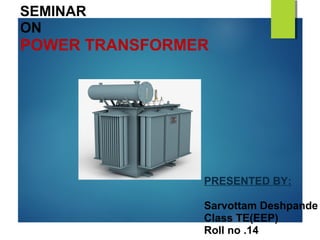
POWER TRANSFORMER
PRESENTED BY:
Sarvottam Deshpande
Class TE(EEP)
Roll no .14
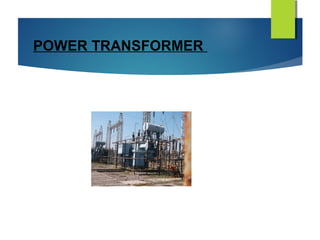
POWER TRANSFORMER
INTRODUCTION:
A TRANSFORMER CAN BE DEFINED AS A STATIC ELECTRICAL DEVICE WHICH
TRANSFERS POWER FROM ONE CIRCUIT TO ANOTHER BY MEANS OF
ELECTROMAGNETIC INDUCTION. THE TRANSFER IS ACCOMPANIED WITHOUT
ANY CHANGE IN THE FREQUENCY.
THE TERM POWER TRANSFORMER IS GENERALLY USED TO REFER TO
TRANSFORMERS WITH A RATING OF 500KVA OR GREATER.
POWER TRANSFORMERS ARE USED IN DISTRIBUTION SYSTEMS WHEREVER THERE
IS A NEED TO INTERFACE BETWEEN DIFFERENT VOLTAGE LEVELS I.E. TO STEP UP
AND STEP DOWN VOLTAGES.
Power transformers are generally of the liquid-immersed type. However,
Power transformers used for indoor applications may be air-cooled.
Based on the size ranges, transformers can be classified into three types.
Small Power Transformers : 500 to 7500kVA
Medium power transformers : 7500 to 100MVA
Large power transformers : 100MVA and beyond
The average life of a transformer is around 30 years.
.
CORE MATERIAL
Basic material are Alloy Steel having main content Silicon & carbon
Which increases permeability & reduces losses
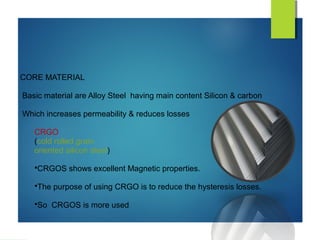
CRGO
(cold rolled grain
oriented silicon steel)
CRGOS shows excellent Magnetic properties.
The purpose of using CRGO is to reduce the hysteresis losses.
So CRGOS is more used
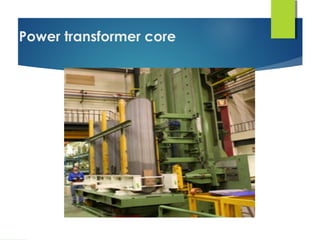
Power transformer core
CORE AND ACTIVE PART
ACTIVE PART
C.R.G.O. STRIPS
1-STRIP HAS WIDTH OF 0.27 mm
COIL OR WINDING ASSEMBLY
PROCEDURE
Manufacturing of LIMB
Core Insulation
CORE AND ACTIVE PART
 Removal of TOP FRAM for Coil assembly
 Winding insulation detail
 TOP YOKE FILLING
 VAPOUR PHASE OVEN
 HV & LV leads from top & bottom to the bushings
 REGULATING COILS to the tap changer
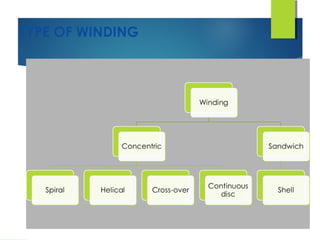
TYPE OF WINDING
SPIRAL
• It is used 100 A& for low Voltage Winding
 Mechanically very strong
Helical
 Intermediate range of current
 Suitable for LV winding of large transformer
Cross over
• Cross-over suitable of current not exceeding 20 A.
• Use for HV winding of small transformer
 Continuous disc:
• No of turns wound radially over one another
• separated by spacers
• HV winding
• Mechanically strong
Sandwich
 mostly used for shell type transformer
 Control leakage reactance
 HV & LV are near so leakage flux is reduced
 mmf of each section is same.
INSULATION
kinds of Insulations:
Major Insulation:
Insulating between LV & core
Also between HV & LV
Insulating barriers between limbs, coils & core yoke
Oil impregnated paper used as it has high dielectric
strength
MINOR INSULATION
• Insulation between individual turns &
between layers
Conductor Insulation
• paper & cotton
• Air insulated Transformer insulation
used is glass tap
TRANSFORMER TANK
 Plain sheet steel Tank
 Tube Tank
 Radiator Tank
 Tank with separate coolers
TRANSFORMER OIL
 Double purpose , cooling & Insulating
 Permittivity is 2.5
 Breakdown strength of oil used must be 50kv RMS
 Major disadvantage is sluging
 To overcome this, synthetic oil is prefered
FINAL ASSEMBLY
 Installation of active part and assembly of accessories
 TRANSFORMER TANK
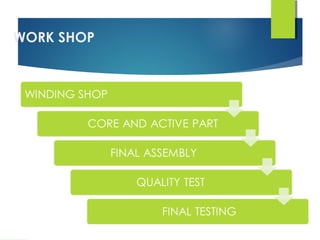
WORK SHOP
QUALITY TEST
 Design
 Process Time
 M/C size specification
 Process of manufacturing
 Dimension specification
 Testing specification
THANK YOU

Powertransformer

  • 1.
    SEMINAR ON POWER TRANSFORMER PRESENTED BY: SarvottamDeshpande Class TE(EEP) Roll no .14
  • 2.
  • 3.
    INTRODUCTION: A TRANSFORMER CANBE DEFINED AS A STATIC ELECTRICAL DEVICE WHICH TRANSFERS POWER FROM ONE CIRCUIT TO ANOTHER BY MEANS OF ELECTROMAGNETIC INDUCTION. THE TRANSFER IS ACCOMPANIED WITHOUT ANY CHANGE IN THE FREQUENCY. THE TERM POWER TRANSFORMER IS GENERALLY USED TO REFER TO TRANSFORMERS WITH A RATING OF 500KVA OR GREATER. POWER TRANSFORMERS ARE USED IN DISTRIBUTION SYSTEMS WHEREVER THERE IS A NEED TO INTERFACE BETWEEN DIFFERENT VOLTAGE LEVELS I.E. TO STEP UP AND STEP DOWN VOLTAGES.
  • 4.
    Power transformers aregenerally of the liquid-immersed type. However, Power transformers used for indoor applications may be air-cooled. Based on the size ranges, transformers can be classified into three types. Small Power Transformers : 500 to 7500kVA Medium power transformers : 7500 to 100MVA Large power transformers : 100MVA and beyond The average life of a transformer is around 30 years. .
  • 5.
    CORE MATERIAL Basic materialare Alloy Steel having main content Silicon & carbon Which increases permeability & reduces losses CRGO (cold rolled grain oriented silicon steel) CRGOS shows excellent Magnetic properties. The purpose of using CRGO is to reduce the hysteresis losses. So CRGOS is more used
  • 6.
  • 7.
    CORE AND ACTIVEPART ACTIVE PART C.R.G.O. STRIPS 1-STRIP HAS WIDTH OF 0.27 mm COIL OR WINDING ASSEMBLY PROCEDURE Manufacturing of LIMB Core Insulation
  • 8.
    CORE AND ACTIVEPART  Removal of TOP FRAM for Coil assembly  Winding insulation detail  TOP YOKE FILLING  VAPOUR PHASE OVEN  HV & LV leads from top & bottom to the bushings  REGULATING COILS to the tap changer
  • 9.
  • 11.
    SPIRAL • It isused 100 A& for low Voltage Winding  Mechanically very strong Helical  Intermediate range of current  Suitable for LV winding of large transformer
  • 12.
    Cross over • Cross-oversuitable of current not exceeding 20 A. • Use for HV winding of small transformer  Continuous disc: • No of turns wound radially over one another • separated by spacers • HV winding • Mechanically strong
  • 13.
    Sandwich  mostly usedfor shell type transformer  Control leakage reactance  HV & LV are near so leakage flux is reduced  mmf of each section is same.
  • 14.
    INSULATION kinds of Insulations: MajorInsulation: Insulating between LV & core Also between HV & LV Insulating barriers between limbs, coils & core yoke Oil impregnated paper used as it has high dielectric strength
  • 15.
    MINOR INSULATION • Insulationbetween individual turns & between layers Conductor Insulation • paper & cotton • Air insulated Transformer insulation used is glass tap
  • 16.
    TRANSFORMER TANK  Plainsheet steel Tank  Tube Tank  Radiator Tank  Tank with separate coolers
  • 18.
    TRANSFORMER OIL  Doublepurpose , cooling & Insulating  Permittivity is 2.5  Breakdown strength of oil used must be 50kv RMS  Major disadvantage is sluging  To overcome this, synthetic oil is prefered
  • 19.
    FINAL ASSEMBLY  Installationof active part and assembly of accessories  TRANSFORMER TANK
  • 20.
  • 21.
    QUALITY TEST  Design Process Time  M/C size specification  Process of manufacturing  Dimension specification  Testing specification
  • 22.