CHAPTER 1
INTRODUCTION
TRANSFORMER
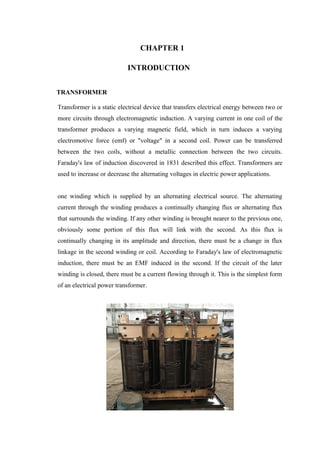
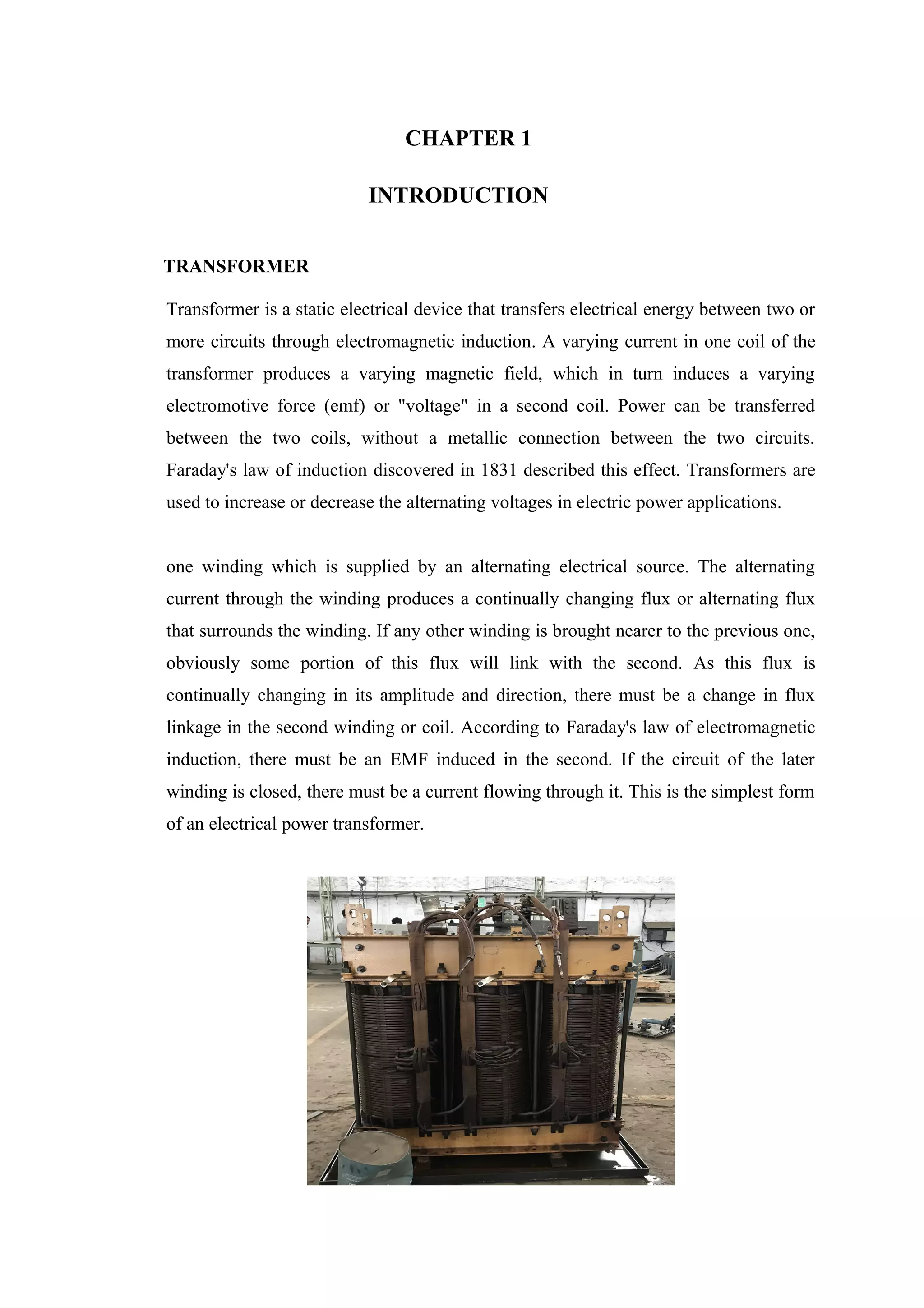
Transformer is a static electrical device that transfers electrical energy between two or
more circuits through electromagnetic induction. A varying current in one coil of the
transformer produces a varying magnetic field, which in turn induces a varying
electromotive force (emf) or "voltage" in a second coil. Power can be transferred
between the two coils, without a metallic connection between the two circuits.
Faraday's law of induction discovered in 1831 described this effect. Transformers are
used to increase or decrease the alternating voltages in electric power applications.
one winding which is supplied by an alternating electrical source. The alternating
current through the winding produces a continually changing flux or alternating flux
that surrounds the winding. If any other winding is brought nearer to the previous one,
obviously some portion of this flux will link with the second. As this flux is
continually changing in its amplitude and direction, there must be a change in flux
linkage in the second winding or coil. According to Faraday's law of electromagnetic
induction, there must be an EMF induced in the second. If the circuit of the later
winding is closed, there must be a current flowing through it. This is the simplest form
of an electrical power transformer.
WORKING PRINCIPAL OF IDEAL TRANSFORMER
Transformer is a static device (and doesn’t contain on rotating parts, hence no friction
losses), which convert electrical power from one circuit to another without changing its
frequency. it Step up (or Step down) the level of AC Voltage and Current.
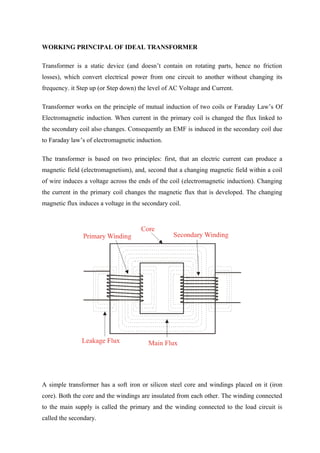
Transformer works on the principle of mutual induction of two coils or Faraday Law’s Of
Electromagnetic induction. When current in the primary coil is changed the flux linked to
the secondary coil also changes. Consequently an EMF is induced in the secondary coil due
to Faraday law’s of electromagnetic induction.
The transformer is based on two principles: first, that an electric current can produce a
magnetic field (electromagnetism), and, second that a changing magnetic field within a coil
of wire induces a voltage across the ends of the coil (electromagnetic induction). Changing
the current in the primary coil changes the magnetic flux that is developed. The changing
magnetic flux induces a voltage in the secondary coil.
A simple transformer has a soft iron or silicon steel core and windings placed on it (iron
core). Both the core and the windings are insulated from each other. The winding connected
to the main supply is called the primary and the winding connected to the load circuit is
called the secondary.
Winding (coil) connected to higher voltage is known as high voltage winding while the
winding connected to low voltage is known as low voltage winding. In case of a step up
transformer, the primary coil (winding) is the low voltage winding, the number of turns of
the windings of the secondary is more than that of the primary. Vice versa for step down
transformer.Transformer Always rated in kVA instead of kW.
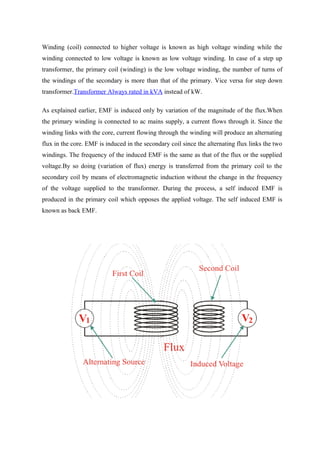
As explained earlier, EMF is induced only by variation of the magnitude of the flux.When
the primary winding is connected to ac mains supply, a current flows through it. Since the
winding links with the core, current flowing through the winding will produce an alternating
flux in the core. EMF is induced in the secondary coil since the alternating flux links the two
windings. The frequency of the induced EMF is the same as that of the flux or the supplied
voltage.By so doing (variation of flux) energy is transferred from the primary coil to the
secondary coil by means of electromagnetic induction without the change in the frequency
of the voltage supplied to the transformer. During the process, a self induced EMF is
produced in the primary coil which opposes the applied voltage. The self induced EMF is
known as back EMF.
MAIN CONSTRUCTIONAL PARTS OF TRANSFORMER
The three main parts of a transformer are,
1. Primary Winding of Transformer- Which produces magnetic flux when it is
connected to electrical source.
2. Magnetic Core of Transformer- The magnetic flux produced by the primary winding,
that will pass through this low reluctance path linked with secondary winding and
create a closed magnetic circuit.
3. Secondary Winding of Transformer- The flux, produced by primary winding, passes
through the core, will link with the secondary winding. This winding also wounds on
the same core and gives the desired output of the transformer.
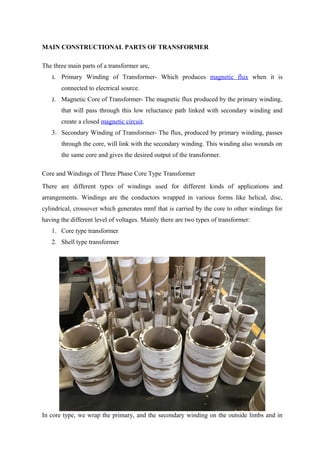
Core and Windings of Three Phase Core Type Transformer
There are different types of windings used for different kinds of applications and
arrangements. Windings are the conductors wrapped in various forms like helical, disc,
cylindrical, crossover which generates mmf that is carried by the core to other windings for
having the different level of voltages. Mainly there are two types of transformer:
1. Core type transformer
2. Shell type transformer
In core type, we wrap the primary, and the secondary winding on the outside limbs and in
shell type we place the primary and secondary windings on the inner limbs.
We use concentric type windings in core type transformer. We place low voltage winding
near to the core. However, to reduce leakage reactance, windings can be interlaced. Winding
for core type depends on many factors like current rating, short circuit withstand capacity,
limit of temperature rise, impedance, surge voltage, transport facilities, etc.
TYPES OF WINDING USED FOR CORE TYPE TRANSFORMER
Cylindrical Windings:- A helical winding consists of a few to more than 100 insulated
strands wound in parallel continuously along the length of the cylinder, with spacers
inserted between adjacent turns or discs and suitable transpositions included to
minimize circulating currents between parallel strands.
Uses of Cylindrical Windings
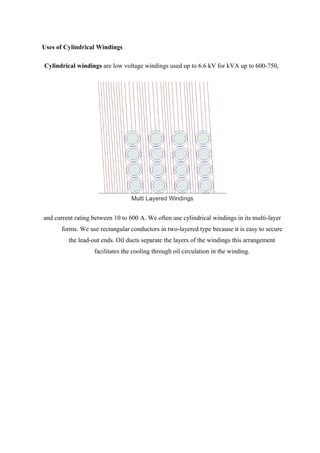
Cylindrical windings are low voltage windings used up to 6.6 kV for kVA up to 600-750,
and current rating between 10 to 600 A. We often use cylindrical windings in its multi-layer
forms. We use rectangular conductors in two-layered type because it is easy to secure
the lead-out ends. Oil ducts separate the layers of the windings this arrangement
facilitates the cooling through oil circulation in the winding.
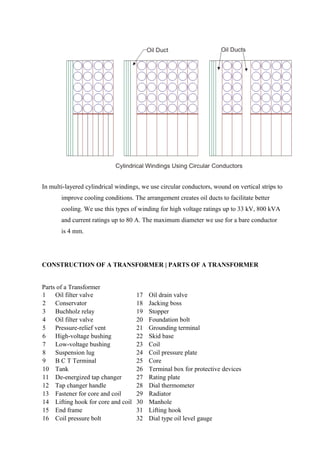
In multi-layered cylindrical windings, we use circular conductors, wound on vertical strips to
improve cooling conditions. The arrangement creates oil ducts to facilitate better
cooling. We use this types of winding for high voltage ratings up to 33 kV, 800 kVA
and current ratings up to 80 A. The maximum diameter we use for a bare conductor
is 4 mm.
CONSTRUCTION OF A TRANSFORMER | PARTS OF A TRANSFORMER
Parts of a Transformer
1 Oil filter valve 17 Oil drain valve
2 Conservator 18 Jacking boss
3 Buchholz relay 19 Stopper
4 Oil filter valve 20 Foundation bolt
5 Pressure-relief vent 21 Grounding terminal
6 High-voltage bushing 22 Skid base
7 Low-voltage bushing 23 Coil
8 Suspension lug 24 Coil pressure plate
9 B C T Terminal 25 Core
10 Tank 26 Terminal box for protective devices
11 De-energized tap changer 27 Rating plate
12 Tap changer handle 28 Dial thermometer
13 Fastener for core and coil 29 Radiator
14 Lifting hook for core and coil 30 Manhole
15 End frame 31 Lifting hook
16 Coil pressure bolt 32 Dial type oil level gauge
Steel tank :
It is a main part of transformer. It is steel made box. Transformer core is placed inside this
tank. Windings and other helpful devices are placed inside this tank. It is filled with
insulating oil ( mineral oil ). It have usually cylindrical or cubical shape depending on
transformer construction. It is coated internally and externally with colour for safety point of
view. Colour coating also provide protection in case of winding connection with tank
accidentally.
Core of transformer :
Core is made with laminated steel sheet in all type of transformers to provide continuous
magnetic path and also to provide minimum air gap. For this purpose silicon enriched steel is
used. Sometimes heat treatment is also used on steel to increase permeability of steel.
hysteresis losses also decreased in core with increase in permeability. By making core
laminated eddy current losses also reduced in core. Laminations of core also insulated from
each other through varnish.
Two phase transformers consists of two legs and three-phase transformers are usually
consists of three legs. Cores are usually circular or rectangular in shape. laminated cores
tight with bolts to avoid vibration in core.
Windings :
Single phase transformer have one primary and one secondary winding. But three-phase
transformer consists of three primary and three secondary windings which connects to each
other with proper methods. Low voltage winding is always placed inner side of core. High
voltage is placed above the low voltage winding. Both windings are electrically insulated
from each other through insulation material. There is also a proper distance between two
windings for movement of oil. Oil acts as a cooling agent. Because windings become hot
with the flow of current in windings. To make cooling better, windings also make with many
circular discs. Windings also design like a helical coils. Helical windings are used in high
current transformers. According to capacity of transformer three types of coils are usually
designed:
• Square wound
• continuous
• Disk wound
Winding can be classified in two different ways:-
1. Based on the input and output supply
2. Based on the voltage range
Within the input/output supply classification, windings are further categorized: Primary
winding - These are the windings to which the input voltage is applied. Secondary winding
- These are the windings to which the output voltage is applied.
Within the voltage range classification, windings are further categorized:
High voltage winding - These are made of copper coil. The number of turns is the
multiple of the number of turns in the low voltage windings. The copper coils are
thinner than those of the low voltage windings.
Low voltage windings - These have fewer turns than the high voltage windings. It is
made of thick copper conductors. This is because the current in the low voltage
windings is higher than that of high voltage windings.
Transformers can be supplied from either low voltage (LV) or high voltage (HV)
winding based on the requirement.
Coils are heat bonded with special varnish to increase mechanical strength of coils. Coils are
usually concentric in core type transformers.
Conservator tank :
It is a small tank which used in high power transformers. It is connected above the main
tank of transformer. It has cylindrical shape.Main tank and conservator tank connected to
each other through a pipe. Buchholz relay is used between conservator tank and main tank in
transformers having capacity more than one MVA. Conservator tank have following
functions in transformer :
• It provide place for hot transformer oil to expand. It also provide oil in transformer
after oil become cool.
• It also use to decrease oxidation by reducing area of oil around air.
• Oxidized oil remain in conservator tank. Mirror tube is also connected with
conservator tank to read oil level in transformers. A pre marked gauge is also present
in mirror tube. It is necessary to have cool oil level up to mark of gauge.
With change in temperature oil level keep decreasing and increasing. Because insulating oil
have co-efficient of expansion. Whoever if large cavity is provide in upper part of main tank,
contact area increases between air and oil which decrease dielectric strength of oil. To
reduce this effect, we use a separate small tank through a pipe. It have less oil than main
tank. This tank is called conservator tank. With the help of conservator tank, contact area
reduced between oil and air. Oil also remain ineffective due to oxidation. Oxidation do not
occur in main tank due to conservator tank. Hot oil move to conservator tank through pipe.
Oxidation occur only in conservator tank. Due to oxidation sludge only remain in
conservator tank. Sludge do not enter in main tank.
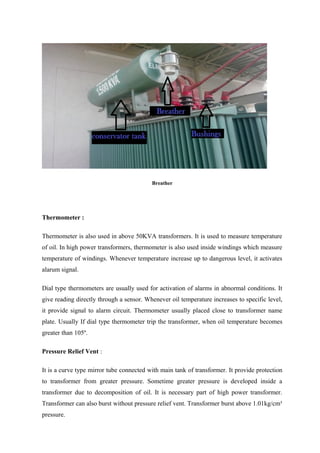
Breather :
Breather is a device which used for Breathing of transformer. Its mean air go in or out from
transformer with the help of breather. Now the Question is why we need breather in
transformer ? Because when hot oil expand, air go out from transformer and when oil
contracts after cooling, air enters in transformer. Breather one side is connected with
conservator tank. A mirror tube is placed inside breather. This mirror tube filled with
calcium chloride or silica gel. When air enters in transformer, this air contain moisture.
Silica gel absorb moisture and only allow dry air to enter in transformer. In this way
breather with the help of silica get stop moisture contain air to pass into transformer and
avoid oxidation in transformer main tank. With the time silica gel colour changes from blue
to pink after absorbing specifing quantity of moisture from air. We can reuse this silica gel
after warming it.
Breather
Thermometer :
Thermometer is also used in above 50KVA transformers. It is used to measure temperature
of oil. In high power transformers, thermometer is also used inside windings which measure
temperature of windings. Whenever temperature increase up to dangerous level, it activates
alarum signal.
Dial type thermometers are usually used for activation of alarms in abnormal conditions. It
give reading directly through a sensor. Whenever oil temperature increases to specific level,
it provide signal to alarm circuit. Thermometer usually placed close to transformer name
plate. Usually If dial type thermometer trip the transformer, when oil temperature becomes
greater than 105º.
Pressure Relief Vent :
It is a curve type mirror tube connected with main tank of transformer. It provide protection
to transformer from greater pressure. Sometime greater pressure is developed inside a
transformer due to decomposition of oil. It is necessary part of high power transformer.
Transformer can also burst without pressure relief vent. Transformer burst above 1.01kg/cm³
pressure.
Valves :
Valves are used for filling and draining of transformer oil. It is also used for filtering and
sampling. Usually three valves are available in transformer.
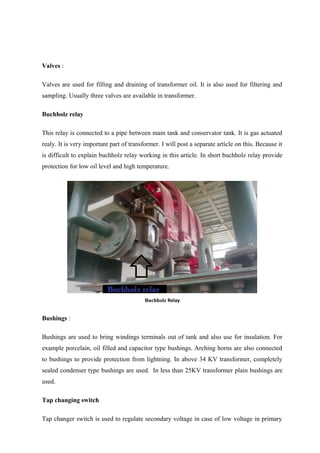
Buchholz relay
This relay is connected to a pipe between main tank and conservator tank. It is gas actuated
realy. It is very important part of transformer. I will post a separate article on this. Because it
is difficult to explain buchholz relay working in this article. In short buchholz relay provide
protection for low oil level and high temperature.
Buchholz Relay
Bushings :
Bushings are used to bring windings terminals out of tank and also use for insulation. For
example porcelain, oil filled and capacitor type bushings. Arching horns are also connected
to bushings to provide protection from lightning. In above 34 KV transformer, completely
sealed condenser type bushings are used. In less than 25KV transformer plain bushings are
used.
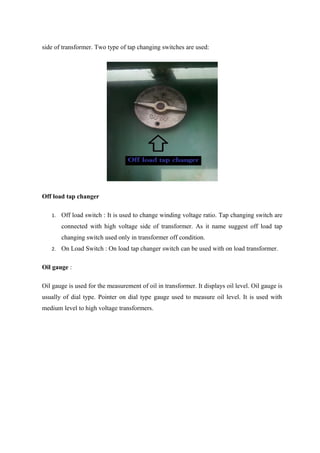
Tap changing switch
Tap changer switch is used to regulate secondary voltage in case of low voltage in primary
side of transformer. Two type of tap changing switches are used:
Off load tap changer
1. Off load switch : It is used to change winding voltage ratio. Tap changing switch are
connected with high voltage side of transformer. As it name suggest off load tap
changing switch used only in transformer off condition.
2. On Load Switch : On load tap changer switch can be used with on load transformer.
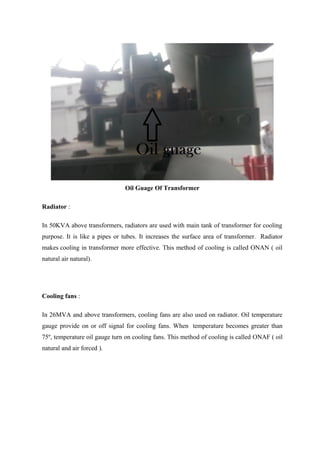
Oil gauge :
Oil gauge is used for the measurement of oil in transformer. It displays oil level. Oil gauge is
usually of dial type. Pointer on dial type gauge used to measure oil level. It is used with
medium level to high voltage transformers.
Oil Guage Of Transformer
Radiator :
In 50KVA above transformers, radiators are used with main tank of transformer for cooling
purpose. It is like a pipes or tubes. It increases the surface area of transformer. Radiator
makes cooling in transformer more effective. This method of cooling is called ONAN ( oil
natural air natural).
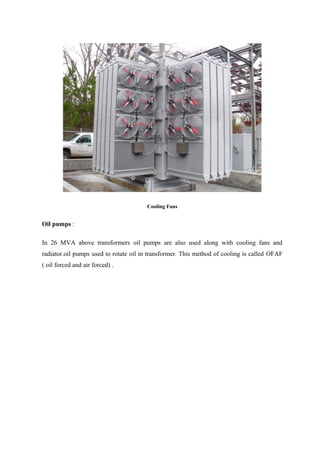
Cooling fans :
In 26MVA and above transformers, cooling fans are also used on radiator. Oil temperature
gauge provide on or off signal for cooling fans. When temperature becomes greater than
75º, temperature oil gauge turn on cooling fans. This method of cooling is called ONAF ( oil
natural and air forced ).
Cooling Fans
Oil pumps :
In 26 MVA above transformers oil pumps are also used along with cooling fans and
radiator.oil pumps used to rotate oil in transformer. This method of cooling is called OFAF
( oil forced and air forced) .
TYPES OF TRANSFORMERS
There are several transformer types used in the electrical power system for different
purposes, like in power generation, distribution and transmission and utilization of electrical
power. The transformers are classified based on voltage levels, Core medium used, winding
arrangements, use and installation place, etc. Here we discuss different types of transformers
are the step up and step down Transformer, Distribution Transformer, Potential Transformer,
Power Transformer, 1- and 3- transformer, Auto transformer, etc.ϕ ϕ
Transformers Based on Voltage Levels
These are the most commonly used transformer types for all the applications. Depends upon
the voltage ratios from primary to secondary windings, the transformers are classified as
step-up and step-down transformers.
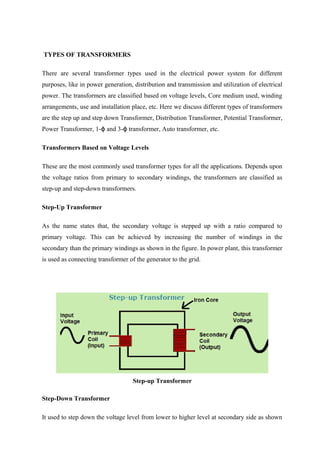
Step-Up Transformer
As the name states that, the secondary voltage is stepped up with a ratio compared to
primary voltage. This can be achieved by increasing the number of windings in the
secondary than the primary windings as shown in the figure. In power plant, this transformer
is used as connecting transformer of the generator to the grid.
Step-up Transformer
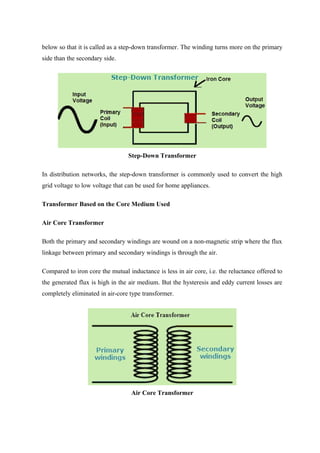
Step-Down Transformer
It used to step down the voltage level from lower to higher level at secondary side as shown
below so that it is called as a step-down transformer. The winding turns more on the primary
side than the secondary side.
Step-Down Transformer
In distribution networks, the step-down transformer is commonly used to convert the high
grid voltage to low voltage that can be used for home appliances.
Transformer Based on the Core Medium Used
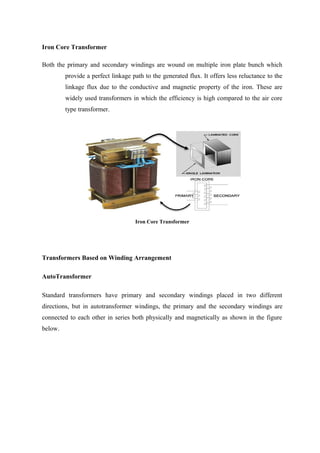
Air Core Transformer
Both the primary and secondary windings are wound on a non-magnetic strip where the flux
linkage between primary and secondary windings is through the air.
Compared to iron core the mutual inductance is less in air core, i.e. the reluctance offered to
the generated flux is high in the air medium. But the hysteresis and eddy current losses are
completely eliminated in air-core type transformer.
Air Core Transformer
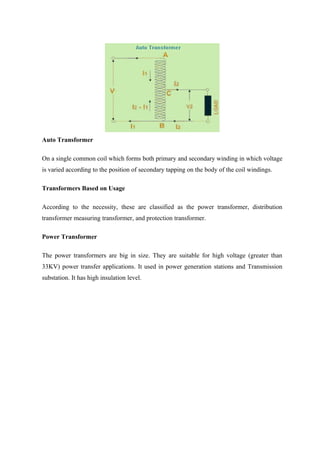
Iron Core Transformer
Both the primary and secondary windings are wound on multiple iron plate bunch which
provide a perfect linkage path to the generated flux. It offers less reluctance to the
linkage flux due to the conductive and magnetic property of the iron. These are
widely used transformers in which the efficiency is high compared to the air core
type transformer.
Iron Core Transformer
Transformers Based on Winding Arrangement
AutoTransformer
Standard transformers have primary and secondary windings placed in two different
directions, but in autotransformer windings, the primary and the secondary windings are
connected to each other in series both physically and magnetically as shown in the figure
below.
Auto Transformer
On a single common coil which forms both primary and secondary winding in which voltage
is varied according to the position of secondary tapping on the body of the coil windings.
Transformers Based on Usage
According to the necessity, these are classified as the power transformer, distribution
transformer measuring transformer, and protection transformer.
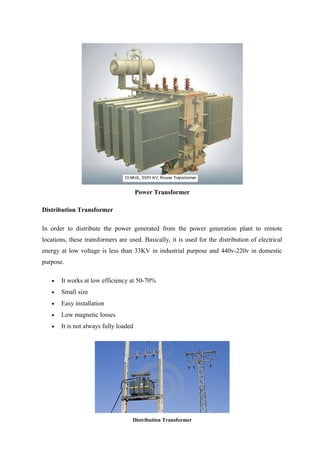
Power Transformer
The power transformers are big in size. They are suitable for high voltage (greater than
33KV) power transfer applications. It used in power generation stations and Transmission
substation. It has high insulation level.
Power Transformer
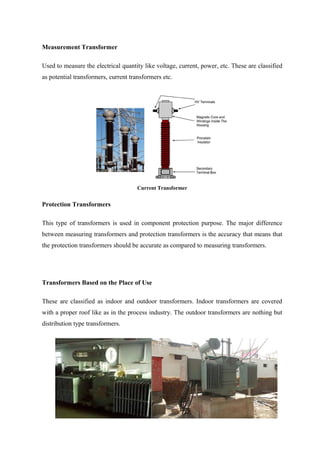
Distribution Transformer
In order to distribute the power generated from the power generation plant to remote
locations, these transformers are used. Basically, it is used for the distribution of electrical
energy at low voltage is less than 33KV in industrial purpose and 440v-220v in domestic
purpose.
• It works at low efficiency at 50-70%
• Small size
• Easy installation
• Low magnetic losses
• It is not always fully loaded
Distribution Transformer
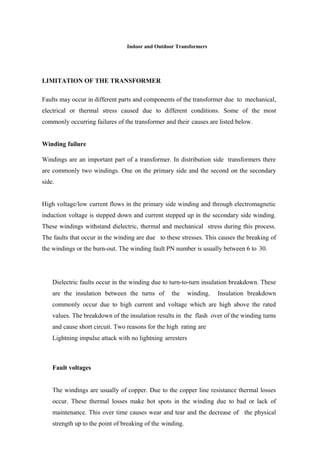
Measurement Transformer
Used to measure the electrical quantity like voltage, current, power, etc. These are classified
as potential transformers, current transformers etc.
Current Transformer
Protection Transformers
This type of transformers is used in component protection purpose. The major difference
between measuring transformers and protection transformers is the accuracy that means that
the protection transformers should be accurate as compared to measuring transformers.
Transformers Based on the Place of Use
These are classified as indoor and outdoor transformers. Indoor transformers are covered
with a proper roof like as in the process industry. The outdoor transformers are nothing but
distribution type transformers.
Indoor and Outdoor Transformers
LIMITATION OF THE TRANSFORMER
Faults may occur in different parts and components of the transformer due to mechanical,
electrical or thermal stress caused due to different conditions. Some of the most
commonly occurring failures of the transformer and their causes are listed below.
Winding failure
Windings are an important part of a transformer. In distribution side transformers there
are commonly two windings. One on the primary side and the second on the secondary
side.
High voltage/low current flows in the primary side winding and through electromagnetic
induction voltage is stepped down and current stepped up in the secondary side winding.
These windings withstand dielectric, thermal and mechanical stress during this process.
The faults that occur in the winding are due to these stresses. This causes the breaking of
the windings or the burn-out. The winding fault PN number is usually between 6 to 30.
Dielectric faults occur in the winding due to turn-to-turn insulation breakdown. These
are the insulation between the turns of the winding. Insulation breakdown
commonly occur due to high current and voltage which are high above the rated
values. The breakdown of the insulation results in the flash over of the winding turns
and cause short circuit. Two reasons for the high rating are
Lightning impulse attack with no lightning arresters
Fault voltages
The windings are usually of copper. Due to the copper line resistance thermal losses
occur. These thermal losses make hot spots in the winding due to bad or lack of
maintenance. This over time causes wear and tear and the decrease of the physical
strength up to the point of breaking of the winding.
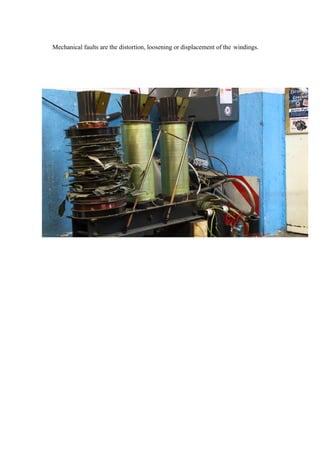
Mechanical faults are the distortion, loosening or displacement of the windings.
This results in the decrease of the performance of the transformer and the tearing of the
turn-to-turn ratio. The main reasons that cause this fault are the improper repair, bad
maintenance, corrosion, manufacturing deficiencies, vibration and mechanical movement
within the transformer.
Bushing Failure
Bushes are insulating devices that insulate a high voltage electrical conductor to pass
through an earth conductor. In transformers it provides a current path through the tank
wall. Inside the transformer paper insulators are used which are surrounded by oil that
provides further insulation. Bushing failure usually occurs over time [5]. Bushes failure
PN number is between 24 to 48. Some of the main reasons for bushing failure are
discussed below.
A. Loosening of conductors is caused by transformer vibrations which results in
overheating. This heat damage the insulating paper and the oil used.
B. sudden high fault voltages causes’ partial discharge (breakdown of solid/liquid
electrical insulators) which damage the bushes and causes its degeneration and
complete breakdown within hours.
C. Seal breaking of bushes happen due to ingress of water, aging or excessive
dielectric losses. Due to this fault core failure of the transformer occurs.
D. Not replacing of old oil over long time or its deficiency due to leakage causes
internal over-flashing.
Tap Changer Failure
The tap changer function in the transformer is to regulate the voltage level. This is
done by either adding or removing turns from the secondary transformer winding. It is
the most complex part of the transformer and also an important one. Even the
smallest fault results in the wrong power output. The PN number is usually between
28 to 52.
Some fault and causes are
In Run-Through fault the tap changer takes time and after a delay changes the
turn ratio. The main reason for it is the relay responsible for the tap change has
residue flux because of polluted oil, therefore taking time to change. The
other reason for run-through fault is the spring becoming fragile over time.
Lack of maintenance causes the shaft connection between the tap and the motor driver
of the ta no changer to be not synchronous. Because of this the tap changer is not in
the position where it needs to be.
Old capacitors or burned-out capacitor in the motor causes the tap changer to fail to
control its direction movement.
Regular use of the tap changer causes the spring in it to slowly become fragile over
time and then finally break. Because of this the tap changer is not able to change the
turn ratio of the winding.
Breakdown of the motor in the tap changer because of over voltage or miss-use also
causes the tap changer to fail to change the turn ratio of the winding.
Core failure
The transformers have laminated steel cores in the middle surrounded by the transformer
windings. The function of the core is to concentrate the magnetic flux. Fault in the core
directly affect the transformer windings, causing faults in them. The cores of the
transformers are laminated to reduce eddy-current. The lamination of the core can
become defected by poor maintenance, old oil or corrosion. The breakdown of the
smallest part of the lamination results in increase of thermal heat due to eddy-current . The
effects of this over heating are
The over-heating reaches the core surface which is in direct contact with the windings.
As a result of this the windings are damaged by The heat.
This heat also damages the oil in the transformers resulting in the release of a gas
from the oil that damages other parts of the transformer. The PN number of the core
failure is often 6.
Tank Failures
The function of the tank in the transformer is to be a container for the oil used in it. The
oil in the tank is used for insulation and cooling. The tank can also be used as a support
for other equipment of the transformer . The PN number for the failure is 18. The fault in
the tank occurs due to environmental stress, corrosion, high humidity and sun radiation
resulting in a leakage or cracks in the tank walls. From these leakages and cracks oil spill
from the tank causing the reduction of oil.
The reduction in oil level results in the reduction of insulation in the transformer and
affecting the windings.
The oil is also used for cooling purposes so the reduction of oil causes overheating
with damages different parts of the transformer.
Protection system Failure
The main function of the protection system is to protect the transformer from faults by
first detecting the fault and then resolving it as fast as possible. If it cannot fix the fault, it
isolates it so that it may not damage the transformer. Protection systems include the
Buchholz protection, pressure relief valve circuitry, surge protection and Sudden Pressure
Relays.This is the most occurring failure with a PN between 22 to 64.
Buchholz protection is a protective device that is sensitive to dielectric faults in the
transformer. Overheating of the relay occurs because of accumulation of gasses over
time, which reduces its sensitivity to dielectric faults. Low level oil due to leakage
causes the Buchholz protection to come into action even if there is not a fault
which is not needed and waste of energy.
Pressure relief valve circuitry protects the transformer from exploding due to gas
pressure. The gas pressure is produced due to overheating of oil . Pressure relief
valve circuitry slowly reduces the pressure of the gasses. Fault in this circuitry mainly
occurs due to the spring init becoming fragile over time resulting in the circuitry not
being able to reduce pressure quickly. This circuitry also fails when gas pressure
increases quickly as this is only able to
release pressure slowly.
Surge protector protects the transformer from over voltage by allowing specific magnitude
of voltage to go to transformer and for the rest alternate route is found. Failure in surge
protection causes high voltage to pass to the windings which becomes damaged because of
it. Moisture, heat and corrosion are the main reasons of the failure of surge protection as it
causes overheating and short circuit in it.
Sudden Pressure Relays protects the transformers from blowing up from sudden
exponential increase of gas pressure. If it fails to release the sudden pressure the
transformer blows up. Relay fails due to humidity and moisture affecting its internal
circuitry.
Cooling system failure
Cooling system reduces the heat produced in transformers due to copper and iron losses. The
cooling system contains cooling fans, oil pumps and water-cooled heat exchangers. The failure
in the cooling system causes the heat to build up in the transformer which effect different parts
of the transformer and also causes more gas pressure to be built inside which may cause the
transformer to blow. The PN is between 26 to 48. Some of the main reasons for failure are
discussed below.
One of the biggest reasons of cooling system failure is leak in the oil/water pipes. This
causes the reduction in the fluids which results in low heat exchange which is not good
for the transformer. Leakage happens because of environmental stress, corrosion, high
humidity and sun radiation.
Some failure occurs due to fault in the cooling fans which rush-in cool air into the tanks
for cooling purpose. The fans create faults because of poor maintenance, over use or motor
wear-out. Cooling system can perform wrong due to bad thermostats which measure the
heat in the transformer. Faulty thermostats show wrong temperature causing the cooling
system to operate
Other losses
1. Copper (or winding) losses
2. Iron (or core) losses
3. Transformer temperature limitations
4. Current limits
5. Voltage and frequency limits
Transformer Losses (Heat)
The thermal ratings of a transformer are determined by the following three factors:
1. The amount of heat produced inthe windings and connections
2. The amount of heat produced in the iron core
3. How effectively the heat can be removed from the transformer when the thermal rating of
the transformer is reached.
At this point, the heat being produced must equal the heat being removed or dissipated –
thermal equilibrium.
The efficiency of power transformers is high, especially, for large transformers at full load.
However, losses are present in all transformers. These losses may be classified as copper or I2
R
losses and core or iron losses.
Copper (or Winding) Losses
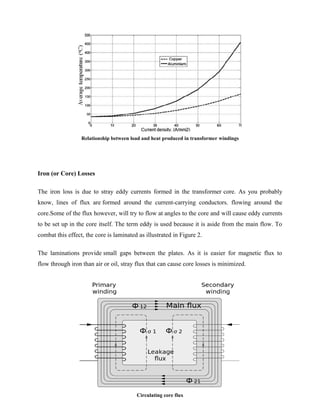
Copper losses are resistive and proportional to load current and are sometimes called “load
losses” or “I2
R losses”. As the transformer is loaded, heat is produced in the primary and
secondary windings and connections due to I2
R. At low loads, the quantity of heat produced will
be small but as load increases, the amount of heat produced becomes significant.
At full load, the windings will be operating at or near their design temperature.
.
Relationship between load and heat produced in transformer windings
Iron (or Core) Losses
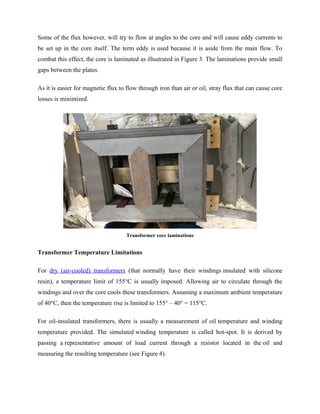
The iron loss is due to stray eddy currents formed in the transformer core. As you probably
know, lines of flux are formed around the current-carrying conductors. flowing around the
core.Some of the flux however, will try to flow at angles to the core and will cause eddy currents
to be set up in the core itself. The term eddy is used because it is aside from the main flow. To
combat this effect, the core is laminated as illustrated in Figure 2.
The laminations provide small gaps between the plates. As it is easier for magnetic flux to
flow through iron than air or oil, stray flux that can cause core losses is minimized.
Circulating core flux
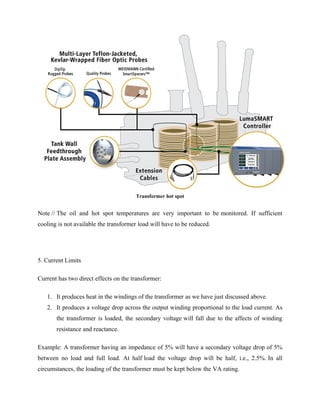
Some of the flux however, will try to flow at angles to the core and will cause eddy currents to
be set up in the core itself. The term eddy is used because it is aside from the main flow. To
combat this effect, the core is laminated as illustrated in Figure 3. The laminations provide small
gaps between the plates.
As it is easier for magnetic flux to flow through iron than air or oil, stray flux that can cause core
losses is minimized.
Transformer core laminations
Transformer Temperature Limitations
For dry (air-cooled) transformers (that normally have their windings insulated with silicone
resin), a temperature limit of 155°C is usually imposed. Allowing air to circulate through the
windings and over the core cools these transformers. Assuming a maximum ambient temperature
of 40°C, then the temperature rise is limited to 155° – 40° = 115°C.
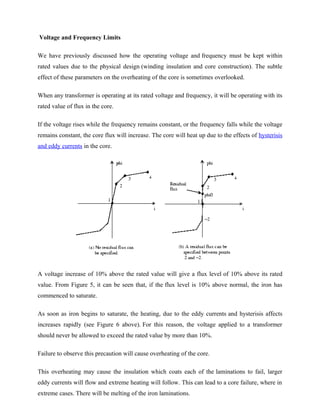
For oil-insulated transformers, there is usually a measurement of oil temperature and winding
temperature provided. The simulated winding temperature is called hot-spot. It is derived by
passing a representative amount of load current through a resistor located in the oil and
measuring the resulting temperature (see Figure 4).
Transformer hot spot
Note // The oil and hot spot temperatures are very important to be monitored. If sufficient
cooling is not available the transformer load will have to be reduced.
5. Current Limits
Current has two direct effects on the transformer:
1. It produces heat in the windings of the transformer as we have just discussed above.
2. It produces a voltage drop across the output winding proportional to the load current. As
the transformer is loaded, the secondary voltage will fall due to the affects of winding
resistance and reactance.
Example: A transformer having an impedance of 5% will have a secondary voltage drop of 5%
between no load and full load. At half load the voltage drop will be half, i.e., 2.5%. In all
circumstances, the loading of the transformer must be kept below the VA rating.
Voltage and Frequency Limits
We have previously discussed how the operating voltage and frequency must be kept within
rated values due to the physical design (winding insulation and core construction). The subtle
effect of these parameters on the overheating of the core is sometimes overlooked.
When any transformer is operating at its rated voltage and frequency, it will be operating with its
rated value of flux in the core.
If the voltage rises while the frequency remains constant, or the frequency falls while the voltage
remains constant, the core flux will increase. The core will heat up due to the effects of hysterisis
and eddy currents in the core.
A voltage increase of 10% above the rated value will give a flux level of 10% above its rated
value. From Figure 5, it can be seen that, if the flux level is 10% above normal, the iron has
commenced to saturate.
As soon as iron begins to saturate, the heating, due to the eddy currents and hysterisis affects
increases rapidly (see Figure 6 above). For this reason, the voltage applied to a transformer
should never be allowed to exceed the rated value by more than 10%.
Failure to observe this precaution will cause overheating of the core.
This overheating may cause the insulation which coats each of the laminations to fail, larger
eddy currents will flow and extreme heating will follow. This can lead to a core failure, where in
extreme cases. There will be melting of the iron laminations.
INSTRUMENTS AND METHODS OF MEASUREMENTS
Measurements/estimation of parameters
The measurements of the following parameters are required for transformer loss estimation.
1. Power input
2. Current
3. Voltage
4. Frequency
5. Winding Resistance
6. Temperature of winding
Power input
A wattmeter or a suitable electronic 3-phase 4-wire energy meter calibrated for 0.1 p.f can be
used for measurement of power in no load test and short circuit test. It also gives a power
reading or for improved resolution, energy reading over a period of measured time is
possible. Modern digital energy meters have indications of voltage, current, power and
frequency; hence more convenient for site measurements.
Electronic 3 phase 4 wire energy/power meters of 0-5A range and multiple voltage ranges
from 60 V to 500 V with a full-scale indication in the range of 0.1 pf and 0.5-class accuracy
is preferred.
Separate single phase energy/power meters can be used but a single 3 phase 4- wire energy
meter is more convenient.
CT’s of bar primary type 0.5-class accuracy with multiple ranges can be used. The CT's
should be calibrated to indicate its ratio error and phase angle error at 10% to 100% current
with the specific burden of ammeters and power meters used.During use, the phase angle
error is directly taken from the calibration curve for specific current readings. Ratio error can
be taken as constant or the nominal ratio can be taken.
No load loss measurements
No load losses can be measured from the L.V. side using an adjustable three phase voltage
source with neutral. It can be derived from mains or a D.G. set. The voltage and frequency
should be steady and at rated values and as near as possible to 50 Hz and it should be
measured. This test can give a basic value near rated conditions if all precautions are taken.
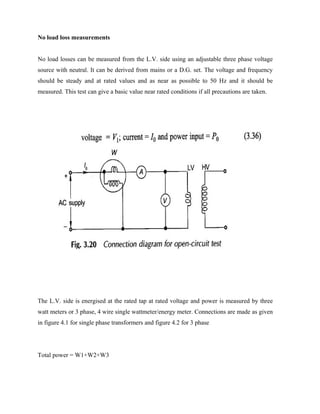
The L.V. side is energised at the rated tap at rated voltage and power is measured by three
watt meters or 3 phase, 4 wire single wattmeter/energy meter. Connections are made as given
in figure 4.1 for single phase transformers and figure 4.2 for 3 phase
Total power = W1+W2+W3
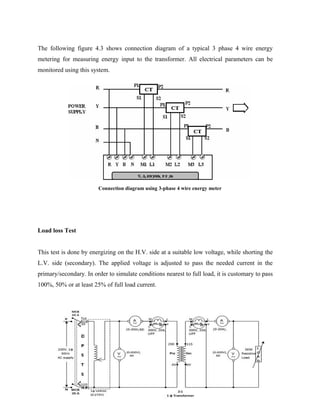
The following figure 4.3 shows connection diagram of a typical 3 phase 4 wire energy
metering for measuring energy input to the transformer. All electrical parameters can be
monitored using this system.
Connection diagram using 3-phase 4 wire energy meter
Load loss Test
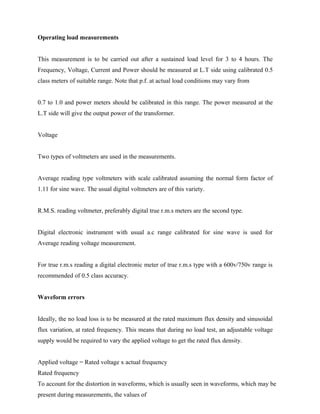
This test is done by energizing on the H.V. side at a suitable low voltage, while shorting the
L.V. side (secondary). The applied voltage is adjusted to pass the needed current in the
primary/secondary. In order to simulate conditions nearest to full load, it is customary to pass
100%, 50% or at least 25% of full load current.
Operating load measurements
This measurement is to be carried out after a sustained load level for 3 to 4 hours. The
Frequency, Voltage, Current and Power should be measured at L.T side using calibrated 0.5
class meters of suitable range. Note that p.f. at actual load conditions may vary from
0.7 to 1.0 and power meters should be calibrated in this range. The power measured at the
L.T side will give the output power of the transformer.
Voltage
Two types of voltmeters are used in the measurements.
Average reading type voltmeters with scale calibrated assuming the normal form factor of
1.11 for sine wave. The usual digital voltmeters are of this variety.
R.M.S. reading voltmeter, preferably digital true r.m.s meters are the second type.
Digital electronic instrument with usual a.c range calibrated for sine wave is used for
Average reading voltage measurement.
For true r.m.s reading a digital electronic meter of true r.m.s type with a 600v/750v range is
recommended of 0.5 class accuracy.
Waveform errors
Ideally, the no load loss is to be measured at the rated maximum flux density and sinusoidal
flux variation, at rated frequency. This means that during no load test, an adjustable voltage
supply would be required to vary the applied voltage to get the rated flux density.
Applied voltage = Rated voltage x actual frequency
Rated frequency
To account for the distortion in waveforms, which is usually seen in waveforms, which may be
present during measurements, the values of
average and r.m.s voltages are to be measured across the transformer phase windings.
The r.m.s. voltage U may slightly higher than average voltage U’.
Frequency
A digital frequency-measuring instrument for 50 Hz range with 600v range and having a
resolution of 0.1 Hz is preferred.
Winding temperature
The transformer should be de-energised with continued cooling for at least 8 hours.
Alternatively, if the winding temperature does not vary by more than 1ºC over a period
of 30 minutes, the transformer can be assumed to have reached a cold stage. For oil
cooled transformers, the temperature can be measured either at the top of the oil surface
or in an oil filled thermo-well if it is provided.
For dry type transformers, the temperature sensor should be kept in close contact with
coil surface. The sensor should be covered and protected from direct draft. When a stable
temperature is reached in the indicator, within 1ºC, this temperature is taken as
temperature of the windings, Tm, at the time of measuring the winding resistance.
For oil temperature measurements calibrated mercury in glass thermometer can be used
with a resolution of 1ºC .in general, electronic instruments with suitable probes are
preferred. They include probes using thermo couple resistance or Thermisters with the
resolution of 1ºC.
For surface temperature measurements the probe of the instrument should be mounted
and covered suitably. Due care should be taken to isolate the instrument for reliable
reading and safety
APPLICATIONS OF TRANSFORMERS
Regulating alternating current
All transformers have one basic function: increasing or decreasing alternating current within
the electrical system. By regulating the flow of current, the transformer allows for increased
energy efficiency, which regulates and ultimately lowers electricity bills.
Stopping and starting the flow of electricity
Transformers are also useful in stopping the flow of electricity and interrupting an electric
current. Transformers are commonly present in circuit breakers, where they utilize a switch
to automatically interrupt the flow of electricity and to prevent damage that can occur as a
result of high voltage.
Battery charging
The concept of battery charging is fuelled by the functioning of generators. Transformers are
used to control the voltage that enters the battery during the charging process in order to
prevent any damages that can occur to the internal battery components. This is important
because an unregulated voltage can result in high surges during charging of batteries.
Steel manufacturing
Steel manufacturing plants rely on the functioning of high voltage transformers to provide a
range of voltages for the manufacturing process. High currents are required during melting
and welding of steel, and lower current are required during the cooling process. In order to
provide this range of voltages, transformers are necessary for regulating currents within the
system.
Electrochemicals
In chemical engineering and manufacturing processes, electrolysis is normally fuelled by the
functioning of transformers. Metals such as copper, zinc, and aluminum are normally used
for the purposes of electroplating. During the process, transformers provide a regulated
electrical current that is used to drive the chemical reaction from the beginning stages until
completion. The current can be therefore be regulated as the reaction proceeds.
CHAPTER – 2
CONTROL PANELS
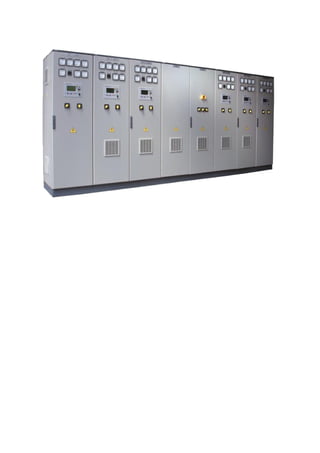
A control panel is a flat, often vertical, area where control or monitoring instruments are
displayed or it is an enclosed unit that is the part of a system that users can access, as the
control panel of a security system (also called control unit).
They are found in factories to monitor and control machines or production lines and in
places such as nuclear power plants, ships, aircraft and mainframe computers. Older control
panels are most often equipped with push buttons and analog instruments, whereas
nowadays in many cases touchscreens are used for monitoring and control purposes.
Control Panel
Panels are used for the protection of transformer. The different protection schemes of
transformer are employed by using panels. Panels mainly serve the purpose of control and
giving indication of the faults that occur.
Types of Panel
Electric Panel
● Marshalling Box - [Fan, pump, CT, 4-20V Analog ]
● RTCC - Remote Tap Changer Control Cubical - [Raise, Lower, AVR, RWTI,
ROTI, RTPI etc]
● TJB- Thermo Junction Box [Only for WTI & OTI]
● CM. Box - Common Marshalling Box
● DM Box - Drive Mechanism Box - [Raise Lower]
● VFD - Variable Frequency Drive
● PLC Panels
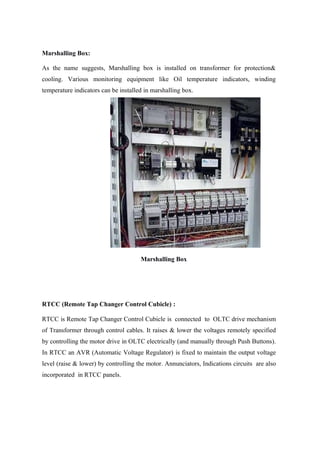
Marshalling Box:
As the name suggests, Marshalling box is installed on transformer for protection&
cooling. Various monitoring equipment like Oil temperature indicators, winding
temperature indicators can be installed in marshalling box.
Marshalling Box
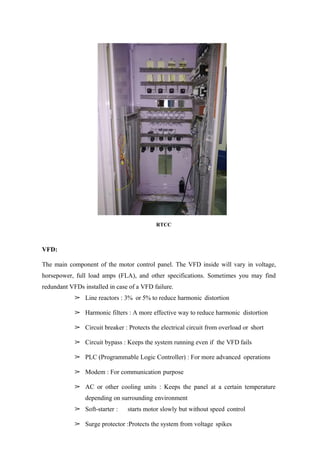
RTCC (Remote Tap Changer Control Cubicle) :
RTCC is Remote Tap Changer Control Cubicle is connected to OLTC drive mechanism
of Transformer through control cables. It raises & lower the voltages remotely specified
by controlling the motor drive in OLTC electrically (and manually through Push Buttons).
In RTCC an AVR (Automatic Voltage Regulator) is fixed to maintain the output voltage
level (raise & lower) by controlling the motor. Annunciators, Indications circuits are also
incorporated in RTCC panels.
RTCC
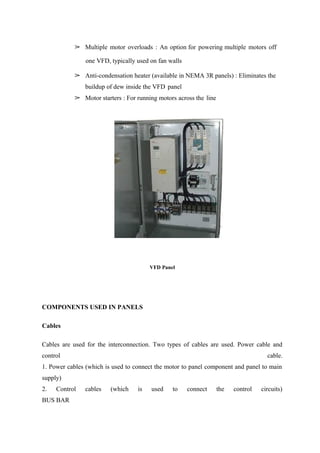
VFD:
The main component of the motor control panel. The VFD inside will vary in voltage,
horsepower, full load amps (FLA), and other specifications. Sometimes you may find
redundant VFDs installed in case of a VFD failure.
➢ Line reactors : 3% or 5% to reduce harmonic distortion
➢ Harmonic filters : A more effective way to reduce harmonic distortion
➢ Circuit breaker : Protects the electrical circuit from overload or short
➢ Circuit bypass : Keeps the system running even if the VFD fails
➢ PLC (Programmable Logic Controller) : For more advanced operations
➢ Modem : For communication purpose
➢ AC or other cooling units : Keeps the panel at a certain temperature
depending on surrounding environment
➢ Soft-starter : starts motor slowly but without speed control
➢ Surge protector :Protects the system from voltage spikes
➢ Multiple motor overloads : An option for powering multiple motors off
one VFD, typically used on fan walls
➢ Anti-condensation heater (available in NEMA 3R panels) : Eliminates the
buildup of dew inside the VFD panel
➢ Motor starters : For running motors across the line
VFD Panel
COMPONENTS USED IN PANELS
Cables
Cables are used for the interconnection. Two types of cables are used. Power cable and
control cable.
1. Power cables (which is used to connect the motor to panel component and panel to main
supply)
2. Control cables (which is used to connect the control circuits)
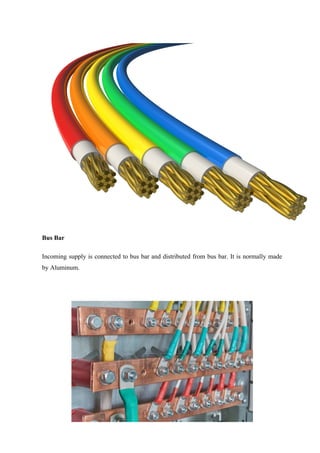
BUS BAR
Bus Bar
Incoming supply is connected to bus bar and distributed from bus bar. It is normally made
by Aluminum.
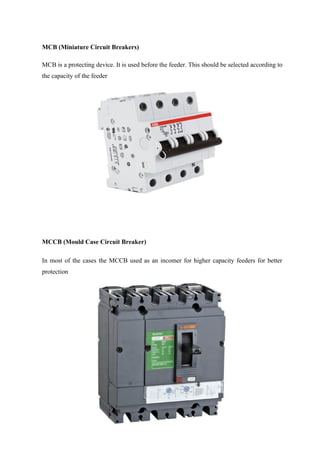
MCB (Miniature Circuit Breakers)
MCB is a protecting device. It is used before the feeder. This should be selected according to
the capacity of the feeder
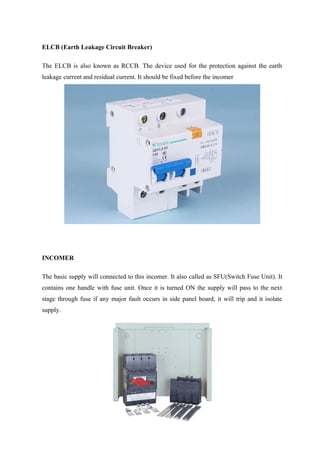
MCCB (Mould Case Circuit Breaker)
In most of the cases the MCCB used as an incomer for higher capacity feeders for better
protection
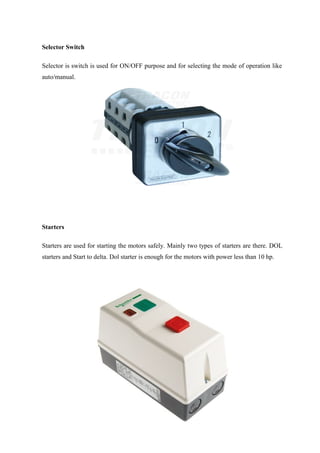
ELCB (Earth Leakage Circuit Breaker)
The ELCB is also known as RCCB. The device used for the protection against the earth
leakage current and residual current. It should be fixed before the incomer
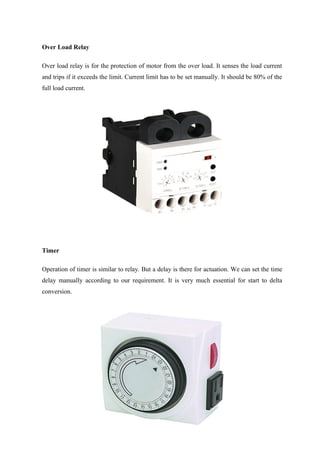
INCOMER
The basic supply will connected to this incomer. It also called as SFU(Switch Fuse Unit). It
contains one handle with fuse unit. Once it is turned ON the supply will pass to the next
stage through fuse if any major fault occurs in side panel board, it will trip and it isolate
supply.
Selector Switch
Selector is switch is used for ON/OFF purpose and for selecting the mode of operation like
auto/manual.
Starters
Starters are used for starting the motors safely. Mainly two types of starters are there. DOL
starters and Start to delta. Dol starter is enough for the motors with power less than 10 hp.
Over Load Relay
Over load relay is for the protection of motor from the over load. It senses the load current
and trips if it exceeds the limit. Current limit has to be set manually. It should be 80% of the
full load current.
Timer
Operation of timer is similar to relay. But a delay is there for actuation. We can set the time
delay manually according to our requirement. It is very much essential for start to delta
conversion.
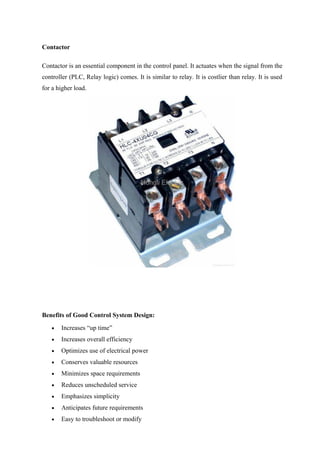
Contactor
Contactor is an essential component in the control panel. It actuates when the signal from the
controller (PLC, Relay logic) comes. It is similar to relay. It is costlier than relay. It is used
for a higher load.
Benefits of Good Control System Design:
• Increases “up time”
• Increases overall efficiency
• Optimizes use of electrical power
• Conserves valuable resources
• Minimizes space requirements
• Reduces unscheduled service
• Emphasizes simplicity
• Anticipates future requirements
• Easy to troubleshoot or modify
• Designed for safety
• Motor Controls
• Low voltage solid-state controllers
• Low voltage vacuum starters
• Low voltage electro-mechanical starters
• Medium voltage vacuum starters
REFRENCES
[1] www.wikipedia.org
[2] www.electrical4u.com
[3] www.google images.com
[4] www.electricaleasy.com
[5] www.google.co.in
[6] www.quora.com
[7] www.ieee.com
[8] www.electricalengineeringschools.com
[9] www.learn.adafruit.com
[10] www.what-when- how.com
*********
Transformers (ee)

Transformers (ee)

  • 1.
    CHAPTER 1 INTRODUCTION TRANSFORMER Transformer isa static electrical device that transfers electrical energy between two or more circuits through electromagnetic induction. A varying current in one coil of the transformer produces a varying magnetic field, which in turn induces a varying electromotive force (emf) or "voltage" in a second coil. Power can be transferred between the two coils, without a metallic connection between the two circuits. Faraday's law of induction discovered in 1831 described this effect. Transformers are used to increase or decrease the alternating voltages in electric power applications. one winding which is supplied by an alternating electrical source. The alternating current through the winding produces a continually changing flux or alternating flux that surrounds the winding. If any other winding is brought nearer to the previous one, obviously some portion of this flux will link with the second. As this flux is continually changing in its amplitude and direction, there must be a change in flux linkage in the second winding or coil. According to Faraday's law of electromagnetic induction, there must be an EMF induced in the second. If the circuit of the later winding is closed, there must be a current flowing through it. This is the simplest form of an electrical power transformer.
  • 2.
    WORKING PRINCIPAL OFIDEAL TRANSFORMER Transformer is a static device (and doesn’t contain on rotating parts, hence no friction losses), which convert electrical power from one circuit to another without changing its frequency. it Step up (or Step down) the level of AC Voltage and Current. Transformer works on the principle of mutual induction of two coils or Faraday Law’s Of Electromagnetic induction. When current in the primary coil is changed the flux linked to the secondary coil also changes. Consequently an EMF is induced in the secondary coil due to Faraday law’s of electromagnetic induction. The transformer is based on two principles: first, that an electric current can produce a magnetic field (electromagnetism), and, second that a changing magnetic field within a coil of wire induces a voltage across the ends of the coil (electromagnetic induction). Changing the current in the primary coil changes the magnetic flux that is developed. The changing magnetic flux induces a voltage in the secondary coil. A simple transformer has a soft iron or silicon steel core and windings placed on it (iron core). Both the core and the windings are insulated from each other. The winding connected to the main supply is called the primary and the winding connected to the load circuit is called the secondary.
  • 3.
    Winding (coil) connectedto higher voltage is known as high voltage winding while the winding connected to low voltage is known as low voltage winding. In case of a step up transformer, the primary coil (winding) is the low voltage winding, the number of turns of the windings of the secondary is more than that of the primary. Vice versa for step down transformer.Transformer Always rated in kVA instead of kW. As explained earlier, EMF is induced only by variation of the magnitude of the flux.When the primary winding is connected to ac mains supply, a current flows through it. Since the winding links with the core, current flowing through the winding will produce an alternating flux in the core. EMF is induced in the secondary coil since the alternating flux links the two windings. The frequency of the induced EMF is the same as that of the flux or the supplied voltage.By so doing (variation of flux) energy is transferred from the primary coil to the secondary coil by means of electromagnetic induction without the change in the frequency of the voltage supplied to the transformer. During the process, a self induced EMF is produced in the primary coil which opposes the applied voltage. The self induced EMF is known as back EMF.
  • 4.
    MAIN CONSTRUCTIONAL PARTSOF TRANSFORMER The three main parts of a transformer are, 1. Primary Winding of Transformer- Which produces magnetic flux when it is connected to electrical source. 2. Magnetic Core of Transformer- The magnetic flux produced by the primary winding, that will pass through this low reluctance path linked with secondary winding and create a closed magnetic circuit. 3. Secondary Winding of Transformer- The flux, produced by primary winding, passes through the core, will link with the secondary winding. This winding also wounds on the same core and gives the desired output of the transformer. Core and Windings of Three Phase Core Type Transformer There are different types of windings used for different kinds of applications and arrangements. Windings are the conductors wrapped in various forms like helical, disc, cylindrical, crossover which generates mmf that is carried by the core to other windings for having the different level of voltages. Mainly there are two types of transformer: 1. Core type transformer 2. Shell type transformer In core type, we wrap the primary, and the secondary winding on the outside limbs and in
  • 5.
    shell type weplace the primary and secondary windings on the inner limbs. We use concentric type windings in core type transformer. We place low voltage winding near to the core. However, to reduce leakage reactance, windings can be interlaced. Winding for core type depends on many factors like current rating, short circuit withstand capacity, limit of temperature rise, impedance, surge voltage, transport facilities, etc. TYPES OF WINDING USED FOR CORE TYPE TRANSFORMER Cylindrical Windings:- A helical winding consists of a few to more than 100 insulated strands wound in parallel continuously along the length of the cylinder, with spacers inserted between adjacent turns or discs and suitable transpositions included to minimize circulating currents between parallel strands.
  • 6.
    Uses of CylindricalWindings Cylindrical windings are low voltage windings used up to 6.6 kV for kVA up to 600-750, and current rating between 10 to 600 A. We often use cylindrical windings in its multi-layer forms. We use rectangular conductors in two-layered type because it is easy to secure the lead-out ends. Oil ducts separate the layers of the windings this arrangement facilitates the cooling through oil circulation in the winding.
  • 7.
    In multi-layered cylindricalwindings, we use circular conductors, wound on vertical strips to improve cooling conditions. The arrangement creates oil ducts to facilitate better cooling. We use this types of winding for high voltage ratings up to 33 kV, 800 kVA and current ratings up to 80 A. The maximum diameter we use for a bare conductor is 4 mm. CONSTRUCTION OF A TRANSFORMER | PARTS OF A TRANSFORMER Parts of a Transformer 1 Oil filter valve 17 Oil drain valve 2 Conservator 18 Jacking boss 3 Buchholz relay 19 Stopper 4 Oil filter valve 20 Foundation bolt 5 Pressure-relief vent 21 Grounding terminal 6 High-voltage bushing 22 Skid base 7 Low-voltage bushing 23 Coil 8 Suspension lug 24 Coil pressure plate 9 B C T Terminal 25 Core 10 Tank 26 Terminal box for protective devices 11 De-energized tap changer 27 Rating plate 12 Tap changer handle 28 Dial thermometer 13 Fastener for core and coil 29 Radiator 14 Lifting hook for core and coil 30 Manhole 15 End frame 31 Lifting hook 16 Coil pressure bolt 32 Dial type oil level gauge
  • 8.
    Steel tank : Itis a main part of transformer. It is steel made box. Transformer core is placed inside this tank. Windings and other helpful devices are placed inside this tank. It is filled with insulating oil ( mineral oil ). It have usually cylindrical or cubical shape depending on transformer construction. It is coated internally and externally with colour for safety point of view. Colour coating also provide protection in case of winding connection with tank accidentally. Core of transformer : Core is made with laminated steel sheet in all type of transformers to provide continuous magnetic path and also to provide minimum air gap. For this purpose silicon enriched steel is used. Sometimes heat treatment is also used on steel to increase permeability of steel. hysteresis losses also decreased in core with increase in permeability. By making core laminated eddy current losses also reduced in core. Laminations of core also insulated from each other through varnish. Two phase transformers consists of two legs and three-phase transformers are usually consists of three legs. Cores are usually circular or rectangular in shape. laminated cores tight with bolts to avoid vibration in core. Windings : Single phase transformer have one primary and one secondary winding. But three-phase transformer consists of three primary and three secondary windings which connects to each other with proper methods. Low voltage winding is always placed inner side of core. High voltage is placed above the low voltage winding. Both windings are electrically insulated from each other through insulation material. There is also a proper distance between two windings for movement of oil. Oil acts as a cooling agent. Because windings become hot with the flow of current in windings. To make cooling better, windings also make with many circular discs. Windings also design like a helical coils. Helical windings are used in high current transformers. According to capacity of transformer three types of coils are usually designed:
  • 9.
    • Square wound •continuous • Disk wound Winding can be classified in two different ways:- 1. Based on the input and output supply 2. Based on the voltage range Within the input/output supply classification, windings are further categorized: Primary winding - These are the windings to which the input voltage is applied. Secondary winding - These are the windings to which the output voltage is applied. Within the voltage range classification, windings are further categorized: High voltage winding - These are made of copper coil. The number of turns is the multiple of the number of turns in the low voltage windings. The copper coils are thinner than those of the low voltage windings. Low voltage windings - These have fewer turns than the high voltage windings. It is made of thick copper conductors. This is because the current in the low voltage windings is higher than that of high voltage windings. Transformers can be supplied from either low voltage (LV) or high voltage (HV) winding based on the requirement. Coils are heat bonded with special varnish to increase mechanical strength of coils. Coils are usually concentric in core type transformers. Conservator tank : It is a small tank which used in high power transformers. It is connected above the main tank of transformer. It has cylindrical shape.Main tank and conservator tank connected to each other through a pipe. Buchholz relay is used between conservator tank and main tank in transformers having capacity more than one MVA. Conservator tank have following functions in transformer :
  • 10.
    • It provideplace for hot transformer oil to expand. It also provide oil in transformer after oil become cool. • It also use to decrease oxidation by reducing area of oil around air. • Oxidized oil remain in conservator tank. Mirror tube is also connected with conservator tank to read oil level in transformers. A pre marked gauge is also present in mirror tube. It is necessary to have cool oil level up to mark of gauge. With change in temperature oil level keep decreasing and increasing. Because insulating oil have co-efficient of expansion. Whoever if large cavity is provide in upper part of main tank, contact area increases between air and oil which decrease dielectric strength of oil. To reduce this effect, we use a separate small tank through a pipe. It have less oil than main tank. This tank is called conservator tank. With the help of conservator tank, contact area reduced between oil and air. Oil also remain ineffective due to oxidation. Oxidation do not occur in main tank due to conservator tank. Hot oil move to conservator tank through pipe. Oxidation occur only in conservator tank. Due to oxidation sludge only remain in conservator tank. Sludge do not enter in main tank. Breather : Breather is a device which used for Breathing of transformer. Its mean air go in or out from transformer with the help of breather. Now the Question is why we need breather in transformer ? Because when hot oil expand, air go out from transformer and when oil contracts after cooling, air enters in transformer. Breather one side is connected with conservator tank. A mirror tube is placed inside breather. This mirror tube filled with calcium chloride or silica gel. When air enters in transformer, this air contain moisture. Silica gel absorb moisture and only allow dry air to enter in transformer. In this way breather with the help of silica get stop moisture contain air to pass into transformer and avoid oxidation in transformer main tank. With the time silica gel colour changes from blue to pink after absorbing specifing quantity of moisture from air. We can reuse this silica gel after warming it.
  • 11.
    Breather Thermometer : Thermometer isalso used in above 50KVA transformers. It is used to measure temperature of oil. In high power transformers, thermometer is also used inside windings which measure temperature of windings. Whenever temperature increase up to dangerous level, it activates alarum signal. Dial type thermometers are usually used for activation of alarms in abnormal conditions. It give reading directly through a sensor. Whenever oil temperature increases to specific level, it provide signal to alarm circuit. Thermometer usually placed close to transformer name plate. Usually If dial type thermometer trip the transformer, when oil temperature becomes greater than 105º. Pressure Relief Vent : It is a curve type mirror tube connected with main tank of transformer. It provide protection to transformer from greater pressure. Sometime greater pressure is developed inside a transformer due to decomposition of oil. It is necessary part of high power transformer. Transformer can also burst without pressure relief vent. Transformer burst above 1.01kg/cm³ pressure.
  • 12.
    Valves : Valves areused for filling and draining of transformer oil. It is also used for filtering and sampling. Usually three valves are available in transformer. Buchholz relay This relay is connected to a pipe between main tank and conservator tank. It is gas actuated realy. It is very important part of transformer. I will post a separate article on this. Because it is difficult to explain buchholz relay working in this article. In short buchholz relay provide protection for low oil level and high temperature. Buchholz Relay Bushings : Bushings are used to bring windings terminals out of tank and also use for insulation. For example porcelain, oil filled and capacitor type bushings. Arching horns are also connected to bushings to provide protection from lightning. In above 34 KV transformer, completely sealed condenser type bushings are used. In less than 25KV transformer plain bushings are used. Tap changing switch Tap changer switch is used to regulate secondary voltage in case of low voltage in primary
  • 13.
    side of transformer.Two type of tap changing switches are used: Off load tap changer 1. Off load switch : It is used to change winding voltage ratio. Tap changing switch are connected with high voltage side of transformer. As it name suggest off load tap changing switch used only in transformer off condition. 2. On Load Switch : On load tap changer switch can be used with on load transformer. Oil gauge : Oil gauge is used for the measurement of oil in transformer. It displays oil level. Oil gauge is usually of dial type. Pointer on dial type gauge used to measure oil level. It is used with medium level to high voltage transformers.
  • 14.
    Oil Guage OfTransformer Radiator : In 50KVA above transformers, radiators are used with main tank of transformer for cooling purpose. It is like a pipes or tubes. It increases the surface area of transformer. Radiator makes cooling in transformer more effective. This method of cooling is called ONAN ( oil natural air natural). Cooling fans : In 26MVA and above transformers, cooling fans are also used on radiator. Oil temperature gauge provide on or off signal for cooling fans. When temperature becomes greater than 75º, temperature oil gauge turn on cooling fans. This method of cooling is called ONAF ( oil natural and air forced ).
  • 15.
    Cooling Fans Oil pumps: In 26 MVA above transformers oil pumps are also used along with cooling fans and radiator.oil pumps used to rotate oil in transformer. This method of cooling is called OFAF ( oil forced and air forced) .
  • 16.
    TYPES OF TRANSFORMERS Thereare several transformer types used in the electrical power system for different purposes, like in power generation, distribution and transmission and utilization of electrical power. The transformers are classified based on voltage levels, Core medium used, winding arrangements, use and installation place, etc. Here we discuss different types of transformers are the step up and step down Transformer, Distribution Transformer, Potential Transformer, Power Transformer, 1- and 3- transformer, Auto transformer, etc.ϕ ϕ Transformers Based on Voltage Levels These are the most commonly used transformer types for all the applications. Depends upon the voltage ratios from primary to secondary windings, the transformers are classified as step-up and step-down transformers. Step-Up Transformer As the name states that, the secondary voltage is stepped up with a ratio compared to primary voltage. This can be achieved by increasing the number of windings in the secondary than the primary windings as shown in the figure. In power plant, this transformer is used as connecting transformer of the generator to the grid. Step-up Transformer Step-Down Transformer It used to step down the voltage level from lower to higher level at secondary side as shown
  • 17.
    below so thatit is called as a step-down transformer. The winding turns more on the primary side than the secondary side. Step-Down Transformer In distribution networks, the step-down transformer is commonly used to convert the high grid voltage to low voltage that can be used for home appliances. Transformer Based on the Core Medium Used Air Core Transformer Both the primary and secondary windings are wound on a non-magnetic strip where the flux linkage between primary and secondary windings is through the air. Compared to iron core the mutual inductance is less in air core, i.e. the reluctance offered to the generated flux is high in the air medium. But the hysteresis and eddy current losses are completely eliminated in air-core type transformer. Air Core Transformer
  • 18.
    Iron Core Transformer Boththe primary and secondary windings are wound on multiple iron plate bunch which provide a perfect linkage path to the generated flux. It offers less reluctance to the linkage flux due to the conductive and magnetic property of the iron. These are widely used transformers in which the efficiency is high compared to the air core type transformer. Iron Core Transformer Transformers Based on Winding Arrangement AutoTransformer Standard transformers have primary and secondary windings placed in two different directions, but in autotransformer windings, the primary and the secondary windings are connected to each other in series both physically and magnetically as shown in the figure below.
  • 19.
    Auto Transformer On asingle common coil which forms both primary and secondary winding in which voltage is varied according to the position of secondary tapping on the body of the coil windings. Transformers Based on Usage According to the necessity, these are classified as the power transformer, distribution transformer measuring transformer, and protection transformer. Power Transformer The power transformers are big in size. They are suitable for high voltage (greater than 33KV) power transfer applications. It used in power generation stations and Transmission substation. It has high insulation level.
  • 20.
    Power Transformer Distribution Transformer Inorder to distribute the power generated from the power generation plant to remote locations, these transformers are used. Basically, it is used for the distribution of electrical energy at low voltage is less than 33KV in industrial purpose and 440v-220v in domestic purpose. • It works at low efficiency at 50-70% • Small size • Easy installation • Low magnetic losses • It is not always fully loaded Distribution Transformer
  • 21.
    Measurement Transformer Used tomeasure the electrical quantity like voltage, current, power, etc. These are classified as potential transformers, current transformers etc. Current Transformer Protection Transformers This type of transformers is used in component protection purpose. The major difference between measuring transformers and protection transformers is the accuracy that means that the protection transformers should be accurate as compared to measuring transformers. Transformers Based on the Place of Use These are classified as indoor and outdoor transformers. Indoor transformers are covered with a proper roof like as in the process industry. The outdoor transformers are nothing but distribution type transformers.
  • 22.
    Indoor and OutdoorTransformers LIMITATION OF THE TRANSFORMER Faults may occur in different parts and components of the transformer due to mechanical, electrical or thermal stress caused due to different conditions. Some of the most commonly occurring failures of the transformer and their causes are listed below. Winding failure Windings are an important part of a transformer. In distribution side transformers there are commonly two windings. One on the primary side and the second on the secondary side. High voltage/low current flows in the primary side winding and through electromagnetic induction voltage is stepped down and current stepped up in the secondary side winding. These windings withstand dielectric, thermal and mechanical stress during this process. The faults that occur in the winding are due to these stresses. This causes the breaking of the windings or the burn-out. The winding fault PN number is usually between 6 to 30. Dielectric faults occur in the winding due to turn-to-turn insulation breakdown. These are the insulation between the turns of the winding. Insulation breakdown commonly occur due to high current and voltage which are high above the rated values. The breakdown of the insulation results in the flash over of the winding turns and cause short circuit. Two reasons for the high rating are Lightning impulse attack with no lightning arresters Fault voltages The windings are usually of copper. Due to the copper line resistance thermal losses occur. These thermal losses make hot spots in the winding due to bad or lack of maintenance. This over time causes wear and tear and the decrease of the physical strength up to the point of breaking of the winding.
  • 23.
    Mechanical faults arethe distortion, loosening or displacement of the windings.
  • 24.
    This results inthe decrease of the performance of the transformer and the tearing of the turn-to-turn ratio. The main reasons that cause this fault are the improper repair, bad maintenance, corrosion, manufacturing deficiencies, vibration and mechanical movement within the transformer. Bushing Failure Bushes are insulating devices that insulate a high voltage electrical conductor to pass through an earth conductor. In transformers it provides a current path through the tank wall. Inside the transformer paper insulators are used which are surrounded by oil that provides further insulation. Bushing failure usually occurs over time [5]. Bushes failure PN number is between 24 to 48. Some of the main reasons for bushing failure are discussed below. A. Loosening of conductors is caused by transformer vibrations which results in overheating. This heat damage the insulating paper and the oil used. B. sudden high fault voltages causes’ partial discharge (breakdown of solid/liquid electrical insulators) which damage the bushes and causes its degeneration and complete breakdown within hours. C. Seal breaking of bushes happen due to ingress of water, aging or excessive dielectric losses. Due to this fault core failure of the transformer occurs. D. Not replacing of old oil over long time or its deficiency due to leakage causes internal over-flashing. Tap Changer Failure The tap changer function in the transformer is to regulate the voltage level. This is done by either adding or removing turns from the secondary transformer winding. It is the most complex part of the transformer and also an important one. Even the smallest fault results in the wrong power output. The PN number is usually between 28 to 52. Some fault and causes are
  • 25.
    In Run-Through faultthe tap changer takes time and after a delay changes the turn ratio. The main reason for it is the relay responsible for the tap change has residue flux because of polluted oil, therefore taking time to change. The other reason for run-through fault is the spring becoming fragile over time. Lack of maintenance causes the shaft connection between the tap and the motor driver of the ta no changer to be not synchronous. Because of this the tap changer is not in the position where it needs to be. Old capacitors or burned-out capacitor in the motor causes the tap changer to fail to control its direction movement. Regular use of the tap changer causes the spring in it to slowly become fragile over time and then finally break. Because of this the tap changer is not able to change the turn ratio of the winding. Breakdown of the motor in the tap changer because of over voltage or miss-use also causes the tap changer to fail to change the turn ratio of the winding. Core failure The transformers have laminated steel cores in the middle surrounded by the transformer windings. The function of the core is to concentrate the magnetic flux. Fault in the core directly affect the transformer windings, causing faults in them. The cores of the transformers are laminated to reduce eddy-current. The lamination of the core can become defected by poor maintenance, old oil or corrosion. The breakdown of the smallest part of the lamination results in increase of thermal heat due to eddy-current . The effects of this over heating are The over-heating reaches the core surface which is in direct contact with the windings. As a result of this the windings are damaged by The heat. This heat also damages the oil in the transformers resulting in the release of a gas from the oil that damages other parts of the transformer. The PN number of the core failure is often 6.
  • 26.
    Tank Failures The functionof the tank in the transformer is to be a container for the oil used in it. The oil in the tank is used for insulation and cooling. The tank can also be used as a support for other equipment of the transformer . The PN number for the failure is 18. The fault in the tank occurs due to environmental stress, corrosion, high humidity and sun radiation resulting in a leakage or cracks in the tank walls. From these leakages and cracks oil spill from the tank causing the reduction of oil. The reduction in oil level results in the reduction of insulation in the transformer and affecting the windings. The oil is also used for cooling purposes so the reduction of oil causes overheating with damages different parts of the transformer. Protection system Failure The main function of the protection system is to protect the transformer from faults by first detecting the fault and then resolving it as fast as possible. If it cannot fix the fault, it isolates it so that it may not damage the transformer. Protection systems include the Buchholz protection, pressure relief valve circuitry, surge protection and Sudden Pressure Relays.This is the most occurring failure with a PN between 22 to 64. Buchholz protection is a protective device that is sensitive to dielectric faults in the transformer. Overheating of the relay occurs because of accumulation of gasses over time, which reduces its sensitivity to dielectric faults. Low level oil due to leakage causes the Buchholz protection to come into action even if there is not a fault which is not needed and waste of energy. Pressure relief valve circuitry protects the transformer from exploding due to gas pressure. The gas pressure is produced due to overheating of oil . Pressure relief valve circuitry slowly reduces the pressure of the gasses. Fault in this circuitry mainly occurs due to the spring init becoming fragile over time resulting in the circuitry not being able to reduce pressure quickly. This circuitry also fails when gas pressure increases quickly as this is only able to
  • 27.
    release pressure slowly. Surgeprotector protects the transformer from over voltage by allowing specific magnitude of voltage to go to transformer and for the rest alternate route is found. Failure in surge protection causes high voltage to pass to the windings which becomes damaged because of it. Moisture, heat and corrosion are the main reasons of the failure of surge protection as it causes overheating and short circuit in it. Sudden Pressure Relays protects the transformers from blowing up from sudden exponential increase of gas pressure. If it fails to release the sudden pressure the transformer blows up. Relay fails due to humidity and moisture affecting its internal circuitry. Cooling system failure Cooling system reduces the heat produced in transformers due to copper and iron losses. The cooling system contains cooling fans, oil pumps and water-cooled heat exchangers. The failure in the cooling system causes the heat to build up in the transformer which effect different parts of the transformer and also causes more gas pressure to be built inside which may cause the transformer to blow. The PN is between 26 to 48. Some of the main reasons for failure are discussed below. One of the biggest reasons of cooling system failure is leak in the oil/water pipes. This causes the reduction in the fluids which results in low heat exchange which is not good for the transformer. Leakage happens because of environmental stress, corrosion, high humidity and sun radiation. Some failure occurs due to fault in the cooling fans which rush-in cool air into the tanks for cooling purpose. The fans create faults because of poor maintenance, over use or motor wear-out. Cooling system can perform wrong due to bad thermostats which measure the heat in the transformer. Faulty thermostats show wrong temperature causing the cooling system to operate
  • 28.
    Other losses 1. Copper(or winding) losses 2. Iron (or core) losses 3. Transformer temperature limitations 4. Current limits 5. Voltage and frequency limits Transformer Losses (Heat) The thermal ratings of a transformer are determined by the following three factors: 1. The amount of heat produced inthe windings and connections 2. The amount of heat produced in the iron core 3. How effectively the heat can be removed from the transformer when the thermal rating of the transformer is reached. At this point, the heat being produced must equal the heat being removed or dissipated – thermal equilibrium. The efficiency of power transformers is high, especially, for large transformers at full load. However, losses are present in all transformers. These losses may be classified as copper or I2 R losses and core or iron losses. Copper (or Winding) Losses Copper losses are resistive and proportional to load current and are sometimes called “load losses” or “I2 R losses”. As the transformer is loaded, heat is produced in the primary and secondary windings and connections due to I2 R. At low loads, the quantity of heat produced will be small but as load increases, the amount of heat produced becomes significant. At full load, the windings will be operating at or near their design temperature. .
  • 29.
    Relationship between loadand heat produced in transformer windings Iron (or Core) Losses The iron loss is due to stray eddy currents formed in the transformer core. As you probably know, lines of flux are formed around the current-carrying conductors. flowing around the core.Some of the flux however, will try to flow at angles to the core and will cause eddy currents to be set up in the core itself. The term eddy is used because it is aside from the main flow. To combat this effect, the core is laminated as illustrated in Figure 2. The laminations provide small gaps between the plates. As it is easier for magnetic flux to flow through iron than air or oil, stray flux that can cause core losses is minimized. Circulating core flux
  • 30.
    Some of theflux however, will try to flow at angles to the core and will cause eddy currents to be set up in the core itself. The term eddy is used because it is aside from the main flow. To combat this effect, the core is laminated as illustrated in Figure 3. The laminations provide small gaps between the plates. As it is easier for magnetic flux to flow through iron than air or oil, stray flux that can cause core losses is minimized. Transformer core laminations Transformer Temperature Limitations For dry (air-cooled) transformers (that normally have their windings insulated with silicone resin), a temperature limit of 155°C is usually imposed. Allowing air to circulate through the windings and over the core cools these transformers. Assuming a maximum ambient temperature of 40°C, then the temperature rise is limited to 155° – 40° = 115°C. For oil-insulated transformers, there is usually a measurement of oil temperature and winding temperature provided. The simulated winding temperature is called hot-spot. It is derived by passing a representative amount of load current through a resistor located in the oil and measuring the resulting temperature (see Figure 4).
  • 31.
    Transformer hot spot Note// The oil and hot spot temperatures are very important to be monitored. If sufficient cooling is not available the transformer load will have to be reduced. 5. Current Limits Current has two direct effects on the transformer: 1. It produces heat in the windings of the transformer as we have just discussed above. 2. It produces a voltage drop across the output winding proportional to the load current. As the transformer is loaded, the secondary voltage will fall due to the affects of winding resistance and reactance. Example: A transformer having an impedance of 5% will have a secondary voltage drop of 5% between no load and full load. At half load the voltage drop will be half, i.e., 2.5%. In all circumstances, the loading of the transformer must be kept below the VA rating.
  • 32.
    Voltage and FrequencyLimits We have previously discussed how the operating voltage and frequency must be kept within rated values due to the physical design (winding insulation and core construction). The subtle effect of these parameters on the overheating of the core is sometimes overlooked. When any transformer is operating at its rated voltage and frequency, it will be operating with its rated value of flux in the core. If the voltage rises while the frequency remains constant, or the frequency falls while the voltage remains constant, the core flux will increase. The core will heat up due to the effects of hysterisis and eddy currents in the core. A voltage increase of 10% above the rated value will give a flux level of 10% above its rated value. From Figure 5, it can be seen that, if the flux level is 10% above normal, the iron has commenced to saturate. As soon as iron begins to saturate, the heating, due to the eddy currents and hysterisis affects increases rapidly (see Figure 6 above). For this reason, the voltage applied to a transformer should never be allowed to exceed the rated value by more than 10%. Failure to observe this precaution will cause overheating of the core. This overheating may cause the insulation which coats each of the laminations to fail, larger eddy currents will flow and extreme heating will follow. This can lead to a core failure, where in extreme cases. There will be melting of the iron laminations.
  • 33.
    INSTRUMENTS AND METHODSOF MEASUREMENTS Measurements/estimation of parameters The measurements of the following parameters are required for transformer loss estimation. 1. Power input 2. Current 3. Voltage 4. Frequency 5. Winding Resistance 6. Temperature of winding Power input A wattmeter or a suitable electronic 3-phase 4-wire energy meter calibrated for 0.1 p.f can be used for measurement of power in no load test and short circuit test. It also gives a power reading or for improved resolution, energy reading over a period of measured time is possible. Modern digital energy meters have indications of voltage, current, power and frequency; hence more convenient for site measurements. Electronic 3 phase 4 wire energy/power meters of 0-5A range and multiple voltage ranges from 60 V to 500 V with a full-scale indication in the range of 0.1 pf and 0.5-class accuracy is preferred. Separate single phase energy/power meters can be used but a single 3 phase 4- wire energy meter is more convenient. CT’s of bar primary type 0.5-class accuracy with multiple ranges can be used. The CT's should be calibrated to indicate its ratio error and phase angle error at 10% to 100% current with the specific burden of ammeters and power meters used.During use, the phase angle error is directly taken from the calibration curve for specific current readings. Ratio error can be taken as constant or the nominal ratio can be taken.
  • 34.
    No load lossmeasurements No load losses can be measured from the L.V. side using an adjustable three phase voltage source with neutral. It can be derived from mains or a D.G. set. The voltage and frequency should be steady and at rated values and as near as possible to 50 Hz and it should be measured. This test can give a basic value near rated conditions if all precautions are taken. The L.V. side is energised at the rated tap at rated voltage and power is measured by three watt meters or 3 phase, 4 wire single wattmeter/energy meter. Connections are made as given in figure 4.1 for single phase transformers and figure 4.2 for 3 phase Total power = W1+W2+W3
  • 35.
    The following figure4.3 shows connection diagram of a typical 3 phase 4 wire energy metering for measuring energy input to the transformer. All electrical parameters can be monitored using this system. Connection diagram using 3-phase 4 wire energy meter Load loss Test This test is done by energizing on the H.V. side at a suitable low voltage, while shorting the L.V. side (secondary). The applied voltage is adjusted to pass the needed current in the primary/secondary. In order to simulate conditions nearest to full load, it is customary to pass 100%, 50% or at least 25% of full load current.
  • 36.
    Operating load measurements Thismeasurement is to be carried out after a sustained load level for 3 to 4 hours. The Frequency, Voltage, Current and Power should be measured at L.T side using calibrated 0.5 class meters of suitable range. Note that p.f. at actual load conditions may vary from 0.7 to 1.0 and power meters should be calibrated in this range. The power measured at the L.T side will give the output power of the transformer. Voltage Two types of voltmeters are used in the measurements. Average reading type voltmeters with scale calibrated assuming the normal form factor of 1.11 for sine wave. The usual digital voltmeters are of this variety. R.M.S. reading voltmeter, preferably digital true r.m.s meters are the second type. Digital electronic instrument with usual a.c range calibrated for sine wave is used for Average reading voltage measurement. For true r.m.s reading a digital electronic meter of true r.m.s type with a 600v/750v range is recommended of 0.5 class accuracy. Waveform errors Ideally, the no load loss is to be measured at the rated maximum flux density and sinusoidal flux variation, at rated frequency. This means that during no load test, an adjustable voltage supply would be required to vary the applied voltage to get the rated flux density. Applied voltage = Rated voltage x actual frequency Rated frequency To account for the distortion in waveforms, which is usually seen in waveforms, which may be present during measurements, the values of
  • 37.
    average and r.m.svoltages are to be measured across the transformer phase windings. The r.m.s. voltage U may slightly higher than average voltage U’. Frequency A digital frequency-measuring instrument for 50 Hz range with 600v range and having a resolution of 0.1 Hz is preferred. Winding temperature The transformer should be de-energised with continued cooling for at least 8 hours. Alternatively, if the winding temperature does not vary by more than 1ºC over a period of 30 minutes, the transformer can be assumed to have reached a cold stage. For oil cooled transformers, the temperature can be measured either at the top of the oil surface or in an oil filled thermo-well if it is provided. For dry type transformers, the temperature sensor should be kept in close contact with coil surface. The sensor should be covered and protected from direct draft. When a stable temperature is reached in the indicator, within 1ºC, this temperature is taken as temperature of the windings, Tm, at the time of measuring the winding resistance. For oil temperature measurements calibrated mercury in glass thermometer can be used with a resolution of 1ºC .in general, electronic instruments with suitable probes are preferred. They include probes using thermo couple resistance or Thermisters with the resolution of 1ºC. For surface temperature measurements the probe of the instrument should be mounted and covered suitably. Due care should be taken to isolate the instrument for reliable reading and safety
  • 38.
    APPLICATIONS OF TRANSFORMERS Regulatingalternating current All transformers have one basic function: increasing or decreasing alternating current within the electrical system. By regulating the flow of current, the transformer allows for increased energy efficiency, which regulates and ultimately lowers electricity bills. Stopping and starting the flow of electricity Transformers are also useful in stopping the flow of electricity and interrupting an electric current. Transformers are commonly present in circuit breakers, where they utilize a switch to automatically interrupt the flow of electricity and to prevent damage that can occur as a result of high voltage. Battery charging The concept of battery charging is fuelled by the functioning of generators. Transformers are used to control the voltage that enters the battery during the charging process in order to prevent any damages that can occur to the internal battery components. This is important because an unregulated voltage can result in high surges during charging of batteries. Steel manufacturing Steel manufacturing plants rely on the functioning of high voltage transformers to provide a range of voltages for the manufacturing process. High currents are required during melting and welding of steel, and lower current are required during the cooling process. In order to provide this range of voltages, transformers are necessary for regulating currents within the system. Electrochemicals In chemical engineering and manufacturing processes, electrolysis is normally fuelled by the functioning of transformers. Metals such as copper, zinc, and aluminum are normally used for the purposes of electroplating. During the process, transformers provide a regulated electrical current that is used to drive the chemical reaction from the beginning stages until completion. The current can be therefore be regulated as the reaction proceeds.
  • 39.
    CHAPTER – 2 CONTROLPANELS A control panel is a flat, often vertical, area where control or monitoring instruments are displayed or it is an enclosed unit that is the part of a system that users can access, as the control panel of a security system (also called control unit). They are found in factories to monitor and control machines or production lines and in places such as nuclear power plants, ships, aircraft and mainframe computers. Older control panels are most often equipped with push buttons and analog instruments, whereas nowadays in many cases touchscreens are used for monitoring and control purposes.
  • 41.
    Control Panel Panels areused for the protection of transformer. The different protection schemes of transformer are employed by using panels. Panels mainly serve the purpose of control and giving indication of the faults that occur. Types of Panel Electric Panel ● Marshalling Box - [Fan, pump, CT, 4-20V Analog ] ● RTCC - Remote Tap Changer Control Cubical - [Raise, Lower, AVR, RWTI, ROTI, RTPI etc] ● TJB- Thermo Junction Box [Only for WTI & OTI] ● CM. Box - Common Marshalling Box ● DM Box - Drive Mechanism Box - [Raise Lower]
  • 42.
    ● VFD -Variable Frequency Drive ● PLC Panels
  • 43.
    Marshalling Box: As thename suggests, Marshalling box is installed on transformer for protection& cooling. Various monitoring equipment like Oil temperature indicators, winding temperature indicators can be installed in marshalling box. Marshalling Box RTCC (Remote Tap Changer Control Cubicle) : RTCC is Remote Tap Changer Control Cubicle is connected to OLTC drive mechanism of Transformer through control cables. It raises & lower the voltages remotely specified by controlling the motor drive in OLTC electrically (and manually through Push Buttons). In RTCC an AVR (Automatic Voltage Regulator) is fixed to maintain the output voltage level (raise & lower) by controlling the motor. Annunciators, Indications circuits are also incorporated in RTCC panels.
  • 44.
    RTCC VFD: The main componentof the motor control panel. The VFD inside will vary in voltage, horsepower, full load amps (FLA), and other specifications. Sometimes you may find redundant VFDs installed in case of a VFD failure. ➢ Line reactors : 3% or 5% to reduce harmonic distortion ➢ Harmonic filters : A more effective way to reduce harmonic distortion ➢ Circuit breaker : Protects the electrical circuit from overload or short ➢ Circuit bypass : Keeps the system running even if the VFD fails ➢ PLC (Programmable Logic Controller) : For more advanced operations ➢ Modem : For communication purpose ➢ AC or other cooling units : Keeps the panel at a certain temperature depending on surrounding environment ➢ Soft-starter : starts motor slowly but without speed control ➢ Surge protector :Protects the system from voltage spikes
  • 45.
    ➢ Multiple motoroverloads : An option for powering multiple motors off one VFD, typically used on fan walls ➢ Anti-condensation heater (available in NEMA 3R panels) : Eliminates the buildup of dew inside the VFD panel ➢ Motor starters : For running motors across the line VFD Panel COMPONENTS USED IN PANELS Cables Cables are used for the interconnection. Two types of cables are used. Power cable and control cable. 1. Power cables (which is used to connect the motor to panel component and panel to main supply) 2. Control cables (which is used to connect the control circuits) BUS BAR
  • 46.
    Bus Bar Incoming supplyis connected to bus bar and distributed from bus bar. It is normally made by Aluminum.
  • 47.
    MCB (Miniature CircuitBreakers) MCB is a protecting device. It is used before the feeder. This should be selected according to the capacity of the feeder MCCB (Mould Case Circuit Breaker) In most of the cases the MCCB used as an incomer for higher capacity feeders for better protection
  • 48.
    ELCB (Earth LeakageCircuit Breaker) The ELCB is also known as RCCB. The device used for the protection against the earth leakage current and residual current. It should be fixed before the incomer INCOMER The basic supply will connected to this incomer. It also called as SFU(Switch Fuse Unit). It contains one handle with fuse unit. Once it is turned ON the supply will pass to the next stage through fuse if any major fault occurs in side panel board, it will trip and it isolate supply.
  • 49.
    Selector Switch Selector isswitch is used for ON/OFF purpose and for selecting the mode of operation like auto/manual. Starters Starters are used for starting the motors safely. Mainly two types of starters are there. DOL starters and Start to delta. Dol starter is enough for the motors with power less than 10 hp.
  • 50.
    Over Load Relay Overload relay is for the protection of motor from the over load. It senses the load current and trips if it exceeds the limit. Current limit has to be set manually. It should be 80% of the full load current. Timer Operation of timer is similar to relay. But a delay is there for actuation. We can set the time delay manually according to our requirement. It is very much essential for start to delta conversion.
  • 51.
    Contactor Contactor is anessential component in the control panel. It actuates when the signal from the controller (PLC, Relay logic) comes. It is similar to relay. It is costlier than relay. It is used for a higher load. Benefits of Good Control System Design: • Increases “up time” • Increases overall efficiency • Optimizes use of electrical power • Conserves valuable resources • Minimizes space requirements • Reduces unscheduled service • Emphasizes simplicity • Anticipates future requirements • Easy to troubleshoot or modify
  • 52.
    • Designed forsafety • Motor Controls • Low voltage solid-state controllers • Low voltage vacuum starters • Low voltage electro-mechanical starters • Medium voltage vacuum starters
  • 53.
    REFRENCES [1] www.wikipedia.org [2] www.electrical4u.com [3]www.google images.com [4] www.electricaleasy.com [5] www.google.co.in [6] www.quora.com [7] www.ieee.com [8] www.electricalengineeringschools.com [9] www.learn.adafruit.com [10] www.what-when- how.com *********