The document outlines a performance task design for students to demonstrate measuring tools, aiming for 85% mastery in creating and presenting these tools. Students must select a tool, present its application, and answer related questions within a time limit, following a detailed rubric for evaluation. The assessment criteria include tool creation, presentation skills, problem-solving, language use, pronunciation, timeliness, and comprehension of questions.
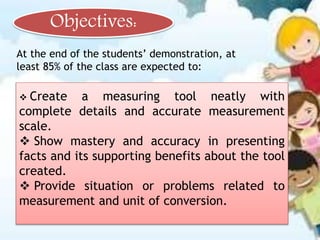
Objectives:
At the endof the students’ demonstration, at
least 85% of the class are expected to:
Create a measuring tool neatly with
complete details and accurate measurement
scale.
Show mastery and accuracy in presenting
facts and its supporting benefits about the tool
created.
Provide situation or problems related to
measurement and unit of conversion.
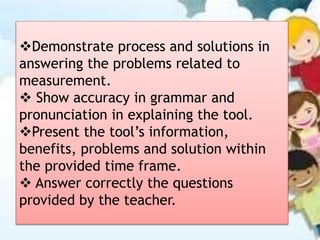
3.
Demonstrate process andsolutions in
answering the problems related to
measurement.
Show accuracy in grammar and
pronunciation in explaining the tool.
Present the tool’s information,
benefits, problems and solution within
the provided time frame.
Answer correctly the questions
provided by the teacher.
4.
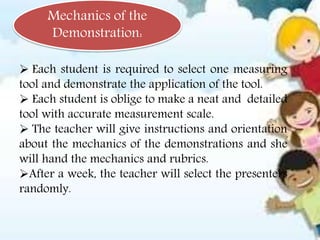
Mechanics of the
Demonstration:
Each student is required to select one measuring
tool and demonstrate the application of the tool.
Each student is oblige to make a neat and detailed
tool with accurate measurement scale.
The teacher will give instructions and orientation
about the mechanics of the demonstrations and she
will hand the mechanics and rubrics.
After a week, the teacher will select the presenters
randomly.
5.
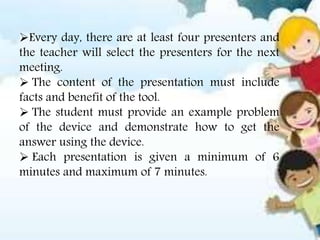
Every day, thereare at least four presenters and
the teacher will select the presenters for the next
meeting.
The content of the presentation must include
facts and benefit of the tool.
The student must provide an example problem
of the device and demonstrate how to get the
answer using the device.
Each presentation is given a minimum of 6
minutes and maximum of 7 minutes.
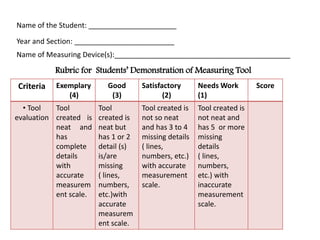
Criteria Exemplary
(4)
Good
(3)
Satisfactory
(2)
Needs Work
(1)
Score
•Tool
evaluation
Tool
created is
neat and
has
complete
details
with
accurate
measurem
ent scale.
Tool
created is
neat but
has 1 or 2
detail (s)
is/are
missing
( lines,
numbers,
etc.)with
accurate
measurem
ent scale.
Tool created is
not so neat
and has 3 to 4
missing details
( lines,
numbers, etc.)
with accurate
measurement
scale.
Tool created is
not neat and
has 5 or more
missing
details
( lines,
numbers,
etc.) with
inaccurate
measurement
scale.
Name of the Student: ______________________
Year and Section: _________________________
Name of Measuring Device(s):____________________________________________
Rubric for Students’ Demonstration of Measuring Tool
8.
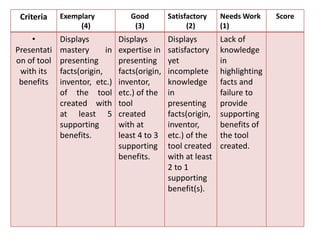
Criteria Exemplary
(4)
Good
(3)
Satisfactory
(2)
Needs Work
(1)
Score
•
Presentati
onof tool
with its
benefits
Displays
mastery in
presenting
facts(origin,
inventor, etc.)
of the tool
created with
at least 5
supporting
benefits.
Displays
expertise in
presenting
facts(origin,
inventor,
etc.) of the
tool
created
with at
least 4 to 3
supporting
benefits.
Displays
satisfactory
yet
incomplete
knowledge
in
presenting
facts(origin,
inventor,
etc.) of the
tool created
with at least
2 to 1
supporting
benefit(s).
Lack of
knowledge
in
highlighting
facts and
failure to
provide
supporting
benefits of
the tool
created.
9.
Criteria Exemplary
(4)
Good
(3)
Satisfactory
(2)
Needs
Work (1)
Score
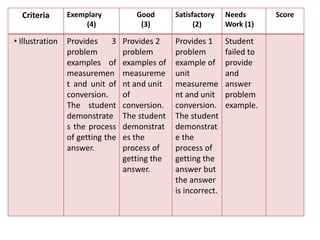
•Illustration Provides 3
problem
examples of
measuremen
t and unit of
conversion.
The student
demonstrate
s the process
of getting the
answer.
Provides 2
problem
examples of
measureme
nt and unit
of
conversion.
The student
demonstrat
es the
process of
getting the
answer.
Provides 1
problem
example of
unit
measureme
nt and unit
conversion.
The student
demonstrat
e the
process of
getting the
answer but
the answer
is incorrect.
Student
failed to
provide
and
answer
problem
example.
10.
Criteria Exemplary
(4)
Good
(3)
Satisfactory
(2)
Needs Work
(1)
Score
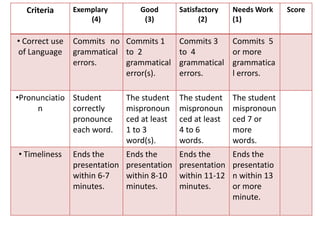
•Correct use
of Language
Commits no
grammatical
errors.
Commits 1
to 2
grammatical
error(s).
Commits 3
to 4
grammatical
errors.
Commits 5
or more
grammatica
l errors.
•Pronunciatio
n
Student
correctly
pronounce
each word.
The student
mispronoun
ced at least
1 to 3
word(s).
The student
mispronoun
ced at least
4 to 6
words.
The student
mispronoun
ced 7 or
more
words.
• Timeliness Ends the
presentation
within 6-7
minutes.
Ends the
presentation
within 8-10
minutes.
Ends the
presentation
within 11-12
minutes.
Ends the
presentatio
n within 13
or more
minute.
11.
Criteria Exemplary
(4)
Good
(3)
Satisfactory
(2)
Needs Work
(1)
Score
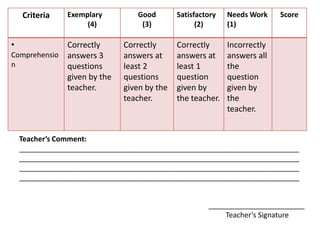
•
Comprehensio
n
Correctly
answers3
questions
given by the
teacher.
Correctly
answers at
least 2
questions
given by the
teacher.
Correctly
answers at
least 1
question
given by
the teacher.
Incorrectly
answers all
the
question
given by
the
teacher.
Teacher’s Comment:
______________________________________________________________________
______________________________________________________________________
______________________________________________________________________
______________________________________________________________________
________________________
Teacher’s Signature