Pooja K More
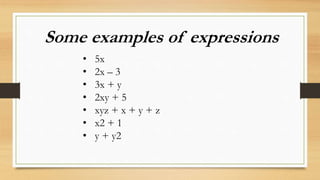
Some examples of expressions
• 5x
• 2x – 3
• 3x + y
• 2xy + 5
• xyz + x + y + z
• x2 + 1
• y + y2
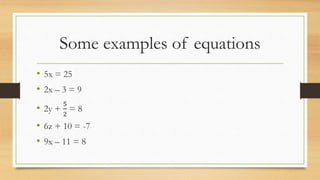
Some examples of equations
• 5x = 25
• 2x – 3 = 9
• 2y +
5
2
= 8
• 6z + 10 = -7
• 9x – 11 = 8
equations use the equality (=) sign
If yes = equation 
If no = equation 
• For example,
2xy + 5 has two variables.
2.1 Introduction
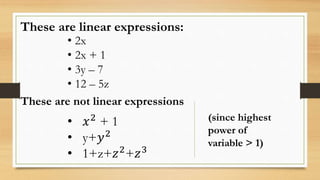
These are linear expressions:
• 2x
• 2x + 1
• 3y – 7
• 12 – 5z
These are not linear expressions
• 𝑥2
+ 1
• y+𝑦2
• 1+z+𝑧2
+𝑧3
(since highest
power of
variable > 1)
• An algebraic equation is an
equality involving variables.
• It has an equality sign.
• The expression on the left of
the equality sign is the Left
Hand Side (LHS).
• The expression on the right
of the equality sign is the
Right Hand Side (RHS).
• In an equation the values of the expressions on the
LHS and RHS are equal.
• This happens to be true only for certain values of the
variable.
• These values are the solutions of the equation.
• x = 5 is the solution of the equation 2x – 3 = 7.
For x = 5, LHS = 2 × 5 – 3 = 7 = RHS
• On the other hand x = 10 is not a solution of the
equation.
• For x = 10, LHS = 2 × 10 –3 = 17. This is not equal to
the RHS
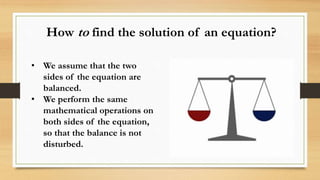
• We assume that the two
sides of the equation are
balanced.
• We perform the same
mathematical operations on
both sides of the equation,
so that the balance is not
disturbed.
How to find the solution of an equation?
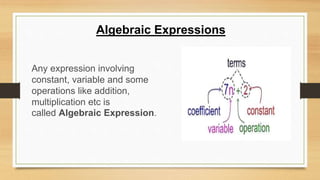
Algebraic Expressions
Any expression involving
constant, variable and some
operations like addition,
multiplication etc is
called Algebraic Expression.
•A variable is an unknown number
and generally, it is represented by
a letter like x, y, n etc.
•Any number without any variable
is called Constant.
•A number followed by a variable
is called Coefficient of that
variable.
•A term is any number or variable
separated by operators.
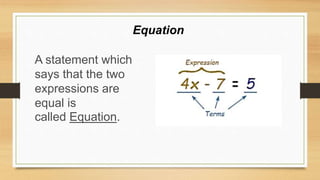
Equation
A statement which
says that the two
expressions are
equal is
called Equation.
Linear Expression
A linear expression is an expression whose highest
power of the variable is one only.
Linear Equations
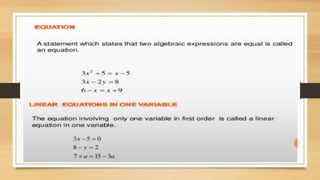
The equation of a straight line is the linear equation. It could be in one
variable or two variables.
Linear Equation in One Variable
If there is only one variable in the equation then it is called a linear
equation in one variable.
The general form is
ax + b = c, where a, b and c are real numbers and a ≠ 0.
Example
x + 5 = 10
y – 3 = 19
These are called linear equations in one variable
because the highest degree of the variable is one and
there is only one variable.
Some Important points related to Linear
Equations
• There is an equality sign in the linear equation. The
expression on the left of the equal sign is called the
LHS (left-hand side) and the expression on the right
of the equal sign is called the RHS (right-hand side).
• In the linear equation, the LHS is equal to RHS but
this happens for some values only and these
values are the solution of these linear equations.
2.2 Solving Equations which have Linear
Expressions on one Side and Numbers on the
other Side
There are two methods to solve such type of
problems-
1. Balancing Method
2. Transposing Method
1. Balancing Method
• In this method, we have to add or subtract
with the same number on both the sides
without disturbing the balance to find the
solution.
Example
Find the solution for 3x – 10 = 14
Step 2: Now to balance the equation, we
need to divide by 3 into both the sides.
3𝑥
3
=
24
3
x = 8
Hence x = 8 is the solution of the equation.
We can recheck our answer by substituting the value of x
in the equation.
Here, LHS = RHS, so our solution is correct
2. Transposing Method
• In this method, we need to transpose or
transfer the constants or variables from one
side to another until we get the solution.
• When we transpose the terms the sign will get
changed.
Example
Find the solution for 2z +10 = 4.
Solution
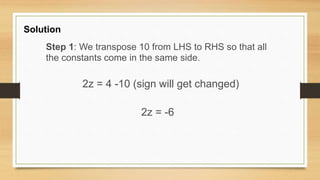
Step 1: We transpose 10 from LHS to RHS so that all
the constants come in the same side.
2z = 4 -10 (sign will get changed)
2z = -6
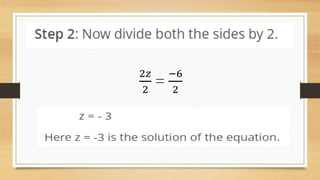
2𝑧
2
=
−6
2
2.3 Some Applications of Linear Equation
We can use the concept of linear equations in our daily
routine also. There are some situations where we need
to use the variable to find the solution. Like,
•What number should be added to 23 to get 75?
•If the sum of two numbers is 100 and one of the
no. is 63 then what will be the other number?
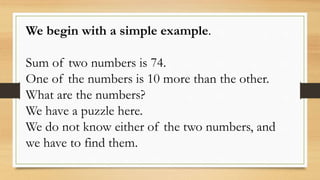
We begin with a simple example.
Sum of two numbers is 74.
One of the numbers is 10 more than the other.
What are the numbers?
We have a puzzle here.
We do not know either of the two numbers, and
we have to find them.
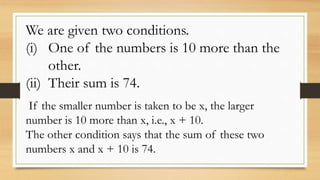
We are given two conditions.
(i) One of the numbers is 10 more than the
other.
(ii) Their sum is 74.
If the smaller number is taken to be x, the larger
number is 10 more than x, i.e., x + 10.
The other condition says that the sum of these two
numbers x and x + 10 is 74.
This means that x + (x + 10) = 74.
or 2x + 10 = 74 Transposing 10 to RHS,
2x = 74 – 10 or 2x = 64
Dividing both sides by 2, x = 32.
This is one number.
The other number is x + 10 = 32 + 10 = 42
The desired numbers are 32 and 42.
(Their sum is indeed 74 as given and also one number is 10
more than the other.)
We shall now consider several examples to show how useful
this method is.
2.4 Solving Equations having the Variable
on both Sides
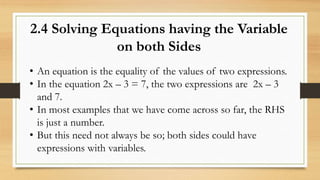
• An equation is the equality of the values of two expressions.
• In the equation 2x – 3 = 7, the two expressions are 2x – 3
and 7.
• In most examples that we have come across so far, the RHS
is just a number.
• But this need not always be so; both sides could have
expressions with variables.
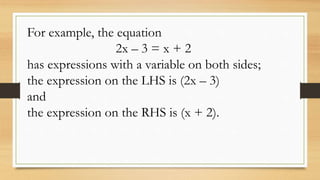
For example, the equation
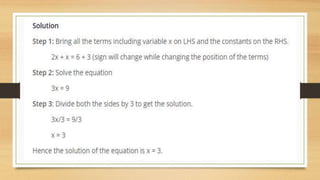
2x – 3 = x + 2
has expressions with a variable on both sides;
the expression on the LHS is (2x – 3)
and
the expression on the RHS is (x + 2).
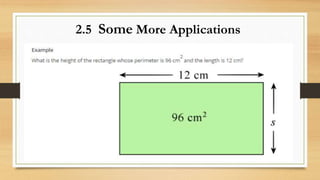
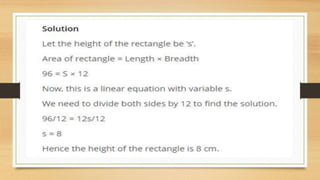
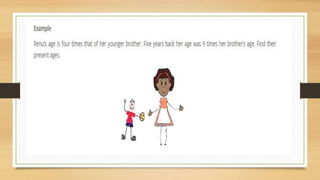
2.5 Some More Applications
2.6 Reducing Equations to Simpler Form
2.7 Equations Reducible to the Linear
Form
Sometimes there are some equations which are not
linear equations but can be reduced to the linear form
and then can be solved by the above methods.
WHAT HAVE WE DISCUSSED?
• An algebraic equation is an equality involving variables. It says
that the value of the expression on one side of the equality
sign is equal to the value of the expression on the other side.
• Just as numbers, variables can, also, be transposed from one
side of the equation to the other.
• The utility of linear equations is in their diverse applications;
different problems on numbers, ages, perimeters, combination
of currency notes, and so on can be solved using linear
equations.

Linear Equation In One Variable

  • 1.
  • 2.
    Some examples ofexpressions • 5x • 2x – 3 • 3x + y • 2xy + 5 • xyz + x + y + z • x2 + 1 • y + y2
  • 3.
    Some examples ofequations • 5x = 25 • 2x – 3 = 9 • 2y + 5 2 = 8 • 6z + 10 = -7 • 9x – 11 = 8
  • 4.
    equations use theequality (=) sign If yes = equation  If no = equation  • For example, 2xy + 5 has two variables. 2.1 Introduction
  • 5.
    These are linearexpressions: • 2x • 2x + 1 • 3y – 7 • 12 – 5z These are not linear expressions • 𝑥2 + 1 • y+𝑦2 • 1+z+𝑧2 +𝑧3 (since highest power of variable > 1)
  • 6.
    • An algebraicequation is an equality involving variables. • It has an equality sign. • The expression on the left of the equality sign is the Left Hand Side (LHS). • The expression on the right of the equality sign is the Right Hand Side (RHS).
  • 7.
    • In anequation the values of the expressions on the LHS and RHS are equal. • This happens to be true only for certain values of the variable. • These values are the solutions of the equation. • x = 5 is the solution of the equation 2x – 3 = 7. For x = 5, LHS = 2 × 5 – 3 = 7 = RHS • On the other hand x = 10 is not a solution of the equation. • For x = 10, LHS = 2 × 10 –3 = 17. This is not equal to the RHS
  • 8.
    • We assumethat the two sides of the equation are balanced. • We perform the same mathematical operations on both sides of the equation, so that the balance is not disturbed. How to find the solution of an equation?
  • 9.
    Algebraic Expressions Any expressioninvolving constant, variable and some operations like addition, multiplication etc is called Algebraic Expression.
  • 10.
    •A variable isan unknown number and generally, it is represented by a letter like x, y, n etc. •Any number without any variable is called Constant. •A number followed by a variable is called Coefficient of that variable. •A term is any number or variable separated by operators.
  • 11.
    Equation A statement which saysthat the two expressions are equal is called Equation.
  • 12.
    Linear Expression A linearexpression is an expression whose highest power of the variable is one only.
  • 13.
    Linear Equations The equationof a straight line is the linear equation. It could be in one variable or two variables. Linear Equation in One Variable If there is only one variable in the equation then it is called a linear equation in one variable. The general form is ax + b = c, where a, b and c are real numbers and a ≠ 0.
  • 14.
    Example x + 5= 10 y – 3 = 19 These are called linear equations in one variable because the highest degree of the variable is one and there is only one variable.
  • 15.
    Some Important pointsrelated to Linear Equations • There is an equality sign in the linear equation. The expression on the left of the equal sign is called the LHS (left-hand side) and the expression on the right of the equal sign is called the RHS (right-hand side). • In the linear equation, the LHS is equal to RHS but this happens for some values only and these values are the solution of these linear equations.
  • 18.
    2.2 Solving Equationswhich have Linear Expressions on one Side and Numbers on the other Side There are two methods to solve such type of problems- 1. Balancing Method 2. Transposing Method
  • 19.
    1. Balancing Method •In this method, we have to add or subtract with the same number on both the sides without disturbing the balance to find the solution. Example Find the solution for 3x – 10 = 14
  • 20.
    Step 2: Nowto balance the equation, we need to divide by 3 into both the sides. 3𝑥 3 = 24 3 x = 8 Hence x = 8 is the solution of the equation.
  • 21.
    We can recheckour answer by substituting the value of x in the equation. Here, LHS = RHS, so our solution is correct
  • 22.
    2. Transposing Method •In this method, we need to transpose or transfer the constants or variables from one side to another until we get the solution. • When we transpose the terms the sign will get changed. Example Find the solution for 2z +10 = 4.
  • 23.
    Solution Step 1: Wetranspose 10 from LHS to RHS so that all the constants come in the same side. 2z = 4 -10 (sign will get changed) 2z = -6
  • 24.
  • 25.
    2.3 Some Applicationsof Linear Equation We can use the concept of linear equations in our daily routine also. There are some situations where we need to use the variable to find the solution. Like, •What number should be added to 23 to get 75? •If the sum of two numbers is 100 and one of the no. is 63 then what will be the other number?
  • 26.
    We begin witha simple example. Sum of two numbers is 74. One of the numbers is 10 more than the other. What are the numbers? We have a puzzle here. We do not know either of the two numbers, and we have to find them.
  • 27.
    We are giventwo conditions. (i) One of the numbers is 10 more than the other. (ii) Their sum is 74. If the smaller number is taken to be x, the larger number is 10 more than x, i.e., x + 10. The other condition says that the sum of these two numbers x and x + 10 is 74.
  • 28.
    This means thatx + (x + 10) = 74. or 2x + 10 = 74 Transposing 10 to RHS, 2x = 74 – 10 or 2x = 64 Dividing both sides by 2, x = 32. This is one number. The other number is x + 10 = 32 + 10 = 42 The desired numbers are 32 and 42. (Their sum is indeed 74 as given and also one number is 10 more than the other.) We shall now consider several examples to show how useful this method is.
  • 37.
    2.4 Solving Equationshaving the Variable on both Sides • An equation is the equality of the values of two expressions. • In the equation 2x – 3 = 7, the two expressions are 2x – 3 and 7. • In most examples that we have come across so far, the RHS is just a number. • But this need not always be so; both sides could have expressions with variables.
  • 38.
    For example, theequation 2x – 3 = x + 2 has expressions with a variable on both sides; the expression on the LHS is (2x – 3) and the expression on the RHS is (x + 2).
  • 46.
    2.5 Some MoreApplications
  • 50.
    2.6 Reducing Equationsto Simpler Form
  • 53.
    2.7 Equations Reducibleto the Linear Form Sometimes there are some equations which are not linear equations but can be reduced to the linear form and then can be solved by the above methods.
  • 56.
    WHAT HAVE WEDISCUSSED? • An algebraic equation is an equality involving variables. It says that the value of the expression on one side of the equality sign is equal to the value of the expression on the other side. • Just as numbers, variables can, also, be transposed from one side of the equation to the other. • The utility of linear equations is in their diverse applications; different problems on numbers, ages, perimeters, combination of currency notes, and so on can be solved using linear equations.