Approaches to School
Curriculum
Prepared By: Junila A. Tejada
Desired Learning Outcomes
• Describe the different approaches to
school curriculum
• Explain by examples how the approaches
clarify the definition of curriculum
• Reflect on how the three approaches
interrelate with each other
Three Ways of Approaching a
Curriculum
• Curriculum as a Content
• Curriculum as a Process
• Curriculum as a Product
Three Ways of Approaching a
Curriculum
• Curriculum as a Content
• Curriculum as a Process
• Curriculum as a Product
1. Curriculum as a Content or
Body of Language
 Focus will be the body of
knowledge to be transmitted to
students using appropriate
teaching method.
 The likelihood of teaching will be
limited to acquisition of facts,
concepts and principles of the subject
matter; however , the content can also
be taken as a means to an end.
Ways of presenting the content in the
curriculum
• Topical approach- much content is based
on knowledge , and experiences are
included.
• Concept approach - fewer topics in
clusters among major and sub-concepts
and their interaction, with relatedness
emphasized;
• Thematic Approach- combination of
concepts that develop conceptual
structures
• Modular Approach- leads to complete
units of instruction
Criteria in Selection of Content
(Scheffer, 1970 in Bilbao, et al 2009)
 Significance
 Validity
Utility
 Learnability
 Feasibility
 Interest
Significance
• Content should contribute to the ideas,
concepts, principles and generalization that
should attain the overall purpose of the
curriculum.
• Content becomes the means of developing
cognitive, affective, or psychomotor skills of
the learners.
Validity
• Authenticity of the subject matter forms its
validity.
• There is a need for validity check and
verification at a regular interval, because
content may not continue to be valid.
Utility
• Usefulness of the content in the
curriculum is relative to the learners who
are going to use this.
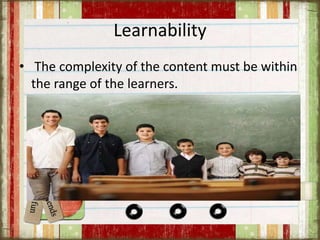
Learnability
• The complexity of the content must be within
the range of the learners.
Feasibility
• Can the subject be learned within the time allowed,
resources available, expertise of the teachers and the
nature of the learners?
• Are the contents of learning which can learned
beyond the formal teaching-learning engagement?
• Are there opportunities to learn these?
Interest
• Will the learners take interest in the content?
• What value will the contents have in present
and future life of the learners?
• Interest is one of the driving forces for the
students to lean better.
Guide in the Selection of the Content
in the Curriculum
• Commonly used in the daily life
• Appropriate to the maturity levels and
abilities of the learners
• Valuable in meeting the needs and
competencies of the future career
• Related to other subject fields or
discipline for complementation and
integration
• Important in transfer of learning to
other disciplines
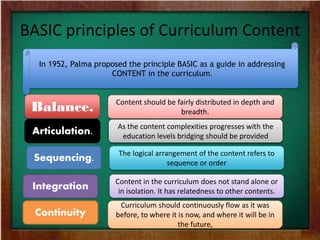
BASIC principles of Curriculum Content
In 1952, Palma proposed the principle BASIC as a guide in addressing
CONTENT in the curriculum.
Balance. Content should be fairly distributed in depth and
breadth.
Articulation. As the content complexities progresses with the
education levels bridging should be provided
Integration
Continuity
Sequencing. The logical arrangement of the content refers to
sequence or order
Content in the curriculum does not stand alone or
in isolation. It has relatedness to other contents.
Curriculum should continuously flow as it was
before, to where it is now, and where it will be in
the future,
Three Ways of Approaching a
Curriculum
• Curriculum as a Content
• Curriculum as a Process
• Curriculum as a Product
2. Curriculum as a Process
 Curriculum hapens in the
classrom as the questions as by
the teacher and learning activities
engaged in by the students.
lThe process of the teaching and learning process
becomes the central concern of teaching to
emphasize critical thinking, thinking meaning-making
and heads on, hands-on doing and many others.
There are the ways of teaching, ways of
managing the content, guiding learning,
methods of teaching and learning and
strategies of teaching or delivery modes.
When curriculum is approached as a
PROCESS, guiding principles are
presented• Curriculum process in the form of teaching methods
or strategies are means to achieve the end.
• There is no single best process in method.
• Curriculum should stimulate the learners' desire to
develop the cognitive, affective, psychomotor
domain in each individual.
• In the choice of methods, learning and teaching
styles should be considered.
• Every method or process should result to learning
outcomes which can be described as cognitive,
affective, and psychomotor.
• Flexibility in the use of the process or methods
should be considered.
• Both teaching and learning are the two important
processes in the implementation of the curriculum.
Three Ways of Approaching a
Curriculum
• Curriculum as a Content
• Curriculum as a Process
• Curriculum as a Product
3. Curriculum as a Product
 Central to the approach is the
formulation of behavioral
objectives stated as intended
learning outcomes.
These learned or achieved learning
outcomes are demostrated by the
person who has meaningful
experiences in the curriculum. All
these result of planning, content and
processes in the curriculum.

Approaches to School Curriculum

  • 1.
  • 2.
    Desired Learning Outcomes •Describe the different approaches to school curriculum • Explain by examples how the approaches clarify the definition of curriculum • Reflect on how the three approaches interrelate with each other
  • 3.
    Three Ways ofApproaching a Curriculum • Curriculum as a Content • Curriculum as a Process • Curriculum as a Product
  • 4.
    Three Ways ofApproaching a Curriculum • Curriculum as a Content • Curriculum as a Process • Curriculum as a Product
  • 5.
    1. Curriculum asa Content or Body of Language  Focus will be the body of knowledge to be transmitted to students using appropriate teaching method.  The likelihood of teaching will be limited to acquisition of facts, concepts and principles of the subject matter; however , the content can also be taken as a means to an end.
  • 6.
    Ways of presentingthe content in the curriculum • Topical approach- much content is based on knowledge , and experiences are included. • Concept approach - fewer topics in clusters among major and sub-concepts and their interaction, with relatedness emphasized; • Thematic Approach- combination of concepts that develop conceptual structures • Modular Approach- leads to complete units of instruction
  • 7.
    Criteria in Selectionof Content (Scheffer, 1970 in Bilbao, et al 2009)  Significance  Validity Utility  Learnability  Feasibility  Interest
  • 8.
    Significance • Content shouldcontribute to the ideas, concepts, principles and generalization that should attain the overall purpose of the curriculum. • Content becomes the means of developing cognitive, affective, or psychomotor skills of the learners.
  • 9.
    Validity • Authenticity ofthe subject matter forms its validity. • There is a need for validity check and verification at a regular interval, because content may not continue to be valid.
  • 10.
    Utility • Usefulness ofthe content in the curriculum is relative to the learners who are going to use this.
  • 11.
    Learnability • The complexityof the content must be within the range of the learners.
  • 12.
    Feasibility • Can thesubject be learned within the time allowed, resources available, expertise of the teachers and the nature of the learners? • Are the contents of learning which can learned beyond the formal teaching-learning engagement? • Are there opportunities to learn these?
  • 13.
    Interest • Will thelearners take interest in the content? • What value will the contents have in present and future life of the learners? • Interest is one of the driving forces for the students to lean better.
  • 14.
    Guide in theSelection of the Content in the Curriculum • Commonly used in the daily life • Appropriate to the maturity levels and abilities of the learners • Valuable in meeting the needs and competencies of the future career • Related to other subject fields or discipline for complementation and integration • Important in transfer of learning to other disciplines
  • 15.
    BASIC principles ofCurriculum Content In 1952, Palma proposed the principle BASIC as a guide in addressing CONTENT in the curriculum. Balance. Content should be fairly distributed in depth and breadth. Articulation. As the content complexities progresses with the education levels bridging should be provided Integration Continuity Sequencing. The logical arrangement of the content refers to sequence or order Content in the curriculum does not stand alone or in isolation. It has relatedness to other contents. Curriculum should continuously flow as it was before, to where it is now, and where it will be in the future,
  • 16.
    Three Ways ofApproaching a Curriculum • Curriculum as a Content • Curriculum as a Process • Curriculum as a Product
  • 17.
    2. Curriculum asa Process  Curriculum hapens in the classrom as the questions as by the teacher and learning activities engaged in by the students. lThe process of the teaching and learning process becomes the central concern of teaching to emphasize critical thinking, thinking meaning-making and heads on, hands-on doing and many others. There are the ways of teaching, ways of managing the content, guiding learning, methods of teaching and learning and strategies of teaching or delivery modes.
  • 18.
    When curriculum isapproached as a PROCESS, guiding principles are presented• Curriculum process in the form of teaching methods or strategies are means to achieve the end. • There is no single best process in method. • Curriculum should stimulate the learners' desire to develop the cognitive, affective, psychomotor domain in each individual. • In the choice of methods, learning and teaching styles should be considered. • Every method or process should result to learning outcomes which can be described as cognitive, affective, and psychomotor. • Flexibility in the use of the process or methods should be considered. • Both teaching and learning are the two important processes in the implementation of the curriculum.
  • 19.
    Three Ways ofApproaching a Curriculum • Curriculum as a Content • Curriculum as a Process • Curriculum as a Product
  • 20.
    3. Curriculum asa Product  Central to the approach is the formulation of behavioral objectives stated as intended learning outcomes. These learned or achieved learning outcomes are demostrated by the person who has meaningful experiences in the curriculum. All these result of planning, content and processes in the curriculum.