Learning Competency:
Calculates the measures of
variability of grouped and
ungrouped data.
Learning Objectives:
Identify the measures of variability
of grouped and ungroup data.
Link the concept of measures
of variability in real life context.
Solve the measures of variability
of grouped and ungrouped data.
DRILL
Let’s have a
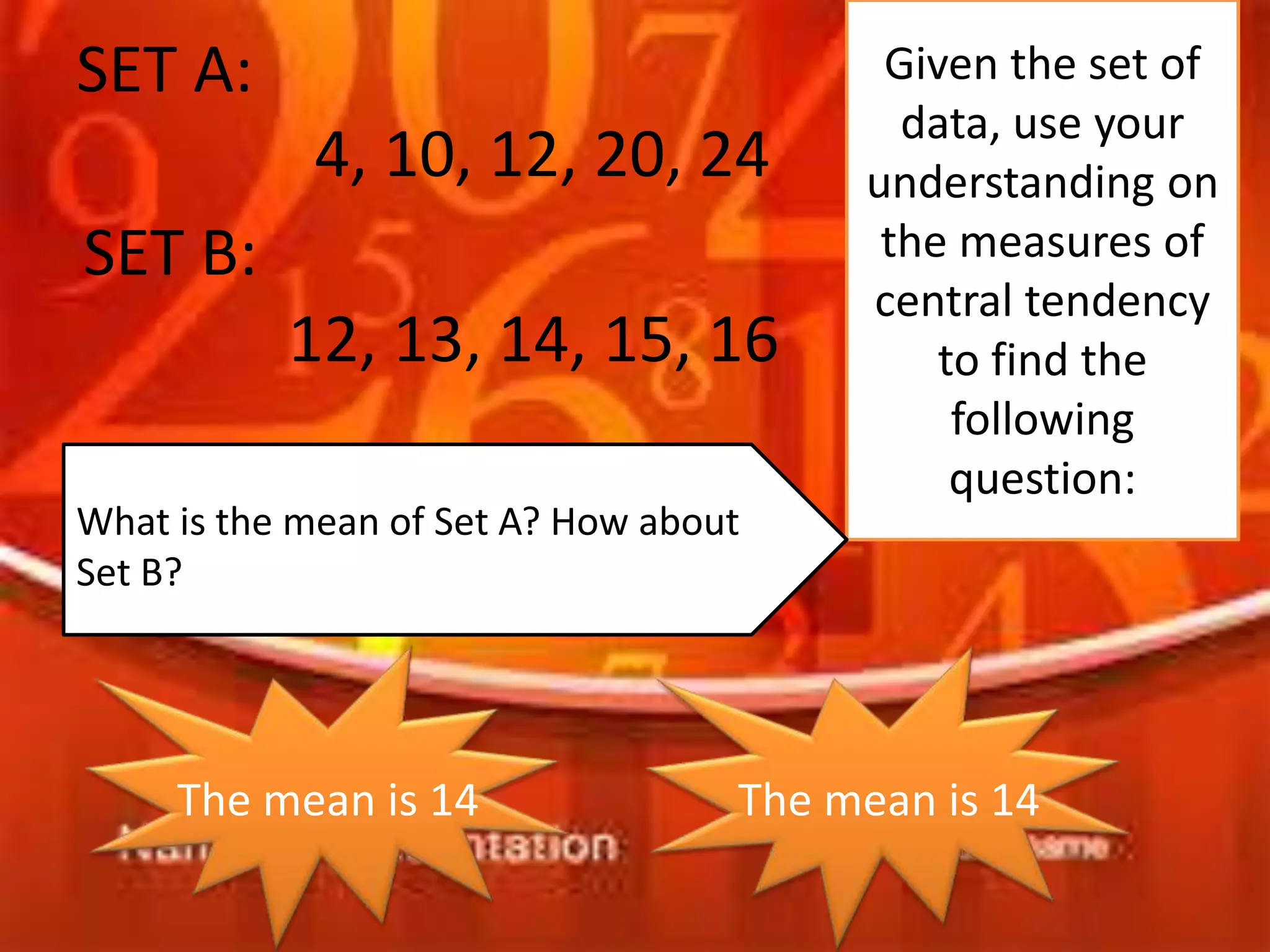
SET A:
4, 10, 12, 20, 24
SET B:
12, 13, 14, 15, 16
Given the set of
data, use your
understanding on
the measures of
central tendency
to find the
following
question:
What is the mean of Set A? How about
Set B?
The mean is 14 The mean is 14
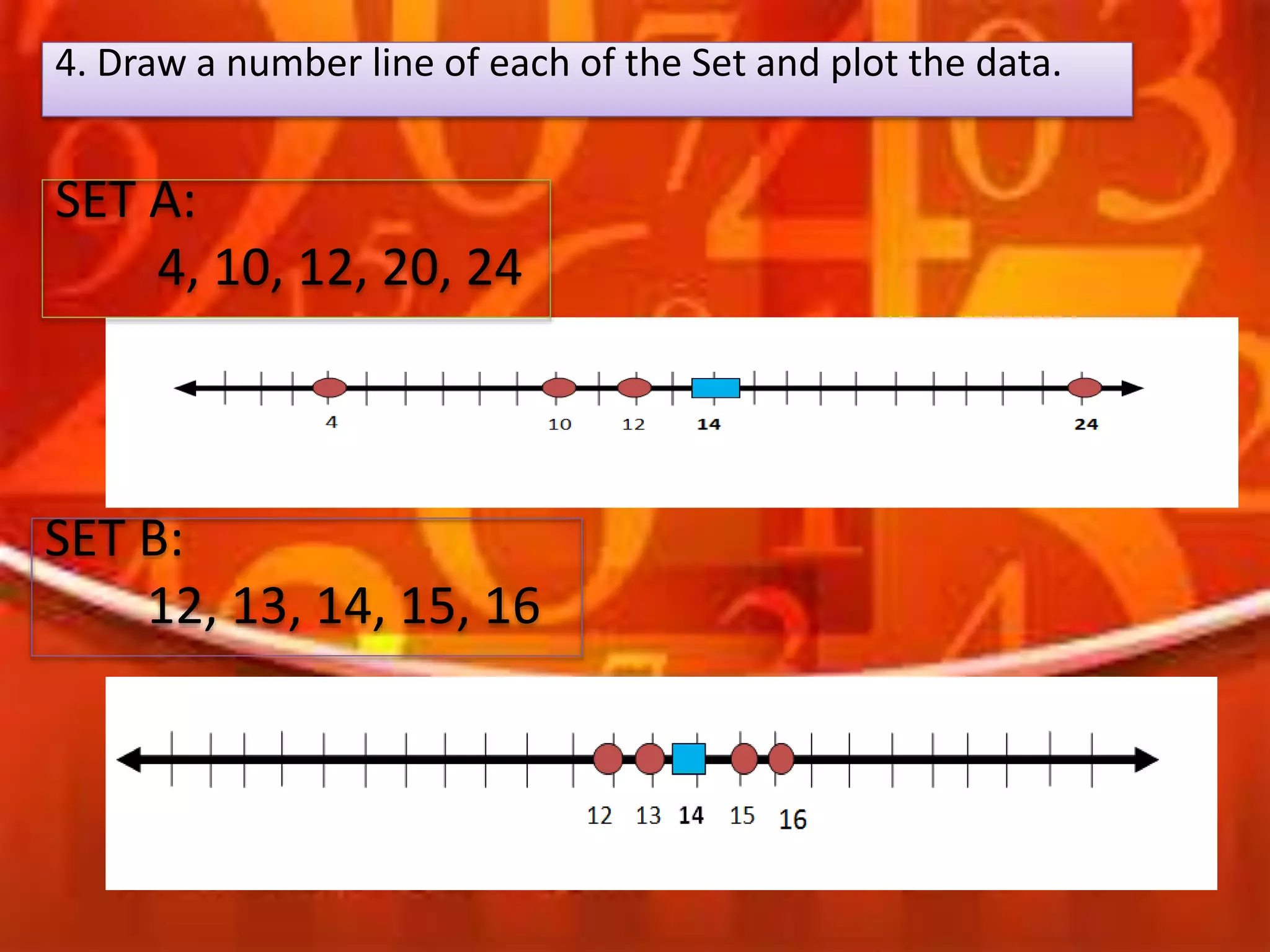
4. Draw a number line of each of the Set and plot the data.
SET A:
4, 10, 12, 20, 24
SET B:
12, 13, 14, 15, 16
Are you familiar with
the term “measures of
variability”?
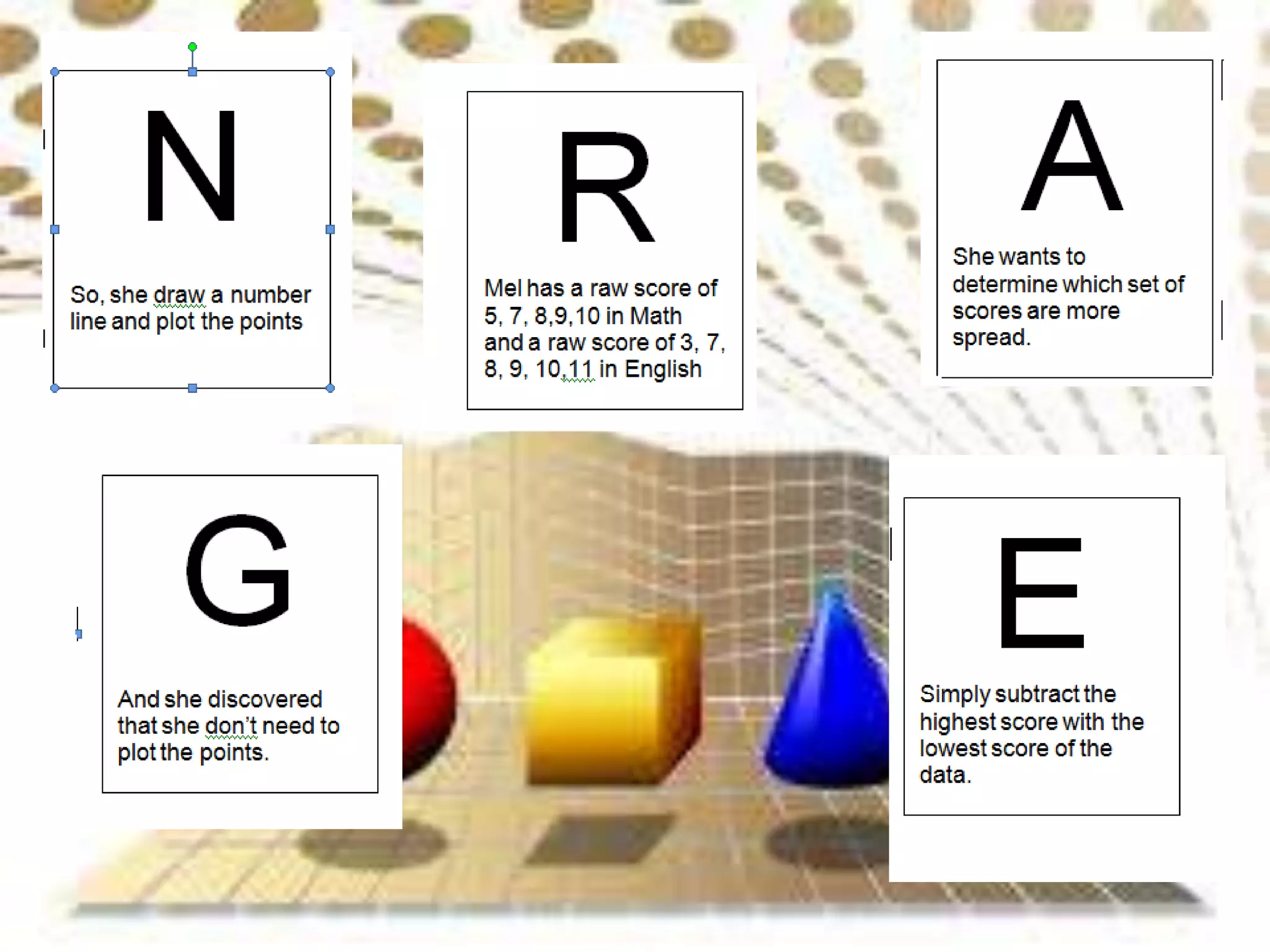
Your task: The students will arrange the
shuffled letters by sequencing the
clues indicated below the letter.
The activity is for only 5 minutes. Once
the time is done, the students will
submit their work.
Note:
What did we do
in our activity?
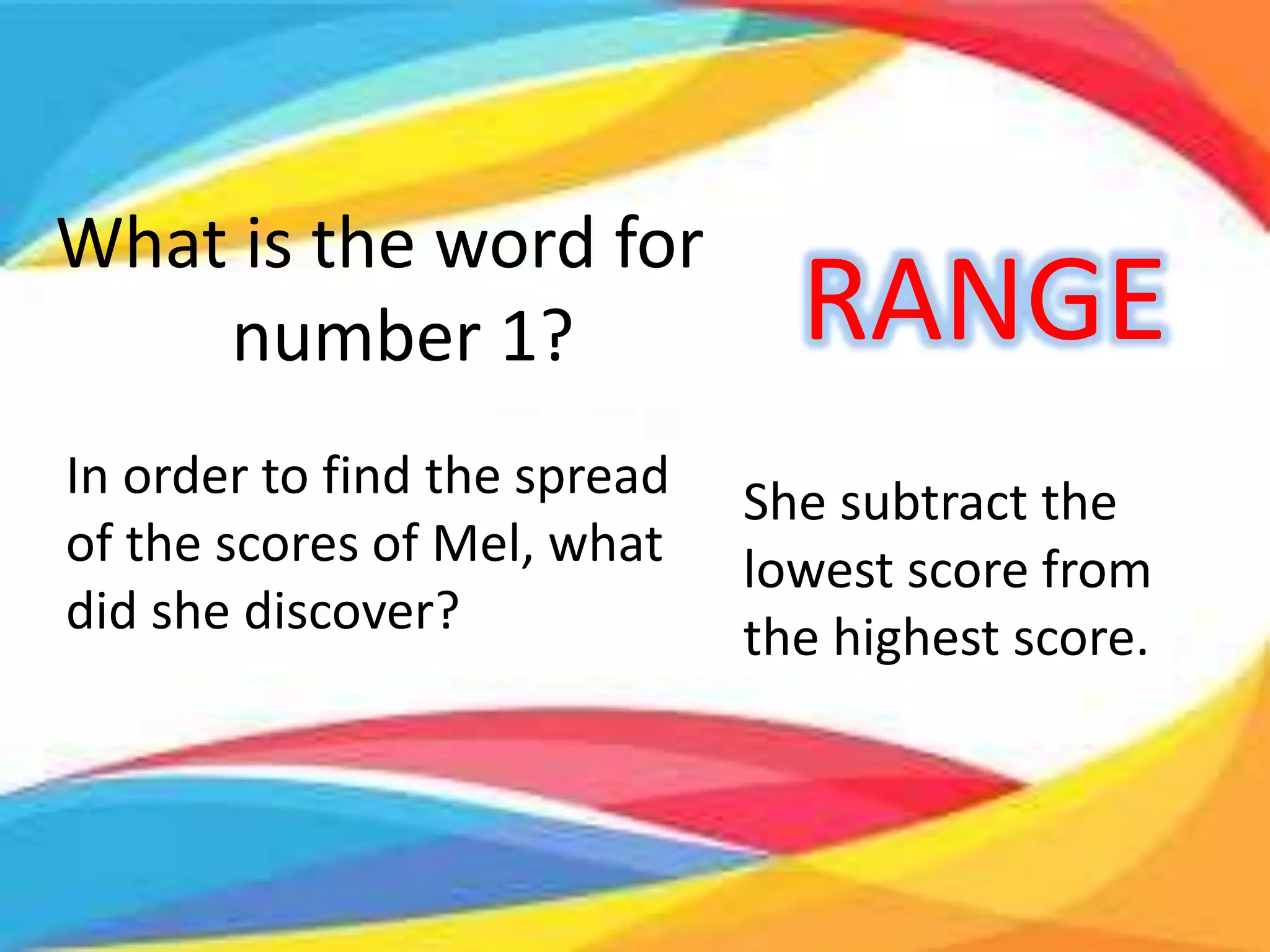
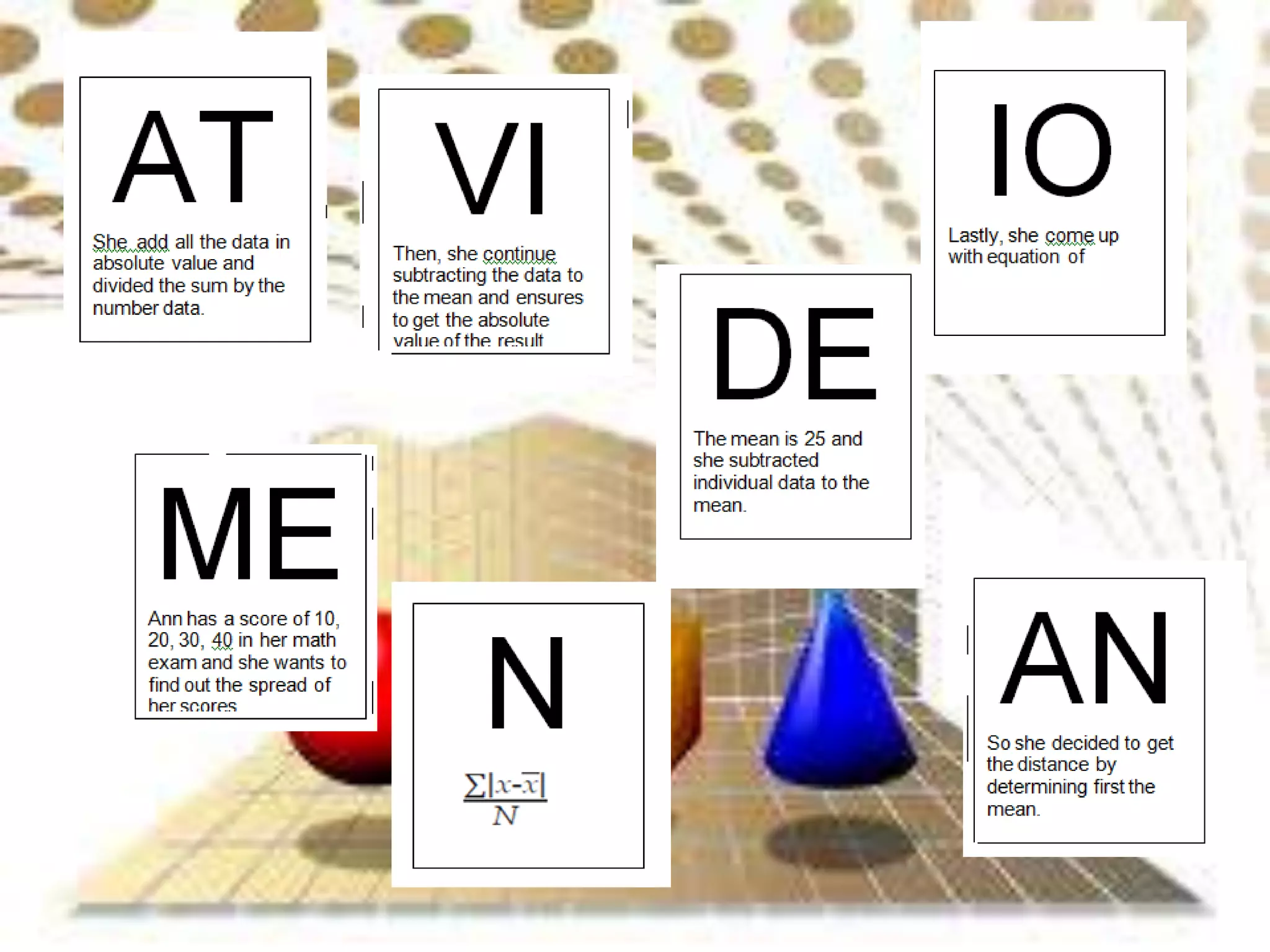
What is the word for
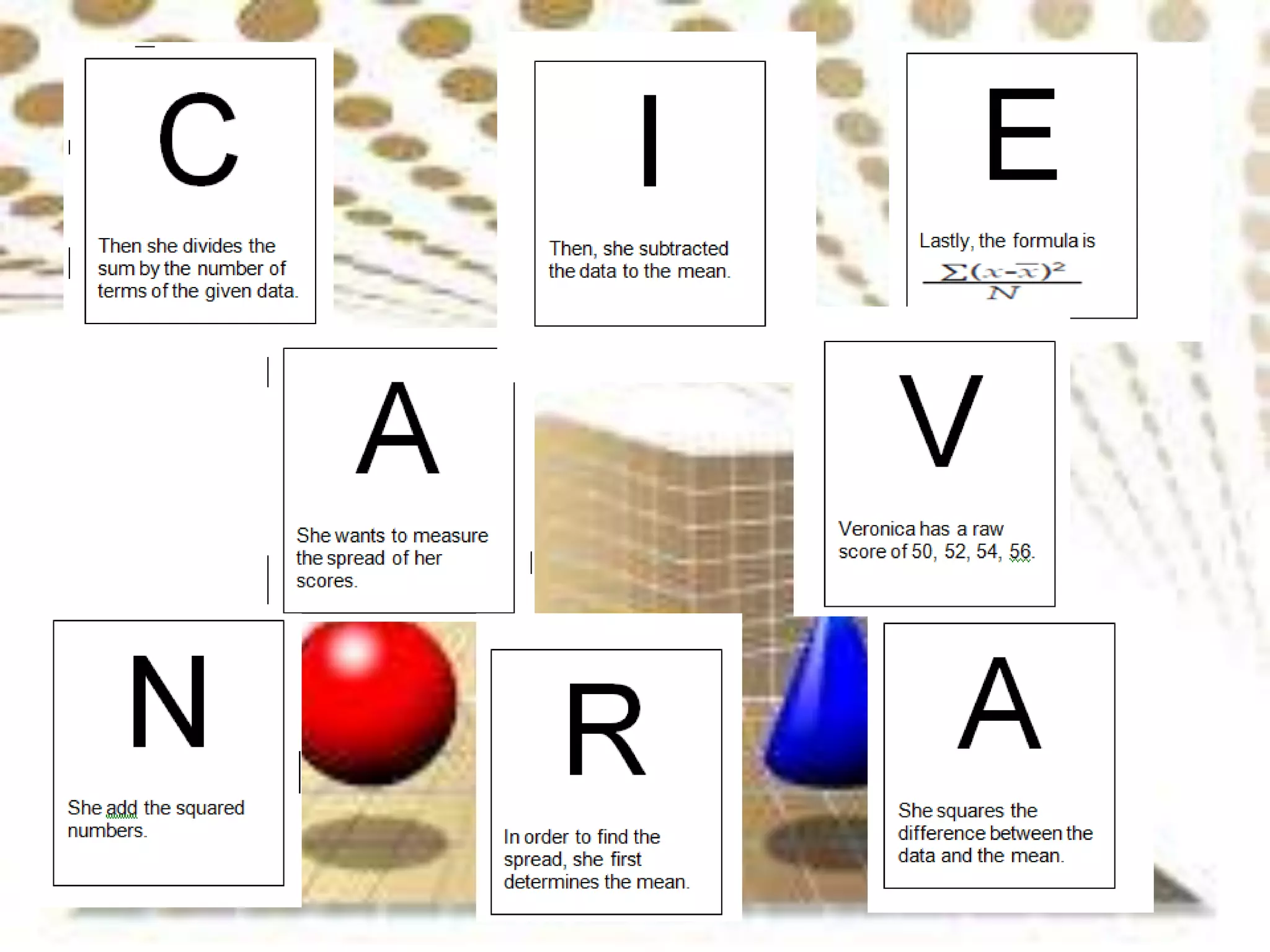
number 1? RANGE
In order to find the spread
of the scores of Mel, what
did she discover?
She subtract the
lowest score from
the highest score.
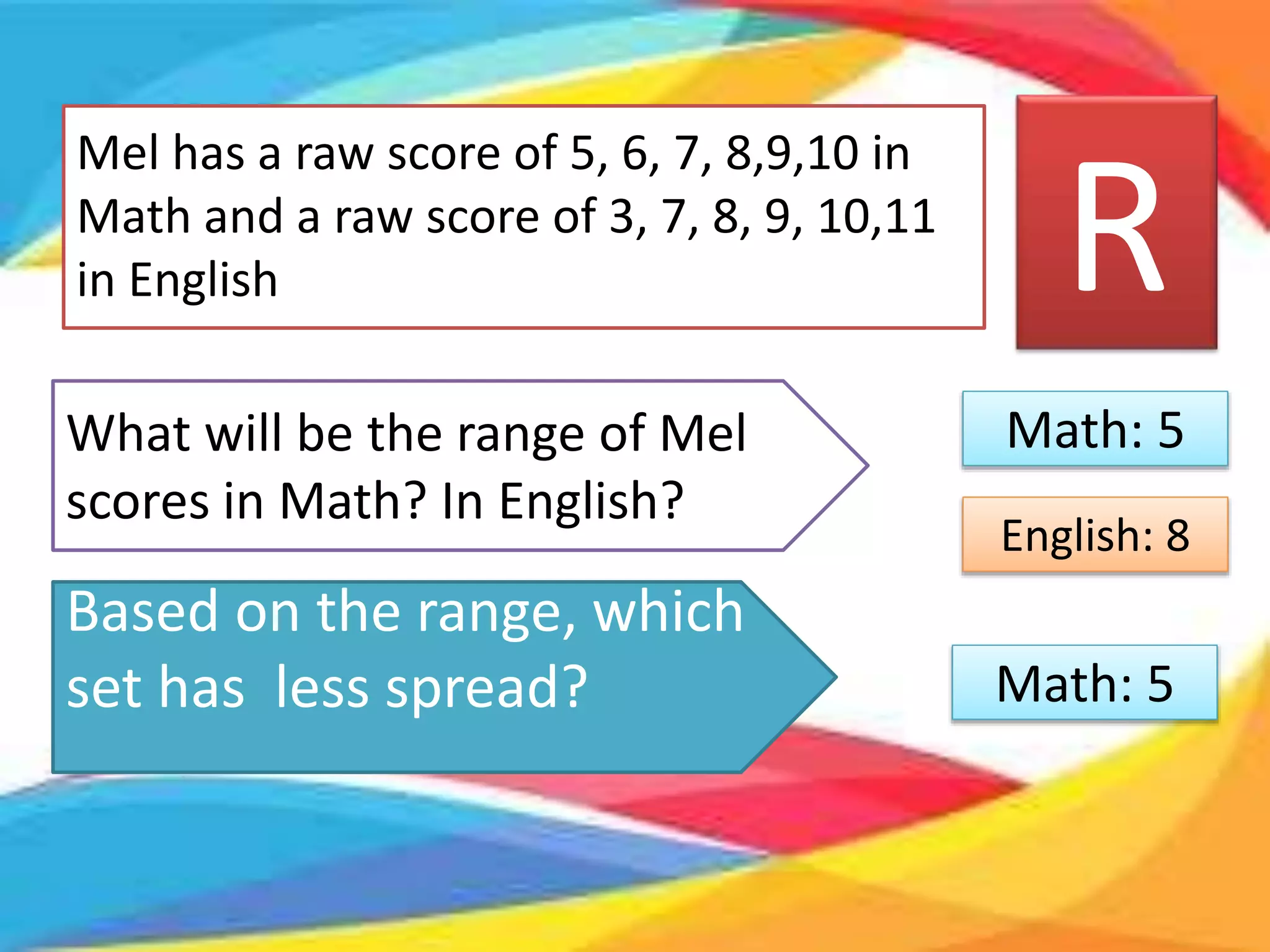
Mel has a raw score of 5, 6, 7, 8,9,10 in
Math and a raw score of 3, 7, 8, 9, 10,11
in English R
What will be the range of Mel
scores in Math? In English?
Math: 5
English: 8
Based on the range, which
set has less spread? Math: 5
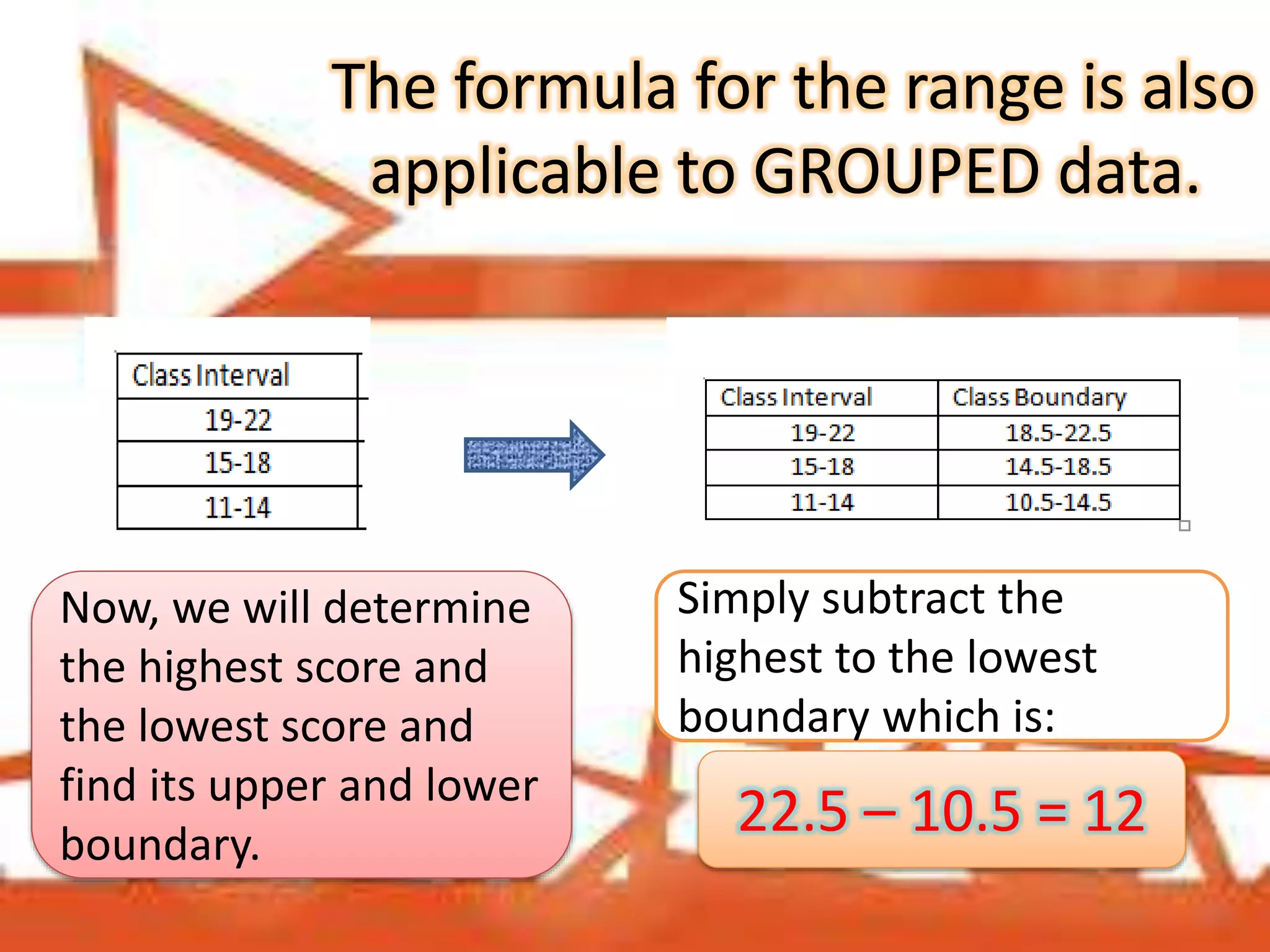
The formula for the range is also
applicable to GROUPED data.
Now, we will determine
the highest score and
the lowest score and
find its upper and lower
boundary.
Simply subtract the
highest to the lowest
boundary which is:
22.5 – 10.5 = 12
What if the two sets of
data have the same
range? Is there other
way to compute the
spread of the data?
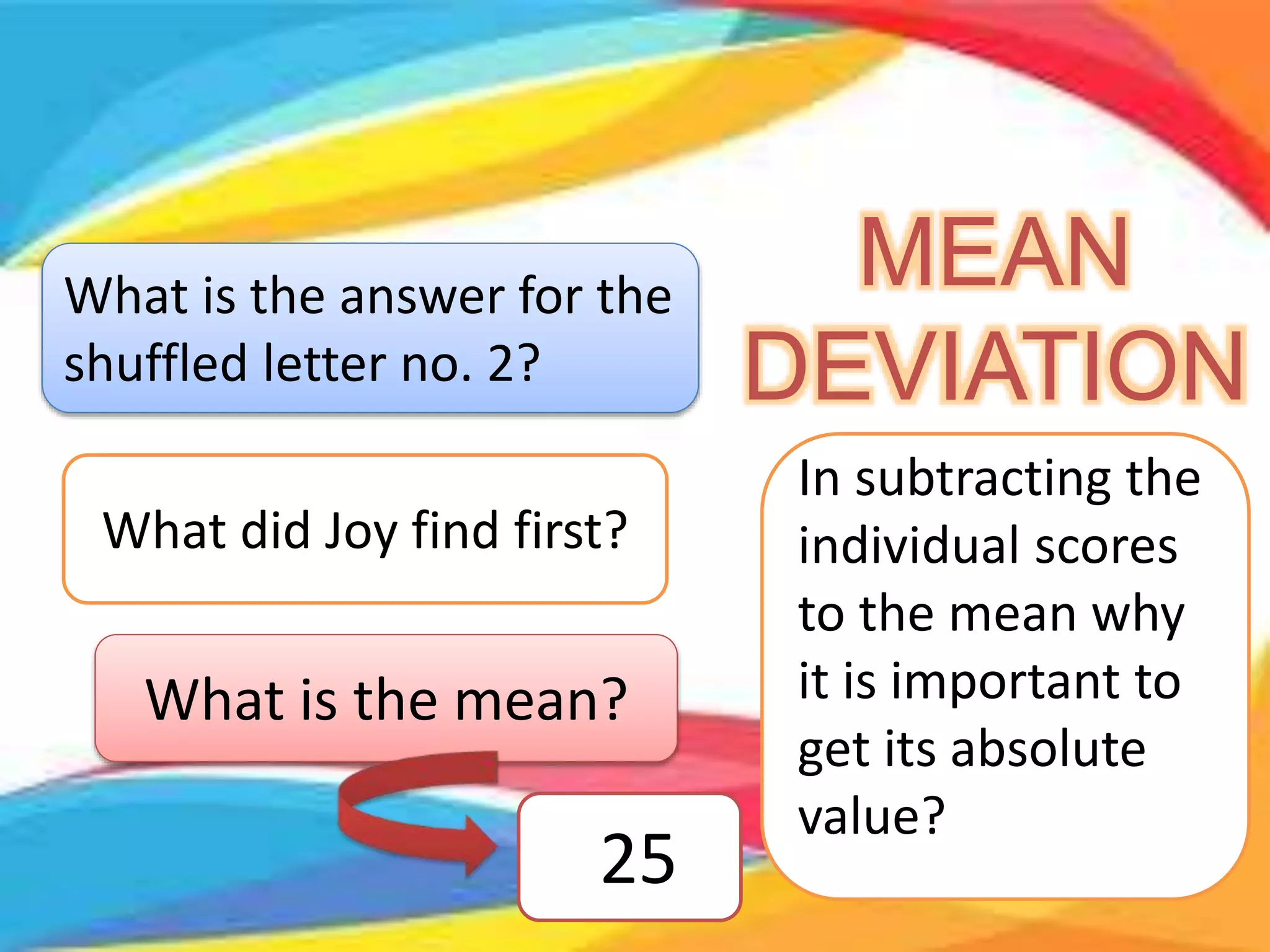
What is the answer for the
shuffled letter no. 2?
MEAN
DEVIATION
What did Joy find first?
What is the mean?
25
In subtracting the
individual scores
to the mean why
it is important to
get its absolute
value?
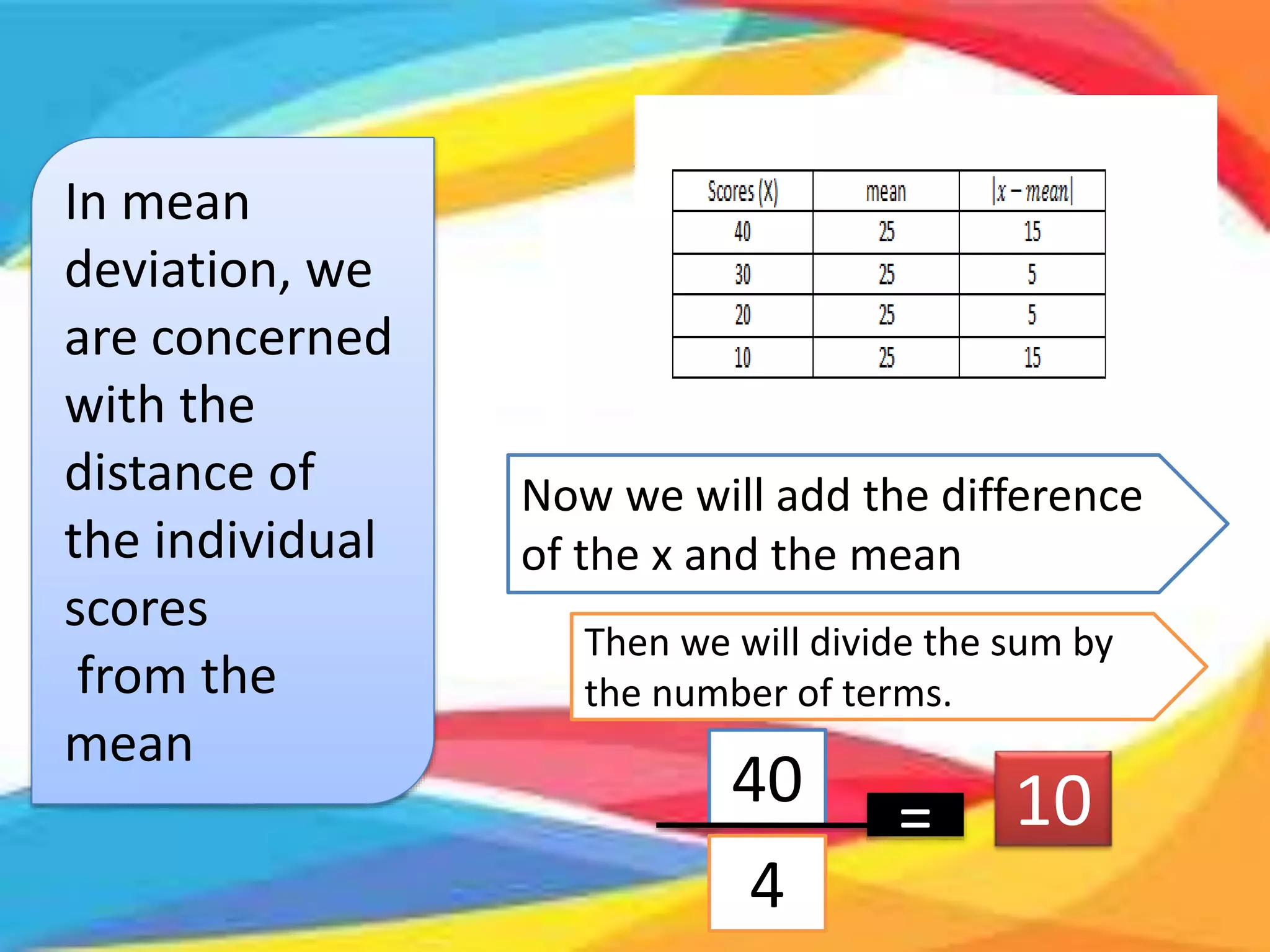
In mean
deviation, we
are concerned
with the
distance of
the individual
scores
from the
mean
Now we will add the difference
of the x and the mean
Then we will divide the sum by
the number of terms.
40
4
= 10
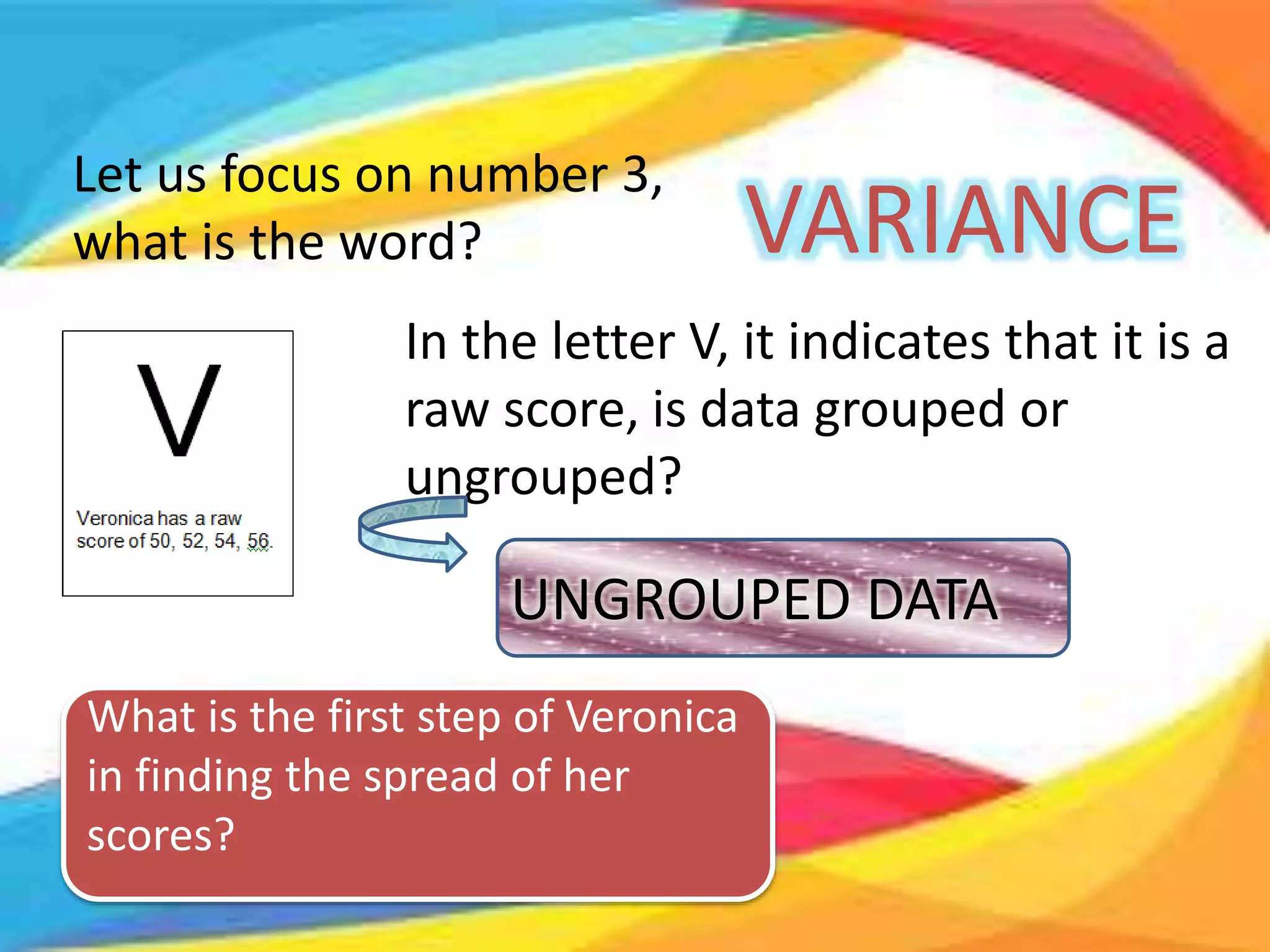
In the letter V, it indicates that it is a
raw score, is data grouped or
ungrouped?
UNGROUPED DATA
Let us focus on number 3,
what is the word? VARIANCE
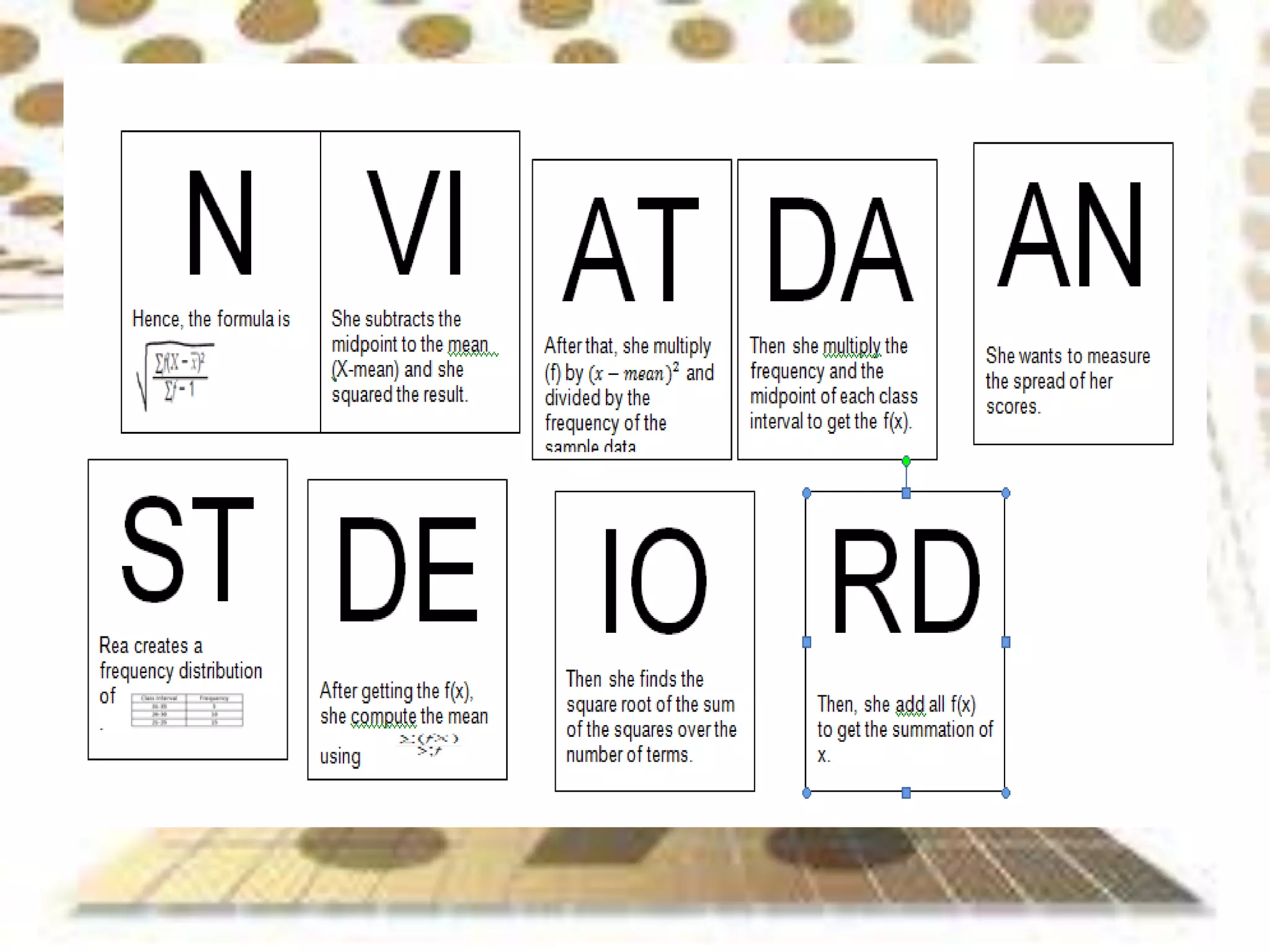
What is the first step of Veronica
in finding the spread of her
scores?
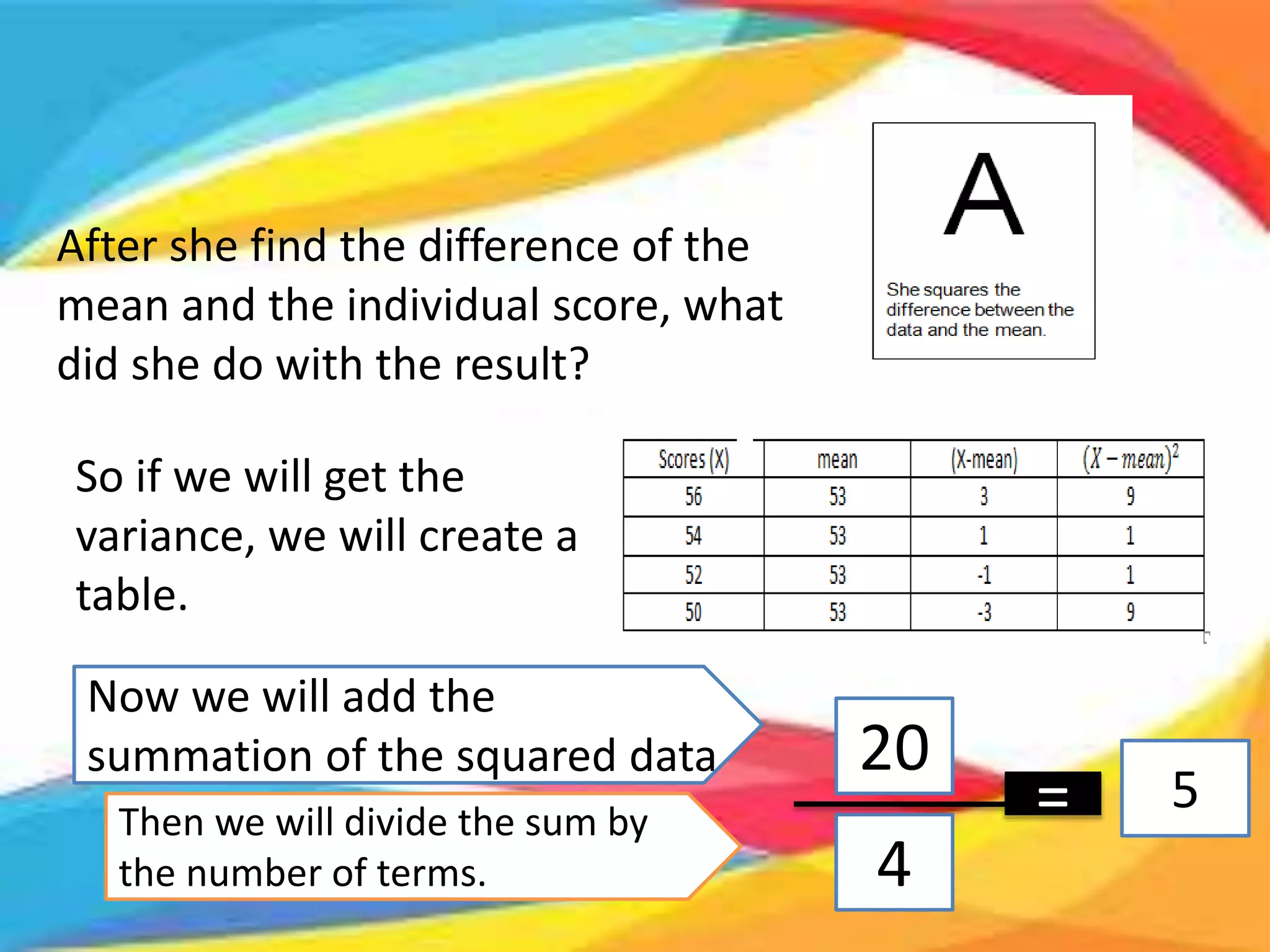
After she find the difference of the
mean and the individual score, what
did she do with the result?
So if we will get the
variance, we will create a
table.
Now we will add the
summation of the squared data
Then we will divide the sum by
the number of terms. 4
20
5=
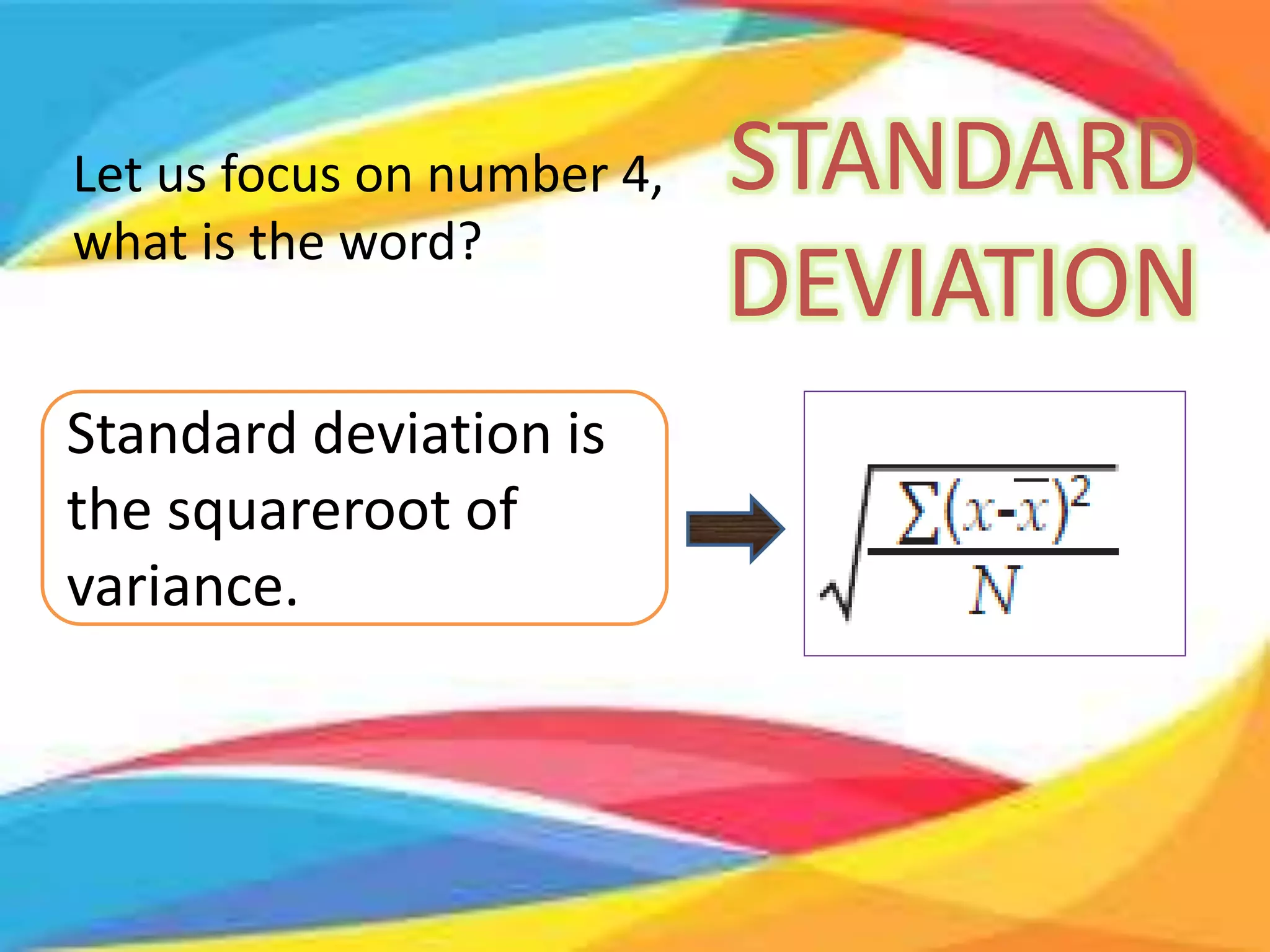
Let us focus on number 4,
what is the word?
STANDARD
DEVIATION
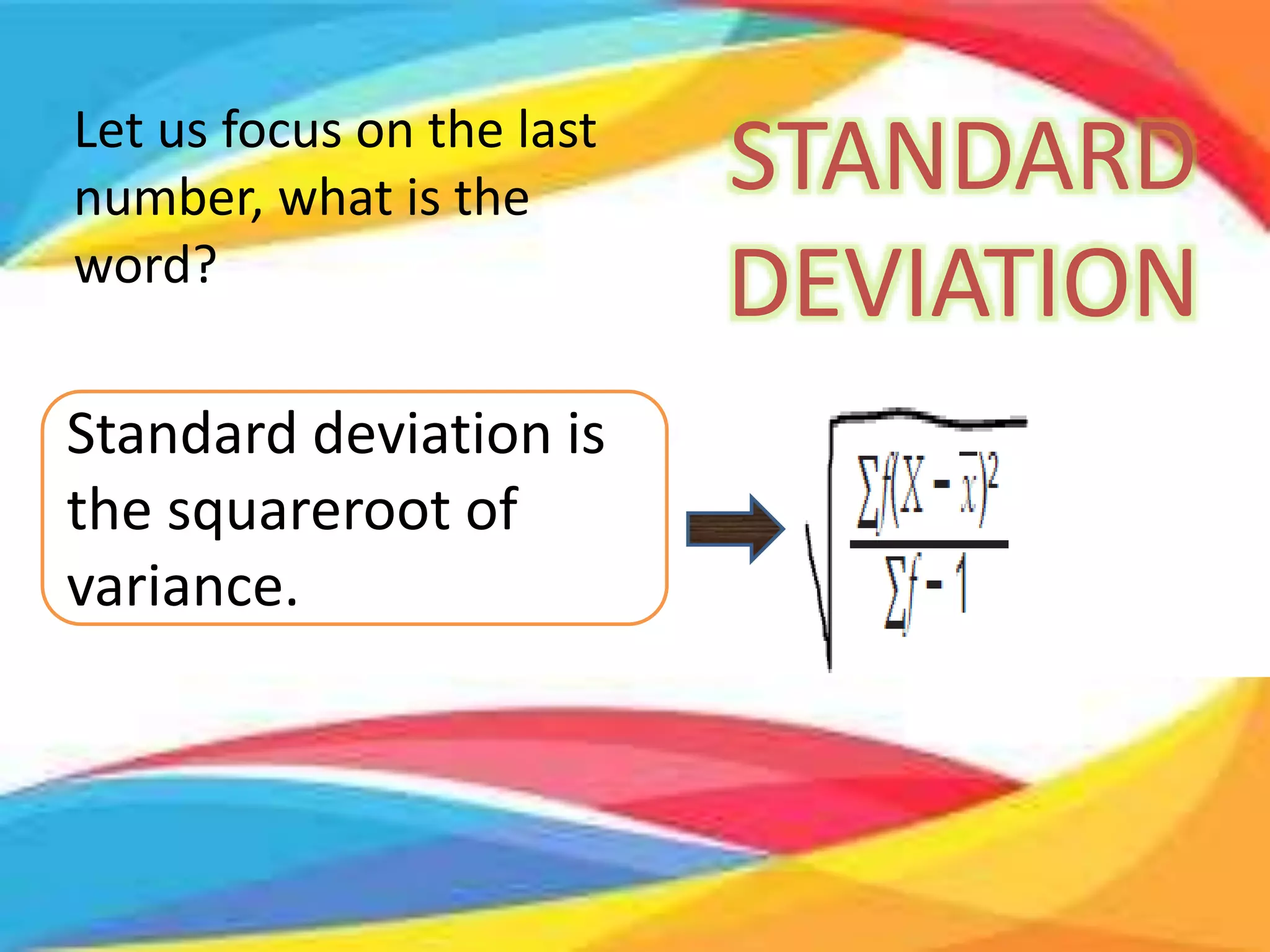
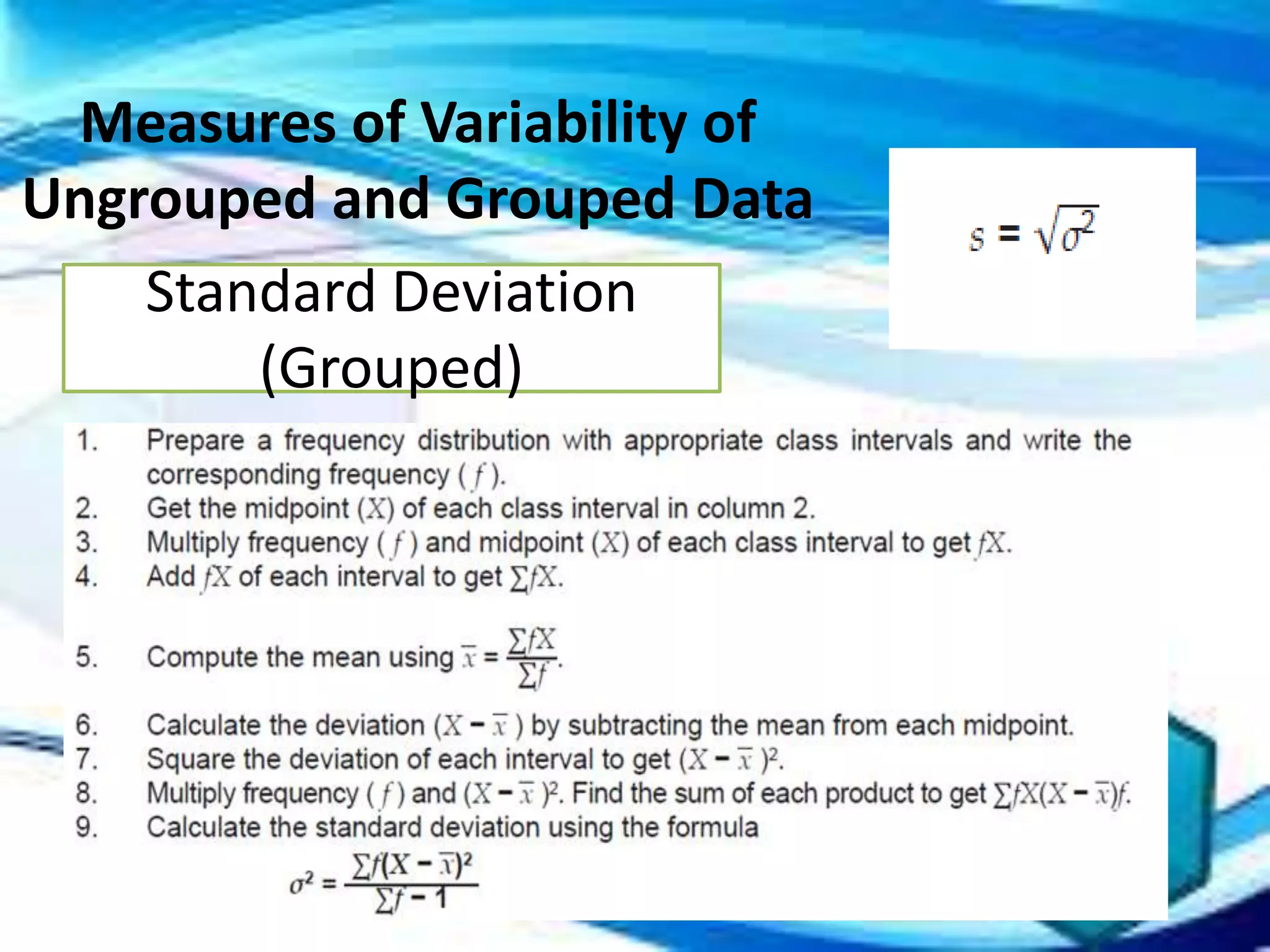
Standard deviation is
the squareroot of
variance.
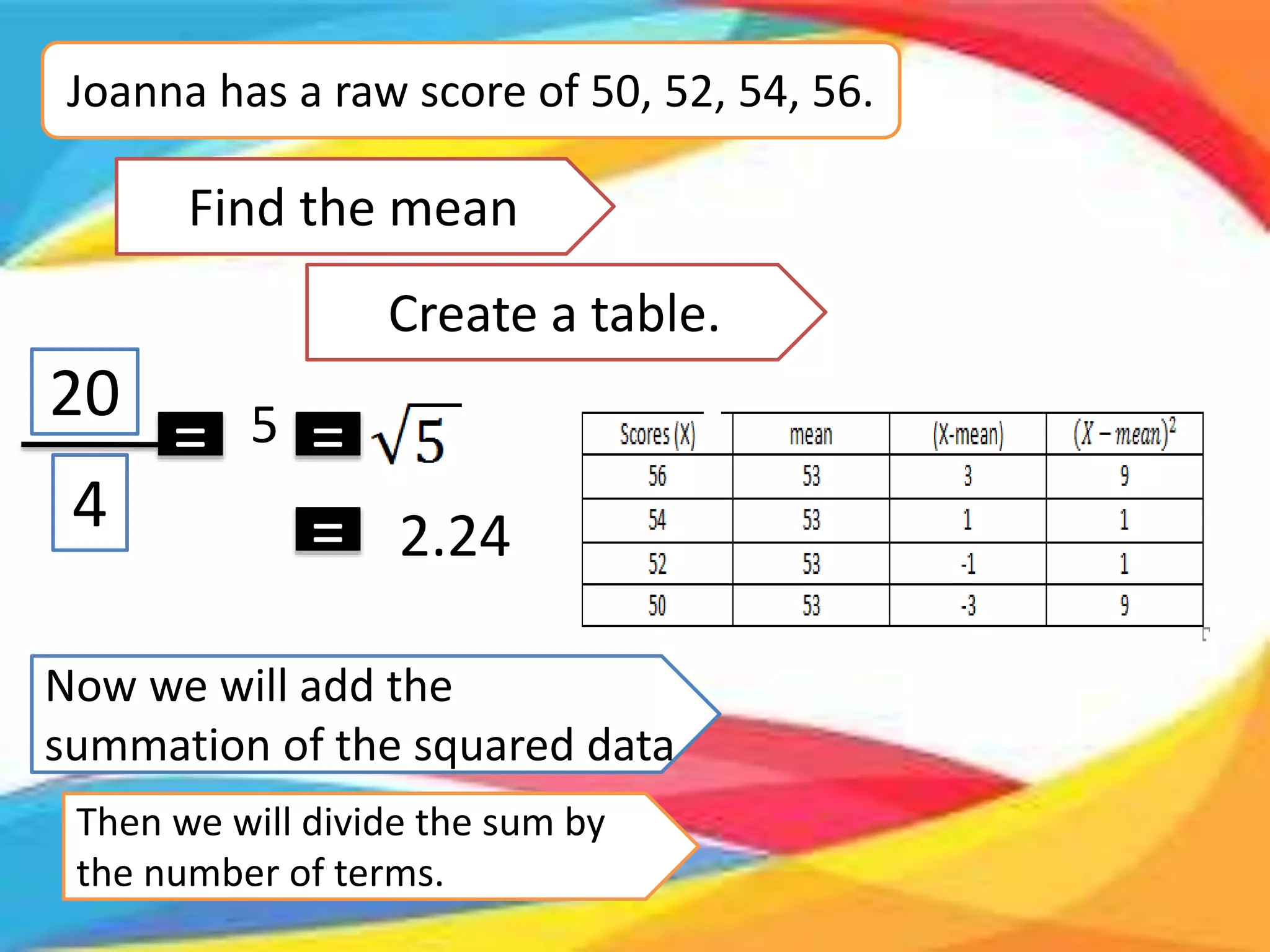
Joanna has a raw score of 50, 52, 54, 56.
Find the mean
Create a table.
Now we will add the
summation of the squared data
20
Then we will divide the sum by
the number of terms.
4
5= =
= 2.24
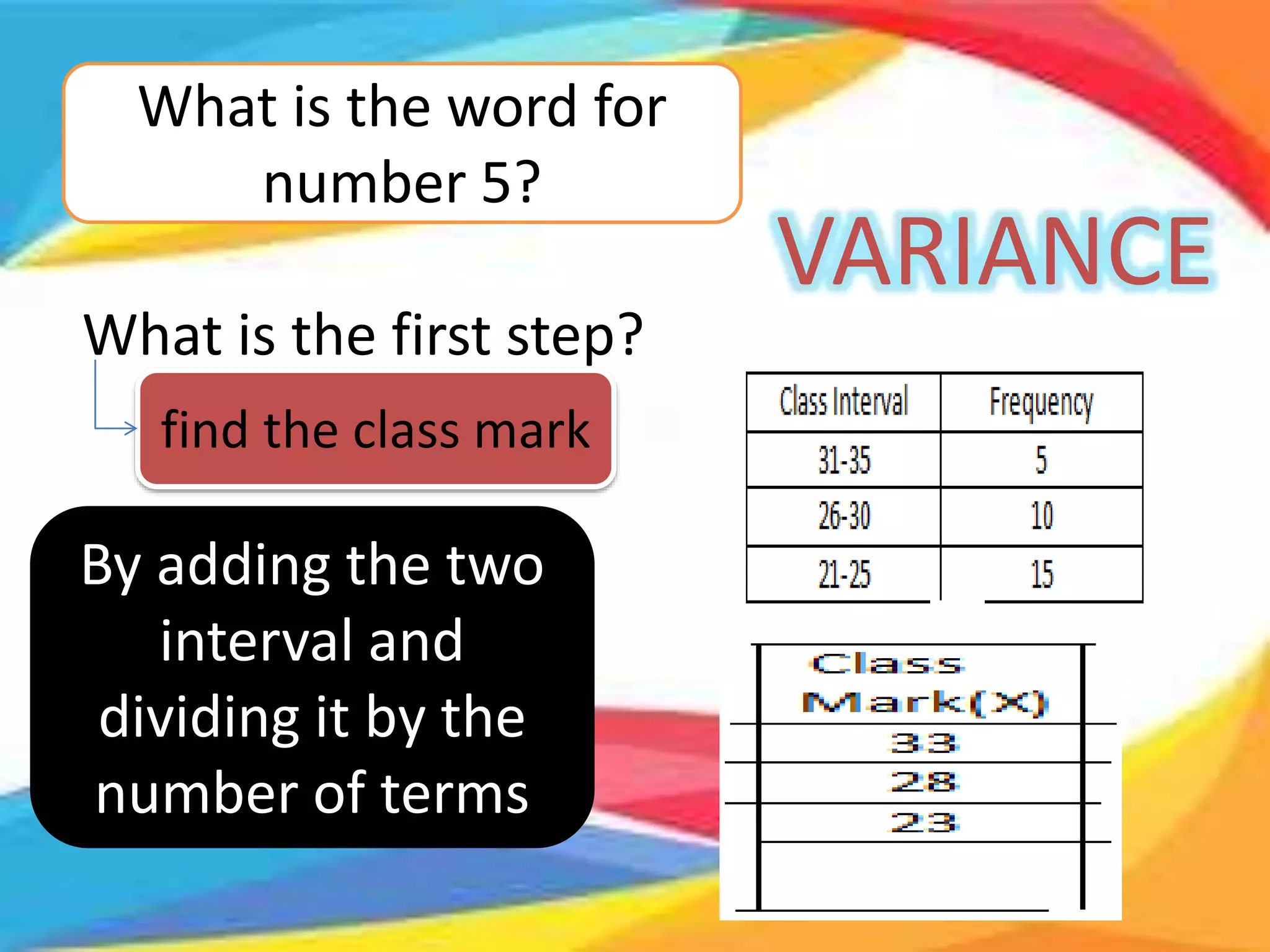
What is the word for
number 5?
VARIANCE
What is the first step?
find the class mark
By adding the two
interval and
dividing it by the
number of terms
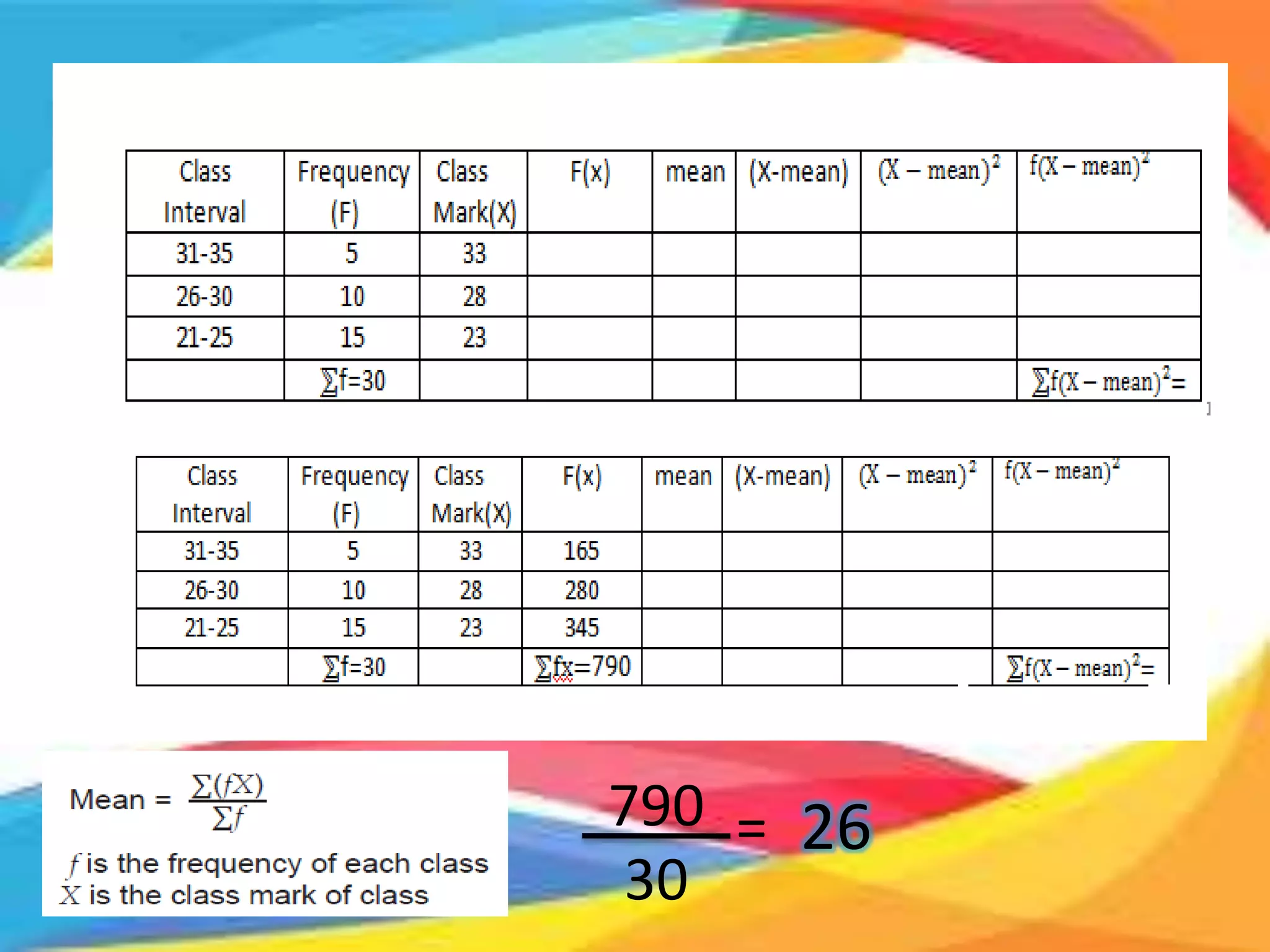
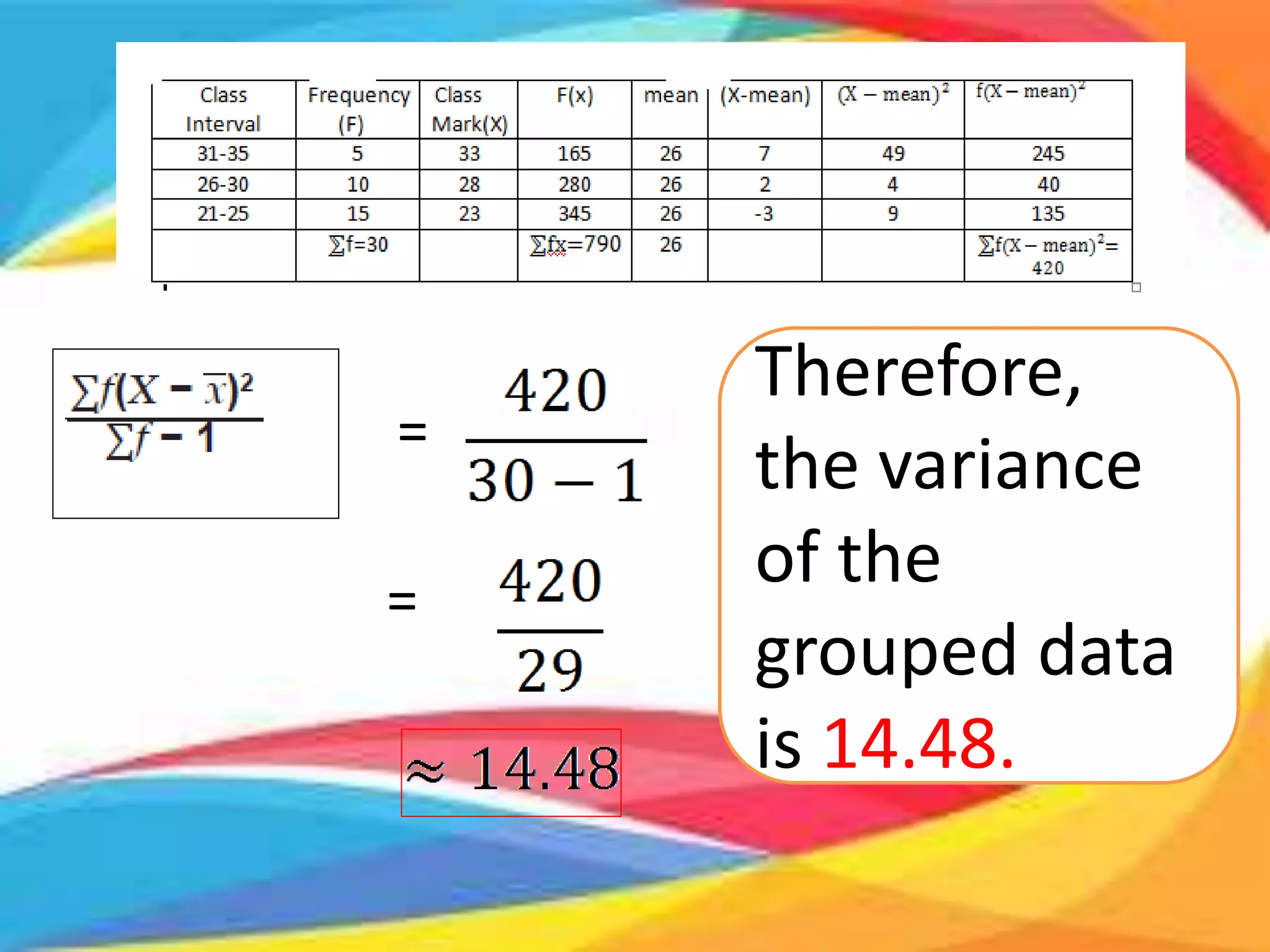
790
30
= 26
=
=
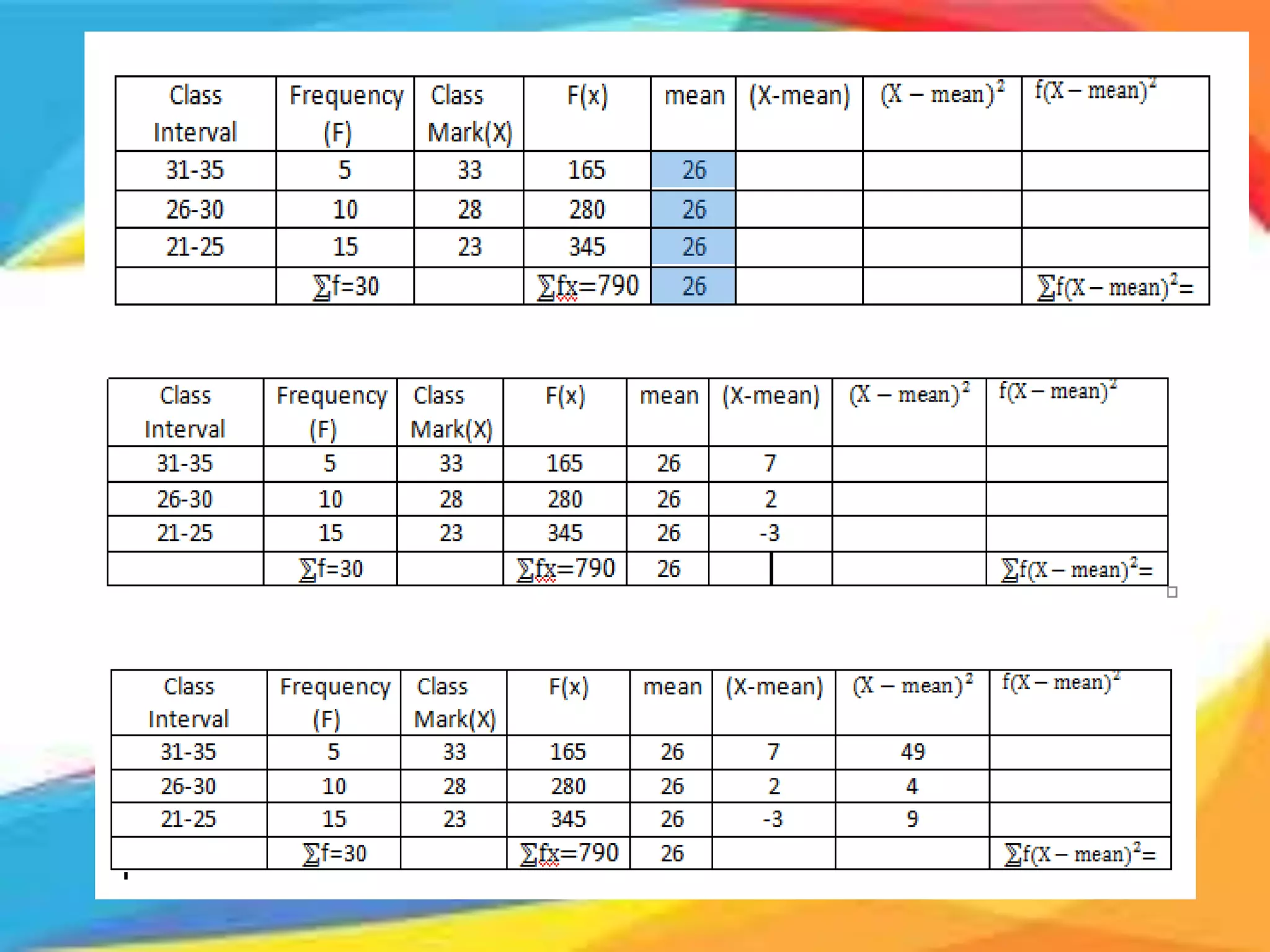
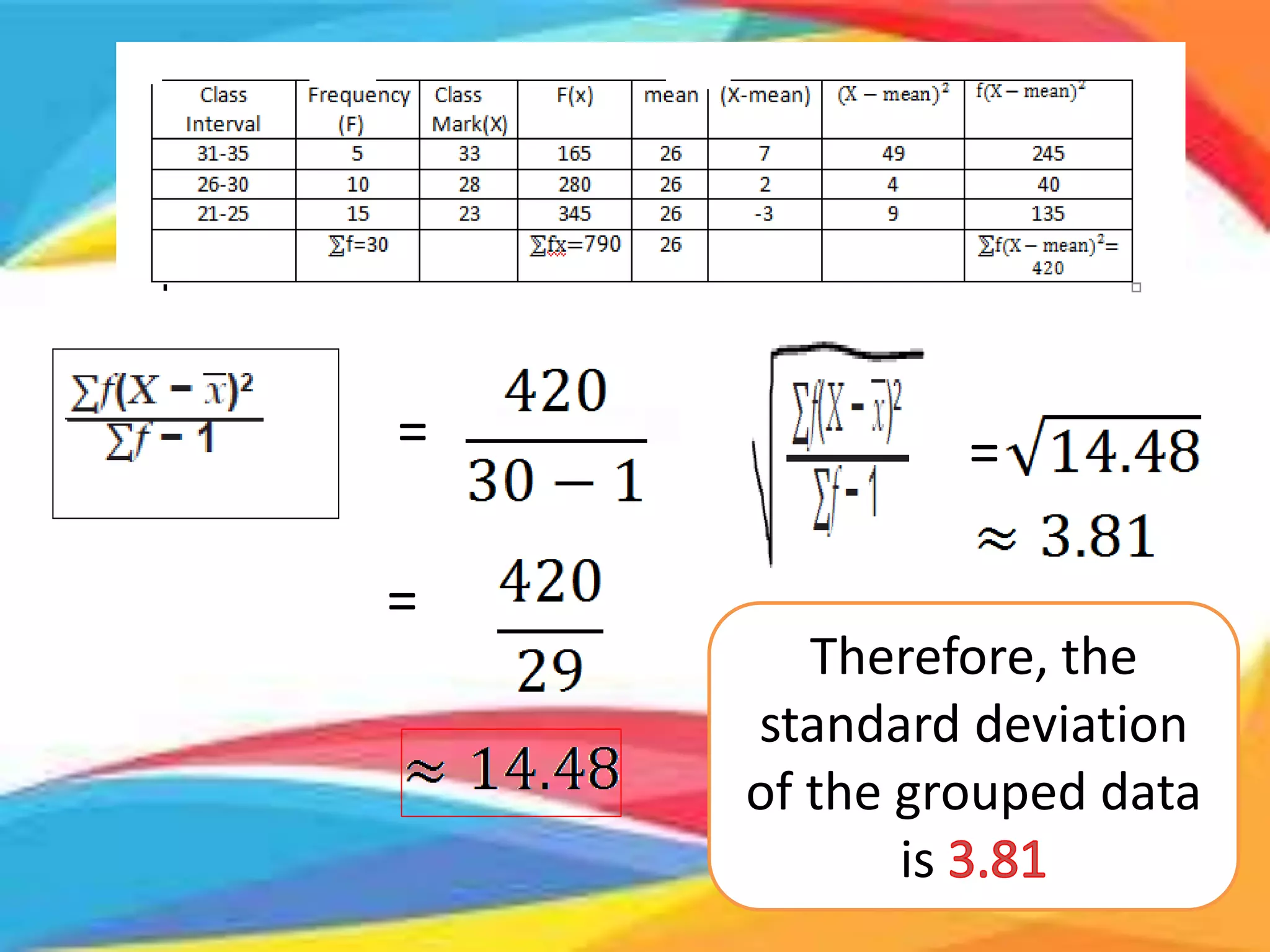
Therefore,
the variance
of the
grouped data
is 14.48.
What do you think is
difference of this
variance from the
variance presented
earlier?
Let us focus on the last
number, what is the
word?
STANDARD
DEVIATION
Standard deviation is
the squareroot of
variance.
=
=
=
Therefore, the
standard deviation
of the grouped data
is
Measures of
Variability
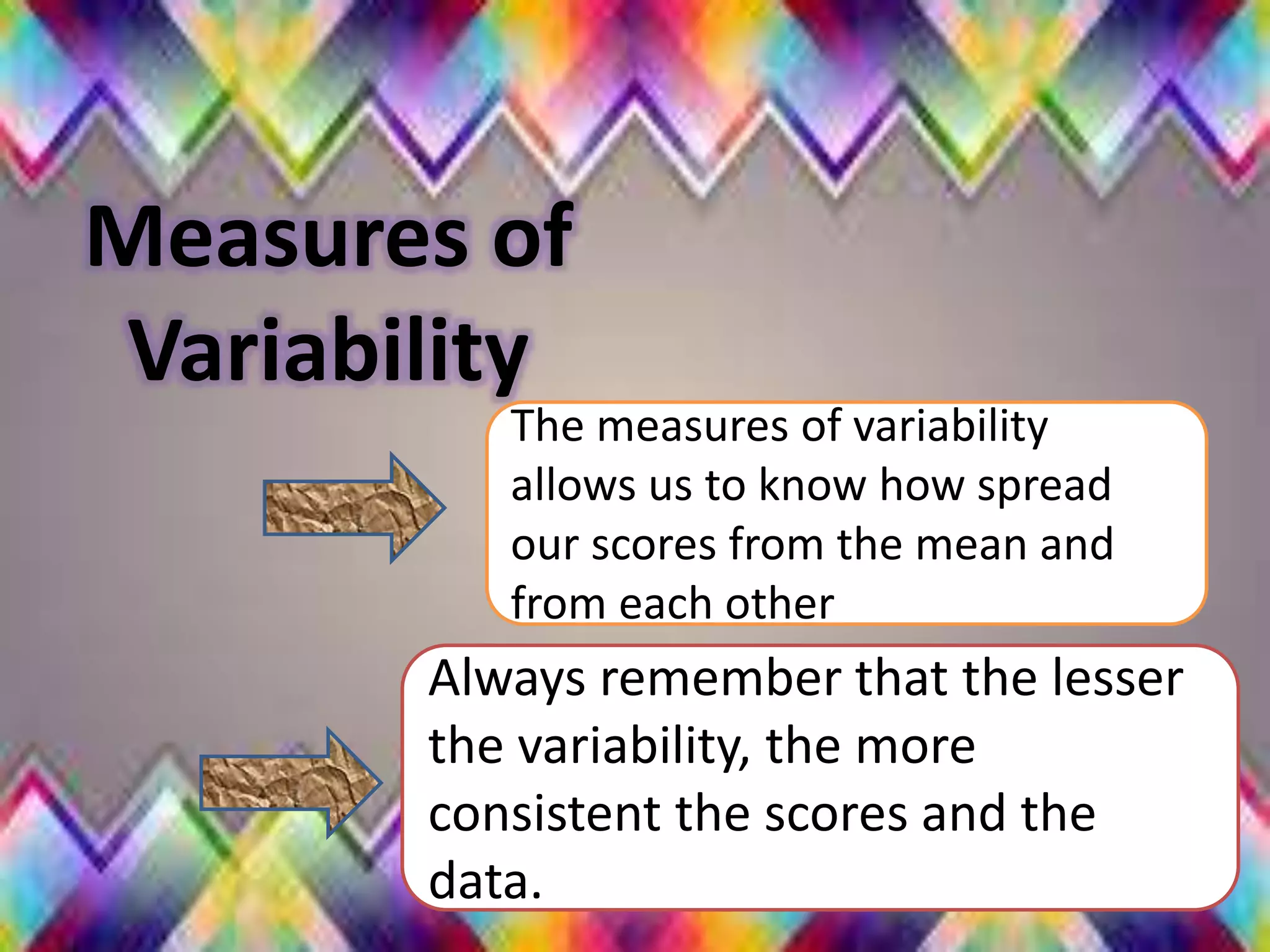
The measures of variability
allows us to know how spread
our scores from the mean and
from each other
Always remember that the lesser
the variability, the more
consistent the scores and the
data.
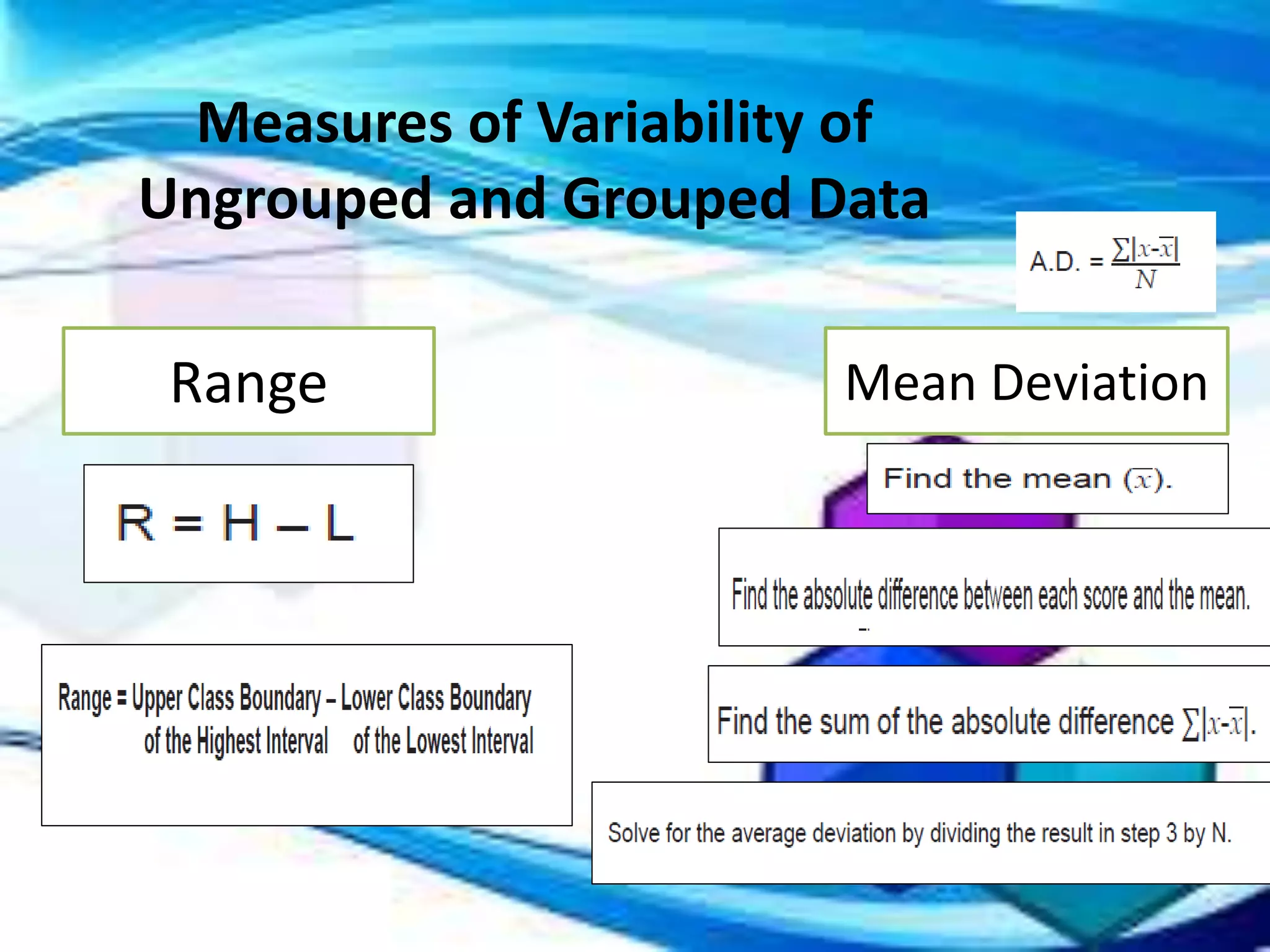
Measures of Variability of
Ungrouped and Grouped Data
Range Mean Deviation
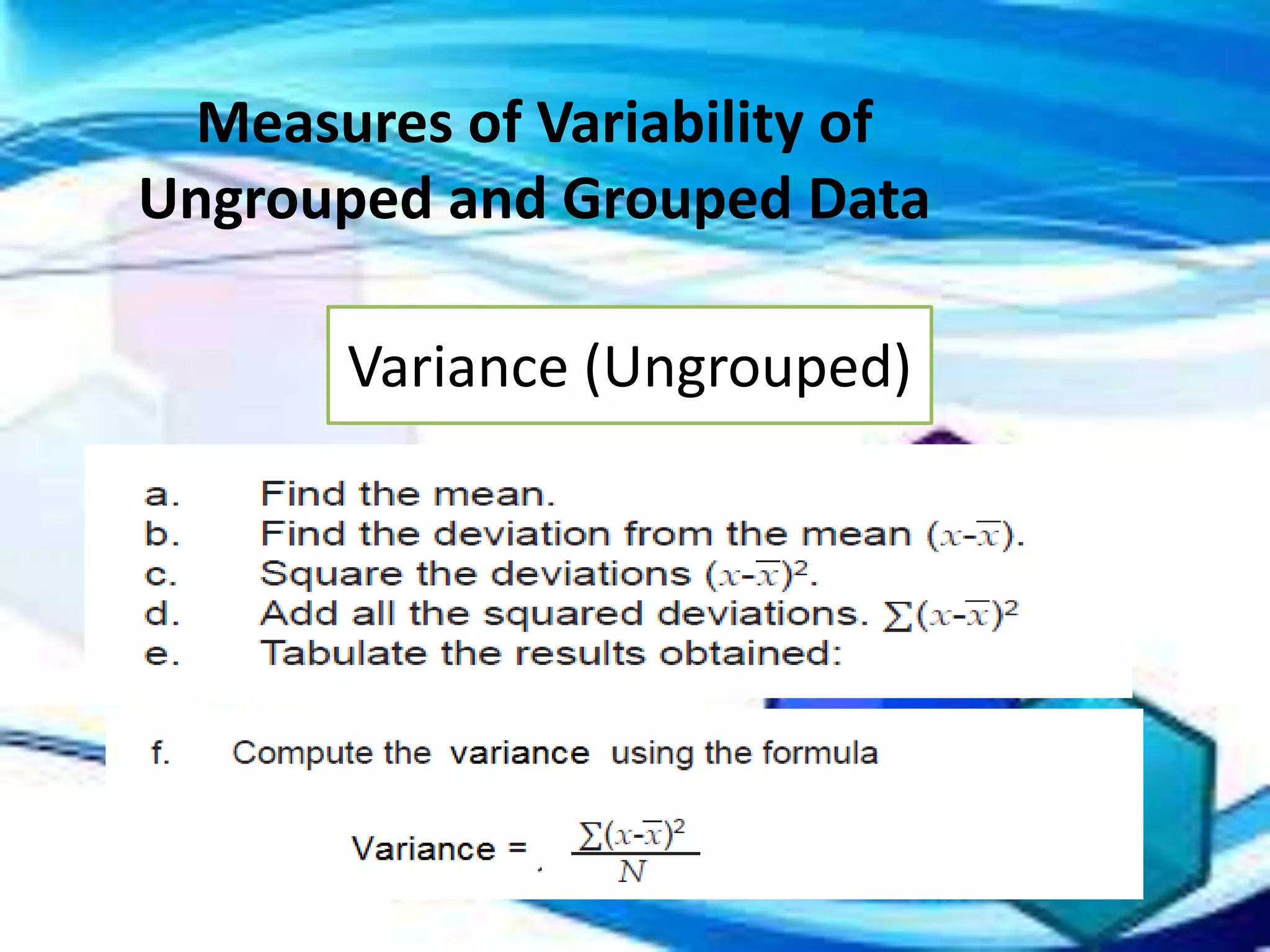
Measures of Variability of
Ungrouped and Grouped Data
Variance (Ungrouped)
Measures of Variability of
Ungrouped and Grouped Data
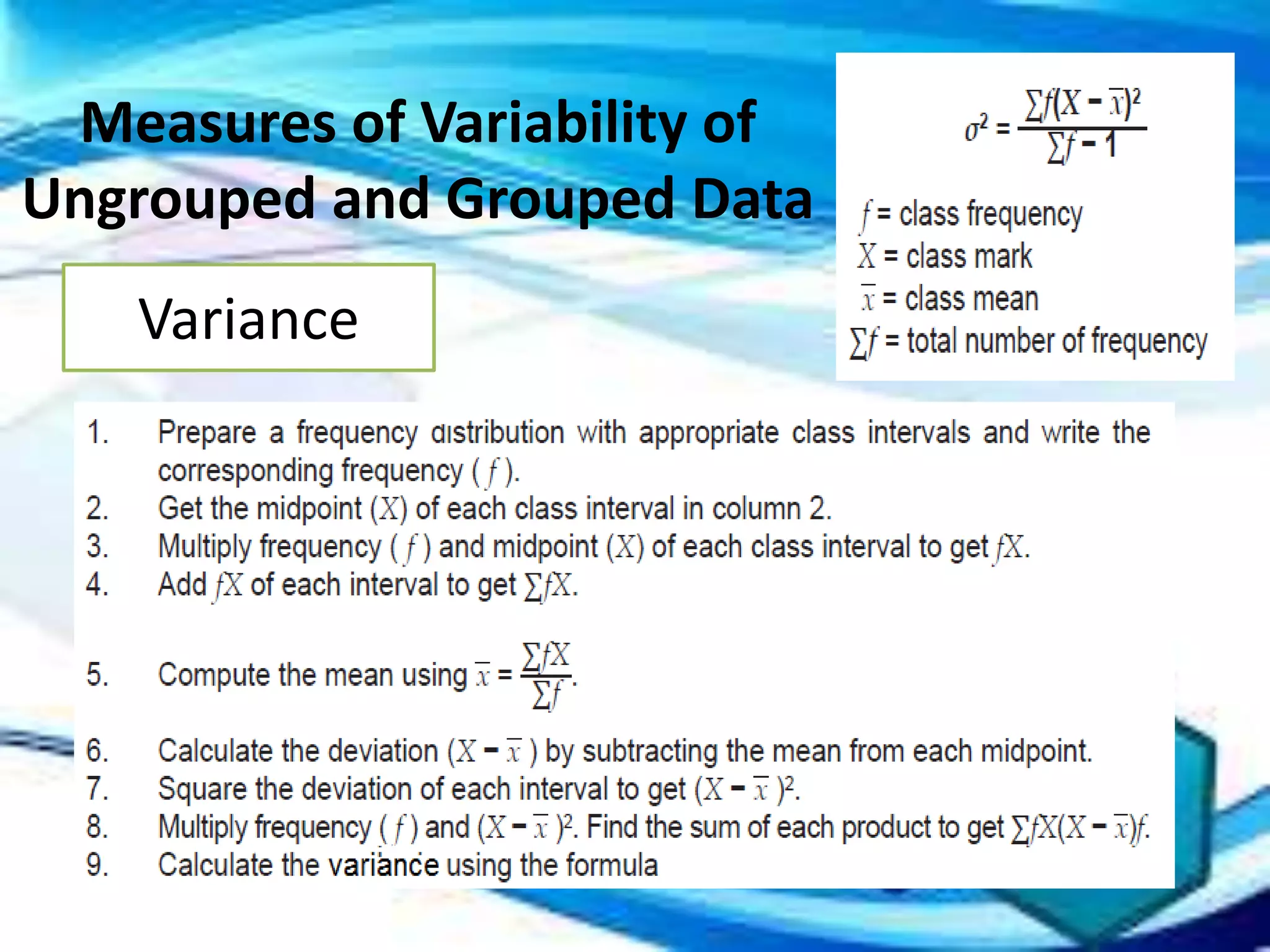
Variance
Measures of Variability of
Ungrouped and Grouped Data
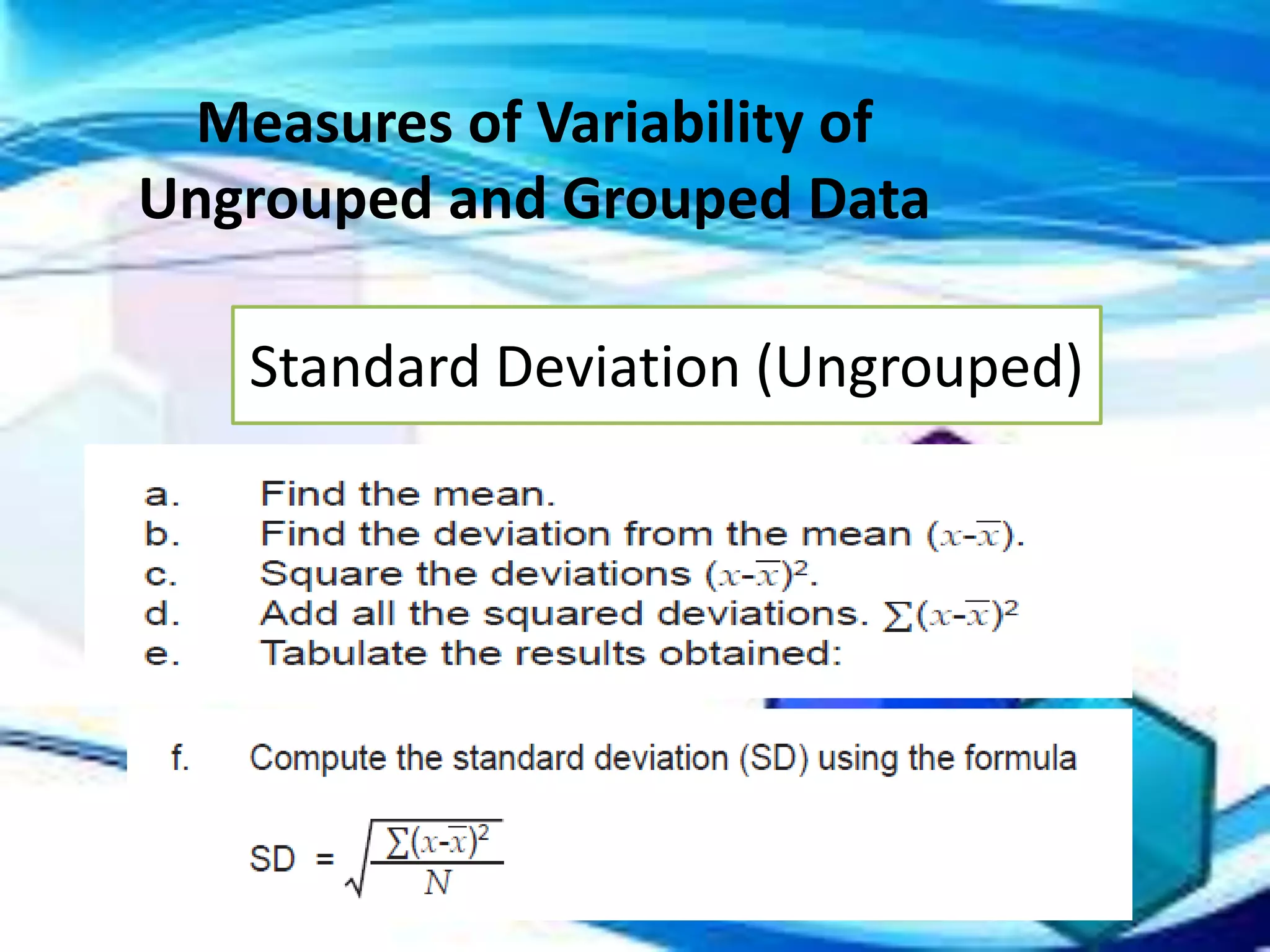
Standard Deviation (Ungrouped)
Measures of Variability of
Ungrouped and Grouped Data
Standard Deviation
(Grouped)
QUESTIONS
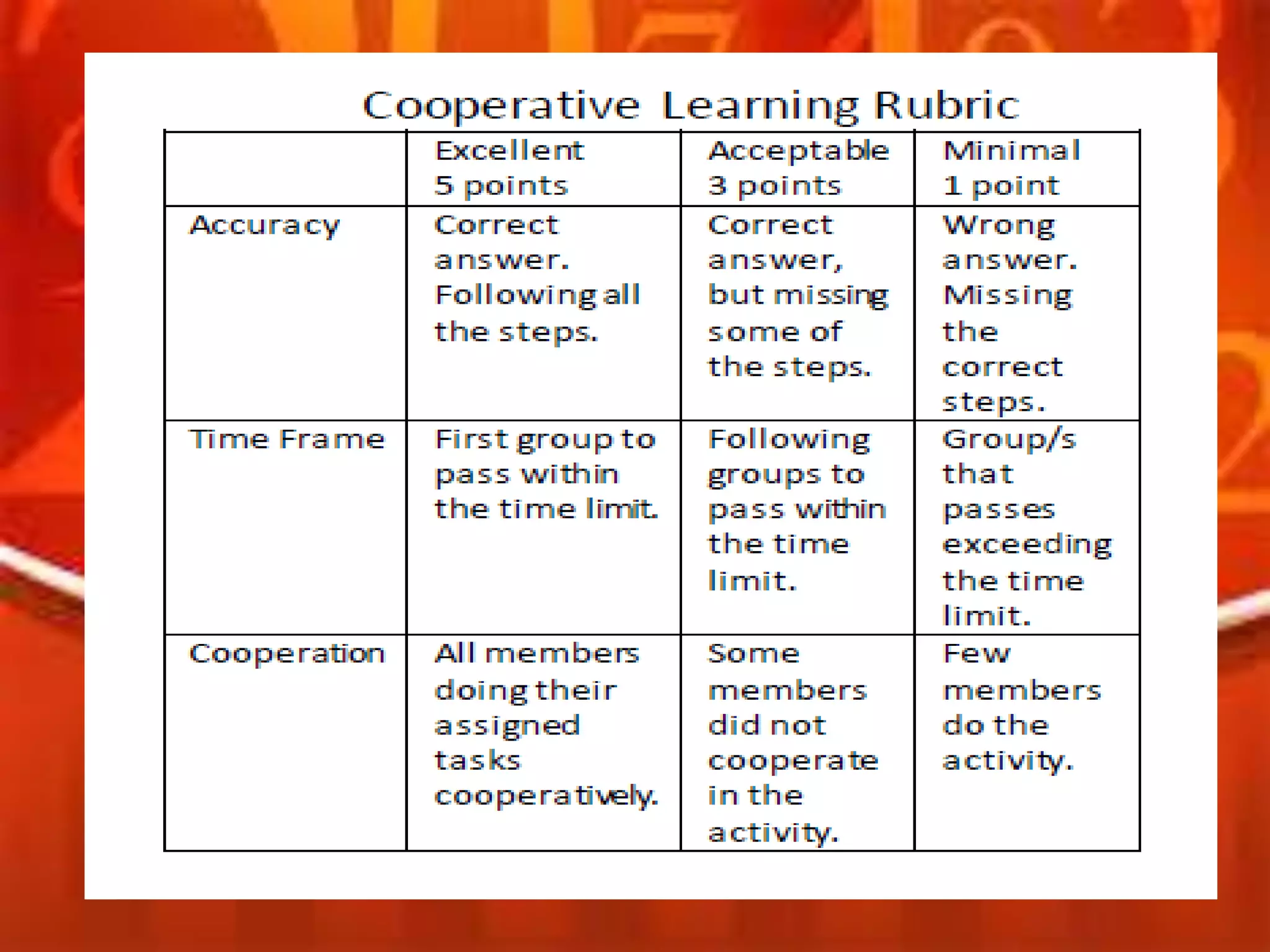
Each group will select their group leaders. The
leader will be the one who is responsible for
dividing the task among the members of the
group.
Each group will be given a pen and a manila
paper that consists of tables the goal of the
group is to complete the table and answer the
given questions. The activity will only cover 10
minutes of the time.
The class will be divided into two groups.
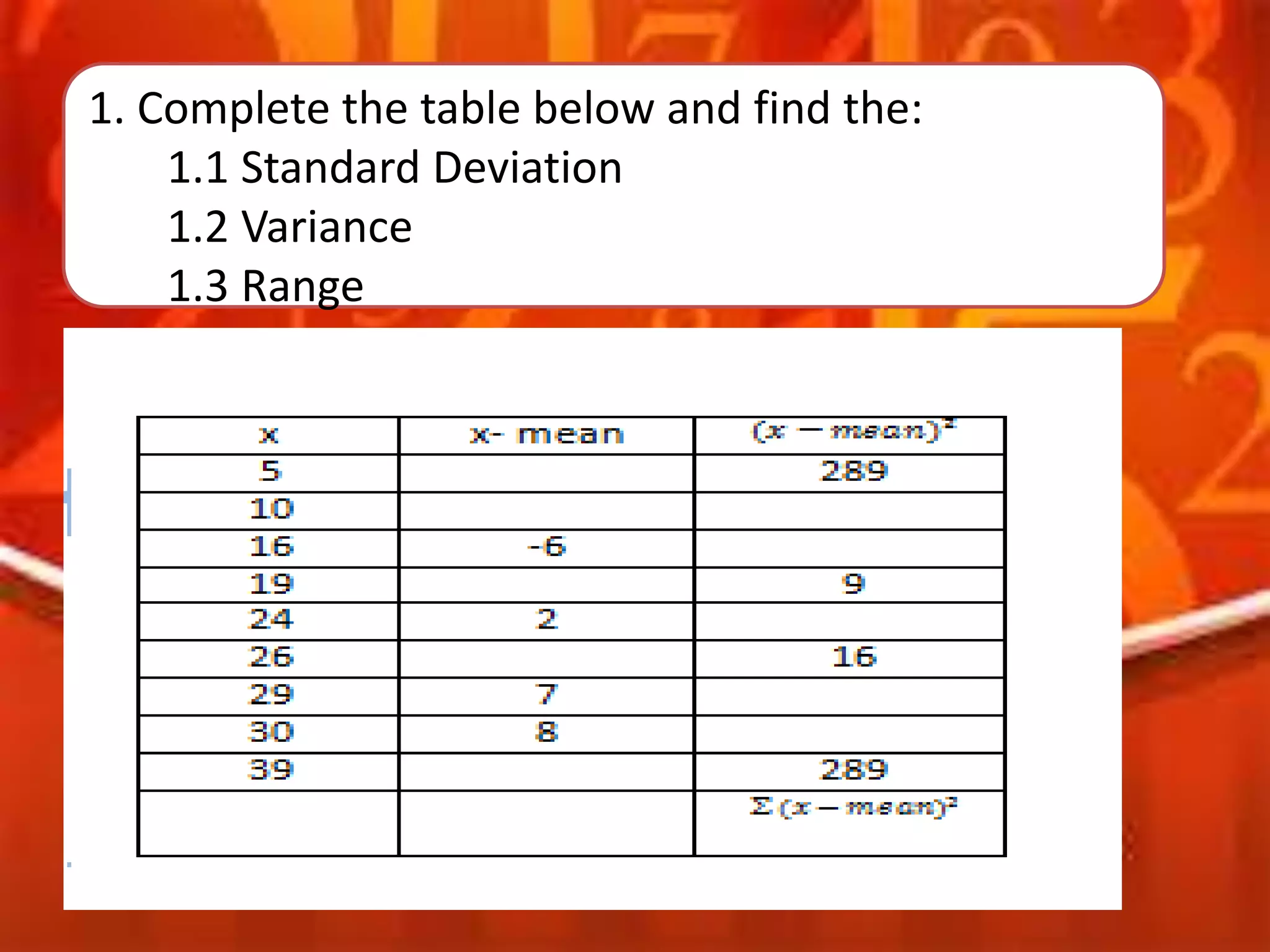
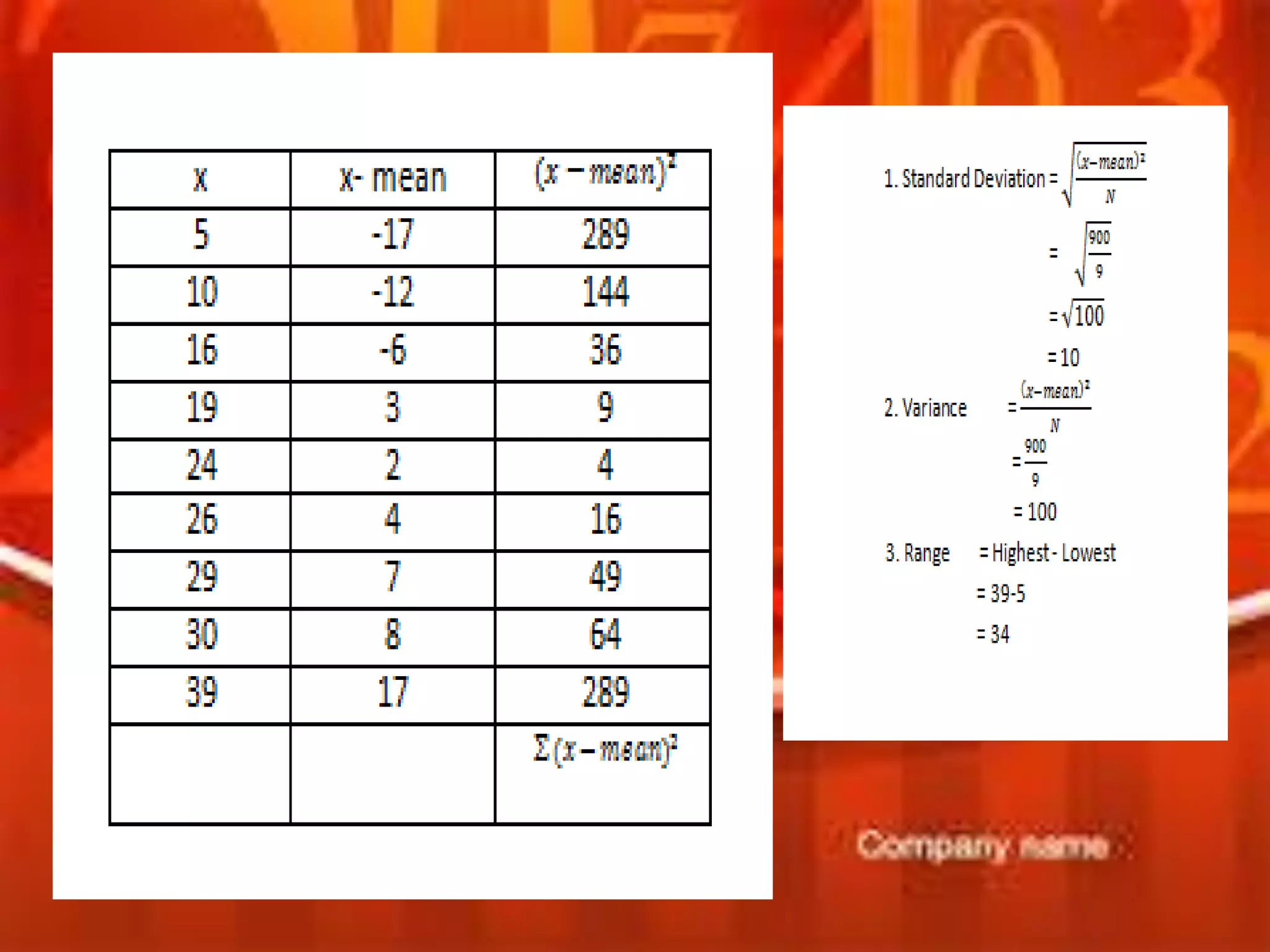
1. Complete the table below and find the:
1.1 Standard Deviation
1.2 Variance
1.3 Range
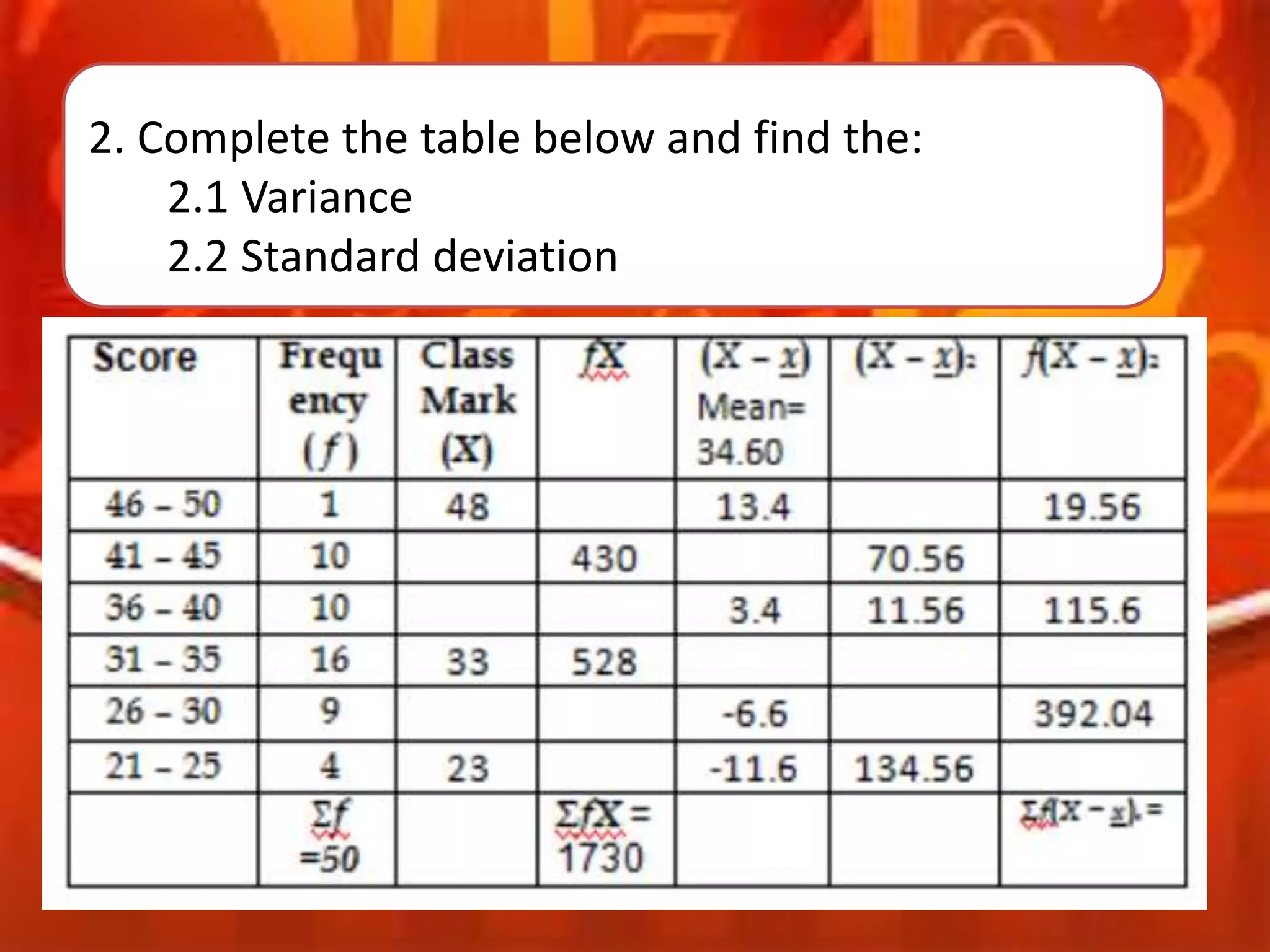
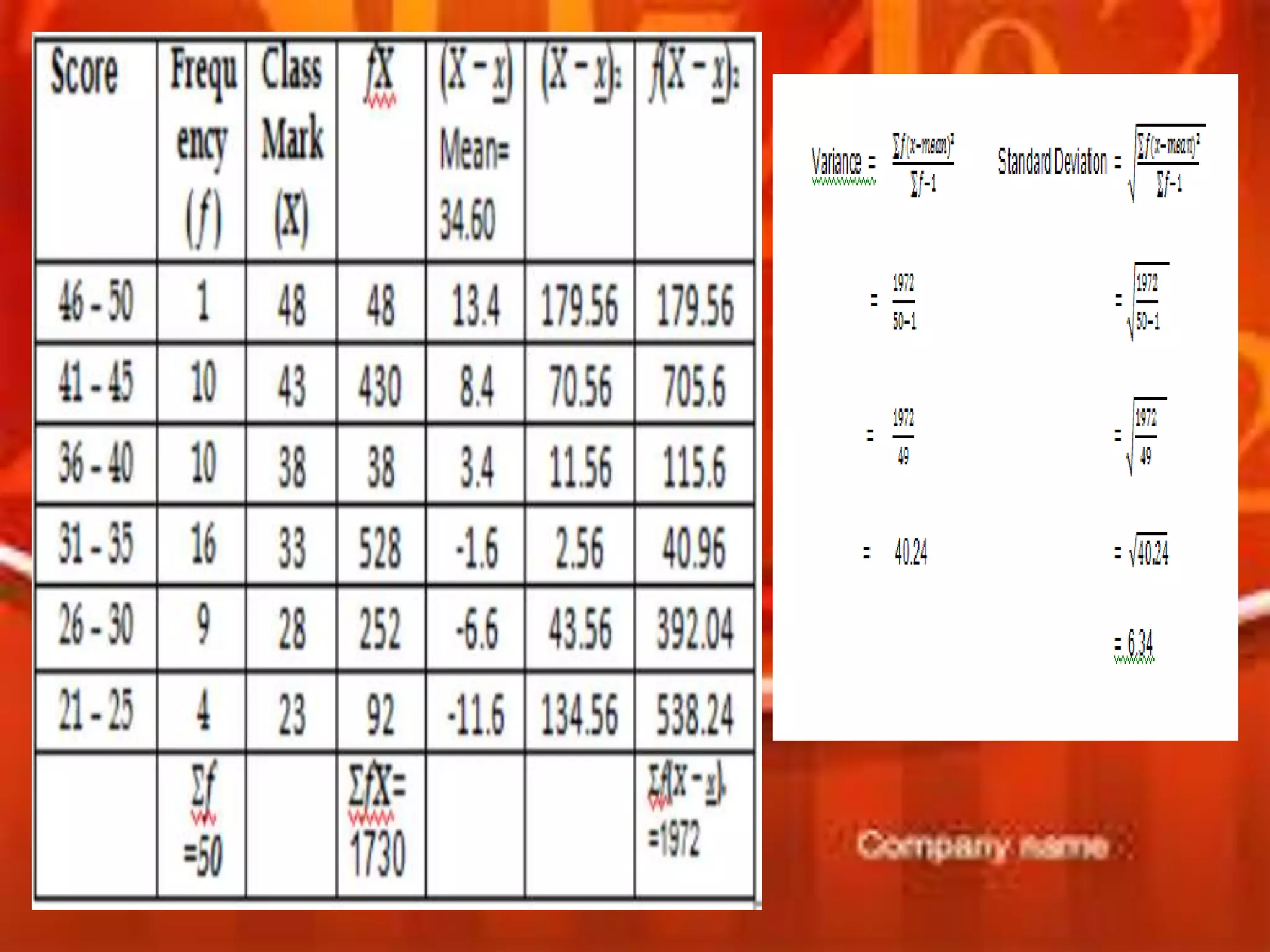
2. Complete the table below and find the:
2.1 Variance
2.2 Standard deviation
Learning Objectives:
Identify the measures of variability
of grouped and ungroup data.
Link the concept of measures
of variability in real life context.
Solve the measures of variability
of grouped and ungrouped data.
QUIZ
Let’s have a
Class, write TRUE if the statement is
true and FALSE if the statement is false.
You have five minutes to answer this
quiz.
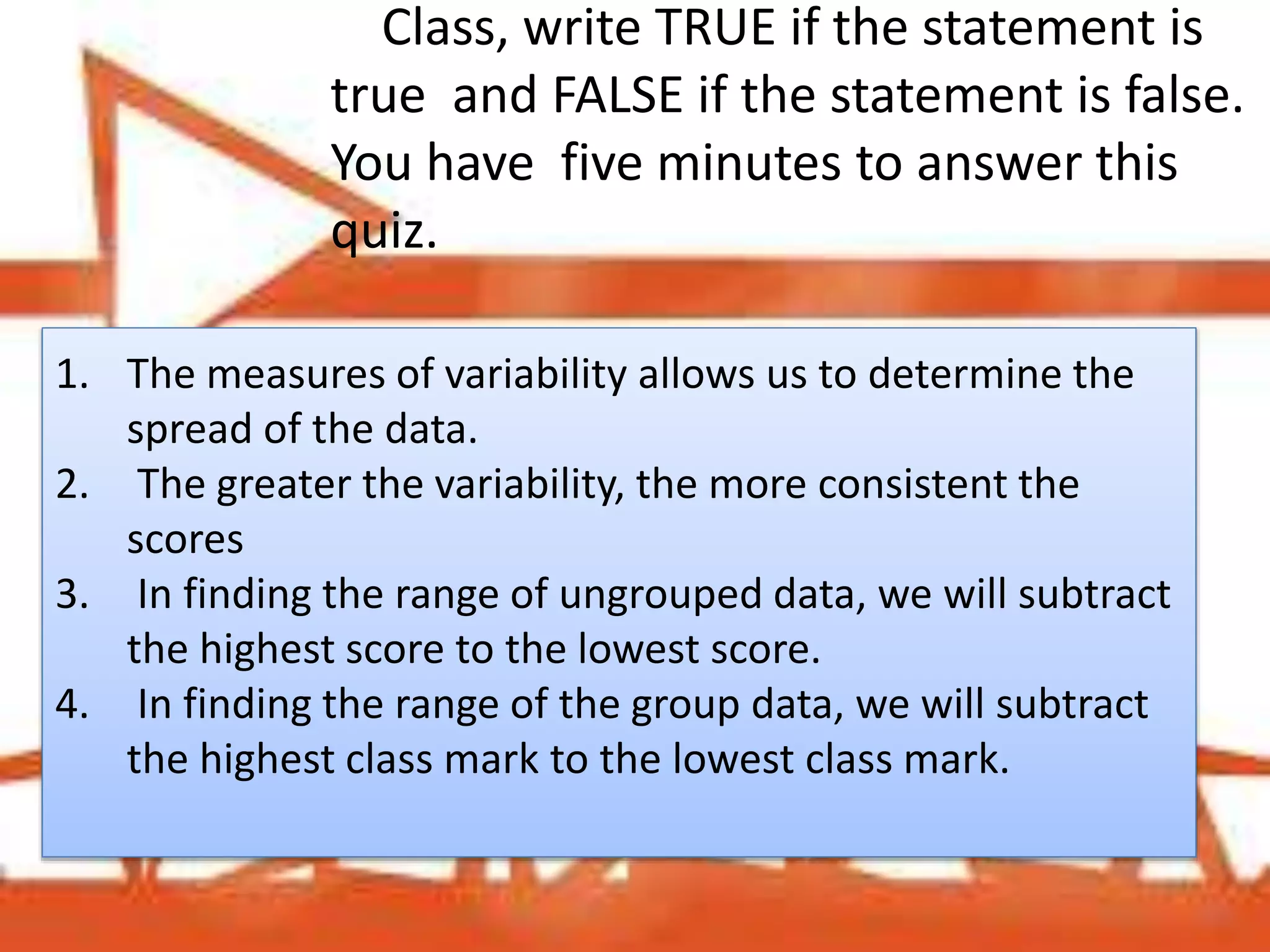
1. The measures of variability allows us to determine the
spread of the data.
2. The greater the variability, the more consistent the
scores
3. In finding the range of ungrouped data, we will subtract
the highest score to the lowest score.
4. In finding the range of the group data, we will subtract
the highest class mark to the lowest class mark.
Class, write TRUE if the statement is
true and FALSE if the statement is false.
You have five minutes to answer this
quiz.
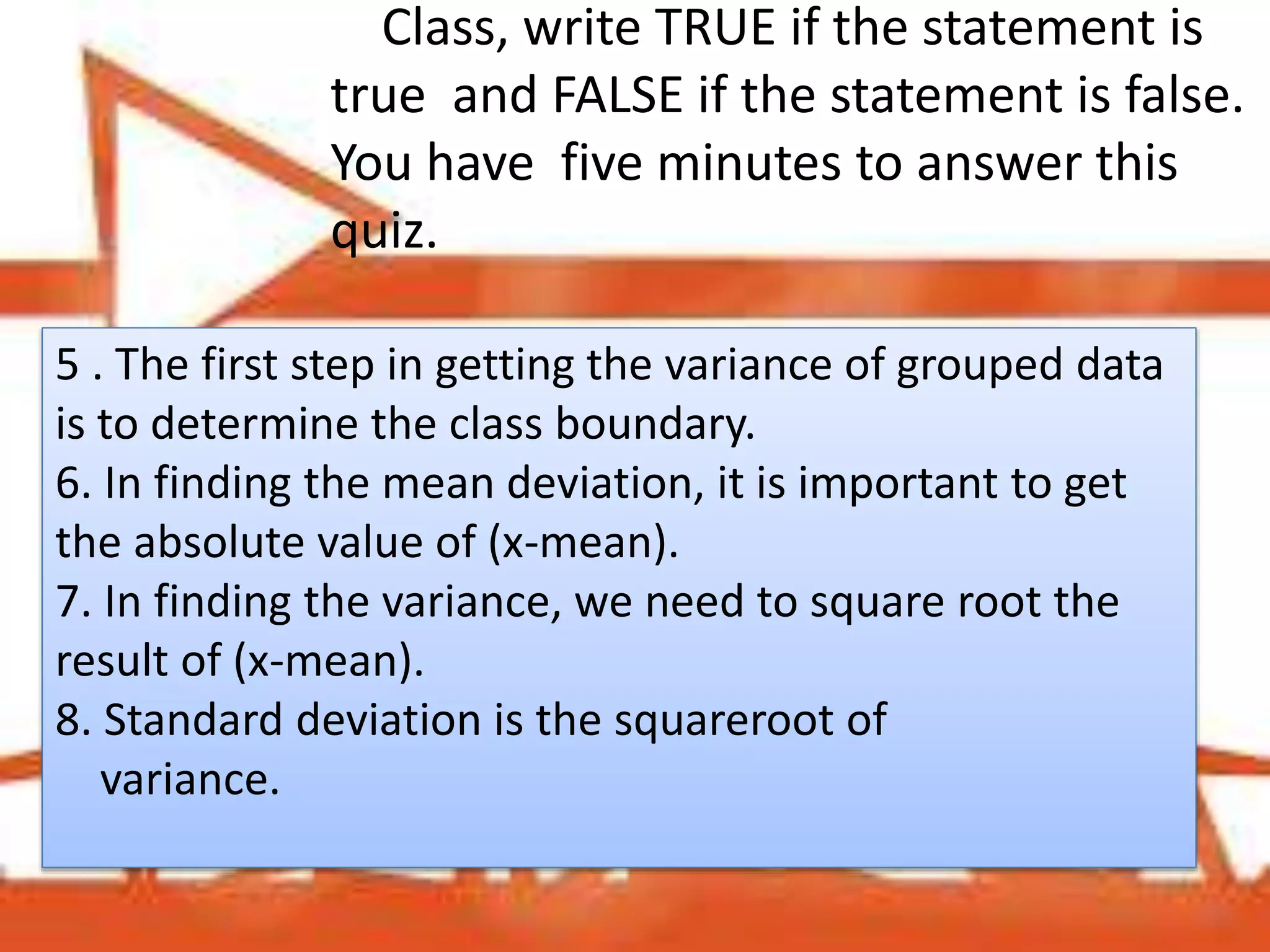
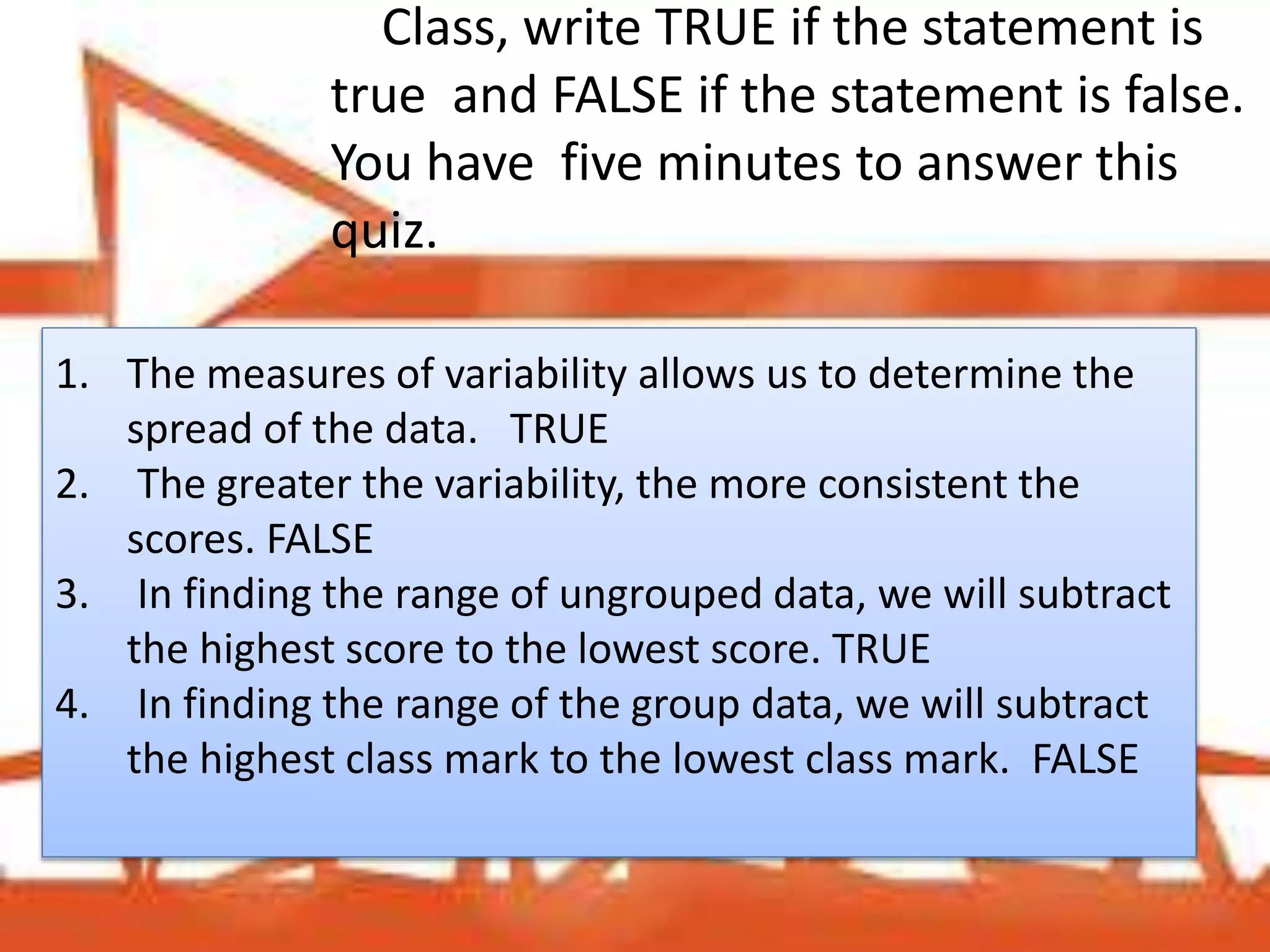
5 . The first step in getting the variance of grouped data
is to determine the class boundary.
6. In finding the mean deviation, it is important to get
the absolute value of (x-mean).
7. In finding the variance, we need to square root the
result of (x-mean).
8. Standard deviation is the squareroot of
variance.
Class, write TRUE if the statement is
true and FALSE if the statement is false.
You have five minutes to answer this
quiz.
1. The measures of variability allows us to determine the
spread of the data. TRUE
2. The greater the variability, the more consistent the
scores. FALSE
3. In finding the range of ungrouped data, we will subtract
the highest score to the lowest score. TRUE
4. In finding the range of the group data, we will subtract
the highest class mark to the lowest class mark. FALSE
Class, write TRUE if the statement is
true and FALSE if the statement is false.
You have five minutes to answer this
quiz.
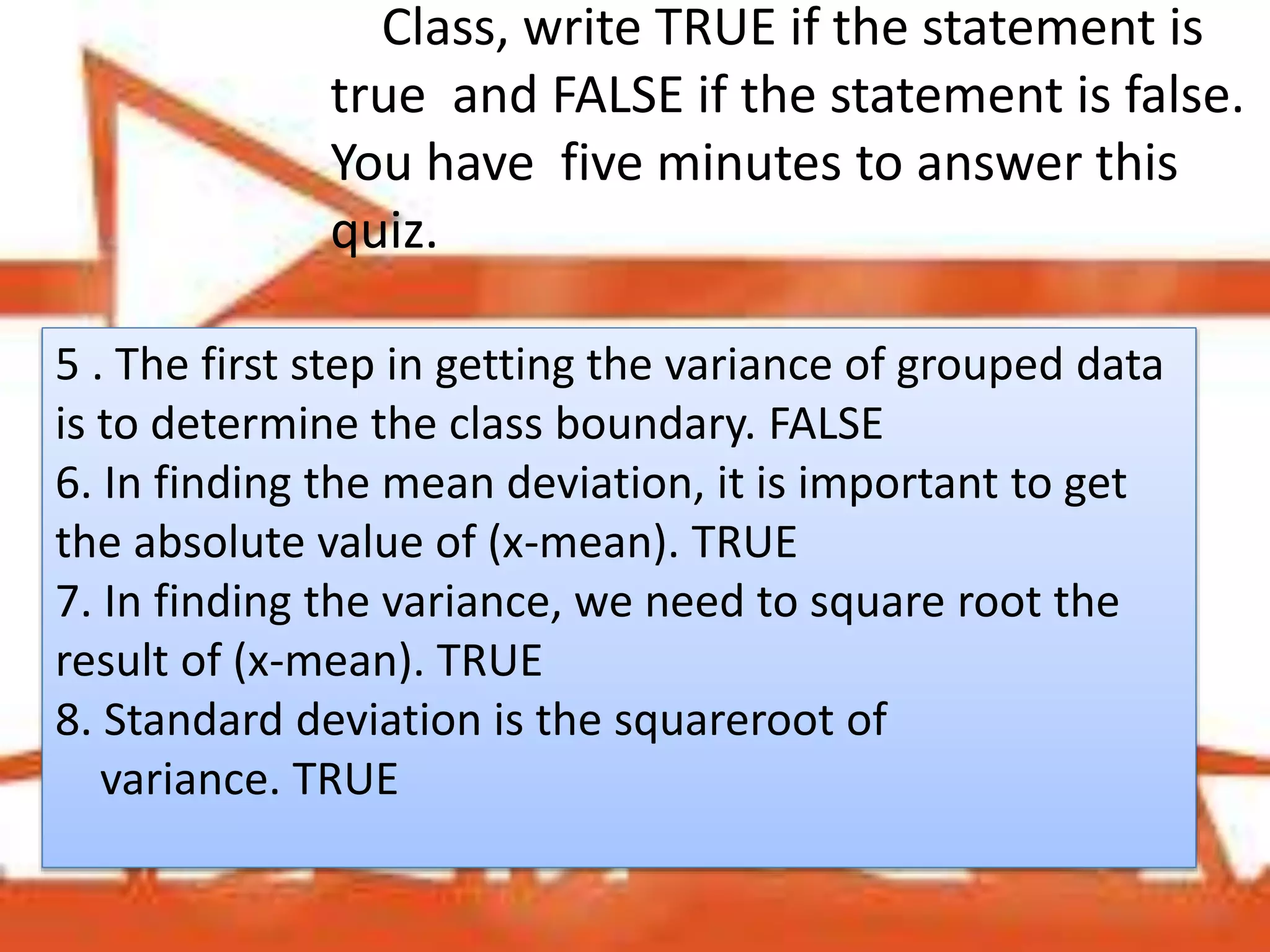
5 . The first step in getting the variance of grouped data
is to determine the class boundary. FALSE
6. In finding the mean deviation, it is important to get
the absolute value of (x-mean). TRUE
7. In finding the variance, we need to square root the
result of (x-mean). TRUE
8. Standard deviation is the squareroot of
variance. TRUE
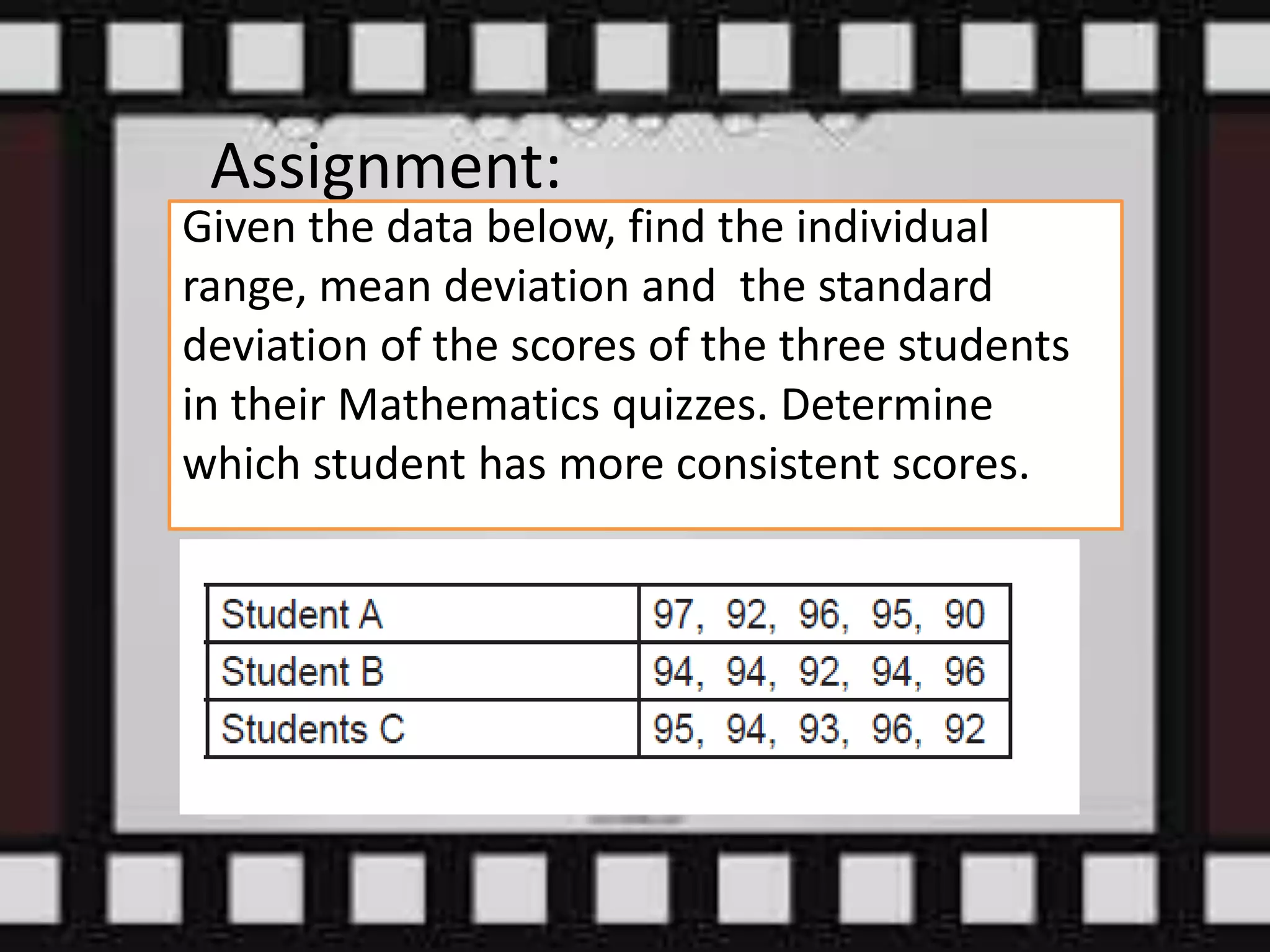
Assignment:
Given the data below, find the individual
range, mean deviation and the standard
deviation of the scores of the three students
in their Mathematics quizzes. Determine
which student has more consistent scores.

Measures of Variability of Grouped and Ungrouped Data

  • 2.
    Learning Competency: Calculates themeasures of variability of grouped and ungrouped data.
  • 3.
    Learning Objectives: Identify themeasures of variability of grouped and ungroup data. Link the concept of measures of variability in real life context. Solve the measures of variability of grouped and ungrouped data.
  • 4.
  • 5.
    SET A: 4, 10,12, 20, 24 SET B: 12, 13, 14, 15, 16 Given the set of data, use your understanding on the measures of central tendency to find the following question: What is the mean of Set A? How about Set B? The mean is 14 The mean is 14
  • 6.
    4. Draw anumber line of each of the Set and plot the data. SET A: 4, 10, 12, 20, 24 SET B: 12, 13, 14, 15, 16
  • 7.
    Are you familiarwith the term “measures of variability”?
  • 9.
    Your task: Thestudents will arrange the shuffled letters by sequencing the clues indicated below the letter. The activity is for only 5 minutes. Once the time is done, the students will submit their work. Note:
  • 11.
    What did wedo in our activity?
  • 13.
    What is theword for number 1? RANGE In order to find the spread of the scores of Mel, what did she discover? She subtract the lowest score from the highest score.
  • 14.
    Mel has araw score of 5, 6, 7, 8,9,10 in Math and a raw score of 3, 7, 8, 9, 10,11 in English R What will be the range of Mel scores in Math? In English? Math: 5 English: 8 Based on the range, which set has less spread? Math: 5
  • 15.
    The formula forthe range is also applicable to GROUPED data. Now, we will determine the highest score and the lowest score and find its upper and lower boundary. Simply subtract the highest to the lowest boundary which is: 22.5 – 10.5 = 12
  • 16.
    What if thetwo sets of data have the same range? Is there other way to compute the spread of the data?
  • 18.
    What is theanswer for the shuffled letter no. 2? MEAN DEVIATION What did Joy find first? What is the mean? 25 In subtracting the individual scores to the mean why it is important to get its absolute value?
  • 19.
    In mean deviation, we areconcerned with the distance of the individual scores from the mean Now we will add the difference of the x and the mean Then we will divide the sum by the number of terms. 40 4 = 10
  • 21.
    In the letterV, it indicates that it is a raw score, is data grouped or ungrouped? UNGROUPED DATA Let us focus on number 3, what is the word? VARIANCE What is the first step of Veronica in finding the spread of her scores?
  • 22.
    After she findthe difference of the mean and the individual score, what did she do with the result? So if we will get the variance, we will create a table. Now we will add the summation of the squared data Then we will divide the sum by the number of terms. 4 20 5=
  • 24.
    Let us focuson number 4, what is the word? STANDARD DEVIATION Standard deviation is the squareroot of variance.
  • 25.
    Joanna has araw score of 50, 52, 54, 56. Find the mean Create a table. Now we will add the summation of the squared data 20 Then we will divide the sum by the number of terms. 4 5= = = 2.24
  • 27.
    What is theword for number 5? VARIANCE What is the first step? find the class mark By adding the two interval and dividing it by the number of terms
  • 28.
  • 30.
  • 31.
    What do youthink is difference of this variance from the variance presented earlier?
  • 33.
    Let us focuson the last number, what is the word? STANDARD DEVIATION Standard deviation is the squareroot of variance.
  • 34.
  • 35.
    Measures of Variability The measuresof variability allows us to know how spread our scores from the mean and from each other Always remember that the lesser the variability, the more consistent the scores and the data.
  • 36.
    Measures of Variabilityof Ungrouped and Grouped Data Range Mean Deviation
  • 37.
    Measures of Variabilityof Ungrouped and Grouped Data Variance (Ungrouped)
  • 38.
    Measures of Variabilityof Ungrouped and Grouped Data Variance
  • 39.
    Measures of Variabilityof Ungrouped and Grouped Data Standard Deviation (Ungrouped)
  • 40.
    Measures of Variabilityof Ungrouped and Grouped Data Standard Deviation (Grouped)
  • 41.
  • 43.
    Each group willselect their group leaders. The leader will be the one who is responsible for dividing the task among the members of the group. Each group will be given a pen and a manila paper that consists of tables the goal of the group is to complete the table and answer the given questions. The activity will only cover 10 minutes of the time. The class will be divided into two groups.
  • 46.
    1. Complete thetable below and find the: 1.1 Standard Deviation 1.2 Variance 1.3 Range
  • 48.
    2. Complete thetable below and find the: 2.1 Variance 2.2 Standard deviation
  • 50.
    Learning Objectives: Identify themeasures of variability of grouped and ungroup data. Link the concept of measures of variability in real life context. Solve the measures of variability of grouped and ungrouped data.
  • 51.
  • 52.
    Class, write TRUEif the statement is true and FALSE if the statement is false. You have five minutes to answer this quiz. 1. The measures of variability allows us to determine the spread of the data. 2. The greater the variability, the more consistent the scores 3. In finding the range of ungrouped data, we will subtract the highest score to the lowest score. 4. In finding the range of the group data, we will subtract the highest class mark to the lowest class mark.
  • 53.
    Class, write TRUEif the statement is true and FALSE if the statement is false. You have five minutes to answer this quiz. 5 . The first step in getting the variance of grouped data is to determine the class boundary. 6. In finding the mean deviation, it is important to get the absolute value of (x-mean). 7. In finding the variance, we need to square root the result of (x-mean). 8. Standard deviation is the squareroot of variance.
  • 54.
    Class, write TRUEif the statement is true and FALSE if the statement is false. You have five minutes to answer this quiz. 1. The measures of variability allows us to determine the spread of the data. TRUE 2. The greater the variability, the more consistent the scores. FALSE 3. In finding the range of ungrouped data, we will subtract the highest score to the lowest score. TRUE 4. In finding the range of the group data, we will subtract the highest class mark to the lowest class mark. FALSE
  • 55.
    Class, write TRUEif the statement is true and FALSE if the statement is false. You have five minutes to answer this quiz. 5 . The first step in getting the variance of grouped data is to determine the class boundary. FALSE 6. In finding the mean deviation, it is important to get the absolute value of (x-mean). TRUE 7. In finding the variance, we need to square root the result of (x-mean). TRUE 8. Standard deviation is the squareroot of variance. TRUE
  • 56.
    Assignment: Given the databelow, find the individual range, mean deviation and the standard deviation of the scores of the three students in their Mathematics quizzes. Determine which student has more consistent scores.