
TEST ANXIETY
What is Test Anxiety?
• Type of performance anxiety
• It is a psychological condition in which people
  experience extreme distress and anxiety in
  testing situations
Measurement Scales
• State/Trait Anxiety Inventory
 ▫ Charles Spielberger
• Westside Test Anxiety Scale
 ▫ Richard Driscoll
• 10 item Debilitative Anxiety Scale
 ▫ Alpert-Haber
• Reactions to Tests (RTT) Scale
 ▫ Irwin. G. Sarason
• Cognitive Test Anxiety Scale
 ▫ Cassady & Johnson
Components of Test Anxiety
• Physical Component (Physiological over-
  arousal)
 ▫ typical bodily reactions to acute anxiety: a knot in
   the stomach, wet and trembling hands, nausea or
   "butterflies in the stomach," tense shoulders and
                   back of the neck, dry mouth, and
                   pounding heart.
Components of Test Anxiety
• Emotional Component (Worry & Dread)
 ▫ involves fear or panic
 ▫ Can include depression, low self-esteem,
   anger and a feeling of
   hopelessness
Components of Test Anxiety
• Mental/Cognitive Component
  (Impairment)
 ▫ involve problems with attention and memory
 ▫ "My mind jumps from one thing to another" and
   "I think I am certain to fail"
 ▫ include fidgeting or outright
   avoidance of testing situations
 ▫ Negative self-talk
Causes of Test Anxiety
• Mental causes:
 ▫ Students’ expectations
• Biological causes:
 ▫ Adrenaline (flight-fight response)
• For many students, it can be a combination of
  things...
 ▫ Bad study habits
 ▫ poor past test performance
 ▫ and an underlying anxiety problem can all
   contribute to test anxiety.
Who’s likely to have Test Anxiety?
• People who worry a lot or
  who are perfectionists
• Students who aren't
  prepared for tests but who
  care about doing well are
  also likely to experience
  test anxiety
What can you do?
• Before the Test
 ▫ Discuss test content with the instructor and
   classmates.
 ▫ Develop effective study and test preparation skills.
 ▫ Spread review of class material over several days
   rather than cramming.
 ▫ Intensive review should be done a few days before test.
 ▫ Review text, notes, and homework problems.
 ▫ Use 3x5 cards for learning specific concepts or
   formulas.
 ▫ Take a practice test under exam-like conditions.
 ▫ Continue regular exercise program.
 ▫ Get sufficient rest and nutrition.
What can you do?
• During the Test
 ▫ Read the directions carefully.
 ▫ Budget your test taking time.
 ▫ Change positions to help you relax.
 ▫ If you go blank, skip the question and go on.
 ▫ If you're taking an essay test and you go blank on
   the whole test, pick a question and start writing. It
   may trigger the answer in your mind.
 ▫ Don't panic when students start handing in their
   papers. There's no reward for being the first done.
What can you do?
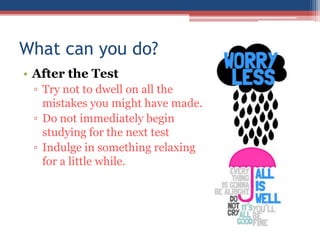
• After the Test
 ▫ Try not to dwell on all the
   mistakes you might have made.
 ▫ Do not immediately begin
   studying for the next test
 ▫ Indulge in something relaxing
   for a little while.
References
• http://www.counselingcenter.illinois.edu/?page_i
  d=114

• http://kidshealth.org/teen/school_jobs/school/test
  _anxiety.html#

• http://psychology.about.com/od/mentalhealth/a/t
  est-anxiety.htm

• http://www.utdallas.edu/counseling/testanxiety/

Testanxiety 120316073051-phpapp01

  • 1.
  • 2.
    What is TestAnxiety? • Type of performance anxiety • It is a psychological condition in which people experience extreme distress and anxiety in testing situations
  • 3.
    Measurement Scales • State/TraitAnxiety Inventory ▫ Charles Spielberger • Westside Test Anxiety Scale ▫ Richard Driscoll • 10 item Debilitative Anxiety Scale ▫ Alpert-Haber • Reactions to Tests (RTT) Scale ▫ Irwin. G. Sarason • Cognitive Test Anxiety Scale ▫ Cassady & Johnson
  • 4.
    Components of TestAnxiety • Physical Component (Physiological over- arousal) ▫ typical bodily reactions to acute anxiety: a knot in the stomach, wet and trembling hands, nausea or "butterflies in the stomach," tense shoulders and back of the neck, dry mouth, and pounding heart.
  • 5.
    Components of TestAnxiety • Emotional Component (Worry & Dread) ▫ involves fear or panic ▫ Can include depression, low self-esteem, anger and a feeling of hopelessness
  • 6.
    Components of TestAnxiety • Mental/Cognitive Component (Impairment) ▫ involve problems with attention and memory ▫ "My mind jumps from one thing to another" and "I think I am certain to fail" ▫ include fidgeting or outright avoidance of testing situations ▫ Negative self-talk
  • 7.
    Causes of TestAnxiety • Mental causes: ▫ Students’ expectations • Biological causes: ▫ Adrenaline (flight-fight response) • For many students, it can be a combination of things... ▫ Bad study habits ▫ poor past test performance ▫ and an underlying anxiety problem can all contribute to test anxiety.
  • 8.
    Who’s likely tohave Test Anxiety? • People who worry a lot or who are perfectionists • Students who aren't prepared for tests but who care about doing well are also likely to experience test anxiety
  • 9.
    What can youdo? • Before the Test ▫ Discuss test content with the instructor and classmates. ▫ Develop effective study and test preparation skills. ▫ Spread review of class material over several days rather than cramming. ▫ Intensive review should be done a few days before test. ▫ Review text, notes, and homework problems. ▫ Use 3x5 cards for learning specific concepts or formulas. ▫ Take a practice test under exam-like conditions. ▫ Continue regular exercise program. ▫ Get sufficient rest and nutrition.
  • 10.
    What can youdo? • During the Test ▫ Read the directions carefully. ▫ Budget your test taking time. ▫ Change positions to help you relax. ▫ If you go blank, skip the question and go on. ▫ If you're taking an essay test and you go blank on the whole test, pick a question and start writing. It may trigger the answer in your mind. ▫ Don't panic when students start handing in their papers. There's no reward for being the first done.
  • 11.
    What can youdo? • After the Test ▫ Try not to dwell on all the mistakes you might have made. ▫ Do not immediately begin studying for the next test ▫ Indulge in something relaxing for a little while.
  • 12.
    References • http://www.counselingcenter.illinois.edu/?page_i d=114 • http://kidshealth.org/teen/school_jobs/school/test _anxiety.html# • http://psychology.about.com/od/mentalhealth/a/t est-anxiety.htm • http://www.utdallas.edu/counseling/testanxiety/