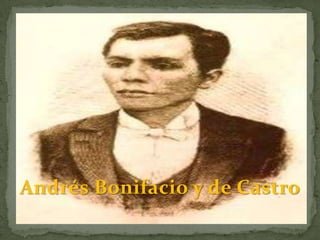
Andrés Bonifacio y de Castro
Andrés Bonifacio y de Castro (Andres Bonifacio)
 Born: November 30, 1863 in Tondo Manila

 Filipino nationalist and revolutionary

 Father: Santiago Bonifacio a tailor who served as a teniente mayor

  (municipal official)

 Mother: Catalina de Castro a mestiza of Spanish descent who worked

  in a cigarette factory.

 He was a founder and later the supreme leader of the Katipunan

  movement which sought the independence of the Philippines from

  Spanish colonial rule and started the Philippine Revolution.

 He is considered a de facto national hero of the Philippines.
 Eldest child among the siblings.

 Brothers: Ciriaco, Procopio, and Troadio.

 Sisters: Espiridonia and Maxima.

 His education was very limited because the death of his

  parents forced him to leave school while still quite young in

  order to support his siblings.
 Studied under Guillermo Osmeña, who taught him basic

  arithmetic, writing in Tagalog, and basic Spanish.

 Worked as a messenger(clerk/messenger) for the local parish

  choir.

 Became a salesman (agent) of tar and other goods for the

  English firm of J.M. Fleeming & Company.

 Transferred to Fressell and Company, a German trading firm,

  where he worked as a bodeguero (warehouseman/agent).

 Also set up a family business of selling canes and paper fans.
 Despite not finishing formal education, Bonifacio was self-

  educated.

 He read books about the French Revolution, biographies of

  the Presidents of the United States, the colonial penal and
  civil codes, and novels such as Victor Hugo's Les Misérables,
  Eugène Sue's Le Juif errant and José Rizal's Noli Me Tangere
  and El Filibusterismo.
 Bonifacio was married twice.

 First wife: a certain person named Monica who died of leprosy.

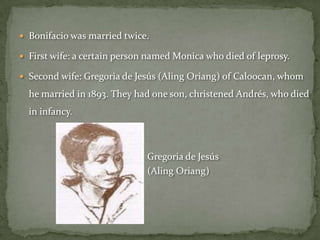
 Second wife: Gregoria de Jesús (Aling Oriang) of Caloocan, whom

  he married in 1893. They had one son, christened Andrés, who died
  in infancy.


                              Gregoria de Jesús
                              (Aling Oriang)
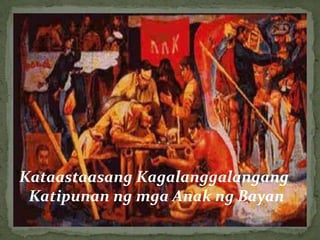
Kataastaasang Kagalanggalangang
 Katipunan ng mga Anak ng Bayan
The Katipunan
 A Philippine revolutionary society founded by anti-Spanish

  Filipinos on July 7, 1892

 With his two friends Ladislao Diwa and Teodoro Plata, he formed

  the first triangle of a secret society which bore the initials K.K.K.

 Kataastaasang Kagalanggalangang Katipunan ng mga Anak ng

  Bayan ("Highest and Most Respected Society of the Children of the
  Country").

 Katipunan was a secret organization until its discovery in 1896 that

  led to the outbreak of Philippine Revolution.
 Within the society Bonifacio used the pseudonym May pag-

  asa ("There is Hope").

 For a time, Bonifacio worked with both the Katipunan and La Liga

  Filipina.

 From Manila, the Katipunan expanded into several provinces,

  including Batangas, Laguna, Cavite, Bulacan,Pampanga, and Nueva
  Ecija.

 Most of its members, called Katipuneros, came from the lower and

  middle classes, with many of its local leaders being prominent figures
  in their municipalities.

 At first exclusively male, membership was later extended to females,

  with Bonifacio's wife Gregoria de Jesús as a leading member.
 Bonifacio was a member and eventually head of

  theKatipunan Supreme Council.

 Bonifacio developed a strong friendship with Emilio

  Jacinto who served as his adviser and confidant, as well as a
  member of the Supreme Council.

 Bonifacio wrote several pieces for the paper, including the

  poem Pag-ibig sa Tinubuang Lupà (roughly, "Love for the
  homeland”) under the pseudonym Agapito Bagumbayan.
 The publication of Kalayaan in March 1896 led to a great

  increase in membership.

 Bonifacio, Jacinto and Pio Valenzuela collaborated on the

  society's organ Kalayaan (Freedom), which had only one
  printed issue.

 The Katipunan spread throughout Luzon, to Panay in

  the Visayas and even as far as Mindanao. From less than 300
  members in January 1896, it had about 30,000 to 40,000 by
  August.
The Katipunan had three aims:
 First, it wanted to free the Philippines from Spain, by force
  of arms if necessary. Its members, called Katipuneros, were
  taught to make and use weapons.

 Second is the the moral, or spiritual, aim. The Katipunan
  saw all men, rich or poor, as equals.

 Third, the Katipuneros were taught to care for one another
  in times of sickness and need. The society took care of its
  sick. If a member died, the Katipunan helped to pay the
  cost of a simple funeral.
Death of Bonifacio
 May 10, 1897

 Sealed order was received by Maj. Lazaro Makapagal from
  General Noriel.
 The latter further ordered Makapagal to take four soldiers and
  escort the Bonifacio brothers to Mount Buntis.
 At the foot of the mountain, Andres Bonifacio asked
  Makapagal to open the sealed order.
 After reading the content, the Bonifacio brothers were shot
  and buried in a shallow grave marked only by a few twigs and
  leaves.
Bonifacio as a Hero

 Andrés Bonifacio, along with José Rizal, is one of only two

  implied national heroes of the Philippines.

 Bonifacio and Rizal are given the implied recognition of

  being national heroes because they both have national
  holidays in their honor: Bonifacio Day on November 30,
  and Rizal Day on December 30.
Notable Contributions to the World of
 Colonial Literature
 Bonifacio wrote poetry, and was a moro-moro actor - very

  typical of great communicators.

 Bonifacio was probably one of the greatest motivational

  writers and speakers of his generation.

 Using his native language, Bonifacio wrote with full

  passion and compassion.

 Bonifacio also wrote about how the Filipinos were tortured

  by the Spaniards.
Interesting Facts
 Bonifacio kept himself busy with other productive

  endeavors.

 He became a member of a Tagalog dramatic society, both as

  an actor and organizer of plays.

 In 1887, he and his friends established the Teatro Porvenir

  and staged moro-moros in Tondo.

 Bonifacio was also a freemason and a member of the Taliba

  Lodge.
Poems and Works
 Katapusang Hibik Ng Pilipinas (The Last Appeal of the

  Philippines)

 Pag-ibig Sa Tinubuang Lupa

 Tapunan ng Lingap

 Ang mga Cazadores

 Huling Paalam ni Dr. Jose Rizal (Salin ng Mi Ultimo Adios

  ni Gat Andres Bonifacio)

 The Decalogue, a ten-point addressed to “sons of the

  country” and how they should behave
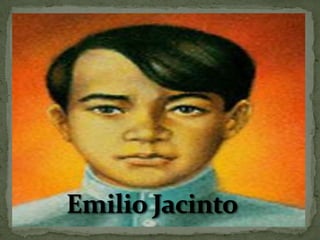
Emilio Jacinto
 Born: December 15, 1875 in Trozo, Tondo Manila

 Filipino Revolutionary known as the Brains of the Katipunan.

 Father: Mariano Jacinto (died shortly after Emilio was born).

 Mother: Josefa Dizon

 It was his sad experiences with his Spanish classmates and

  sensitivity to the plight of the Filipinos as caused by the

  injustices of the Spaniards that led Emilio Jacinto to become a

  Katipunero.
 Jacinto's early education was supported by his widowed

  mother who worked as a midwife.

 Later, his uncle enrolled him at the San Juan Letran

  College after which he took Law at the University of
  Santo Tomas.

 Jacinto was fluent in both Spanish and Tagalog, but

  preferred to speak in Spanish.

 Although poor in appearance, he was gifted with brains

  and good character.
The Katipunan
 He did not finish college and, at the age of 19, he joined the secret
  society called Katipunan.
 At that young age, he became one of the ablest leaders of the
  movement.
 He became the advisor on fiscal matters and secretary to Andrés
  Bonifacio.
 His enthusiasm, ideals and spirit soon guided the course of the
  secret revolutionary society.
 He wrote the Kartilya ng Katipunan (Primer of the Katipunan), and
  the oath of membership, which served as guiding principles of the
  Katipuneros.
 Jacinto also wrote for the Katipunan newspaper called

  Kalayaan. He wrote in the newspaper under the pen
  name Dimasilaw, and used the alias Pingkian in the
  Katipunan.

 Some of the teachings of the Katipunan as written by Jacinto

  were deeply appreciated by the Katipuneros.


Life which is not consecrated to a lofty and just purpose is like a
        tree which cause no shadow – a poisonous weed.
 To do good for some personal motive and not because of a true desire to
    do good is not a virtue.
   All men are equal, be the color of their skin black or white. One may be
    superior to another in wisdom, appearance, or wealth, but they are
    equal as men.
   He whose sentiments are noble prefers honor to personal
    aggrandizement; he whose sentiments are perverse prefers personal
    desires to honor.
   To a man of honor, his word is his oath.
   Defend the oppressed and fight the oppressor.
   He who is intelligent is cautious in speech and knows how to keep
    secrets which must be guarded.
   Think not of woman as a thing with which to merely pass the time, but
    as a helper and a partner in hardships. Respect her and think only of
    your mother and took care of you in childhood.
   Great and noble is he who loves and looks after the welfare of his
    country.
Notable Contributions to the World of
  Colonial Literature
 His greatest poem was A La Patria, which he composed
  under the coconut palms of Santa Cruz, Laguna.
 He composed this poem, which was inspired by Dr. Jose
  Rizal's "Mi Ultimo Adios," under the pen name of Dimas
  Law.
 Bonifacio recognized Jacinto’s talents and patriotism, and
  appointed him in various capacities, as secretary, editor,
  and later general of the Katipunan.
Death of Jacinto
 April 16, 1899.

 In February, 1897, Jacinto fought the Spanish cazadores

  (riflemen) in Magdalena, Laguna.

 He was wounded in the thigh, and was taken as a prisoner

  to the church of Santa Cruz.

 Returned to Laguna and established the secret

  headquarters in the hills of Majayjay.

 He contracted malignant malaria and died.
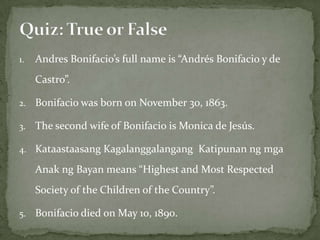
1.   Andres Bonifacio’s full name is “Andrés Bonifacio y de
     Castro”.

2.   Bonifacio was born on November 30, 1863.

3.   The second wife of Bonifacio is Monica de Jesús.

4. Kataastaasang Kagalanggalangang Katipunan ng mga

     Anak ng Bayan means “Highest and Most Respected
     Society of the Children of the Country”.

5.   Bonifacio died on May 10, 1890.
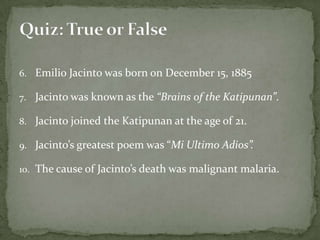
6. Emilio Jacinto was born on December 15, 1885

7. Jacinto was known as the “Brains of the Katipunan”.

8. Jacinto joined the Katipunan at the age of 21.

9. Jacinto’s greatest poem was “Mi Ultimo Adios”.

10. The cause of Jacinto’s death was malignant malaria.

4.8 andres and emilio

  • 1.
  • 2.
    Andrés Bonifacio yde Castro (Andres Bonifacio)  Born: November 30, 1863 in Tondo Manila  Filipino nationalist and revolutionary  Father: Santiago Bonifacio a tailor who served as a teniente mayor (municipal official)  Mother: Catalina de Castro a mestiza of Spanish descent who worked in a cigarette factory.  He was a founder and later the supreme leader of the Katipunan movement which sought the independence of the Philippines from Spanish colonial rule and started the Philippine Revolution.  He is considered a de facto national hero of the Philippines.
  • 3.
     Eldest childamong the siblings.  Brothers: Ciriaco, Procopio, and Troadio.  Sisters: Espiridonia and Maxima.  His education was very limited because the death of his parents forced him to leave school while still quite young in order to support his siblings.
  • 4.
     Studied underGuillermo Osmeña, who taught him basic arithmetic, writing in Tagalog, and basic Spanish.  Worked as a messenger(clerk/messenger) for the local parish choir.  Became a salesman (agent) of tar and other goods for the English firm of J.M. Fleeming & Company.  Transferred to Fressell and Company, a German trading firm, where he worked as a bodeguero (warehouseman/agent).  Also set up a family business of selling canes and paper fans.
  • 5.
     Despite notfinishing formal education, Bonifacio was self- educated.  He read books about the French Revolution, biographies of the Presidents of the United States, the colonial penal and civil codes, and novels such as Victor Hugo's Les Misérables, Eugène Sue's Le Juif errant and José Rizal's Noli Me Tangere and El Filibusterismo.
  • 6.
     Bonifacio wasmarried twice.  First wife: a certain person named Monica who died of leprosy.  Second wife: Gregoria de Jesús (Aling Oriang) of Caloocan, whom he married in 1893. They had one son, christened Andrés, who died in infancy. Gregoria de Jesús (Aling Oriang)
  • 7.
  • 8.
    The Katipunan  APhilippine revolutionary society founded by anti-Spanish Filipinos on July 7, 1892  With his two friends Ladislao Diwa and Teodoro Plata, he formed the first triangle of a secret society which bore the initials K.K.K.  Kataastaasang Kagalanggalangang Katipunan ng mga Anak ng Bayan ("Highest and Most Respected Society of the Children of the Country").  Katipunan was a secret organization until its discovery in 1896 that led to the outbreak of Philippine Revolution.
  • 9.
     Within thesociety Bonifacio used the pseudonym May pag- asa ("There is Hope").  For a time, Bonifacio worked with both the Katipunan and La Liga Filipina.  From Manila, the Katipunan expanded into several provinces, including Batangas, Laguna, Cavite, Bulacan,Pampanga, and Nueva Ecija.  Most of its members, called Katipuneros, came from the lower and middle classes, with many of its local leaders being prominent figures in their municipalities.  At first exclusively male, membership was later extended to females, with Bonifacio's wife Gregoria de Jesús as a leading member.
  • 10.
     Bonifacio wasa member and eventually head of theKatipunan Supreme Council.  Bonifacio developed a strong friendship with Emilio Jacinto who served as his adviser and confidant, as well as a member of the Supreme Council.  Bonifacio wrote several pieces for the paper, including the poem Pag-ibig sa Tinubuang Lupà (roughly, "Love for the homeland”) under the pseudonym Agapito Bagumbayan.
  • 11.
     The publicationof Kalayaan in March 1896 led to a great increase in membership.  Bonifacio, Jacinto and Pio Valenzuela collaborated on the society's organ Kalayaan (Freedom), which had only one printed issue.  The Katipunan spread throughout Luzon, to Panay in the Visayas and even as far as Mindanao. From less than 300 members in January 1896, it had about 30,000 to 40,000 by August.
  • 12.
    The Katipunan hadthree aims:  First, it wanted to free the Philippines from Spain, by force of arms if necessary. Its members, called Katipuneros, were taught to make and use weapons.  Second is the the moral, or spiritual, aim. The Katipunan saw all men, rich or poor, as equals.  Third, the Katipuneros were taught to care for one another in times of sickness and need. The society took care of its sick. If a member died, the Katipunan helped to pay the cost of a simple funeral.
  • 13.
    Death of Bonifacio May 10, 1897  Sealed order was received by Maj. Lazaro Makapagal from General Noriel.  The latter further ordered Makapagal to take four soldiers and escort the Bonifacio brothers to Mount Buntis.  At the foot of the mountain, Andres Bonifacio asked Makapagal to open the sealed order.  After reading the content, the Bonifacio brothers were shot and buried in a shallow grave marked only by a few twigs and leaves.
  • 14.
    Bonifacio as aHero  Andrés Bonifacio, along with José Rizal, is one of only two implied national heroes of the Philippines.  Bonifacio and Rizal are given the implied recognition of being national heroes because they both have national holidays in their honor: Bonifacio Day on November 30, and Rizal Day on December 30.
  • 15.
    Notable Contributions tothe World of Colonial Literature  Bonifacio wrote poetry, and was a moro-moro actor - very typical of great communicators.  Bonifacio was probably one of the greatest motivational writers and speakers of his generation.  Using his native language, Bonifacio wrote with full passion and compassion.  Bonifacio also wrote about how the Filipinos were tortured by the Spaniards.
  • 16.
    Interesting Facts  Bonifaciokept himself busy with other productive endeavors.  He became a member of a Tagalog dramatic society, both as an actor and organizer of plays.  In 1887, he and his friends established the Teatro Porvenir and staged moro-moros in Tondo.  Bonifacio was also a freemason and a member of the Taliba Lodge.
  • 17.
    Poems and Works Katapusang Hibik Ng Pilipinas (The Last Appeal of the Philippines)  Pag-ibig Sa Tinubuang Lupa  Tapunan ng Lingap  Ang mga Cazadores  Huling Paalam ni Dr. Jose Rizal (Salin ng Mi Ultimo Adios ni Gat Andres Bonifacio)  The Decalogue, a ten-point addressed to “sons of the country” and how they should behave
  • 19.
    Emilio Jacinto  Born:December 15, 1875 in Trozo, Tondo Manila  Filipino Revolutionary known as the Brains of the Katipunan.  Father: Mariano Jacinto (died shortly after Emilio was born).  Mother: Josefa Dizon  It was his sad experiences with his Spanish classmates and sensitivity to the plight of the Filipinos as caused by the injustices of the Spaniards that led Emilio Jacinto to become a Katipunero.
  • 20.
     Jacinto's earlyeducation was supported by his widowed mother who worked as a midwife.  Later, his uncle enrolled him at the San Juan Letran College after which he took Law at the University of Santo Tomas.  Jacinto was fluent in both Spanish and Tagalog, but preferred to speak in Spanish.  Although poor in appearance, he was gifted with brains and good character.
  • 21.
    The Katipunan  Hedid not finish college and, at the age of 19, he joined the secret society called Katipunan.  At that young age, he became one of the ablest leaders of the movement.  He became the advisor on fiscal matters and secretary to Andrés Bonifacio.  His enthusiasm, ideals and spirit soon guided the course of the secret revolutionary society.  He wrote the Kartilya ng Katipunan (Primer of the Katipunan), and the oath of membership, which served as guiding principles of the Katipuneros.
  • 22.
     Jacinto alsowrote for the Katipunan newspaper called Kalayaan. He wrote in the newspaper under the pen name Dimasilaw, and used the alias Pingkian in the Katipunan.  Some of the teachings of the Katipunan as written by Jacinto were deeply appreciated by the Katipuneros. Life which is not consecrated to a lofty and just purpose is like a tree which cause no shadow – a poisonous weed.
  • 23.
     To dogood for some personal motive and not because of a true desire to do good is not a virtue.  All men are equal, be the color of their skin black or white. One may be superior to another in wisdom, appearance, or wealth, but they are equal as men.  He whose sentiments are noble prefers honor to personal aggrandizement; he whose sentiments are perverse prefers personal desires to honor.  To a man of honor, his word is his oath.  Defend the oppressed and fight the oppressor.  He who is intelligent is cautious in speech and knows how to keep secrets which must be guarded.  Think not of woman as a thing with which to merely pass the time, but as a helper and a partner in hardships. Respect her and think only of your mother and took care of you in childhood.  Great and noble is he who loves and looks after the welfare of his country.
  • 24.
    Notable Contributions tothe World of Colonial Literature  His greatest poem was A La Patria, which he composed under the coconut palms of Santa Cruz, Laguna.  He composed this poem, which was inspired by Dr. Jose Rizal's "Mi Ultimo Adios," under the pen name of Dimas Law.  Bonifacio recognized Jacinto’s talents and patriotism, and appointed him in various capacities, as secretary, editor, and later general of the Katipunan.
  • 25.
    Death of Jacinto April 16, 1899.  In February, 1897, Jacinto fought the Spanish cazadores (riflemen) in Magdalena, Laguna.  He was wounded in the thigh, and was taken as a prisoner to the church of Santa Cruz.  Returned to Laguna and established the secret headquarters in the hills of Majayjay.  He contracted malignant malaria and died.
  • 26.
    1. Andres Bonifacio’s full name is “Andrés Bonifacio y de Castro”. 2. Bonifacio was born on November 30, 1863. 3. The second wife of Bonifacio is Monica de Jesús. 4. Kataastaasang Kagalanggalangang Katipunan ng mga Anak ng Bayan means “Highest and Most Respected Society of the Children of the Country”. 5. Bonifacio died on May 10, 1890.
  • 27.
    6. Emilio Jacintowas born on December 15, 1885 7. Jacinto was known as the “Brains of the Katipunan”. 8. Jacinto joined the Katipunan at the age of 21. 9. Jacinto’s greatest poem was “Mi Ultimo Adios”. 10. The cause of Jacinto’s death was malignant malaria.