Introduction 
Question: Why do we need new forms of 
parametric curves? 
Answer: Those parametric curves 
discussed are not very geometric.
Introduction 
 Given such a parametric form, it is 
difficult to know the underlying geometry 
it represents without some further analysis. 
 It is almost impossible to predict the 
change of shape if one or more coefficient 
are modified.
Introduction 
 In practice, designers or users usually 
do not care about the underlying 
mathematics and equation.
Introduction 
 A system that supports users to design curves 
must be: 
1. Intuitive: We expect that every step. 
2. Flexible: The system should provide the 
users with more control for designing and 
editing the shape of a curve. 
3. Easy: The way of creating and editing a 
curve should be easy.
Introduction 
4. Unified Approach: The way of 
representing, creating and editing different 
types of curves (e,g., lines, conic sections 
and cubic curves) must be the same. 
5. Invariant: The represented curve will not 
change its geometry under geometric 
transformation (translation, rotation, …)
Introduction 
 Bézier, B-spline and NURBS curves advantage: 
1. A user layouts a set of control points for the 
system. 
2. A user can change the positions of some control 
points and some other characteristics for 
modifying the shape of curve.
Introduction 
3. If necessary, a user can add control points. 
4. They are very geometric, intuitive. 
5. The transition from curve to surface will not 
cause much difficulty.
Bézier 
Curves
Bézier Curves 
Bézier splines are: 
 spline approximation method; 
 useful and convenient for curve and 
surface design; 
 easy to implement; 
 available in Cad system, graphic package, 
drawing and painting packages.
Bézier Curves 
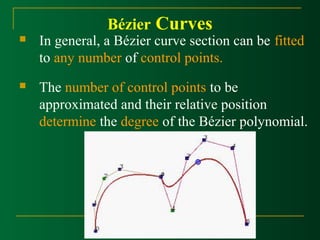
 In general, a Bézier curve section can be fitted 
to any number of control points. 
 The number of control points to be 
approximated and their relative position 
determine the degree of the Bézier polynomial.
Bézier Curves 
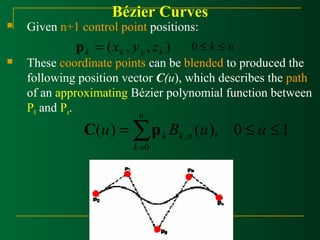
 Given n+1 control point positions: 
( , , ) k k y k p = x y z 0 £ k £ n 
 These coordinate points can be blended to produced the 
following position vector C(u), which describes the path 
of an approximating Bézier polynomial function between 
P0 and Pn. 
£ £ =å= 
k C p 
u B u u k n 
( ) ( ), 0 1 , 
0 
n 
k
Properties 
of 
Bézier Curves
Properties of a Bézier Curve 
£ £ =å= 
k C p 
u B u u k n 
( ) ( ), 0 1 , 
0 
n 
k 
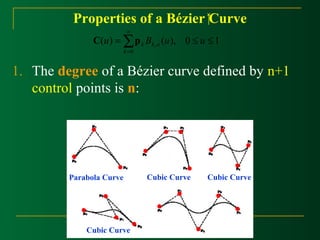
1. The degree of a Bézier curve defined by n+1 
control points is n: 
Parabola Curve Cubic Curve Cubic Curve 
Cubic Curve
Properties of a Bézier Curve 
2. The curve passes though the first and the last control point 
C(u) passes through P0 and Pn.
Properties of a Bézier Curve 
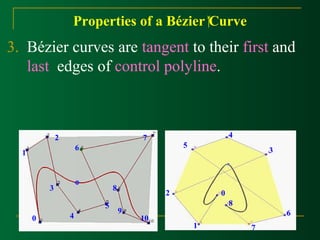
3. Bézier curves are tangent to their first and 
last edges of control polyline. 
1 
2 
0 
3 
4 
5 
8 
7 
6 
10 
9 
0 
1 
2 
3 
4 
5 
6 
7 
8
Properties of a Bézier Curve 
4. The Bézier curve lies completely in the convex hull of the 
given control points. 
 Note that not all control points are on the boundary of the convex 
hull. For example, control points 3, 4, 5, 6, 8 and 9 are in the 
interior. The curve, except for the first two endpoints, lies 
completely in the convex hull.
Properties of a Bézier Curve 
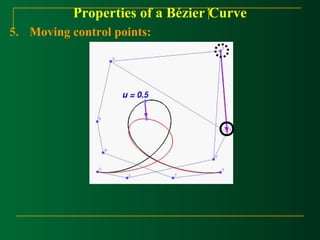
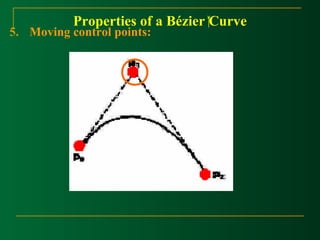
5. Moving control points:
Properties of a Bézier Curve 
5. Moving control points:
Bézier Curves 
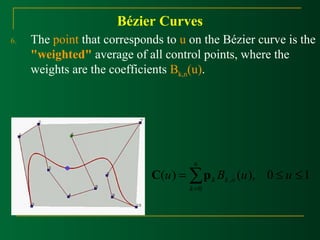
6. The point that corresponds to u on the Bézier curve is the 
"weighted" average of all control points, where the 
weights are the coefficients Bk,n(u). 
£ £ =å= 
k C p 
u B u u k n 
( ) ( ), 0 1 , 
0 
n 
k
Design Techniques Using Bézier Curve 
(Weights) 
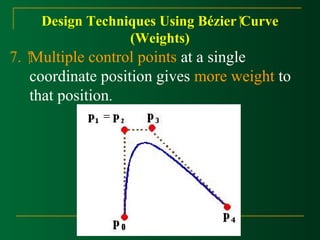
7. Multiple control points at a single 
coordinate position gives more weight to 
that position.
Design Techniques Using Bézier Curve 
(Closed Curves) 
8. Closed Bézier curves are generated by 
specifying the first and the last control points at 
the same position. 
N Noottee:: Bézier curves are polynomials which cannot represent 
circles and ellipses. 
0 
1 
2 
3 
4 
5 
6 
7 
8
Properties of a Bézier Curve 
9. If an affine transformation is applied to a Bézier 
curve, the result can be constructed from the affine 
images of its control points.
Construction 
of 
Bézier Curves
Bézier Curves 
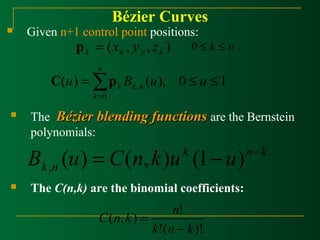
 Given n+1 control point positions: 
( , , ) k k y k p = x y z 0 £ k £ n 
£ £ =å= 
k C p 
u B u u k n 
( ) ( ), 0 1 , 
0 
n 
k 
 The BBéézziieerr bblleennddiinngg ffuunnccttiioonnss are the Bernstein 
k n k 
k n B (u) = C(n,k)u (1- u) - , 
C n k n 
( , ) ! 
k n - 
k 
!( )! 
= 
polynomials: 
 The C(n,k) are the binomial coefficients:
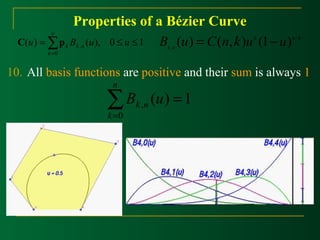
Properties of a Bézier Curve 
£ £ =å= 
C ( u ) p B ( u ), 0 u 1 k n k 
k k , 
n 
0 
n 
k 
k n B (u) = C(n,k)u (1- u) - , 
10. All basis functions are positive and their sum is always 1 
å= 
= 
n 
k 
k n B u 
0 
, ( ) 1
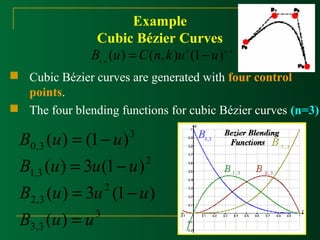
Example 
Cubic Bézier Curves 
k n B (u) = C(n,k)u (1- u) - , 
k n k 
 Cubic Bézier curves are generated with four control 
points. 
 The four blending functions for cubic Bézier curves (n=3): 
B u = - 
u 
( ) (1 ) 
B u = u - 
u 
( ) 3 (1 ) 
B u = u - 
u 
( ) 3 (1 ) 
3 
B u u 
3,3 
2 
2,3 
2 
1,3 
3 
0,3 
( ) 
= 
1,3 B
Design Techniques 
Using Bézier Curve 
(Complicated curves)
Design Techniques Using Bézier Curve 
(Complicated curves) 
 When complicated curves are to be generated, 
they can be formed by piecing several Bézier 
sections of lower degree together. 
 Piecing together smaller sections gives us better 
control over the shape of the curve in small 
region.
Design Techniques Using Bézier Curve 
(Complicated curves) 
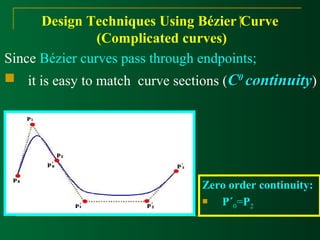
Since Bézier curves pass through endpoints; 
 it is easy to match curve sections (CC00 ccoonnttiinnuuiittyy) 
Zero order continuity: 
 P´0=P2
Design Techniques Using Bézier Curve 
(Complicated curves) 
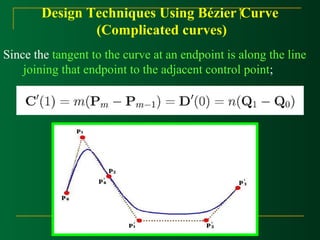
Since the tangent to the curve at an endpoint is along the line 
joining that endpoint to the adjacent control point;
Design Techniques Using Bézier Curve 
(Complicated curves) 
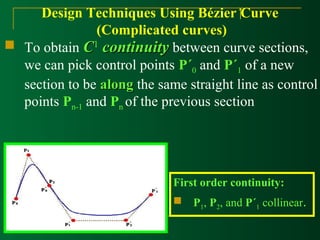
 To obtain CC1 ccoonnttiinnuuiittyy between curve sections, 
we can pick control points P´0 and P´1 of a new 
section to be aalloonngg the same straight line as control 
points Pn-1 and Pn of the previous section 
First order continuity: 
 P1, P2, and P´1 collinear.
Design Techniques Using Bézier Curve 
(Complicated curves) 
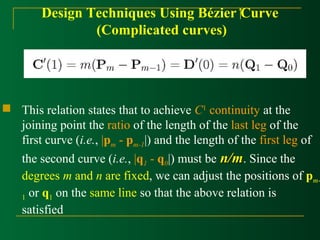
 This relation states that to achieve C1 continuity at the 
joining point the ratio of the length of the last leg of the 
first curve (i.e., |pm - pm-1|) and the length of the first leg of 
the second curve (i.e., |q1 - q0|) must be nn//mm. Since the 
degrees m and n are fixed, we can adjust the positions of pm- 
1 or q1 on the same line so that the above relation is 
satisfied
Design Techniques Using Bézier Curve 
(Complicated curves) 
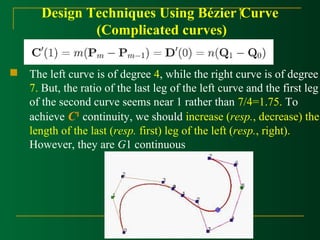
 The left curve is of degree 4, while the right curve is of degree 
7. But, the ratio of the last leg of the left curve and the first leg 
of the second curve seems near 1 rather than 7/4=1.75. To 
achieve C1 continuity, we should increase (resp., decrease) the 
length of the last (resp. first) leg of the left (resp., right). 
However, they are G1 continuous
Cubic 
Bézier Curves
Cubic Bézier Curves 
 Cubic Bézier curves gives reasonable 
design flexibility while avoiding the 
increased calculations needed with 
higher order polynomials.
Cubic Bézier Curves 
( ) ( ), 0 1 , 
£ £ =å= 
k C p 
u B u u k n 
0 
n 
k 
k n B (u) = C(n,k)u (1- u) - , 
k n k 
 Cubic Bézier curves are generated with four control 
points. 
 The four blending functions for cubic Bézier curves (n=3): 
B u = - 
u 
( ) (1 ) 
B u = u - 
u 
( ) 3 (1 ) 
B u = u - 
u 
( ) 3 (1 ) 
3 
B u u 
3,3 
2 
2,3 
2 
1,3 
3 
0,3 
( ) 
=
Cubic Bézier Curves 
 At u=0, B0,3=1, and at u=1, B3,3=1. thus, the curve will 
always pass through control points P0 and P3. 
 The functions B1,3 and B2,3, influence the shape of the curve 
at intermediate values of parameter u, so that the resulting 
curve tends toward points P1 and P3. 
 At u=1/3, B1,3 is maximum, and at u=2/3, B2,3 is maximum. 
B u = - 
u 
( ) (1 ) 
B u = u - 
u 
( ) 3 (1 ) 
B u = u - 
u 
( ) 3 (1 ) 
3 
B u u 
3,3 
2 
2,3 
2 
1,3 
3 
0,3 
( ) 
= 
0 £ u £1
Cubic Bézier Curves 
 At the end positions of the cubic Bézier curve, The 
parametric first and second derivatives are: 
(0) 3( 2 ), (1) 3( ) 1 0 3 2 C¢ = p - p C¢ = p - p 
(0) 6( 2 ), (1) 6( 2 ) 0 1 2 1 2 3 C¢¢ = p - p + p C¢¢ = p - p + p 
 With C1 and C2 continuity between sections, and by 
expanding the polynomial expressions for the blending 
functions: the cubic Bézier point function in the matrix form: 
[ ] 
ù 
ú ú ú ú 
û 
é 
ê ê ê ê 
ë 
= × × 
0 
1 
2 
3 
( ) 3 2 1 
p 
p 
p 
p 
C MBez u u u u 
1 3 3 1 
ù 
ú ú ú ú 
û 
é 
ê ê ê ê 
ë 
- - 
- 
- 
= 
3 6 3 0 
3 3 0 0 
1 0 0 0 
Bez M
Finding a point on a 
Bézier Curve: 
De Casteljau's Algorithm
Finding a point on a Bézier Curve 
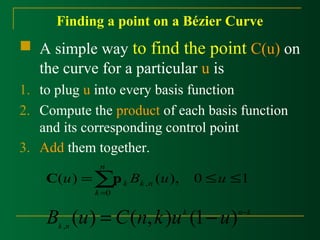
 A simple way to find the point C(u) on 
the curve for a particular u is 
1. to plug u into every basis function 
2. Compute the product of each basis function 
and its corresponding control point 
3. Add them together. 
£ £ =å= 
k C p 
u B u u k n 
( ) ( ), 0 1 , 
0 
n 
k 
k n B (u) = C(n,k)u (1- u) - , 
k n k
Finding a point on a Bézier Curve 
De Casteljau's Algoritm 
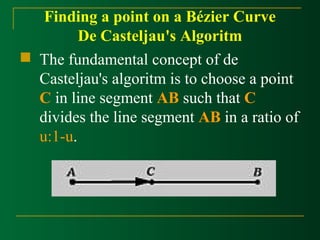
 The fundamental concept of de 
Casteljau's algoritm is to choose a point 
C in line segment AB such that C 
divides the line segment AB in a ratio of 
u:1-u.
Finding a point on a Bézier Curve 
De Casteljau's Algoritm 
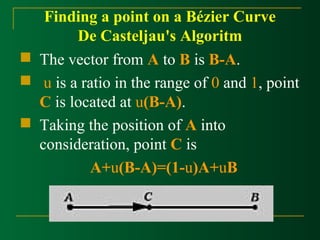
 The vector from A to B is B-A. 
 u is a ratio in the range of 0 and 1, point 
C is located at u(B-A). 
 Taking the position of A into 
consideration, point C is 
A+u(B-A)=(1-u)A+uB
De Casteljau's Algoritm 
 Casteljau's algorithm: we want to find C(u), where u 
is in [0,1]. 
 Starting with the first polyline, 00-01-02-03…-0n, use the 
formula to find a point 1i on the leg from 0i to 0(i+1) that 
divides the line segment in a ratio of u:1-u. we ill obtain n 
point 10,11,12,…,1(n-1), they defind a new polyline of n-1 
legs.
De Casteljau's Algoritm 
 Casteljau's algorithm: we want to find C(u), where u 
is in [0,1]. 
 Starting with the first polyline, 00-01-02-03…-0n, use the 
formula to find a point 1i on the leg from 0i to 0(i+1) that 
divides the line segment in a ratio of u:1-u. we ill obtain n 
point 10,11,12,…,1(n-1), they defind a new polyline of n-1 
legs.
De Casteljau's Algoritm 
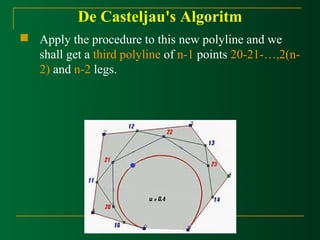
 Apply the procedure to this new polyline and we 
shall get a third polyline of n-1 points 20-21-…,2(n- 
2) and n-2 legs.
De Casteljau's Algoritm 
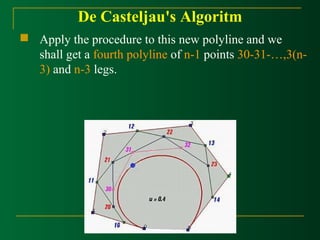
 Apply the procedure to this new polyline and we 
shall get a fourth polyline of n-1 points 30-31-…,3(n- 
3) and n-3 legs.
De Casteljau's Algoritm 
 From this fourth polyline, we have the fifth one of 
two points 40 and 41.
De Casteljau's Algoritm 
 Do it once more, and we have 50, the point 
C(0.4) on the curve. 
 De Casteljau proved that this is the point C(u) on the 
curve that corresponds to u.
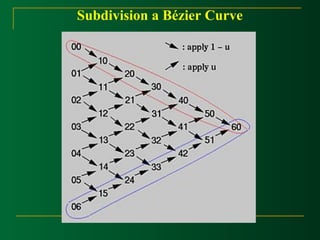
De Casteljau's Algoritm Actual Compution 
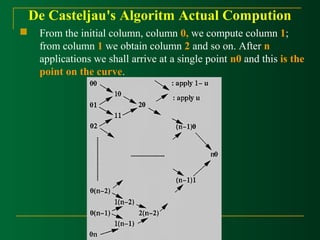
 From the initial column, column 0, we compute column 1; 
from column 1 we obtain column 2 and so on. After n 
applications we shall arrive at a single point n0 and this is the 
point on the curve.
Subdivision a Bézier Curve
Subdivision a Bézier Curve 
 Given s set of n+1 control points P0,p1,P2, …,Pn and a 
parameter value u in the range of 0 and 1, we wannt to find 
two sets of n+1 control points Q0,Q1,Q2, ..,Qn and R0,R1,R2, 
…,Rn such that the Bézier curve definde by Qi’s (resp. Ri’s) is 
the piece of the original Bézier curve on [0,u] (resp., [u,1]).
Subdivision a Bézier Curve 
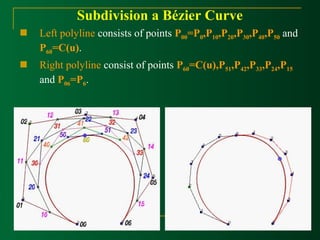
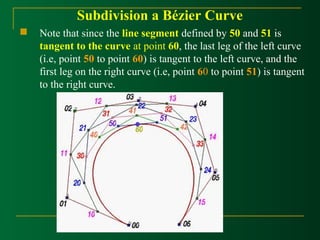
 Left polyline consists of points P00=P0,P10,P20,P30,P40,P50 and 
P60=C(u). 
 Right polyline consist of points P60=C(u),P51,P42,P33,P24,P15 
and P06=P6.
Subdivision a Bézier Curve
Subdivision a Bézier Curve 
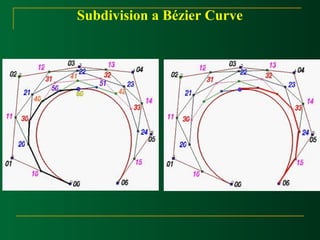
 Note that since the line segment defined by 50 and 51 is 
tangent to the curve at point 60, the last leg of the left curve 
(i.e, point 50 to point 60) is tangent to the left curve, and the 

first leg on the right curve (i.e, point 60 to point 51) is tangent 
to the right curve.
Subdivision a Bézier Curve 
Why Do we need curve Subdivision? 
Used for: 
 Computating the intersection of two 
Bézier curves 
 Rendering Bézier curves 
 Making curve design easier.

Curve modeling bezier curves

  • 1.
    Introduction Question: Whydo we need new forms of parametric curves? Answer: Those parametric curves discussed are not very geometric.
  • 2.
    Introduction  Givensuch a parametric form, it is difficult to know the underlying geometry it represents without some further analysis.  It is almost impossible to predict the change of shape if one or more coefficient are modified.
  • 3.
    Introduction  Inpractice, designers or users usually do not care about the underlying mathematics and equation.

  • 4.
    Introduction  Asystem that supports users to design curves must be: 1. Intuitive: We expect that every step. 2. Flexible: The system should provide the users with more control for designing and editing the shape of a curve. 3. Easy: The way of creating and editing a curve should be easy.


  • 5.
    Introduction 4. UnifiedApproach: The way of representing, creating and editing different types of curves (e,g., lines, conic sections and cubic curves) must be the same. 5. Invariant: The represented curve will not change its geometry under geometric transformation (translation, rotation, …)
  • 6.
    Introduction  Bézier,B-spline and NURBS curves advantage: 1. A user layouts a set of control points for the system. 2. A user can change the positions of some control points and some other characteristics for modifying the shape of curve.
  • 7.
    Introduction 3. Ifnecessary, a user can add control points. 4. They are very geometric, intuitive. 5. The transition from curve to surface will not cause much difficulty.
  • 8.
  • 9.
    Bézier Curves Béziersplines are:  spline approximation method;  useful and convenient for curve and surface design;  easy to implement;  available in Cad system, graphic package, drawing and painting packages.
  • 10.
    Bézier Curves In general, a Bézier curve section can be fitted to any number of control points.  The number of control points to be approximated and their relative position determine the degree of the Bézier polynomial.
  • 11.
    Bézier Curves Given n+1 control point positions: ( , , ) k k y k p = x y z 0 £ k £ n  These coordinate points can be blended to produced the following position vector C(u), which describes the path of an approximating Bézier polynomial function between P0 and Pn. £ £ =å= k C p u B u u k n ( ) ( ), 0 1 , 0 n k
  • 12.
  • 13.
    Properties of aBézier Curve £ £ =å= k C p u B u u k n ( ) ( ), 0 1 , 0 n k 1. The degree of a Bézier curve defined by n+1 control points is n: Parabola Curve Cubic Curve Cubic Curve Cubic Curve
  • 14.
    Properties of aBézier Curve 2. The curve passes though the first and the last control point C(u) passes through P0 and Pn.
  • 15.
    Properties of aBézier Curve 3. Bézier curves are tangent to their first and last edges of control polyline. 1 2 0 3 4 5 8 7 6 10 9 0 1 2 3 4 5 6 7 8
  • 16.
    Properties of aBézier Curve 4. The Bézier curve lies completely in the convex hull of the given control points.  Note that not all control points are on the boundary of the convex hull. For example, control points 3, 4, 5, 6, 8 and 9 are in the interior. The curve, except for the first two endpoints, lies completely in the convex hull.
  • 17.
    Properties of aBézier Curve 5. Moving control points:
  • 18.
    Properties of aBézier Curve 5. Moving control points:
  • 19.
    Bézier Curves 6.The point that corresponds to u on the Bézier curve is the "weighted" average of all control points, where the weights are the coefficients Bk,n(u). £ £ =å= k C p u B u u k n ( ) ( ), 0 1 , 0 n k
  • 20.
    Design Techniques UsingBézier Curve (Weights) 7. Multiple control points at a single coordinate position gives more weight to that position.
  • 21.
    Design Techniques UsingBézier Curve (Closed Curves) 8. Closed Bézier curves are generated by specifying the first and the last control points at the same position. N Noottee:: Bézier curves are polynomials which cannot represent circles and ellipses. 0 1 2 3 4 5 6 7 8
  • 22.
    Properties of aBézier Curve 9. If an affine transformation is applied to a Bézier curve, the result can be constructed from the affine images of its control points.
  • 23.
  • 24.
    Bézier Curves Given n+1 control point positions: ( , , ) k k y k p = x y z 0 £ k £ n £ £ =å= k C p u B u u k n ( ) ( ), 0 1 , 0 n k  The BBéézziieerr bblleennddiinngg ffuunnccttiioonnss are the Bernstein k n k k n B (u) = C(n,k)u (1- u) - , C n k n ( , ) ! k n - k !( )! = polynomials:  The C(n,k) are the binomial coefficients:
  • 25.
    Properties of aBézier Curve £ £ =å= C ( u ) p B ( u ), 0 u 1 k n k k k , n 0 n k k n B (u) = C(n,k)u (1- u) - , 10. All basis functions are positive and their sum is always 1 å= = n k k n B u 0 , ( ) 1
  • 26.
    Example Cubic BézierCurves k n B (u) = C(n,k)u (1- u) - , k n k  Cubic Bézier curves are generated with four control points.  The four blending functions for cubic Bézier curves (n=3): B u = - u ( ) (1 ) B u = u - u ( ) 3 (1 ) B u = u - u ( ) 3 (1 ) 3 B u u 3,3 2 2,3 2 1,3 3 0,3 ( ) = 1,3 B
  • 27.
    Design Techniques UsingBézier Curve (Complicated curves)
  • 28.
    Design Techniques UsingBézier Curve (Complicated curves)  When complicated curves are to be generated, they can be formed by piecing several Bézier sections of lower degree together.  Piecing together smaller sections gives us better control over the shape of the curve in small region.
  • 29.
    Design Techniques UsingBézier Curve (Complicated curves) Since Bézier curves pass through endpoints;  it is easy to match curve sections (CC00 ccoonnttiinnuuiittyy) Zero order continuity:  P´0=P2
  • 30.
    Design Techniques UsingBézier Curve (Complicated curves) Since the tangent to the curve at an endpoint is along the line joining that endpoint to the adjacent control point;
  • 31.
    Design Techniques UsingBézier Curve (Complicated curves)  To obtain CC1 ccoonnttiinnuuiittyy between curve sections, we can pick control points P´0 and P´1 of a new section to be aalloonngg the same straight line as control points Pn-1 and Pn of the previous section First order continuity:  P1, P2, and P´1 collinear.
  • 32.
    Design Techniques UsingBézier Curve (Complicated curves)  This relation states that to achieve C1 continuity at the joining point the ratio of the length of the last leg of the first curve (i.e., |pm - pm-1|) and the length of the first leg of the second curve (i.e., |q1 - q0|) must be nn//mm. Since the degrees m and n are fixed, we can adjust the positions of pm- 1 or q1 on the same line so that the above relation is satisfied
  • 33.
    Design Techniques UsingBézier Curve (Complicated curves)  The left curve is of degree 4, while the right curve is of degree 7. But, the ratio of the last leg of the left curve and the first leg of the second curve seems near 1 rather than 7/4=1.75. To achieve C1 continuity, we should increase (resp., decrease) the length of the last (resp. first) leg of the left (resp., right). However, they are G1 continuous
  • 34.
  • 35.
    Cubic Bézier Curves  Cubic Bézier curves gives reasonable design flexibility while avoiding the increased calculations needed with higher order polynomials.
  • 36.
    Cubic Bézier Curves ( ) ( ), 0 1 , £ £ =å= k C p u B u u k n 0 n k k n B (u) = C(n,k)u (1- u) - , k n k  Cubic Bézier curves are generated with four control points.  The four blending functions for cubic Bézier curves (n=3): B u = - u ( ) (1 ) B u = u - u ( ) 3 (1 ) B u = u - u ( ) 3 (1 ) 3 B u u 3,3 2 2,3 2 1,3 3 0,3 ( ) =
  • 37.
    Cubic Bézier Curves  At u=0, B0,3=1, and at u=1, B3,3=1. thus, the curve will always pass through control points P0 and P3.  The functions B1,3 and B2,3, influence the shape of the curve at intermediate values of parameter u, so that the resulting curve tends toward points P1 and P3.  At u=1/3, B1,3 is maximum, and at u=2/3, B2,3 is maximum. B u = - u ( ) (1 ) B u = u - u ( ) 3 (1 ) B u = u - u ( ) 3 (1 ) 3 B u u 3,3 2 2,3 2 1,3 3 0,3 ( ) = 0 £ u £1
  • 38.
    Cubic Bézier Curves  At the end positions of the cubic Bézier curve, The parametric first and second derivatives are: (0) 3( 2 ), (1) 3( ) 1 0 3 2 C¢ = p - p C¢ = p - p (0) 6( 2 ), (1) 6( 2 ) 0 1 2 1 2 3 C¢¢ = p - p + p C¢¢ = p - p + p  With C1 and C2 continuity between sections, and by expanding the polynomial expressions for the blending functions: the cubic Bézier point function in the matrix form: [ ] ù ú ú ú ú û é ê ê ê ê ë = × × 0 1 2 3 ( ) 3 2 1 p p p p C MBez u u u u 1 3 3 1 ù ú ú ú ú û é ê ê ê ê ë - - - - = 3 6 3 0 3 3 0 0 1 0 0 0 Bez M
  • 39.
    Finding a pointon a Bézier Curve: De Casteljau's Algorithm
  • 40.
    Finding a pointon a Bézier Curve  A simple way to find the point C(u) on the curve for a particular u is 1. to plug u into every basis function 2. Compute the product of each basis function and its corresponding control point 3. Add them together. £ £ =å= k C p u B u u k n ( ) ( ), 0 1 , 0 n k k n B (u) = C(n,k)u (1- u) - , k n k
  • 41.
    Finding a pointon a Bézier Curve De Casteljau's Algoritm  The fundamental concept of de Casteljau's algoritm is to choose a point C in line segment AB such that C divides the line segment AB in a ratio of u:1-u.
  • 42.
    Finding a pointon a Bézier Curve De Casteljau's Algoritm  The vector from A to B is B-A.  u is a ratio in the range of 0 and 1, point C is located at u(B-A).  Taking the position of A into consideration, point C is A+u(B-A)=(1-u)A+uB
  • 43.
    De Casteljau's Algoritm  Casteljau's algorithm: we want to find C(u), where u is in [0,1].  Starting with the first polyline, 00-01-02-03…-0n, use the formula to find a point 1i on the leg from 0i to 0(i+1) that divides the line segment in a ratio of u:1-u. we ill obtain n point 10,11,12,…,1(n-1), they defind a new polyline of n-1 legs.
  • 44.
    De Casteljau's Algoritm  Casteljau's algorithm: we want to find C(u), where u is in [0,1].  Starting with the first polyline, 00-01-02-03…-0n, use the formula to find a point 1i on the leg from 0i to 0(i+1) that divides the line segment in a ratio of u:1-u. we ill obtain n point 10,11,12,…,1(n-1), they defind a new polyline of n-1 legs.
  • 45.
    De Casteljau's Algoritm  Apply the procedure to this new polyline and we shall get a third polyline of n-1 points 20-21-…,2(n- 2) and n-2 legs.
  • 46.
    De Casteljau's Algoritm  Apply the procedure to this new polyline and we shall get a fourth polyline of n-1 points 30-31-…,3(n- 3) and n-3 legs.
  • 47.
    De Casteljau's Algoritm  From this fourth polyline, we have the fifth one of two points 40 and 41.
  • 48.
    De Casteljau's Algoritm  Do it once more, and we have 50, the point C(0.4) on the curve.  De Casteljau proved that this is the point C(u) on the curve that corresponds to u.
  • 49.
    De Casteljau's AlgoritmActual Compution  From the initial column, column 0, we compute column 1; from column 1 we obtain column 2 and so on. After n applications we shall arrive at a single point n0 and this is the point on the curve.
  • 50.
  • 51.
    Subdivision a BézierCurve  Given s set of n+1 control points P0,p1,P2, …,Pn and a parameter value u in the range of 0 and 1, we wannt to find two sets of n+1 control points Q0,Q1,Q2, ..,Qn and R0,R1,R2, …,Rn such that the Bézier curve definde by Qi’s (resp. Ri’s) is the piece of the original Bézier curve on [0,u] (resp., [u,1]).
  • 52.
    Subdivision a BézierCurve  Left polyline consists of points P00=P0,P10,P20,P30,P40,P50 and P60=C(u).  Right polyline consist of points P60=C(u),P51,P42,P33,P24,P15 and P06=P6.
  • 53.
  • 54.
  • 55.
    Subdivision a BézierCurve  Note that since the line segment defined by 50 and 51 is tangent to the curve at point 60, the last leg of the left curve (i.e, point 50 to point 60) is tangent to the left curve, and the first leg on the right curve (i.e, point 60 to point 51) is tangent to the right curve.
  • 56.
    Subdivision a BézierCurve Why Do we need curve Subdivision? Used for:  Computating the intersection of two Bézier curves  Rendering Bézier curves  Making curve design easier.